25) You are the auditor of Brody Grass Inc. The CEO expressed a concern that the audit fees for
the year were very high. You then explained that this is largely due to poor internal controls in
the cash and transaction cycle and that the audit fees could decrease if better controls were in
place.
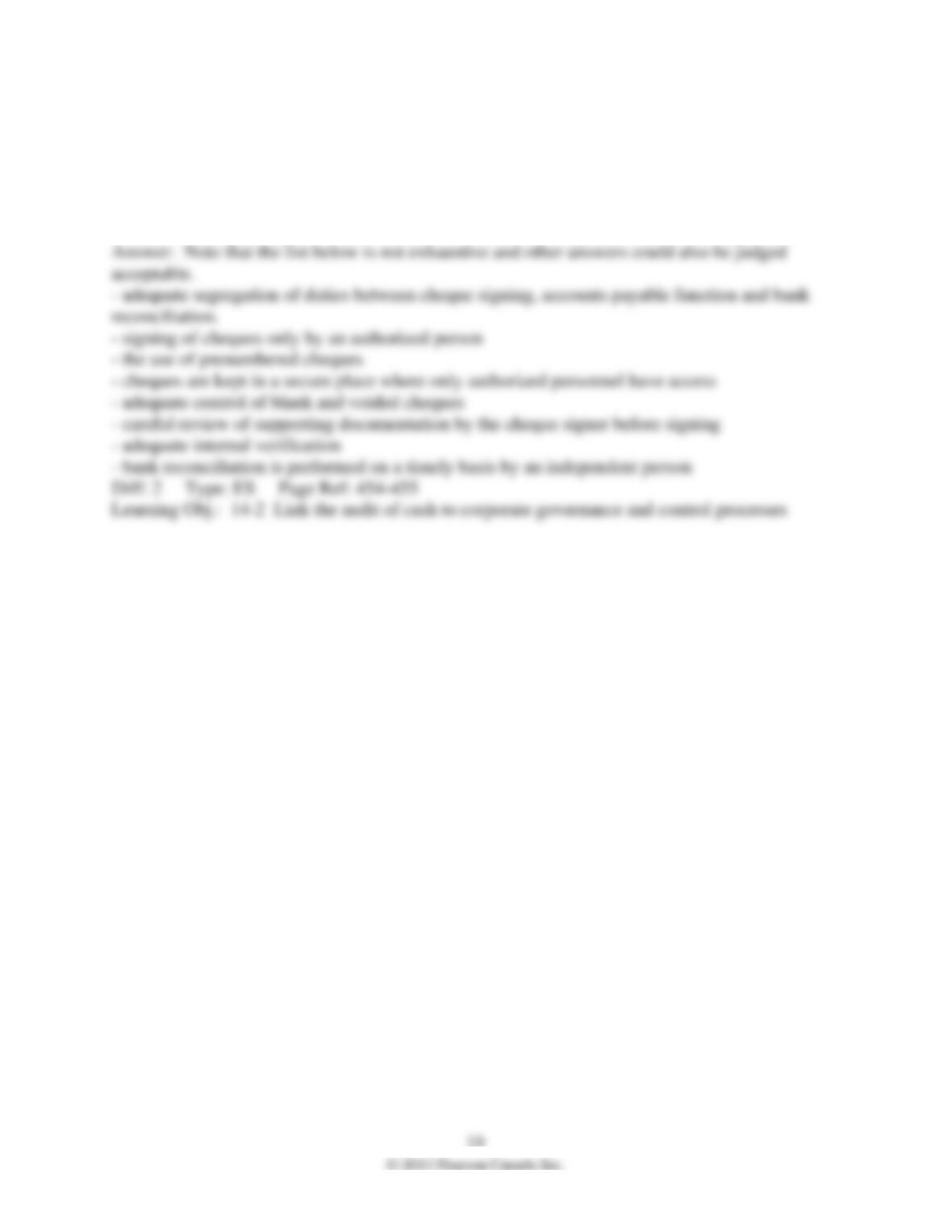
Provide 5 examples of general cash account controls that Brody Grass Inc. could implement.
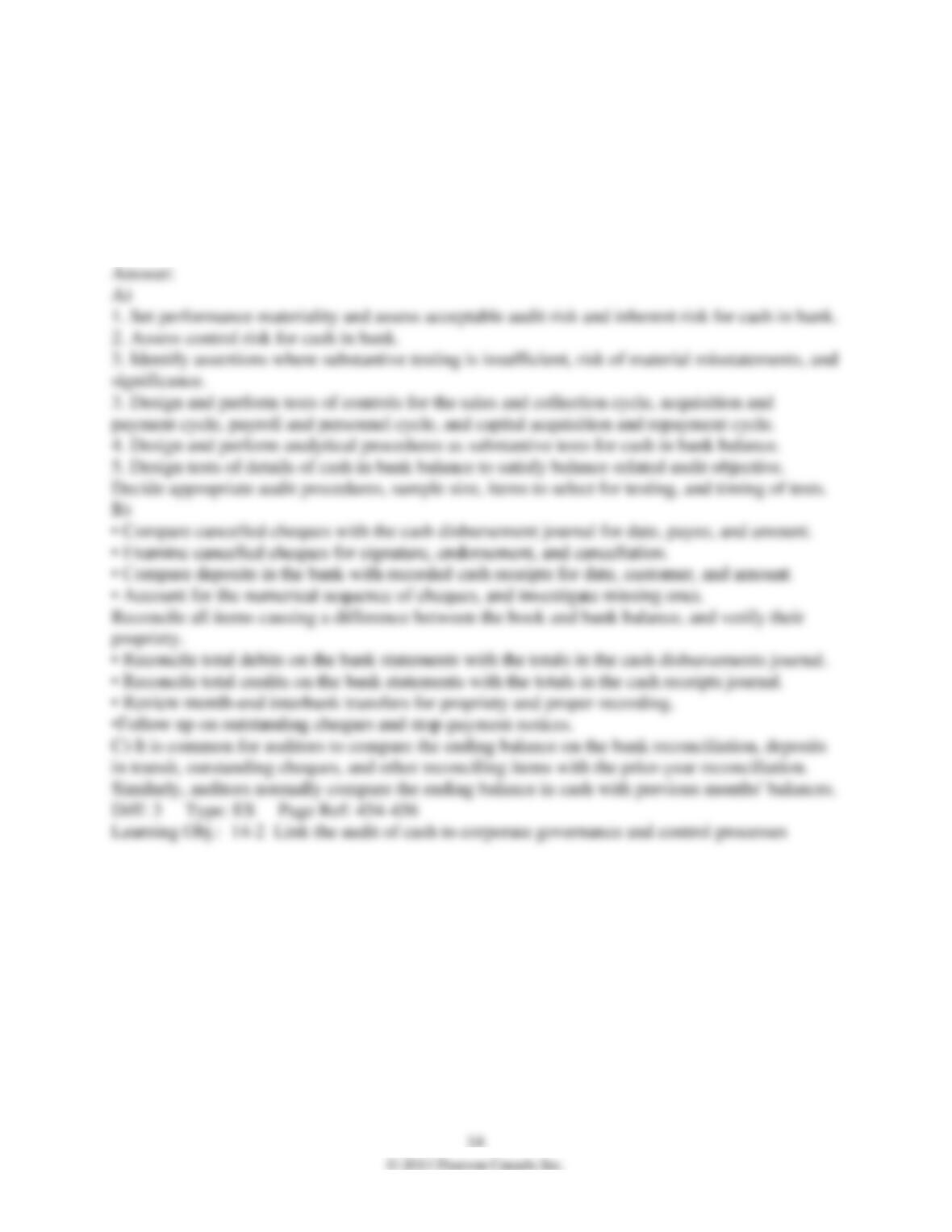
26) A) Discuss the methodology for designing tests of details of balances for cash in the bank.
B) An effective monthly bank reconciliation by client personnel includes nine procedures. List
these nine bank reconciliation procedures.
C) Discuss two analytical procedures commonly performed during the audit of the cash account.
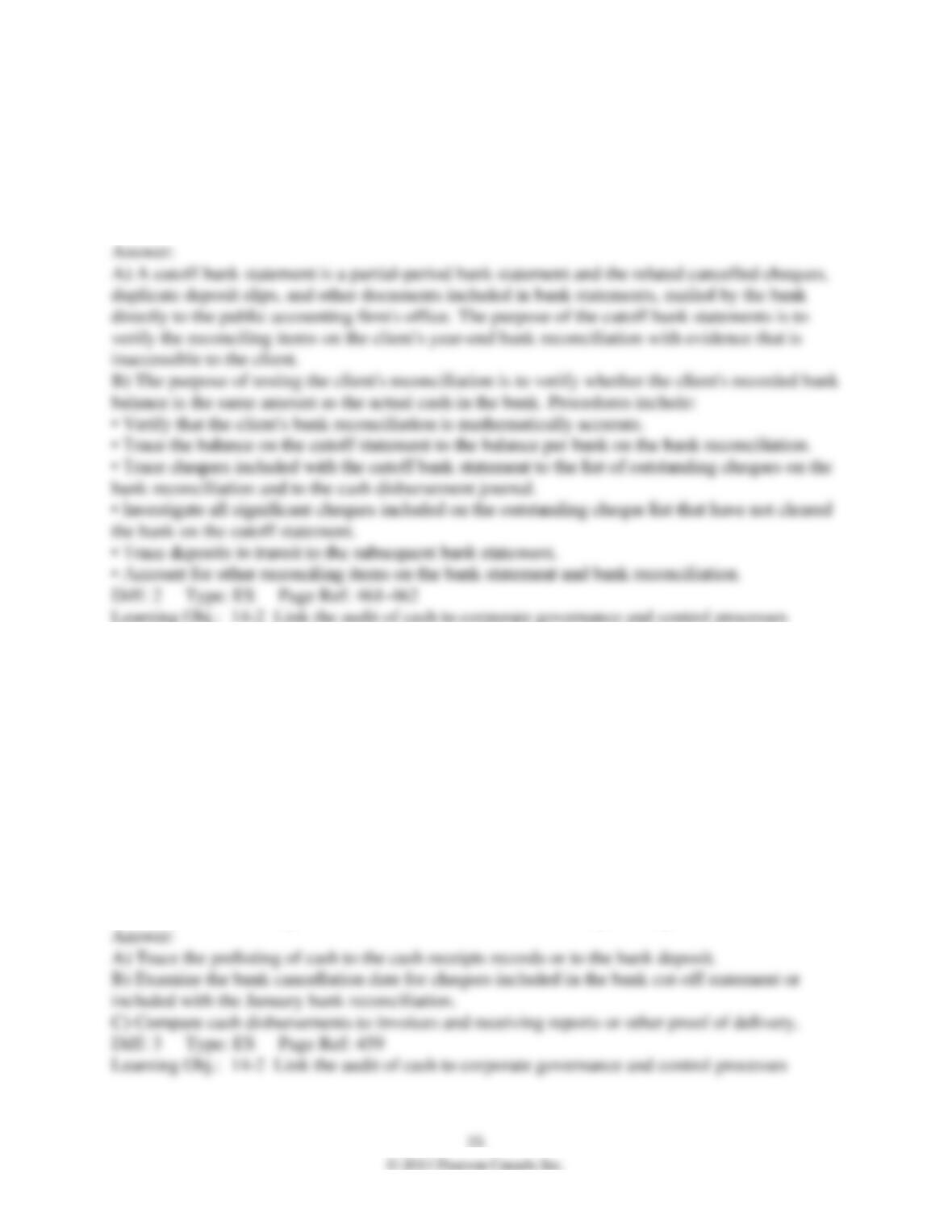
27) A) Explain what is meant by a cutoff bank statement and discuss the purpose of the cutoff
bank statement in the audit of cash.
B) Explain the purpose of testing the client’s bank reconciliation and discuss the major audit
procedures involved.
28) Following are situations that an auditor might find by means of tests of controls or tests of
details of cash balances for a company with a December year end.
A) The accountant did not record or deposit a cash receipt for $50,000 that was received on
December 28. Cash is prelisted by the receptionist.
B) Cheques prepared up to January 6 were dated December 31 and recorded in the cash
disbursements journal.
C) A cheque was issued for office supplies that were never received by the client.
Required:
List a substantive audit procedure that could uncover each of the preceding situations.
29) Serena is the assistant controller of Opus Inc. As a result of a recent expansion the controller
has been very busy and delegated the signing authority of the cheques to Serena. Further, due to
the cash accountant leaving on maternity leave, Serena was asked to perform the bank
reconciliation until they found someone to replace the cash accountant.
Serena is a qualified accountant and has been able to handle all of these additional tasks.
However, she asked her boss for a raise to compensate her for the additional responsibilities that
she currently has. Her boss indicated that this was only temporary and the company could not
afford a raise for now.
Serena created a vendor in the system with her home address. She has been paying this vendor
$2,000 for the past 3 months as a means of compensating herself. This theft has yet to be
discovered by Opus.
Required:
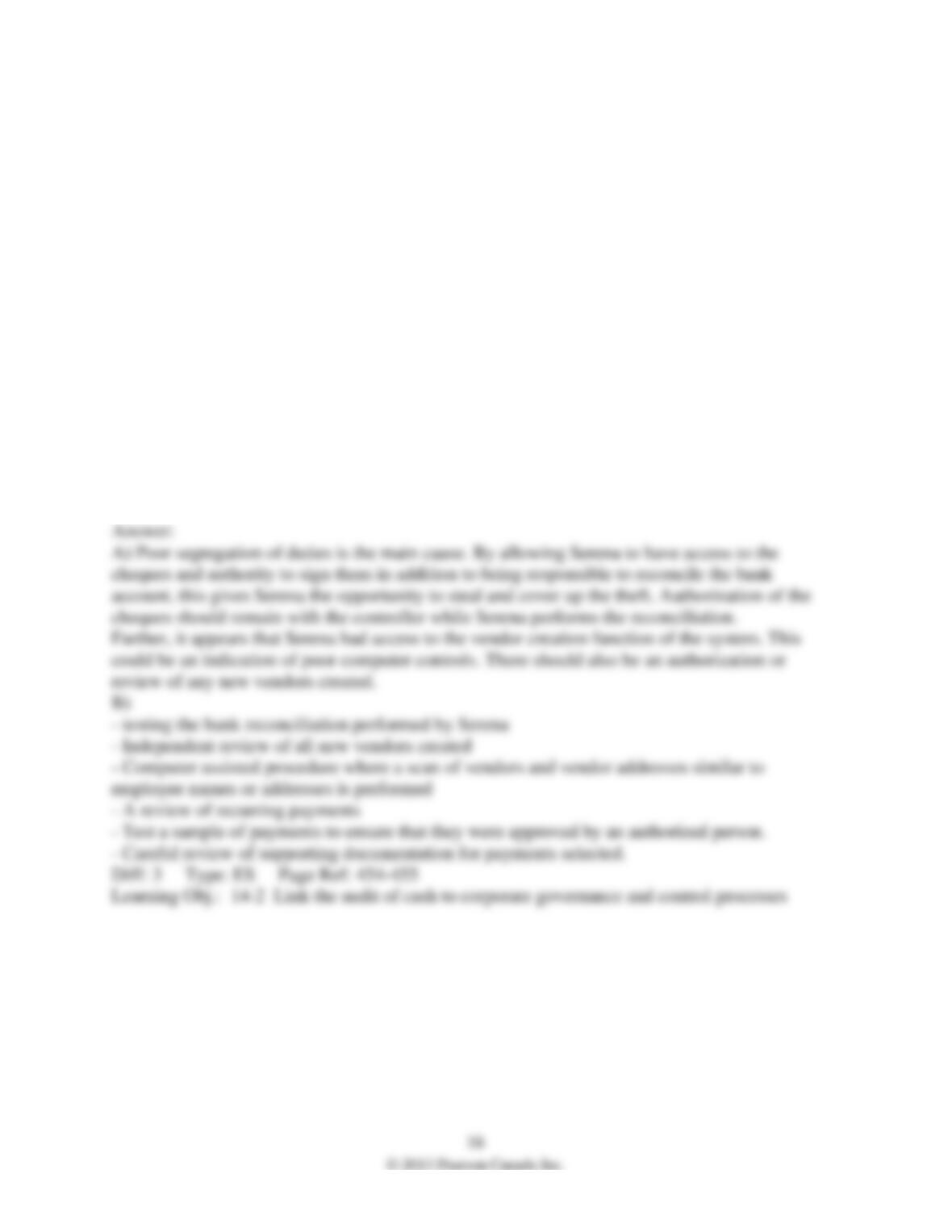
A) What internal controls are missing to enable the theft to occur?
B) What audit procedures might detect the theft?
14.3 Identify the additional audit procedures conducted when there is suspicion of fraud
1) A major consideration in the audit of the general cash balance is the possibility of fraud. The
auditor must extend his or her procedures in the audit of year-end cash to determine the
possibility of a material fraud when there are
A) large cash balances at the end of the year.
B) large cash receipts and disbursements during the year.
C) no imprest accounts used for payroll.
D) material internal control weaknesses.
2) What is the purpose of an extended test of the bank reconciliation? To
A) verify whether all transactions included in the journals for the last month of the year were
correctly allocated to the bank reconciliation.
B) compensate for material weaknesses in internal control with respect to segregation of duties.
C) increase detection risk for the audit of cash.
D) verify whether specific transactions that flowed through the cash account were correctly
recorded.
3) Under what circumstances would an auditor prepare a proof of cash? When
A) the client has material internal control weaknesses in cash.
B) control risk is set at minimum.
C) inherent risk in cash is considered to be low.
D) an enterprise resource system is in use for processing of cash transactions.
4) A four-column proof of cash can be performed for
A) one or more interim months.
B) the entire year.
C) the last month of the year.
D) any specified time period for which bank statements are available and which the auditor
chooses to designate.
5) The auditor uses a proof of cash to determine whether
A) internal controls over cash have been functioning effectively in the period under audit.
B) all recorded cash receipts were deposited and whether all recorded cash disbursements were
paid by the bank.
C) accounts receivable was properly recorded and whether cash receipts transactions were
properly recorded.
D) accounts payable was properly recorded and whether cash disbursement transactions were
properly recorded.
6) What type of audit test is a proof of cash?
A) Test of control
B) Test of details
C) Dual-purpose
D) Analytical review
7) The process of transferring money from one bank account to another and improperly
recording the transaction in both accounts is called
A) lapping.
B) embezzling.
C) kiting.
D) a scam.
8) Testing to ensure that bank transfers are recorded in both the receiving and disbursing banks
helps to detect evidence
A) that would reduce inherent risk to a minimum.
B) associated with an attempt to conceal a theft of cash.
C) that increases reliability with respect to the accuracy of the transfer schedule.
D) that would warrant decreasing control risk to a minimum.
9) On a bank transfer schedule, if a cash disbursement was recorded in the current fiscal year,
and the receipt in the subsequent fiscal year, this might be
A) the best way to record this type of transaction.
B) an indication of increased inherent risk with respect to cash.
C) an attempt to cover a cash shortage.
D) an indication of an error in recording information by the bank.
10) On the last day of the fiscal year, the cash disbursements clerk drew a company cheque on
bank A and deposited the cheque in the company account in bank B to cover a previous theft of
cash. The disbursement had not been recorded. The auditor will best detect this form of kiting by
A) comparing the detail of cash receipts as shown by the cash receipts records with the detail on
the confirmed duplicate deposit tickets for three days prior to and subsequent to year-end.
B) preparing from the cash disbursements book a summary of bank transfers for one week prior
to and subsequent to year-end.
C) examining the composition of deposits in both bank A and B subsequent to year-end.
D) examining paid cheques returned with the bank statement of the next account period after
year-end.
11) Disbursements on the bank transfer schedule should be correctly included in or excluded
from year-end bank reconciliations as outstanding cheques. Understating outstanding cheques on
the bank reconciliation indicates
A) the possibility of kiting.
B) a cut-off error in the bank account.
C) an understatement of the bank balance.
D) an increase in inherent risks associated with cash.
12) What audit objective is associated with the comparison of disbursement and receipt
information on a bank transfer schedule to the cash disbursements and cash receipts journals?
A) Accuracy
B) Classification
C) Occurrence
D) Completeness
13) In addition to the possibility of kiting, inaccurate handling of bank transfers could result in
A) a misclassification between cash and accounts receivable.
B) an incorrect balance in the accounts receivable account.
C) a misclassification between cash and accounts payable.
D) an incorrect balance in the bank loan account.
14) A) Many auditors prove the subsequent period bank statement if a cutoff statement is not
received directly from the bank. Discuss the purpose of proving the subsequent period statement,
and explain the audit procedures performed during the proof of cash.
B) Discuss the circumstances in which an auditor would prepare a proof of cash.
15) A) Explain what is meant by kiting and discuss how it is performed.
B) Discuss how an auditor can test for kiting.
14.4 Explain how an audit of the payroll cash account differs from the audit of the general cash
account
1) When examining the bank reconciliation for the imprest payroll account, it is normal for the
only reconciling item to be
A) outstanding cheques.
B) direct deposits from customers.
C) outstanding deposits.
D) corrections to payroll amounts.
2) Electronic data interchange (EDI) represents the electronic transfer of
A) funds.
B) business documents.
C) data between accounting systems of the company’s entities.
D) information between the bank and the company.
3) Stella is auditing the electronic receipts and payments. The extent of her audit work conducted
on the bank reconciliation will
A) be less extensive than if the company did not engage in electronic receipts and payments.
B) be more extensive than if the company did not engage in electronic receipts and payments.
C) depend on the assessed quality of internal controls.
D) be significantly diminished if Stella can determine that the receipts and payments come from
a reputable bank with proper internal controls.
4) The most important internal control for petty cash is
A) the use of an imprest fund that is the responsibility of one individual.
B) keeping it in a safe or locked drawer.
C) keeping the amount of cash to a minimum.
D) accessibility so that cheques won’t have to be written for small amounts.
5) Petty cash tests can ordinarily be performed at any time during the year, but as a matter of
convenience they are typically done
A) on the balance sheet date.
B) near the end of the field work.
C) at the same time as the observation of inventory, since both auditor and client must be present
at that time.
D) on any interim date.
6) Outline the audit procedures that would be performed when testing electronic receipts and
payments.