Chapter 14: Applying Financial Modeling
To Value, Structure, and Negotiate Mergers and Acquisitions
Answers to End of Chapter Discussion Questions
14.1 Why should a target company be valued as a standalone business? Give examples of the types of
adjustments that might have to be made if the target company is part of a larger company?
14.2 Why should “in the money” options, warrants, and convertible preferred stock and debt be included in the
calculation of the purchase price to be paid for Target?
14.3 What are value drivers? How can they be misused in M&A models?
14.4 Can the initial offer price ever exceed the maximum purchase price? If yes, why? If no, why not?
14.5 Why is it important to clearly state assumptions underlying a valuation?
14.6 Assume two firms have little geographic overlap in terms of sales and facilities. If they were to merge, how
might this affect the potential for synergy?
14.7 Dow Chemical, a leading manufacturer of chemicals, announced that they had an agreement to acquire
competitor Rhom and Haas Company. Dow expects to broaden its current product offering by offering the
higher margin Rohm and Haas products. What would you identify as possible synergies between these two
businesses? In what ways could the combination of these two firms erode combined cash flows?
14.8 Dow Chemical’s acquisition of Rhom and Haas included a 74 percent premium over the firm’s pre–
announcement share price. What is the probable process Dow employed in determining the stunning
magnitude of this premium?
14.9 For most transactions, the full impact of net synergy will not be realized for many months. Why? What
factors could account for the delay?
14.10 How does the presence of management options and convertible securities affect the calculation of the offer
price for the target firm?
Practice Problems and Solutions
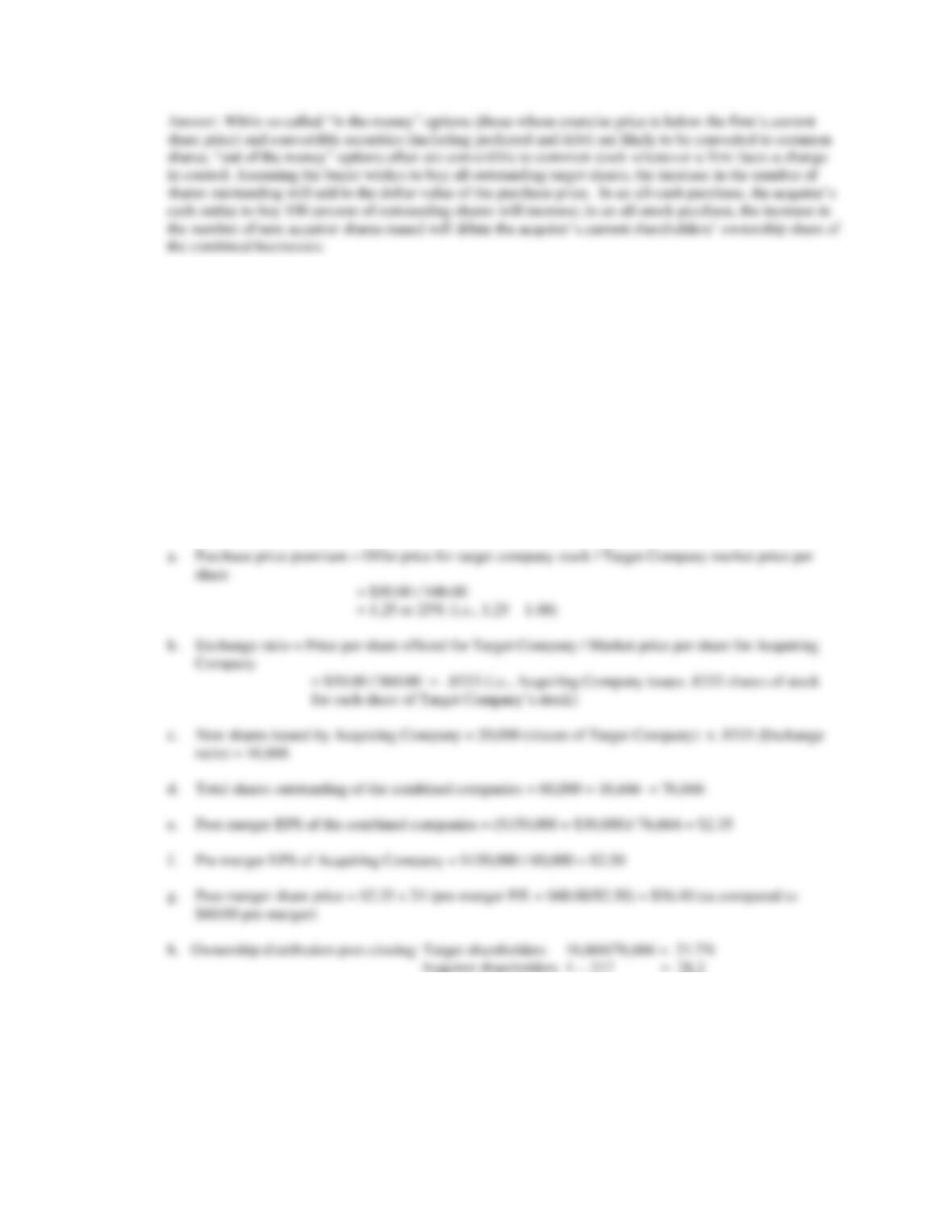
14.11 Acquiring Company is considering the acquisition of Target Company in a stock for stock transaction in
which Target Company would receive $50.00 for each share of its common stock. The Acquiring
Company does not expect any change in its price/earnings multiple after the merger.
Acquiring Co.
Target Co.
Earnings available for
common stock
$150,000
$30,000
Number of shares of
common stock outstanding
60,000
20,000
Market price per share
$60.00
$40.00
Using the information provided above on these two firms and showing your work, calculate the following:
100.0%
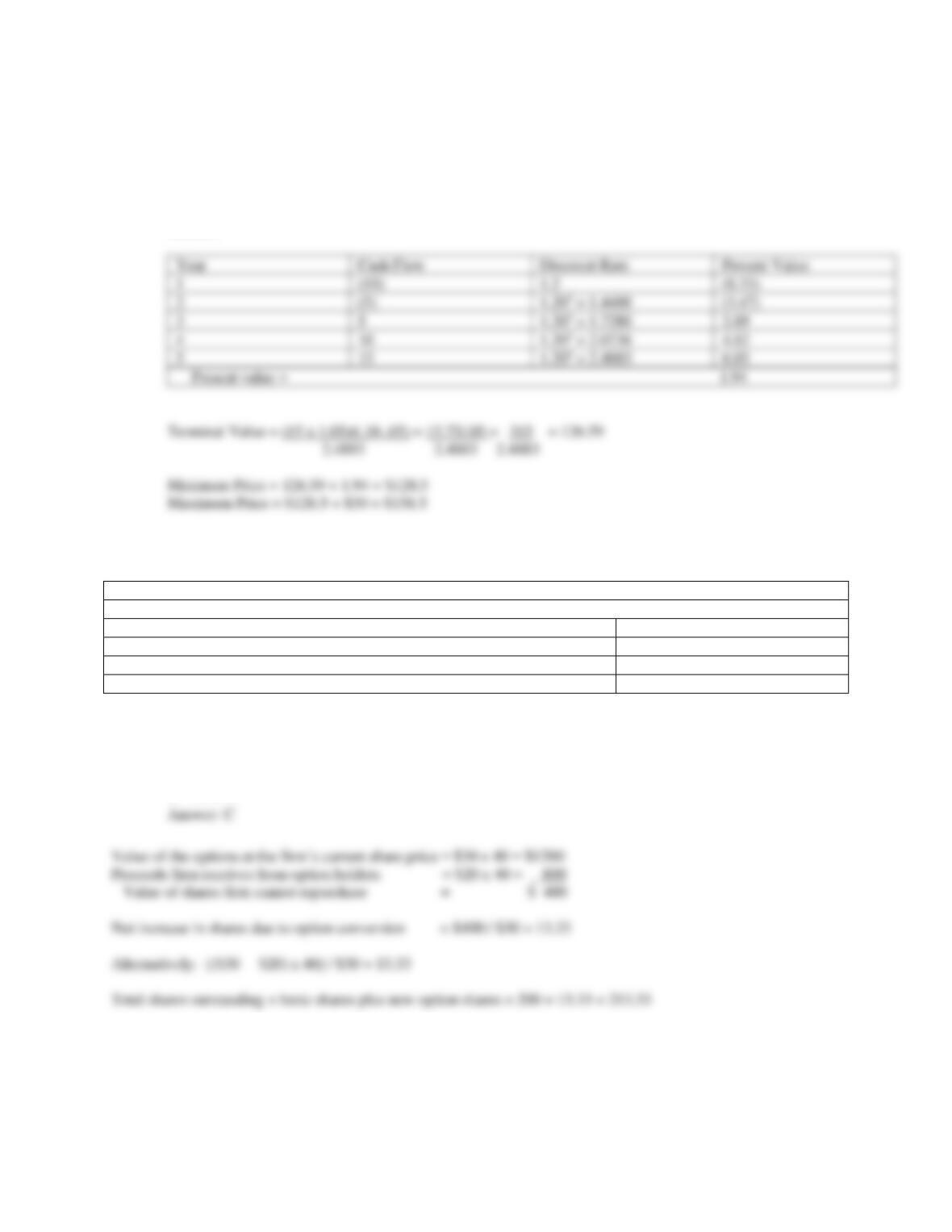
14.12 Acquiring Company is considering buying Target Company. Target Company is a small biotechnology
firm, which develops products that are licensed to the major pharmaceutical firms? Development costs are
expected to generate negative cash flows during the first two years of the forecast period of $(10) and $(5)
million, respectively. Licensing fees are expected to generate positive cash flows during years three
through five of the forecast period of $5, $10, and $15 million, respectively. Due to the emergence of
competitive products, cash flow is expected to grow at a modest 5 percent annually after the fifth year. The
discount rate for the first five years is estimated to be 20 percent and then to drop to 10 percent beyond the
fifth year. In addition, the present value of the estimated synergy by combining Acquiring and Target
companies is $30 million. Calculate the minimum and maximum purchase prices for Target Company.
Show your work.
Answer:
14.13 Using the data given below, calculate fully diluted shares. Assume the firm uses proceeds received from the
conversion of options to common shares to repurchase as many of these new shares as possible.
Calculating Fully Diluted Shares Outstanding
$Million, except per share data, shares in millions
Current Share Price
$30.00
Basic Shares Outstanding
200.00
Options that can be Exercised
40.0
Weighted Average Exercise Price
$20.00
a. 224.52
b. 263.59
c. 213.33
d. 256.87
e. 233.47
14.14 What is the fully diluted offer price (equity value) for a tender offer made to acquire a target whose pre–
tender shares are trading for $1.50 per share? The tender offer includes a 30% premium to the target’s pre–
tender share price. The target has basic shares outstanding of 70 million and 5 million options which may
be converted into common shares at $1.60 per share.
Cash Flow
Discount Rate
1
(10)
1.2
(8.33)
2
(5)
(3.47)
3
5
2.89
4
4.82
5
6.03
14.15 Using the M&A Valuation & Deal Structuring Model on the website accompanying this text and the data
contained in the cells as a starting point, complete the following:
a. What is the enterprise and equity value of Target on the Valuation Worksheet?
b. Increase the sales growth rate by one percentage point (i.e., to 6.5%) on the Target Assumptions
Worksheet.
What is the impact on the Target’s enterprise and equity values? (Hint: See Valuation Worksheet)
Close model but do not save results.
14.16 Using the M&A Valuation & Deal Structuring Model accompanying this text and the data contained in the
cells as a starting point, complete the following:
a. On the Valuation worksheet, what is the enterprise and equity value of Target on the Valuation
Worksheet?
b. On the worksheet named Target Assumptions, decrease COGS (cost of goods sold) as a percent of sales
by one percentage point (i.e., .43 to .44) on the Target Assumptions Worksheet.
What is the impact on the Target’s enterprise and equity values? (Hint: See Valuation Worksheet)
Close Model but do not save results.
14.17 Using the M&A Valuation & Deal Structuring Model accompanying this text:
a. On the Valuation Worksheet, note the enterprise and equity values for Newco.
b. On the Summary Worksheet under Incremental Sales Synergy, change incremental
revenue by $200 million in the first year and $250 million in the second year and
$350 in the third year.
What is the impact on Newco’s enterprise and equity values? (Hint: See Valuation Worksheet)
Close model but do not save results.
14.18 Using the M&A Valuation & Deal Structuring Model accompanying this text:
a. Under the heading Form of Payment, change the composition of the purchase price to 100% cash.
Assume the purchase price is partially financed by reducing Acquirer excess cash by $1 billion and by
raising $4 billion by issuing new Acquirer equity. Under the Sources and Uses heading, how is the
remainder of the purchase price financed?
b. Change the composition of the purchase price to 100% equity, what is the impact on how the purchase
price is financed?
Close model but do not save the results.
Solutions to Chapter Case Study Questions
Case Study 9.1 Thermo Fisher Acquires Life Technologies
Discussion Questions and Answers:
Answer questions 1 to 4 using as the base case the firm valuation and deal structure data in the model available on
MyLMU Connect entitled Thermo Fisher Buys Life Technologies Financial Model. Assume that the base case
assumptions were those used by Thermo Fisher in its merger with Life Tech. The base case reflects the input data
described in this case study. To answer each question you must change selected input data in the base case, which
will change significantly the base case projections. After answering a specific question, do not save the model
results. This will cause the model to revert back to the base case. In this way, it will be possible to analyze each
question in terms of how it is different from the base case.
1. Thermo Fisher paid $76 per share for each outstanding share of Life Tech. What is the maximum offer
price Thermo Fisher could have made without ceding all of the synergy value to Life Tech shareholders?
(Hint: Using the Transaction Summary Worksheet, increase the offer price until the NPV in the section
entitled Valuation turns negative.)
2. Thermo Fisher designed a capital structure for financing the deal that would retain its investment grade
credit rating. To do so, it targeted a debt to total capital and interest coverage ratio consistent with the
industry average for these credit ratios. What is the potential impact on Thermo Fisher’s ability to retain an
investment grade credit rating if it had financed the takeover using 100% senior debt? (Hint: In the Sources
and Uses section of the Transaction Summary Worksheet, set excess cash, new common shares issued, and
convertible preferred shares to zero. Senior debt will automatically increase to 100% of the equity
consideration plus transaction expenses.) Explain your answer.
3. Assuming Thermo Fisher would have been able to purchase the firm in a share for share exchange, what
would have happened to the EPS in the first year? (Hint: In the form of payment section of the Acquirer
Transaction Summary Worksheet, set the percentage of the payment denoted by “% Stock” to 100%. In the
Sources and Uses Section, set excess cash, new common shares issued, and convertible preferred shares to
zero.)
4. Mark Fisher, CEO of Thermo Fisher, asked rhetorically what if synergy were not realized as quickly and in
the amount expected. How patient would shareholders be if the projected impact on earnings per share was
not realized? Assume that the integration effort is far more challenging than anticipated and that only one–
fourth of the expected SG&A savings, margin improvement, and revenue synergy are realized.
Furthermore, assume that actual integration expenses (shown on Newco’s Assumptions Worksheet) due to
the unanticipated need to upgrade and co-locate research and development facilities and to transfer
hundreds of staff are $150 million in 2014, $150 million in 2015, $100 million in 2016, and $50 million in
2017. The model output resulting from these assumption changes is called the Impaired Integration Case.
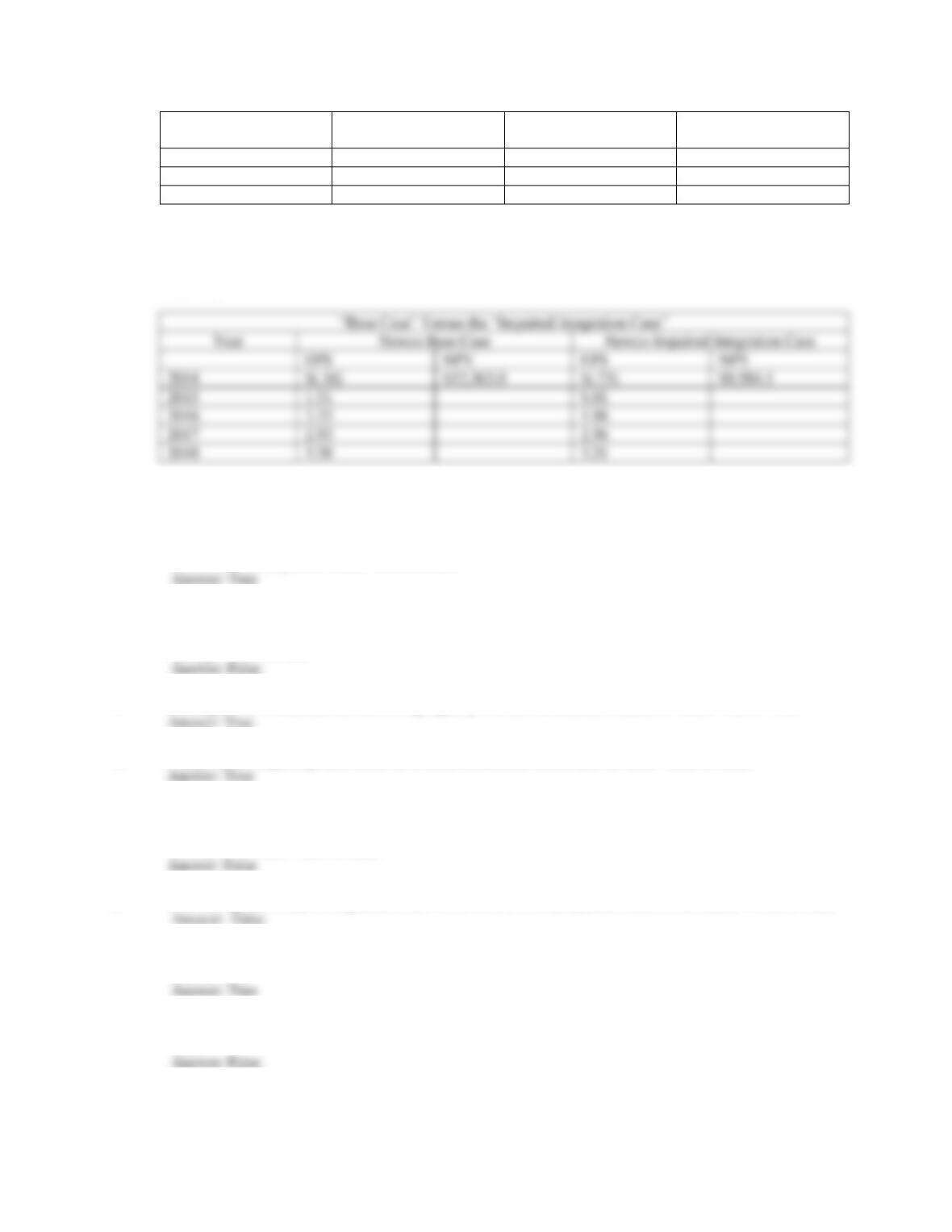
What is the impact on Thermo Fisher’s earning per share (including Life Tech) and the net present value
of the combined firms? Compare the difference between the model “Base Case” and the model output from
the “Impaired Integration Case” resulting from making the changes indicated in this question. (Hints: In the
Synergy Section of the Acquirer (Thermo Fisher) Worksheet, reduce the synergy inputs for each year
between 2014 and 2016 by seventy-five percent and allow them to remain at those levels through 2018.
New Synergy Inputs
Year
SG&A Synergies
Gross Margin
Improvement
Incremental Sales
Revenue
2014
2.5
18.75
1.25
2015
5.0
50.0
5.0
2016
6.25
56.25
6.25
On the Newco Assumptions Worksheet, change the integration expense figures to reflect the new numbers
for 2014, 2015, 2016, and 2017.).
Answer:
Examination Questions and Answers
1. The present value of net synergy is the difference between the present value of projected cash flows from
sources and destroyers of value. True or False
2. Net synergy may be estimated as the difference between the sum of the present values of the target and
acquiring firms, including the effects of synergy, and the value of the target firm including the effects of
synergy. True or False
3. The target firm’s underutilized borrowing capacity is often considered a source of value. True or False
4. A target firm’s high employee turnover is often considered a destroyer of value. True or False
5. Non-compliance with environmental laws, product liabilities, pending lawsuits, poor product quality,
patents, poorly written or missing customer contracts, and high employee turnover are all considered
destroyers of value. True or False
6. Cost savings are likely to be greatest when firms with dissimilar operations are consolidated. True or False
7. Minimum purchase price or initial offer price for a target is the target’s standalone value or market value.
True or False
8. The maximum purchase price is the minimum price plus the present value of sources of value. True or
False

9. If the acquisition of the target is believed to be very important to implement the acquirer’s strategy, the
acquirer should be willing to pay up to the maximum purchase price. True or False
10. The acquiring firm’s existing loan covenants need not be considered in determining the feasibility of
acquiring the target firm. True or False
11. The effects of synergy resulting from combining the acquirer and target firms do not affect the acquirer’s
ability to finance the transaction. True or False
12. The current stock price of the acquiring firm may decline in a share for share exchange due to the potential
dilution in earnings per share. True or False
13. The share exchange ratio is defined as offer price divided by the target firm’s current share price. True or
False
14. The share exchange ratio indicates the number of acquirer shares to be exchanged for each share of target
stock based on the target firm’s current share price. True or False
15. Pro forma financial statements are frequently used to show what the acquirer and target’s combined
financial statements would look like if they were merged. True or False
16. Net synergy is the difference between the present value of the estimated sources of value and destroyers of
value. True of False
17. In determining the initial offer price, the acquirer must decide how much of the anticipated synergy to
share with the target firm’s shareholders. True or False
18. Complex models because of their greater sophistication are necessarily more accurate than simple models.
True or False
19. A clear statement of all assumptions underlying the model’s projections forces the analyst to display their
biases and to be prepared to defend their assumptions to others. True or False
20. Financial modeling refers to the application of spreadsheet software to define simple arithmetic
relationships among variables within the firm’s income, balance sheet, and cash-flow statements and to
define the interrelationships among the various financial statements. True or False
21. Financial models can be used to answer the following questions: How much is the target company worth
without the effects of synergy? What is the value of expected synergy? What is the maximum price that the
acquiring company should pay for the target? True or False
22. When one company acquires another, year over year historical earnings comparisons for the acquiring firm
are unaffected. True or False

23. A standalone business is one whose financial statements reflect all the costs of running the business and all
of the revenues generated by the business. True or False
24. The appropriate discount rate for the combined firms is generally the target’s cost of capital unless the two
firms have similar risk profiles and are based in the same country. True or false
25. It is unimportant whether the acquirer uses the target’s or its own weighted average cost of capital when
valuing the target firm. True or False
26. Financial models are of little value in determining whether the proposed purchase price can be financed by
the acquirer. True or False
27. The appropriate financial structure can be determined from a range of different scenarios created by making
small changes in selected value drivers. True or False
28. Potential sources of value rarely include factors not recorded on a firm’s balance sheet. True or False
29. Assume Firm A’s acquisition of Firm B results in a reduction in the combined firms’ debt–to-total capital
ratio to .25. If the same ratio for the industry is .5, the combined firm may be able to increase its borrowing
to the industry average, assuming no extenuating circumstances. However, this should not be viewed as a
source of value to the acquiring firm. True or False
30. In calculating the value of net synergy, the costs required to realize the anticipated synergy should be
ignored because they are difficult to forecast. True or False
31. In determining the initial offer price, the acquiring company must decide how much of anticipated synergy
it is willing to share with the target firm’s shareholders. True or False
32. Revenue-related synergy may result from the acquirer being able to sell their products to the target firm’s
customers. True or False
33. M&A valuation and deal structuring models commonly require the estimation of the standalone value of
target firm but never the acquirer. True or False
34. The acquirer’s standalone value represents a reference point against which the value of the combined
businesses (Newco) must be compared to determine if a deal makes sense.
35. The valuation of the combined businesses should reflect only the sum of their standalone values but
not the incremental value of synergy. True or False

36. The offer price for a target firm is considered appropriate if the NPV of the difference between the present
value of target plus anticipated synergy and the offer price including any transaction-related expenses is
less than zero. True or False
37. Value drivers are variables which exert the greatest impact on firm value, often including the revenue
growth rate, cost of sales as a percent of sales, S,G,&A as a percent of sales, WACC assumed during
annual cash flow growth and terminal periods, and the cash flow growth rate assumed during terminal
period. True or False
38. To evaluate the credibility of a financial model’s results it is important to examine the credibility of the
assumptions used to project the value drivers. True or False
39. Although public firms are required to file their financial statements with the Securities and Exchange
Commission in accordance with GAAP, so-called pro forma financial statements are used as hypothetical
representations of the potential performance of the acquirer and target firms if they were merged. True or
False
40. To determine if certain cash flows result from synergy ask if they can be generated only if the businesses
are combined. If the answer is yes, then the cash flow in question is due to synergy. True or False
41. Underutilized borrowing capacity or significant excess cash balances also can make an acquisition target
less attractive. True or False
42. In calculating synergy, it is important to include the costs associated with recruiting and training
employees, achieving productivity improvements, layoffs, and exploiting revenue opportunities. True or
False
43. The maximum offer price is equal to the sum of the standalone value (or minimum price) plus some
fraction of present value net synergy. True or False
44. The initial offer price for the target firm should lie between the minimum and maximum offer prices. True
or False
45. Ultimately, what fraction of synergy is negotiated successfully by the target depends on its leverage or
influence relative to the acquirer. True or False
46. If the acquirer were to pay the target firm shareholders the maximum estimated offer price it would be
ceding all of the net synergy created by combining the two firms to the target’s shareholders. True or False
47. The number of new acquirer shares that must be issued to complete a deal is unaffected by such
derivative securities as options issued to Target’s employees and warrants, as well as convertible securities.
True or False
48. Fully diluted shares outstanding, that is, the number of Target’s “basic” shares outstanding (i.e., pre–

transaction shares outstanding) plus the number of shares represented by the firm’s “in the money” options,
warrants, and convertible debt and preferred securities should be used in the calculation of the total cost of
a takeover. True or false
49. M&A modeling facilitates deal valuation and structuring but not financing decisions. True or False
50. Assume a firm’s debt to equity ratio is currently below its industry average. Increasing it to the industry
average can represent a source of value. True or False
51. The value of the firm created by combining an acquiring and target firms is impacted only by changes in
the value drivers of the target firm. True or False
1. Which of the following is not true about generally accepted accounting principles (GAAP)?
a. GAAP provide specific guidelines as to how to account for specific events impacting the financial
performance of the firm.
b. The scrupulous application GAAP accounting rules does ensure consistency in comparing one
firm’s financial performance to another.
c. It is customary for definitive agreements of purchase and sale to require that a target company
represent that its financial books are kept in accordance with GAAP.
d. GAAP guarantees that a firm’s financial books are accurate.
e. Differences between how a firm records actual financial transactions and how they should be
recorded based on GAAP may indicate fraud or mismanagement.
2. Which of the following is not true about common size financial statements?
a. Such statements are used to uncover data irregularities.
b. Such statements are constructed by calculating the percentage each line item of the income
statement, balance sheet, and cash flow statement is of annual sales.
c. Such statements are useful for comparing businesses of different sizes in the same industry at
different moments in time.
d. Common size statements applied over a number of consecutive periods may be used to determine
if the target firm is deferring necessary spending.
e. Common size statements may be calculated for both quarterly and annual financial data.
3. Target is a wholly owned subsidiary of MegaCorp Inc. MegaCorp supplies a number of services to target.
Target sells some of its products to other MegaCorp subsidiaries. Target also buys products from other
MegaCorp subsidiaries that are used as inputs in producing Target’s products. Which of the following
adjustments should the acquirer make to Target’s financial statements before valuing the firm?
a. Deduct the actual cost of services required by Target that are being supplied by the parent without
charge from target’s cost of sales.
b. Deduct the difference between the cost of products purchased from other MegaCorp subsidiaries
at below market prices and the actual market prices for such products from Target’s cost of sales.
c. Deduct the difference between the cost of products purchased from other MegaCorp subsidiaries
at above market prices and the actual cost of such products if purchased from other sources from
Target’s cost of sales
d. A and B only.
e. None of the above.

4. Which of the following is generally not considered a source of value to the acquiring firm?
a. Duplicate facilities
b. Patents
c. Land on the balance sheet at below market value
d. Warranty claims
5. The initial offer price for the target firm is defined as
a. The minimum price
b. The present value of the minimum price plus some fraction of the present value of net synergy
c. The present value of net synergy plus the current market value of the target firm
d. The maximum price less the minimum price
e. The maximum price less the present value of net synergy
6. The share exchange ratio is defined as
a. Offer price for the target divided by the acquirer’s share price
b. Offer price for the target divided by the target’s share price
c. Acquirer’s share price divided by the target’s share price
d. Target’s share price divided by the offer price
e. Acquirer’s share price divided by the offer price
7. Acquiring Corp agrees to buy 100% of the outstanding shares of Target Corp in a share for share exchange.
How would Acquiring Corp determine how many new share of its stock it would have to issue?
a. Multiply the purchase price premium paid for Target’s stock by the number of shares of target
stock outstanding.
b. Multiply the share exchange ratio by the number of Acquirer shares outstanding.
c. Add the number of Acquirer and Target shares outstanding
d. Multiply the share exchange ratio by the number of Target shares outstanding.
e. Divide the share exchange ratio by the purchase price premium
8. What happens to the outstanding shares of the target firm when the acquirer purchases 100% of the target’s
outstanding stock?
a. They are added to the number of shares of Acquirer stock outstanding
b. They are cancelled.
c. They are converted into preferred stock.
d. They are shown as treasury stock on the books of the combined companies.
e. They are swapped for debt in the new company.
9. Which one of the following is not one of the steps in the M&A model building process?
a. Valuing the acquirer and the target firms as standalone businesses
b. Valuing the target and acquiring firms including synergy
c. Determining the initial offer price for the target firm
d. Establishing search criteria for the potential target firm
e. Determining the combined firm’s ability to finance the transaction.

10. Realizing synergy often requires spending money. Which of the following are examples of such
expenditures?
a. Employee recruitment and training expenses
b. Severance expenses
c. Investment in equipment to improve employee productivity
d. Redesigning workflow
e. All of the above
11. Selecting the appropriate financing structure for the combined firms requires consideration of which of the
following:
a. The impact on the combined firm’s EPS
b. Potential violation of loan covenants
c. The extent to which the primary needs of both the buyer’s and seller’s shareholders are satisfied.
d. A and B only
e. A, B, and C
12. Post merger earnings per share are affected by all of the following factors, except for
a. Acquiring firm’s outstanding shares
b. Price offered for the target company
c. Number of target firm’s outstanding shares
d. Current price of the acquiring company’s stock
e. Current price of the target firm’s stock
13. The share exchange ratio is impacted by all of the following except for
a. The current share price of the target firm
b. The current share price of the acquirer
c. The offer price for the target firm
d. The number of shares outstanding for the target firm
e. A and D
14. Real Cool Autos acquired Automotive Industries in a transaction that produced an NPV of $3.7 million.
This NPV represents
a. Synergy
b. Book value
c. Investment value
d. Diversification
e. None of the above
15. Which of the following are examples of cost-related synergy?
a. Spreading fixed costs over increased output levels
b. Eliminating duplicate jobs
c. Discounts from suppliers due to bulk purchases
d. Paying termination expenses
e. A, B, and C only

16. A merger which is expected to produce synergy
a. Should be rejected because the synergy will dilute the combined firm’s earnings per share
b. Should be rejected because the first year’s cash flow is negative
c. Has a negative NPV
d. Should be pursued because it creates value
e. Reduces target firm revenues
17. Which one of the following is the correct calculation of fully diluted shares outstanding for a firm with in–
the-money options, warrants, as well as convertible preferred and convertible debt?
a. Out of the money options and warrants plus in the money convertible preferred and debt
b. Basic shares outstanding + in-the-money options and warrants + in the money convertible
preferred and debt
c. In the money options and warrants + in the money convertible preferred and debt
d. Basic shares outstanding + out of the money options and warrants.
e. Basic shares outstanding + convertible preferred and debt
18. How does a firm’s enterprise value change if the firm issues equity and uses the proceeds to repay debt?
a. No change
b. Decreases
c. Increases
d. Indeterminate
e. None of the above.
19. The value of combined businesses following a takeover should reflect:
a. The sum of their standalone values
b. The sum of their standalone values less anticipated synergy
c. The standalone value of the target plus net synergy less the standalone value of the acquirer
d. The sum of the standalone values of the target and acquirer plus net synergy
e. None of the above
20. A takeover creates value for the acquirer as long as which of the following statements is true:
a. The NPV of the standalone value of the target firm plus synergy less the offer price is greater than
or equal to zero
b. The NPV of the standalone value of the target firm less the offer price is greater than or equal to
zero
c. The NPV of the standalone value of the target firm plus synergy less the sum of the offer price and
transaction-related expenses is greater than or equal to zero
d. The NPV of the offer price less the standalone value of the target firm is less than or equal to zero
e. None of the above
21. Which of the following is most true about synergy in the context of M&A?
a. Synergy refers to the cash flows that can be generated only as a result of two businesses
combining
b. Realizing synergy usually does not require investment
c. Most often anticipated synergy is realized immediately following closing
d. The value of synergy should not be reflected in the purchase price paid for a target firm
e. None of the above
22. Which of the following statements is true in a deal involving the exchange of acquirer shares for target

shares?
a. The acquirer should consider the impact of the deal on fully diluted earnings
b. The acquirer should consider the likely conversion of “in the money” options held by target
employees
c. Target convertible debt can impact the number of acquirer shares that must be issued to purchase
all of the target shares outstanding
d. Target convertible preferred stock can impact the number of acquirer shares that must be issued to
purchase all of the target shares outstanding
e. All of the above
23. Which of the following statements is true for M&A financial models?
a. They are used to address valuation questions only
b. They are used to address valuation and deal structuring questions only
c. They are used to address deal structuring questions only
d. They are used to address deal structuring, valuation, and financing questions
e. None of the above
24. Which of the following questions can be addressed by financial models?
a. What are the key drivers of firm value?
b. Can the proposed purchase be financed?
c. What is the value of expected synergy?
d. What is the impact of a deal on the acquirer’s fully diluted earnings per share?
e. All of the above
25. The most common sources of value include potential cost savings resulting from all of the following except
for which of the following:
a. Shared overhead
b. Elimination of duplicate facilities
c. Better utilization of existing facilities (i.e., economies of scale)
d. Warranty claims
e. Productivity improvements by applying the best practices of both firms
26. Factors destroying firm value following a merger or acquisition could include all but which of the
following:
a. Poor product quality
b. Excessive wage and benefit levels
c. Low labor productivity
d. High employee turnover
e. Incremental revenue due to product cross-selling
27. An acquirer will be more likely to finance a takeover using borrowed funds if
a. Its debt to equity ratio is increasing in the future
b. Its interest coverage ratio is decreasing in the future
c. Its interest coverage ratio is increasing and debt to equity ratio is decreasing in the future
d Its interest coverage ratio is decreasing and debt to equity ratio is decreasing in the future
e. Its interest coverage ratio is increasing and debt to equity ratio is increasing in the future
28. Which of the following is not true of share exchange ratios?
a. They are used to value target firms
b. They are used to determine the number of new shares that must be issued by the acquirer in a