Chapter 14: Distributions to Shareholders: Dividends and Repurchases
1. Which of the following statements is correct?
a. One advantage of dividend reinvestment plans is that they enable investors to postpone paying taxes on the
dividends credited to their account.
b. Stock repurchases can be used by a firm that wants to increase its debt ratio.
c. Stock repurchases make sense if a company expects to have a lot of profitable new projects to fund over the next
few years, provided investors are aware of these investment opportunities.
d. One advantage of an open market dividend reinvestment plan is that it provides new equity capital and increases
the shares outstanding.
e. One disadvantage of dividend reinvestment plans is that they increase transactions costs for investors who want to
increase their ownership in the company.
2. Which of the following statements is correct?
a. One nice feature of dividend reinvestment plans (DRIPs) is that they reduce the taxes investors would have to pay
if they received cash dividends.
b. Empirical research indicates that, in general, companies send a negative signal to the marketplace when they
announce an increase in the dividend, and as a result share prices fall when dividend increases are announced. The reason
is that investors interpret the increase as a signal that the firm has relatively few good investment opportunities.
c. If a company wants to raise new equity capital rather steadily over time, a new stock dividend reinvestment plan
would make sense. However, if the firm does not want or need new equity, then an open market purchase dividend
reinvestment plan would probably make more sense.
d. Dividend reinvestment plans have not caught on in most industries, and today about 99% of all companies with
DRIPs are utilities.
e. If a company offers a dividend reinvestment plan, almost all of its shareholders enroll in the plan.
Chapter 14: Distributions to Shareholders: Dividends and Repurchases
3. Which of the following statements is correct?
a. If a company uses the residual dividend model to determine its dividend payments, dividends payout will tend to
increase whenever its profitable investment opportunities increase.
b. The stronger management thinks the clientele effect is, the more likely the firm is to adopt a strict version of the
residual dividend model.
c. Companies may pay too high a price in a large open market repurchase if it takes too long to complete.
d. An investor’s capital gains from selling stock in a repurchase are always taxed at a higher rate than if the
distribution were dividends.
e. The tax code encourages companies to pay dividends rather than reinvest earnings.
4. Which of the following statements is correct?
a. Capital gains earned in a share repurchase are taxed less favorably than dividends; this explains why companies
typically pay dividends and avoid share repurchases.
b. Very often, a company’s stock price will rise when it announces that it plans to commence a share repurchase
program because a repurchase announcement usually is seen as a positive signal from management.
c. Stock repurchases increase the number of outstanding shares.
d. The clientele effect is the best explanation for why companies tend to vary their dividend payments from quarter
to quarter.
e. If a company has a 2-for-1 stock split, its stock price should roughly double.
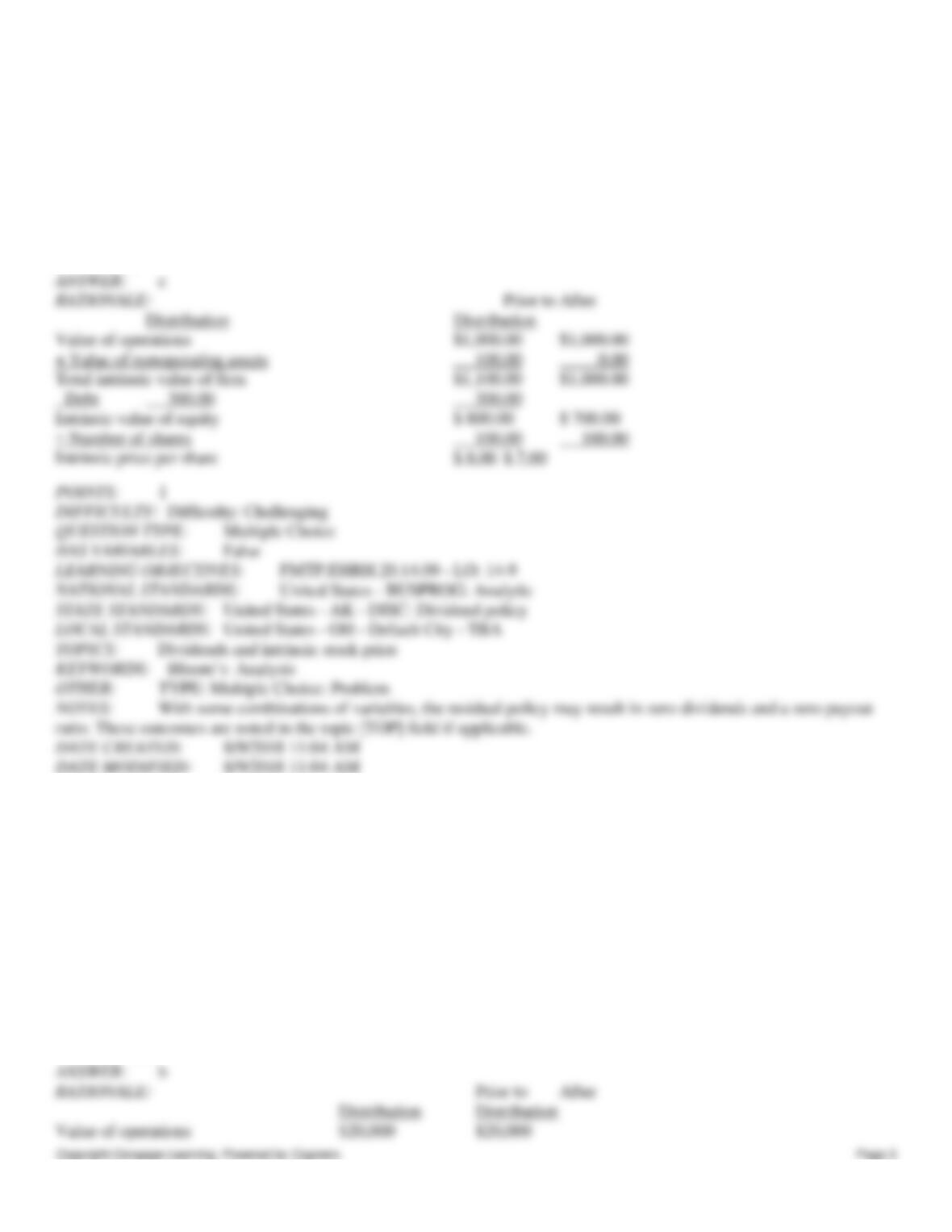
5. The following data apply to Garber Industries, Inc. (GII):
Value of operations $1,000
Short-term investments $100
Chapter 14: Distributions to Shareholders: Dividends and Repurchases
Debt $300
Number of shares 100
The company plans on distributing $100 as dividend payments. What will the intrinsic per share stock price be
immediately after the distribution?
a. $6.32
b. $6.65
c. $7.00
d. $7.35
e. $7.72
6. The following data apply to Elizabeth’s Electrical Equipment:
Value of operations $20,000
Short-term investments $1,000
Debt $6,000
Number of shares 300
The company plans on distributing $1,000 by repurchasing stock. What will the intrinsic per share stock price be
immediately after the repurchase?
a. $47.50
b. $50.00
c. $52.50
d. $55.13
e. $57.88
Chapter 14: Distributions to Shareholders: Dividends and Repurchases
7. The optimal distribution policy strikes that balance between current dividends and capital gains that maximizes the
firm’s stock price.
a. True
b. False
8. The dividend irrelevance theory, proposed by Miller and Modigliani, says that provided a firm pays at least some
dividends, how much it pays does not affect either its cost of capital or its stock price.
a. True
b. False
Chapter 14: Distributions to Shareholders: Dividends and Repurchases
9. MM’s dividend irrelevance theory says that while dividend policy does not affect a firm’s value, it can affect the cost of
capital.
a. True
b. False
10. If investors prefer firms that retain most of their earnings, then a firm that wants to maximize its stock price should set
a low payout ratio.
a. True
b. False
11. The announcement of an increase in the cash dividend should, according to MM, lead to an increase in the price of the
firm’s stock.
a. True
b. False

Chapter 14: Distributions to Shareholders: Dividends and Repurchases
12. Underlying the dividend irrelevance theory proposed by Miller and Modigliani is their argument that the value of the
firm is determined only by its basic earning power and its business risk.
a. True
b. False
13. One implication of the bird-in-the-hand theory of dividends is that a given reduction in dividend yield must be offset
by a more than proportionate increase in growth in order to keep a firm’s required return constant, other things held
constant.
a. True
b. False

Chapter 14: Distributions to Shareholders: Dividends and Repurchases
14. Myron Gordon and John Lintner believe that the required return on equity increases as the dividend payout ratio is
decreased. Their argument is based on the assumption that
a. investors require that the dividend yield and capital gains yield equal a constant.
b. capital gains are taxed at a higher rate than dividends.
c. investors view dividends as being less risky than potential future capital gains.
d. investors value a dollar of expected capital gains more highly than a dollar of expected dividends because of the
lower tax rate on capital gains.
e. investors are indifferent between dividends and capital gains.
15. Which of the following should not influence a firm’s dividend policy decision?
a. A strong preference by most shareholders for current cash income versus capital gains.
b. Constraints imposed by the firm’s bond indenture.
c. The fact that much of the firm’s equipment has been leased rather than bought and owned.
d. The fact that Congress is considering changes in the tax law regarding the taxation of dividends versus capital
gains.
e. The firm’s ability to accelerate or delay investment projects.
16. If the signaling, hypothesis (which is also called the information content hypothesis) is correct, then changes in
dividend policy can have an important effect on the firm’s value and capital costs.
a. True
b. False
Chapter 14: Distributions to Shareholders: Dividends and Repurchases
17. Which of the following statements about dividend policies is correct?
a. One reason that companies tend to avoid stock repurchases is that dividend payments are taxed at a lower rate
than gains on stock repurchases.
b. One advantage of dividend reinvestment plans is that they allow shareholders to avoid paying taxes on the
dividends that they choose to reinvest.
c. One key advantage of a residual dividend policy is that it enables a company to follow a stable dividend policy.
d. The clientele effect suggests that companies should follow a stable dividend policy.
e. Modigliani and Miller argue that investors prefer dividends to capital gains because dividends are more certain
than capital gains. They call this the “bird-in-the hand” effect.
18. In the real world, dividends
a. are usually more stable than earnings.
b. fluctuate more widely than earnings.
c. tend to be a lower percentage of earnings for mature firms.
d. are usually changed every year to reflect earnings changes, and these changes are randomly higher or lower,
depending on whether earnings increased or decreased.
e. are usually set as a fixed percentage of earnings, e.g., at 40% of earnings, so if EPS = $2.00, then DPS will equal
$0.80. Once the percentage is set, then dividend policy is on “automatic pilot” and the actual dividend depends strictly on
earnings.

Chapter 14: Distributions to Shareholders: Dividends and Repurchases
19. If a firm adopts a residual distribution policy, distributions are determined as a residual after funding the capital
budget. Therefore, the better the firm’s investment opportunities, the lower its payout ratio should be.
a. True
b. False
20. If management wants to maximize its stock price, and if it believes that the dividend irrelevance theory is correct, then
it must adhere to the residual distribution policy.
a. True
b. False
21. If the shape of the curve depicting a firm’s WACC versus its debt ratio is more like a sharp “V”, as opposed to a
shallow “U”, it will be easier for the firm to maintain a steady dividend in the face of varying investment opportunities or
earnings from year to year.
a. True
b. False
Chapter 14: Distributions to Shareholders: Dividends and Repurchases
22. Which of the following would be most likely to lead to a decrease in a firm’s dividend payout ratio?
a. Its access to the capital markets increases.
b. Its R&D efforts pay off, and it now has more high-return investment opportunities.
c. Its accounts receivable decrease due to a change in its credit policy.
d. Its stock price has increased over the last year by a greater percentage than the increase in the broad stock market
averages.
e. Its earnings become more stable.
23. Reynolds Paper Products Corporation follows a strict residual dividend policy. All else equal, which of the following
factors would be most likely to lead to an increase in the firm’s dividend per share?
a. The company increases the percentage of equity in its target capital structure.
b. The number of profitable potential projects increases.
c. Congress lowers the tax rate on capital gains. The remainder of the tax code is not changed.
d. Earnings are unchanged, but the firm issues new shares of common stock.
e. The firm’s net income increases.
Chapter 14: Distributions to Shareholders: Dividends and Repurchases
24. The projected capital budget of Kandell Corporation is $1,000,000, its target capital structure is 60% debt and 40%
equity, and its forecasted net income is $550,000. If the company follows a residual dividend policy, what total dividends,
if any, will it pay out?
a. $122,176
b. $128,606
c. $135,375
d. $142,500
e. $150,000
25. Grandin Inc. is evaluating its dividend policy. It has a capital budget of $625,000, and it wants to maintain a target
capital structure of 60% debt and 40% equity. The company forecasts a net income of $475,000. If it follows the residual
dividend policy, what is its forecasted dividend payout ratio?
a. 40.61%
b. 42.75%
c. 45.00%
d. 47.37%
e. 49.74%
Chapter 14: Distributions to Shareholders: Dividends and Repurchases
26. The capital budget of Creative Ventures Inc. is $1,000,000. The company wants to maintain a target capital structure
that is 30% debt and 70% equity. The company forecasts that its net income this year will be $800,000. If the company
follows a residual dividend policy, what will be its total dividend payment?
a. $100,000
b. $200,000
c. $300,000
d. $400,000
e. $500,000
27. Rohter Galeano Inc. is considering how to set its dividend policy. It has a capital budget of $3,000,000. The company
wants to maintain a target capital structure that is 15% debt and 85% equity. The company forecasts that its net income
this year will be $3,500,000. If the company follows a residual dividend policy, what will be its total dividend payment?
a. $205,000
b. $500,000
c. $950,000
d. $2,550,000
e. $3,050,000
Chapter 14: Distributions to Shareholders: Dividends and Repurchases
28. Sanchez Company has planned capital expenditures that total $2,000,000. The company wants to maintain a target
capital structure that is 35% debt and 65% equity. The company forecasts that its net income this year will be $1,800,000.
If the company follows a residual dividend policy, what will be its total dividend payment?
a. $100,000
b. $200,000
c. $300,000
d. $400,000
e. $500,000
29. McCann Publishing has a target capital structure of 35% debt and 65% equity. This year’s capital budget is $850,000
and it wants to pay a dividend of $400,000. If the company follows a residual dividend policy, how much net income must
it earn to meet its capital budgeting requirements and pay the dividend, all while keeping its capital structure in balance?
a. $904,875
b. $952,500
c. $1,000,125
d. $1,050,131
e. $1,102,638
Chapter 14: Distributions to Shareholders: Dividends and Repurchases
30. Harvey’s Industrial Plumbing Supply’s target capital structure consists of 40% debt and 60% equity. Its capital budget
this year is forecast to be $650,000. It also wants to pay a dividend of $225,000. If the company follows the residual
dividend policy, how much net income must it earn to meet its capital requirements, pay the dividend, and keep the capital
structure in balance?
a. $584,250
b. $615,000
c. $645,750
d. $678,038
e. $711,939
Chapter 14: Distributions to Shareholders: Dividends and Repurchases
31. Victor Rumsfeld Inc.’s dividend policy is under review by its board. Its projected capital budget is $2,000,000, its
target capital structure is 60% debt and 40% equity, and its forecasted net income is $600,000. If the company follows a
residual dividend policy, what total dividends, if any, will it pay out?
a. $240,000
b. $228,000
c. $216,600
d. $205,770
e. $0
32. The capital budget forecast for the Santano Company is $725,000. The CFO wants to maintain a target capital
structure of 45% debt and 55% equity, and it also wants to pay dividends of $500,000. If the company follows the residual
dividend policy, how much income must it earn, and what will its dividend payout ratio be?
Net Income Payout
a. $ 898,750 55.63%
b. $ 943,688 58.41%
c. $ 990,872 61.34%
d. $1,040,415 64.40%
e. $1,092,436 67.62%