1
Foundations of Finance, 7e (Keown/Martin/Petty)
Chapter 14 Short-Term Financial Planning
14.1 Learning Objective 1
1) The key ingredient in a firm’s financial planning is an accurate sales forecast.
2) Financial forecasting is the process of attempting to estimate a firm’s future financing
requirements.
3) The percent of sales method does not provide a reasonable prediction of asset levels for
instances when there are economies of scale in the use of the asset being forecast and when asset
purchases are lumpy.
4) The percent of sales method assumes that all assets and all liabilities increase proportionally
with sales, but retained earnings does not.
5) A corporation that increases it net profit margin will need less discretionary financing, other
things being equal.
6) Discretionary financing needed is equal to the predicted change in total assets minus the
change in retained earnings.
7) For a typical firm expecting higher sales, external financing needed will be greater than
discretionary financing needed.
8) Issuing new short-term bonds to finance an expansion is an example of spontaneous financing.
9) If the sales growth rate is greater than zero, then the discretionary financing needed will also
be greater than zero.
10) Discretionary financing needed must be obtained through additional borrowing because
additional equity measured by the increase in retained earnings has already been deducted.
11) The first step in a corporation’s financial forecasting process is the determination of the firm’s
financing needs.
12) In the percent of sales method, a company’s asset requirements are based on the company’s
projected sales level.
13) Notes payable and bonds payable are spontaneous liabilities.
14) In order to reduce discretionary financing needed, a profitable company could decrease its
dividend payout ratio.
15) The forecasted retained earnings balance is equal to (current retained earnings/current sales)
times projected sales for next year.
16) Discretionary financing needed is equal to projected total assets minus projected total
liabilities.
17) Discretionary financing needed will be zero when the company’s sales growth rate is zero.
18) When fixed costs are part of a firm’s cost structure, the percent of sales method will
understate net income and overstate discretionary financing needed, if sales are increasing.
19) Traditional financial forecasting takes the sales forecast as given and forecasts the
corresponding expenses, assets, and liabilities of the firm.
20) The cash budget can be used to provide an estimate of the firm’s future financing needs.
21) Accounts payable and accrued expenses are known as discretionary sources of financing.
22) One of the virtues of the percent-of-sales method is the precision of the estimate of future
financing needs.
23) Pro forma financial statements depict the end result of the planning period’s operations.
24) Accrued expenses represent a spontaneous form of financing.
25) Discretionary sources of financing are those sources that vary automatically with a firm’s
level of sales.
26) A set of estimates which corresponds to the worst and best case outcomes is often desired in
preparing a financial forecast.
27) Forecasts of revenues and their related expenses are the basis on which firms forecast their
future financing needs.
28) It is often the case that the planning process has its greatest value when the resulting
forecasts have the most error, because the planning process offers its greatest value when the
future is the most uncertain.
29) Purchasing supplies on credit and paying for them 45 days later is an example of
discretionary financing.
30) Spontaneous financing is financing obtained at the last minute due to poor financial
planning.
31) When preparing pro forma financial statement, the income statement must be prepared first
because the projected retained earnings balance on the balance sheet is based on the expected net
income.
32) Discretionary financing needed (DFN) is equal to projected total assets minus projected total
liabilities minus projected owners’ equity.
33) Other things equal, higher net profit margins mean higher discretionary financing needed.
34) Other things equal, if a firm increases its dividend payout ratio, its discretionary financing
needed will also increase.
35) Discretionary financing needed can be positive or zero, but not negative.
36) For a growing firm, external financing needed will most likely be greater than discretionary
financing needed due to increases in accounts payable and accruals.
37) Using the percent of sales method, projected common stock on the 2010 pro forma balance
sheet is equal to (Common Stock 2009/Sales 2009) times Projected Sales 2010.
38) If external financing needed cannot be obtained due to poor market conditions, a firm could
reduce the amount needed by increasing its retention ratio.
39) The percent of sales method can be used to forecast
A) expenses.
B) assets.
C) liabilities.
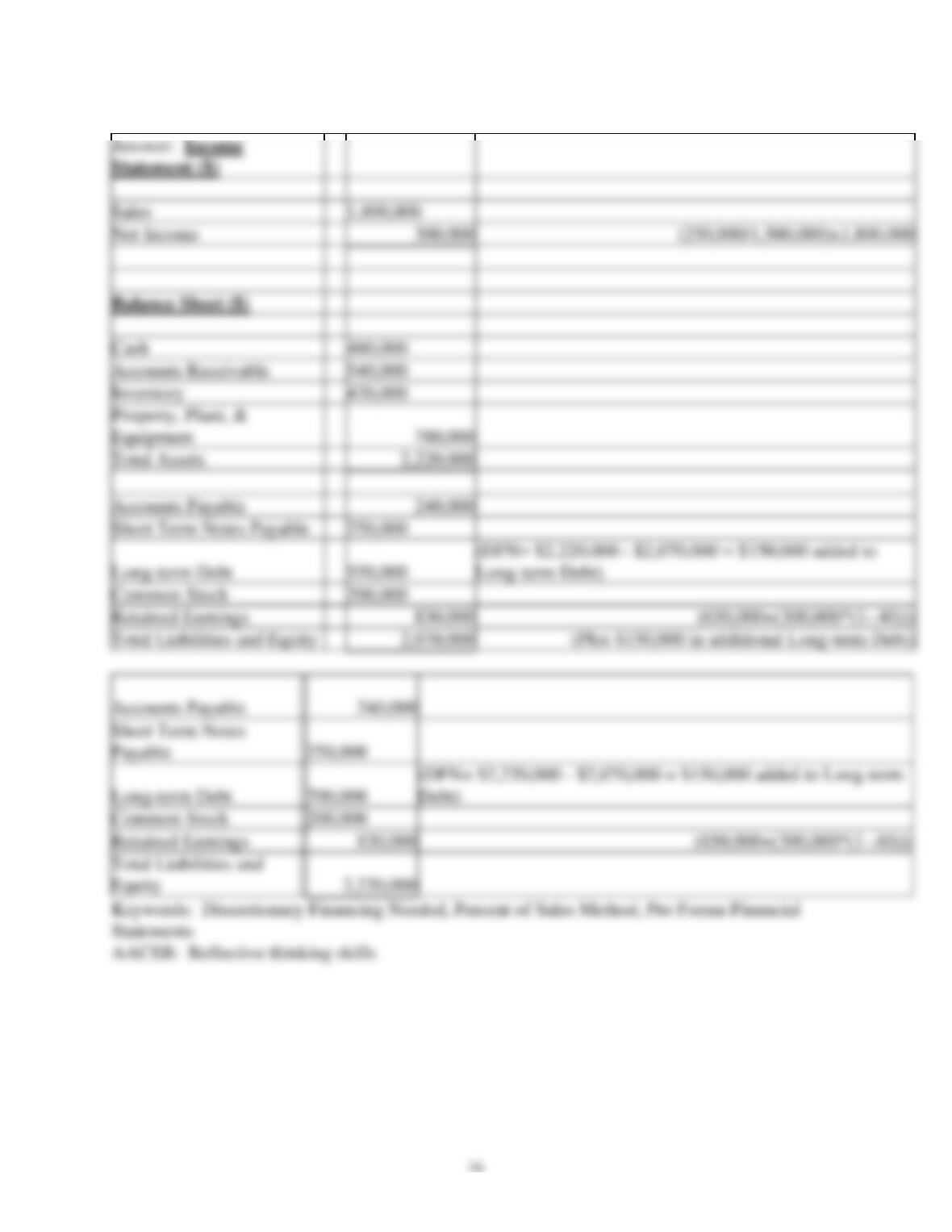
D) all of the above.
40) A company calculates its discretionary financing needed and determines this amount of
capital cannot be raised at a reasonable cost. Which of the following would reduce the amount of
discretionary financing needed?
A) reduce the company’s net profit margin
B) reduce the company’s sales growth rate
C) increase the company’s dividend payout ratio
D) increase the proportion of the company’s sales that are made on credit
41) Twine Enterprises reported sales of $3 million and net income of $400,000 for 2010. The
retained earnings balance at the end of 2010 is $7 million. Twine Enterprises has a dividend
payout ratio of 30%. If sales are expected to increase by 25% next year, what will be the
projected balance in retained earnings using the percent of sales method?
A) $7,280,000
B) $6,720,000
C) $7,350,000
D) $8,750,000
42) Discretionary financing accounts include all of the following except:
A) Long-term Debt.
B) Notes Payable.
C) Accrued Liabilities.
D) Common Stock.
43) Using the percent of sales method and assuming that no excess capacity exists, a 20%
increase in sales will result in
A) a 20% increase in total assets.
B) a 20% increase in total liabilities.
C) a 20% increase in retained earnings.
D) a 20% increase in the company’s profit margin.
44) The chief financial officer of AJAX Industries expects sales to increase from $8,000,000 in
2010 to $12,000,000 in 2011. Current assets in 2010 are equal to $5,000,000. Using the percent
of sales method, projected current assets for 2011 are equal to
A) $5,500,000.
B) $7,083,333.
C) $9,000,000.
D) $7,500,000.
45) All of the following will increase the discretionary financing needed except:
A) decrease the net profit margin.
B) decrease the dividend payout ratio.
C) decrease the sales growth rate.
D) decrease the spontaneous financing.
46) Billings Corporation is preparing its financial forecast for next year and its discretionary
financing needed is negative. This means that
A) sales growth must be negative.
B) the predicted change in total assets must be negative.
C) the predicted change in spontaneous liabilities and retained earnings must be greater than the
predicted change in total assets.
D) the dividend payout ratio must be greater than the predicted growth rate in sales.
47) Potential sources of financing to support an increase in sales include all of the following
except:
A) increase in the dividend payout ratio.
B) increase in spontaneous liabilities.
C) increase in accounts payable.
D) issuance of bonds and/or common stock.
48) When forecasting fixed asset requirements, the projected fixed asset balance will
A) not increase proportionally with sales if the existing level of fixed assets is sufficient to
support current sales.
B) not increase proportionally if excess capacity exists.
C) remain the same since the balance is fixed.
D) always increase proportionally with sales.
49) Using the percentage of sales method of forecasting,
A) all asset and liability accounts increase or decrease proportionally with sales.
B) only asset accounts increase or decrease proportionally with sales.
C) accounts payable and accrued expenses are the only liabilities that increase or decrease
proportionally with sales.
D) all balance sheet accounts increase or decrease proportionally with sales.
50) Which of the following will most likely result in an increase in discretionary funding
needed?
A) The company’s profit margin increases.
B) The company’s dividend payout ratio increases.
C) The company’s assets are only operating at 50% of capacity.
D) The company pays its accounts payable in 50 days, up from 45 days.
51) Fixed assets are often estimated incorrectly by the percent of sales method because
A) fixed assets remain constant and the percent of sales method assumes all assets increase
proportionally with sales.
B) fixed asset are very expensive.
C) fixed assets are typically purchased in “lumps” and therefore do not increase proportionally
with sales.
D) fixed assets are part of the capital budgeting process.
52) Using the percentage of sales method, forecasted retained earnings balance is equal to
A) prior year retained earnings plus projected net income less projected dividends.
B) the ratio of retained earnings to sales for the current year multiplied by projected sales for
next year.
C) the retained earnings balance for the current year as no changes are made to this financing
account when using the percent of sales method.
D) the ratio of retained earnings to sales for the current year multiplied by projected sales for
next year, minus dividends paid.
53) JR Textiles, a highly profitable company, is considering two growth strategies, one that will
achieve sales growth of 20% in one year, and the other that will achieve 20% growth in sales, but
over a 4-year time frame. Assuming JR Textiles uses the percent of sales method, which of the
following statements is true?
A) Discretionary financing needed will be much greater for the 4-year growth strategy.
B) Discretionary financing needed could be much less for the 4-year growth strategy due to
retained earnings.
C) The asset balances at the end of 4 years for strategy two will be much greater than the asset
balances required at the end of year one for strategy one.
D) Discretionary financing needed could be much greater for the slow growth strategy because
interest charges will accumulate on the company’s debt.
54) The first step involved in predicting financing needs is
A) project the firm’s sales revenues and expenses over the planning period.
B) estimating the levels of investment in current and fixed assets that are necessary to support the
projected sales.
C) determining the firm’s financing needs throughout the planning period.
D) estimating the cost of debt.
55) A sales forecast for the coming year would reflect
A) any past trend which is expected to continue.
B) the influence of any events that might materially affect that trend.
C) Both A and B.
D) Neither A nor B.
56) The “percentage” used in the percent of sales calculation can come
A) from the most recent financial statement item as a percent of current sales.
B) from an average computed over several years.
C) from an analyst’s judgment.
D) from any of the above or a combination of the above.
57) Spontaneous sources of financing include
A) accounts payable and accrued expenses.
B) notes payable and mortgages payable.
C) long term debt and capital leases.
D) common stock and paid-in capital.
58) A discretionary form of financing would be
A) notes payable.
B) accounts payable.
C) accrued expenses.
D) A and B.
59) Which of the following is a spontaneous source of financing?
A) accrued expenses
B) notes payable
C) common stock
D) paid-in-capital
60) All of the following are useful purposes of pro forma financial statements except:
A) they provide a useful tool for analyzing the effects of a firm’s forecasts on its financial
performance.
B) they satisfy the SEC requirement for audited financial disclosure.
C) they can be used to control, or monitor a firm’s progress for a planning period.
D) they serve as a benchmark to compare actual results to planned activities.
61) Which of the following statements would not be a valid use of pro forma financial
statements?
A) to determine a firm’s needs for financing
B) to enhance a firm’s ability to offer shareholders guaranteed operating results
C) to analyze the effects of a firm’s forecasts on its financial performance
D) to serve as a benchmark when comparing actual results to planned activities
62) Which of the following is the initial and most important step in the preparation of pro forma
financial statements?
A) Estimate the levels of investment in current and fixed assets.
B) Determine the rate of interest that will be required for borrowed funds.
C) Project the firm’s sales revenues for the planning period.
D) Approximate the cost of raw materials.
63) The “percent of sales method” is a method of preparing pro forma financial statements. All of
the following would be examples of how the “percent of sales method” is developed except?
A) Forecast expenses by applying a percent of projected sales, using last year’s expenses as a
percent of last year’s sales.
B) Forecast assets by applying a percent of projected sales, using current year’s assets as a
percent of current year’s sales.
C) Approximate liabilities by applying a percent of projected sales, using the last five-year
average of liabilities as a percent of sales.
D) Forecast retained earnings by applying a percent of projected sales, using current year’s
retained earnings as a percent of current year’s sales.
64) Use the “percent of sales method” of preparing pro forma financial statements to determine
the projection for next year’s accounts receivable. Make the following assumptions: current
year’s sales are $45,450,000; current year’s cost of goods sold is $26,950,000; sales are expected
to rise by 20%. The firm’s investment in accounts receivable in the current year is $8,600,000.
The firm’s marginal tax rate is 35%. What is the projection for next year’s accounts receivable?
A) $11,345,000
B) $10,320,000
C) $9,575,000
D) $8,772,000
65) Use the “percent of sales method” of preparing pro forma financial statements to determine
the projection for next year’s inventory. Make the following assumptions: current year’s sales are
$27,800,000; current year’s cost of goods sold is $17,528,000; sales are expected to rise by 30%.
The firm’s investment in inventory in the current year is $5,890,200. What is the projection for
next year’s inventory?
A) $7,657,260
B) $6,981,250
C) $5,845,500
D) $4,526,600
66) Discretionary financing needs will be lower if ________. Assume “all else equal.”
A) the dividend payout ratio is raised
B) the firm’s net profit margin increases
C) sales increase
D) fixed assets are currently at full capacity
67) Discretionary financing needs will be higher if ________. Assume “all else equal.”
A) the firm’s net profit margin increases
B) sales decline
C) the dividend payout ratio is raised
D) excess capacity exists for fixed assets
68) Use the “percent of sales method” of preparing pro forma financial statements to determine
the projection for next year’s accounts payable. Make the following assumptions: current year’s
sales are $27,800,000; current year’s cost of goods sold is $17,528,000; sales are expected to rise
by 30%. The firm’s investment in accounts payable in the current year is $2,218,500. What is the
projection for next year’s accounts payable?
A) $2,127,000
B) $3,781,750
C) $2,884,050
D) $4,184,000
69) Use the “percent of sales method” of preparing pro forma financial statements to determine
the projection for next year’s cost of goods sold. Make the following assumptions: current year’s
sales are $27,800,000; current year’s cost of goods sold is $17,528,000; sales are expected to rise
by 30%. What is the projection for next year’s cost of goods sold?
A) $20,481,000
B) $21,138,900
C) $21,459,200
D) $22,786,400
70) Spontaneous sources of funds refers to all of the below except:
A) accruals.
B) a bank loan.
C) accounts payable.
D) common stock.
71) What differentiates “discretionary financing needs” from “external financing needs?”
A) Assets
B) Retained earnings
C) Sales
D) Spontaneous liabilities
72) Which of the following is a limitation of the “percent of sales method” of preparing pro
forma financial statements?
A) A firm’s investment in accounts receivable is seldom related to sales volume.
B) Not all assets and liabilities increase or decrease as a constant percent of sales.
C) Inventory levels are seldom affected by changes in sales volume.
D) The dividend payout ratio may change from one year to the next.
73) At a minimum, the sales forecast for the coming year would reflect
A) any future trend in sales that is expected to begin in the new year.
B) the influence of any anticipated events that might materially affect the sales trend.
C) both of the above are correct.
D) neither of the above are correct.
74) A budget
A) records the amount and timing of the firm’s past financing needs.
B) provides a basis for taking corrective action in the event that budgeted figures do not match
actual or realized figures.
C) remains independent of the human resource performance evaluation task.
D) only makes sense for annual periods of time
75) All of the following are examples of sources of discretionary financing except:
A) bank loans.
B) notes payable.
C) trade credit.
D) common stock.
76) Predicting a firm’s future financial needs includes all of the following steps except:
A) review of the firm’s sales revenues and expenses over all past planning periods.
B) estimation of investment levels for current and fixed assets.
C) determination of the firm’s financing needs for the period.
D) estimation of projected sales and expenses.

15
77) Using the 2010 financial statements for DRE Corporation and this additional information,
prepare a pro forma income statement and balance sheet for the year 2011. Determine the
discretionary financing needed (DFN) and assume that if the DFN is positive, the company will
increase long-term debt, and if DFN is negative, the company will pay back some long-term
debt.
Sales for next year (2011) are expected to increase by $300,000 to $1,800,000. The firm is
running efficiently and at full capacity so that all assets and spontaneous liabilities are expected
to increase proportionally with sales. The dividend payout ratio for 2011 will be 40%.
DRE Corporation
2010 Financial Statements
Income Statement ($)
Sales
1,500,000
Net Income
250,000
Balance Sheet ($)
Cash
400,000
Accounts Receivable
450,000
Inventory
350,000
Property, Plant, &
Equipment
650,000
Total Assets
1,850,000
Accounts Payable
200,000
Short Term Notes Payable
250,000
Long-term Debt
550,000
Common Stock
200,000
Retained Earnings
650,000
Total Liabilities and Equity
1,850,000
78) Lindsey Insurance Co. has current sales of $10 million and predicts next year’s sales will
grow to $14 million. Current assets are $3 million and fixed assets are $4 million. The firm’s net
profit margin is 7 percent after taxes. Presently, Lindsey has $900,000 in accounts payable, $1.1
million in long-term debt, and $5 million (including $2.5 million in retained earnings) in
common equity. Next year, Lindsey projects that current assets will rise in direct proportion to
the forecasted sales, and that fixed assets will rise by $500,000. Lindsey also plans to pay
dividends of $400,000 to common shareholders.
a. What are Lindsey’s total financing needs for the upcoming year?
b. Given the above information, what are Lindsey’s discretionary financing needs?
14.2 Learning Objective 2
1) The percent of sales forecasting method works well because it accounts for economies of scale
in assets such as inventory.
2) When economies of scale exist, the percent of sales method will overestimate the assets
required and therefore overestimate the amount of discretionary financing needed.
3) If a firm currently has excess capacity, then using the percent of sales method to forecast its
fixed asset balance will likely result in an overestimate of the fixed asset balance and an inflated
amount of discretionary financing needed.
4) Corporation A is expecting sales to increase by 20% next year, but its net fixed assets are
expected to remain at their current level. This is an example of
A) economies of scale.
B) lumpy assets.
C) spontaneous financing.
D) discretionary financing.
5) Wilbur and Company reports sales of $20,000,000 and inventory of $4,000,000. Wilbur’s
inventory possesses significant economies of scale. Therefore, if Wilbur’s sales increase by 10%,
Wilbur’s inventory will ________ and if Wilbur’s sales decrease by 10%, Wilbur’s inventory will
________.
A) increase by more than 10%, increase by more than 10%
B) decrease by more than 10%, decrease by more than 10%
C) increase by more than 10%, decrease by less than 10%
D) increase by less than 10%, decrease by less than 10%
6) XDR Corp. is expecting a 10% increase in sales next year. XDR has an inventory balance of
$1,000,000 and uses the percent of sales forecasting method. Which of the following could
explain why the inventory forecast of $1,100,000 might be too high?
A) The current inventory balance of $1,000,000 is lower than usual because of a one-time end of
year fire sale.
B) The company is going to change its depreciation method in the coming year.
C) The growth in sales could be as high as 15%.
D) A fixed amount of inventory is required to do business, so inventory doesn’t increase
proportionally with sales.
7) The percent of sales method does not accurately estimate the balances for lumpy assets.
Which of the following statements best describes the possible errors?
A) if excess capacity exists, the percent of sales method will overestimate asset requirements
B) the percent of sales method consistently underestimates the forecasted balances of lumpy
assets
C) the percent of sales method consistently overestimates the forecasted balances of lumpy assets
D) if fixed assets are utilized at full capacity currently, the percent of sales method will
underestimate the forecasted fixed asset balance
8) The accuracy of the percent of sales forecast method is impaired if
A) scale economies are present for assets.
B) assets must be purchased in discrete quantities.
C) asset needs are independent of sales level.
D) all of the above impair the accuracy of the percent of sales forecast method.
9) The term “lumpy asset” means
A) the same thing as assets that exhibit scale economies.
B) assets that can be purchased in incremental units.
C) assets that have economies of scale but not economies of scope.
D) assets that must be purchased in discrete quantities.
14.3 Learning Objective 3
1) Budgets should not be used for performance evaluation because there is too much uncertainty
involved and this makes it unfair to the person being evaluated.
2) The percent of sales method provides a more detailed plan for future financing needs than the
cash budget because both pro forma income statements and balance sheets are used in the
analysis.
3) Cash budgets do not provide reasonable predictions for asset requirements when the asset
purchases are lumpy.
4) The percent of sales method provides a general estimate, but the more detailed cash budget
will ultimately be used to estimate financing needs.
5) Cash budgets are completed only on an annual basis because shorter periods of time are too
variable and uncertain for meaningful results.
6) The annual cash budget not only shows the amount of financing needed for the year, but also
when the funds will be needed.
7) The cash budget is composed of four elements: cash receipts, cash disbursements,
depreciation, and the net change in cash for the period.
8) Monthly cash receipts in the cash budget are typically made up of cash sales during the month
and collections from credit sales from prior months.
9) Pro forma statements are important since they formally report the performance of the firm
during the previous reporting period.
10) A budget is a forecast of future events.
11) The cash budget represents a detailed plan of future cash flows.