
Part 6 Long-Term Investment Decisions
CHAPTER 13
CAPITAL BUDGETING, RISK CONSIDERATIONS, AND
OTHER SPECIAL ISSUES
CHAPTER LEARNING OBJECTIVES
13.1 Describe the capital budgeting process and explain its importance to
13.2 Identify and apply the main tools used to evaluate investments.
13.3 Analyze independent projects and explain how they differ from
13.5 Explain the importance of international foreign direct investment both inside
13.6 Explain how the modified internal rate of return (MIRR) is calculated and why
this represents a conceptual improvement over the way the IRR is calculated.
Capital Budgeting, Risk Considerations, and Other Special Issues 13 – 2
MULTIPLE CHOICE QUESTIONS
1. Which of the following is a FALSE statement regarding capital expenditures?
a) They are a firm’s investments in long-lived assets.
b) They may be tangible assets or intangible assets.
c) They determine a company’s future direction.
d) They usually involve large amounts of money and the decisions are frequently recoverable.
2. Capital expenditures are
a) a firm’s investments in net working capital.
b) a firm’s investments in long-lived tangible and non-tangible assets.
c) a firm’s investments in financial securities.
d) all of the above.
3. Which of the following is NOT one of the distinct steps in the capital budgeting process?
a) Identifying investment alternatives
b) Obtaining the financing to pay for the investment
c) Implementing the chosen investment decisions
d) Monitoring and evaluating the implemented decisions
4. Capital budgeting is:
a) the process through which a firm makes capital expenditure decisions.
b) the process through which a firm makes investment in stocks.
c) the process of raising capital in the financial markets.
5. A firm that does not invest effectively will:
a) find itself at a competitive advantage.
b) make itself more attractive in the short run.
c) increase its cost of capital.
d) increase its market prices of debt and equity securities.
6. Which of the following is NOT one of Michael Porter’s five critical factors that determine the
attractiveness of an industry?
a) Entry barriers.
b) The threat of substitutes.
c) The bargaining power of buyers/suppliers.
d) Coalition among existing competitors.
7. Which one of the following statements is NOT true?

Capital Budgeting, Risk Considerations, and Other Special Issues 13 – 4
a) Capital expenditures in good projects will increase the value of the firm.
b) A pending drug patent can be used as collateral.
c) Capital budgeting is a dynamic process and depends on changing conditions.
d) A change in interest rates is not important enough to change a decision about a project.
8. Michael Porter argues that firms can create competitive advantages for themselves by
adopting one of the following strategies:
I. Cost leadership: firms strive to use the latest technology to lower the costs of production.
II. Differentiation: firms can differentiate their products by providing customers with unique
delivery alternatives.
a) I and II are correct.
b) I and II are incorrect.
c) I is correct, II is incorrect.
d) I is incorrect, II is correct.
9. Use the following two statements to answer this question:
I. Bottom-up analysis: an investment strategy in which capital expenditure decisions are
considered in connection with whether the firm should continue in this business or for general
industry and economic trends.
II. Top-down analysis: an investment strategy that focuses on strategic decisions, such as which
industries or products the firm should be involved in, looking at the overall economic picture.
a) I and II are correct.
b) I and II are incorrect.
c) I is correct, II is incorrect.
d) I is incorrect, II is correct.
10. Use the following two statements to answer this question:
I. DCF methodologies are techniques for making capital expenditure decisions that are
consistent with the overriding objective of maximizing shareholder wealth.
II. DCF valuation involves estimating future cash flows and comparing their present values with
investment outlays required today.
a) I and II are correct.
b) I and II are incorrect.
c) I is correct, II is incorrect.
d) I is incorrect, II is correct.
11. Which of the following is NOT a true statement about net present value (NPV) analysis?
a) The NPV of a project is the sum of the present value of all future after-tax incremental cash
flows generated by an initial cash outlay, minus the present value of the investment outlays.
b) Projects that have a positive NPV should be accepted, and projects that have a negative
NPV should be rejected.
c) The NPV is the present value of the expected cash flows net of the costs needed to generate
them.
d) The firm’s after-tax marginal cost of capital is the appropriate discount rate for all projects.
12. Which of the following statements is FALSE?
a) Positive NPVs arise only in situations in which a company has a competitive advantage.
b) Projects that produce an NPV of zero should be rejected.
c) The market value of any firm in an efficient market should equal the present value of its
expected after-tax cash flows.
d) Because of the competitive nature of today’s business environment, we would not expect to
see an abundance of positive NPV opportunities to persist for very long.
Capital Budgeting, Risk Considerations, and Other Special Issues 13 – 6
13. Suppose a project requires an initial investment of $10,000 and it will yield $1,500 for 8
years. The discount rate is 10%. What is the NPV of the project and should we accept or reject
it?
a) −$1,997.61; reject
b) $1,997.61; accept
c) −$2,000; reject
d) $2,000; accept
14. Suppose a project requires an initial investment of $10,000 and it will yield $10,500 one year
later. The NPV of the project is:
a) equal to $500.
b) less than 0 if the discount rate is less than 5 percent.
c) zero if the discount rate is equal to 5 percent.
d) positive if the discount rate is greater than 5 percent.
15. A project that requires a $ 100,000 investment yields $50,000 in 6 months and $50,000 in
one year should be rejected for the following reasons:
I. The cost of time is not incorporated in the calculation
II. The sum of the cash inflows following the investment is equivalent to the initial investment
a) I only
b) II only
c) I and II
d) None of these reasons
13 – 7 Test Bank for Introduction to Corporate Finance, Fourth Canadian Edition
16. The IRR and NPV may yield the same conclusion about a project except:
a) when interest rates are too high
b) when the project is short term
c) when cash flows are irregular
d) when the management is using debt to finance the project
17. The acceptance of an investment project implies that:
I. its IRR is greater than a certain threshold.
II. its NPV is greater than its IRR.
III. its NPV is greater than or equal to 0.
a) I only
b) II only
c) I and II only
d) I and III only
18. The risk-adjusted discount rate is:
a) the overall company expected return for investors
b) the debt rate of the company
c) the cost of financing from the bank
d) the discount rate that reflects the project’s risk
19. The internal rate of return (IRR) is:
a) the discount rate that makes the NPV greater than zero for a given set of cash flows.
b) the discount rate that sets the FV of future CFs equal to the initial cash outlay.
c) the opportunity cost of the capital invested in the project.
d) the economic rate of return of a given project.
20. Use the following two statements to answer this question:
I. A firm should accept a project whenever IRR > k.
II. When IRR < k, the NPV will be positive, and vice versa.
a) I and II are correct.
b) I and II are incorrect.
c) I is correct, II is incorrect.
d) I is incorrect, II is correct.
21. Which of the following statements is FALSE?
a) The NPV profile shows the NPV of a project for various IRRs.
b) Mutually exclusive projects are projects for which the acceptance of one precludes the
acceptance of one or more of the alternative projects.
c) The crossover rate is a special discount rate at which the NPV profiles of two projects cross.
d) There may be more than one IRR for cash flow streams where the cash flows change signs
more than once.
22. You are the CFO of a major, publicly traded corporation. You must choose between two
mutually exclusive projects. You will accept a project based on which of the following?
a) The greatest increase in shareholder value.
b) The highest accounting profit.
c) The greatest tax benefit.
d) The highest internal rate of return.
23. Which of the following are NOT mutually exclusive projects?
a) Building a factory in New Brunswick or Nova Scotia.
b) Building a gas station or a strip mall on a given piece of land.
c) Selling canoes or paddles at different times.
d) An electricity utility building a coal-fired power plant or a natural gas-fired plant.
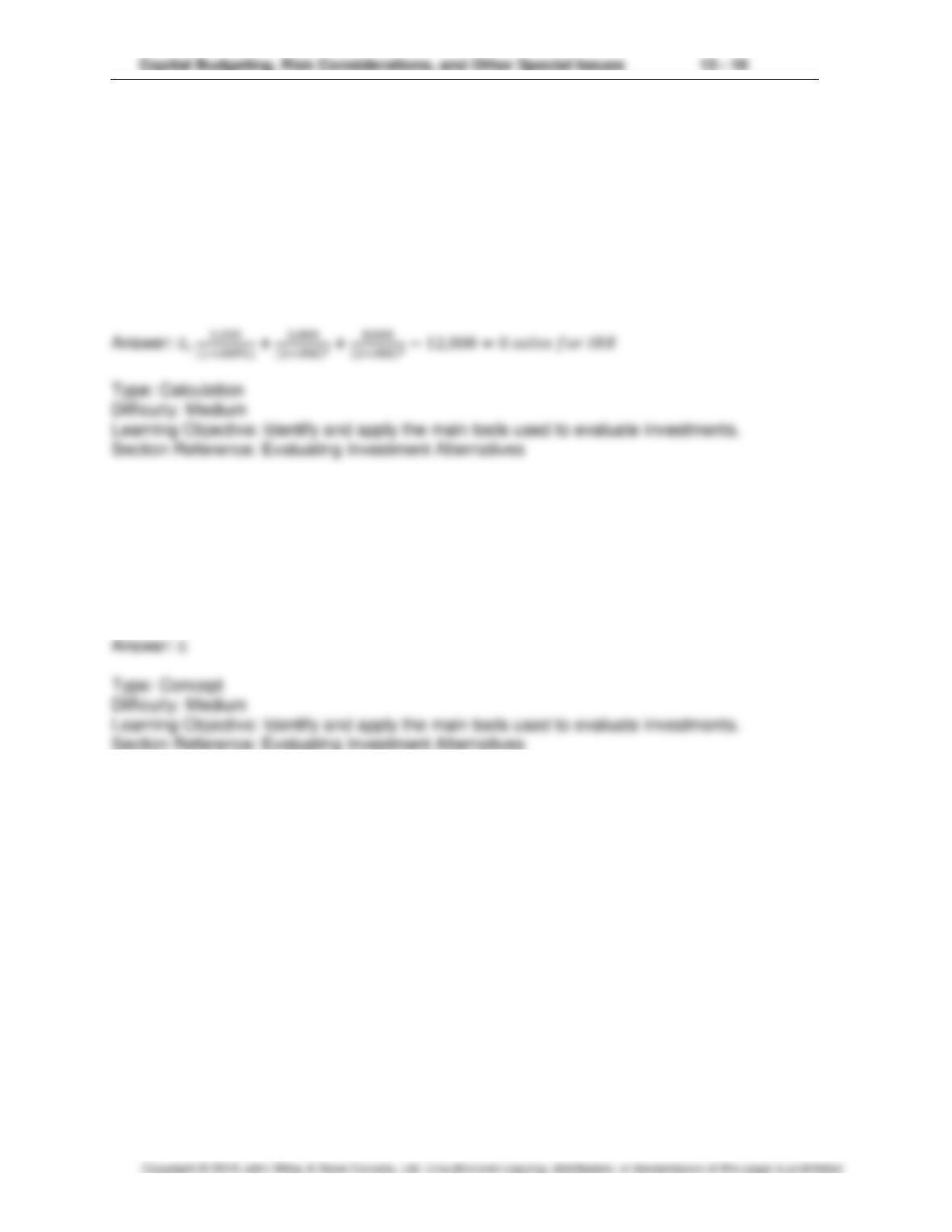
24. Suppose a company has an investment that requires an after-tax incremental cash outlay of
$12,000 today. It estimates that the expected future after-tax cash flows associated with this
investment are $5,000 in years 1 and 2, and $8,000 in year 3. Using a 12-percent discount rate,
determine the project’s NPV.
a) $16,071.43
b) $14,144.50
c) $4,071.43
d) $2,144.50
25. Suppose a company has an investment that requires an after-tax incremental cash outlay of
$12,000 today. It estimates that the expected future after-tax cash flows associated with this
investment are $5,000 in years 1 and 2, and $8,000 in year 3. What is the IRR?
a) 50%
b) 49.26%
c) 21.31%
d) Cannot be determined
26. What is the major assumption in the calculation of IRR?
a) IRR is more intuitive than NPV
b) Every dollar of cash flows is reinvested at the discount rate
c) Every dollar of cash flows is reinvested at the IRR
d) Every dollar of cash flows is measured in real dollars
27. Consider the following graph:

13 – 11 Test Bank for Introduction to Corporate Finance, Fourth Canadian Edition
Which capital budget criterion would yield contradictory conclusions about this project?
a) Net present value
b) Payback period
c) Discounted payback period
d) Internal rate of return
28. Which one of the following is an example of mutual exclusive projects?
I. A piece of land may be either used for the extension of the existing plant or the building of a
more efficient headquarters for the company
II. Expanding the plant or relocating the company’s head office to a new location
a) I only
b) II only
c) Both I and II
d) Neither I nor II
29. If projects Mars and Venus are mutually exclusive, the acceptance of project Mars means:
($10,000.00)
($8,000.00)
($6,000.00)
($4,000.00)
($2,000.00)
$0.00
$2,000.00
$4,000.00
0 0.1 0.2 0.3 0.4 0.5 0.6
NPV
Rate

Capital Budgeting, Risk Considerations, and Other Special Issues 13 – 12
a) project Venus is rejected.
b) project Venus is accepted.
c) project Mars has a higher IRR.
d) project Venus has a shorter payback period.
30. Suppose projects Mars and Venus are mutually exclusive. Project Mars has an IRR of 10
percent and project Venus has an IRR of 20 percent. One can then conclude that:
a) project Venus must always be preferred to Mars.
b) project Mars must always be preferred to Venus.
c) project Mars has a negative NPV while project Venus has a positive NPV.
d) it is impossible to rank the two projects without further information about the timing and
amounts of the cash flows.
31. Suppose the Canadian Space Agency has two mutually exclusive projects: landing a
woman on Mars and landing a man on Venus. Project Mars has an IRR of 12 percent and
project Venus has an IRR of 15 percent. The crossover rate is 9 percent. The project’s
appropriate discount rate is 18 percent.
a) Accept project Mars.
b) Accept project Venus.
c) Accept both projects.
d) Accept neither project.
32. Suppose the Canadian Space Agency has two mutually exclusive projects: landing a
woman on Mars and landing a man on Venus. Project Mars has an IRR of 12 percent and
project Venus has an IRR of 15 percent. The crossover rate is 9 percent. The project’s
13 – 13 Test Bank for Introduction to Corporate Finance, Fourth Canadian Edition
appropriate discount rate is 8 percent.
a) Accept project Mars.
b) Accept project Venus.
c) Accept both projects.
d) Accept neither project.
33. Suppose the Canadian Space Agency has two mutually exclusive projects: landing a
woman on Mars and landing a man on Venus. Project Mars has an IRR of 12 percent and
project Venus has an IRR of 15 percent. The crossover rate is 9 percent. The project’s
appropriate discount rate is 10 percent.
a) Accept project Mars.
b) Accept project Venus.
c) Accept both projects.
d) Accept neither project.
Capital Budgeting, Risk Considerations, and Other Special Issues 13 – 14
34. Suppose the Canadian Space Agency has two independent Martian rover projects: Spirit
and Endeavour. Project Spirit has an IRR of 13 percent and project Endeavour has an IRR of 15
percent. The crossover rate is 10 percent. The project’s appropriate discount rate is 12 percent.
a) Accept project Spirit.
b) Accept project Endeavour.
c) Accept both projects.
d) Accept neither project.
35. Suppose the Canadian Space Agency has two independent Martian rover projects: Spirit
and Endeavour. Project Spirit has an IRR of 10 percent and project Endeavour has an IRR of 15
percent. The crossover rate is 9 percent. The project’s appropriate discount rate is 12 percent.
a) Accept project Spirit.
b) Accept project Endeavour.
c) Accept both projects.
500
Mars and Venus
13 – 15 Test Bank for Introduction to Corporate Finance, Fourth Canadian Edition
d) Accept neither project.
36. Suppose the Canadian Space Agency has two independent Martian rover projects: Spirit
and Endeavour. Project Spirit has an IRR of 10 percent and project Endeavour has an IRR of 15
percent. The crossover rate is 9 percent. The project’s appropriate discount rate is 18 percent.
a) Accept project Spirit.
b) Accept project Endeavour.
c) Accept both projects.
d) Accept neither project.
37. Use the following two statements to answer this question:
I. The NPV assumes that all cash flows are reinvested at the firm’s cost of capital.
II. The IRR assumes that all cash flows are reinvested at the project’s economic rate of return.
a) I and II are correct.
b) I and II are incorrect.
c) I is correct, II is incorrect.
d) I is incorrect, II is correct.
38. The net present value method is preferred to the internal rate of return in all of the following
situations, EXCEPT for:
I. mutually exclusive projects
II. projects of different scales
III. projects with multiple cash inflows and outflows
a) I is correct, II and III are incorrect.
Capital Budgeting, Risk Considerations, and Other Special Issues 13 – 16
b) I and II are correct and III are incorrect.
c) I is incorrect, II and III are correct.
d) I, II, and III are correct.
39. Which of the following is a DCF approach?
I. Profitability index
II. Internal rate of return
III. Net present value
IV. Payback period
a) I and III only
b) II and III only
c) I, II, and III only
d) I, III, and IV only
40. Which of the following ignores late cash flows?
I. Profitability index
II. Discounted payback period
III. Net present value
IV. Payback period
a) I and III only
b) II and IV only
c) I, II, and III only
d) I, III, and IV only
41. The NPV rule is preferred to the payback period as a project evaluation criterion because
13 – 17 Test Bank for Introduction to Corporate Finance, Fourth Canadian Edition
the payback period rule ignores the impact of:
I. the initial cost
II. the timing of cash flows prior to the payback period
III. any cash flows beyond the payback period
a) III only
b) I and II only
c) I and III only
d) II and III only
42. Which of the following is FALSE about the payback period?
a) It is used as an informal measure of project risk.
b) It is evaluated by choosing an arbitrary cut-off date.
c) It rejects projects whose payback period is shorter than the cut-off period.
d) It disregards the time and risk value of money.
43. Which of the following is NOT a disadvantage of the payback period?
a) It disregards the time and risk value of money.
b) It provides an intuitive measure of how long it takes to recover an investment.
c) It does not account for the cash flows received after the cut-off date.
d) The choice of the cut-off date is somewhat arbitrary.
44. The NPV rule is preferred to the discounted payback period as a project evaluation criterion
because the discounted payback period rule ignores:
I. The initial cost

Capital Budgeting, Risk Considerations, and Other Special Issues 13 – 18
II. The timing of cash flows prior to the discounted payback period
III. Any cash flows beyond the discounted payback period
a) III only
b) I and II only
c) I and III only
d) II and III only
45. Which of the following is NOT true about the discounted payback period?
a) It accounts for the time value of money.
b) It ignores cash flows beyond the cut-off date.
c) The choice of the cut-off date is somewhat arbitrary.
d) Projects with discounted payback periods beyond the cut-off date will be accepted.
46. The discounted payback period is longer than the simple payback period because:
a) the future cash flows are worth less.
b) the cut-off dates are different.
c) the cash outflows are worth more.
d) the PV of cash inflows are worth more.
47. Use the following statements to answer the question:
I. The payback period does not take into consideration time value of money
II. In capital budgeting, the most important factor is to recoup the initial investment.
a) I and II are correct.
13 – 19 Test Bank for Introduction to Corporate Finance, Fourth Canadian Edition
b) I and II are incorrect.
c) I is correct and II is incorrect.
d) I is incorrect and II is correct.
48. If the NPV of a project is greater than zero, then its profitability index is
a) less than 1.
b) equal to 1.
c) greater than 1.
d) equal to 0.
49. Which of the following is FALSE about the profitability index?
a) It is an absolute measure of wealth.
b) It is often used when firms are capital constrained.
c) It produces the same accept/reject decisions as does the NPV.
d) It works even when future cash flows change signs.
50. If the NPV of a project is less than zero, then its profitability index is:
a) less than 1.
b) equal to1.
c) greater than 1.
d) equal to 0.
51. Suppose your friend Sarah came to see you with an opportunity to invest in a project that
generates $5,000 in the first and the third year, and where the cash flow in the second year is
$3,000. The initial investment required for the project is $10,000. If the risk-adjusted rate is 15%,
she insists that the project is worth the investment. Which method is Sarah using?
a) Internal rate of return
b) Payback period
c) Net present value
d) Profitability index
52. Suppose you have an opportunity to invest in a project, which requires a cash outlay of
$15,000 today. The project is expected to generate $6,000 in year 1, $6,500 in year 2, and
$7,000 in year 3. The appropriate risk-adjusted discount rate for the project is 12 percent. What
is the project’s NPV? Assume the tax rate is zero.
a) −$1,120.29
b) $521.36
c) $732.48
d) $2,410.71
53. Suppose you have an opportunity to invest in a project, which is expected to generate
$6,800 in year 1, $7,200 in year 2, and $7,500 in year 3. The appropriate risk-adjusted discount
rate for the project is 10.5 percent. What is project’s initial investment when the project’s NPV is
$2,609.25? Assume the tax rate is zero.
a) $15,000.00
b) $17,609.25
c) $20,218.50