13 – 21 Test Bank for Introduction to Corporate Finance, Fourth Canadian Edition
d) $21,500.00
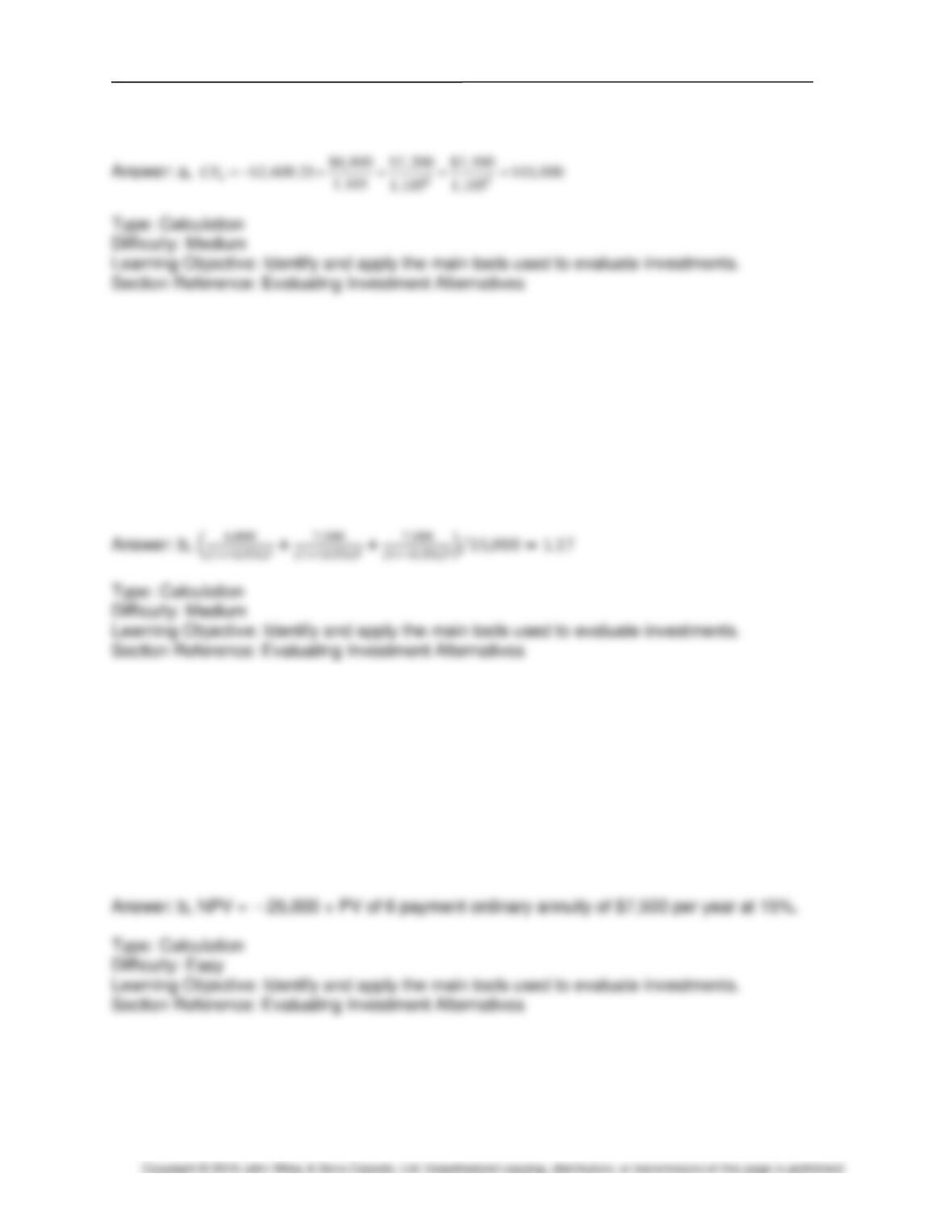
54. Suppose you have an opportunity to invest in a project, which is expected to generate
$6,800 in year 1, $7,200 in year 2, and $7,500 in year 3. The appropriate risk-adjusted discount
rate for the project is 10.5 percent. The project’s initial investment is $15,000. What is the
profitability index?
a) 1.29
b) 1.17
c) 0.85
d) 0.17
55. Suppose you have an opportunity to invest in a project, which requires an after-tax
incremental cash outlay of $25,000 today. The project is expected to generate after-tax cash
flows of $7,500 per year for the next six years. What is the project’s NPV if the appropriate
discount rate is 15 percent?
a) $141.16
b) $3,383.62
c) $7,641.63
d) $10,883.62
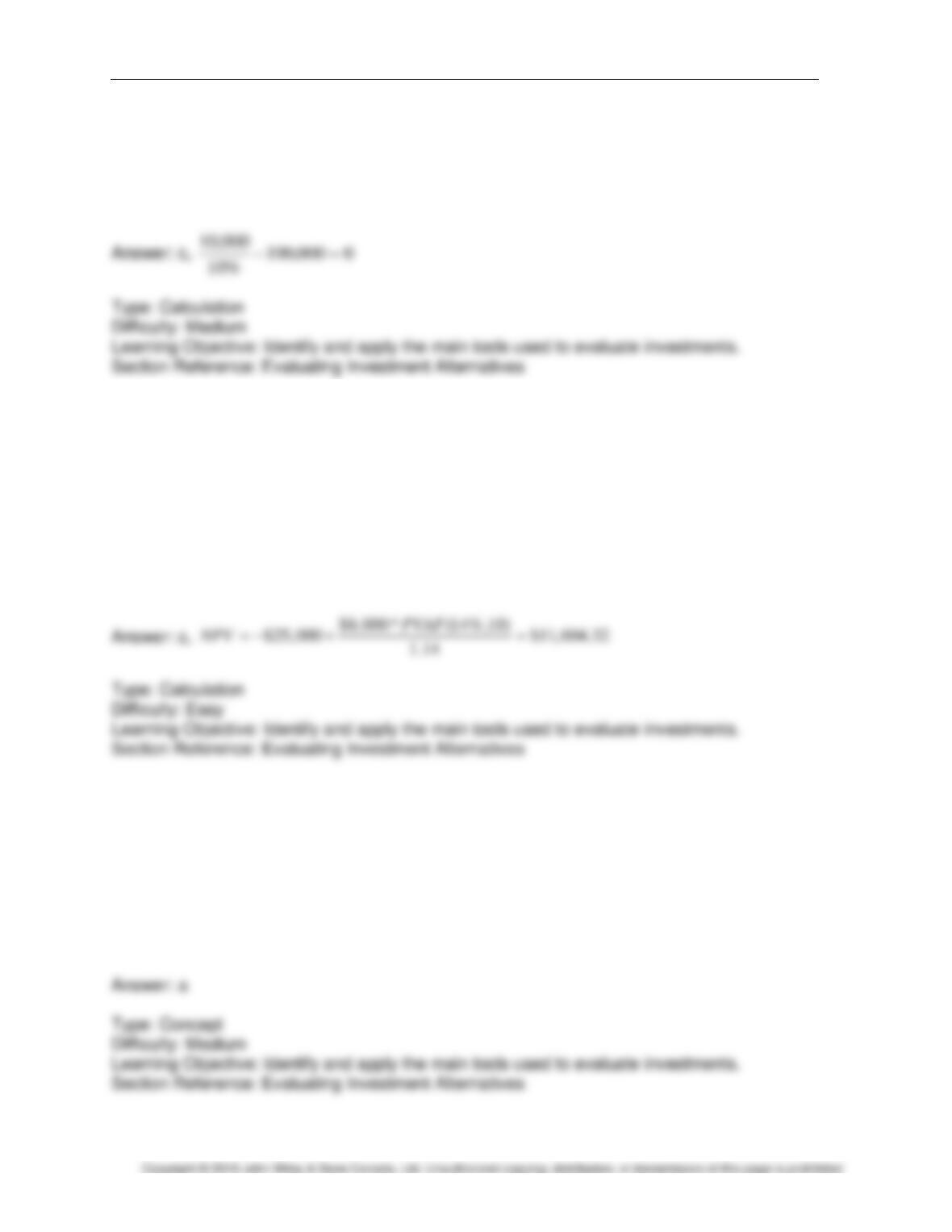
56. Consider a project that would change the way your company is doing business. Investing
$100,000 would save your company $10,000 a year forever. Calculate the NPV of this project if
the risk-adjusted rate is 10%.
Capital Budgeting, Risk Considerations, and Other Special Issues 13 – 22
a) $10,000
b) $100,000
c) $0
d) $ −90,000
57. Suppose you have an opportunity to invest in a project, which requires an after-tax
incremental cash outlay of $25,000 today. The project is expected to generate its first cash flow
of $8,000 two years from now, which will remain the same for a total of 10 years. What is the
project’s NPV if the appropriate discount rate is 14 percent?
a) $7,109.05
b) $9,236.48
c) $11,604.32
d) $16,728.93
58. Use the following statements to answer the question:
I. The IRR of a project that has a profitability index equal to 1 is equal to the risk-adjusted rate.
II. IRR and NPV results can be contradictory.
a) I and II are correct.
b) I and II are incorrect.
c) I is correct and II is incorrect.
d) I is incorrect and II is correct.
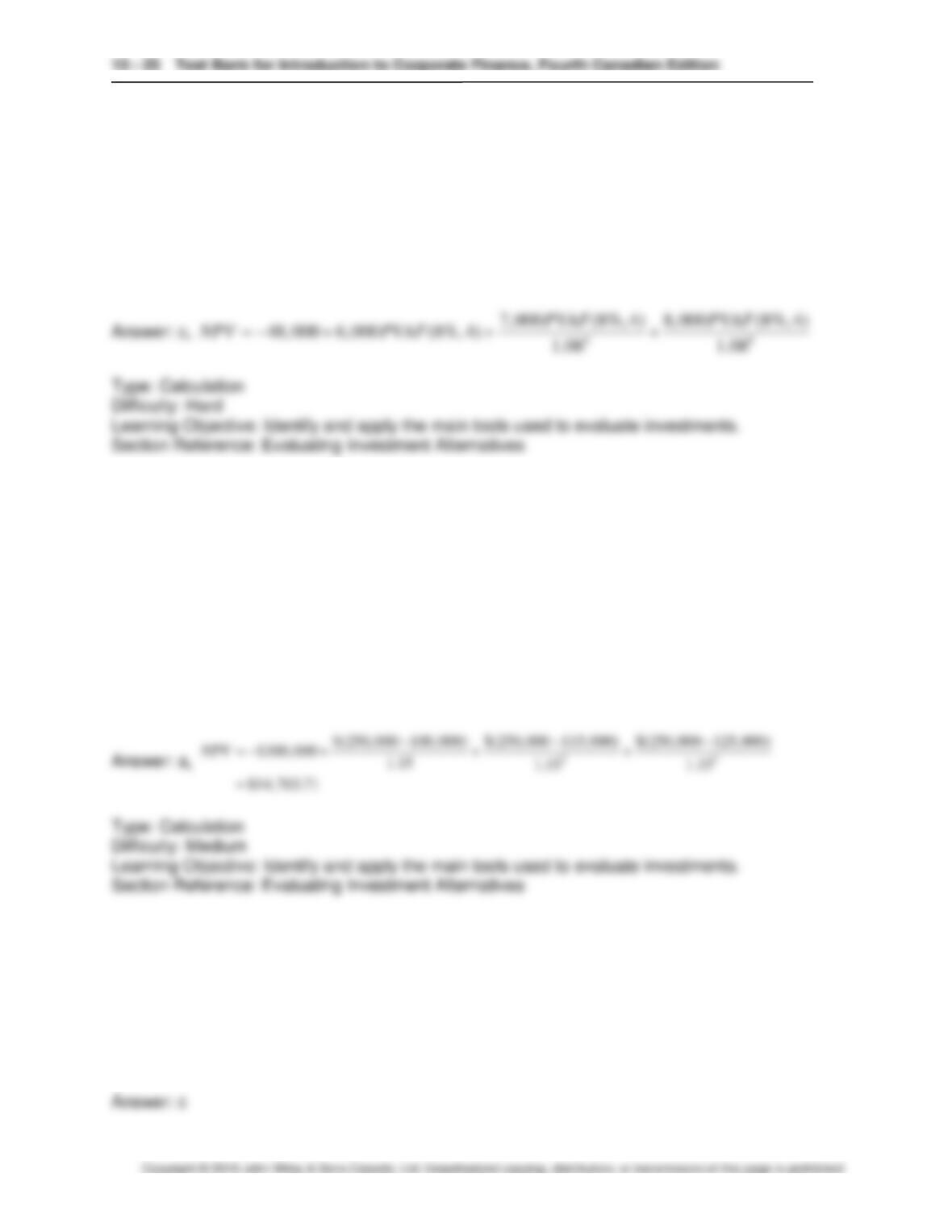
59. Consider a 12-year project that costs $48,000 today and will produce after-tax cash flows of
$6,000 each year for the first four years, $7,000 each year for the next four years, and $8,000
each year for the last four years. If the cost of capital is 8 percent, what is the project’s NPV?
a) –$30,092.41
b) $907.11
c) $3,229.86
d) $21,554.66
60. Vancouver Salmon Farm Inc.’s current operations will generate cash flows of $100,000 in
year one, $115,000 in year two, and $125,000 in year three. The company is considering a new
investment, which requires an immediate cash outlay of $300,000. With the new investment, the
company can instead expect to have cash flows of $250,000 per year for the next three years.
The appropriate discount rate is 15 percent. What is the incremental NPV of the new
investment?
a) $14,703.71
b) $65,439.36
c) $256,107.57
d) $270,806.28
61. What is the discounted payback period of a project whose profitability index is higher than
1?
a) Lower than 1
b) Higher than 1
c) Lower than the project life time
d) Higher than the project life time
62. What is the discounted payback period of a project whose NPV is positive?
a) Lower than 1
b) Higher than 1
c) Lower than the project life time
d) Higher than the project life time
63. Which of the following investment rules may not use all possible cash flows in its
calculations?
a) NPV
b) IRR
c) Payback
d) All of the above
64. What is the payback period of a project whose NPV is positive?
a) Lower than 1
b) Higher than 1
c) Lower than the project life time
d) Higher than the project life time
65. What is the project’s NPV if it requires an initial cash outlay of $50,000 and pays $8,000 per
year indefinitely? Assume the appropriate discount rate is 15 percent and the tax rate is zero.
a) –$3,623.19
b) $1,479.82
c) $3,333.33
d) $53,333.33
66. What is the IRR of a project that requires an initial cash outlay of $12,345 and is expected to
generate cash flows of $3,600 a year for three years and then $4,200 a year for two more
years? Assume the tax rate is zero.
a) 14.00%
b) 15.50%
c) 16.20%
d) 17.80%
67. Which of the following methods does not consider the time value of the money?
a) Net present value
b) Payback period
c) Internal rate of return
d) All of the above
Capital Budgeting, Risk Considerations, and Other Special Issues 13 – 26
68. Construct an investment opportunity ranking using the following information on four
independent projects using IRR:
Project CF0 Annual CF Project Life
I $4 million $1.1 million 5 years
II $8 million $2.8 million 4 years
III $7 million $2.1 million 5 years
IV $6 million $2.0 million 4 years
a) I, II, III, IV
b) II, III, IV, I
c) III, II, IV, I
d) IV, III, II, I
69. What is the IRR of a project that requires an investment of $9,900.39 today and will
generate $1,500 per year for ten years and an additional $10,000 at the end of the tenth year?
a) 8.37%
b) 11.75%
c) 14.43%
d) 15.20%
70. A company is considering two mutually exclusive projects Adept and Boffo. Project Adept
requires an initial investment of $100,000 and is expected to generate after-tax cash flows of
$45,000 per year for three years. Project Boffo requires an initial investment of $150,000 and is
expected to generate after-tax cash flows of $50,000 per year for four years. The appropriate
13 – 27 Test Bank for Introduction to Corporate Finance, Fourth Canadian Edition
discount rate is 10 percent. What is the crossover rate for projects Adept and Boffo?
a) 4.06%
b) 7.77%
c) 12.59%
d) 16.65%
71. Suppose project Acquisition and project Merger are mutually exclusive. Project Acquisition
requires an initial cash outlay of $50,000 and is expected to provide after-tax cash flows of
$15,000 in year 1, $25,000 in year 2, $20,000 in year 3, and $15,000 in year 4. Project Merger
requires an initial cash outlay of $75,000 and is expected to provide after-tax cash flows of
$20,000 in year 1, $28,000 in year 2, $35,000 in year 3, and $20,000 in year 4. The appropriate
discount rate is 12 percent. What is the crossover rate?
a) 4.30%
b) 4.87%
c) 13.72%
d) 18.59%
72. Consider a project that requires an investment of $28,000 today and generates after-tax
cash flows of $10,000 per year for the next four years. The appropriate discount rate is 15
Capital Budgeting, Risk Considerations, and Other Special Issues 13 – 28
percent. What are the project’s NPV and IRR?
a) NPV = –$264.37; IRR = 14.85%
b) NPV = $335.92; IRR = 15.34%
c) NPV = $549.78; IRR = 15.97%
d) NPV = $738.26; IRR = 16.13%
73. Consider a five-year project that costs $20,000 today, which is expected to generate $6,000
at the end of the second year and then the cash flows will increase by $1,000 per year for each
of the subsequent years. The cost of capital is 8 percent. What are the project’s NPV and IRR?
a) NPV = $1,083.24; IRR = 8.96%
b) NPV = $2,706.35; IRR = 11.93%
c) NPV = $3,824.56; IRR = 14.87%
d) NPV = $4,522.85: IRR = 17.09%
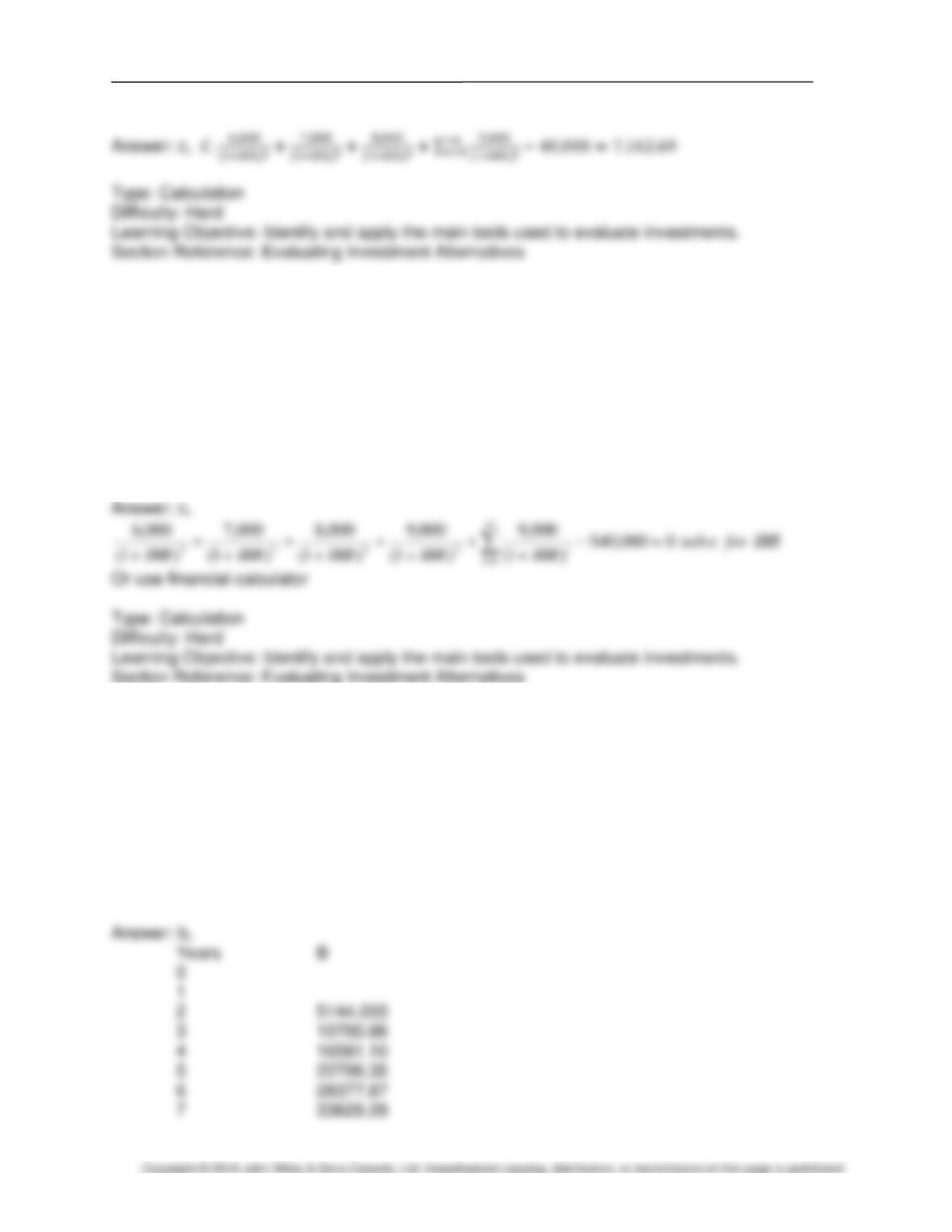
74. Consider a ten-year project that costs $40,000 today, which is expected to generate $6,000
at the end of the second year and then the cash flows will increase by $1,000 for three years
and then stagnate for the rest of the project life. The cost of capital is 8 percent. What is the
project’s NPV?
a) $14,897.61
b) $12,718.24
c) $7,162.69
d) $3,764.73
13 – 29 Test Bank for Introduction to Corporate Finance, Fourth Canadian Edition
75. Consider a ten-year project that costs $40,000 today, which is expected to generate $6,000
at the end of the second year and then the cash flows will increase by $1,000 for three years
and then stagnate for the rest of the project life. The cost of capital is 8 percent. What is the
project’s IRR?
a) 14.04%
b) 13.85%
c) 11.17%
d) 9.74%
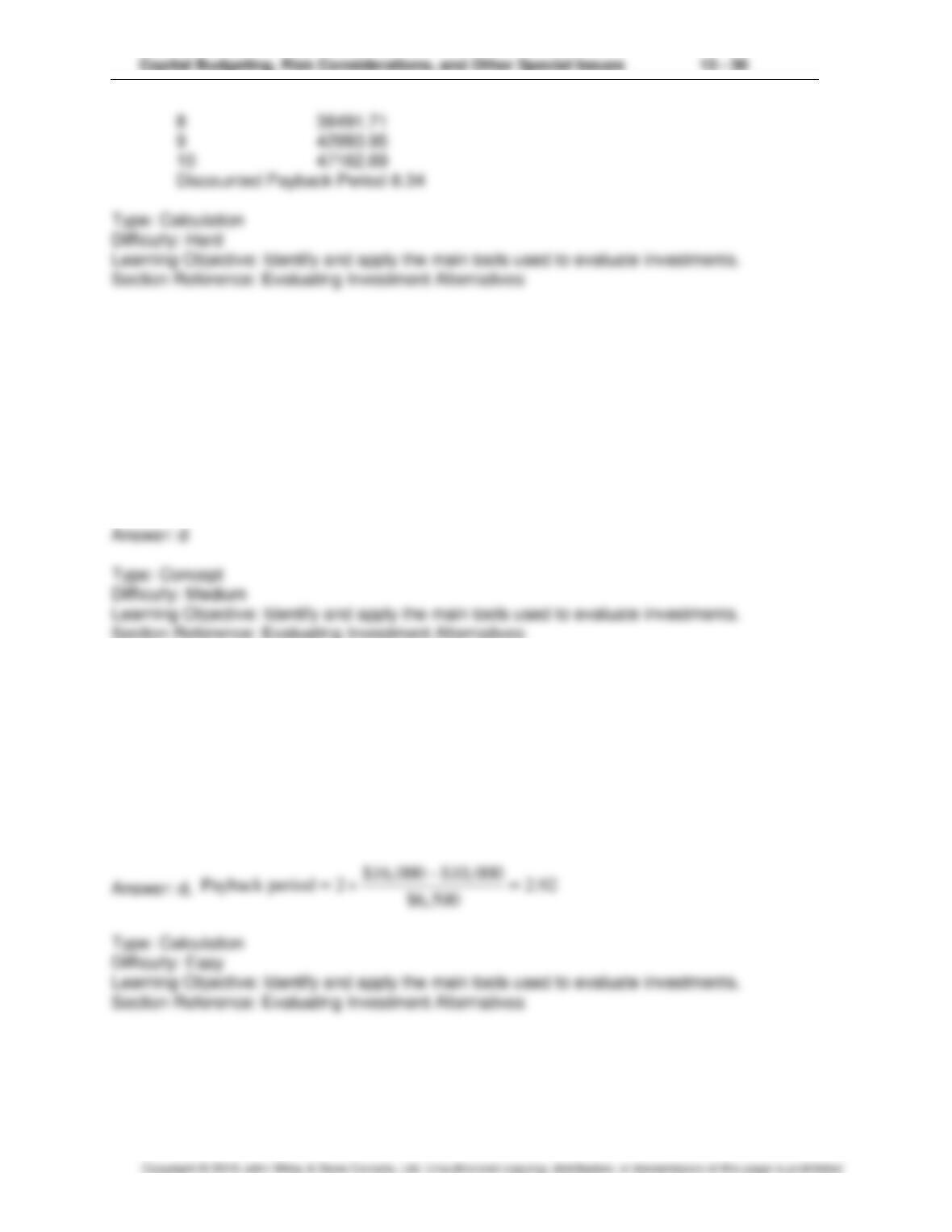
76. Consider a ten-year project that costs $40,000 today, which is expected to generate $6,000
at the end of the second year and then the cash flows will increase by $1,000 for three years
and then stagnate for the rest of the project life. The cost of capital is 8 percent. What is
discounted payback period?
a) 8.99 years
b) 8.34 years
c) 7.71 years
d) 7.17 years
77. Use the following statements to answer this question:
I. The payback period is always longer than the discounted payback period.
II. Both the discounted payback and payback period ignore cash flows beyond the cut-off
period.
a) I and II are correct.
b) I and II are incorrect.
c) I is correct and II is incorrect.
d) I is incorrect and II is correct.
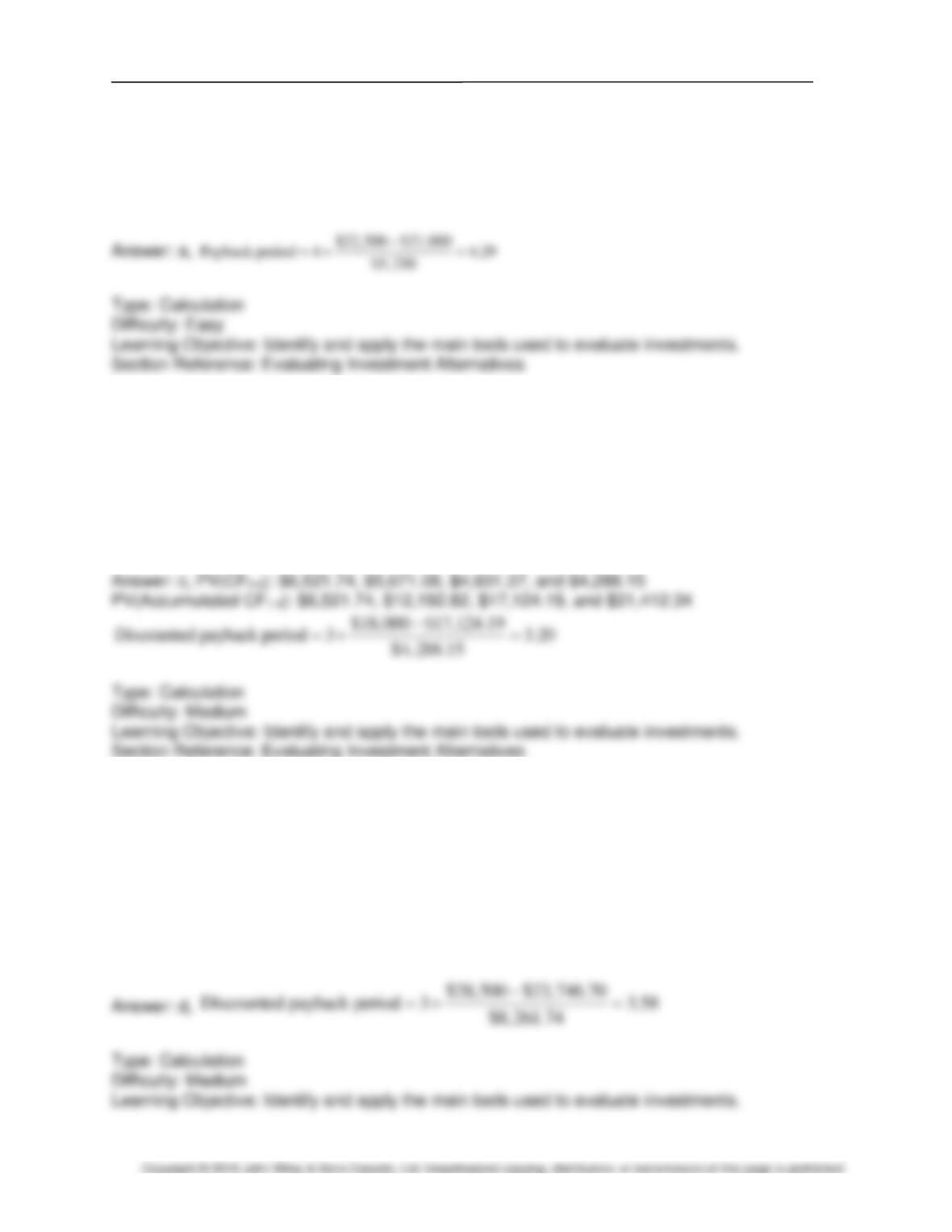
78. What is the payback period of a project that requires an initial cash outlay of $16,000 and
provides cash flows of $4,500 in year 1, $5,500 in year 2, $6,500 in year 3, and $7,500 in year
4? Assume the appropriate discount rate is 10 percent.
a) 2.08 years
b) 2.36 years
c) 2.68 years
d) 2.92 years
79. Consider a project that requires an investment of $22,500 today and pays $5,250 per year
for ten years. What is the payback period of the project? Assume the cost of capital is 12
percent.
13 – 31 Test Bank for Introduction to Corporate Finance, Fourth Canadian Edition
a) 4.29 years
b) 4.52 years
c) 4.71 years
d) 4.93 years
80. What is the discounted payback period of a five-year project that costs $18,000 today and
pays an annual cash flow of $7,500? Assume the cost of capital is 15%.
a) 2.40 years
b) 3.12 years
c) 3.20 years
d) 3.80 years
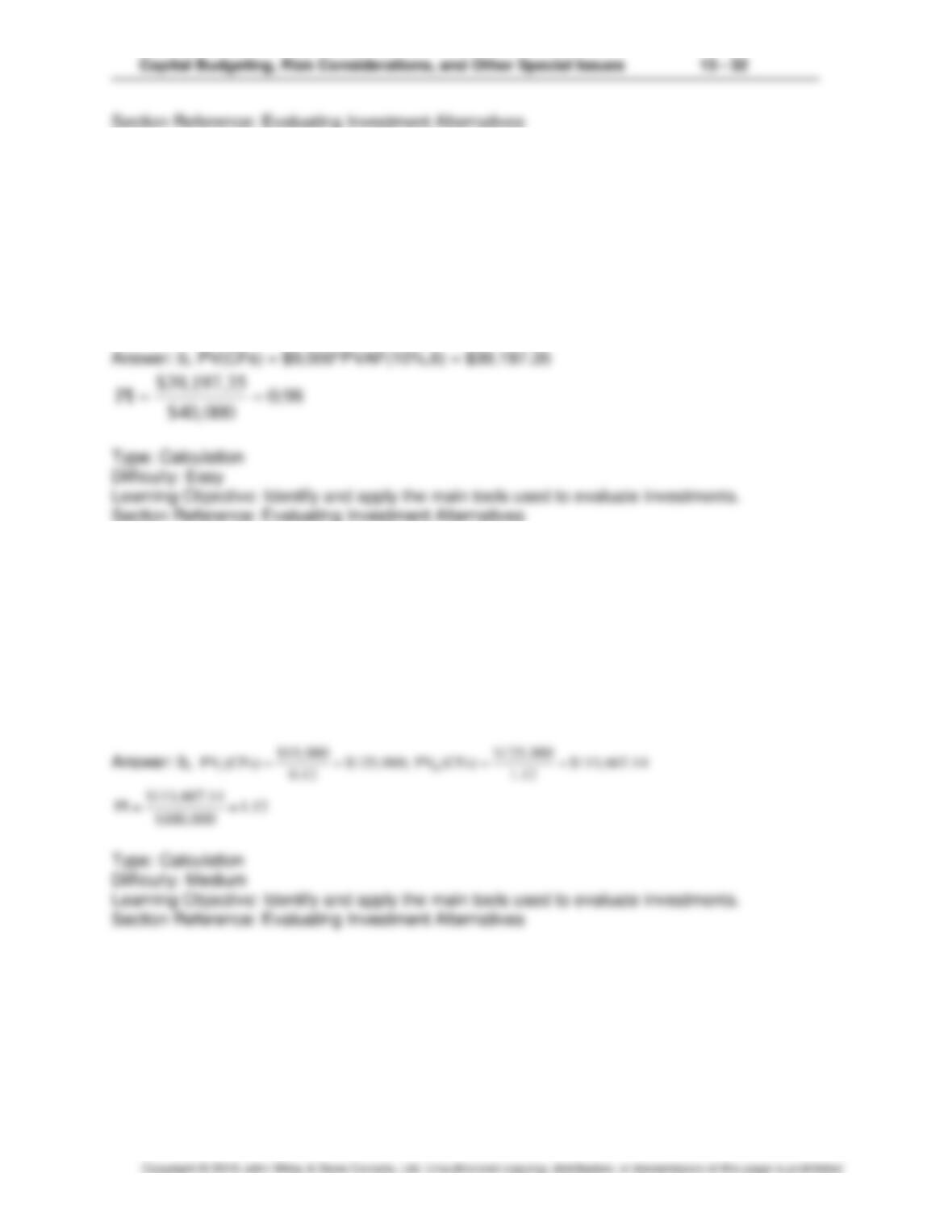
81. Consider an investment opportunity that requires an initial cash outlay of $28,500 and
provides cash flows of $8,500 in year 1, $10,000 in year 2, $11,500 in year 3, and $13,000 in
year 4. The cost of capital is 12 percent. What is the discounted payback period of the project?
a) 2.87 years
b) 3.37 years
c) 3.42 years
d) 3.58 years
82. Suppose a project requires an after-tax incremental cash outflow of $40,000 today. The
project is expected to generate after-tax cash inflows of $9,000 per year for the next six years.
What is the project’s PI if the appropriate discount rate is 10 percent?
a) 0.92
b) 0.98
c) 1.03
d) 1.11
83. Consider a project that requires an immediate cash outflow of $100,000 and provides a
perpetual annual inflow of $15,000 starting two years from today. The cost of capital is 12
percent. What is the project’s PI?
a) 1.04
b) 1.12
c) 1.25
d) 1.33
84. Rank the following projects by their PIs in descending order:
Project CF0 NPV
I $100,000 $12,345
II $125,000 $21,338
III $75,000 $10,467
IV $135,000 $24,680
13 – 33 Test Bank for Introduction to Corporate Finance, Fourth Canadian Edition
a) I, II, III, IV
b) II, III, I, IV
c) III, I, IV, II
d) IV, II, III, I
85. A company is considering four mutually exclusive projects A, B, C, and D. Project A requires
an initial investment of $100,000 and is expected to generate after-tax cash flows of $62,500
per year for two years. Project B requires an initial investment of $160,000 and is expected to
generate after-tax cash flows of $72,000 per year for three years. Project C requires an initial
investment of $125,000 and is expected to generate $45,000 per year for four years. Project D
requires an initial investment of $200,000 and is expected to generate after-tax cash flows of
$87,500 per year for three years. The appropriate discount rate is 10 percent. Rank the projects
by their PIs in descending order.
a) A, B, C, D
b) B, C, A, D
c) C, B, D, A
d) D, A, B, C
86. What is the PI of a project that requires an initial investment of $36,000 and pays $10,000 in
year 1, $18,000 in year 2, $15,000 in year 3, and $12,000 in year 4? Assume the discount rate
Capital Budgeting, Risk Considerations, and Other Special Issues 13 – 34
is 9 percent and the tax rate is zero.
a) 1.05
b) 1.16
c) 1.23
d) 1.38
87. Which of the following are NOT contingent projects?
a) Buying a truck and a trailer.
b) Selling canoes and paddles.
c) Manufacturing milk and butter.
d) Manufacturing baby food and apple sauce.
88. Contingent projects are
a) projects for which the acceptance of one requires the acceptance of another either
beforehand or simultaneously.
b) projects for which the acceptance of one requires the rejection of another either beforehand
or simultaneously.
c) all of the above.
89. The investment rule for contingent projects is:
a) to accept the projects only if all of the individual NPVs are positive.
b) to accept the projects even if all of the individual NPVs are negative.
c) to accept the projects only if the total NPV of all projects is positive.
d) to accept the projects even if the total NPV of all projects is negative.
90. Mutually exclusive projects with unequal lives can be compared by using the:
a) NPV approach
b) IRR approach
c) PI approach
d) chain replication approach
91. Which of the following statements is FALSE?
a) Contingent projects are projects for which the acceptance of one requires the acceptance of
another, either beforehand or simultaneously.
b) The chain replication approach is a way to compare projects with equal lives by finding a time
horizon into which all the project lives under consideration divide equally, and then assuming
each project repeats until it reaches this horizon.
c) The equivalent annual NPV approach is a way to compare projects by finding the NPV of the
individual projects, and then determining the amount of an annual annuity that is economically
equivalent to the NPV generated by each project over its respective time horizon.
d) Mutually exclusive projects require the firm to choose one project over another.
92. The equivalent annual NPV approach is used if:
a) the projects have the same life.
b) the projects have unequal lives.
c) all of the above
93. Use these statements to answer the following question:
I. Contingent projects are evaluated independently and should be accepted independently.
II. When considering contingent projects, all projects should have a positive NPV.
a) I and II are correct.
b) I and II are incorrect.
c) I is correct and II is incorrect.
d) I is incorrect and II is correct.
94. A company must choose between two mutually exclusive projects: Alpha and Bravo, to
enhance its current operations. Project Alpha requires a $12,000 cash outlay today and is
expected to generate after-tax cash flows of $6,000 in year 1, $6,500 in year 2, and $7,000 in
year 3. Project Bravo requires a $20,000 cash outlay today and is expected to generate after–
tax cash flows of $7,000 in year 1, $8,000 in year 2, $9,000 in year 3 and $8,000 in year 4. The
appropriate discount rate is 10 percent. Which project should the firm choose? Assume both
projects can be replicated.
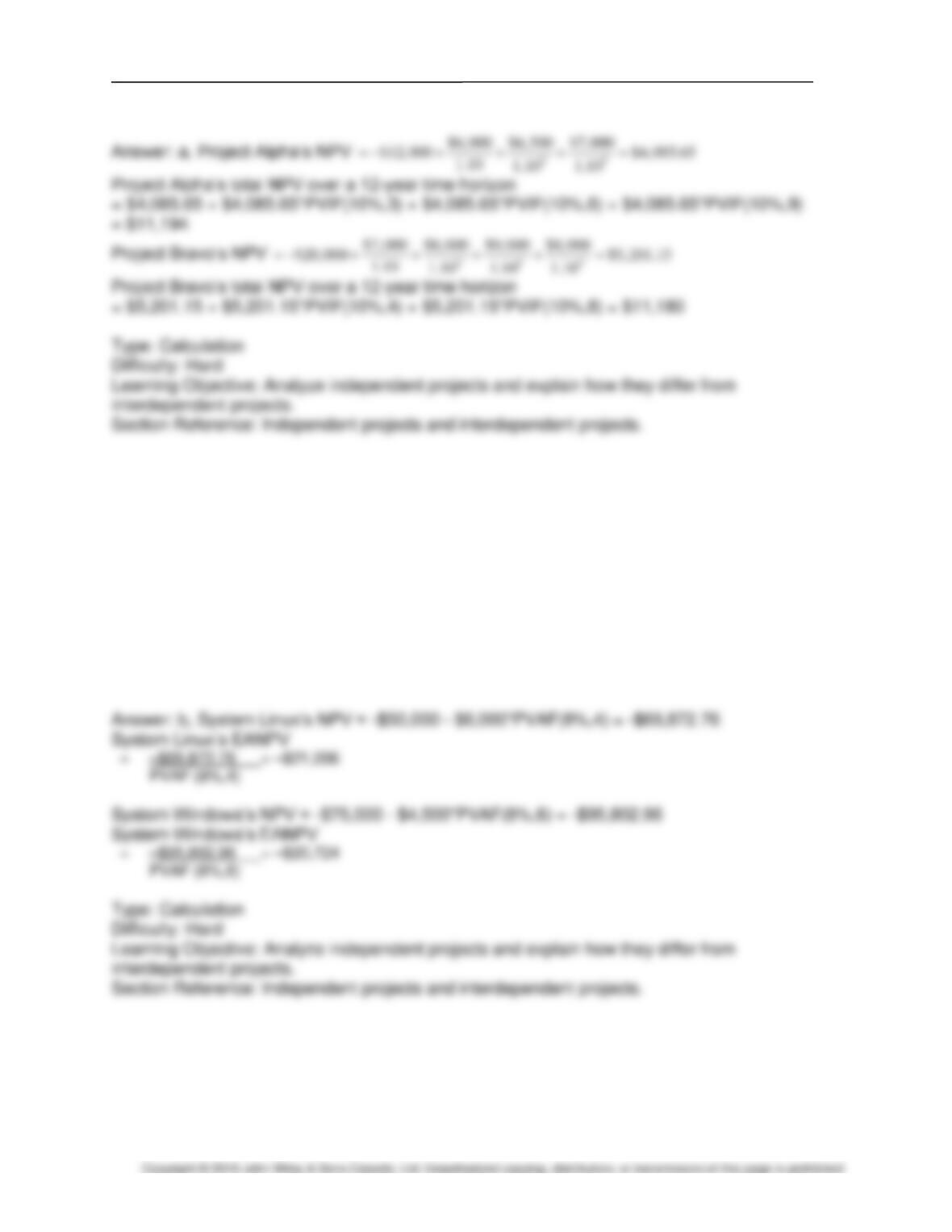
a) Total NPVAlpha=$11,194 > total NPVBravo=$11,180 over a 12-year time horizon, choose project
Alpha
b) Total NPVAlpha=$16,343 > total NPVBravo=$15,603 over a 12-year time horizon, choose project
Alpha
c) Total NPVBravo=$11,194 > total NPVAlpha=$11,180 over a 12-year time horizon, choose project
Bravo
d) Total NPVBravo=$16,343 > total NPVAlpha=$15,603 over a 12-year time horizon, choose project
Bravo
13 – 37 Test Bank for Introduction to Corporate Finance, Fourth Canadian Edition
95. A company must choose between two new computer operating systems: Linux and
Windows, to replace the existing system to support its ongoing operations. System Linux costs
$50,000 and requires annual maintenance costs of $6,000 during its four-year life. System
Windows costs $75,000 and requires annual maintenance cost of $4,500 during its six-year life.
The appropriate discount rate is 8 percent. Which system should the firm choose? Assume both
systems can be replicated.
a) EANPVL=–$21,096 > EANPVW=–$20,724, choose system Linux
b) EANPVL=–$21,096 > EANPVW=–$20,724, choose system Windows
c) EANPVL= –$9,096 > EANPVW= –$11,724, choose system Linux
d) EANPVL= –$9,096 > EANPVW= –$11,724, choose system Windows
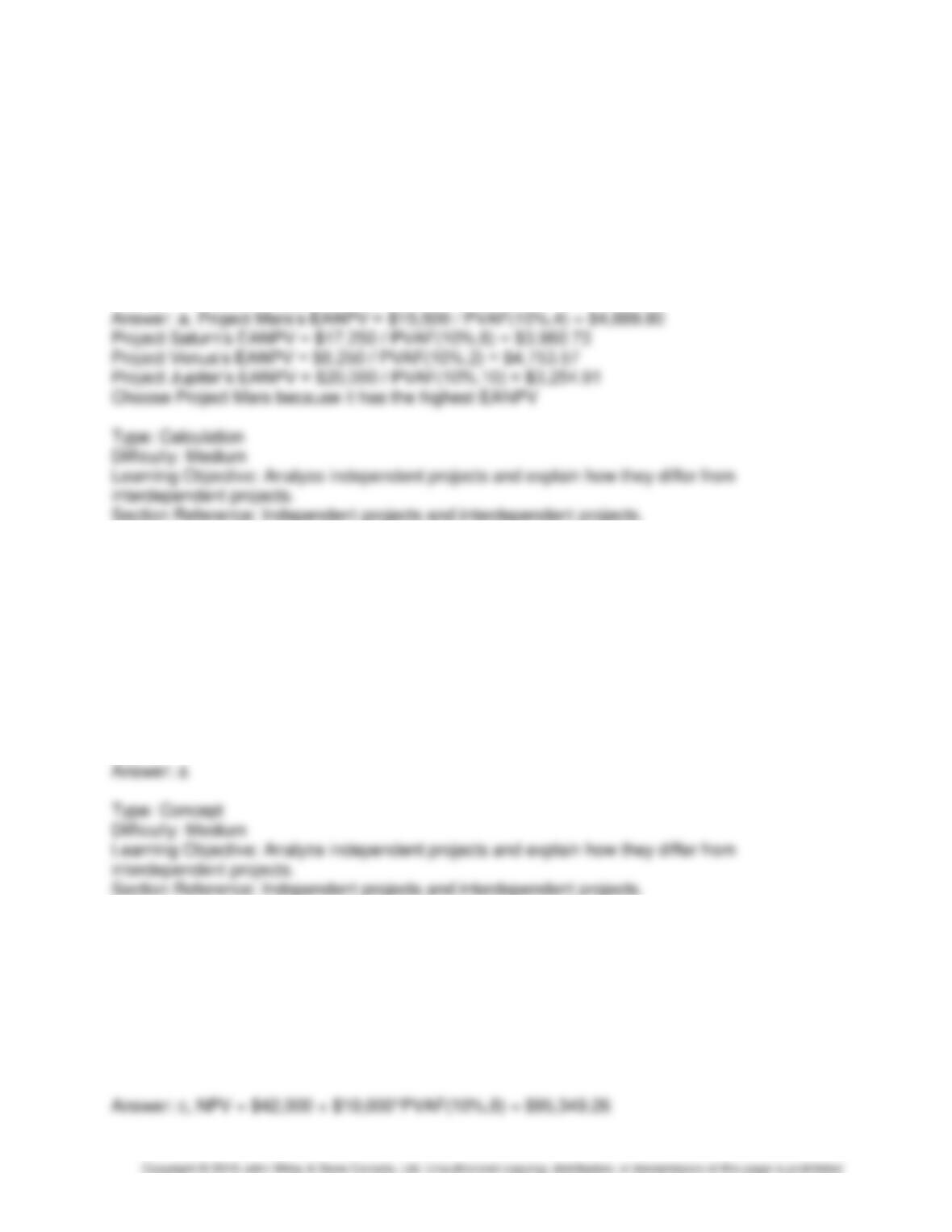
96. Suppose the following projects are mutually exclusive. Which project should be chosen if the
appropriate discount rate is 10 percent? Assume all projects can be replicated.
Project CF0 NPV Project Life
Capital Budgeting, Risk Considerations, and Other Special Issues 13 – 38
Mars $100,000 $15,500 4
Saturn $125,000 $17,250 6
Venus $75,000 $8,250 2
Jupiter $135,000 $20,000 10
a) Project Mars
b) Project Saturn
c) Project Venus
d) Project Jupiter
97. Use the following statements to answer this question:
I. The EANPV is effective in choosing between projects that have different life spans.
II. The IRR will lead to the same conclusion as EANPV if the two projects are not mutually
exclusive and the cash flows are conventional.
a) I and II are correct.
b) I and II are incorrect.
c) I is correct and II is incorrect.
d) I is incorrect and II is correct.
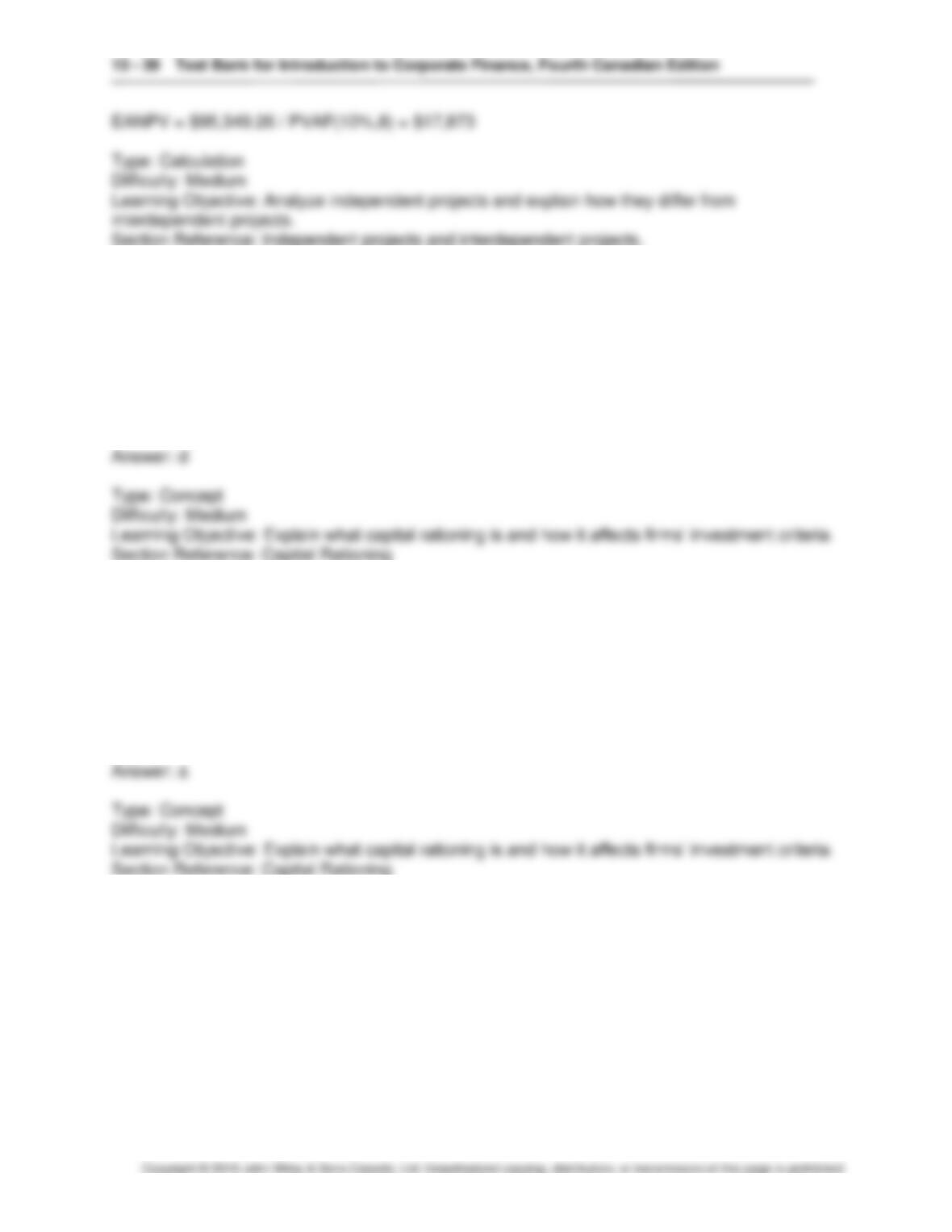
98. What is the EANPV of a project that requires an initial investment of $42,000 and costs
$10,000 per year for 8 years? Assume the discount rate is 10 percent and the tax rate is zero.
a) $2,127
b) $11,919
c) $17,873
d) $95,349
99. Which of the following is NOT true when a firm faces capital budget constraints?
a) Capital rationing prevails.
b) Independent projects that generate positive NPVs may not be accepted.
c) Investment capital must be rationed among available investment projects.
d) All the projects listed on its investment opportunity schedule until the IRR equals its WACC
will be accepted.
100. In the presence of capital rationing:
a) the cost of capital is no longer the appropriate opportunity cost.
b) firms can fully rely on either IRR or NPV as a criterion.
c) PIs are often useful to conclude on the optimal solution.
d) the investment decision should be based on which combination of projects generates the
highest total NPV, regardless of the cost of the investment.
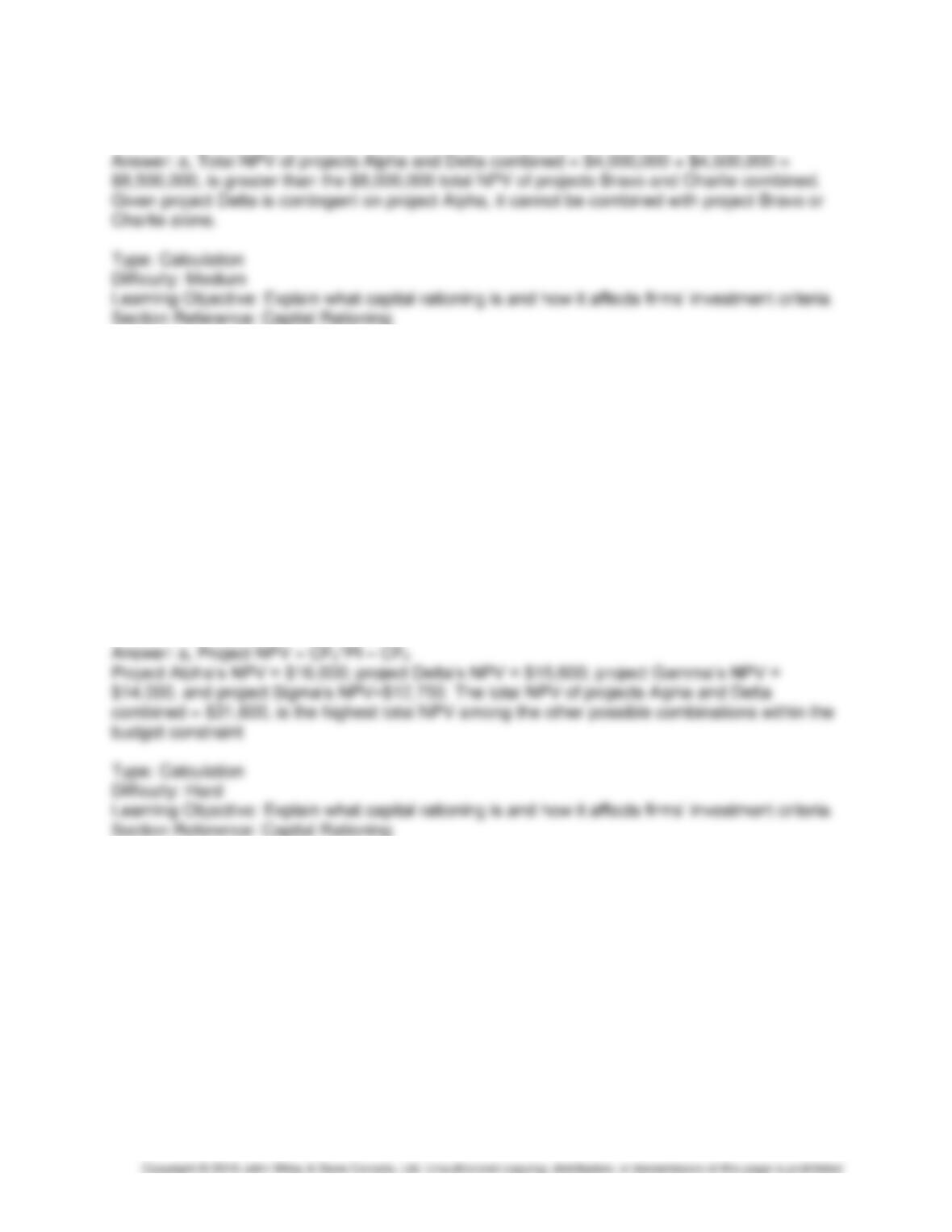
101. You must choose between the following projects. Project Alpha requires an initial
investment of $10 million and provides an NPV of $4 million. Project Bravo requires an
investment of $7 million and provides an NPV of $4 million. Project Charlie requires an
investment of $8 million and provides an NPV of $4 million. Project Delta, contingent on project
Alpha, requires an investment of $5 million and provides an NPV of $4.5 million. If you only
have $15 million in available capital, which projects will you select?
a) Projects Alpha and Delta
b) Projects Bravo and Charlie
c) Projects Bravo and Delta
Capital Budgeting, Risk Considerations, and Other Special Issues 13 – 40
d) Projects Charlie and Delta
102. A firm has set a budget constraint of $220,000 on new investments, which cannot be
exceeded. Given the following independent investments, which projects should the firm
undertake?
Project CF0 PI
Alpha $80,000 1.20
Delta $120,000 1.13
Gamma $140,000 1.10
Sigma $85,000 1.15
a) Projects Alpha and Delta
b) Projects Alpha and Gamma
c) Projects Alpha and Sigma
d) Projects Venus and Jupiter
103. A firm has set a budget constraint of $220,000 on new investments, which cannot be
exceeded. Given the following independent investments, what is the highest NPV that the firm
will get?
Project CF0 PI
Mars $80,000 1.20
Venus $120,000 1.13
Saturn $140,000 1.10
Jupiter $85,000 1.15
a) $ 31,600
b) $ 45,600
c) $ 28,750