13 – 41 Test Bank for Introduction to Corporate Finance, Fourth Canadian Edition
d) $ 28,350
104. A firm has set a budget constraint of $220,000 on new investments, which cannot be
exceeded. Given the following independent investments, which one of the following
combinations is part of the investment opportunity schedule?
Project CF0 PI
Mars $80,000 1.20
Venus $120,000 1.13
Saturn $140,000 1.10
Jupiter $85,000 1.15
a) Saturn and Venus
b) Mars and Jupiter
c) Mars and Venus
d) Saturn and Jupiter
105. A firm has set a budget constraint of $200,000 on new investments, which cannot be
exceeded. Given the following independent investments, what is the loss to the firm from the
capital rationing constraint?
Project CF0 NPV
Alpha $70,000 $9,238
Delta $50,000 $6,500
Gamma $150,000 $25,000
Sigma $80,000 $11,262
a) $15,738
b) $17,762
c) $20,500
d) $31,500
106. A firm has a budget constraint of $40 million to invest in new projects. Given the following
information on four independent projects, which projects should the firm undertake?
Project CF0 Annual CF k Project Life
Alpha $10 million $5 million 11% 3 years
Delta $15 million $6 million 13% 4 years
Gamma $25 million $7 million 10% 5 years
Sigma $30 million $8 million 12% 6 years
a) Projects Alpha and Delta
b) Projects Alpha and Gamma
c) Projects Alpha and Sigma
d) Projects Delta and Gamma
107. A firm has a budget constraint of $35 million to invest in new projects. Given the following
information on four independent projects, what is the loss to the firm from the capital rationing
constraint?
Project CF0 Annual CF k Project Life
Alpha $10 million $3 million 10% 6 years
Bravo $15 million $5 million 11% 5 years
Ceta $20 million $9 million 9% 3 years
Delta $25 million $8 million 8% 4 years
a) $4,278,667
b) $4,562,797
c) $5,847,434
d) $6,545,267
13 – 43 Test Bank for Introduction to Corporate Finance, Fourth Canadian Edition
108. The profitability index can be useful in:
a) ranking projects under capital rationing.
b) mutually exclusive projects.
c) all of the above.
109. Which of the following about a firm’s weighted average cost of capital (WACC) is FALSE?
a) It is the after-tax cost of the average dollar of long-term financing to the firm.
b) It is the appropriate discount rate to evaluate long-term investment projects.
c) It is the appropriate discount rate to evaluate typical investment projects.
d) It is the appropriate discount rate to evaluate atypical investment projects.
110. If a firm uses a constant WACC to select investments projects, it will:
a) always make appropriate decisions.
b) not accept negative NPV high-risk projects.
c) not reject positive NPV low-risk projects.
d) cause the market price of its debt and equity securities to decline.
111. Which of the following is NOT an approach to estimate risk-adjusted discount rates for an
atypical investment?
a) Estimating the weighted average cost of capital of firms in an industry associated with the
project.
b) Adjusting the firm’s cost of capital up or down based on the risk level and financing of the
project.
c) Estimating betas and the risk associated with the firm’s overall investments.
d) Estimating beta for the project by regressing the ROA of the project against the ROA of the
market index.
112. Use the following statements to answer these questions:
I. Everything else held constant, increasing the proportion of debt in the project would increase
the WACC.
II. A typical project of the company should be discounted using a risk-adjusted rate different
than the WACC.
a) I and II are correct.
b) I and II are incorrect.
c) I is correct and II is incorrect.
d) I is incorrect and II is correct.
113. Fussy Inc. is composed of two different divisions: food catering and shoe making. The
company’s overall WACC is 10 percent, while the WACC for the food catering division is 9
percent and for the shoe making division is 12 percent. What would happen if the company
used the overall WACC in the valuation of the following independent projects?
Project Industry CF0 Annual CF Project Life
I Food catering $400,000 $125,000 4 years
13 – 45 Test Bank for Introduction to Corporate Finance, Fourth Canadian Edition
II Shoe making $600,000 $150,000 6 years
III Shoe making $500,000 $135,000 5 years
IV Food catering $800,000 $170,000 6 years
a) Incorrectly accept project III and incorrectly reject project IV
b) Incorrectly accept projects II and III
c) Incorrectly reject project I and incorrectly accept project III
d) Incorrectly reject projects I and IV
114. Northwest Territories Holding Corporation is comprised of two different divisions: car rental
and furniture manufacturing. Two-thirds of the company’s business comes from the furniture
manufacturing division and the balance from the car rental division. The WACC for the car rental
division is 9 percent and for the furniture manufacturing division is 15 percent. What would
happen if the company used the overall WACC in the valuation of the following independent
projects?
Project Industry CF0 Annual CF Project Life
I Car rental $1 million $270,000 5 years
II Furniture manufacturing $3 million $765,000 6 years
III Car rental $2 million $510,000 6 years
IV Furniture manufacturing $4 million $1,500,000 4 years
a) Incorrectly accept project II and incorrectly reject project I.
b) Incorrectly accept projects II and IV.
c) Incorrectly reject projects I and III.
d) Incorrectly reject project III and incorrectly accept IV.
Capital Budgeting, Risk Considerations, and Other Special Issues 13 – 46
115. Rationing may be used to give an incentive to management to maximize the value of the
firm
a) True
b) False
116. Thunder Bay Entertainment Inc. has two separate divisions: DVD rental and sporting
goods. The beta of the entire company is 1.25. The beta of the DVD rentals division is 0.8 and
the beta of the sporting goods division is 1.5. The risk-free rate is 4 percent and the market risk
premium is 7.5 percent. Which of the following independent projects should the company
undertake?
Project Industry CF0 Perpetual annual CF
I Sporting goods $150,000 $25,000
II Sporting goods $200,000 $30,000
III DVD rental $50,000 $6,000
IV DVD rental $80,000 $7,500
a) Projects I and II
b) Projects I and III
c) Projects II and IV
d) Projects III and IV
117. Toronto Skaters Corporation has no budget constraint on new investments. The risk-free
rate is 2 percent and the market risk premium is 6 percent. Which of the following independent
projects should the firm undertake?
Project Beta CF0 Annual CF Project Life
Tango 0.8 $80,000 $30,000 4
Foxtrot 1.2 $120,000 $32,000 5
Zulu 1.5 $60,000 $35,000 2
Whiskey 0.9 $150,000 $65,000 3
a) Projects Tango and Zulu
b) Projects Whiskey and Zulu
c) Projects Foxtrot and Zulu
d) Projects Tango, Foxtrot, and Whiskey
118. Use the following two statements to answer this question:
I. Portfolio flows are investments in financial securities and in companies by firms.
II. Foreign direct investments include investments in real assets.
a) I and II are correct.
b) I and II are incorrect.
c) I is correct, II is incorrect.
d) I is incorrect, II is correct.
119. The most important aspect of international capital budgeting is:
a) the impact of foreign currency on the cash flows of the project.
b) the impact of political risk.
c) none of the above because the NPV model does not apply to international projects.
d) a and b.
120. Which of the following is the best answer for a reason(s) that firms make foreign
investments?
a) They want to enter new markets.
b) They want to have access to new technology.
c) They want to take advantage of cheaper resources.
d) All of the above
121. Use the following statements to answer this question:
I. The fact that Export Development Corporation of Canada (EDC) provides an insurance
against political risk lowers the cost of capital for the firm.
II. Foreign direct investments are priced the same way as domestic investments.
a) I and II are correct.
b) I and II are incorrect.
c) I is correct and II is incorrect.
d) I is incorrect and II is correct.
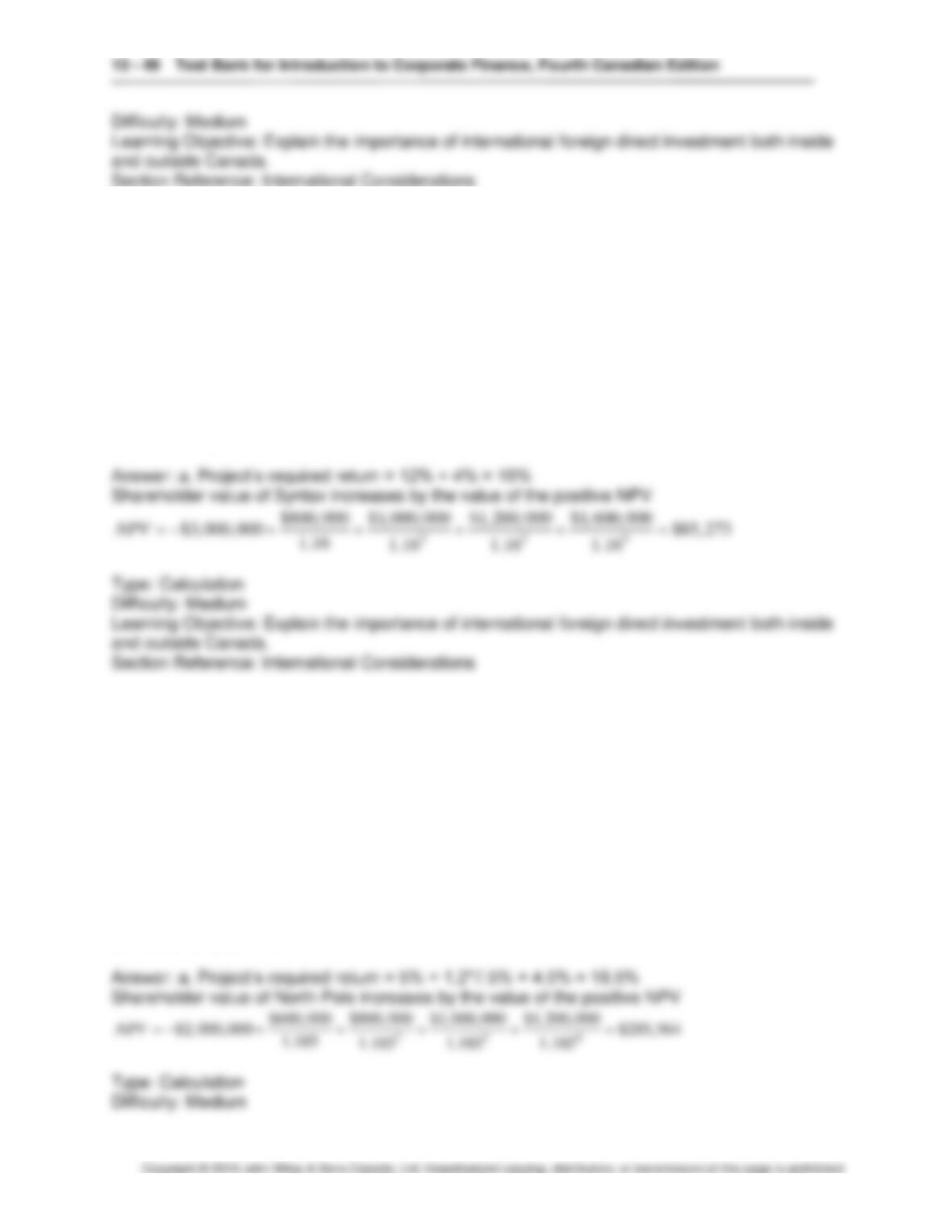
122. Syntax Tar Sand Inc., a Canadian company, has an opportunity to invest in Peru. The
project requires an immediate cash outlay of $3 million and is expected to provide after-tax cash
flows of $800,000 in year 1, $1,000,000 in year 2, $1,200,000 in year 3, and $1,600,000 in year
4. The appropriate discount rate for a similar project in Canada is 12 percent. The risks of
implementing such a project in Peru will require a risk premium of 4 percent. What will be the
impact on the shareholder value of Syntax if the firm undertakes this project in Peru?
a) Increase by $85,273
b) Increase by $382,445
c) Increase by $3,085,273
d) Increase by $3,382,445
123. North Pole Inc., a Canadian company, has an opportunity to invest in India. The project
requires an immediate cash outlay of $2 million and is expected to provide after-tax cash flows
of $600,000 in year 1, $800,000 in year 2, $1,000,000 in year 3, and $1,200,000 in year 4. The
beta for a similar project in Canada is 1.2. The risk-free rate is 5 percent and the market risk
premium is 7.5 percent. The risks of implementing such a project in India will require a risk
premium of 4.5 percent. What will be the impact on the shareholder value of North Pole Inc. if
the firm undertakes this project?
a) Increase by $285,564
b) Increase by $527,358
c) Increase by $616,918
d) Increase by $917,295
124. Export Development Corporation of Canada (EDC) offers political risk insurance (PRI)
against:
a) breach of contract risk.
b) expropriation risk.
c) risk of non-payment by a sovereign obligor.
d) all of the above.
125. What improvement does MIRR represent over traditional IRR?
a) It relaxes the assumption that cash flows are reinvested at the cost of capital.
b) It relaxes the assumption that cash flows are reinvested at IRR.
c) It always gives the same accept/reject decision as IRR.
d) It always gives the same accept/reject decision as NPV.
126. In project valuation, one should accept the project if the MIRR is less than the cost of
capital.
a) True
b) False
c) Need additional information
13 – 51 Test Bank for Introduction to Corporate Finance, Fourth Canadian Edition
127. The MIRR method is better than the IRR method because:
a) the cash flows from the project are explicitly reinvested at the cost of capital
b) it eliminates the possibility to have multiple IRRs
c) it ranks the projects using dollar values
d) none of the above
e) a and b
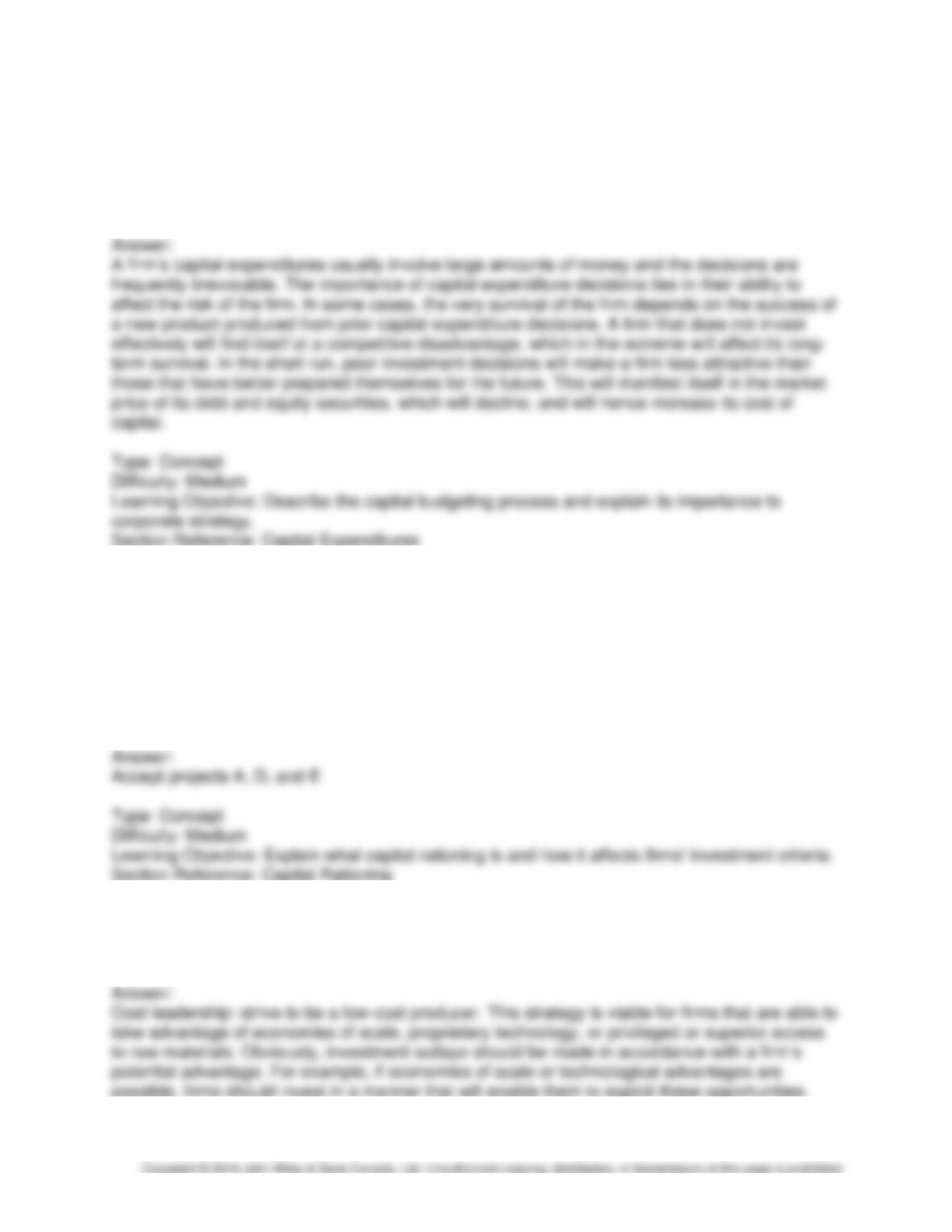
128. Project X has a project with cost of capital of 8 percent, initial cost of $1,000, and annual
after-tax cash flow of $450 for 3 years. Cash flow is reinvested at 8 percent. What are the IRR
and MIRR, respectively?
a) 16.65% and 13.47%
b) 13.47% and 16.65%
c) 16.65% and 16.65%
d) 16.65% and 10.52%
Capital Budgeting, Risk Considerations, and Other Special Issues 13 – 52
PRACTICE PROBLEMS
129. Explain why capital expenditures can be viewed as the most important decisions a firm can
make.
130. The following table gives the available projects for a firm.
A B C D E
Initial Investment 10 13 6 7 2
NPV 3.5 –2 0.5 6 3
The firm has only $20 million to invest. Which project(s) will be accepted?
131. Michael Porter argues that firms can create competitive advantages for themselves by
adopting one of two strategies. Explain what they are.