13 – 53 Test Bank for Introduction to Corporate Finance, Fourth Canadian Edition
132. Why is the NPV rule a better choice than the IRR rule to rank projects?
133. Under what circumstances will the IRR method of project evaluation conflict with the NPV
method?
134. Under what conditions will the NPV be a better capital budgeting criterion than the PI?
135. What are project interdependencies?
136. Differentiate between projects that are mutually exclusive and projects that are contingent
upon each other.
137. When a business faces capital rationing, what discount rate is used and why?
138. In a capital rationing situation, should firms always accept the project with the highest
NPV?
139. Name the five practical difficulties that firms may encounter in applying the NPV evaluation
process to foreign direct investments.
140. How do firms manage foreign exchange risk arising from their foreign direct investments?
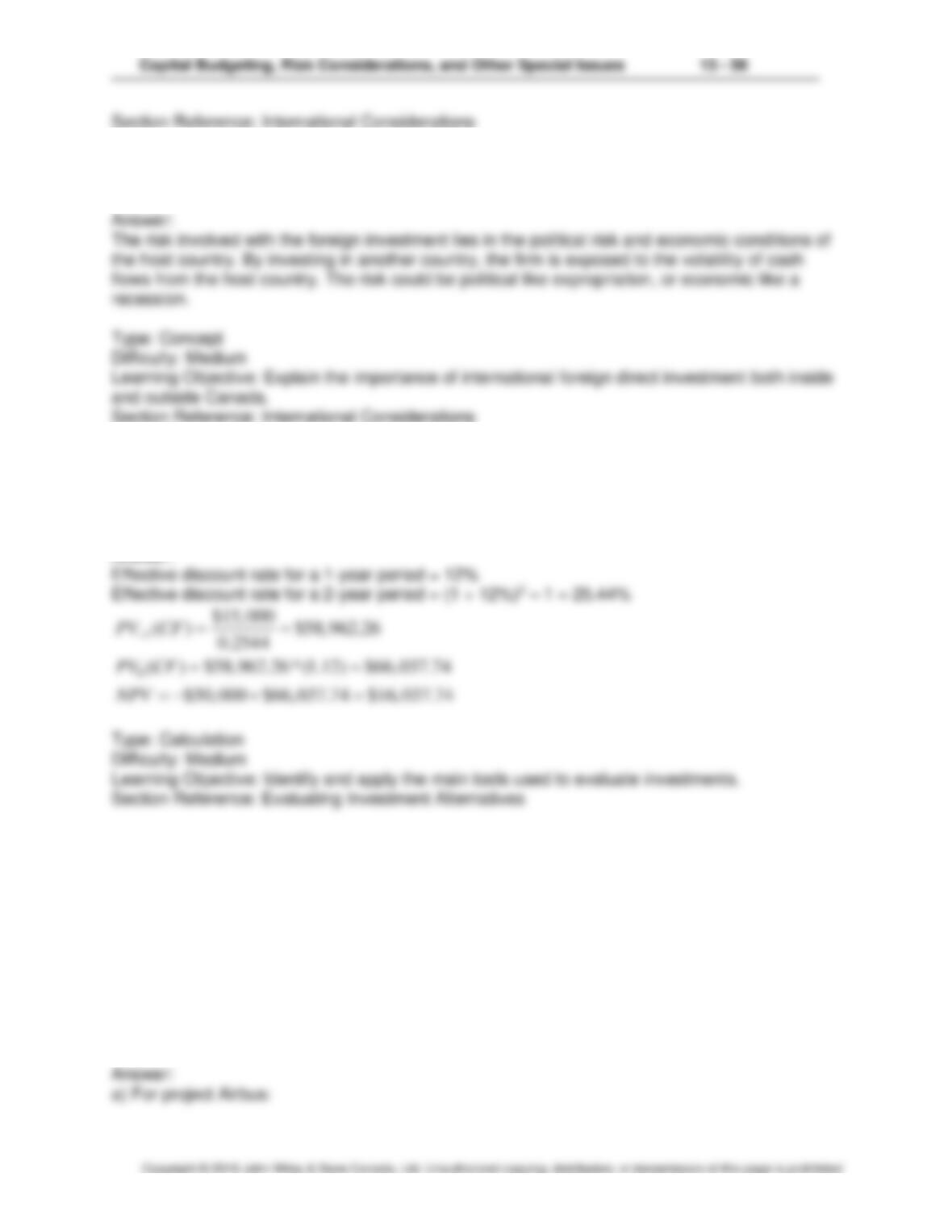
141. What are the sources of risk in foreign direct investments?
142. What is a project’s NPV if it requires an initial cash outlay of $50,000 and pays $15,000
every other year forever, with the first payment occurring one year from now? Assume the
discount rate is 12 percent and the tax rate is zero.
Answer:
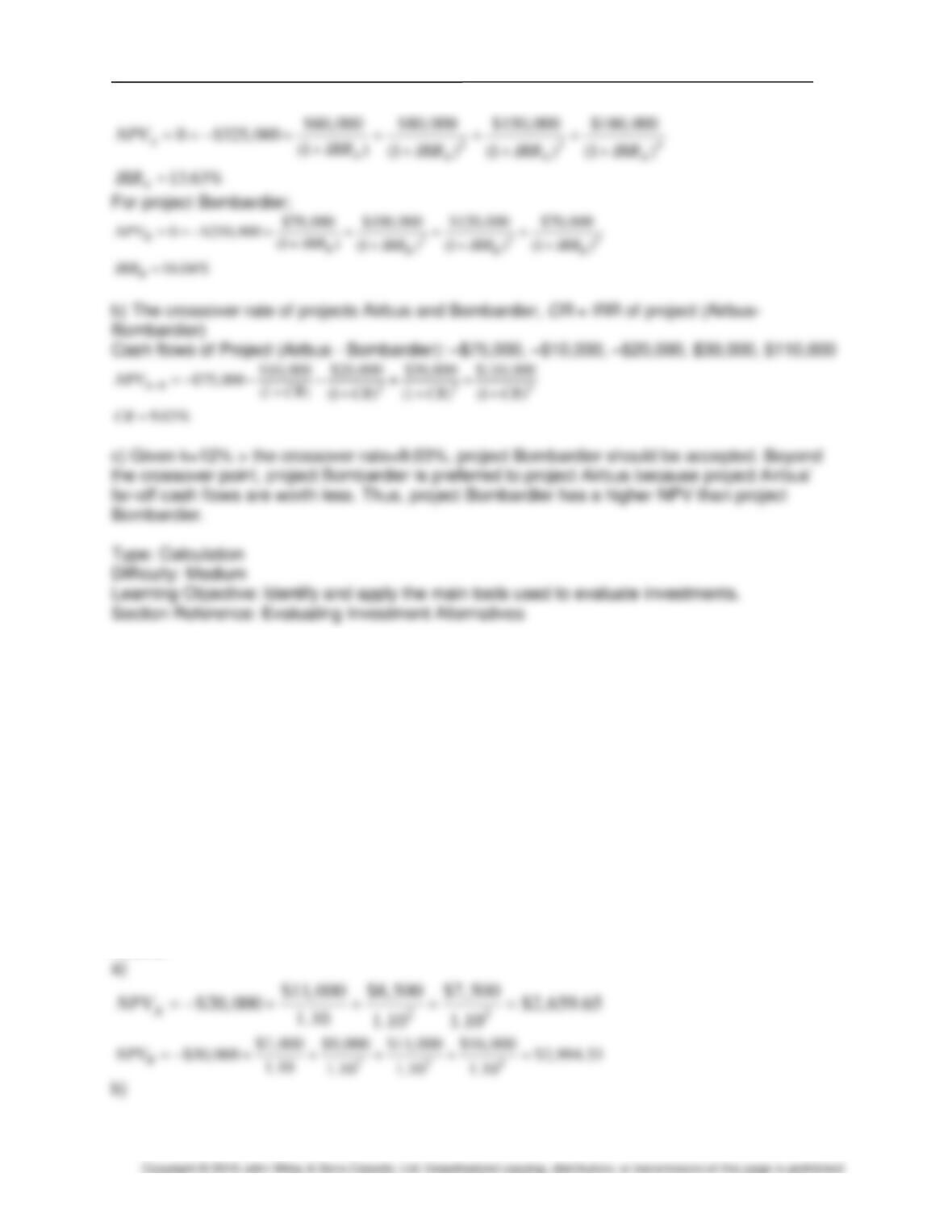
143. Suppose Canadian Space Flight Group has two mutually exclusive projects: space flight
using an Airbus and space flight using a Bombardier aircraft. Project Airbus requires an initial
cash outlay of $325,000 and is expected to provide after-tax cash flows of $60,000 in year 1,
$80,000 in year 2, $150,000 in year 3, and $180,000 in year 4. Project Bombardier requires an
initial cash outlay of $250,000 and is expected to provide after-tax cash flows of $70,000 in year
1, $100,000 in year 2, $120,000 in year 3, and $70,000 in year 4. The appropriate discount rate
is 12 percent.
a) Find the IRRs of both projects.
b) Find the crossover rate of the two projects.
c) Which project should be accepted using the information in (B)? Why?
13 – 57 Test Bank for Introduction to Corporate Finance, Fourth Canadian Edition
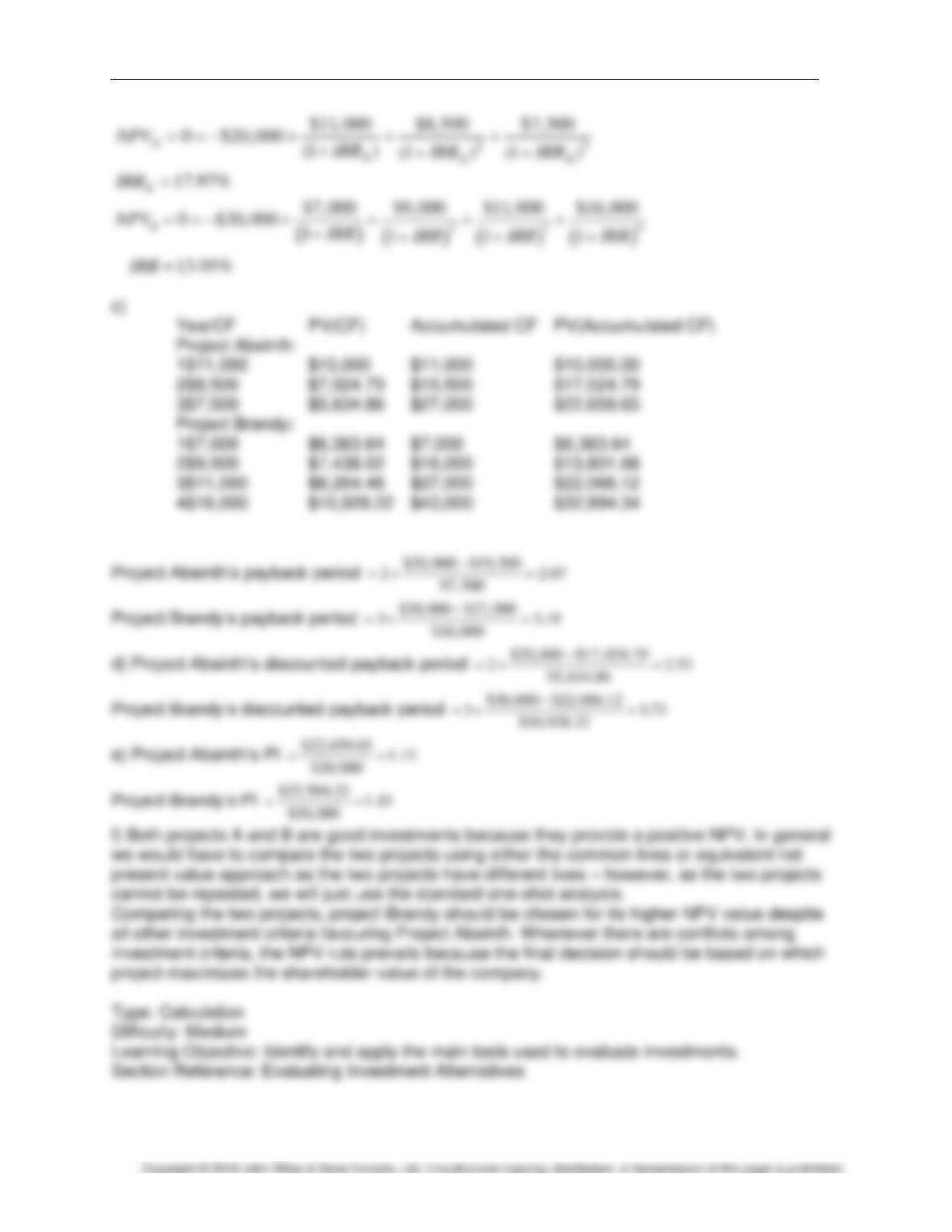
144. Newfoundland Vintners Co-operative is considering two mutually exclusive projects:
Absinth and Brandy. Project Absinth requires a $20,000 cash outlay today and is expected to
generate after-tax cash flows of $11,000 in year 1, $8,500 in year 2, and $7,500 in year 3.
Project Brandy requires a $30,000 cash outlay today and is expected to generate after-tax cash
flows of $7,000 in year 1, $9,000 in year 2, $11,000 in year 3, and $16,000 in year 4. Neither
project can be repeated at the end of its life. The appropriate discount rate for both projects is
10 percent.
a) Calculate the NPV of both projects.
b) Calculate the IRR of both projects.
c) Calculate the payback periods of both projects.
d) Calculate the discounted payback periods of both projects.
e) Calculate the profitability index of both projects.
f) Which project should the firm choose using the information in (A) – (E)? Why?
Answer:
Capital Budgeting, Risk Considerations, and Other Special Issues 13 – 58
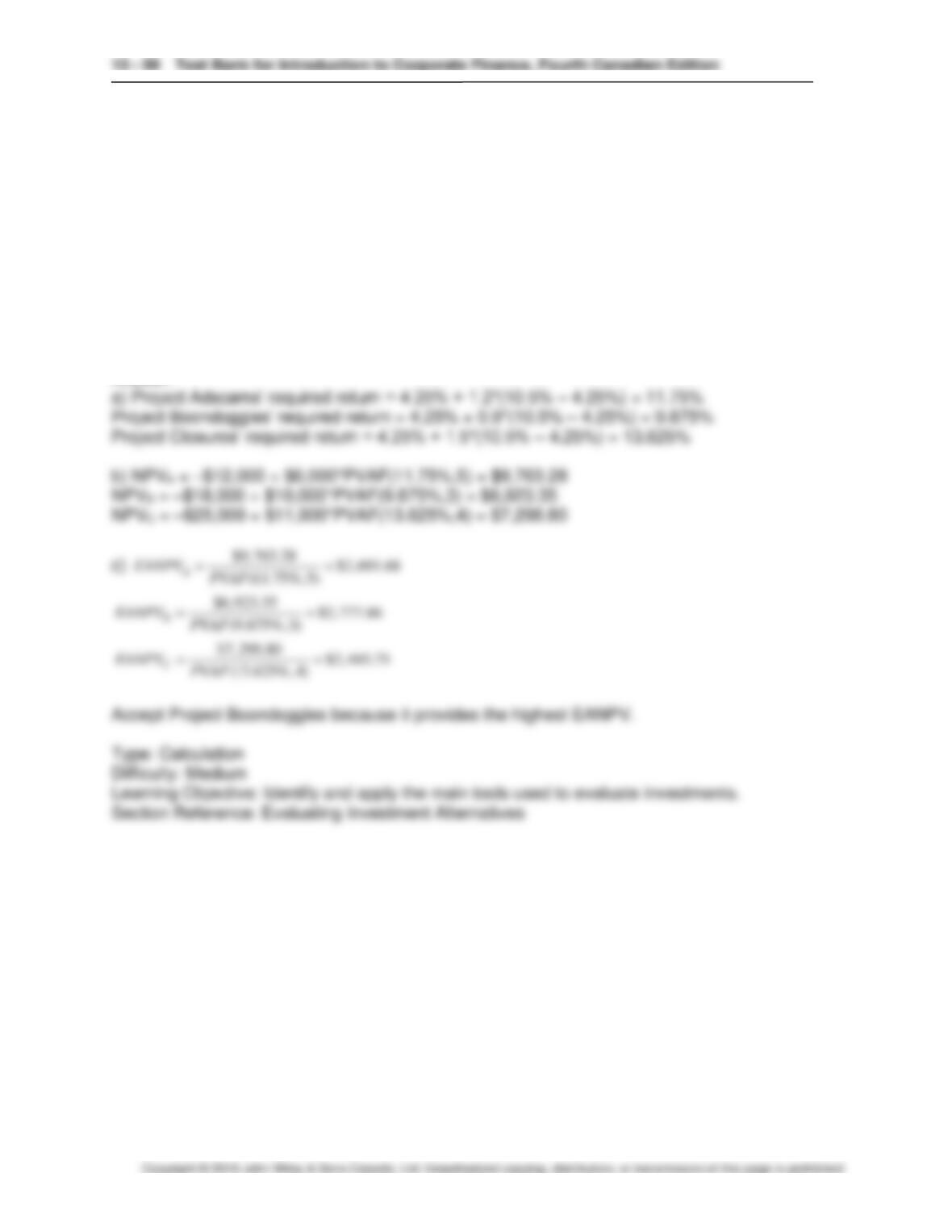
145. The Spinning Politician Company is considering three mutually exclusive projects:
Adscams, Boondoggles, and Closures. Project Adscams requires an initial investment of
$12,000 and is expected to generate after-tax cash flows of $6,000 per year for five years.
Project Boondoggles requires an initial investment of $18,000 and is expected to generate after-
tax cash flows of $10,000 per years for three years. Project Closures requires an initial
investment of $25,000 and is expected to generate $11,000 per year for four years. All projects
can be replicated. The project betas for Adscams, Boondoggles, and Closures are 1.2, 0.9, and
1.5, respectively. The risk-free rate is 4.25 percent and the expected return on the market is
10.5 percent.
a) Find the required rates of return for the three projects.
b) Find the NPVs of the three projects.
c) Which project should the company undertake? Why?
Answer:
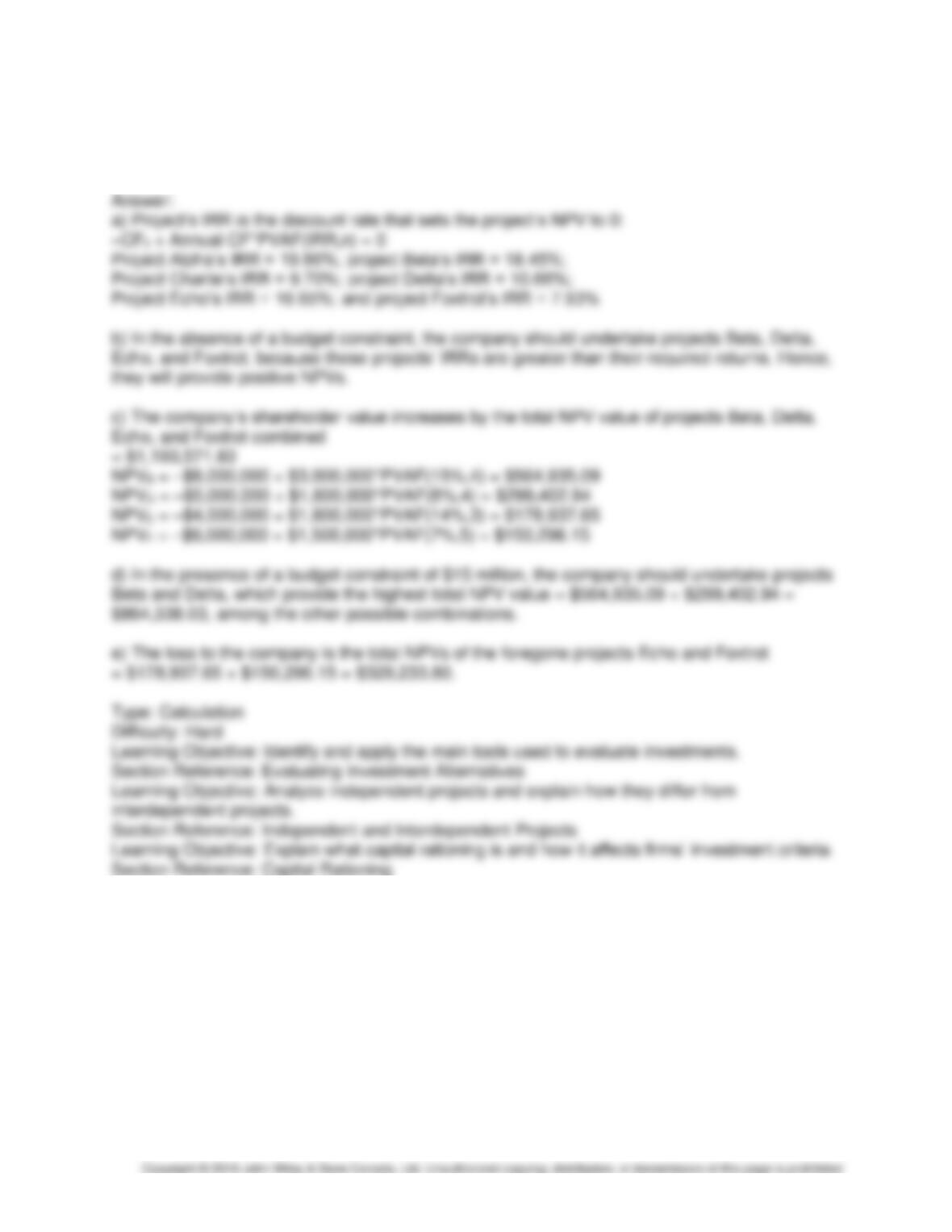
146. Suppose a company has the following information on six independent projects:
Project CF0 Annual CF k Project Life
Alpha $3 million $1.0 million 20% 5 years
Beta $8 million $3.0 million 15% 4 years
Charlie $7 million $2.8 million 10% 3 years
Delta $5 million $1.6 million 8% 4 years
Echo $4 million $1.8 million 14% 3 years
Foxtrot $6 million $1.5 million 7% 5 years
a) Find the IRRs of the six projects.
b) Which projects should the company undertake if it has no capital constraints? Why?
c) What is the impact on the company‘s shareholder value in (b)?
Capital Budgeting, Risk Considerations, and Other Special Issues 13 – 60
d) Which projects should the company undertake if it has a capital constraint of $15 million?
Why?
e) What is the loss to the company from the capital rationing constraint in (d)?
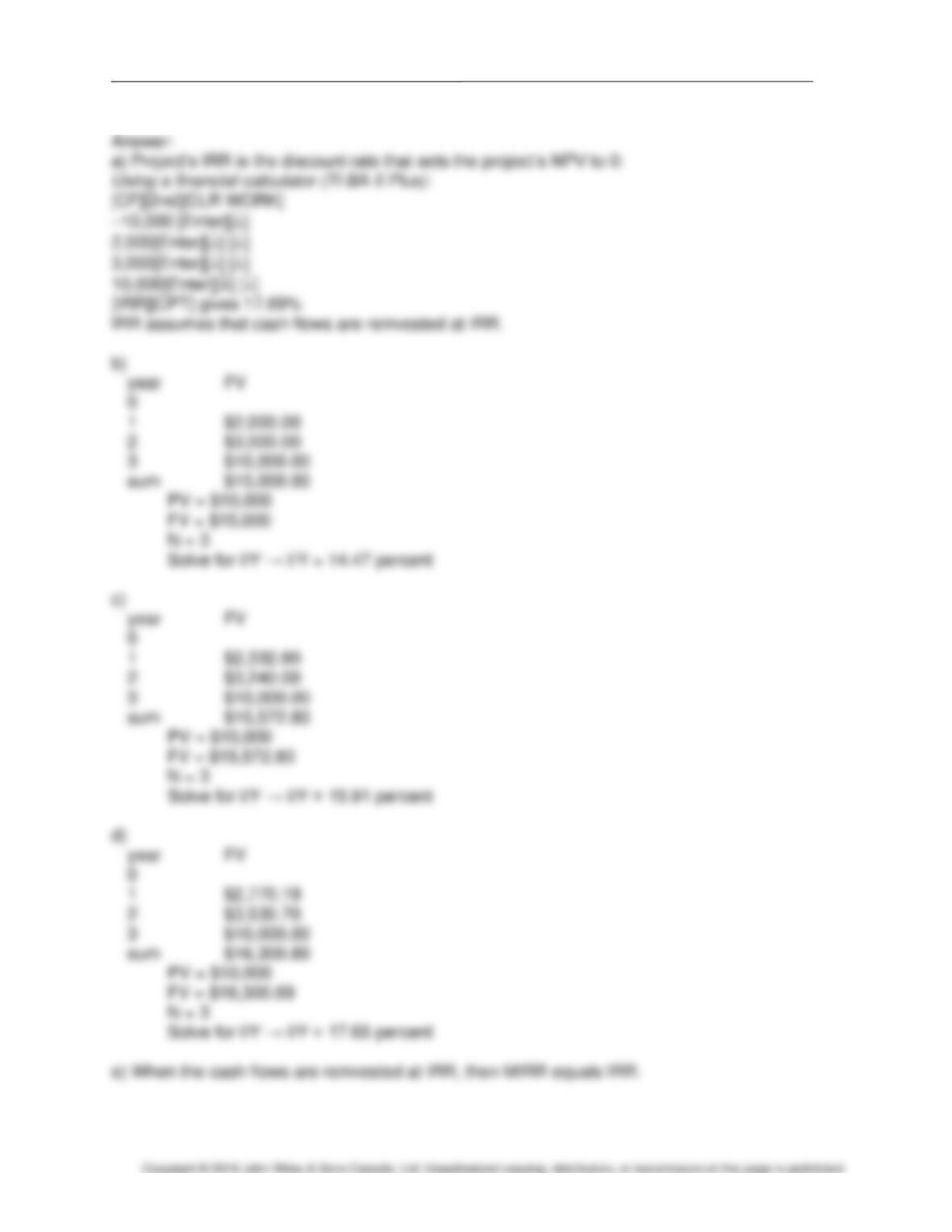
147. Project X has a cost of capital of 8 percent and the following cash flows: investment of
$10,000 in year 0, cash inflows of $2,000, $ 3,000, and $10,000 in years 1, 2, and 3,
respectively.
a) What is the IRR? What is the assumption of IRR on reinvesting cash?
b) Suppose the cash inflows are deposited in an account without interest. What is the MIRR?
c) Suppose the cash inflows are deposited in an account with an 8% annual interest rate. What
is the MIRR?
d) Suppose the cash inflows are deposited in an account with a 17.69% annual interest rate.
What is the MIRR?
e) When will IRR equal MIRR?
13 – 61 Test Bank for Introduction to Corporate Finance, Fourth Canadian Edition

Capital Budgeting, Risk Considerations, and Other Special Issues 13 – 62
13 – 63 Test Bank for Introduction to Corporate Finance, Fourth Canadian Edition
LEGAL NOTICE