
FOR INSTRUCTOR USE ONLY
CHAPTER 13
FINANCIAL ANALYSIS: THE BIG PICTURE
SUMMARY OF QUESTIONS BY LEARNING OBJECTIVE AND BLOOM’S TAXONOMY
Item
LO
BT
Item
LO
BT
Item
LO
BT
Item
LO
BT
Item
LO
BT
True-False Statements
1.
1
K
10.
3
K
19.
5
K
28.
6,8
K
37.
6,8
C
2.
2
K
11.
3
K
20.
5
K
29.
6,8
K
38.
6,8
K
3.
2
K
12.
4, 5
K
21.
5
K
30.
6,8
K
39.
6,8
C
4.
2
K
13.
4
K
22.
5
K
31.
6,8
K
40.
6,8
K
5.
2
K
14.
4
K
23.
5
K
32.
6,8
K
41.
6,8
K
6.
2
K
15.
4
K
24.
5
K
33.
6,8
K
42.
6,8
K
7.
2
K
16.
4
AP
25.
5
K
34.
6,8
K
43.
7
K
8.
3
K
17.
4
C
26.
5
C
35.
6,8
K
44.
7
K
9.
3
K
18.
5
K
27.
5
K
36.
6,8
K
45.
7
K
Multiple Choice Questions
46.
1
K
79.
3
AP
112.
5
K
145.
6,8
AP
178.
6,8
K
47.
1
K
80.
3
AP
113.
5
K
146.
6,8
AP
179.
6,8
AN
48.
1
K
81.
3
C
114.
5
K
147.
6,8
AP
180.
6,8
C
49.
2
AP
82.
3
K
115.
5
K
148.
6,8
AP
181.
6,8
AN
50.
2
AP
83.
3
K
116.
5
K
149.
6,8
AP
182.
6,8
AP
51.
2
K
84.
3
K
117.
5
K
150.
6,8
AP
183.
6,8
AP
52.
2
K
85.
3
AP
118.
5
AP
151.
6,8
AP
184.
6,8
AP
53.
2
C
86.
3
K
119.
5
AP
152.
6,8
K
185.
6,8
AP
54.
2
C
87.
4
K
120.
5
AP
153.
6,8
K
186.
6,8
AP
55.
2
K
88.
4
AP
121.
5
AP
154.
6,8
K
187.
6,8
AP
56.
2
K
89.
4
K
122.
5
AP
155.
6,8
K
188.
6,8
AP
57.
2
K
90.
4
K
123.
5
K
156.
6,8
AP
189.
6,8
AP
58.
2
C
91.
4
K
124.
5
K
157.
6,8
AP
190.
6,8
AN
59.
2
K
92.
4
K
125.
6,8
K
158.
6,8
AP
191.
6,8
AP
60.
2
K
93.
4
K
126.
6,8
K
159.
6,8
AP
192.
6,8
AP
61.
2
K
94.
4
K
127.
6,8
K
160.
6,8
K
193.
6,8
AP
62.
2
C
95.
4
AP
128.
6,8
K
161.
6,8
AP
194.
6,8
AP
63.
2
K
96.
4
AP
129.
6,8
K
162.
6,8
K
195.
6,8
AP
64.
2
AP
97.
4
AP
130.
6,8
K
163.
6,8
AP
196.
6,8
AP
65.
2
AP
98.
4
AP
131.
6,8
C
164.
6,8
K
197.
6,8
AP
66.
2
AP
99.
4
K
132.
6,8
C
165.
6,8
AP
198.
6,8
AP
67.
2
AP
100.
4
AP
133.
6,8
K
166.
6,8
K
199.
6,8
AP
68.
2
K
101.
4
K
134.
6,8
K
167.
6,8
K
200.
6,8
AP
69.
2
K
102.
4
AP
135.
6,8
K
168.
6,8
K
201.
6,8
AP
70.
2
K
103.
4
K
136.
6,8
K
169.
6,8
K
202.
6,8
AP
71.
2
C
104.
4
AP
137.
6,8
K
170.
6,8
K
203.
6,8
AP
72.
2
K
105.
5
K
138.
6,8
K
171.
6,8
AN
204.
6,8
AP
73.
2
AP
106.
5
K
139.
6,8
C
172.
6,8
K
205.
6,8
AP
74.
2
K
107.
5
K
140.
6,8
K
173.
6,8
K
206.
6,8
K
75.
2
AP
108.
5
K
141.
6,8
AP
174.
6,8
AN
207.
6,8
K
76.
2
AP
109.
5
K
142.
6,8
AP
175.
6,8
AN
208.
6,8
K
77.
3
K
110.
5
K
143.
6,8
C
176.
6,8
AN
209.
6,8
K
78.
3
K
111.
5
K
144.
6,8
AP
177.
6,8
K
210.
6,8
K

Test Bank for Accounting: Tools for Business Decision Making, Fifth Edition
FOR INSTRUCTOR USE ONLY
13-2
Multiple Choice Questions (Cont.)
211.
6,8
AN
214.
6,8
K
217.
7
C
220.
7
K
212.
6,8
AP
215.
6,8
AN
218.
7
C
221.
7
C
213.
6,8
AP
216.
6,8
C
219.
7
C
Brief Exercises
222.
2
K
227
4
AP
232.
4, 5
AP
237.
6,8
AP
242.
6,8
AP
223.
2
K
228
4
AP
233.
5
AP
238.
6,8
AP
243.
6,8
AP
224.
2
AP
229.
4
AP
234.
5
AP
239.
6,8
AP
225.
2
AP
230.
4
AN
235.
6,8
AP
240.
6,8
AN
226.
4
AP
231.
4
C
236.
6,8
AP
241.
6,8
AP
Exercises
244.
4
AN
247.
4,5
AP
250.
5
AP
253.
6,8
AN
256.
6,8
AP
245.
4
AP
248.
4, 5
AP
251.
6,8
AP
254.
6,8
AP
246.
4
AP
249.
5
AN
252.
6,8
AP
255.
6,8
AN
Completion Statements
257.
2
K
260.
4
K
263.
6,8
K
266.
6,8
K
269.
6,8
K
258.
2
K
261.
5
K
264.
6,8
K
267.
6,8
K
259.
2
K
262.
6,8
K
265.
6,8
K
268.
6,8
K
Matching
270.
6,8
K
271.
6,8
K
Short Answer Essay
272.
1
C
274.
3
K
276.
6,8
K
278.
6,8
S
273.
2
K
275.
4, 5
C
277.
7
C
SUMMARY OF LEARNING OBJECTIVES BY QUESTION TYPE
Learning Objective 1
Item
Type
Item
Type
Item
Type
Item
Type
Item
Type
Item
Type
1.
TF
46.
MC
47.
MC
48.
MC
272.
SA
Learning Objective 2
2.
TF
50.
MC
57.
MC
64.
MC
71.
MC
223.
Be
3.
TF
51.
MC
58.
MC
65.
MC
72.
MC
224.
Be
4.
TF
52.
MC
59.
MC
66.
MC
73.
MC
225.
Be
5.
TF
53.
MC
60.
MC
67.
MC
74.
MC
257.
C
6.
TF
54.
MC
61.
MC
68.
MC
75.
MC
258.
C
7.
TF
55.
MC
62.
MC
69.
MC
76.
MC
259.
C
49.
MC
56.
MC
63.
MC
70.
MC
222.
Be
273.
SA
Learning Objective 3
8.
TF
11.
TF
79.
MC
82.
MC
85.
MC
9.
TF
77.
MC
80.
MC
83.
MC
86.
MC
10.
TF
78.
MC
81.
MC
84.
MC
274.
SA

Financial Analysis: The Big Picture
FOR INSTRUCTOR USE ONLY
13-3
Learning Objective 4
Item
Type
Item
Type
Item
Type
Item
Type
Item
Type
Item
Type
12.
TF
88.
MC
95.
MC
102.
MC
230.
Be
248.
Ex
13.
TF
89.
MC
96.
MC
103.
MC
231.
Be
260.
C
14.
TF
90.
MC
97.
MC
104.
MC
232.
Be
275.
SA
15.
TF
91.
MC
98.
MC
226.
Be
244.
Ex
16.
TF
92.
MC
99.
MC
227.
Be
245.
Ex
17.
TF
93.
MC
100.
MC
228.
Be
246.
Ex
87.
MC
94.
MC
101.
MC
229.
Be
247.
Ex
Learning Objective 5
12.
TF
24.
TF
108.
MC
115.
MC
122.
MC
248.
Ex
18.
TF
25.
TF
109.
MC
116.
MC
123.
MC
249.
Ex
19.
TF
26.
TF
110.
MC
117.
MC
124.
MC
250.
Ex
20.
TF
27.
TF
111.
MC
118.
MC
232.
Be
261.
C
21.
TF
105.
MC
112.
MC
119.
MC
233.
Be
275.
SA
22.
TF
106.
MC
113.
MC
120.
MC
234.
Be
23.
TF
107.
MC
114.
MC
121.
MC
247.
Ex
Learning Objective 6
28.
TF
133.
MC
156.
MC
179.
MC
202.
MC
243.
Be
29.
TF
134.
MC
157.
MC
180.
MC
203.
MC
251.
Ex
30.
TF
135.
MC
158.
MC
181.
MC
204.
MC
252.
Ex
31.
TF
136.
MC
159.
MC
182.
MC
205.
MC
253.
Ex
32.
TF
137.
MC
160.
MC
183.
MC
206.
MC
254.
Ex
33.
TF
138.
MC
161.
MC
184.
MC
207.
MC
255.
Ex
34.
TF
139.
MC
162.
MC
185.
MC
208.
MC
256.
Ex
35.
TF
140.
MC
163.
MC
186.
MC
209.
MC
262.
C
36.
TF
141.
MC
164.
MC
187.
MC
210.
MC
263.
C
37.
TF
142.
MC
165.
MC
188.
MC
211.
MC
264.
C
38.
TF
143.
MC
166.
MC
189.
MC
212.
MC
265.
C
39.
TF
144.
MC
167.
MC
190.
MC
213.
MC
266.
C
40.
TF
145.
MC
168.
MC
191.
MC
214.
MC
267.
C
41.
TF
146.
MC
169.
MC
192.
MC
215.
MC
268.
C
42.
TF
147.
MC
170.
MC
193.
MC
216.
MC
269.
C
125.
MC
148.
MC
171.
MC
194.
MC
235.
Be
270.
Ma
126.
MC
149.
MC
172.
MC
195.
MC
236.
Be
276.
SA
127.
MC
150.
MC
173.
MC
196.
MC
237.
Be
278.
SA
128.
MC
151.
MC
174.
MC
197.
MC
238.
Be
129.
MC
152.
MC
175.
MC
198.
MC
239.
Be
130.
MC
153.
MC
176.
MC
199.
MC
240.
Be
131.
MC
154.
MC
177.
MC
200.
MC
241.
Be
132.
MC
155.
MC
178.
MC
201.
MC
242.
Be

Test Bank for Accounting: Tools for Business Decision Making, Fifth Edition
FOR INSTRUCTOR USE ONLY
13-4
Learning Objective 7
Item
Type
Item
Type
Item
Type
Item
Type
Item
Type
Item
Type
43.
TF
45.
TF
218.
MC
220.
MC
277.
SA
44.
TF
217.
MC
219.
MC
221.
MC
Learning Objective 8
28.
TF
133.
MC
156.
MC
179.
MC
202.
MC
243.
Be
29.
TF
134.
MC
157.
MC
180.
MC
203.
MC
251.
Ex
30.
TF
135.
MC
158.
MC
181.
MC
204.
MC
252.
Ex
31.
TF
136.
MC
159.
MC
182.
MC
205.
MC
253.
Ex
32.
TF
137.
MC
160.
MC
183.
MC
206.
MC
254.
Ex
33.
TF
138.
MC
161.
MC
184.
MC
207.
MC
255.
Ex
34.
TF
139.
MC
162.
MC
185.
MC
208.
MC
256.
Ex
35.
TF
140.
MC
163.
MC
186.
MC
209.
MC
262.
C
36.
TF
141.
MC
164.
MC
187.
MC
210.
MC
263.
C
37.
TF
142.
MC
165.
MC
188.
MC
211.
MC
264.
C
38.
TF
143.
MC
166.
MC
189.
MC
212.
MC
265.
C
39.
TF
144.
MC
167.
MC
190.
MC
213.
MC
266.
C
40.
TF
145.
MC
168.
MC
191.
MC
214.
MC
267.
C
41.
TF
146.
MC
169.
MC
192.
MC
215.
MC
268.
C
42.
TF
147.
MC
170.
MC
193.
MC
216.
MC
269.
C
125.
MC
148.
MC
171.
MC
194.
MC
235.
Be
270.
Ma
126.
MC
149.
MC
172.
MC
195.
MC
236.
Be
276.
SA
127.
MC
150.
MC
173.
MC
196.
MC
237.
Be
278.
SA
128.
MC
151.
MC
174.
MC
197.
MC
238.
Be
129.
MC
152.
MC
175.
MC
198.
MC
239.
Be
130.
MC
153.
MC
176.
MC
199.
MC
240.
Be
131.
MC
154.
MC
177.
MC
200.
MC
241.
Be
132.
MC
155.
MC
178.
MC
201.
MC
242.
Be
Note: TF = True-False C = Completion
MC = Multiple Choice Ex = Exercise
Ma = Matching SA = Short Answer Essay

Financial Analysis: The Big Picture
FOR INSTRUCTOR USE ONLY
13-5
CHAPTER LEARNING OBJECTIVES
1. Understand the concept of sustainable income. Sustainable income refers to a company’s
ability to sustain its profits from operations.
2. Indicate how irregular items are presented. Irregular items—discontinued operations and
extraordinary items—are presented on the income statement net of tax below “Income before
irregular items” to highlight their unusual nature. Changes in accounting principle are reported
retroactively.
3. Explain the concept of comprehensive income. Comprehensive income includes all
changes in stockholders’ equity during a period except those resulting from investments by
stockholders and distributions to stockholders. “Other comprehensive income” is added to net
income to arrive at comprehensive income.
4. Describe and apply horizontal analysis. Horizontal analysis is a technique for evaluating a
series of data over a period of time to determine the increase or decrease that has taken
place, expressed as either an amount or a percentage.
5. Describe and apply vertical analysis. Vertical analysis is a technique that expresses each
item in a financial statement as a percentage of a relevant total or a base amount.
6. Identify and compute ratios used in analyzing a company’s liquidity, solvency, and
profitability. Financial ratios are provided in Illustration 13-16 (liquidity), Illustration 13-17
(solvency) and Illustration 13-18 (profitability).
7. Understand the concept of quality of earnings. A high quality of earnings provides full and
transparent information that will not confuse or mislead users of the financial statements.
Issues related to quality of earnings are (1) alternative accounting methods, (2) pro forma
income, and (3) improper recognition. The price-earnings (P-E) ratio reflects investors’
assessment of a company’s future earnings potential.
*8. Evaluate a company comprehensively using ratio analysis. To evaluate a company, ratios
(liquidity, solvency, and profitability) provide clues to underlying conditions, but intracompany,
intercompany, and industry average comparisons are also needed.
Test Bank for Accounting: Tools for Business Decision Making, Fifth Edition
13-6
TRUE-FALSE STATEMENTS
1. Analysts are interested in sustainable income, which is equal to the past year’s net income.
2. One objective of the income statement is to separate the results of continuing operations
from those of discontinued operations.
3. When the disposal of a significant segment occurs, the income statement should report
both income from continuing operations and income (loss) from discontinued operations.
4. An event or transaction should be classified as an extraordinary item if it is unusual in
nature or if it occurs infrequently.
5. Companies report most changes in accounting principle currently.
6. The loss on disposal of a significant component of a business is disclosed in the statement
of retained earnings.
7. A change in accounting principle occurs when the principle used in the current year is
different from the one used by competitors in the current year.
8. Comprehensive income includes all changes in stockholders’ equity during a period except
those resulting from investments by stockholders and distributions to stockholders.
9. Comprehensive income includes all revenues, expenses, gains, losses, and dividends.
10. Intracompany comparisons of the same financial statement items are often useful to detect
changes in financial relationships and significant trends.
11. Comparisons of company data with industry averages provide information about a
company’s relative position within the industry.
Financial Analysis: The Big Picture
13-7
12. Horizontal, vertical, and circular analyses are the basic tools of financial statement
analysis.
13. In horizontal analysis, the base year is the most current year being examined.
14. Horizontal analysis is a technique for evaluating a financial statement item in the current
year with other items in the current year.
15. Another name for horizontal analysis is trend analysis.
16. If a company has sales of $130 in 2014 and $182 in 2013, the percentage decrease in
sales from 2013 to 2014 is 40%.
17. In horizontal analysis, if an item has a negative amount in the base year, and a positive
amount in the following year, no percentage change for that item can be computed.
18. A primary purpose of vertical analysis is to observe trends over a three-year period.
19. Vertical analysis is a technique for evaluating a series of financial statement data over a
period of time to determine the increase (decrease) that has taken place.
20. Common size analysis expresses each item in a financial statement as a percent of a base
amount.
21. In a common size income statement, net sales are represented by 100%.
22. In a common size income statement, each item is expressed as a percentage of net
income.
23. In a common size balance sheet, total assets are represented by 100%.
Test Bank for Accounting: Tools for Business Decision Making, Fifth Edition
13-8
24. In the vertical analysis of a balance sheet, the base for current liabilities is total liabilities.
25. Vertical analysis is useful in making comparisons of companies of different sizes.
26. Using vertical analysis of the income statement, a company’s net income as a percentage
of net sales is 15%; therefore, the cost of goods sold as a percentage of sales must be
85%.
27. In the vertical analysis of an income statement, each item is generally stated as a
percentage of net income.
28. Liquidity ratios measure the ability of the enterprise to survive over a long period of time.
29. A solvency ratio measures the income or operating success of an enterprise for a given
period of time.
30. The current ratio is a measure of all the ratios calculated for the current year.
31. Accounts receivable turnover is useful in assessing the profitability of receivables.
32. Inventory turnover measures the number of times on average the inventory was sold
during the period.
33. Inventory turnover is a measure of liquidity that focuses on efficient use of inventory.
34. Profitability ratios are frequently used as a basis for evaluating management’s operating
effectiveness.
35. Both profit margin and asset turnover affect a company’s return on assets.
Financial Analysis: The Big Picture
FOR INSTRUCTOR USE ONLY
13-9
36. Leverage and return on equity are closely related.
37. The return on assets will be greater than the rate of return on common stockholders’ equity
if the company has been successful in trading on the equity at a gain.
38. The current ratio is one of the most utilized measures of profitability.
39. From a creditor’s point of view, the higher the debt to assets ratio, the lower the risk that
the company may be unable to pay its obligations.
40. A current ratio of 1.2 to 1 indicates that a company’s current assets exceed its current
liabilities.
41. Using borrowed money to increase the rate of return on common stockholders’ equity is
called “trading on the equity.”
42. Declining profitability and liquidity ratios are indications that a company may not survive.
43. Alternative accounting methods affect the quality of earnings.
44. Improper recognition of income is not one of the factors affecting the quality of earnings.
45. Because pro forma earnings are based on specific rules, these amounts are highly reliable.
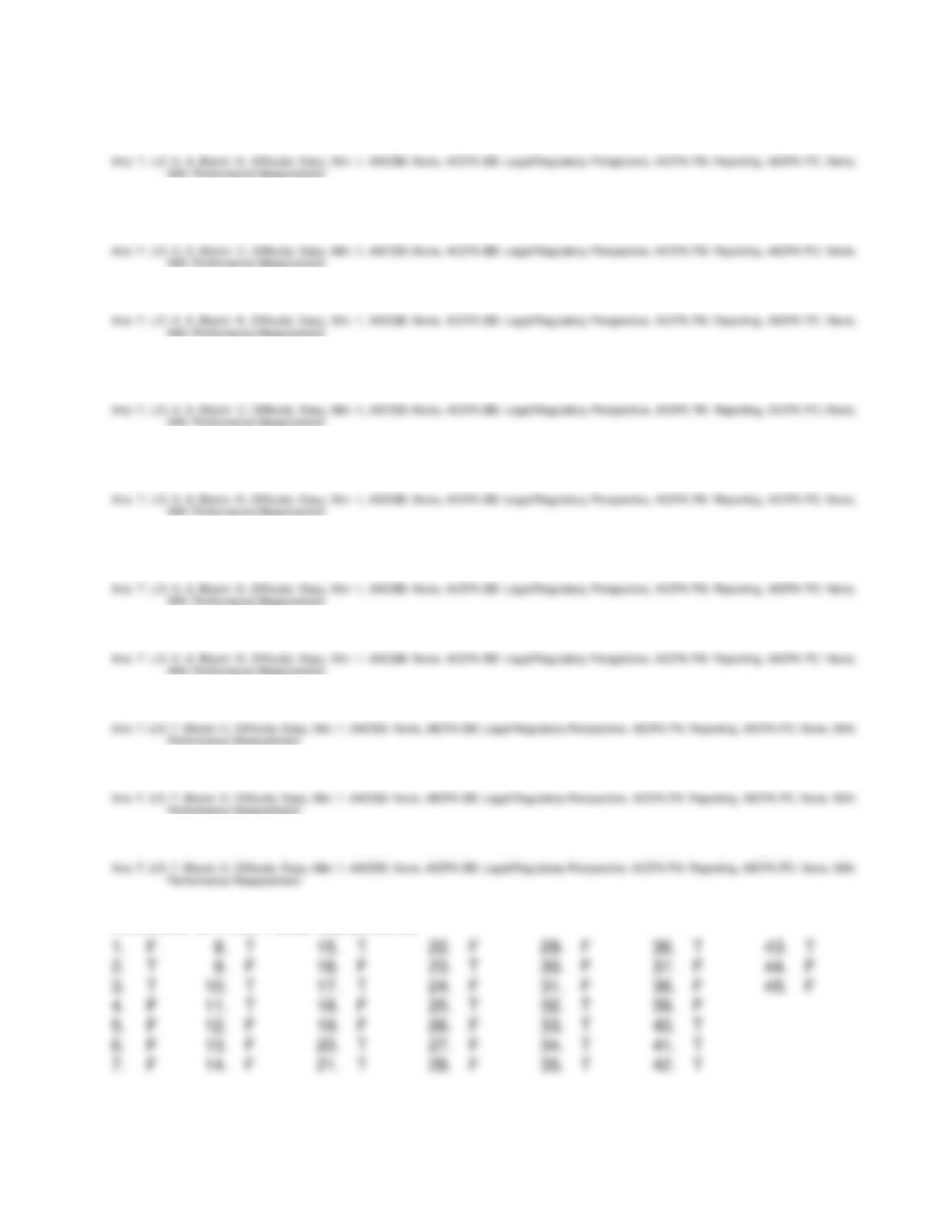
Answers to True-False Statements

Test Bank for Accounting: Tools for Business Decision Making, Fifth Edition
13–10
MULTIPLE CHOICE QUESTIONS
46. Which of the following income statement figures would probably be the best indicator of a
company’s future performance?
a. Total revenues
b. Income from operations
c. Net income
d. Gross profit
47. Which of the following is the best definition of sustainable income?
a. Sustainable income is a measure of solvency that does not include capital expenditure.
b. Sustainable income is the same as net income.
c. Sustainable income is income that is unusual in nature and infrequent in occurrence.
d. Sustainable income is the most likely level of income to be obtained in the future.
48. When preparing an income statement, which of the following is the proper order for income
statement components?
a. Comprehensive income, Other comprehensive income items, irregular items, Net
income
b. Net income, irregular items, Comprehensive income, Other comprehensive income
items
c. Irregular items, Net income, Other comprehensive income items, Comprehensive
income
d. Irregular items, Net income, Comprehensive income, Other comprehensive income
items
49. Sophie’s Dog Supplies has income before taxes of $550,000 and an extraordinary loss of
$170,000. If the income tax rate is 30% on all items, the income statement should show
income before irregular items and an extraordinary loss, respectively, of
a. $550,000 and ($170,000).
b. $385,000 and ($86,700).
c. $385,000 and ($119,000).
d. $165,000 and ($51,000).
50. If a company has an extraordinary gain of $20,000 and a 32% tax rate, what is the effect
on net income?
a. Increase of $20,000.
b. Increase of $13,600.
c. Increase of $6,400.
d. No effect.

Financial Analysis: The Big Picture
13–11
51. An extraordinary item must meet which of the following two criteria?
a. Foreseeable and material
b. Infrequent and unusual
c. Substantial and measurable
d. Unusual and measurable
52. All of the following are reported on the income statement net of tax except
a. irregular items.
b. other comprehensive income items.
c. income from operations.
d. extraordinary items.
53. Indian River Groves in central Florida lost about 10% of its strawberries (or $750,000) due
to frost. Based on this information, how will Indian River Groves most likely report this
loss?
a. As an extraordinary item net of taxes.
b. Below discontinued operations.
c. As a pretax ordinary loss prior to income before income taxes.
d. As a discontinued operation net of taxes.
54. All of the following statements regarding changes in accounting principles are true except
which of the following?
a. Most changes in accounting principles are only reported in current periods when the
principle change takes place.
b. Changes in accounting principles are allowed when new principles are preferable to old
ones.
c. Most changes in accounting principles are retroactively reported.
d. Consistency is one of the biggest concerns when a change in accounting principle is
undertaken.
55. An income statement would not include
a. other revenue and gains.
b. extraordinary items.
c. discontinued operations.
d. dividends paid.
56. The discontinued operations section of the income statement refers to
a. discontinuance of a product line.
b. the income or loss on products that have been completed and sold.
c. obsolete equipment and discontinued inventory items.
d. the disposal of a significant component of a business.

Test Bank for Accounting: Tools for Business Decision Making, Fifth Edition
13–12
57. Which one of the following would be classified as an extraordinary item?
a. Expropriation of property by a foreign government
b. Losses attributed to a labor strike
c. Write-down of inventories
d. Gains or losses from sales of equipment
58. When a change in depreciation method occurs
a. prior years’ financial statements should be changed to reflect the newly adopted
method.
b. the change should be reported in current and future years.
c. the cumulative effect of the change should be reflected on the income statement as of
the beginning of the next year.
d. the cumulative effect of the change in accounting principle should be classified as an
extraordinary item on the income statement.
59. If an item meets one (but not both) of the criteria for an extraordinary item, it
a. only needs to be disclosed in the footnotes of the financial statements.
b. may be treated as sales revenue (if it is a gain) and as an operating expense (if it is a
loss).
c. is reported as an “other revenue or gain” or “other expense and loss,” net of tax.
d. is reported at its gross amount as an “other revenue or gain” or “other expense or
loss.”
60. The order of presentation of items that may appear on the income statement is
a. Extraordinary items, Discontinued operations, Income before income taxes.
b. Discontinued operations, Extraordinary items, Income before income taxes.
c. Income before income taxes, Discontinued operations, Extraordinary items.
d. Income before income taxes, Extraordinary items, Discontinued operations.
61. Which of the following items appears on the income statement before income before
irregular items?
a. Other comprehensive income.
b. Extraordinary items.
c. Income tax expense.
d. Discontinued operations.

Financial Analysis: The Big Picture
13–13
62. Which of the following items should be classified as an extraordinary item on an income
statement?
a. Gain on the sale of property, plant or equipment
b. Loss due to expropriation of property by a foreign government
c. Loss due to discontinued operations
d. Excess of the selling price over the cost of treasury stock
63. Which of the following statements is true with respect to financial statement reporting for all
cases when a company changes from one acceptable accounting method to another?
a. Comparability across periods is impaired
b. Only a footnote is required to report the change
c. Changes in both depreciation methods and inventory methods are reported
retroactively.
d. Management must indicate that the accounting method change is preferable to the old
method.
64. The Holiday House had severe damage done to its Christmas inventory due to an escaped
circus monkey rampaging through the store. The inventory loss was $150,000 before
applicable taxes of $30,000. The Holiday House should record the loss as a(n)
a. $150,000 loss in other expenses and losses.
b. $180,000 extraordinary loss.
c. $120,000 extraordinary loss.
d. $130,000 extraordinary loss.
65. Shambhala Spice Company has experienced a $60,000 loss due to tornado damage to
their inventory. Tornados have never before occurred in this area. Assuming that the
company’s tax rate is 30%, what amount will be reported for this loss on the income
statement?
a. $60,000
b. $42,000
c. $18,000
d. $36,000
Test Bank for Accounting: Tools for Business Decision Making, Fifth Edition
13–14
66. Patchett Company reported income before taxes of $800,000 and an extraordinary loss of
$200,000. Assume that the company’s tax rate is 25%. What amounts will be reported on
the income statement for income before irregular items and extraordinary items,
respectively?
a. $600,000 and $200,000
b. $600,000 and $150,000
c. $600,000 and $180,000
d. $600,000 and $170,000
67. Dandy Candy Company sold its licorice division resulting in a loss of $60,000. Assuming a
tax rate of 25%, the loss on this disposal will be reported on the income statement at what
amount?
a. $75,000
b. $15,000
c. $60,000
d. $45,000
68. Which of the following is not an irregular item on the income statement?
a. Discontinued operations
b. Extraordinary items
c. Other revenues and expenses
d. Loss on disposal of a significant component of a business
69. Which of the following would not be considered an example of a discontinued operation?
a. Shifting production processes within an operation
b. Elimination of a major class of customers
c. Elimination of an entire activity
d. Disposal of a significant component of a business
70. Extraordinary items are reported on the income statement immediately
a. below income from continuing operations.
b. after comprehensive income.
c. below income before taxes.
d. after discontinued operations.
Financial Analysis: The Big Picture
13–15
71. Which of the following would not be considered a change in accounting principle?
a. Changing the estimated percentage used in calculating bad debt expense
b. Changing the inventory costing method used from FIFO to LIFO
c. Changing from straight-line depreciation to double-declining balance depreciation
d. Changing from the cost method of accounting for investments to the equity method
72. In reporting discontinued operations, the income statement should show in a special
section
1. gains on the disposal of a discontinued component.
2. losses on the disposal of a discontinued component.
a. 1 only.
b. 2 only.
c. neither 1 nor 2.
d. both 1 and 2.
73. R. Stone Corporation has income before taxes of $780,000 and an extraordinary gain of
$200,000. If the income tax rate is 25% on all items, the income statement should show
income before irregular items and extraordinary items, respectively, of
a. $635,000 and $200,000.
b. $635,000 and $150,000.
c. $585,000 and $200,000.
d. $585,000 and $150,000.
74. The disposal of a significant component of a business is called
a. a change in accounting principle.
b. an extraordinary item.
c. an other expense.
d. discontinued operations.
75. Lupton Inc. disposes of an unprofitable segment of its business. The operation of the
segment suffered a $160,000 loss in the year of disposal. The loss on disposal of the
segment was $80,000. If the tax rate is 30%, and income before income taxes was
$1,300,000,
a. the income tax expense on the income before discontinued operations is $318,000.
b. the income from continuing operations is $910,000.
c. net income is $1,060,000.
d. the losses from discontinued operations are reported net of income taxes at $240,000.
Test Bank for Accounting: Tools for Business Decision Making, Fifth Edition
13–16
76. Stellar, Inc. decided on January 1 to discontinue its telescope manufacturing division. On
July 1, the division’s assets with a book value of $840,000 are sold for $600,000.
Operating income from January 1 to June 30 for the division amounted to $130,000.
Ignoring income taxes, what total amount should be reported on Stellar’s income statement
for the current year under the caption, Discontinued Operations?
a. $130,000
b. $110,000 loss
c. $240,000 loss
d. $370,000
77. Comprehensive income would not include
a. dividends declared.
b. unrealized gains on available–for-sale securities.
c. discontinued operations.
d. extraordinary gains and losses.
78. Which of the following would be considered an “Other Comprehensive Income” item?
a. Net income
b. Gain on disposal of discontinued operations
c. Extraordinary loss related to flood
d. Unrealized loss on available–for-sale securities
79. Jack’s by the Tracks. has the following partial balance sheet:
JACK’S BY THE TRACKS.
Balance Sheet (partial)
Stockholders’ Equity:
Common Stock $6,000,000
Retained Earnings 2,000,000
Total Paid-in capital and retained earnings 8,000,000
Add: Unrealized gain on available-for-sale securities 800,000
Total Stockholders’ Equity: $8,800,000
What effect will the unrealized gain on available for sales securities have on comprehensive
income?
a. No effect on comprehensive income.
b. Increase of $800,000 in comprehensive income.
c. Increase of $8,800,000 in comprehensive income.
d. Decrease of $800,000 in comprehensive income.
Financial Analysis: The Big Picture
13–17
80. Reardon Inc. has an investment in trading securities of $120,000. This investment
experienced an unrealized loss of $6,000 during the current year. Assuming a 35% tax
rate, the effect of this loss on comprehensive income will be
a. no effect.
b. $120,000 increase.
c. $42,000 decrease.
d. $78,000 decrease.
81. Which of the following would be considered an “Other comprehensive income” item?
a. Loss on disposal of discontinued operations
b. Unrealized loss on available–for-sale securities
c. Extraordinary gain due to expropriated plant facilities
d. Net income
82. Comparisons of financial data made within a company are called
a. intracompany comparisons.
b. interior comparisons.
c. intercompany comparisons.
d. industry comparisons.
83. Which one of the following is not a tool in financial statement analysis?
a. Horizontal analysis
b. Circular analysis
c. Vertical analysis
d. Ratio analysis
84. All of the following statements are true regarding comprehensive income except
a. companies are required to report comprehensive income.
b. a company would add an unrealized loss on available–for-sale securities to net income
to calculate comprehensive income.
c. comprehensive income does not include changes resulting from investments by
stockholders.
d. comprehensive income does not include dividends to stockholders.

Test Bank for Accounting: Tools for Business Decision Making, Fifth Edition
13–18
85. On January 1, 2014, Tri-State Industries had cash and common stock of $180,000. At that
date the company had no other asset, liability or equity balances. On January 2, 2014, it
purchased $160,000 of equity securities for cash that it classified as available–for-sale. It
received cash dividends of $9,000 during the year on these securities. In addition, it had an
unrealized holding gain on these securities of $24,000 net of tax. Based on this
information, what is the amount of comprehensive income in 2014?
a. $33,000
b. $273,000
c. $9,000
d. $24,000
86. A comparison with other companies that provides insight into a company’s competitive
position is most commonly known as which of the following types of comparisons?
a. Industry average comparison
b. Intracompany comparison
c. Intercompany comparison
d. Comprehensive income comparison
87. When a horizontal analysis is performed and a zero or negative amount is reported in the
base year, then
a. no percentage change can be computed.
b. the percent change will be negative.
c. the accountant has made a mistake.
d. the percentage change will be 100% of greater.
88. Danner Corporation reported net sales of $600,000, $680,000, and $780,000 in the years
2013, 2014, and 2015, respectively. If 2013 is the base year, what percentage do 2015
sales represent of the base?
a. 115%
b. 130%
c. 77%
d. 30%
89. In analyzing financial statements, horizontal analysis is a
a. requirement.
b. tool.
c. principle.
d. theory.

Financial Analysis: The Big Picture
13–19
90. Horizontal analysis is also known as
a. linear analysis.
b. vertical analysis.
c. trend analysis.
d. common size analysis.
91. Under which of the following cases may a percentage change be computed?
a. The trend of the amounts is decreasing but all amounts are positive.
b. There is no amount in the base year.
c. There is a negative amount in the base year and a negative amount in the subsequent
year.
d. There is a negative amount in the base year and a positive amount in the subsequent
year.
92. Horizontal analysis is a technique for evaluating a series of financial statement data over a
period of time
a. that has been arranged from the highest number to the lowest number.
b. that has been arranged from the lowest number to the highest number.
c. to determine which items are in error.
d. to determine the amount and/or percentage increase or decrease that has taken place.
93. Horizontal analysis of comparative financial statements includes the
a. development of common size statements.
b. calculation of liquidity ratios.
c. calculation of dollar amount and percentage changes from financial statements over a
period of time, as compared to a base year.
d. evaluation of financial statement data that expresses each item in a financial statement
as a percentage of a base amount.
94. Horizontal analysis is a technique for evaluating financial statement data
a. within a period of time.
b. over a period of time.
c. on a certain date.
d. as it may appear in the future.
Test Bank for Accounting: Tools for Business Decision Making, Fifth Edition
13–20
95. If Year 1 equals $800, Year 2 equals $840, and Year 3 equals $900, the percentage to be
assigned for Year 3 in a trend analysis, assuming that Year 1 is the base year, is
a. 112.5%.
b. 105%.
c. 88.8%.
d. 100%.
96. If Year 1 equals $780, Year 2 equals $858, and Year 3 equals $896, the percentage to be
assigned for Year 2 in a trend analysis, assuming that Year 1 is the base year, is
a. 100%.
b. 120%.
c. 110%.
d. 115%.
97. Assume the following sales data for a company:
2015 $910,000
2014 $770,000
2013 700,000
If 2013 is the base year, what is the percentage increase in sales from 2013 to 2014?
a. 130%
b. 110%
c. 30%
d. 10%
98. If Year 1 equals $700, Year 2 equals $810, and Year 3 equals $650, the percentage to be
assigned for Year 1 in a trend analysis, assuming that Year 1 is the base year, is
a. 100%.
b. 89%.
c. 105%.
d. 112%.
99. In horizontal or trend analysis, each item is expressed as a(n)
a. amount.
b. percentage.
c. rate.
d. amount or a percentage.