Chapter 13—Long-Term Debt and Leasing
MULTIPLE CHOICE
1. Quiz Company has a 12 year lease, with payments of $250,000 made at the beginning of each year. If
no purchase option exists, and the company is in the 40% tax bracket, what is the annual after-tax cash
outflow on the lease?
a.
$416,667
b.
$250,000
c.
$150,000
d.
$100,000
NARRBEGIN: Loose Cannon refunding
Loose Cannon Co.
Loose Cannon Co. is evaluating a new $75 million bond issue, the proceeds of which would be used to
call and retire its outstanding $75 million bonds. Details on both bond issues are presented below. The
firm is in the 35% tax bracket.
Old Bonds The old issue sold at par, with a coupon rate of 11 percent. It was issued five years ago
with a twenty year maturity. The issue had $350,000 in flotation costs and carries a call price of $1150.
New Bonds The new issue are expected to sell at par with an 8.5 percent coupon rate and a 15 year
maturity. Flotation costs are forecast to be $500,000. Interest payments will overlap for 2 months
while the old bonds are retired.
NARREND
2. Refer to Loose Cannon Co. What is the initial investment required to refund the bonds?
a.
$11,250,000
b.
$8,614,375
c.
$7,312,500
d.
$3,937,500
3. Refer to Loose Cannon Co. What are the annual cash flows associated with the new bonds?
a.
$4,143,750
b.
$6,375,000
c.
$4,132,083
d.
$6,357,051
4. Refer to Loose Cannon Co. What is the NPV of the refunding decision?
a.
$3,654,164
b.
$5,356,375
c.
$1,224,292
d.
$8,614,375
5. Booyah Company has a callable bond issue, with 55,000 bonds with $1000 par outstanding. If the call
price is $1125 per bond, and Booyah’s tax rate is 35%, what is the after-tax cost of calling the bonds?
a.
$10,576,925
b.
$2,406,250
c.
$6,875,000
d.
$4,468,750
NARRBEGIN: Bear Lake Lease Purchase
Bear Lake Equipment Company (BLEC)
Bear Lake Equipment Company (BLEC) is considering an expansion which will require a new
machine that costs $125,000. BLEC can either lease or buy the equipment. The company’s tax rate is
40% and its after tax cost of debt is 5%.
Lease: Annual payments of $26,400 made at the beginning of each year over five years. The lessor
covers all maintenance, while the lessee covers insurance and other costs. The lessee has the option to
purchase the machine for $31,250 paid along with the final lease payment.
Purchase: The $125,000 cost will be financed over five years with annual end of year payments of
$31,580. The machine will be depreciated on the five year MACRS schedule, and the firm will pay
$3,500 per year for a service contract to cover all maintenance. The company will cover all insurance
and other costs.
NARREND
6. Refer to BLEC. What is the after-tax cash flow per year for the lease?
a.
$26,400
b.
$15,840
c.
$10,560
d.
$39,600
7. Refer to BLEC. What is the after tax cash flow for the first year from a purchase of the machine?
a.
$31,583
b.
$21,167
c.
$19,515
d.
$25,000
8. Refer to BLEC. What is the present value of the five years of after-tax cash flows from purchasing the
machine?
a.
$92,504
b.
$108,120
c.
$77,351
d.
$123,273
9. If a 9%, $100,000 loan has a balance of $83,724 and an annual payment of $13,965 is to be made,
what will the allocation of principal and interest be?
a.
$9,000 interest, $4,965 principal
b.
$7,535 interest, $6,430 principal
c.
$6,430 interest, $7,535 principal
d.
$4,965 interest, $9,000 principal
10. Contract terms that specify things a borrower “must”do are referred to as
a.
instructive covenants
b.
informative covenants
c.
negative covenants
d.
positive covenants
11. A balloon payment is
a.
payment made on circus debt.
b.
a large front-end debt payment, followed by smaller payments.
c.
a large lump-sum payment at maturity of a debt.
d.
none of the above.
12. The yield curve’s typical shape suggests
a.
short term debt will carry higher interest rates than long term debt.
b.
short term debt will carry about the same rates as long term debt.
c.
short term debt will carry lower rates than long term debt.
d.
nothing about the differences in rates due to maturity difference.
13. Suppose a firm is asked to pledge collateral for a term loan. Which of the following is likely to be least
acceptable to the lender?
a.
a rare book collection owned by the company.
b.
the firm’s inventory of industrial chemicals.
c.
the firm’s real estate holding.
d.
securities held by the firm for investment.
14. How do project finance (PF) loans differ from other syndicated loans?
a.
PF loans are guaranteed by the borrower, while other syndicated loans are not.
b.
PF loans are issued to special stand-alone companies whose sole purpose is the
construction and operation of a single project.
c.
PF loans are issued in multiple currencies, while most other syndicated loans are issued in
a single currency.
d.
All of the above are true.
15. The feature in a bond indenture that requires systematic retirement of the bond issue is a
a.
planned call provision.
b.
sinking fund provision.
c.
forced conversion provision.
d.
mandated redemption provision.
16. A call feature
a.
allows the bondholder to redeem the bond prior to maturity.
b.
allows the bond issuer to redeem the bond prior to maturity.
c.
allows the bondholder to increase the coupon rate on the bond at specific points in time
over the bond’s life.
d.
forces the bond issuer to buy back the bond prior to maturity at the bondholder’s
discretion.
17. Callable bonds may not be called immediately after a rate decrease because
a.
the call price if often at a premium above par value.
b.
the call provision is often deferred for several years after the bond’s issue.
c.
recalling the old bonds and issuing new ones involves non-trivial flotation costs.
d.
all of the above.
18. All else equal, the higher the call premium,
a.
the smaller the drop in rates necessary for a call to be beneficial.
b.
the larger the drop in rates necessary for a call to be beneficial.
c.
the more likely any rate drop will lead to a call.
d.
none of the above; the call premium does not affect the call decision.
19. Wuzzy, Inc. is evaluating the acquisition of a new car for deliveries. Automobile leases are
a.
typically operating leases.
b.
typically financial (capital) leases.
c.
either operating or financial, depending on the firm.
d.
not covered by these categories.
20. An important consideration in the lease versus purchase decision is
a.
the loss of the depreciation tax shield if leased.
b.
the benefit of the lease payment as a tax deduction.
c.
the effect on financial structure and future funding needs.
d.
all of the above.
21. Which of the following is (are) an advantage(s) to leasing rather than purchasing?
a.
Leasing effectively allows for the depreciation of land.
b.
A lease does not have a stated interest cost.
c.
A lessee generally cannot make improvements to the leased property.
d.
At the end of the lease, the lessor realizes any salvage value of the leased property.
22. Specialized equipment that may become obsolete quickly
a.
may be more attractive to purchase than lease.
b.
may be more attractive to lease than purchase.
c.
cannot easily be evaluated in the lease versus purchase context.
d.
should be deferred until newer equipment is available.
23. Prior to FASB No. 13, leasing could be used
a.
to finance assets used in the firm without balance sheet consequences.
b.
but lease payments were not expensed on the income statement.
c.
only by largest corporations.
d.
but its advantages were fewer than under the present standard.
24. A bond issue with specifically designated bonds maturing each year is a(n)
a.
mandated redemption issue.
b.
sinking issue.
c.
serial issue.
d.
sequential issue.
25. Bonds that received investment-grade ratings when first issued but later fell to junk status are known
as:
a.
disgraced stars.
b.
shamed debt.
c.
fallen angels.
d.
dead wood.
26. A contractual clause that requires a borrower to pay taxes and other liabilities when due is an example
of a
a.
positive covenant
b.
negative covenant
c.
lien
d.
term loan
27. An unsecured bond that only creditworthy firms can issue is called a
a.
mortgage bond
b.
collateral trust bond
c.
debentures
d.
junk bond
28. The legal document stating the conditions under which a bond is issued is called the
a.
indenture
b.
trustee
c.
covenant
d.
call provision
29. A bond where the investor is granted the right to receive payment in shares of underlying stock rather
than in cash is called a
a.
junk bond
b.
zero-coupon bond
c.
convertible bond
d.
bearer bond
30. The user of an asset in a leasing arrangement is called the
a.
lessor
b.
lessee
c.
trustee
d.
none of the above
NARRBEGIN: Bavarian Brew Bond
Bavarian Brew Bond
Bavarian Brew is thinking about recalling $30 million of 15 year, $1,000 par value bonds, that were
issued ten years ago. The bonds carry a coupon rate of 7.8% and have a call price of $1,110. Initially
the bonds generated total proceeds of $28.65 million and the flotation costs were $500,000. Bavarian
Brew wants to sell $30 million of 5 year, $1,000 par value bonds with a 5.8% coupon rate to retire the
old bonds. The flotation costs on the new bond issue are estimated to be $525,000. Due to having to
issue the new bonds before the old bonds can be retired the company expects a period of 3 months
were they have to pay interest on the old and the new bonds. Assume a tax rate of 34%
NARREND
31. Refer to Bavarian Brew Bond. What is the call premium per bond?
a.
$110
b.
$100
c.
$90
d.
$125
32. Refer to Bavarian Brew Bond. What is the after tax cost of the call premium?
a.
$3,300,000
b.
$1,122,000
c.
$2,178,000
d.
$2,867,000
33. How much overlapping interest does Bavarian Brew have to pay on the old bonds after taxes?
a.
$585,000
b.
$386,100
c.
$198,900
d.
$494,500
34. Refer to Bavarian Brew Bond. What is the tax reduction caused by the unamortized discount on the
old bonds?
a.
$1,500,000
b.
$1,000,000
c.
$340,000
d.
$187,000
35. Refer to Bavarian Brew Bond. What is the tax reduction caused by the unamortized flotation costs?
a.
$500,000
b.
$333,333
c.
$56,667
d.
$256,472
36. Refer to Bavarian Brew Bond. What is the initial investment in the new bond issue?
a.
$2,635,767
b.
$3,542,433
c.
$2,178,000
d.
$2,845,433
37. Refer to Bavarian Brew Bond. What are the annual after tax interest payments on the old bond?
a.
$1,544,400
b.
$2,340,000
c.
$795,600
d.
$1,858,900
38. Refer to Bavarian Brew Bond. What are the annual tax savings from the amortization of the discount
on the old bond?
a.
$1,500,000
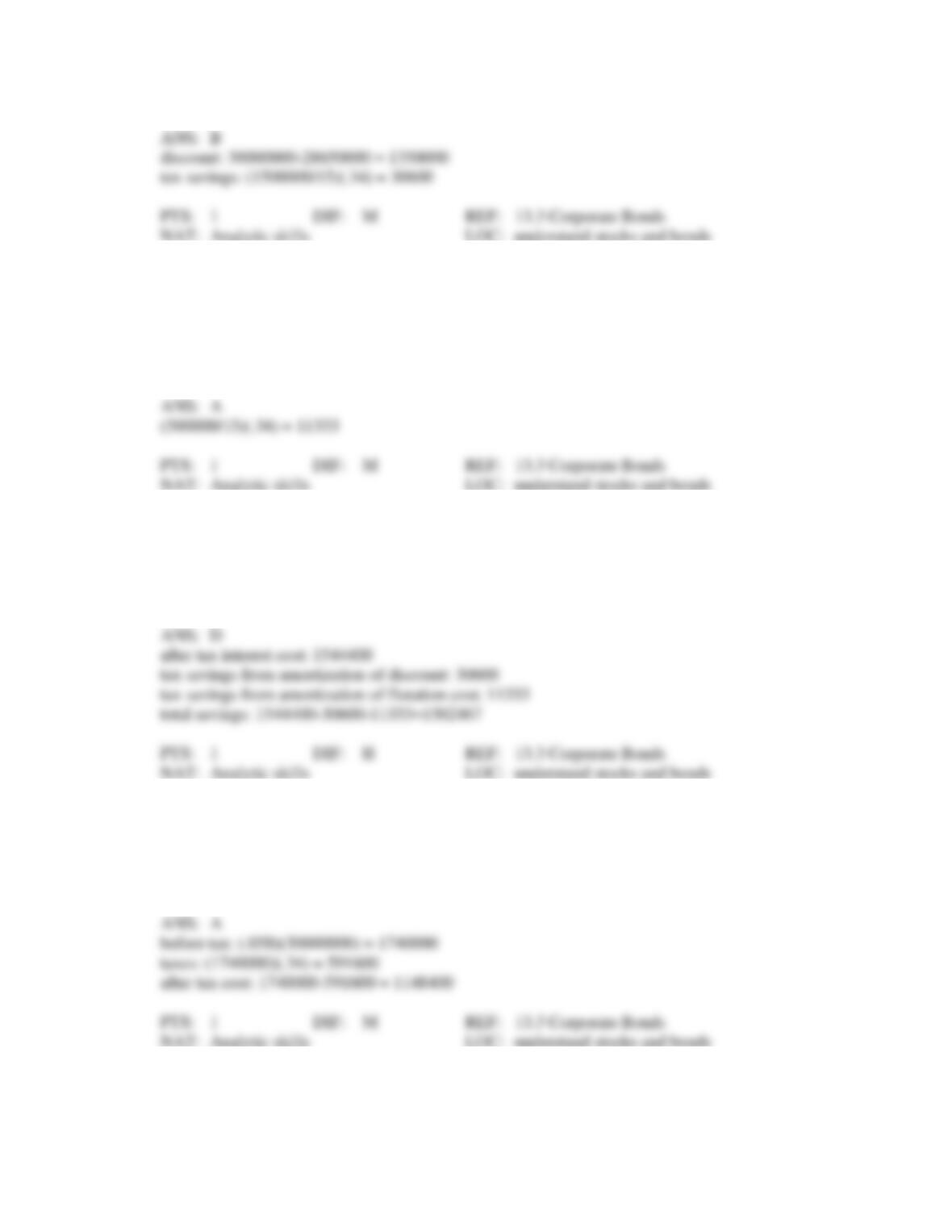
b.
$30,600
c.
$160,000
d.
$61,200
39. Refer to Bavarian Brew Bond. What are the annual tax savings from the amortization of the flotation
costs on the old bond?
a.
$11,333
b.
$33,333
c.
$21,999
d.
$18,988
40. Refer to Bavarian Brew Bond. What are the annual after tax savings from paying off the old bonds?
a.
$985,270
b.
$1,544,400
c.
$1,256,569
d.
$1,502,467
41. Refer to Bavarian Brew Bond. What are the annual after tax interest cost on the new bond?
a.
$1,148,400
b.
$1,740,000
c.
$591,600
d.
$967,500
42. Refer to Bavarian Brew Bond. What are the annual tax savings from the amortization of the flotation
cost of the new bonds?
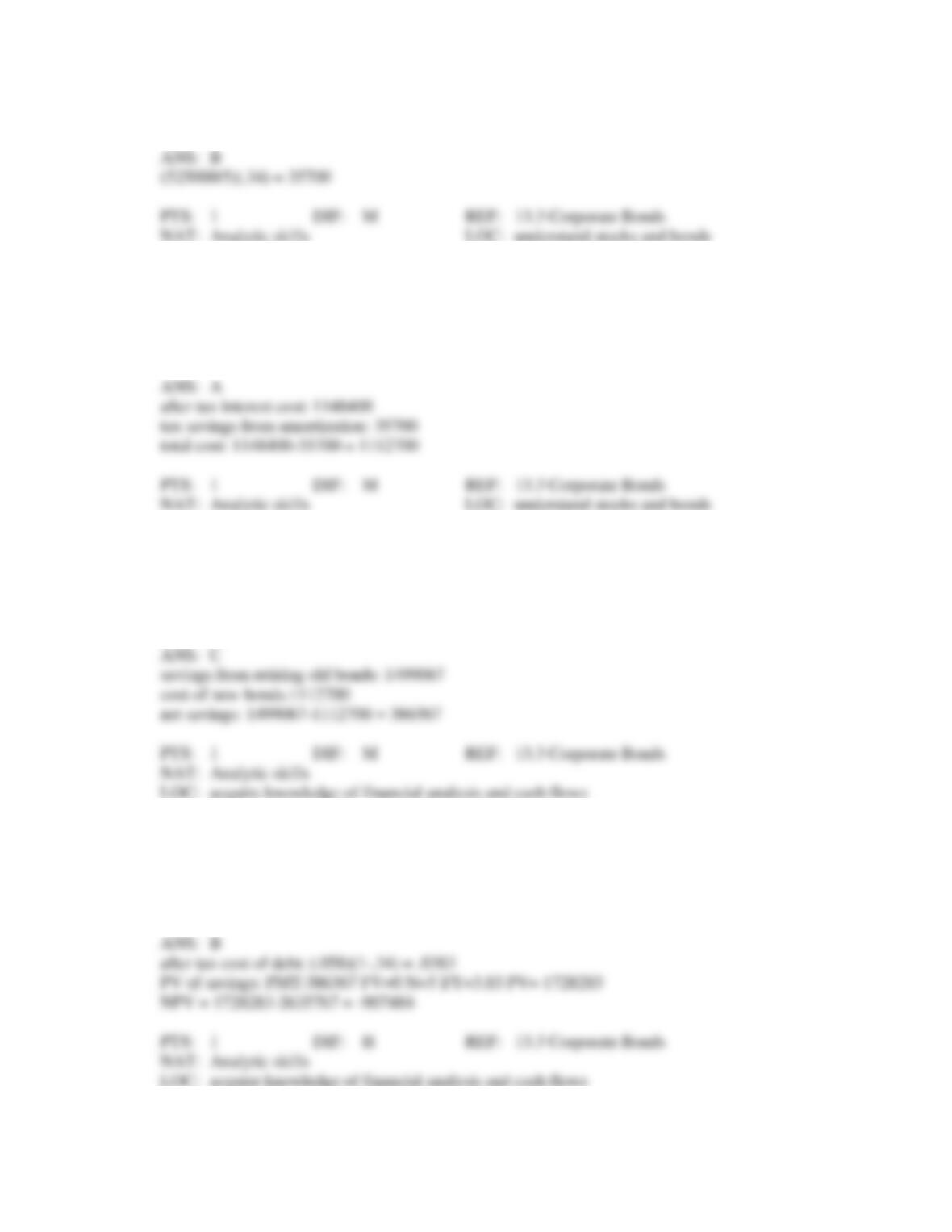
a.
$11,900
b.
$35,700
c.
$23,100
d.
$27,500
43. Refer to Bavarian Brew Bond. What are the annual after tax debt payments on the new bond?
a.
$1,112,700
b.
$1,148,400
c.
$1,235,300
d.
$1,478,900
44. Refer to Bavarian Brew Bond. What are the annual net cash flow savings from issuing the new bonds?
a.
$236,734
b.
$478,923
c.
$386,367
d.
$529,645
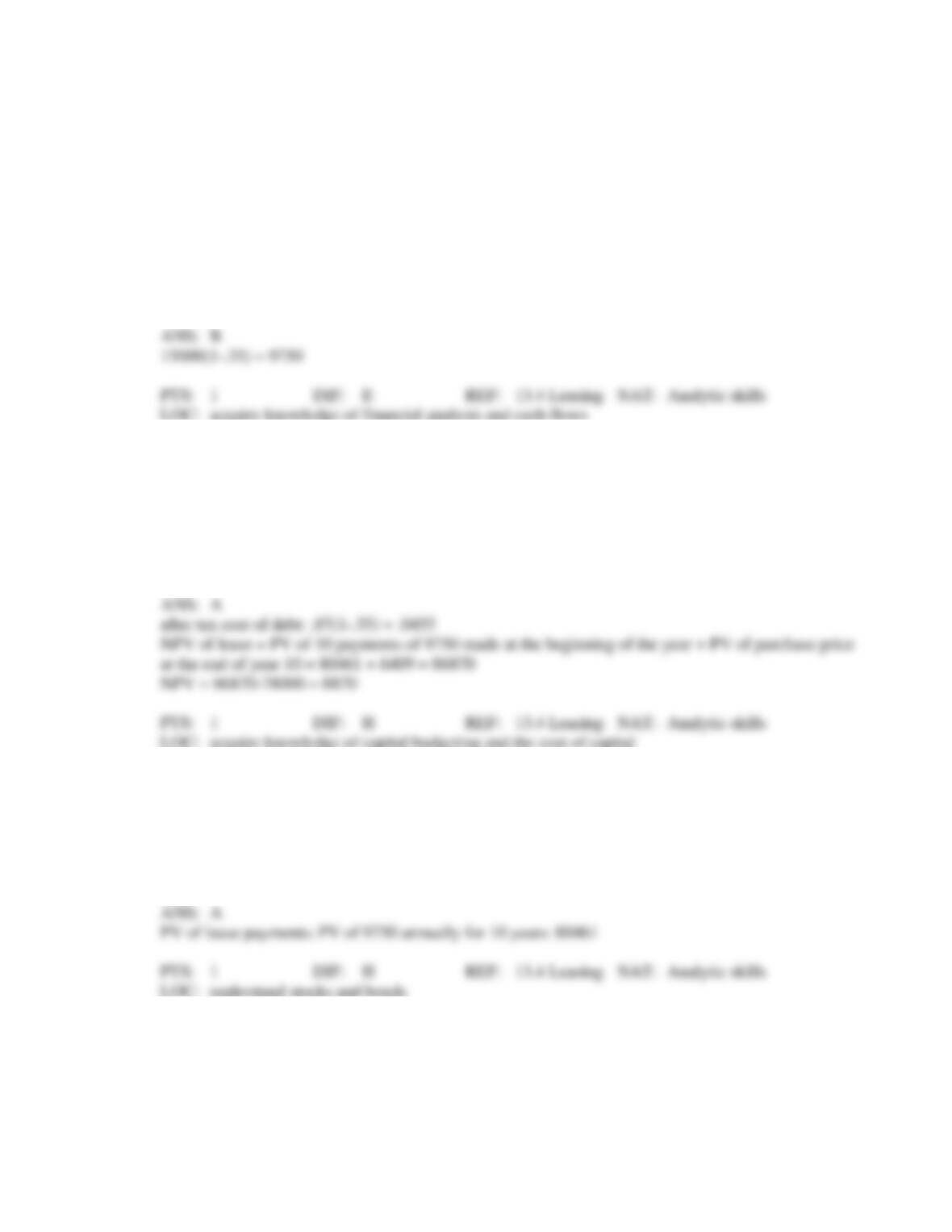
45. Refer to Bavarian Brew Bond. What is the NPV of the proposed bond refinancing?
a.
$907,484
b.
-$907,484
c.
-$895,453
d.
$895,453
NARRBEGIN: Bavarian Brew Lease
Bavarian Brew Lease
Bavarian Brew wants to lease a new bottling machine. The company obtains a 10 year lease requiring
annual payments of $15,000 at the beginning of the year. The firm is expected to exercise its option to
purchase the machine at the termination of the lease for $10,000 at the end of year 10. The company is
in the 35% tax bracket.
NARREND
46. What is the annual after tax cash flow for Bavarian Brew from the lease?
a.
$15,000
b.
$9,750
c.
$5,250
d.
$12,550
47. Bavarian Brew has also the option to purchase the machine. If the present value of the cash flows
associated with the purchase is $78,000, what is the net present value of the lease option? Assume that
the company’s cost of debt is 7%.
a.
$8,870
b.
-$8,870
c.
$7,950
d.
-$7,950
48. If Bavarian Brew capitalizes the lease, what would be the value of the corresponding asset on the
company’s balance sheet?
a.
$80,461
b.
$76,960
c.
$72,580
d.
$83,890
49. You are contemplating leasing a new car. The monthly lease payments (to be made at the end of each
months) are $299 for 36 months. At the end of the lease you have the option of purchasing the car for
$17,800. If you could buy the car today for $22,500, what is the implicit interest on the lease?
a.
9.942%
b.
.8285%
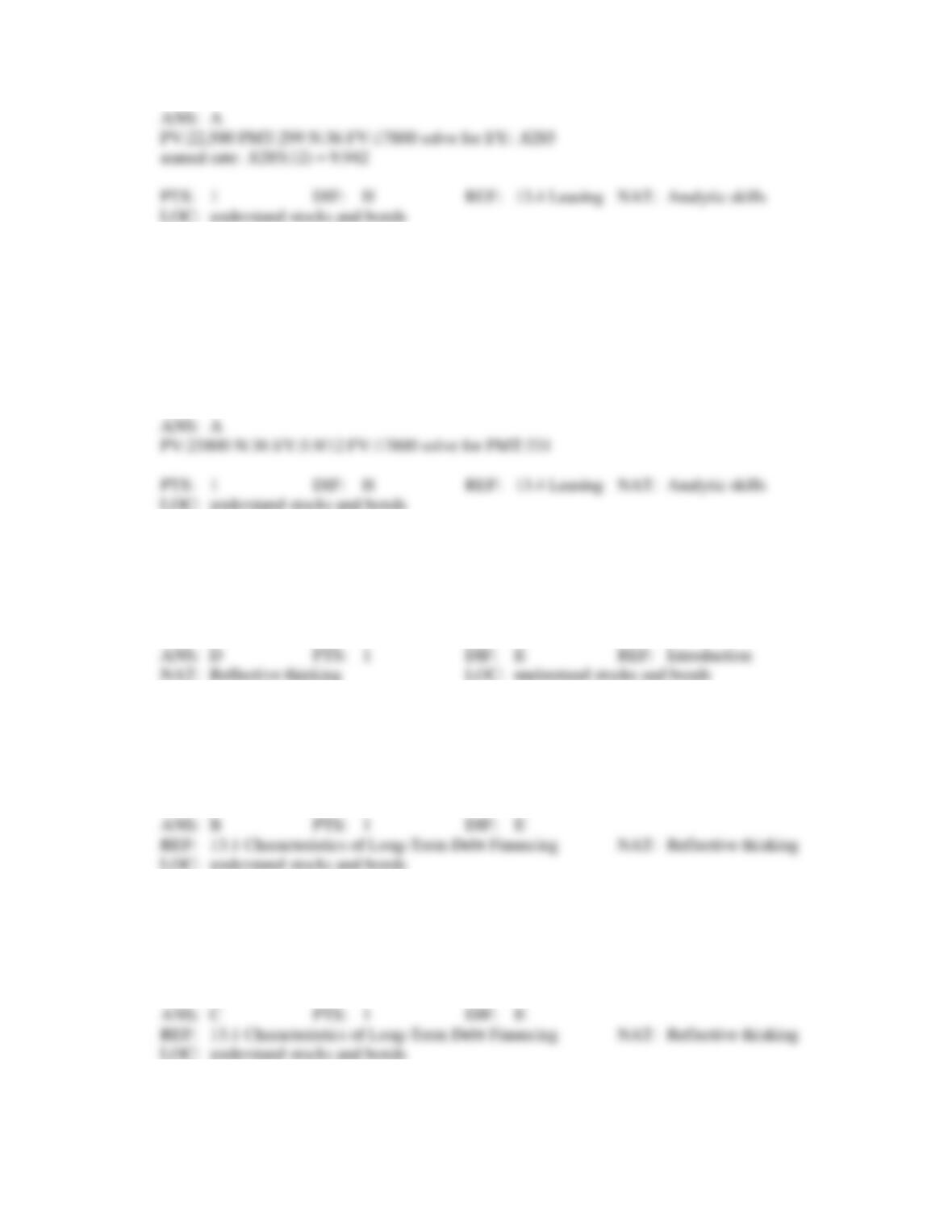
c.
12.345%
d.
7.852%
50. You are contemplating leasing a new car. The monthly lease payments (to be made at the end of each
months) are for 36 months. At the end of the lease you have the option of purchasing the car for
$17,800. If you could finance the car at 5.9% for the same period, what is the most that you should be
willing to pay in monthly lease payments if the sticker price of the car is $25,800?
a.
$331
b.
$299
c.
$413
d.
$199
51. The vast majority of external capital raised by companies each year is
a.
common stock.
b.
preferred stock.
c.
short-term debt.
d.
long-term debt.
52. Accountants classify debt as long-term if
a.
the debt is financing a long-term asset.
b.
the debt matures in more than one year.
c.
the debt matures in more than 6 months.
d.
it is interest bearing.
53. Private debt can take the form of
a.
a private debt agreement arranged between corporate borrowers and financial institutions.
b.
an unregistered security offering sold directly to accredited investors.
c.
both a and b.
d.
none of the above
54. A clause in a borrowing agreement that requires the firm to maintain a given level of debt- equity is
a.
a negative covenant.
b.
a positive covenant.
c.
an active covenant.
d.
none of the above
55. Which of the following would generally be assumed to increase the cost of debt for a firm?
a.
issuing bonds that have a longer-maturity than usual
b.
having a bond issue that is much larger than that of similar sized firms in the same
industry
c.
having a bond issue that is convertible into commons stock
d.
both a and b
56. Which of the following is also referred to as asset-backed lending?
a.
term loans
b.
syndicated loans
c.
project finance loans
d.
all of the above
57. Which of the following is typically arranged for infrastructure projects such as bridges and power
plants?
a.
term loans
b.
syndicated loans
c.
project finance
d.
all of the above
58. If a corporation is looking for a loan that is too large for any one bank to lend to the corporation, then
what type of loan will the firm most likely have to take out?
a.
term loan
b.
syndicated loan
c.
project finance loan
d.
none of the above
59. A firm issues a bond which is secured by a building that the firm will buy with the loan proceeds.
What type of bond has the firm issued?
a.
debenture
b.
income bond
c.
mortgage bond
d.
none of the above