Chapter 13—Investing in Mutual Funds
128. Advantages of exchange-traded funds over mutual funds include all of the following except
a. lower overhead expenses.
b. lower capital gains tax.
c. lower expense ratio.
d. better diversification.
e. longer time horizon.
129. Expected cash flows from real estate investments are determined by
a. rent.
b. depreciation.
c. taxes.
d. all of these.
e. none of these.
130. A downside of investing in income property is
a. depreciation.
b. appreciation in value.
c. low degree of financial leverage.
d. high taxes.
e. maintenance costs.
131. An example of a commercial property is a(n)
a. office building.
b. shopping mall.
c. warehouse.
d. hotel.
Chapter 13—Investing in Mutual Funds
e. all of these.
132. Asset allocation funds invest money in
a. stocks.
b. bonds.
c. real estate.
d. a and b only.
e. all of these.
INSTRUCTIONS: Choose the word or phrase in [ ] which will correctly complete the statement. Select A for the first
item, B for the second item, and C if neither item will correctly complete the statement.
133. [Open-end | Closed-end] mutual funds always redeem shares at NAV.
134. There are [more | fewer] mutual funds than there are stocks listed on the New York Stock Exchange.
135. The value of your shares in a closed-end fund is determined by [the fund’s NAV only | the fund’s NAV plus supply and
demand factors].
Chapter 13—Investing in Mutual Funds
136. The market value of your mutual fund shares will move in the [same | opposite] direction as the market value of the
underlying securities.
137. Usually the management firm of a mutual fund also serves as the [custodian | investment advisor] of the fund.
138. The actual ownership of a mutual fund is in the hands of the [management company | shareholders].
139. You can lose money in a mutual fund because of [fraud of the management company | a downturn in the market].
140. The securities owned by a mutual fund are in the custody of [the management company | an independent bank].
Chapter 13—Investing in Mutual Funds
141. The [custodian | investment advisor] buys and sells the stocks or bonds of a mutual fund.
142. “Mutual fund” technically refers to [an open-end | a closed-end] investment company.
143. Individuals would not trade among themselves in [a closed-end | an open-end] investment company.
144. A mutual fund [does | does not] have to fully disclose its fees in the fund’s prospectus.
Chapter 13—Investing in Mutual Funds
145. A mutual fund cannot charge more than [6.5 | 8.5] percent in total sales charges and fees.
146. The first mutual fund in the United States was started in [1954 | 1924].
147. [Both load and no-load | Only no-load] funds can charge a redemption fee.
148. Growth funds [do | do not] involve a fair amount of risk.
149. A quotation for a mutual fund shows a NAV of $9.60 and an offer price of $10.00. With an investment of $1,000,
you could buy [104.17 | 100] shares.
Chapter 13—Investing in Mutual Funds
150. The cost of buying shares in a load fund is [high | low] compared to the commissions charged for buying stock.
151. All funds will have [management | 12b-1] fees.
152. You [could | could not] learn in the financial press whether your fund charged a redemption fee.
153. You could discover the actual fees charged by your mutual fund in the [daily Wall Street Journal | fund prospectus].
154. [Growth | Equity–income] funds would be more speculative.
Chapter 13—Investing in Mutual Funds
155. The primary investment objective of bond mutual funds is [growth | income].
156. A fund that invests only in utility stocks could be classified as [an industry | a sector] fund.
157. Value funds are comprised of stocks with [low | high] P/E ratios.
158. One type of [stock | bond] fund provides tax-free income.
159. A fund that invests both in foreign and U.S. securities would be known as [an international | a global] fund.
Chapter 13—Investing in Mutual Funds
160. The primary reason for investing in mutual funds is [professional management | diversification].
161. If you choose to have your mutual fund dividends automatically reinvested, you [may defer taxes on the dividends
until you redeem some shares | still owe taxes for the year the dividends were earned].
162. You [could | could not] switch your investments from your Fidelity income fund to another Fidelity fund by making
a phone call.
163. You could drop an automatic investment plan [at any time | only by fulfilling the original agreement].
164. A [global | international] fund invests exclusively in foreign securities.
Chapter 13—Investing in Mutual Funds
165. Index funds, while trying to match market performance, consistently [perform well | perform poorly] against market
benchmarks.
166. An [automatic investment plan | automatic reinvestment plan] gives share owners the option of electing to have
dividends and capital gains distributions reinvested.
167. Value funds look for stocks with relatively [high | low] dividend yields.
168. Advantages of exchange-traded funds over mutual funds include [narrow | broad] industry selection.
169. Advantages of exchange-traded funds over mutual funds include [lower | higher] expense ratio.
Chapter 13—Investing in Mutual Funds
170. Real estate typically exhibits [less | more] volatility than stocks.
171. [Appreciation | Depreciation] gives the property owner an allowance for the decline in the physical condition of real
estate over time.
172. George purchased a large piece of undeveloped land that he plans to hold for future development. This is an example
of [speculating in raw land | investing in income property].
173. Calculating the value of income-producing property requires estimating the [NAV | NOI].
174. First-time real estate investors often purchase [commercial | residential] properties.
Chapter 13—Investing in Mutual Funds
175. [Equity | Mortgage] REITs own income-producing real estate.
176. Exchange-traded funds are investment company shares that trade [at day’s close | throughout the day] on stock
exchanges.
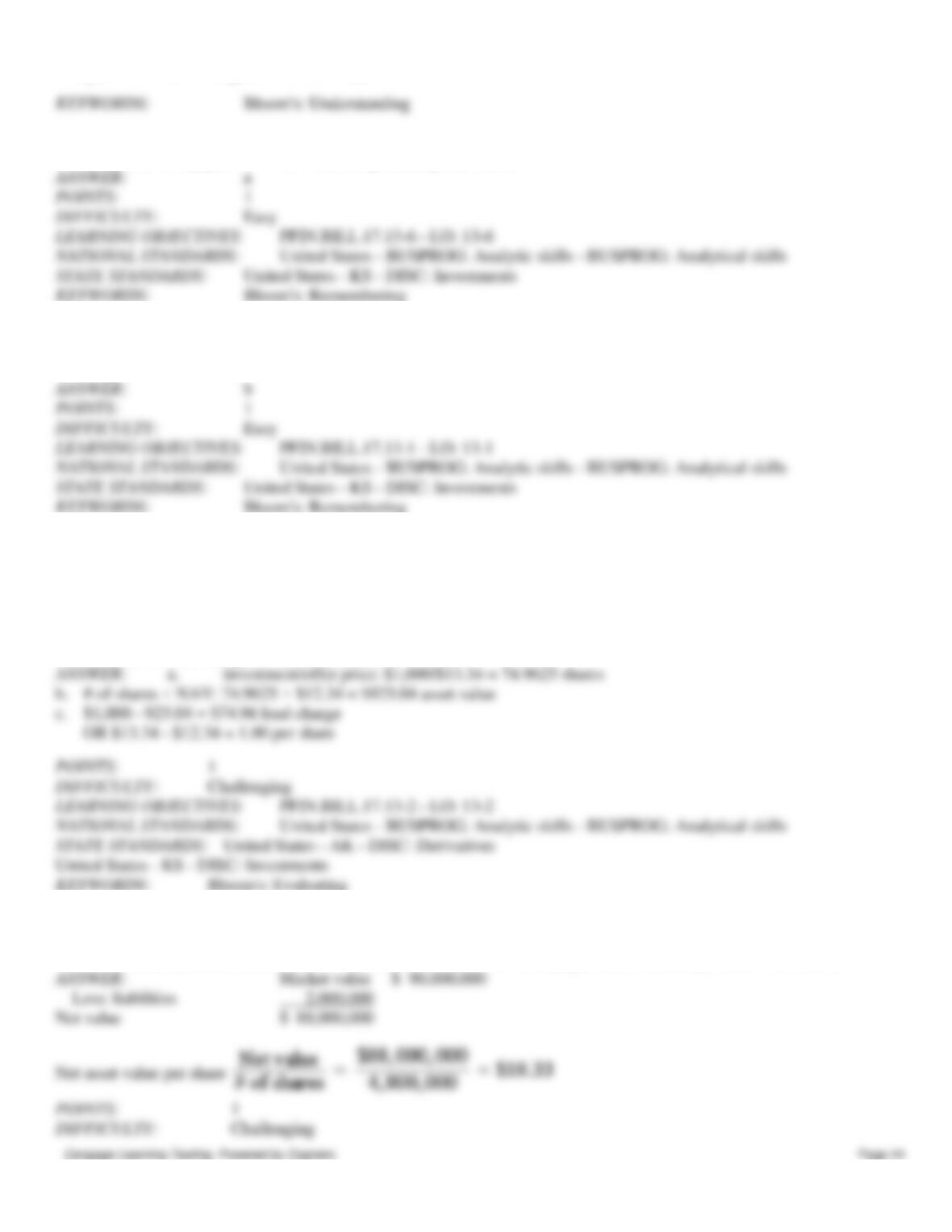
177. The KLM Mutual Fund has a net asset value of $12.34 and an offer price of $13.34. Use this information to answer
the following questions. (Show all work.)
a. How many shares will you receive when you invest $1,000?
b. What is the immediate asset value of these shares?
c. What is the load charge for this transaction?
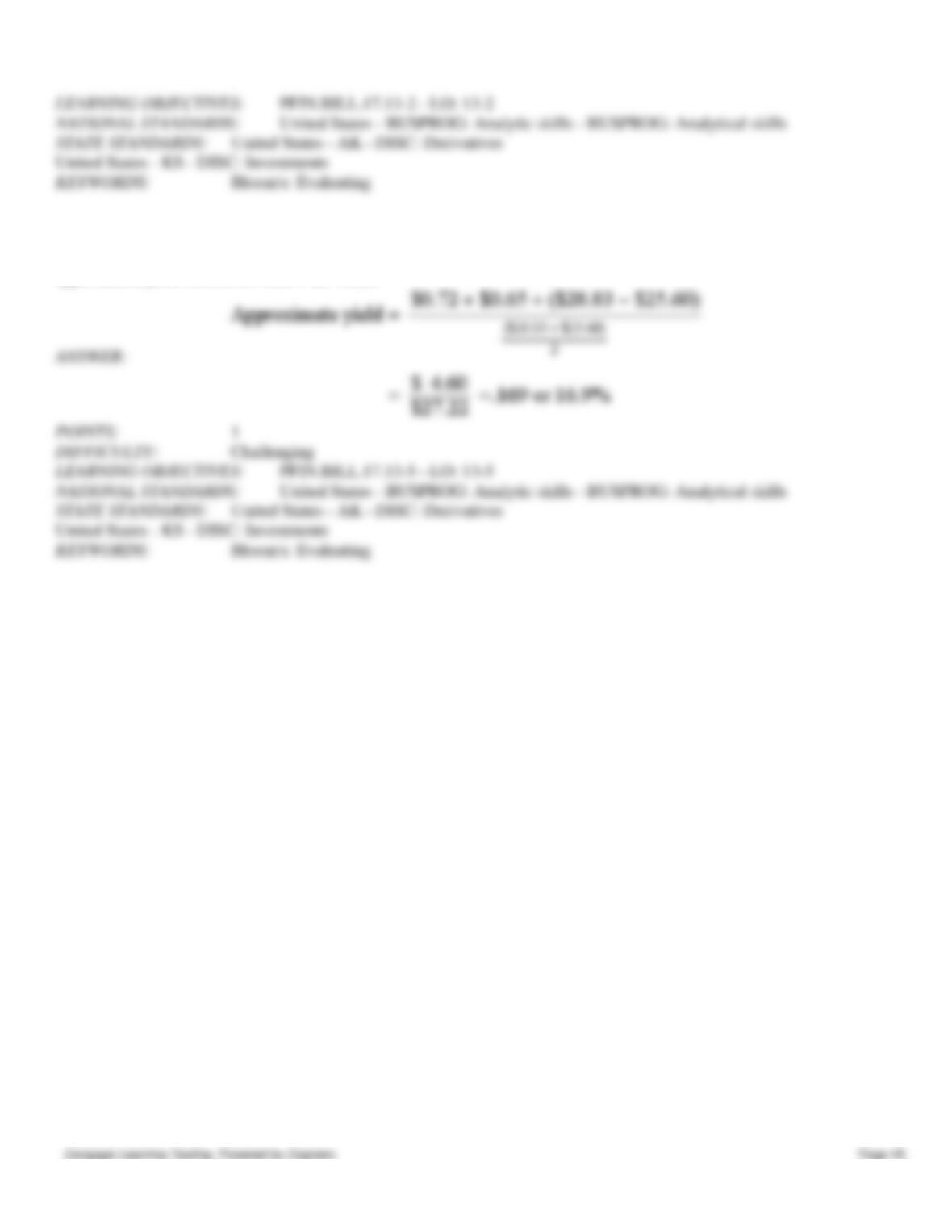
178. Creviston Mutual Fund, a load fund, holds securities valued at $90,000,000 on August 30. The fund had liabilities of
$2,000,000 and 4,800,000 shares outstanding. Calculate the net asset value per share on this day. (Show all work.)
Chapter 13—Investing in Mutual Funds
179. RACE Mutual fund is a no-load fund that had a net asset value one year ago of $25.60. Today the NAV is $28.83.
During the year dividends of $0.72 were paid out and a capital gains distribution of $0.65 was made. Calculate the
approximate yield for RACE. (Show all work.)