11) A corporation has been paying out $1 million per year in dividends for the past several years.
This year, the company wants to pay the $1 million dividend, but can’t. All of the following are
reasons the company cannot continue its dividend payment policy except:
A) the company’s net income this year is less than $1 million.
B) the company’s retained earnings balance at the end of the year is less than $1 million.
C) the company’s cash balance is less than $1 million.
D) the company’s liabilities exceed its assets.
12) The difference between the capital gains tax rate and the income tax rate is an incentive for
A) firms never to split their stock.
B) firms to declare more stock dividends.
C) firms to pay more earnings as dividends.
D) firms to retain more earnings.
13) Flotation costs:
A) include the fees paid to the investment bankers, lawyers, and accountants involved in selling a
new security issue.
B) encourage firms to pay large dividends.
C) are encountered whenever a firm fails to pay a dividend.
D) are incurred when investors fail to cash their dividend check.
14) Dividend policy is influenced by:
A) a company’s investment opportunities.
B) a firm’s capital structure mix.
C) a company’s availability of internally generated funds.
D) all of the above.
15) All of the following conclusions on the importance of a dividend policy are true except:
A) as a firm’s investment opportunities increase, the dividend payout ratio should decrease.
B) the firm’s expected earning power and the riskiness of these earnings are more important to
the investor than the dividend policy.
C) dividends may influence stock price by the investor’s desire to minimize and/or defer taxes
and from the role of dividends in minimizing agency costs.
D) in order to avoid surprising investors, management should anticipate financing needs for the
short-term, but not for the long term.
16) While Captive, Inc. has been in business for over 50 years, newly developed products pushed
the firm’s year-over-year growth rate to 35% during the latest three years. The firm is proud of its
history of paying dividends, but the vigorous recent growth of the firm has left it cash
challenged. Which of the following policies/procedures would you consider best under the
circumstances?
A) Borrow long-term to pay the current dividend.
B) Look seriously for a merger partner.
C) Enter into a long-term stock repurchase program.
D) Substitute a stock dividend for the current cash dividend.
17) LAW, Inc. settled a large lawsuit that caused earnings to be negative for the quarter. This
quarterly loss was the first in 22 years. In addition, the company has a record of 48 consecutive
quarters of dividend payments. Which of the following is correct?
A) The company cannot pay dividends this quarter since the company had no earnings.
B) The company can use cash generated through prior retention of earnings, or borrowed funds
to pay the dividend.
C) The company can omit the dividend; shareholders are always understanding about the
riskiness of business.
D) The clientele effect says that investor choice of investment vehicle is independent of dividend
policy and therefore the payment/omission of the dividend is immaterial.
13.4 Learning Objective 4
1) Other things equal, in imperfect markets a firm that maintains a stable dividend will have a
lower required rate of return on its equity.
2) Other things equal, individuals in high-income tax brackets should have a preference for firms
that retain their earnings rather than pay dividends.
3) JLI Corp. had earnings per share of $4 per share last year and paid a dividend of $1 per share.
For the current year, JLI Corp. generated earnings per share of $6 and paid a dividend of $1 per
share. This is an example of what type of dividend policy?
A) constant dividend payout ratio
B) stable dollar dividend per share
C) small, regular dividend plus a year-end extra
D) payout ratio equal to zero
4) Corporation A’s dividend policy is to maintain a constant payout ratio. This year Corporation
A paid out a total of $2 million in dividends. Next year, Corporation A’s sales and earnings per
share are expected to increase. Dividend payments are expected to
A) remain at $2 million.
B) increase above $2 million.
C) decrease below $2 million.
D) increase above $2 million only if the company issues additional shares of common stock.
5) The CEO of Marletti Pasta Company wants a dividend policy that minimizes the likelihood of
decreasing the company’s dividend per share. Which of the following policies should the CEO
select?
A) constant dividend payout ratio
B) stable dollar dividend per share
C) regular dividend plus a year-end extra
D) All policies have the same likelihood of a dividend decrease because dividend changes are
dependent on changes in earnings.
6) Which of the following dividend policies will cause dividends per share to fluctuate the most?
A) constant dividend payout ratio
B) stable dollar dividend
C) small, low, regular dividend plus a year-end extra
D) no difference between the various dividend policies
7) A firm that maintains a “stable dollar dividend per share” will generally not increase the
dividend unless
A) a stock split occurs.
B) the firm merges with another profitable firm.
C) the firm is sure that a higher dividend level can be maintained.
D) the P/E ratio has increased steadily over the past 5 years.
8) The problem with the constant dividend payout ratio is
A) investors may come to expect a specified amount.
B) the dollar amount of the dividend fluctuates from year to year.
C) management is reluctant to cut the dividend even if there are low profits that year.
D) management cannot decrease the dividend when times are tough.
9) You are a retired worker whose income is derived from your company pension plan and social
security. However, you are highly dependent upon the income generated from your 401(k) plan,
which is heavily weighted in stocks that pay substantial dividends. Which of the following
dividend policies would you prefer?
A) Constant dividend payment ratio
B) Stable dollar dividend per share
C) Small, regular dividend plus a year-end extra
D) Any of the above would be equally desirable
10) Which of the following is (are) false?
A) The constant dividend payout ratio policy seeks to pay a constant percentage of earnings each
year.
B) The stable dollar dividend per share policy seeks to maintain a relatively stable percentage
dividend over time.
C) The small, regular dividend plus a year-end extra policy pays a small, regular dividend plus a
year-end extra dividend in good years.
D) The constant dividend payout ratio policy will result in more variability in dividends than the
stable dollar dividend per share policy.
11) Trevor Co.’s future earnings for the next four years are predicted below. Assuming there are
500,000 shares outstanding, what will the yearly dividend per share be if the dividend policy is:
Trevor & Co.
1 $ 900,000
2 1,200,000
3 850,000
4 1,350,000
a. a constant payout ratio of 40%
b. stable dollar dividend targeted at 40% of the average earnings over the four-year period
c. small, regular dividend of $0.75 plus a year-end extra of 40% of profits exceeding $1,000,000
12) Describe the types of dividend policies that corporations frequently use. Which is most
common? Why?
27
13.5 Learning Objective 5
1) The ex-dividend date occurs prior to the declaration date.
2) The ex-dividend date is typically two days prior to the payment date of the dividend.
3) BTW Corp. Declared a $1.00 dividend on January 5th, with an ex-dividend date of January
19th, a record date of January 21st, and a payment date of March 15th. Joe purchased BTW
stock on January 6th.
A) Joe will not receive the dividend because he purchased the stock after the declaration date.
B) Joe will not receive the dividend because he purchased the stock prior to the record date.
C) Joe will receive the dividend if he still sells his stock on January 20th because he owned the
stock on the ex-dividend date.
D) Joe will receive the dividend if he still owns the stock on January 21st, even if he sells the
stock before the payment date.
4) Howton Corporation declared a dividend of $1 per share on March 1. The ex-dividend date is
March 15th, and the payment date is april 1st. The most likely record date is
A) February 27th.
B) March 17th.
C) March 13th.
D) March 29th.
5) CDE Corporation declared a $2 per share dividend on October 1. The date of record is
October 20th, the ex-dividend date is October 18th, and the payment date is October 31st. Joe
owns a share of stock on October 1. Joe sells his share to Mary on October 19th, and Mary sells
the share to Tom on October 29th. Who will receive the dividend?
A) Joe
B) Mary
C) Tom
D) No one, since the share was not owned consistently by one person over the period.
6) Arden Corporation pays a quarterly dividend of $1.00 per share. Which of the following
statements is most accurate concerning which shareholders will receive the dividend payment?
A) The shareholders who own the stock on the date the dividend is declared will receive the
dividend, even if they sell their stock before the dividend checks are mailed.
B) The shareholders who are identified as owning the stock on the record date will receive the
dividend, even if they sell their stock before the dividend checks are mailed.
C) The shareholders who own the stock the day the dividend is paid will receive the dividend.
D) All shareholders who own the stock on the record date, but sell the stock before the dividend
checks are mailed, forfeit their right to receive the dividend and the money reverts back to the
corporation.
7) The final approval of a dividend payment comes from
A) the controller.
B) the president of the company.
C) the board of directors.
D) It is a joint decision requiring approval from all of the above.
8) How frequently do corporations generally pay dividends?
A) Annually
B) Semi-annually
C) Quarterly
D) Monthly
9) The correct order of dividend process dates is
A) date of record, declaration date, ex-dividend date, payment date.
B) declaration date, date of record, ex-dividend date, payment date.
C) ex-dividend date, date of record, declaration date, payment date.
D) declaration date, ex-dividend date, date of record, payment date.
13.6 Learning Objective 6
1) A stock split is defined as a stock dividend exceeding 25%.
2) Investor A owns 10% of the common stock of IDE Corporation. After IDE completes a 2-for-
1 stock split, Investor A will own 20% of the common stock of the corporation.
3) A 100% stock dividend and a 2-for-1 stock split will result in the same number of shares of
stock being held by investors after the transaction is completed.
4) There is no difference on an economic basis between a stock dividend and a stock split.
5) After a stock split of 2:1, each investor will have twice the number of shares, but the same
percentage ownership in the firm that he had before the split.
6) Conceptually, stock dividends and stock splits may be expected to increase the shareholder‘s
value.
7) If John owns 5% of XYZ corporation before its 2 for 1 stock split, John will own 5% of XYZ
corporation after the stock split as well.
8) A firm’s stock price may decline by less than 50% after a 2 for 1 stock split if the reduction in
price moves the stock into its optimal trading range.
9) A stock dividend differs from a stock split because in a stock split, the par value of the
company’s stock is reduced, while the par value remains the same after a stock dividend is paid.
10) JB Appliance, Inc. stock is currently selling for $20 per share. The company completed a 5–
for-1 stock split two days earlier. Two years ago, the company had a 2-for-1 stock split. If the
stock splits had not happened, the price of JB Appliance, Inc. stock would, other things being
equal, be
A) $140.00 per share.
B) $200.00 per share.
C) $100.00 per share.
D) $2.00 per share.
11) Sam owns 1,000 shares of XYZ Corporation’s common stock. The stock has a par value of
$1 per share and is currently selling for $80 per share. XYZ declares a 20% stock dividend. In a
perfect capital market, after the dividend Sam will have
A) 1,200 shares selling for $66.67 each.
B) 1,020 shares selling for $80.80 each.
C) 1,200 shares selling for $96.00 each.
D) 1,020 shares selling for $64.00 each.
12) Stock dividends
A) decrease stock prices because no cash goes to shareholders but companies pay transactions
costs.
B) may increase stock prices if the dividend is used to maintain on optimal trading range for the
common stock.
C) may increase stock prices if investors perceive the dividend as containing favorable
information about the firm’s future prospects.
D) Both B and C are true.
13) Sam owns 5,000 shares of stock in Global X Corporation with a market value of $15,000.
Global X declares a 20% stock dividend. After the dividend is paid, Sam owns
A) 6,000 shares with a market value of $18,000.
B) 6,000 shares with a market value of $15,000.
C) 5,100 shares with a market value of $15,300.
D) 5,000 shares with a market value of $18,000.
14) Cryptic Corporation has 10 million shares of stock outstanding. Cryptic’s after-tax profits are
$140 million and the corporation’s stock is selling at a price-earnings multiple of 18, for a stock
price of $252 per share. Cryptic’s management issues a 40% stock dividend. What is the effect
on an investor who owns 100 shares of Cryptic before the dividend if Cryptic’s price-earnings
multiple remains the same after the dividend is paid?
A) The investor will own 140 shares worth $25,200.
B) The investor will own 140 shares worth $35,280.
C) The investor will own 100 shares worth $25,200.
D) The investor will own 100 shares worth $35,280.
15) Which of the following transactions will decrease a corporation’s retained earnings?
A) The corporation declares and pays a $2 per share cash dividend.
B) The company completes a 2 for 1 stock split.
C) The company pays a 20% stock dividend.
D) Both A and C.
16) For accounting purposes a stock split has been defined as a stock dividend exceeding
A) 25 percent.
B) 35 percent.
C) 50 percent.
D) 66 2/3 percent.
17) All of the following are rationales given for a stock dividend or split except:
A) the price will not fall proportionately to the share increase.
B) an optimum price range does not exist.
C) there is positive informational content associated with the announcement.
D) conservation of corporate cash.
18) Which of the following is the most valid reason to split a stock that has a market price of
$110 per share?
A) Conserve cash.
B) Reduce the market price to a more popular trading range.
C) Obtain additional capital.
D) Increase investor’s net worth.
19) What is the economic difference between a stock dividend and a stock split?
A) Stock splits create greater economic benefits to shareholders than stock dividends.
B) Stock splits increase EPS more than stock dividends.
C) There is no economic difference between a stock dividend and a stock split.
D) Stock dividends create greater economic benefits to shareholders than stock splits.
20) Assume that Harris, Inc. has 10,000,000 common shares outstanding that have a par value of
$2 per share. The stock is currently trading for $30 per share. The firm reported a net profit after–
tax of $25,000,000. All else equal, what will happen to earnings per share if the company issues
a 10% stock dividend?
A) Earnings per share will remain the same since a stock dividend does not create an expense.
B) Earnings per share will increase because the dividend increases the value of the company.
C) Earnings per share will decrease because the number of shares outstanding will go up.
D) The impact cannot be determined without additional information on the new price per share.
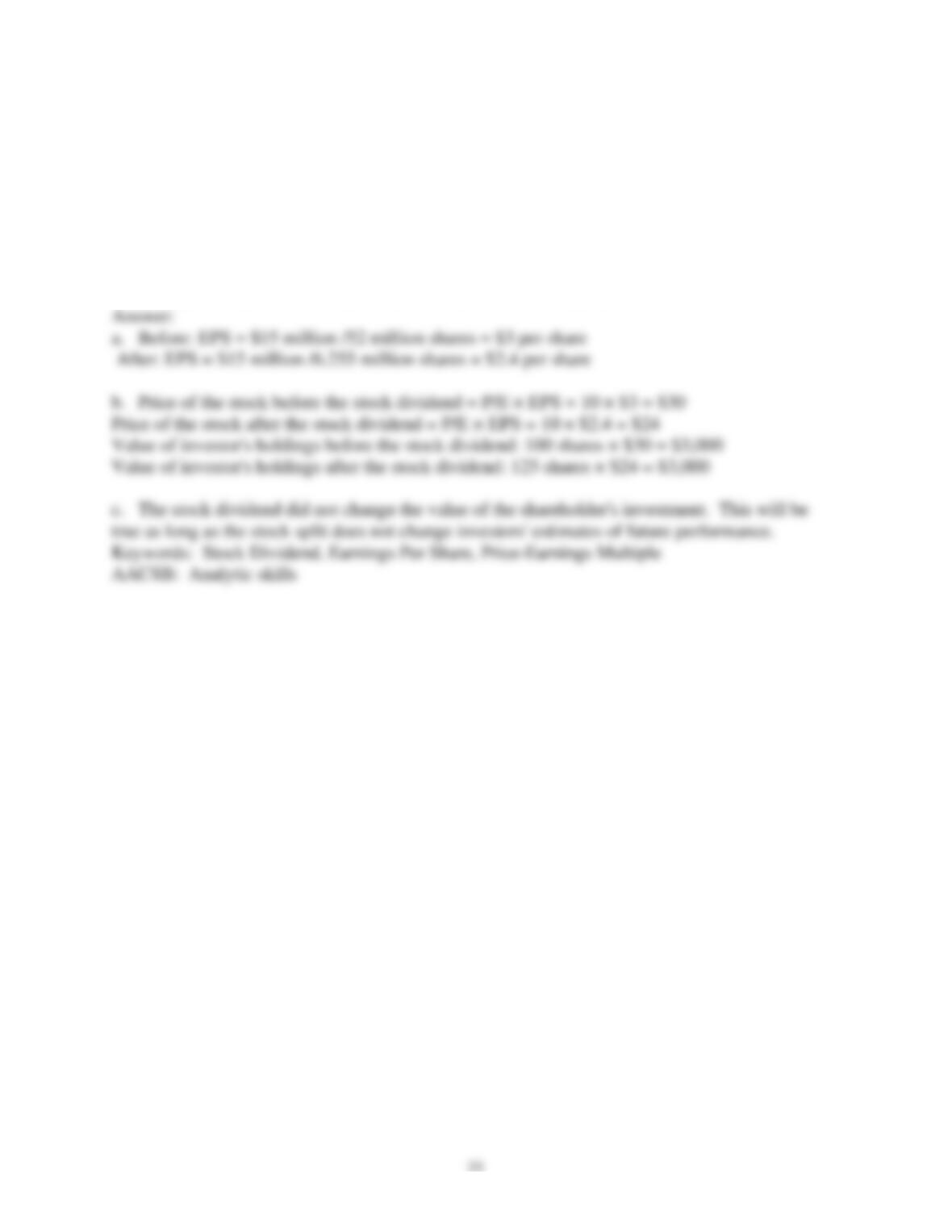
21) Cyberco Corporation has 5 million shares of stock outstanding. Cyberco’s after-tax profits
are $15 million and the corporation’s stock is selling at a price-earnings multiple of 10, for a
stock price of $30 per share. Cyberco management issues a 25% stock dividend.
a. Calculate Cyberco’s earnings per share before and after the stock dividend.
b. Suppose an investor owns 100 shares of Cyberco before the stock dividend. Use the price
earnings multiple to estimate the value of the investor’s holdings both before and after the
dividend.
c. Comment on the results of the stock dividend for current shareholders.
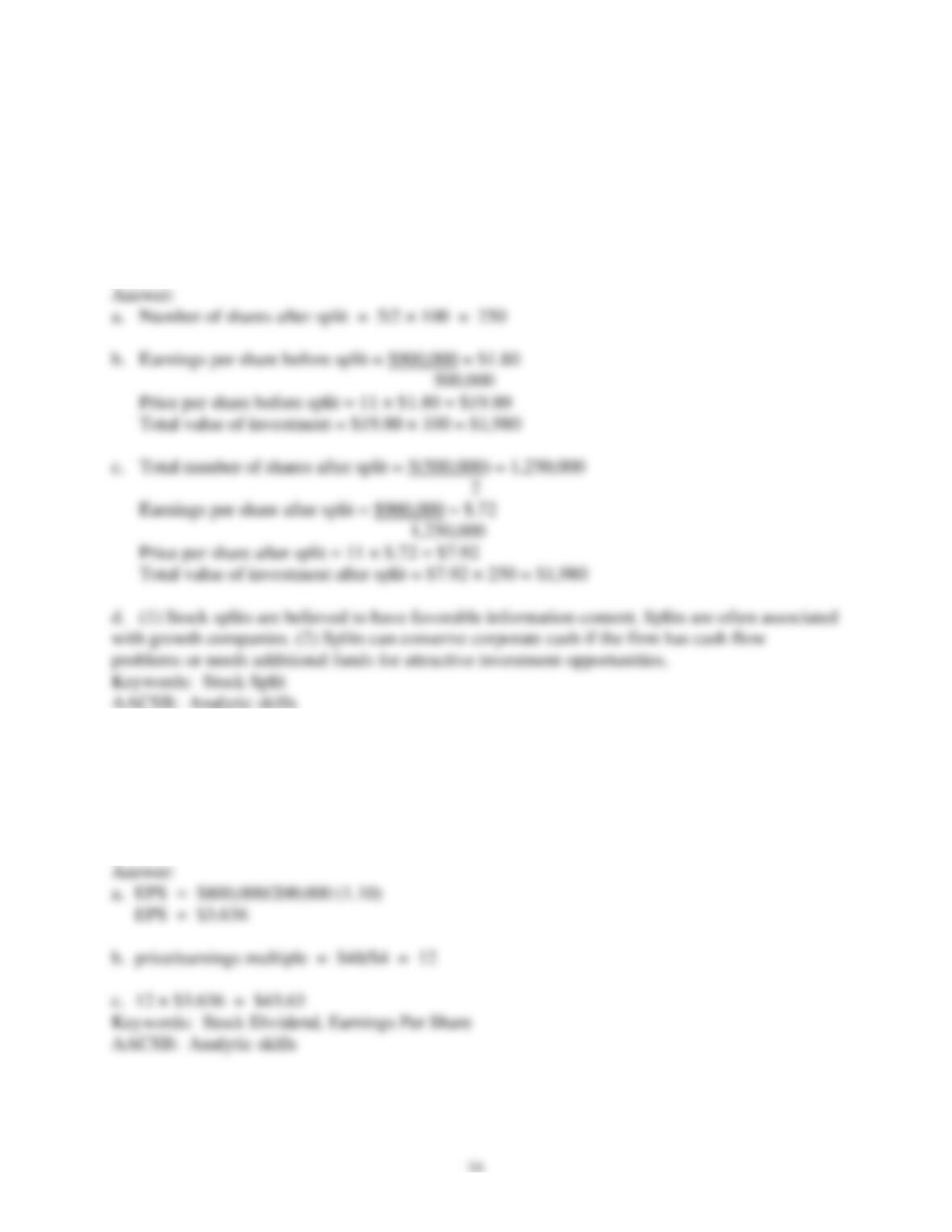
22) Dryden, Corp. has 500,000 shares of common stock outstanding, a P/E ratio of 11, and
$900,000 earnings available for common stockholders. The board of directors has just voted a
5:2 stock split.
a. If you had 100 shares of stock before the split, how many shares will you have after the split?
b. What was the total value of your investment in Dryden stock before the split?
c. What should be the total value of your investment in Dryden stock after the split?
d. In view of your answers to (b) and (c) above, why would a firm’s management want to have a
stock split?
23) Ted Tech Inc. is offering a 10% stock dividend. The firm currently has 200,000 shares
outstanding and after-tax profits of $800,000. The current price of the stock is $48.
a. Calculate the new earnings per share.
b. What is the original price/earnings multiple?
c. Providing that the price/earnings multiple stays the same, what will the new stock price be
after the stock dividend?
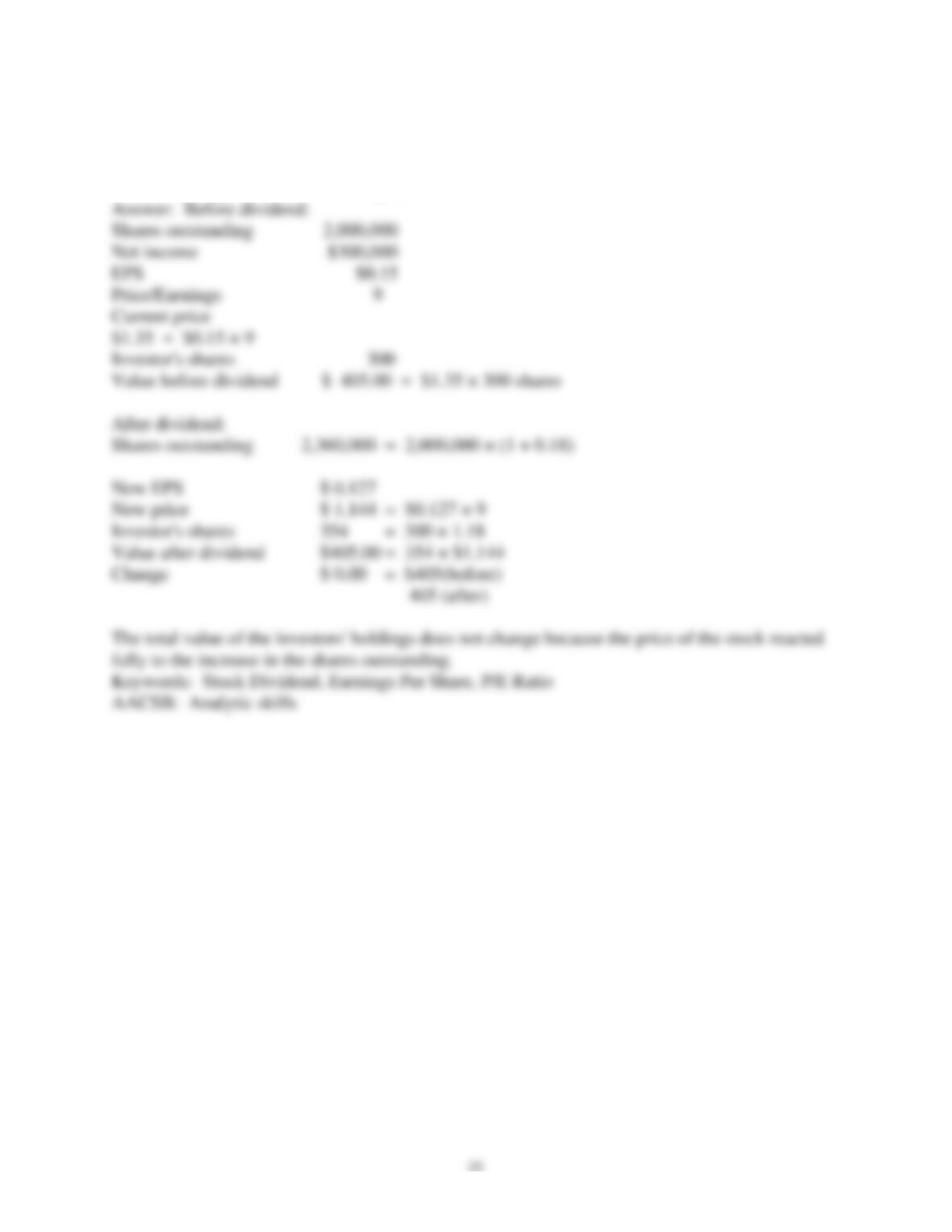
24) Outpost has 2 million shares of common stock outstanding; net income is $300,000; the P/E
ratio is 9; and management is considering an 18% stock dividend. What will be the expected
effect on the price of the common stock? If an investor owns 300 shares in the company, how
does this change his total value? Explain.
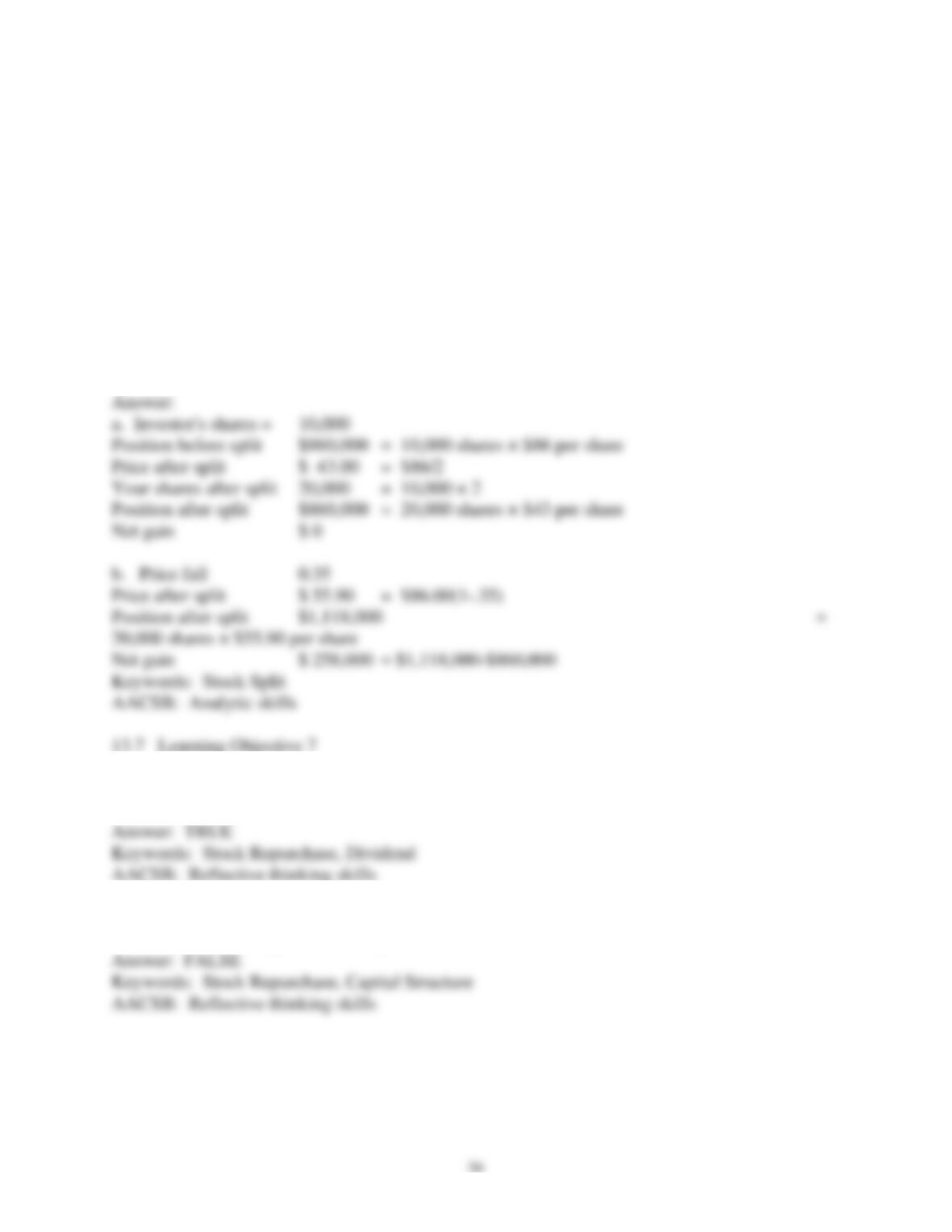
25) Kelly owns 10,000 shares in McCormick Spices, which currently has 500,000 shares
outstanding. The stock sells for $86 on the open market. McCormick’s management has decided
on a two-for-one split.
a. Will Kelly’s financial position change after the split, assuming that the stock’s price will
fall proportionately?
Trevor Corporation – Stock Split
Market price $ 86.00
Split multiple 2
Shares outstanding 500,000
b. Assuming only a 35% decrease in the stock price, what will be Kelly’s value after the
split?
1) From the shareholders’ perspective, a stock repurchase has a potential tax advantage over the
payment of a cash dividend.
2) Stock repurchases do not alter a company’s capital structure since all of the purchased shares
are retired and no longer outstanding.
3) Shareholders may prefer a share repurchase program to dividends because dividends are
subject to taxation and increasing value per share due to repurchase programs is tax deferred.
4) A stock repurchase plan that involves issuing long-term debt to fund the purchase of the
company’s stock may be used as a way to alter a corporation’s capital structure.
5) A stock repurchase plan can be viewed as both a financing decision and an investment
decision.
6) SEC regulations require that corporate stock repurchases must be done in the open market so
that all shareholders have an equal opportunity to sell their shares.
7) One potential reason for a share repurchase is
A) to increase the power of a minority group of shareholders.
B) maximize the dilution in earnings associated with a merger.
C) a reduction in the firm’s cost associated with servicing small stockholders.
D) to signal the market that the firm’s stock price is too high.
8) All of the following are potential benefits of stock repurchases except:
A) a means for providing an internal investment opportunity.
B) an approach for maintaining the existing capital structure while still making a distribution to
shareholders.
C) a favorable impact on earnings per share.
D) the elimination of a minority ownership group of stockholders.
9) Which of the following statements concerning stock repurchases is most correct?
A) Increasingly companies are using stock repurchases to distribute cash to their shareholders,
but dividends remain the primary means to distribute cash.
B) Companies currently spend more money on stock buybacks than on dividend payments.
C) Repurchasing stock is strictly a financing decision made by the corporation.
D) A tender offer is the only way to complete a stock repurchase due to SEC rules.
10) Stock repurchases may be used for all of the following except:
A) a means for providing an internal investment opportunity.
B) to improve earnings per share.
C) to decrease the corporation’s debt ratio.
D) to eliminate a minority ownership group of stockholders.
11) Which of the following strategies may be used to alter a firm’s capital structure toward a
higher percentage of debt compared to equity?
A) stock dividend
B) stock split
C) maintain a low dividend payout ratio
D) stock repurchase
12) A stock repurchase may be viewed as
A) a dividend decision when the firm has excess cash.
B) a financing decision when the firm wants to alter its capital structure.
C) an operating leverage decision.
D) Both A and B.
13) All of the following are methods available to a corporation that desires to repurchase stock
except:
A) offering to employees who own an interest in the firm.
B) open market.
C) tender offer to all existing stockholders.
D) offer to one or more major stockholders on a negotiated basis.
14) Which of the following will result from a stock repurchase?
A) Earnings per share will rise.
B) Number of shares will increase.
C) Corporate cash is conserved.
D) Ownership is diluted.