Chapter 13 – Risk and Capital Budgeting
58. A project’s cash flows have a beta of 1.2, a standard deviation of $340, and a coefficient of
variation of 0.40. What is the expected cash flow?
59. Which investment has the least amount of risk?

Chapter 13 – Risk and Capital Budgeting
60. Risk may be integrated into capital budgeting decisions by
61. The firm’s highest risk-adjusted discount should be applied to
62. Using the risk-adjusted discount rate approach, projects with high coefficients of variation
will have ______ net present values than projects with low coefficients of variation and
similar cash flows.

Chapter 13 – Risk and Capital Budgeting
63. Using the risk-adjusted discount rate approach, the cost of capital is applied to projects
with:
64. Using the risk-adjusted discount rate approach, the firm’s weighted average cost of capital
is applied to projects with:
65. In order to evaluate risk, management may also set qualitative risk classes. Rank these
four projects from the least to the most risky.
Completely new market in United States.
Completely new market in South America.
Addition to normal product line.
Repair to old machinery.
Chapter 13 – Risk and Capital Budgeting
66. Place the following investment decisions in order from the lowest risk to the highest risk:
67. A “what if” simulation using a computer helps to:
68. Simulation models allow the planner to:
Chapter 13 – Risk and Capital Budgeting
69. Which of the following is a common approach in dealing with uncertainty?
70. A Monte Carlo simulation model uses:
71. An al tool which helps to organize the decision process by presenting a graphical
comparison of investment choices is called a
Chapter 13 – Risk and Capital Budgeting
72. The portfolio effect in capital budgeting refers to
73. An example of negative correlation may exist between the
74. A correlation coefficient of zero indicates
Chapter 13 – Risk and Capital Budgeting
75. In order to reduce risk in a firm, the firm would seek to enter a business that
76. The lower the coefficient of correlation the greater the
77. The coefficient of correlation
Chapter 13 – Risk and Capital Budgeting
78. In a portfolio, risk is evaluated in a different way than with an individual project. In
evaluating portfolio risk we
79. Projects that are negatively correlated
80. A correlation coefficient of _____ provides no risk reduction.

Chapter 13 – Risk and Capital Budgeting
81. A correlation coefficient of _____ provides the greatest risk reduction.
82. Projects that are totally uncorrelated provide:
83. A correlation coefficient of _____ provides the greatest possible risk reduction to the
firm.

Chapter 13 – Risk and Capital Budgeting
84. A project that carries a normal amount of risk and does not affect the risk exposure of the
firm should be discounted back at the:
85. The “efficient frontier” indicates
86. All of the following are methods of evaluating the risk of a project except:

Chapter 13 – Risk and Capital Budgeting
87. When considering the efficient frontier, financial managers should adhere to all of the
following guidelines except:
88. Which of the following combinations of investments would provide the firm with the
highest negative correlation?
Chapter 13 – Risk and Capital Budgeting
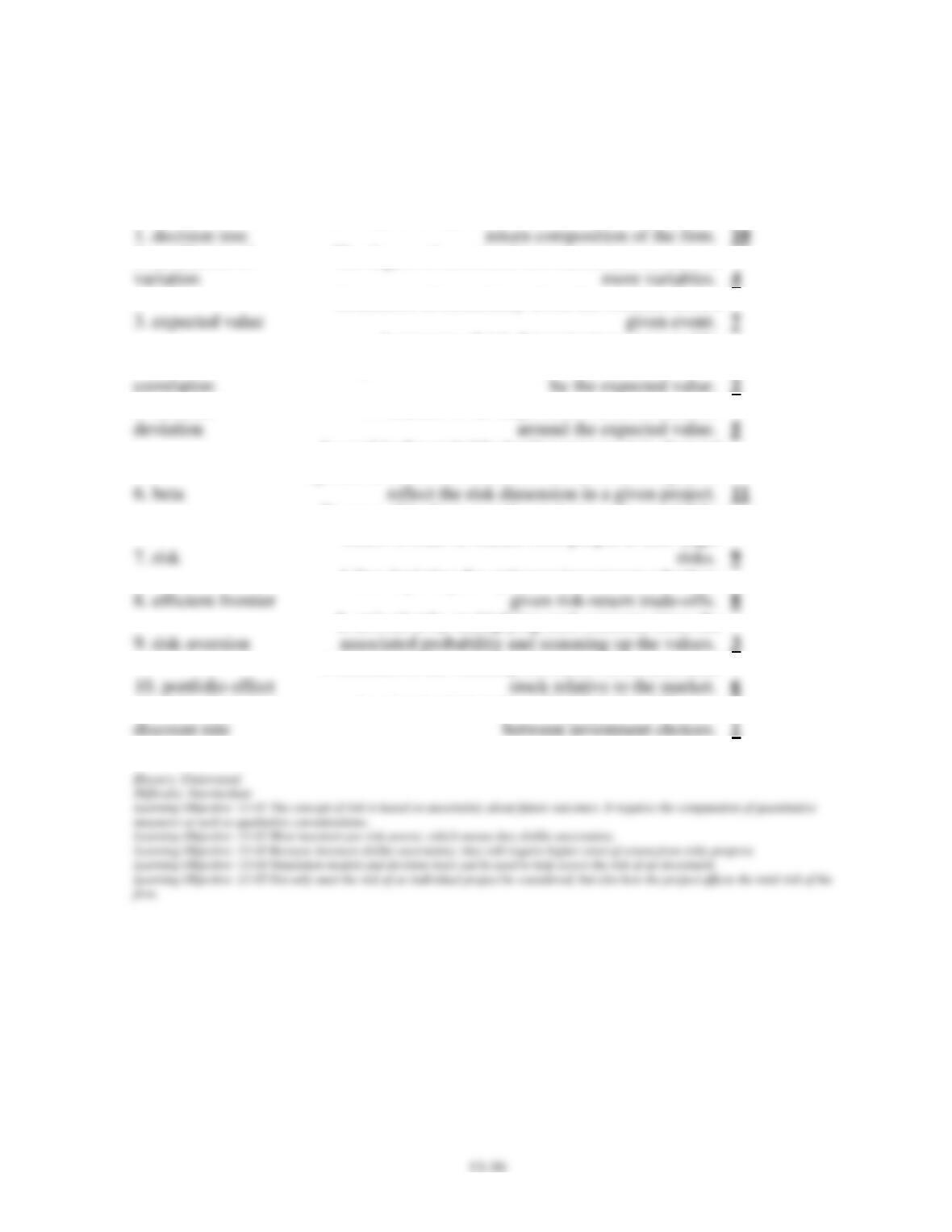
89. Match the following with the items below:
The impact of a given investment on the overall risk-
2. coefficient of
The degree of associated movement between two or
A measure of uncertainty about the outcome from a
4. coefficient of
A measure of risk determination computed by
dividing the standard deviation for a series of outcomes
5. standard
A measure of the dispersion of a set of numbers
As used in the capital budgeting process, it is changed
upward or downward from the normal cost of capital to
Because of it, there must be an increased potential for
return in order to induce most people to take larger
A line depicting the optimum investment selections
Is arrived at by multiplying each outcome times the
A measure of the volatility of returns on an individual
11. risk-adjusted
An al tool which helps to highlight the difference
Chapter 13 – Risk and Capital Budgeting
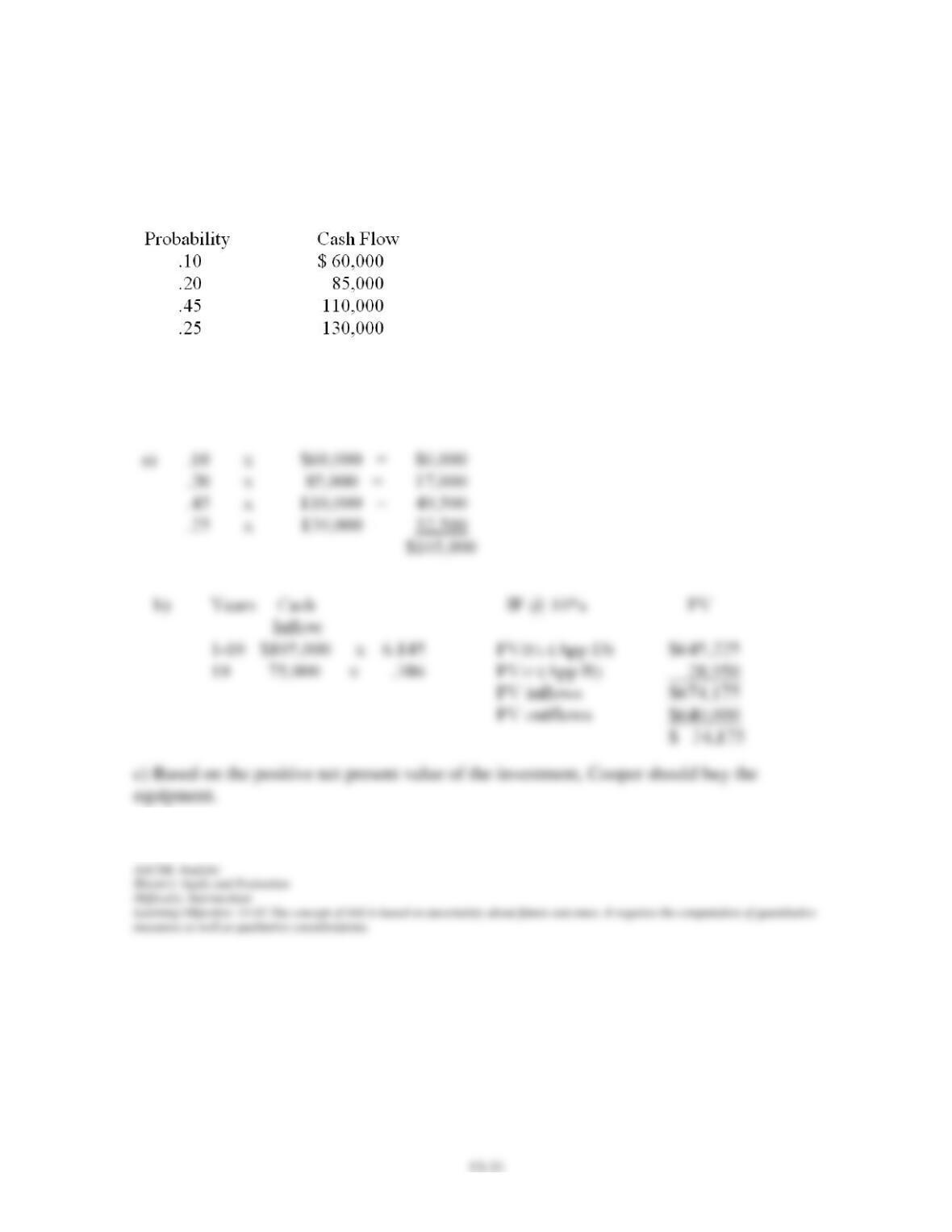
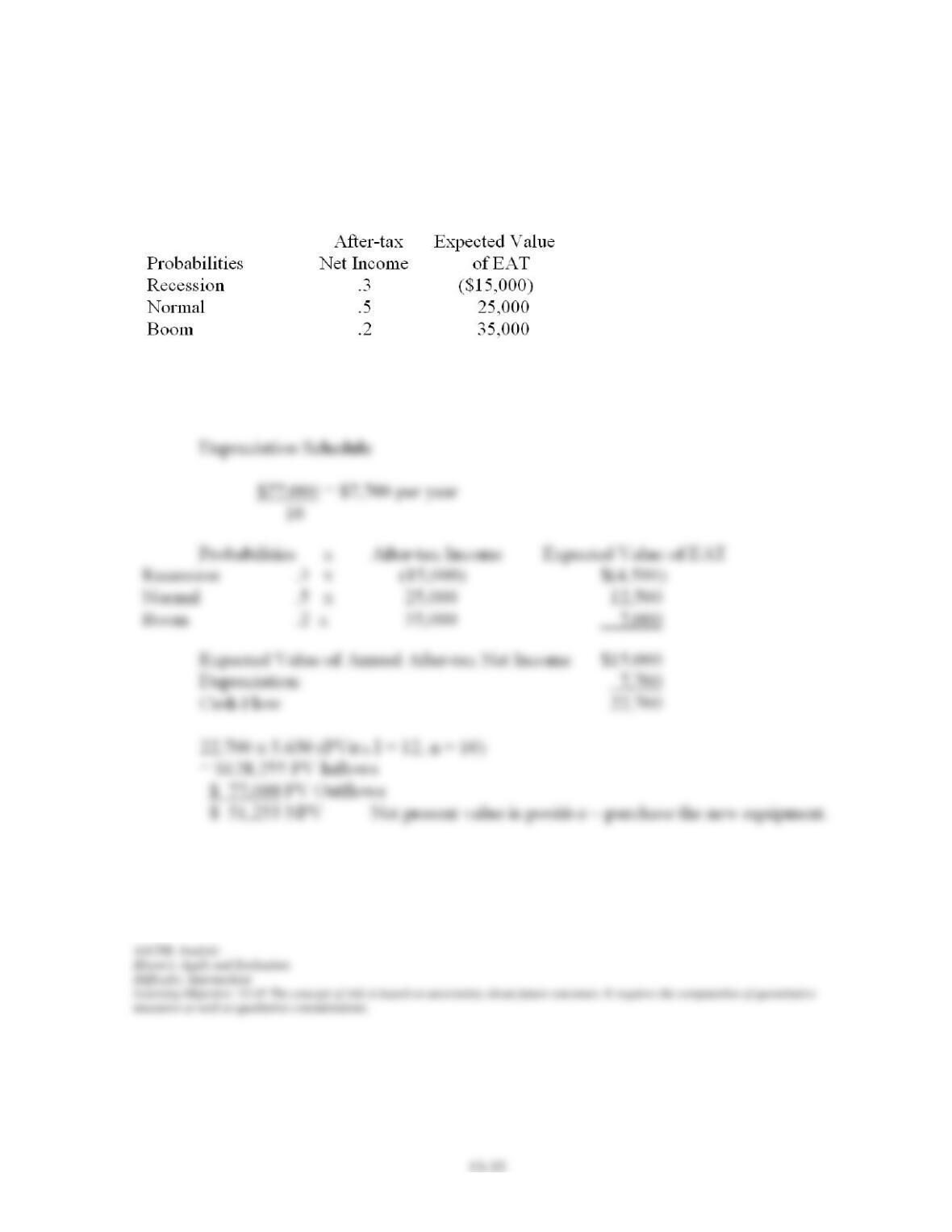
90. Cooper Construction is considering purchasing new, technologically advanced equipment.
The equipment will cost $640,000 with a salvage value of $75,000 at the end of its useful life
of 10 years. The equipment is expected to generate additional annual cash inflows with the
following probabilities for the next ten years:
a) What is the expected cash flow?
b) Cooper’s cost of capital is 10%. What is the expected net present value?
c) Should Cooper buy the equipment?
Chapter 13 – Risk and Capital Budgeting
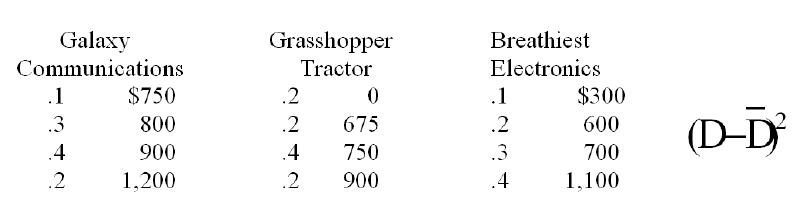
91. Golden Corporation is considering the purchase of new equipment costing $77,000. The
expected life of the equipment is 10 years. The potential increase in annual net income from
the new equipment for the next 10 years depends on the state of the economy as follows.
The equipment will be depreciated using straight line depreciation. Golden’s cost of capital is
12%. What is the expected NPV? Should they purchase the new equipment?
Chapter 13 – Risk and Capital Budgeting
13–33
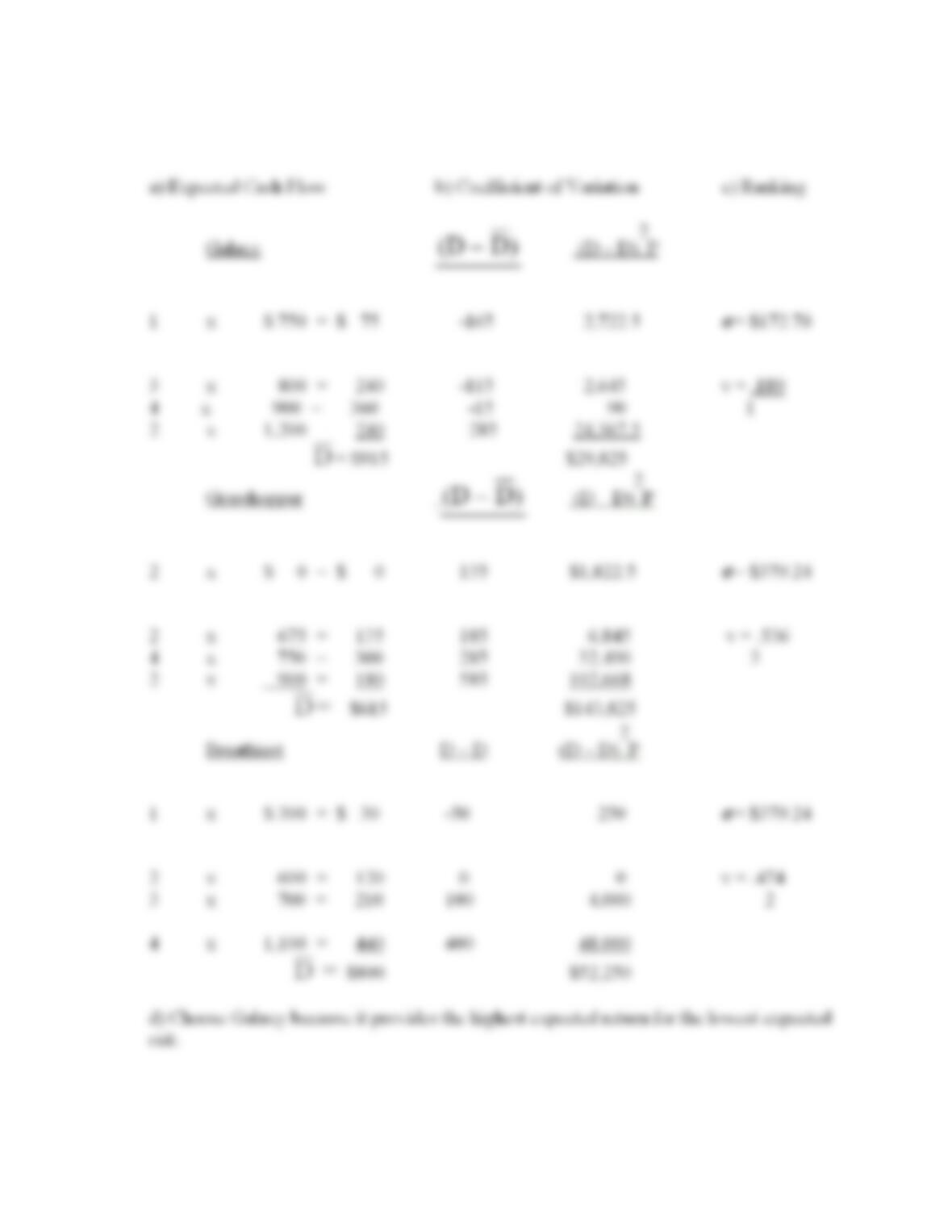
92. Bill Broodiest, star quarterback for the Spring Bay Smashers, would like to invest a small
portion of his earnings in stocks of one of three firms. His estimated returns and the
probabilities of their occurrence follow.
a) Calculate the expected return for each stock.
b) Calculate the coefficient of variation for each stock.
c) Rank the three from the least risky to the most risky.
d) Which stock would you recommend to Bill?
Chapter 13 – Risk and Capital Budgeting
13–34

Chapter 13 – Risk and Capital Budgeting