Auditing, 12e (Arens)
Chapter 13 Completing the Tests in the Sales and Collection Cycle: Accounts Receivable
13.1 Identify and describe the risk-based process for designing tests of details of balances for
accounts receivable
1) Tests of details of balances relate to which part of the Audit Risk Model?
A) control risk
B) inherent risk
C) substantive risk
D) planned detection risk
2) A risk of material misstatement in accounts receivable associated with the rights and
obligations balance-related audit objective is that “consignment goods are recorded as revenue,
overstating both revenue and accounts receivable. Which of the following tests of detail of
balances would respond to this risk?
A) include confirmation of terms of sale with accounts receivable confirmations
B) check cash received after the year end and trace to accounts receivable master file
C) read the notes to the financial statements and compare to audited financial information
D) compare accounts receivable balances by customer last year end to this year
3) A risk of material misstatement in accounts receivable associated with the accuracy balance-
related audit objective is that “sales recorded at the incorrect price result in revenue and accounts
receivable that are over or under stated.” Which of the following tests of detail of balances would
respond to this risk?
A) select a sample of master file change forms and verify that all sales prices changes were
appropriately authorized
B) use audit software to match sales invoice price details to authorized prices in the sales price
master files
C) inquire of management with respect to the procedures used to update sales price master file
D) match shipping details for a sample of invoices to the invoice details, on an item by item basis
4) A risk of material misstatement in accounts receivable associated with the allocation balance-
related audit objective is that “long term service revenue is recorded as current revenue or in the
wrong period, overstating revenue and accounts receivable.” Which of the following tests of
detail of balances would respond to this risk?
A) read customer contracts and audit the criteria used to allocate revenue to components of the
sales contract
B) check cash received after the year end and trace to accounts receivable master file
C) read the notes to the financial statements and compare to audited financial information
D) inquire of management about the process used to make sure that revenue is recorded in the
correct period
5) Audit risk is assessed for
A) the financial statements as a whole and is not usually allocated to various accounts or
objectives.
B) the financial statements as a whole and then allocated to various accounts.
C) various accounts but not for the financial statements as a whole.
D) various accounts and objectives, and the sum is then assigned to the financial statements as a
whole.
6) The two primary classes of transactions in the sales and collection cycle are
A) sales and sales returns.
B) sales and sales discounts.
C) sales and accounts receivable.
D) sales and cash receipts.
7) For sales, the occurrence transaction-related audit objective affects the existence balance-
related audit objective. For cash receipts, the occurrence transaction-related audit objective
affects which balance-related audit objective?
A) existence
B) completeness
C) cut-off
D) valuation
8) For cash receipts, the occurrence transaction-related audit objective affects the completeness
balance-related audit objective of accounts receivable. Which accounts receivable balance-
related audit objective does the cash receipts transaction-related audit objective of completeness
affect?
A) allocation
B) completeness
C) rights and obligations
D) existence
9) Two accounts receivable balance-related audit objectives are not affected by assessed control
risk for the sales and cash receipts classes of transactions. These are
A) valuation allocation.
B) allocation, rights and obligations.
C) valuation, rights and obligations.
D) accuracy, existence.
10) Three presentation and disclosure audit objectives are not affected by assessed control risk
for the sales transactions. These are
A) rights and obligations, valuation, understandability.
B) understandability, valuation, occurrence.
C) valuation, rights and obligations, classification.
D) classification, understandability, rights and obligations.
11) In the planning phase, Denis conducted an analytical procedure to compare the allowance for
doubtful accounts balance to the accounts receivable balance. In the prior years, the allowance
for doubtful accounts/ accounts receivable ratio was between 2.5% to 3.5%. This year, the
number is 1.25%. What should Denis do?
A) Change the assessed inherent risk
B) Conduct additional testing to justify the lower bad debt
C) Advise management that they should increase the allowance for doubtful accounts provision
D) Document this difference and continue with audit work to see if this is pervasive bias of
management
12) At every audit engagement, the auditor is required to consider that there could be significant
risks of misstatement for revenue recognition. At ABC Ltd., the auditor has concluded that, yes,
there are material risks of misstatement associated with revenue recognition. How does this
affect the extent of testing for accounts receivable?
A) audit risk will be increased
B) inherent risks will be decreased
C) decreased control testing is required
D) increased substantive testing is required
13) Your audit client has many different types of accounts receivable: Canadian, American, and
other international accounts, short term and long-term. There are also some sales on
consignment. The company has used forward exchange contracts to reduce its exposure due to
foreign exchange fluctuations. How will this affect the audit engagement?
A) control risk will increase
B) inherent risks of error will decrease
C) risk of material misstatement increases
D) audit risk will be increased
14) In the sales and collection cycle, the results of the tests of controls determine
A) the extent to which planned detection risk is satisfied for each accounts receivable objective.
B) whether assessed control risk for sales and cash receipts needs to be revised.
C) if tests of details of balances need to be performed.
D) whether positive or negative confirmations should be used for this engagement.
15) You are the auditor for GreenAcres, a non-profit home for homeless elderly. GreenAcres has
a December 31 year end. It receives government funding, and also relies upon donations for
revenue. GreenAcres has a major funding drive in November, when it collects pledges by means
of activities at a garage sale, a walkathon, and fall bake sale events in the community.
During late February you had a meeting with Ellen Famous, the President of GreenAcres, at the
organization’s premises. Ellen reviews and approves bank statements and is the second and final
cheque signer. Two other accounting staff have the following responsibilities:
• Paul approves pledge write-offs (which normally average about 15%), opens the mail, endorses
cheques received in the mail, prepares and delivers bank deposits, and posts transactions into the
accounting system.
• Diana, a retired bookkeeper, volunteers about 10 hours per week to reconcile the bank account,
review journal entries posted to the general ledger, and prepare payroll and accounts payable
transactions for processing.
Ellen normally reviews pledge write-offs, but was very busy in February, so she took a look
while you were there. To her surprise, she found that about 40% of the pledges had been written
off. She asked Diana to investigate, and Diana found that most of the write-offs had actually
been paid.
Required:
A) What are possible causes of the inconsistency with the pledge write-offs?
B) What are the weaknesses in internal control that could allow the excess write-offs to occur?
Provide recommendations for improvement.
C) Identify audit procedures that you would complete to quantify any potential misstatement
with respect to the pledges receivable balance as at December 31.
13.2 Explain when and why analytical review procedures are completed as part of the audit of
sales and accounts receivable
1) Comparing bad debt expense as a percentage of gross sales with previous years will detect
what kind of possible misstatement?
A) cut-off errors in recording cash receipts
B) overstatement of sales and accounts receivable
C) understatement of sales and accounts receivable
D) understatement of allowance for uncollectible accounts
2) As part of audit planning, you have calculated gross margin for the last five years, and
compared gross margin to industry averages. Your client’s gross margin has increased by about
5% in the current year, while the industry gross average has declined. One possible cause of this
increased gross margin is
A) higher cost of goods sold.
B) increased bad debt expenses.
C) fictitious revenue.
D) fictitious expenses.
3) As part of audit planning, you have calculated gross margin for the last five years, and
compared gross margin to industry averages. Your client’s gross margin has increased by about
5% in the current year, while the industry gross average has declined. One possible cause of this
increased gross margin is
A) higher cost of goods sold.
B) increased bad debt expenses.
C) premature revenue recognition.
D) fictitious expenses.
4) As part of audit planning, you have calculated accounts receivable turnover for the last five
years, and compared it to industry averages. Your client’s accounts receivable has decreased by
about 1.25 times in the current year, while the industry rate has improved. One possible cause of
this lowered accounts receivable turnover is
A) higher cost of goods sold.
B) increased bad debt expenses.
C) fictitious revenue.
D) fictitious expenses.
5) Analytical procedures are substantive tests and, if the results of the analytical procedures are
favourable, they will reduce
A) the extent of tests of details of balances.
B) the extent of tests of controls.
C) the analytical procedures.
D) all of the other tests.
6) Comparison of individual customer balances with previous years will detect what type of
possible misstatement?
A) misstatement in gross profit and bad debt expense
B) overstatement or understatement of bad debt expense
C) overstatement or understatement of allowance for uncollectible accounts
D) misstatements in accounts receivable and related income statement accounts
7) Stefano is performing a review of the accounts receivable for large and unusual amounts. Of
the following accounts receivables, Stefano should pay special attention to an account receivable
A) from a related party.
B) for a large dollar amount.
C) recorded close to year end.
D) that is recurring.
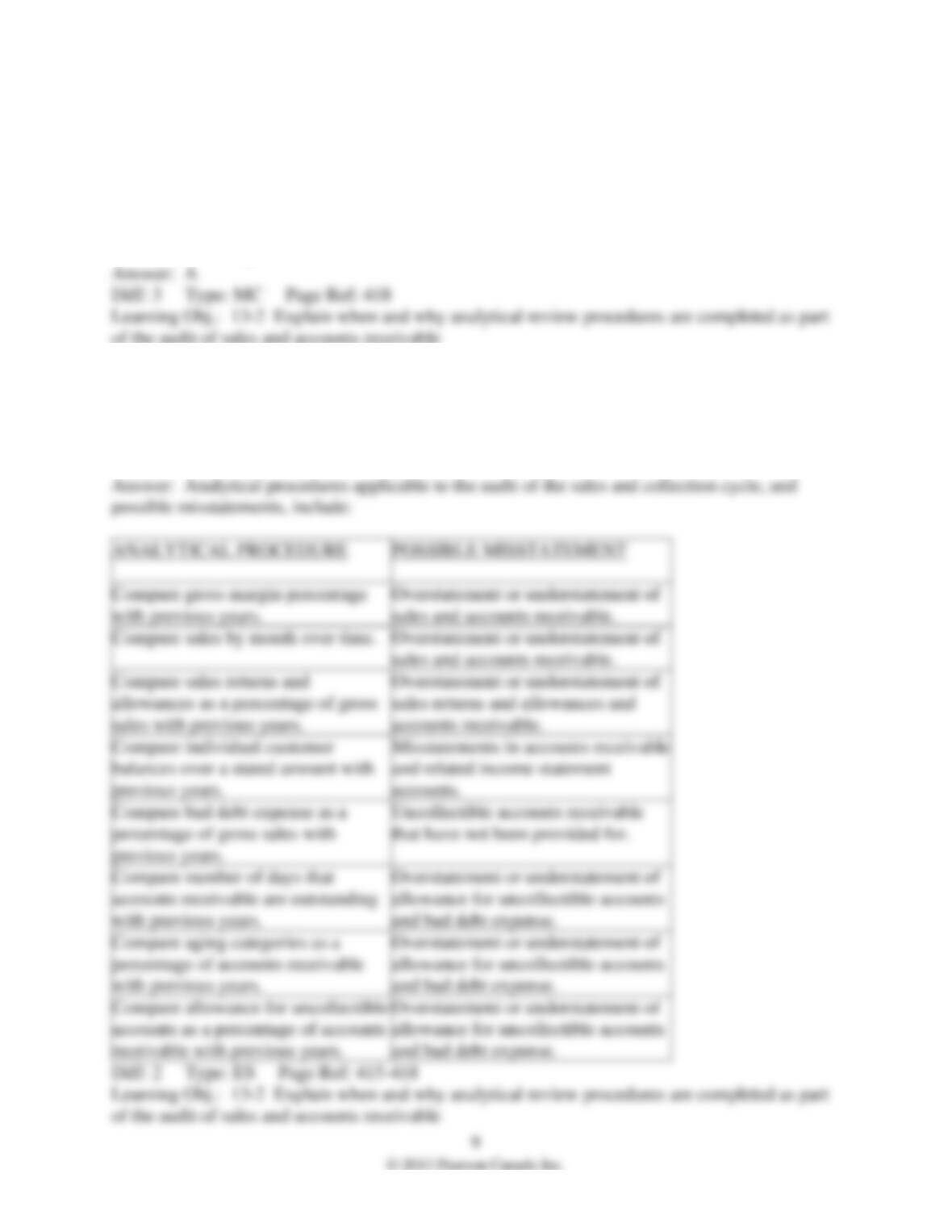
8) Discuss three examples of analytical procedures an auditor might perform while auditing the
sales and collection cycle. Also discuss the potential misstatement(s) that may be revealed by
each analytical procedure.
Note: students could also be asked to separately discuss ratios for planning and ratios as
substantive tests.
13.3 Describe the accounts receivable tests of detail audit tests that would be completed for
each audit assertion
1) Glee Inc. is a manufacturer of musical instruments and its year end is September 30th. Copa
Loca, a local music school, has purchased some instruments from Glee, but was not satisfied
with the quality and returned the goods to Glee during the last week of September. Being very
busy with year end, Glee received the goods from Copa Loca on September 30th, but only
processed the returned merchandised and issued a credit note in October. This represents a
A) cut-off (allocation) misstatement.
B) understandability misstatement.
C) significant misstatement.
D) classification misstatement.
2) Which of the following presentation and disclosure related audit objectives has a matching
transaction related audit objective, but not a matching balance-related audit objective?
A) accuracy
B) classification
C) occurrence
D) completeness
3) Which of the following presentation and disclosure related audit objectives does not have a
parallel audit objective for both the transaction related audit objectives and balance-related audit
objectives?
A) allocation
B) classification
C) understandability
D) rights and obligations
4) The most important test of details of balances to determine the existence of recorded accounts
receivable is
A) tracing sales entries to shipping documents.
B) tracing the credits in accounts receivable to bank deposits.
C) tracing sales returns entries to credit memos issued and receiving room reports.
D) sending external confirmations of customers’ balances.
5) A common way to evaluate the adequacy of the bad debt allowance is to
A) review the results of tests of controls that are concerned with the client’s credit policy.
B) inspect carefully the noncurrent accounts on the aged trial balance to determine which ones
have not been paid subsequent to the balance sheet date.
C) examine the program logic that is used to prepare the aged trial balance and to monitor the
implementation of credit policies.
D) send positive confirmations to all accounts with balances over 90 days based upon the aged
trial balance.
6) As part of the audit testing, the auditor is conducting substantive analytical review over time
(trend analysis) of bad debts to evaluate the quality of the accounts receivable. Which audit
assertion is this associated with?
A) valuation
B) classification
C) rights and obligations
D) occurrence
7) The auditor has elected to conduct the following audit tests: reperform addition of the aged
accounts receivable trial balance for the total column and for the columns depicting the aging.
Which audit objective is associated with these audit tests?
A) valuation
B) classification
C) accuracy
D) occurrence
8) The auditor would like to conduct dual purpose tests verifying that the programs performing
the totaling and aging of accounts receivable are functioning correctly as well as quantifying any
error. Which of the following is a dual purpose test that the auditor could use?
A) use analytical review and compare amounts from current to prior
B) inquire how the calculations are performed
C) use test data and observe how the invoice(s) of the test are aged
D) use generalized audit software to reperform the calculations
9) When the client’s internal control structure is adequate, the cutoff can usually be verified by
A) the client’s representation letter.
B) inquiries of the controller.
C) obtaining the last shipping document number of the year and comparing it with current and
subsequent period recorded sales.
D) confirmation of the receivable for the last recorded sale.
10) Celebra sold some goods to Frankfurt Corp. Frankfurt sent a cheque to Celebra to pay for the
goods on December 24th. Celebra received the check on January 4th. At December 31st, Celebra
still showed an account receivable from Frankfurt while Frankfurt no longer had an account
payable to Celebra. This situation represents a
A) cut-off error.
B) timing difference.
C) error in presentation.
D) lack of communication between the two companies.
11) If the internal controls for recording sales returns and allowances are evaluated as
ineffective,
A) a larger sample is needed to verify cutoff.
B) sampling is not appropriate.
C) all sales returns must be traced to supporting documentation.
D) all sales returns must be confirmed with the customer.
12) IFRS, ASPE and ASNPO require that related party transactions be disclosed. Gregorio
Limited has a materiality threshold of $50,000. Which of the following standards apply to the
disclosure of related party transactions for Gregorio Limited? Disclose
A) all transactions that are greater than the current year’s materiality.
B) all related party transactions, even those below materiality.
C) those related party transactions that relate to officers or directors of the corporation.
D) those related party transactions that could affect the decisions of a user.
13) If accounts receivable accounts with credit balances are significant, they should be
A) written off.
B) reclassified as accounts payable.
C) corrected by making adjusting entries.
D) moved to the debit side.
14) Trade accounts receivable should exclude
A) accounts receivables denominated in foreign currencies.
B) past-due accounts receivable.
C) related party accounts receivable.
D) accounts receivable of clients entitled to receive discounts.
15) One of the most important test of details of balances for accounts receivable is
A) recalculation of the aged receivables and uncollectible accounts.
B) confirmations.
C) tracing from shipping documents to journals to the accounts receivable ledger.
D) tracing credit memos for returned merchandise to receiving room reports.
16) Confirmation of individual accounts receivable balances directly with debtors will, of itself,
normally provide evidence concerning the
A) collectability of the balances confirmed.
B) ownership of the balances confirmed.
C) existence of the balances confirmed.
D) internal control over balances confirmed.
17) Confirmation is most likely to be a relevant form of evidence with regard to assertions about
accounts receivable when the auditor has concerns about the accounts receivable’s
A) valuation.
B) classification.
C) existence.
D) completeness.
18) The primary purpose of accounts receivable confirmation is to satisfy the
A) existence objective.
B) existence and cutoff objectives.
C) accuracy and cutoff objectives.
D) existence, accuracy, and cutoff objectives.
19) There are two important assumptions that underly the auditor’s use of external confirmations.
The first is that the person returning the confirmation is independent of the company and so will
provide an unbiased response. The second is that
A) only authorized employees of the company have prepared the response.
B) the person completing the response has carefully checked the data being confirmed.
C) the respondent has not been coerced or bribed to respond to the confirmation.
D) adequate controls exist at the client company to prevent unauthorized responses.