
55. Refer to Kennesaw Steel Corporation. The tax rate is 40%. What is the earnings per share under the
new plan if EBIT is $600,000 in the next year? (assume that the stock can be repurchased at $50 per
share)
a.
$4.40
b.
$4.20
c.
$4.00
d.
$3.80
56. Refer to Kennesaw Steel Corporation. The tax rate is 40%. What is the return on equity under the new
plan if EBIT is $600,000 in the next year? (assume that the stock can be repurchased at $50 per share)
a.
7.4%
b.
8.1%
c.
8.8%
d.
9.5%
57. Which statement is TRUE regarding a firm that increases financial leverage?
a.
Average earnings per share increases, while shareholder risk increases.
b.
Average earnings per share increases, while shareholder risk decreases.
c.
Average earnings per share decreases, while shareholder risk decreases.
d.
Average earnings per share decreases, while shareholder risk increases.
58. The Globe Incorporated has EBIT of $20 million for the current year. On the firm balance sheet, there
is $80 million of debt outstanding that carries a coupon rate of 8 percent. Investors seek a return of 12
percent on the firm, and the firm has a corporate tax rate of 40%. What is the value of the firm?
a.
$124,000,000
b.
$128,000,000
c.
$132,000,000
d.
$136,000,000
59. The Globe Incorporated has EBIT of $30 million for the current year. On the firm balance sheet, there
is $90 million of debt outstanding that carries a coupon rate of 9 percent. Investors seek a return of 12
percent on the firm, and the firm has a corporate tax rate of 40%. What is the value of the firm?
a.
$152,000,000
b.
$160,000,000
c.
$174,000,000
d.
$186,000,000

60. The Globe Incorporated has EBIT of $20 million for the current year. On the firm balance sheet, there
is $80 million of debt outstanding that carries a coupon rate of 8 percent. Investors seek a return of 12
percent on the firm, and the firm has a corporate tax rate of 40%. What is the present value of the
firm’s tax shields?
a.
$32,000,000
b.
$30,000,000
c.
$24,000,000
d.
$6,400,000
61. TransMetro Incorporated has EBIT of $1 million for the current year. On the firm balance sheet, there
is $6 million of debt outstanding that carries a coupon rate of 15 percent. Investors seek a return of 20
percent on the firm, and the firm has a corporate tax rate of 40%. What is the present value of the
firm’s tax shields?
a.
$2,000,000
b.
$2,200,000
c.
$2,400,000
d.
$2,700,000
62. Which statement correctly describes proposition I of Modigliani and Miller?
a.
The value of the firm is independent of its capital structure.
b.
If there is no default risk, firms should exclusively use debt to finance projects.
c.
If there is no default risk, firms should exclusively use equity to finance projects.
d.
The value of the firm’s tax shields depends solely on the amount of debt issued.

63. Lightyear Technology Corporation finances its operations with $75 million in stock with a required
return of 12 percent and $45 million in bonds with a required return of 8 percent. Suppose the firm
issues $15 million in additional bonds at 8 percent, using the proceeds to retire $15 million worth of
equity. What will be the firm’s new debt to equity ratio? (Assume zero taxes and perfect capital
markets)
a.
0.75
b.
0.90
c.
1.00
d.
1.10
64. Burdell Scientific Incorporated finances its operations with $40 million in stock with a required return
of 12 percent and $10 million in bonds with a required return of 6 percent. Suppose the firm issues $15
million in additional bonds at 8 percent, using the proceeds to retire $15 million worth of equity. If the
WACC remains the same, what will be the firm’s new cost of equity? (Assume zero taxes and perfect
capital markets)
a.
15.60%
b.
15.00%
c.
14.40%
d.
13.80%
65. Bulldog Electronics Corporation finances its operations with $75 million in stock with a required
return of 12 percent and $45 million in bonds with a required return of 8 percent. Suppose the firm
issues $15 million in additional bonds at 8 percent, using the proceeds to retire $15 million worth of
equity. If the WACC remains the same, what will be the firm’s new cost of equity? (Assume zero
taxes and perfect capital markets)
a.
12.50%
b.
13.00%
c.
14.00%
d.
14.40%

66. Oak Barrel Company has net operating income of $10 million. Further, the company has $80 million
of debt outstanding with a required rate of return of 7 percent; the required rate of return on the
industry is 11 percent; and the corporate tax rate is 40 percent. What is the gain from leverage if the
personal tax rate on stock income is 20 percent and the personal tax rate on debt income is 30 percent?
a.
$22.34 million
b.
$23.77 million
c.
$24.63 million
d.
$25.14 million
67. Oak Barrel Company has net operating income of $10 million. Further, the company has $80 million
of debt outstanding with a required rate of return of 7 percent; the required rate of return on the
industry is 12 percent; and the corporate tax rate is 35 percent. What is the gain from leverage if the
personal tax rate on stock income is 15 percent and the personal tax rate on debt income is 30 percent?
a.
$22.34 million
b.
$19.41 million
c.
$16.86 million
d.
$12.19 million

68. Oak Barrel Company has net operating income of $10 million. Further, the company has $80 million
of debt outstanding with a required rate of return of 7 percent; the required rate of return on the
industry is 11 percent; and the corporate tax rate is 40 percent. What is the value of the Oak Barrel
Company?
a.
$86.55 million
b.
$83.77 million
c.
$81.46 million
d.
$72.28 million
69. Which statement is FALSE regarding empirical evidence of capital structures?
a.
Capital structures show strong industry patterns.
b.
Economy wide leverage ratios are consistent across countries.
c.
Leverage ratios are negatively related to the cost of financial distress.
d.
Within industries, the most profitable companies borrow the least.
70. In a world with only company-level taxation of operating profits, no costs of bankruptcy, and
tax-deductible interest payments, what is the optimal corporate strategy?
a.
The firm should use all equity to maximize firm value.
b.
The firm should use all debt to maximize its value.
c.
The firm’s value is independent of the way it is financed.
d.
The firm should maximize the use of preferred stock to create value.
NARRBEGIN: ABC Corporation
ABC Corporation
ABC Corporation has a capital structure that consists of $20 million in debt and $40 million in equity.
The debt has a coupon rate of 10%, while the industry return on equity is 15%. ABC Corporation is
unsure of the state of the economy in the next year. The tax rate facing the company is 40%.
State of the Economy
BAD
GOOD
GREAT
EBIT
$2,000,000
$5,000,000
$10,000,000
Probability
0.40
0.40
0.20
NARREND
71. Refer to ABC Corporation. Given the information in the table, what is the expected earnings per share
if the company has 1 million shares outstanding?
a.
$1.44

b.
$1.56
c.
$1.68
d.
$1.78
72. Refer to ABC Corporation. The company is considering the issue of $10 million in new debt at a rate
of 10%. The funds from the new debt will be used to retire $10 million in equity. Currently, there are 1
million shares outstanding trading at $40 per share. Assuming the stock price will remain the same,
what is the expected earnings per share in the next year if the company goes through with the
re-capitalization?
a.
$1.32
b.
$1.56
c.
$1.68
d.
$1.76
73. Which statement is FALSE concerning capital structure?
a.
Firms with large amounts of tangible assets tend to use a lot of debt in their capital
structures.
b.
When corporate profits are taxed at the corporate and personal level, the benefits of
leverage are greatly reduced.
c.
Modern trade off theory predicts that a firm’s optimal debt level is set by trading off the
tax benefits of leverage against the agency costs of increased debt.
d.
Debt is used more frequently abroad (such as Germany and England) as international laws
tend to favor debtors.

NARRBEGIN: Exhibit 12-1
Exhibit 12-1
An all-equity firm has 80,000 shares outstanding worth $20 each. The firm is considering a project
requiring an investment of $500,000 and has an NPV of $30,000. The company is also considering
financing this project with a new issue of equity.
NARREND
74. Refer to Exhibit 12-1. What is the price at which the firm needs to issue the new shares so that the
existing shareholders are indifferent to whether the firm takes on the project with this equity financing
or does not take on the project?
a.
$18.44
b.
$18.87
c.
$19.71
d.
$20.00
75. Refer to Exhibit 12-1. What is the price at which the firm needs to issue the new shares so that the
existing shareholders capture the full benefit associated with the new project?
a.
$20.48
b.
$20.38
c.
$20.15
d.
$20.07
76. Which of the following statements is true?
a.
The use of debt may lead to financial distress and bankruptcy, thus firms that sell
expensive, durable products that may have warranties and ongoing service requirements
tend to use less debt.
b.
The use of debt may lead to financial distress and bankruptcy, thus firms that sell
expensive, durable products that may have warranties and ongoing service requirements

tend to use more debt.
c.
Companies with a large proportion of tangible assets should be more willing to use debt
than firms with mostly intangible assets.
d.
Companies with a large proportion of tangible assets should be less willing to use debt
than firms with mostly intangible assets.
e.
Both (a) and (c)
77. Financial distress can be particularly dangerous to firms that produce R&D-intensive goods and
services because:
a.
Most of the expenses incurred in production are sunk costs.
b.
It is unlikely to be able to fund future R&D expenditures if it is in financial distress
meaning that it is probably not going to be able to produce cutting-edge products in the
future.
c.
Intangible assets such as patents and trademarks are unlikely to survive the bankruptcy or
financial distress intact.
d.
all of the above
e.
both (a) and (b)
78. Financial distress can lead to financial and operating “games.” Which of the following statements is
(are) true?
a.
A firm’s stockholders may prefer that the firm engage in riskier projects whereas the firm’s
bondholders may prefer that the firm invest in low-risk projects.
b.
The firm may underinvest in projects because the financing must be provided solely by the
stockholders since it is unlikely the firm will be able to borrow additional funds.
c.
The firm may underinvest in projects because the financing must be provided solely by the
bondholders since it is unlikely the firm will be able to issue additional stock.
d.
A firm’s bondholders may prefer that the firm engage in riskier projects whereas the firm’s
stockholders may prefer that the firm invest in low-risk projects.
e.
Both (a) and (b)
79. The agency costs of (outside) equity can result in:
a.
a benefit to society in the sense that the firm can raise external equity thus generating
additional funds that can be invested.
b.
a cost to society because the market value of corporate assets is reduced.
c.
entrepreneurs paying less than 100% of the cost of consuming perquisites.
d.
all of these
e.
none of these
80. One method of preventing or reducing the chance that corporate management will harm the
bondholders to the benefit of the stockholders is to:
a.
require that key executives own a certain percentage of the firm’s outstanding stock
b.
require that key executives own a certain percentage of the firm’s outstanding bonds
c.
write detailed covenants into bond contracts.
d.
all of the above are acceptable methods
NARRBEGIN: Tax Trade Off theory
NARREND
81. A graphical representation of The Trade-Off Model is shown. Various components of the graph are
labeled. Which of the following corresponds to line 1?
a.
Present value of interest tax shields on debt
b.
Present value of expected bankruptcy and agency costs
c.
Value of levered firm with bankruptcy costs
d.
Value of levered firm in the absence of bankruptcy and agency costs
e.
Value of firm under all-equity financing
82. A graphical representation of The Trade-Off Model is shown. Various components of the graph are
labeled. Which of the following corresponds to line 2?
a.
Present value of interest tax shields on debt
b.
Present value of expected bankruptcy and agency costs
c.
Value of levered firm with bankruptcy costs
d.
Value of levered firm in the absence of bankruptcy and agency costs
e.
Value of firm under all-equity financing
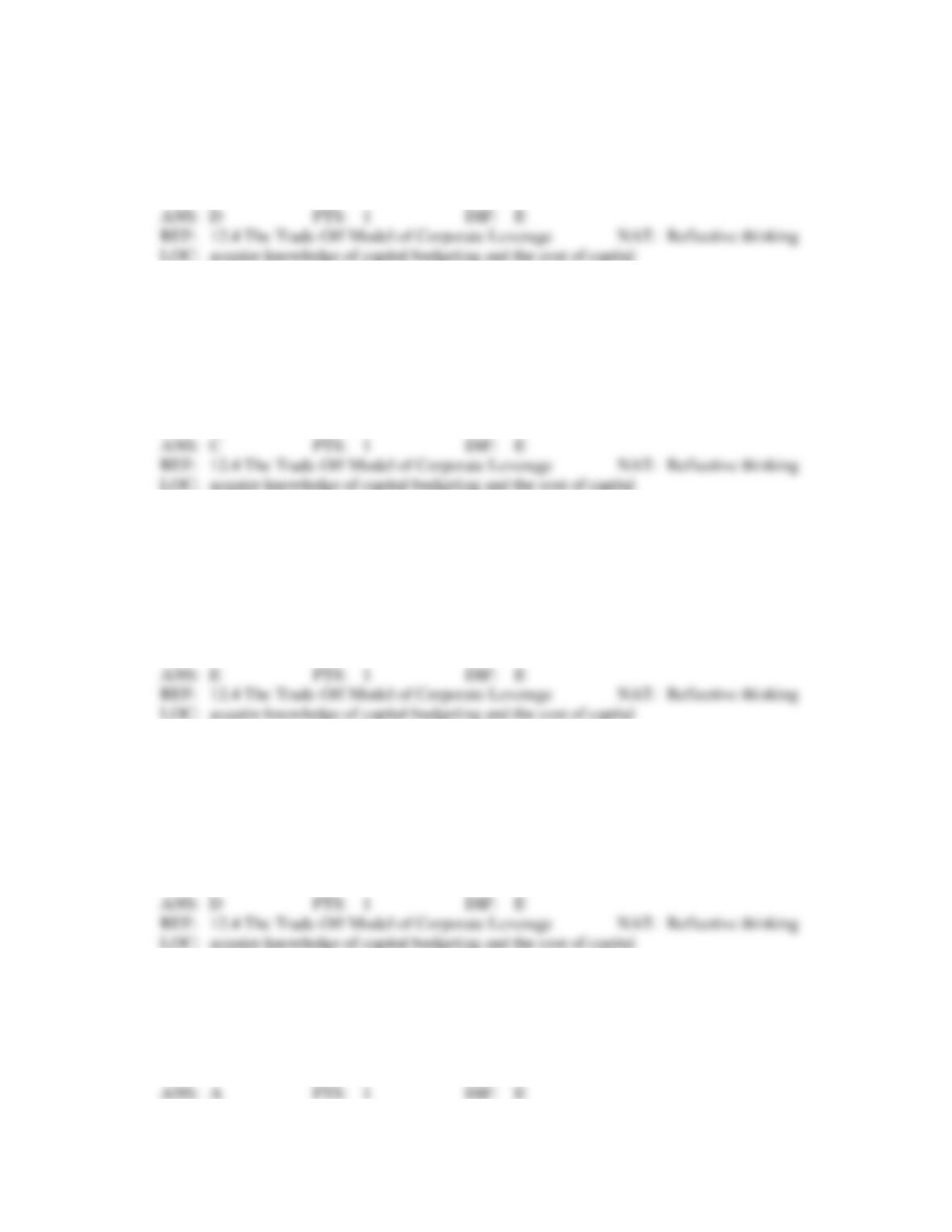
83. A graphical representation of The Trade-Off Model is shown. Various components of the graph are
labeled. Which of the following corresponds to line 3?
a.
Present value of interest tax shields on debt
b.
Present value of expected bankruptcy and agency costs
c.
Value of levered firm with bankruptcy costs
d.
Value of levered firm in the absence of bankruptcy and agency costs
e.
Value of firm under all-equity financing
84. A graphical representation of The Trade-Off Model is shown. Various components of the graph are
labeled. Which of the following corresponds to line 4?
a.
Present value of interest tax shields on debt
b.
Present value of expected bankruptcy and agency costs
c.
Value of levered firm with bankruptcy costs
d.
Value of levered firm in the absence of bankruptcy and agency costs
e.
Value of firm under all-equity financing
85. A graphical representation of The Trade-Off Model is shown. Various components of the graph are
labeled. Which of the following corresponds to line 5?
a.
Present value of interest tax shields on debt
b.
Present value of expected bankruptcy and agency costs
c.
Value of levered firm with bankruptcy costs
d.
Value of levered firm in the absence of bankruptcy and agency costs
e.
Value of firm under all-equity financing
86. The issue of corporate capital structure has similarities to college students’ financial situations because:
a.
Many students use borrowed funds to finance their education.
b.
Most finance students will ultimately work for a major corporation and will make
decisions as to how the firm finances its investment in assets.
c.
using debt to finance one’s education is similar to issuing stock to finance investment in a
firm’s assets
d.
both (a) and (c)
87. A person’s FICO score can range from:
a.
300 to 850.
b.
300 to 800.
c.
600 to 850.
d.
300 to 600.

88. The FICO score:
a.
was developed by Fair Isaac & Company
b.
is based on a person’s income and overall indebtedness, the type of debt outstanding and
the monthly payment amounts.
c.
can have a large impact on the interest rate a person is charged on their mortgage.
d.
all of the above
e.
(b) and (c) only
89. In examining the question as to whether or not capital structures are randomly selected, we generally
find that:
a.
capital structures show strong industry patterns.
b.
within industries, the most profitable companies borrow the least.
c.
corporate and personal income taxes influence capital structures, but taxes alone cannot
explain differences in leverage across firms, industries or countries.
d.
shareholders consider leverage-increasing events to be “good news” and
leverage-decreasing events to be “bad news.”
e.
All of the above
90. Roxy Incorporated has EBIT of $2 million for the current year. The firm has $5 million of debt
outstanding with a coupon rate of 8 percent. Investors require a return of 15 percent on the firm, and
the firm has a corporate tax rate of 40%. What is the present value of the firm’s tax shields?
a.
$2,000,000
b.
$ 400,000
c.
$ 800,000
d.
$ 750,000
91. Louis Incorporated has EBIT of $500,000 for the current year. The firm has $250,500 of debt
outstanding with a coupon rate of 12 percent. Investors require a return of 18 percent on the firm, and
the firm has a corporate tax rate of 40%. What is the present value of the firm’s tax shields?
a.
$ 30,060
b.
$100,200
c.
$200,000
d.
$ 45,090

92. Emma Incorporated has EBIT of $875,000 for the current year. The firm has $350,000 of debt
outstanding with a coupon rate of 7 percent. Investors require a return of 15 percent on the firm, and
the firm has a corporate tax rate of 40%. What is the present value of the firm’s tax shields?
a.
$ 24,500
b.
$350,000
c.
$140,000
d.
$ 52,500
93. Louis Corporation finances its operations with $80 million in stock and $30 million in bonds. If the
firm issues $20 million in additional bonds and uses the proceeds to retire $20 million worth of equity.
What will be the firm’s new debt to equity ratio? (Assume zero taxes and perfect capital markets)
a.
0.75
b.
0.60
c.
0.63
d.
0.83
94. Emma Corporation finances its operations with $5 million in stock and $4 million in bonds. If the
firm issues $1 million in additional bonds and uses the proceeds to retire $1 million worth of equity.
What will be the firm’s new debt to equity ratio? (Assume zero taxes and perfect capital markets)
a.
1.25
b.
0.80
c.
0.80
d.
1.00
95. Roxy Corporation finances its operations with $20 million in stock and $30 million in bonds. If the
firm issues $5 million in additional bonds and uses the proceeds to retire $5 million worth of equity.
What will be the firm’s new debt to equity ratio? (Assume zero taxes and perfect capital markets)
a.
0.75
b.
2.33

c.
0.86
d.
1.75
96. Roxy International has an EBIT of $25 million, debt with a market value of $40 Million and a required
return on assets of 15%. Assuming no taxes, what is the firm ‘s value?
a.
$166,666,667
b.
$266,666,667
c.
$291,666,667
d.
$100,000,000
97. Roxy International has an EBIT of $15,000, debt with a market value of $25,000 and a required return
on assets of 12%. Assuming a corporate tax rate of 40%, what is firm’s value?
a.
$266,666,667
b.
$182,666,667
c.
$106,666,667
d.
$100,000,000
98. Luois International has an EBIT of $2 million, debt with a market value of $3 Million and a required
return on assets of 11%. Assuming no taxes, what is the firm ‘s value?
a.
$10,909,091
b.
$29,272,727
c.
$18,181,818
d.
$27,272,727
99. Luois International has an EBIT of $2 million, debt with a market value of $3 Million and a required
return on assets of 11%. Assuming a corporate tax rate of 40%, what is firm’s value?

a.
$27,272,727
b.
$10,909,091
c.
$ 9,090,909
d.
$19,381,818
100. Emma International has an EBIT of $35 million, debt with a market value of $30 Million and a
required return on assets of 13%. Assuming no taxes, what is the firm ‘s value?
a.
$269,230,769
b.
$230,769,231
c.
$265,769,231
d.
$161,538,462
101. Emma International has an EBIT of $35 million, debt with a market value of $30 Million and a
required return on assets of 13%. Assuming a corporate tax rate of 40%, what is firm’s value?
a.
$230,769,231
b.
$281,230,769
c.
$ 92,307,692
d.
-$38,461,538