12 – 17 Test Bank for Introduction to Corporate Finance, Fourth Canadian Edition
37. Given current stock price = $50
strike price = $50
risk-free rate = 10%
time to expiration of the option = 3 months
N(d1) = 0.5793
N(d2) = 0.4602
Based on the Black-Scholes option pricing model, calculate the price of the
corresponding call option (round to 2 decimal places).
a) $0
b) $5.49
c) $5.96
d) $6.52
38. Given current asset price = $50
strike price = $50
risk-free rate = 1%
time to expiration of the option = 2 years
N(d1) = 0.5793
N(d2) = 0.4602
Based on the Black-Scholes option pricing model, calculate the price of the
corresponding call option (round to 2 decimal places).
a) $0
b) $5.49
c) $5.96
d) $6.41
39. The standard Black-Scholes option pricing model applies to:
a) European call options on non-dividend paying stocks.
b) American call options on non-dividend paying stocks.
c) European call options on all stocks.
d) American call options on all stocks.
40. The standard Black-Scholes option pricing model assumes:
a) European call options.
b) continuous compounding.
c) non continuous volatility of the underlying stock price
d) all of the above.
e) a and b
41. The Black-Scholes model includes the following components:
I. the standard deviation of the underlying asset
II. present value of the strike price
III. current value of the underlying asset
IV. cumulative standard normal density functions
12 – 19 Test Bank for Introduction to Corporate Finance, Fourth Canadian Edition
a) I only
b) I, II only
c) I, II, III only
d) I, II, III, IV
42. Given: S = $55, X = $50, r = 5%, t = 4 months and σ = 20% calculate d1 and d2.
a) –0.62334, –0.73881 respectively
b) 1.0275, –0.4501 respectively
c) –0.62334, –0.82334 respectively
d) 1.0275, 0.9120 respectively
43. Which of the “Greeks” measures the change in option value with a change in volatility
of the underlying asset?
a) Delta
b) Theta
c) Gamma
d) Vega
44. Which of the following best defines implied volatility?
a) An estimate of the price volatility of an option.
b) The observed relationship of past and present option prices.
c) An estimate of the price volatility of the underlying asset based on observed option
prices.
d) The observed relationship of past and present price volatility of the underlying asset.
45. Use the following statements to answer the question:
I. VIX is a measure of volatility in the financial markets
II. VIX is calculated as the aggregate volatility of option prices.
a) I and II are correct
b) I and II are incorrect
c) I is correct and II is incorrect
d) I is incorrect and II is correct
46. VIX can be used
a) to price interest rate volatility.
b) to measure the volatility of the underlying stock price based on the observed option
prices.
c) to estimate the risk of default premium of the underlying debt.
d) none of the above.
47. Higher _________, higher ________
a) price volatility; estimated volatility
b) implied volatility; option price
c) estimated volatility; price volatility
48. _________is an estimate of the ________ of the underlying asset based on
observed option prices.
a) Price volatility; estimated volatility
b) Implied volatility; price volatility
c) Price volatility; implied volatility
d) Estimated volatility; price volatility
49. Suppose Jo’s stock price is currently $100. In the next three months it will either fall
to $70 or rise to $120. What is the option delta of a call option with an exercise price of
$100?
a) 0.375
b) 0.60
Derivative Securities 12 – 22
c) 0.40
d) 0.75
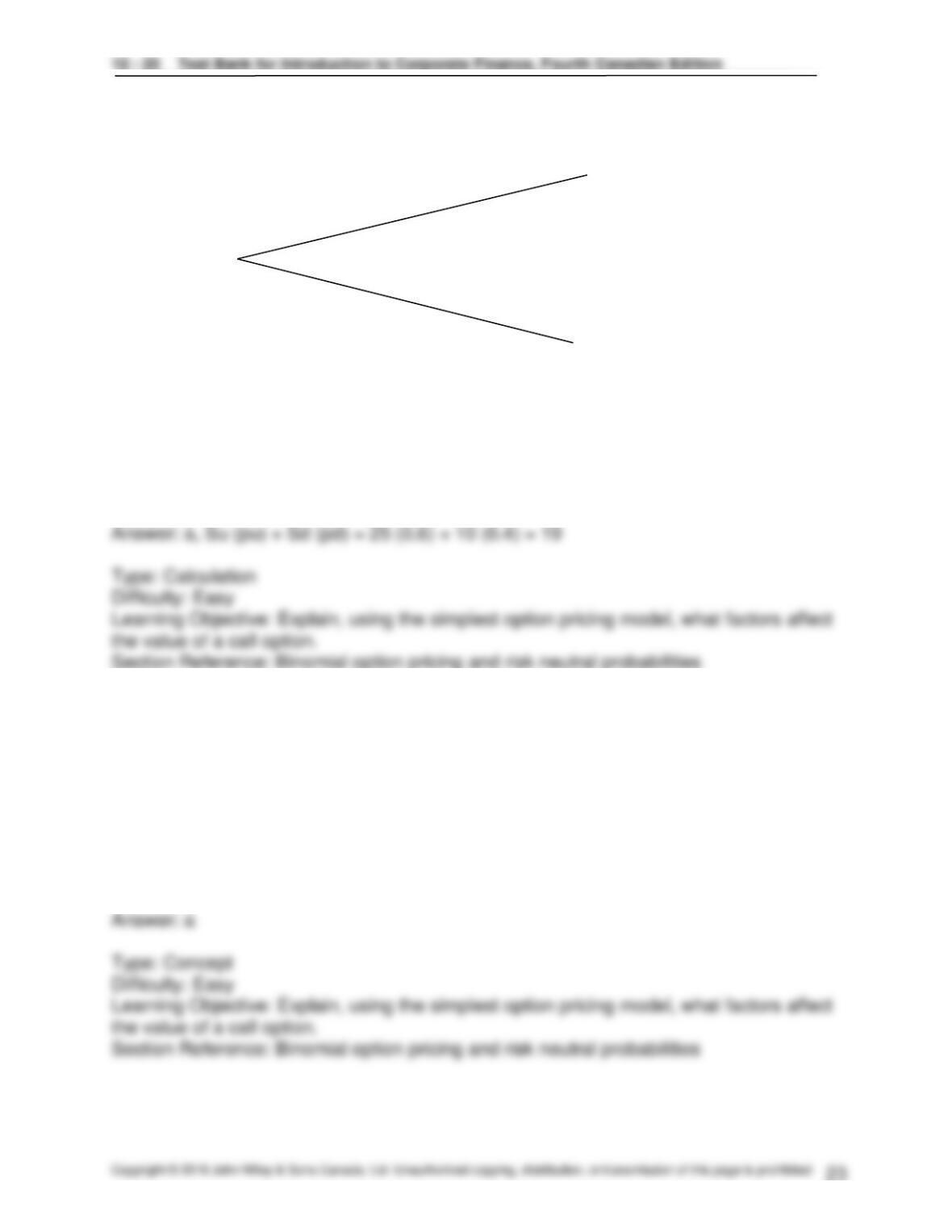
50.
What is the expected value of this asset?
a) $19.00
b) $3.00
c) $16.00
d) $23.00
51. Which of the following is correct ?
a) Risk neutral refers to the state of ignoring the risk involved in determining expected
rates of return.
b) Risk neutral pricing uses the cost of capital to discount the future cash flows of the
option.
c) Risk-neutral pricing ignores the probability of state in pricing the option.
d) b and c
pu = 0.6
pd = 0.4
So = 20
Su = 25
Sd = 10
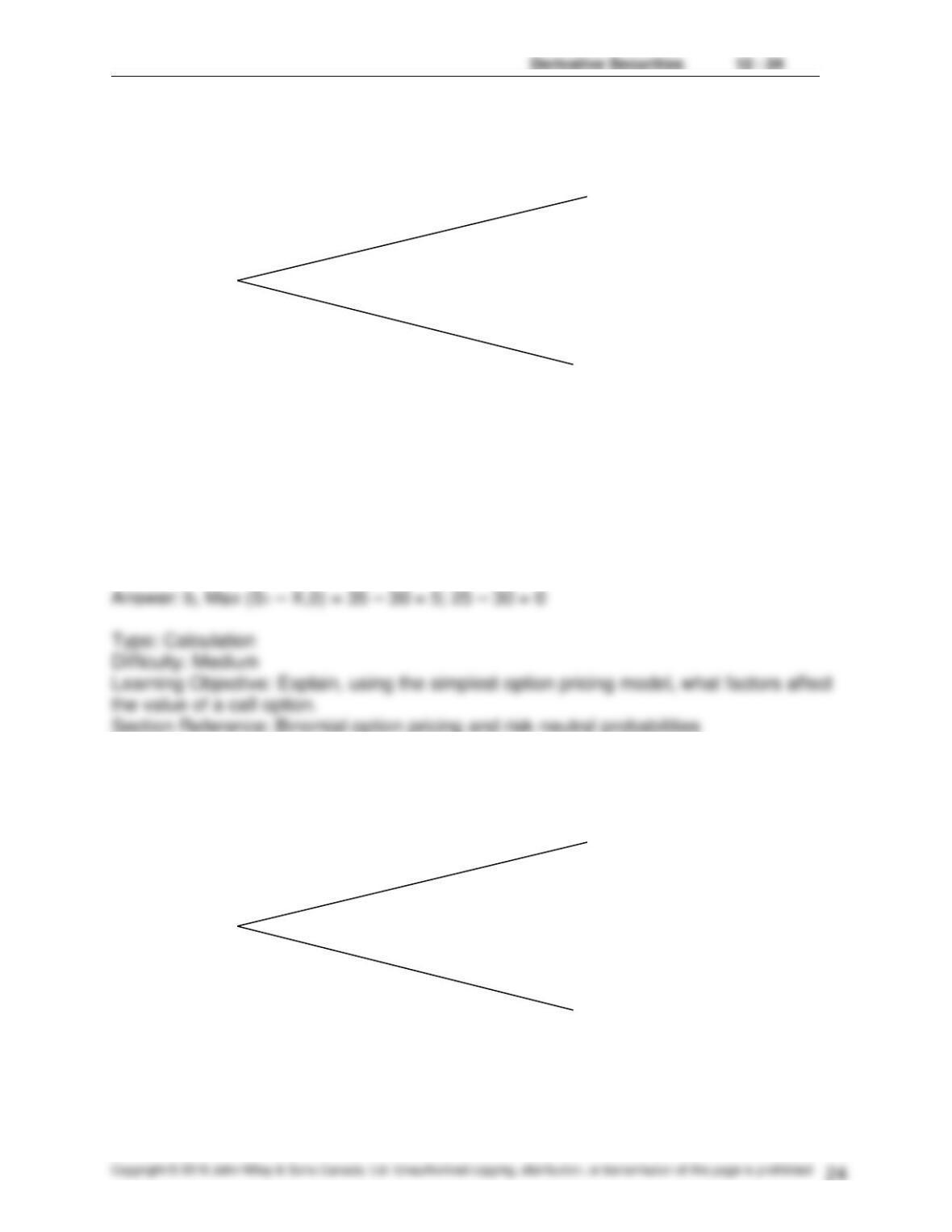
52.
What is the value of a call option with a strike price of $30.00 in scenario:
a. S1 = $35
b. S1 = $25
a) $5, −$5
b) $5, $0
c) $0, $0
d) $0, $5
53.
What is the hedge ratio, given the strike price is $60?
pu = 0.5
pd = 0.5
So = 30
S1 = 35
S1 = 25
0.8
0.2
So = 60
S1 = 80
S1 = 55
12 – 25 Test Bank for Introduction to Corporate Finance, Fourth Canadian Edition
a) 1.25
b) −1
c) −4
d) 0.25
54. Francis is long the underlying and has sold h number of call options with the
following binomial tree:
Given the current asset price is $20 and r is 5%, what is the price of the above call
option?
a) $2.86
b) $0.60
c) $21.43
d) −$21.43
55. Toronto Skaters’ stock is now worth $100. In one month it can either be $80 or $120.
Given that the monthly risk-free rate is 2%, how many calls does the investor need to sell
0.6
0.4
So = 20
S1 = 25
S1 = 15
X = 20
Derivative Securities 12 – 26
to hedge a long position in ABC stock? What is the corresponding value of the call?
(assume strike price = $100)
a) 0.5; $43.14
b) 1; $21.57
c) 2; $10.78
d) 2; $43.14
56. Assume the current value of the underlying asset is $20 and the value of the
underlying asset tomorrow can either be $15 or $25. What is the risk-neutral probability
of generating a 2% return on the asset?
a) 0.54
b) −1.46
c) 0.135
d) 0.9
12 – 27 Test Bank for Introduction to Corporate Finance, Fourth Canadian Edition
PRACTICE PROBLEMS
57. Briefly explain how to replicate the payoff of a risk-free asset using put-call parity.
58. (Assume: continuous compounding and value of the underlying asset is $22)
Marie wants to determine the fair value of a put option with strike price $20 due to expire
in 2 years. A call with the same strike price and expiration is worth $5. The risk-free rate
is 4%. What would you tell Marie is the fair value of the put option?
59. Assume the following:
S = $25
Exercise price = $20
Risk-free rate = 1%
Volatility is 20%
The option expires in one year.
What is the value of the corresponding call option? (NOTE: if using the appendix A-1 to
solve for the N(d1) and N(d2) values you should truncate d1 and d2 to two decimal
places and round down.
Derivative Securities 12 – 28
60. The current value of the underlying asset is $80. The strike price of a call option with
one month to expiration is $85. There is a 20% chance that in one month the value of the
underlying asset will be $75 and an 80% chance that it will be $90.
a) What is the expected value of the underlying asset and the corresponding rate of
return?
b) What is the hedge ratio and the corresponding value of the call given r = 0.02%?
12 – 29 Test Bank for Introduction to Corporate Finance, Fourth Canadian Edition
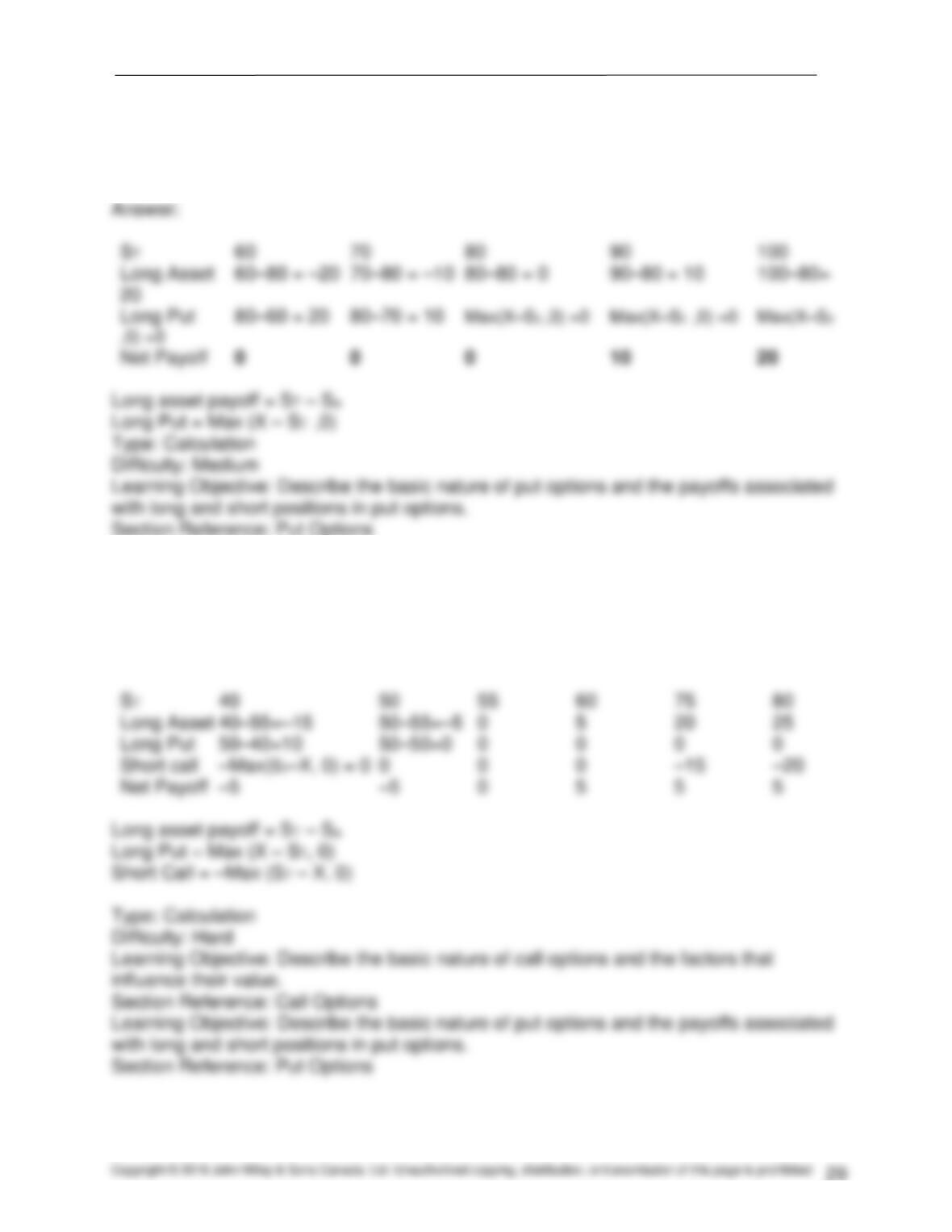
61. Create a table illustrating the range of payoffs of a protective put strategy for the
following values of the underlying asset: 60, 70, 80, 90, 100. The strike price of all
options in the strategy is $80 and the current value of the underlying asset is $80.
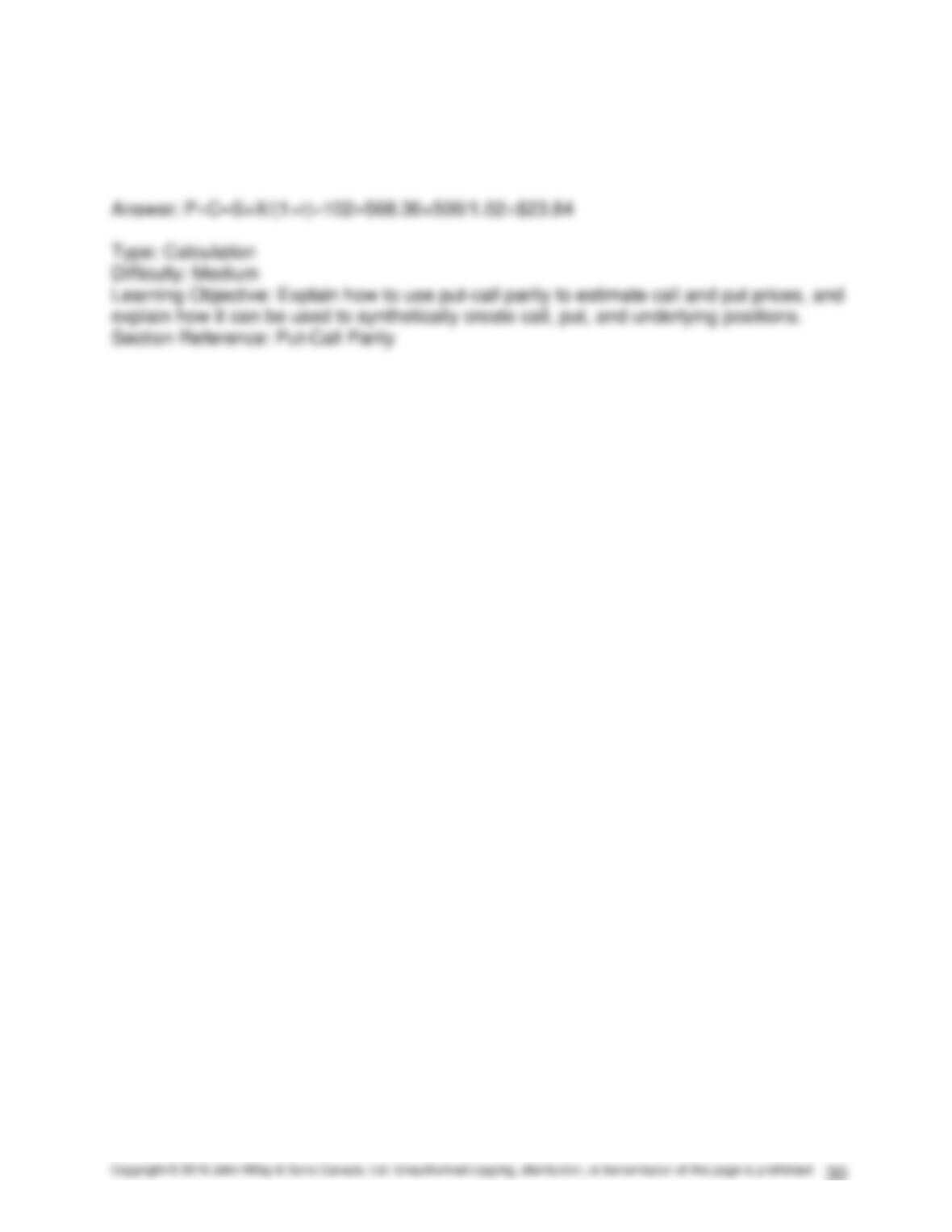
62. Create a table depicting the payoffs for a collar given Xput = $50, S = $55, and Xcall
= $60. Assume the value of the asset in 2 months will be: $40, $50, $55, $60, $75, $80.
Answer:
Derivative Securities 12 – 30
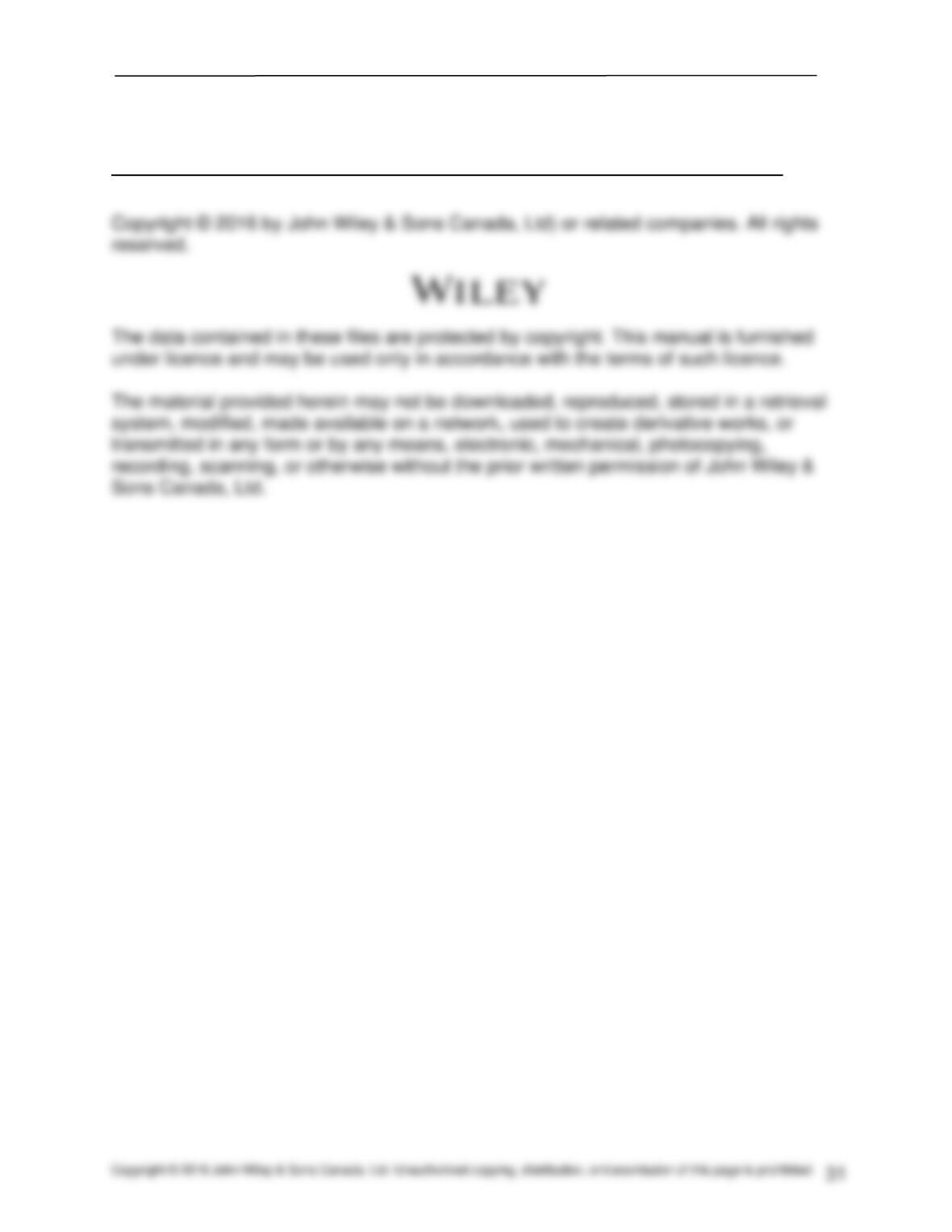
63. The current stock price is $568.36, a one-year call option with strike price of $500 is
$102, and the risk-free rate is 2%. What should be the price of a one-year put option with
the same strike price?
12 – 31 Test Bank for Introduction to Corporate Finance, Fourth Canadian Edition
LEGAL NOTICE