50) An all-equity firm has a beta of 1.27. What will be the equity beta if the firm adopts a
debt-to-equity ratio of 0.42?
A) 1.829
B) 1.803
C) 1.786
D) 1.774
E) 1.843
51) A levered firm has a debt-to-equity ratio of 0.38 and an equity beta of 1.42. What would be the
beta of the firm if it switched to an all-equity financial structure?
A) 1.420
B) 0.704
C) 0.972
D) 0.939
E) 1.029
52) Metal Roofs has an equity beta of 1.47, a capital structure with three parts of debt for every five
parts of equity, and a zero tax rate. What is its asset beta?
A) 1.048
B) 0.940
C) 1.102
D) 1.006
E) 0.919
53) The Template Corporation has an equity beta of 1.16 and a market value debt-to-equity ratio of
0.52. What is the asset beta?
A) 1.805
B) 1.763
C) 0.782
D) 0.763
E) 0.805
54) An all-equity firm has a beta of 0.94. Assume the beta of debt is equal to the risk-free beta. If
the firm changes to a debt-equity ratio of 0.35, its equity beta would be ________, and if it changes
its debt-equity ratio to 0.40, its equity beta would be ________.
A) 1.269; 1.316
B) 1.269; 1.234
C) 1.190; 1.234
D) 1.190; 1.316
E) 1.234; 1.316
55) The Lumber Shack just paid an annual dividend of $1.23 a share. The dividend growth rate is 4
percent, the tax rate is 34 percent, and the common stock sells for $38 a share. What is the cost of
equity?
A) 7.24%
B) 7.09%
C) 7.18%
D) 7.37%
E) 7.32%
56) Upper Roads is an all-equity financed firm. The beta is 0.89, the market risk premium is 7.2
percent, and the tax rate is 34 percent. The firm just issued its annual dividend of $1.04 per share
and announced that future dividends will increase by 3 percent annually. The stock sells for $22 a
share. What is the cost of equity?
A) 9.26%
B) 9.15%
C) 10.19%
D) 7.87%
E) 8.78%
57) Tanner’s Leather is an all-equity financed firm with a beta of 1.07. The market risk premium is
7.08 percent, the market rate of return is 9.84 percent, and the tax rate is 34 percent. The company
announced that the next annual dividend will be $0.72 per share and future dividends will increase
by 2.8 percent annually. The stock sells for $11 a share. What is the average cost of equity?
A) 10.21%
B) 9.84%
C) 10.63%
D) 9.74%
E) 9.98%
58) An all-equity firm has a beta of 1.03. The firm is evaluating a project that will increase the
output of the firm’s existing products. The market risk premium is 6.9 percent, and the risk-free
rate is 3.4 percent. What discount rate should be assigned to this expansion project?
A) 8.39%
B) 7.22%
C) 7.15%
D) 10.51%
E) 11.37%
59) Delta Foods is an unlevered firm that is equally as risky as the market. U.S. Treasury bills are
yielding 2.4 percent, and the market rate of return is 8.1 percent. What discount rate should be
assigned to a project that has the same risks as Delta Foods?
A) 8.1%
B) 9.6%
C) 10.%
D) 5.7%
E) 13.7%
60) A project has an internal rate of return of 11.76 percent. The company beta is 1.22, and the pure
play beta is 1.14. The market rate of return is 11.8 percent, the tax rate is 35 percent, and the
risk-free rate is 3.3 percent. Should this project be accepted according to the CAPM if the firm is
all-equity financed? Why or why not?
A) No, the CAPM rate is 13.36 percent.
B) Yes, the CAPM rate is 12.99 percent.
C) No, the CAPM rate is 11.96 percent.
D) No, the CAPM rate is 12.99 percent.
E) Yes, the CAPM rate is 13.36 percent.
61) Wilson’s is reviewing a project with an internal rate of return of 13.09 percent and a beta of
1.42. The market risk premium is 8.1 percent, the tax rate is 35 percent, and the risk-free rate is 2.9
percent. The firm’s WACC is 12.68 percent. Will the project be accepted if the WACC is used as
the discount rate for the project? Should the project be accepted according to the CAPM, and why
or why not?
A) Yes; No, since the CAPM return of 14.40 percent exceeds the IRR.
B) Yes; Yes, since the project plots above the security market line.
C) Yes; Yes, since the CAPM of 10.28 percent is less than the IRR.
D) No; Yes, since the project plots above the security market line.
E) No; No, since the project plots below the security market line.
62) The Red Hen currently has a debt-to-equity ratio of 0.45, its cost of equity is 13.3 percent, and
its beta is 1.49. The pretax cost of debt is 7.2 percent, the tax rate is 35 percent, and the risk-free
rate is 3.1 percent. The firm’s target debt-to-equity ratio is 0.4. What discount rate should be
assigned to a new project the firm is considering if the project is equally as risky as the overall firm
and will be financed solely with debt?
A) 8.80%
B) 9.76%
C) 11.07%
D) 9.34%
E) 10.84%
63) Green Roof Foods currently has a debt-to-equity ratio of 0.53, its cost of equity is 14.2 percent,
and its pretax cost of debt is 6.8 percent. The tax rate is 35 percent, and the risk-free rate is 3.1
percent. The firm’s preferred capital structure consists of 35 percent debt. What discount rate
should be assigned to a new project the firm is considering if the project is equally as risky as the
overall firm and will be financed solely with equity?
A) 10.03%
B) 9.76%
C) 11.07%
D) 10.78%
E) 10.26%
64) Buster’s target debt-to-equity ratio is 0.65, its cost of equity is 13.7 percent, and its beta is 0.9.
The after-tax cost of debt is 5.8 percent, the tax rate is 34 percent, and the risk-free rate is 2.3
percent. What discount rate should be assigned to a new project the firm is considering if the
project’s beta is estimated at 0.87?
A) 11.08%
B) 9.44%
C) 11.67%
D) 9.67%
E) 10.36%
65) The UpTowner has a beta of 1.18, a debt-to-equity ratio of 0.36, and a cost of equity of 11.74
percent. The market rate of return is 10.4 percent, and the tax rate is 35 percent. If the pretax cost of
debt is 6.9 percent, what is the company’s WACC?
A) 9.82%
B) 8.90%
C) 10.41%
D) 9.96%
E) 10.12%
66) Golden Eagle has 1,250 bonds outstanding with a market value of $980 each. The pretax cost
of debt is 7.2 percent. The firm also has 46,000 shares of common stock outstanding at a price per
share of $32 and a beta of 1.21. The risk-free rate is 2.4 percent, the market risk premium is 7.3
percent, and the tax rate is 34 percent. What is the company’s WACC?
A) 9.03%
B) 9.79%
C) 10.54%
D) 10.09%
E) 9.98%
67) The Flying Dove has 1,600 bonds outstanding with a $1,000 par value, a coupon rate of 5.5
percent, 12 years to maturity, annual interest payments, and a market price equal to par. The firm
also has 52,000 shares of common stock outstanding at a price per share of $43 and a beta of 1.3.
The risk-free rate is 3 percent, the market risk premium is 7 percent, and the tax rate is 35 percent.
What is the company’s WACC?
A) 8.54%
B) 10.51%
C) 9.82%
D) 9.37%
E) 7.38%
68) Finally There! has 1,500 bonds outstanding with a $1,000 par value, a yield to maturity of 6.4
percent, and a market price of $989 each. The firm also has 74,000 shares of common stock
outstanding at a price per share of $35 and a beta of 1.08. The risk-free rate is 2 percent, the market
risk premium is 7 percent, and the tax rate is 34 percent. What is the company’s WACC?
A) 9.58%
B) 8.34%
C) 7.62%
D) 9.19%
E) 10.12%
69) JJ’s Ice Cream has 1,800 bonds outstanding that are selling for $1,015 each, mature in 11 years,
and have an aftertax rate of return of 6.2 percent. There are 45,000 shares of common stock
outstanding with a market price of $50 a share. The next annual dividend will be $2.40 per share
with annual increases thereafter of 2.5 percent. The risk-free rate is 4 percent, the market risk
premium is 7 percent, and the tax rate is 35 percent. What is the company’s WACC?
A) 7.26%
B) 5.39%
C) 6.59%
D) 7.03%
E) 6.81%
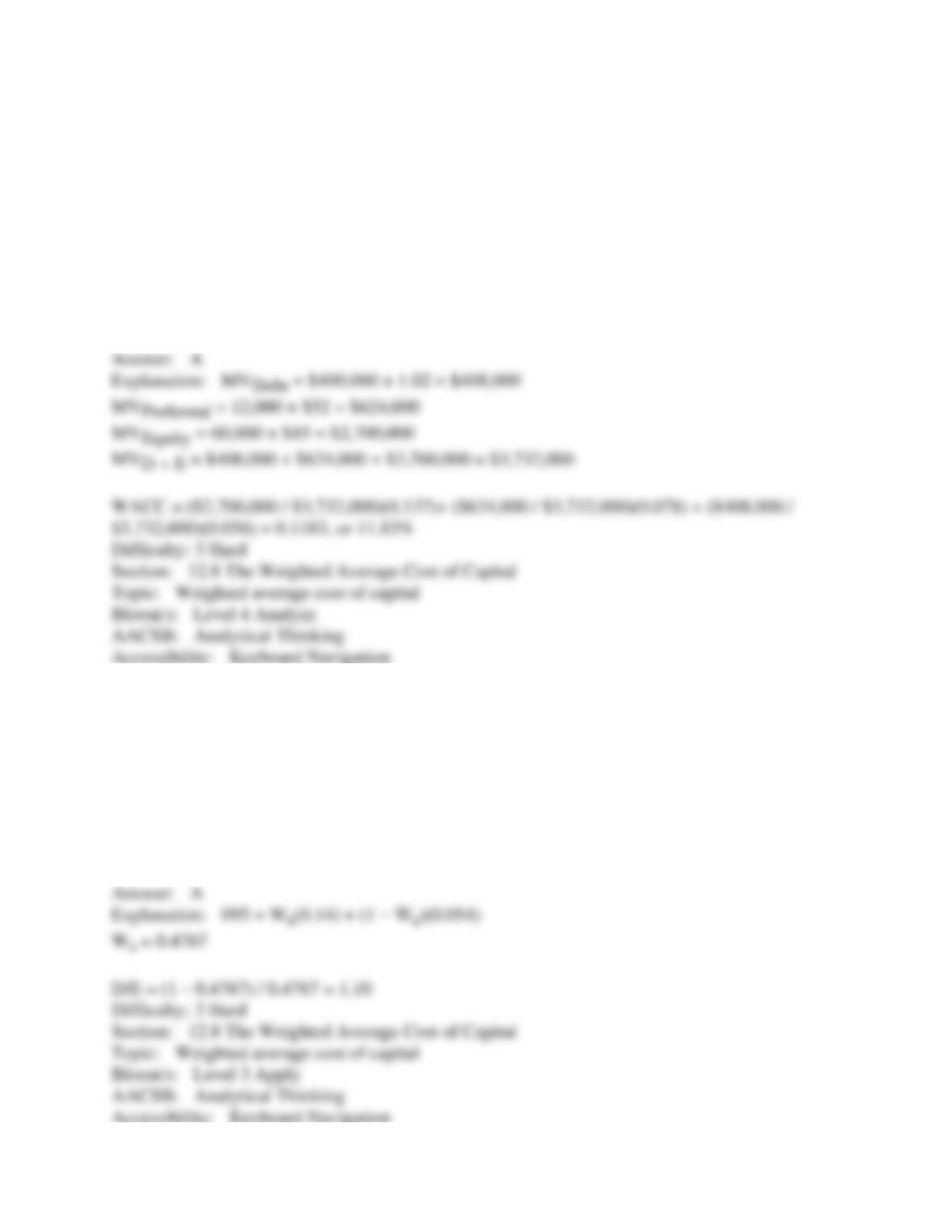
70) CTO Transport has an aftertax cost of debt of 5.6 percent, a cost of equity of 13.7 percent, and
a cost of preferred stock of 7.8 percent. The firm has 60,000 shares of common stock outstanding
at a market price of $45 a share. There are 12,000 shares of preferred stock outstanding at a market
price of $52 a share. The bond issue has a total face value of $400,000 and sells at 102 percent of
face value. The tax rate is 35 percent. What is the company’s WACC?
A) 11.83%
B) 12.06%
C) 12.42%
D) 11.39%
E) 10.87%
71) The Bird Carver has a target WACC of 9.5 percent. The firm has an aftertax cost of debt of 5.4
percent and a cost of equity of 14 percent. What debt-to-equity ratio is needed for the firm to
achieve its target WACC?
A) 0.75
B) 0.67
C) 1.10
D) 0.93
E) 1.06
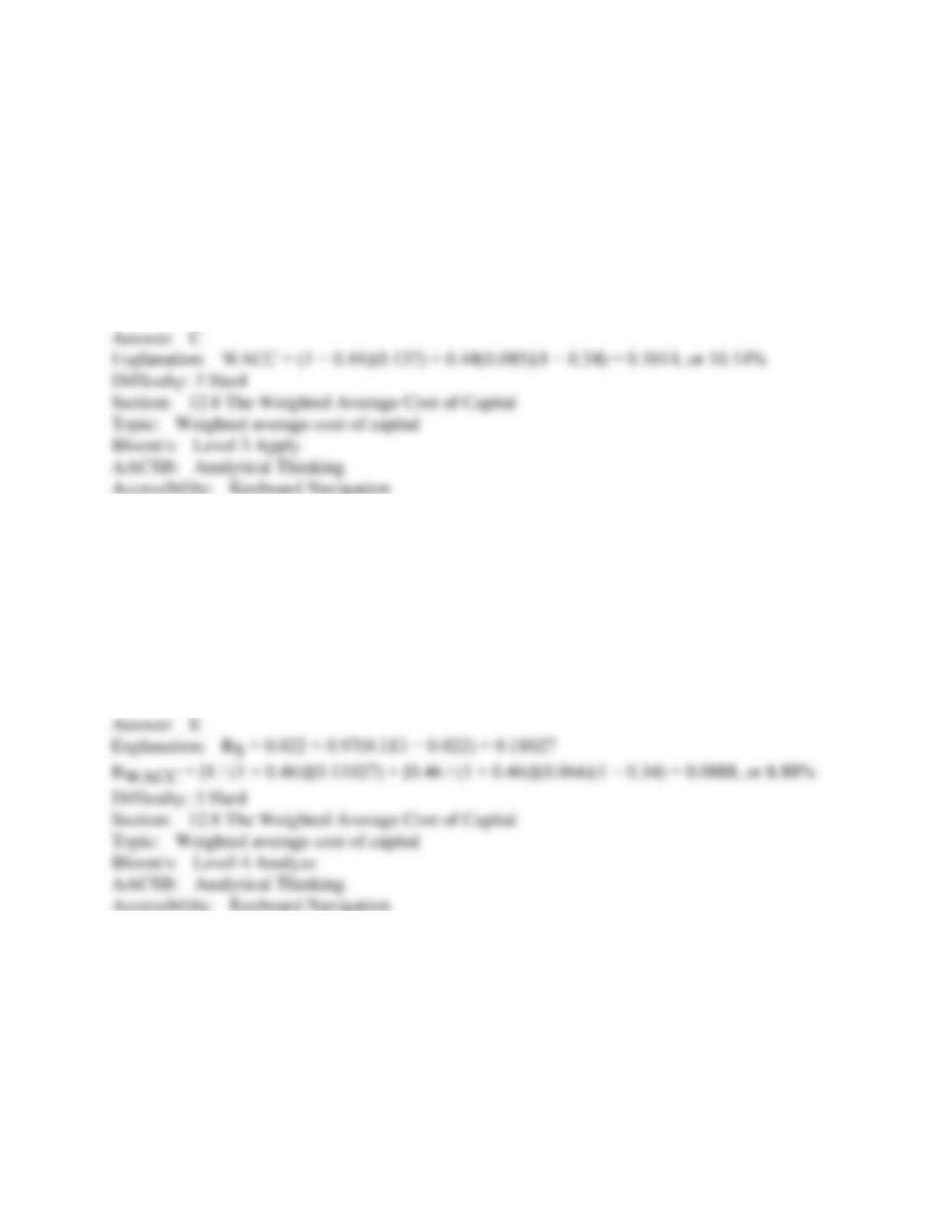
72) NuPress Valet has a proposed investment with an initial cost of $62 million and cash flows of
$12.5 million for 5 years. Debt represents 44 percent of the capital structure. The cost of equity is
13.7 percent, the pretax cost of debt is 8.5 percent, and the tax rate is 34 percent. What is the
company’s WACC?
A) 9.93%
B) 9.12%
C) 10.14%
D) 10.25%
E) 9.75%
73) Taylor’s has a beta of 0.97 and a debt-to-equity ratio of 0.46. The market rate of return is 11.3
percent, the tax rate is 34 percent, and the risk-free rate is 2.2 percent. The pretax cost of debt is 6.4
percent. What is the firm’s WACC?
A) 8.39%
B) 7.67%
C) 8.16%
D) 9.46%
E) 8.88%
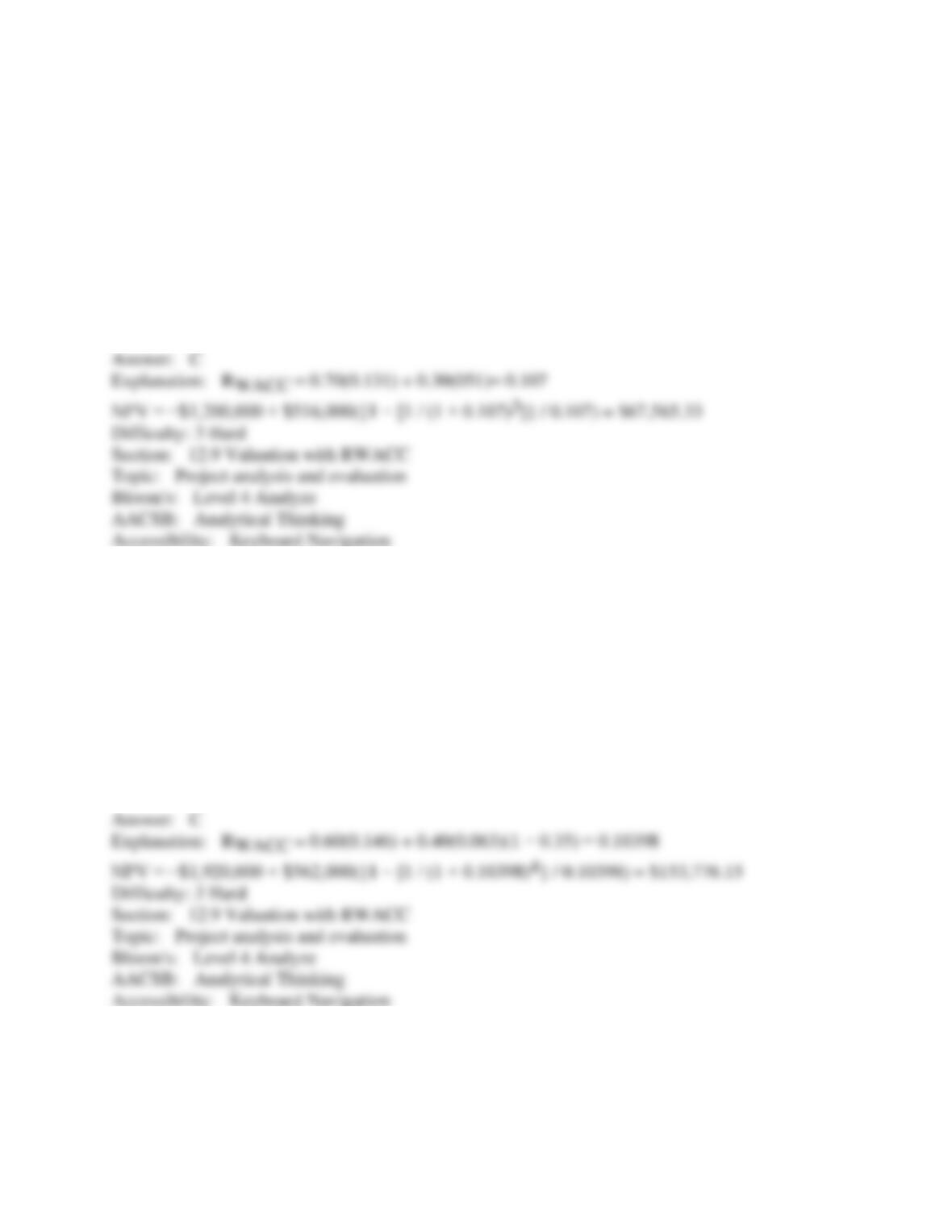
74) A levered firm has a target capital structure of 30 percent debt and 70 percent equity. The
aftertax cost of debt is 5.1 percent, the tax rate is 35 percent, and the cost of equity is 13.1 percent.
The firm is considering a project that is equally as risky as the overall firm. The project has an
initial cash outflow of $1.2 million and annual cash inflows of $516,000 at the end of each year for
3 years. What is the NPV of the project?
A) $60,174.68
B) $69,856.82
C) $67,565.33
D) $64,001.03
E) $93,322.15
75) Alaskan Markets has a target capital structure of 40 percent debt and 60 percent equity. The
pretax cost of debt is 6.3 percent, the tax rate is 35 percent, and the cost of equity is 14.6 percent.
The firm is considering a project that is equally as risky as the overall firm. The project has an
initial cash outflow of $1.92 million and annual cash inflows of $562,000 at the end of each year
for 4 years. What is the NPV of the project?
A) $153,776.15
B) $148,914.70
C) $174,087.95
D) $157,001.03
E) $161,950.98
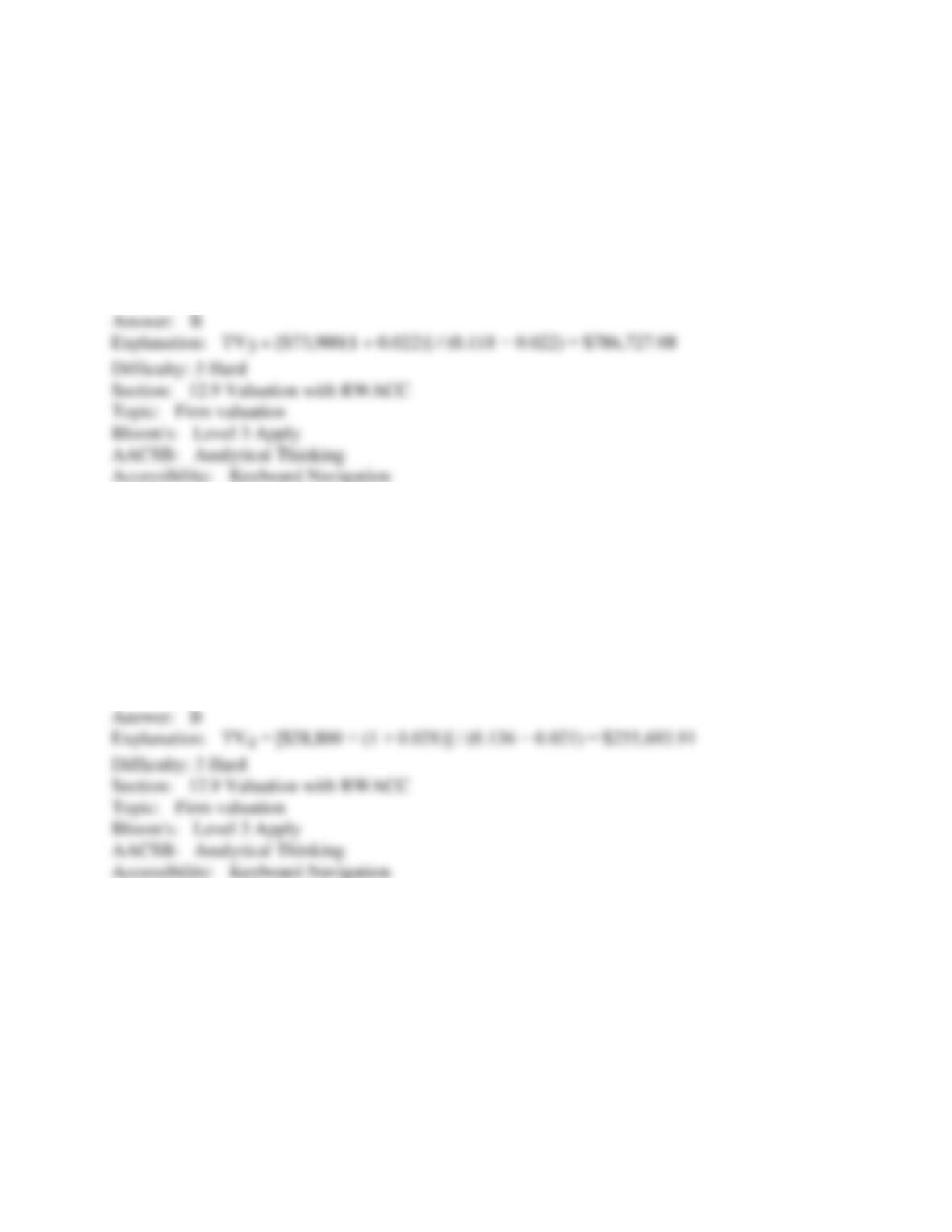
76) Jeanette’s Medical Supply has a beta of 1.47 and its RWACC is 11.8 percent. The market risk
premium is 7.4 percent, and the risk-free rate is 3.6 percent. The firm’s cash flow at Time 3 is
$73,900 with a growth rate of 2.2 percent. What is the terminal value of the firm at Time 3?
A) $748,056.60
B) $786,727.08
C) $667,229.73
D) $844,329.90
E) $649,688.15
77) Leo’s Cars has a beta of 1.1 and its RWACC is 13.6 percent. The market risk premium is 7.2
percent, and the risk-free rate is 2.3 percent. The firm’s cash flow at Time 4 is $28,800 with a
growth rate of 2.1 percent. What is the value of the firm at Time 4?
A) $273,584.91
B) $255,693.91
C) $251,004.16
D) $247,399.38
E) $260,729.20
78) A firm has an EBIT of $41,300, depreciation of $1,200, interest of $850, and taxes of $210.
The EBITDA multiple is 9.6. What is the value of the firm?
A) $378,800
B) $307,300
C) $392,340
D) $408,000
E) $387,200
79) A firm has net income of $21,350, depreciation of $2,780, interest of $640, and taxes of
$10,990. The EBITDA multiple is 10.2. What is the value of the firm?
A) $378,820
B) $364,752
C) $341,008
D) $353,860
E) $341,214
80) Zee’s Toy Store needs $242,000 for expansion. The firm has a target capital structure of 45
percent debt and 55 percent external equity. The flotation cost of debt is 5.2 percent compared to
8.5 percent for equity. What amount does the firm need to raise to fund the expansion?
A) $301,773.00
B) $299,716.00
C) $260,257.03
D) $233,333.33
E) $286,111.75
81) Asian Foods needs $110,000 for a new project. The firm has a target capital structure of 30
percent debt and 70 percent external equity. The flotation cost of debt is 5.25 percent compared to
10.15 percent for equity. What amount does the firm need to raise?
A) $120,801.25
B) $118,211.17
C) $120,455.54
D) $119,497.79
E) $122,674.09
82) Southwest Tours needs $134,000 for a new project. The firm has a target capital structure of 25
percent debt and 75 percent equity. The flotation cost of debt is 5.4 percent compared to 8.6
percent for equity. What amount does the firm need to raise if it generates sufficient internal equity
to cover the equity need?
A) $145,336.23
B) $136,211.17
C) $135,833.76
D) $149,497.79
E) $139,674.09
83) Winter’s prefers to finance its capital spending with 35 percent debt, 25 percent internal equity,
and 40 percent external equity. The floatation cost of debt is 5.2 percent while it is 9.1 percent for
equity. What is the weighted average flotation cost?
A) 5.46%
B) 6.28%
C) 6.49%
D) 7.63%
E) 7.74%