Part 5 Derivative Securities
CHAPTER 12
OPTIONS
CHAPTER LEARNING OBJECTIVES
12.1 Describe the basic nature of call options and the factors that influence their
value.
12.2 Describe the basic nature of put options and the payoffs associated with long
12.3 Explain how to use put-call parity to estimate call and put prices, and explain
12.4 Explain how to use the Black-Scholes option pricing model to price call
12.5 Explain how options are traded and what is meant by implied volatility.
12.6 Explain, using the simplest option pricing model, what factors affect the value
of a call option.
Derivative Securities 12 – 2
MULTIPLE CHOICE QUESTIONS
1. A call option is:
a) the right to buy an underlying asset at a fixed price for a specified time.
b) the right to sell an underlying asset at a fixed price for a specified time.
c) a price established today for future delivery.
d) a standardized exchange-traded contract in which the seller agrees to deliver a
commodity to the buyer at some point in the future.
2. An option can be:
I. in the money
II. out of the money
III. at the money
IV. shallow
a) I, II, III, IV
b) I, II, III only
c) I, II only
d) I only
3. Use the following statements to answer the following question:
I. A call option provides insurance against the decrease of the stock price below the
strike price.
II. The buyer of a call option pays a premium regardless of the underlying asset price.
a) I and II are correct
b) I is correct and II is incorrect
12 – 3 Test Bank for Introduction to Corporate Finance, Fourth Canadian Edition
c) I is incorrect and II is correct
d) I and II are incorrect
4. The strike price of an option is:
a) the value of the underlying asset at expiration.
b) the price of the option.
c) the proceeds generated if today was the expiration day.
d) the price at which an investor can buy or sell the underlying asset.
5. What is a short position?
a) Position taken by the person who sells an option.
b) Position taken by the person who buys an option.
c) Buy a call and buy a put.
d) Sell a call and buy a put.
6. Jay writes a call option with a strike price of $50. What will be Jay’s payoff in dollars if
the underlying asset price at expiration is $55?
Derivative Securities 12 – 4
a) $5
b) −$5
c) 0
d) $105
7. The time value on call option A is $5 and the option premium is $8. What is the
intrinsic value of call option A?
a) $40
b) $13
c) −$3
d) $3
8. The strike price on a call option is $8 and the price of the underlying stock is $10.
What is the time value of money of the call option if the option premium is $3?
a) $4
b) $3
c) −$2
d) $1
9. If an investor is trying to cancel her short position in a call option, she should:
a) buy the underlying asset.
b) sell the underlying asset.
c) buy the call option.
d) sell the call option.
10. The difference between the intrinsic value of an option and its actual value is:
a) the payoff
b) the premium
c) the time value
d) the underlying asset cost
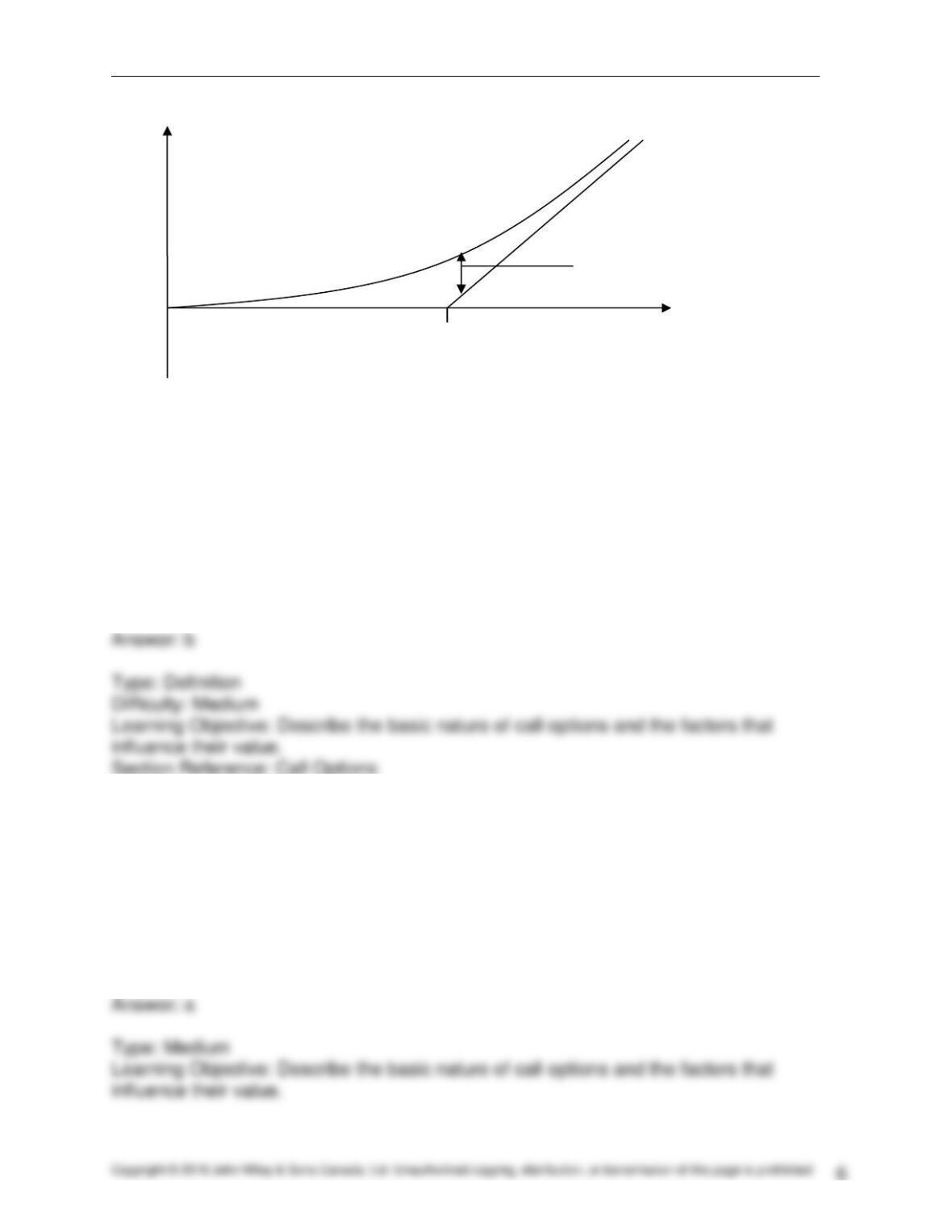
11. Label the diagram below:
Derivative Securities 12 – 6
Time Value
Underlying asset price
Strike price
Intrinsic value of a call
Payoff/profit/option value
a) 1, 2, 3, 4, 5 respectively
b) 5, 3, 2, 4, 1 respectively
c) 4, 1, 2, 5, 3 respectively
d) 5, 1, 2, 4, 3 respectively
12. Which of the following investors would be happy to see the stock price increase
sharply?
a) An investor who bought a call option.
b) An investor who bought a put option.
c) An investor who bought the stock and has sold a call option.
d) An investor who has sold a call option.
4
3
2
5
1
13. Which of the following is the higher priced call option?
A) Higher ST, higher X, increased volatility
b) Higher ST, higher X, decreased volatility
c) Higher ST, lower X, increased volatility
d) Lower ST, higher X, decreased volatility
14. Which of the following factors increases the price of a put option?
a) Higher asset price, higher strike price, increased volatility, increased dividends
b) Higher strike price, longer time to expiration, increased volatility, increased dividends
c) Higher strike price, longer time to expiration, increased volatility, increased interest
rates
d) Longer time to expiration, increased volatility, decreasing interest rates, decreasing
dividends
15. Holding a put option and a call option on the same underlying asset, strike price, and
maturity has payoffs equivalent to:
a) holding a stock today
b) holding a stock in the future
c) holding a call option
d) none of the above
16. The intrinsic value of an in-the-money put option is:
a) X−ST
b) ST −X
c) X−ST+P
d) 0
17. Which of the following types of option is more valuable?
a) American put option
b) European put option
c) Need additional information
d) Neither one
18. An option that can be exercised only at maturity is referred to as:
a) a European option
b) a call option
c) a protective put
d) an American option
19. Which of the following statements is NOT true?
a) An increase in interest rates decreases the value of a call option.
b) An increase in volatility increases the value of a call option.
c) A decrease in volatility decreases the value of a put option.
d) An increase in the underlying asset’s price decreases the value of a put.
20. Which of the following statements is true?
a) An increase in interest rates increases the value of a put option.
b) An increase in volatility increases the value of a put option.
c) A decrease in volatility increases the value of a put option.
d) A decrease in the underlying asset’s price decreases the value of a put.
21. Put-call parity is based on which one of the following principles?
a) Binomial tree
b) Time value of money
c) No arbitrage
d) Normality of returns
22. When can put-call parity be applied?
I. Call and put have the same strike price
II. Call and put have the same time to expiration and are held until expiration
III. Call and put are created using the same underlying asset
IV. Call and put have the same premium
a) Only I is required
b) Only I and II are required
c) Only I, II, and III are required
d) I, II, III, and IV are required
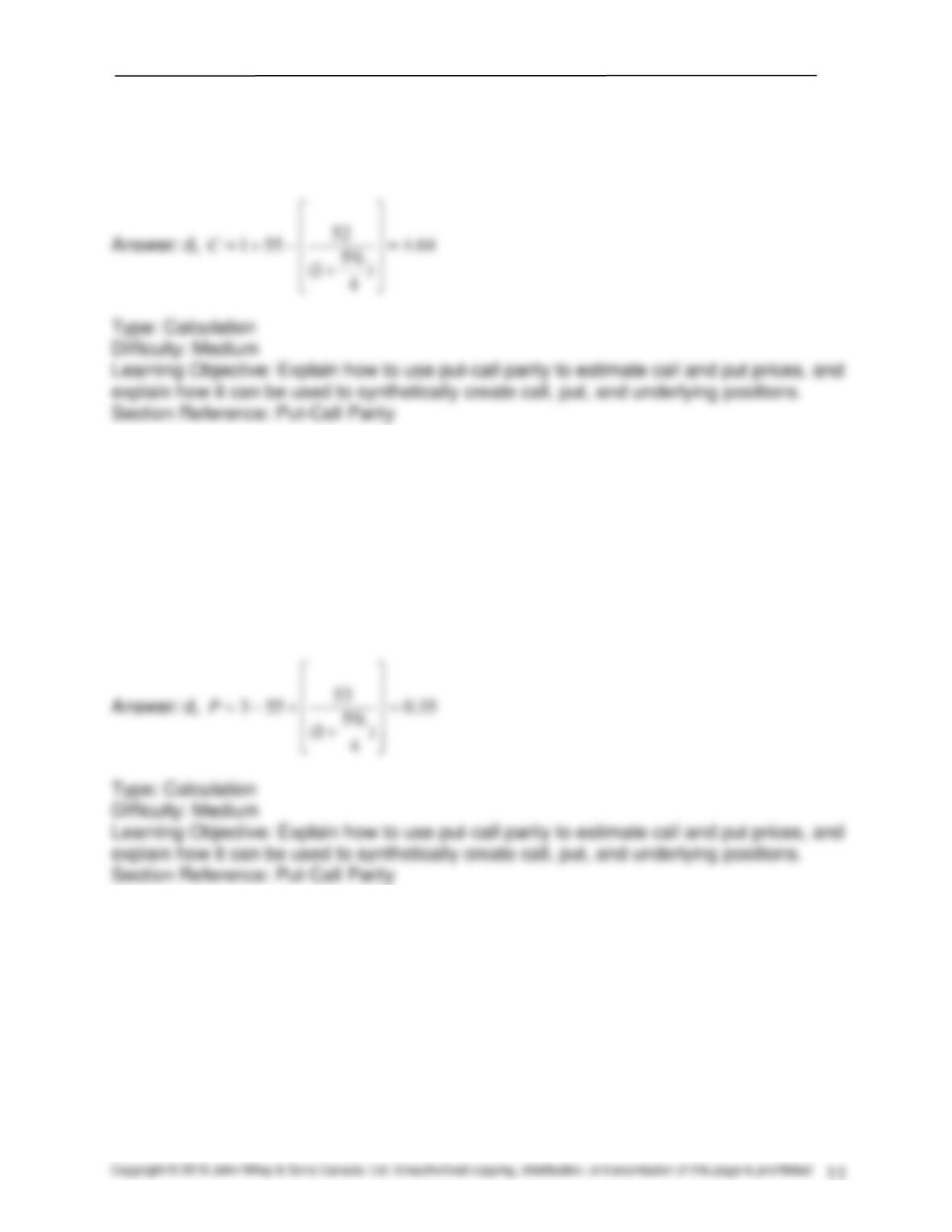
23. Using the following information, find the price of the call option:
Stock price St=$ 55, interest rate I=5%,
Strike price X=$ 52, Put premium=$ 1, Maturity: T=3 months
a) $6.47
12 – 11 Test Bank for Introduction to Corporate Finance, Fourth Canadian Edition
b) $0.62
c) $8.47
d) $4.64
24. Using the following information, find the price of the put option:
Stock price St=$55, interest rate I=5%,
Strike price X=$53, Call premium=$3, Maturity: T=3 months
a) $0.47
b) $0.62
c) $3.47
d) $0.35
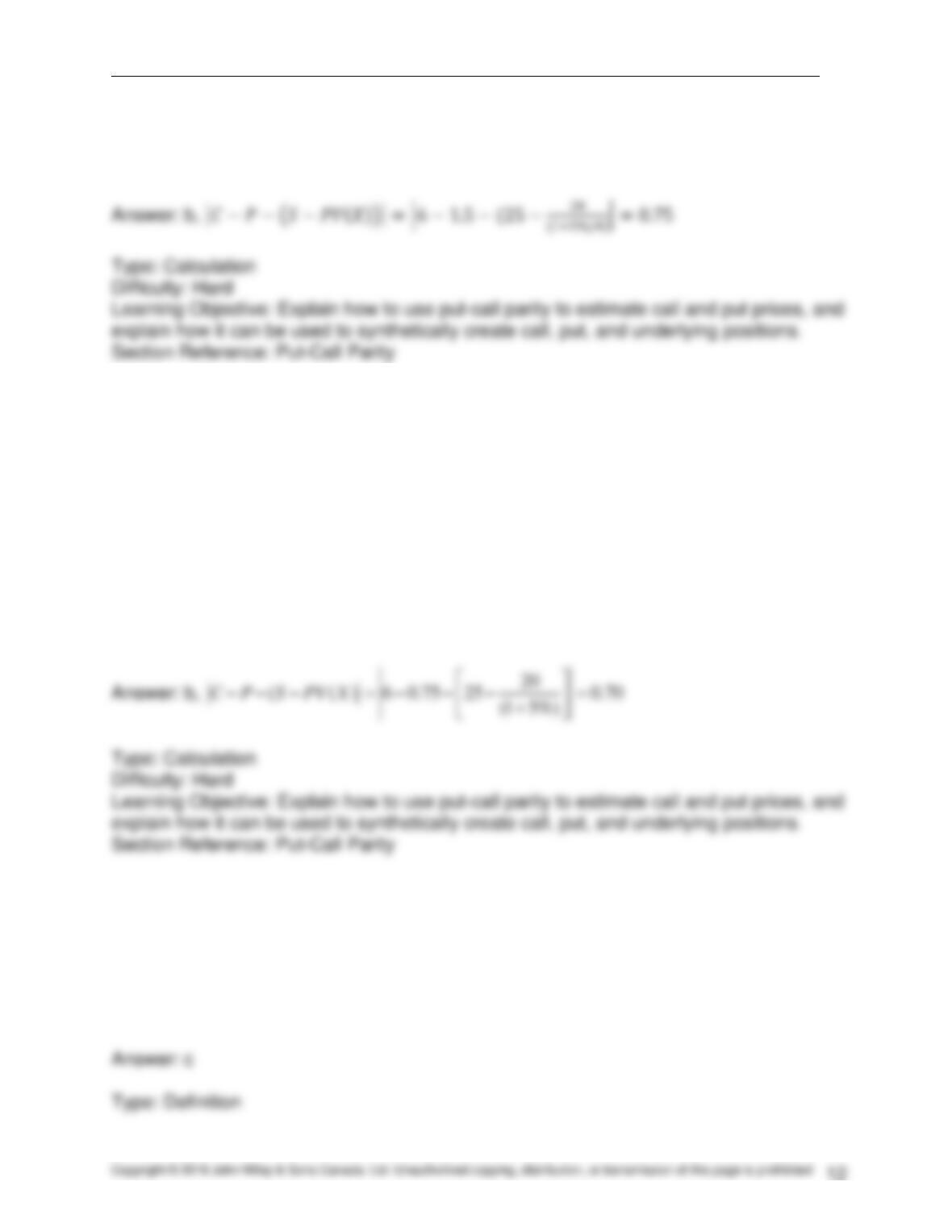
25. Consider the following information about a three-month option on stock XYZ:
Stock Price Interest rate Call Price Put Price Strike Price
25 5% 6.00 1.5 20
Using the information above, calculate the arbitrage profit:
a) $0
Derivative Securities 12 – 12
b) $0.75
c) $1.45
d) $4.19
26. Consider the following information about a one-year option on stock XYZ:
Stock Price Interest rate Call Price Put Price Strike Price
25 5% 6.00 0.75 20
Using the information above, calculate the arbitrage profit:
a) $0
b) $0.70
c) $5.56
d) $6.44
27. ____________is the relationship between the price of a call option and a put option.
a) The binomial option pricing model
b) The Black-Scholes option pricing model
c) Put-call parity
d) A swap
28. Put-call parity has the following conditions:
I. both the call and the put have the same X
II. both the call and the put are purchased at the same time
III. both the call and the put have the same expiration dates
IV. assumed to be European
a) I, II, III only
b) I, III, IV only
c) I, II, IV only
d) II, III, IV only
29. Put-call parity can be used to assess:
a) any arbitrage opportunity between call and put.
b) how far in-the-money call options can get.
c) the precise relationship between put and call prices given unequal exercise prices and
unequal expiration dates.
d) all of the above.
30. Which of the following strategies does NOT require the investor to long a put?
a) Collar
Derivative Securities 12 – 14
b) Covered call
c) Synthetic call and synthetic put
d) Protective put
31. Montreal Smoked Meat shares are selling for $55. The 2-year put option on XYZ
shares has the following characteristics: strike = $50, price = $0.25
Given that the risk-free rate is 2%, what is the price of a 2-year call option on XYZ shares
with an exercise price of $50?
a) $5.25
b) $7.19
c) −$4.75
d) $0
32. The basic put-call parity can be rearranged as:
a) P – S = C + PV(X)
b) C + P = S – PV(X)
c) C = P +S –PV(X)
d) P = C + S + PV(X)
33. Given:
asset price today $50
asset price at expiration $60
put strike price $50
call strike price $50
What is the payoff of a protective put and a covered call?
a) $10, $0
b) $0, $10
c) $10, $20
d) $20, $10
34. Which of the following best defines a covered call?
a) Purchase a put option to protect a long position in an underlying asset.
b) Position between the floor and ceiling price.
c) The right, but not an obligation, to sell an underlying asset at a fixed price for a
specified time.
d) Selling call options while owning the underlying asset
35. Min has created the following portfolio:
bought a share for $20
bought 3 puts, strike price $18
maturity 1yr
Suppose at expiration ST is $17. What is the payoff of her strategy?
Derivative Securities 12 – 16
a) $0
b) $3
c) −$2
d) −$3
36.
In the above collar position, what is the payoff if the underlying asset today is $40 and at
expiration is $50?
a) −$10
b) $10
c) $20
d) −$30
30
60