Corporate Finance, 4e (Berk / DeMarzo)
Chapter 12 Estimating the Cost of Capital
12.1 The Equity Cost of Capital
Use the following information to answer the question(s) below.
Beta
Volatility
“Eenie”
0.45
20%
“Meenie”
0.75
18%
“Miney”
1.05
35%
“Moe”
1.20
25%
Assume that the risk-free rate of interest is 3% and you estimate the market’s expected return to be 9%.
1) Which firm has the most total risk?
A) Eenie
B) Meenie
C) Miney
D) Moe
2) Which firm has the least market risk?
A) Eenie
B) Meenie
C) Miney
D) Moe
3) Which firm has the highest cost of equity capital?
A) Eenie
B) Meenie
C) Miney
D) Moe
4) The equity cost of capital for “Miney” is closest to:
A) 6.30%
B) 7.50%
C) 9.30%
D) 9.75%
5) The equity cost of capital for “Meenie” is closest to:
A) 4.50%
B) 7.50%
C) 9.30%
D) 9.75%
6) The risk premium for “Meenie” is closest to:
A) 4.50%
B) 7.50%
C) 9.30%
D) 9.75%
12.2 The Market Portfolio
Use the following information to answer the question(s) below.
Suppose all possible investment opportunities in the world are limited to the four stocks list in the table
below:
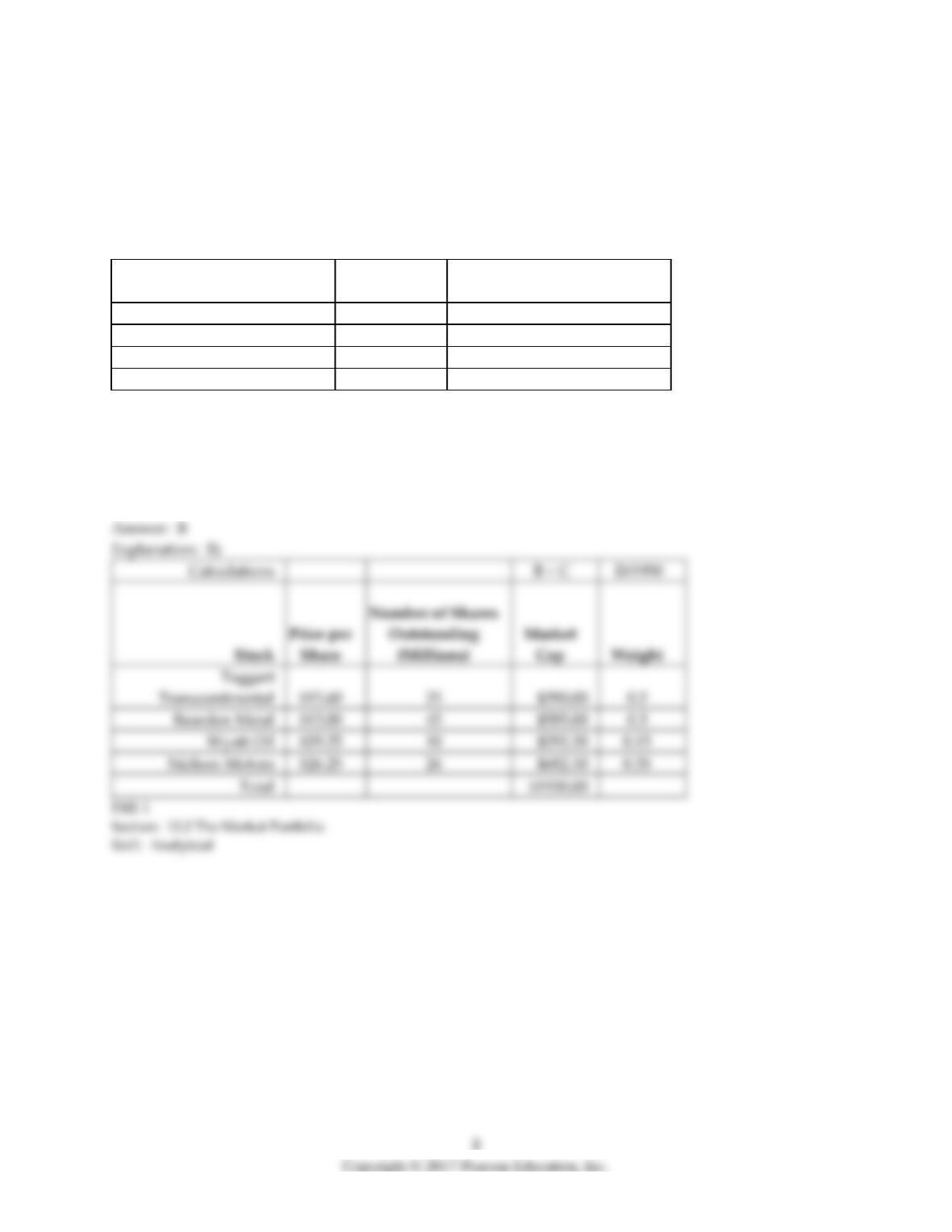
Stock
Price per
Share
Number of Shares
Outstanding (Millions)
Taggart Transcontinental
$15.60
25
Rearden Metal
$13.00
45
Wyatt Oil
$29.25
10
Nielson Motors
$26.25
26
1) The weight on Taggart Transcontinental stock in the market portfolio is closest to:
A) 15%
B) 20%
C) 25%
D) 30%
2) The weight on Wyatt Oil stock in the market portfolio is closest to:
A) 15%
B) 20%
C) 25%
D) 30%
3) Suppose that you are holding a market portfolio and you have invested $9000 in Rearden Metal. The
amount that you have invested in Nielson Motors is closest to:
A) $6000
B) $7715
C) $9000
D) $10,500
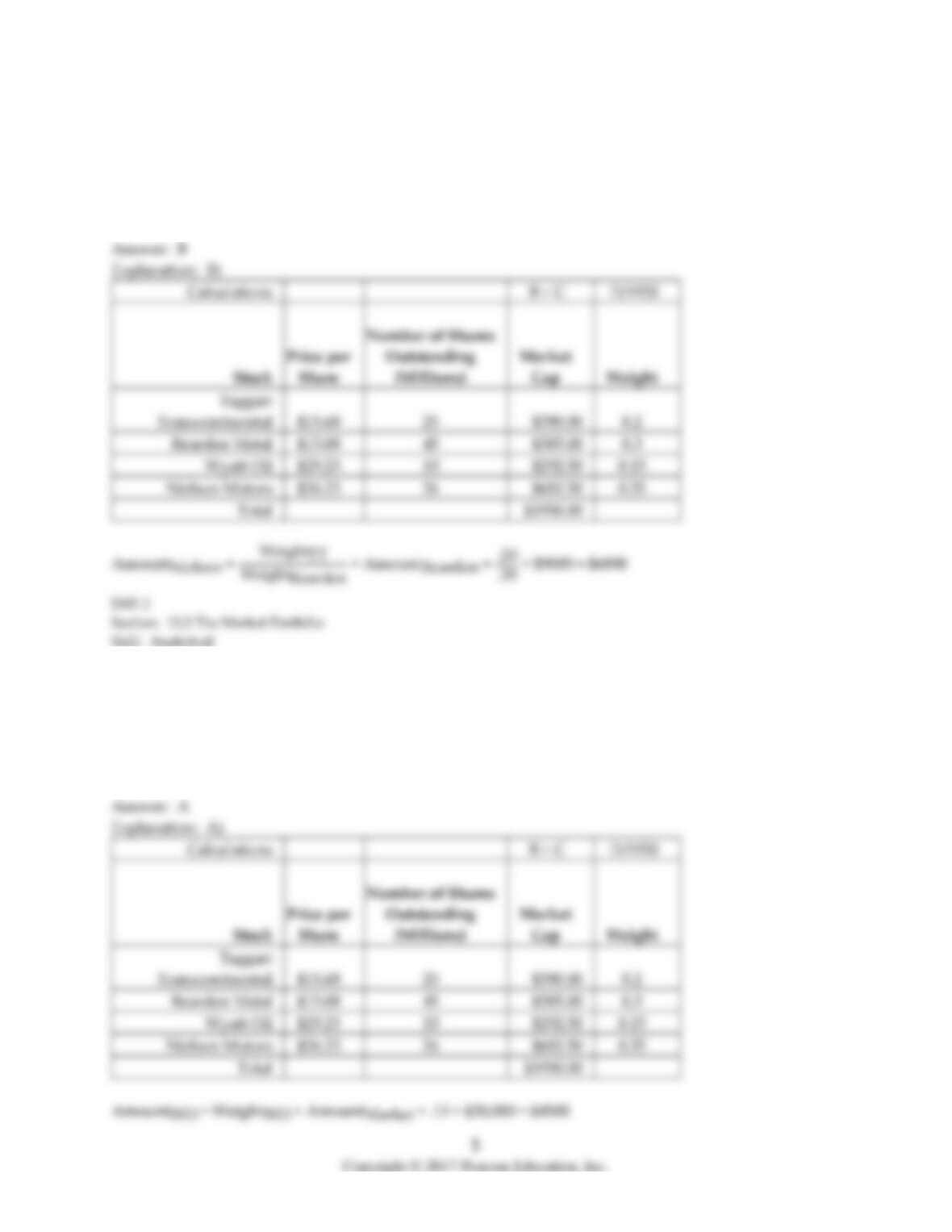
4) Suppose that you are holding a market portfolio and you have invested $9000 in Rearden Metal. The
amount that you have invested in Taggart Transcontinental is closest to:
A) $4500
B) $6000
C) $7715
D) $9000
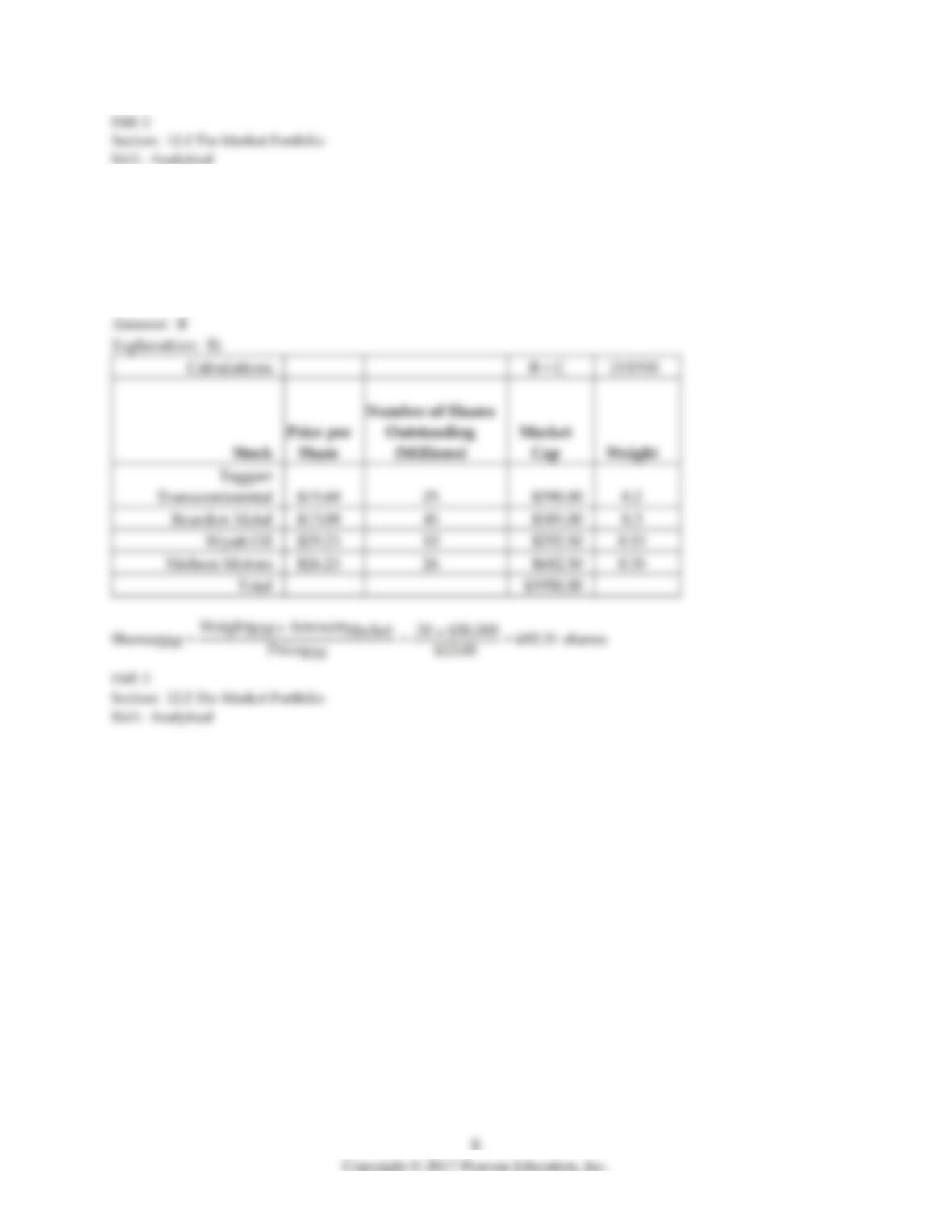
5) Suppose that you have invested $30,000 invested in the market portfolio. Then the amount that you
have invested in Wyatt Oil is closest to:
A) $4500
B) $6000
C) $7715
D) $9000
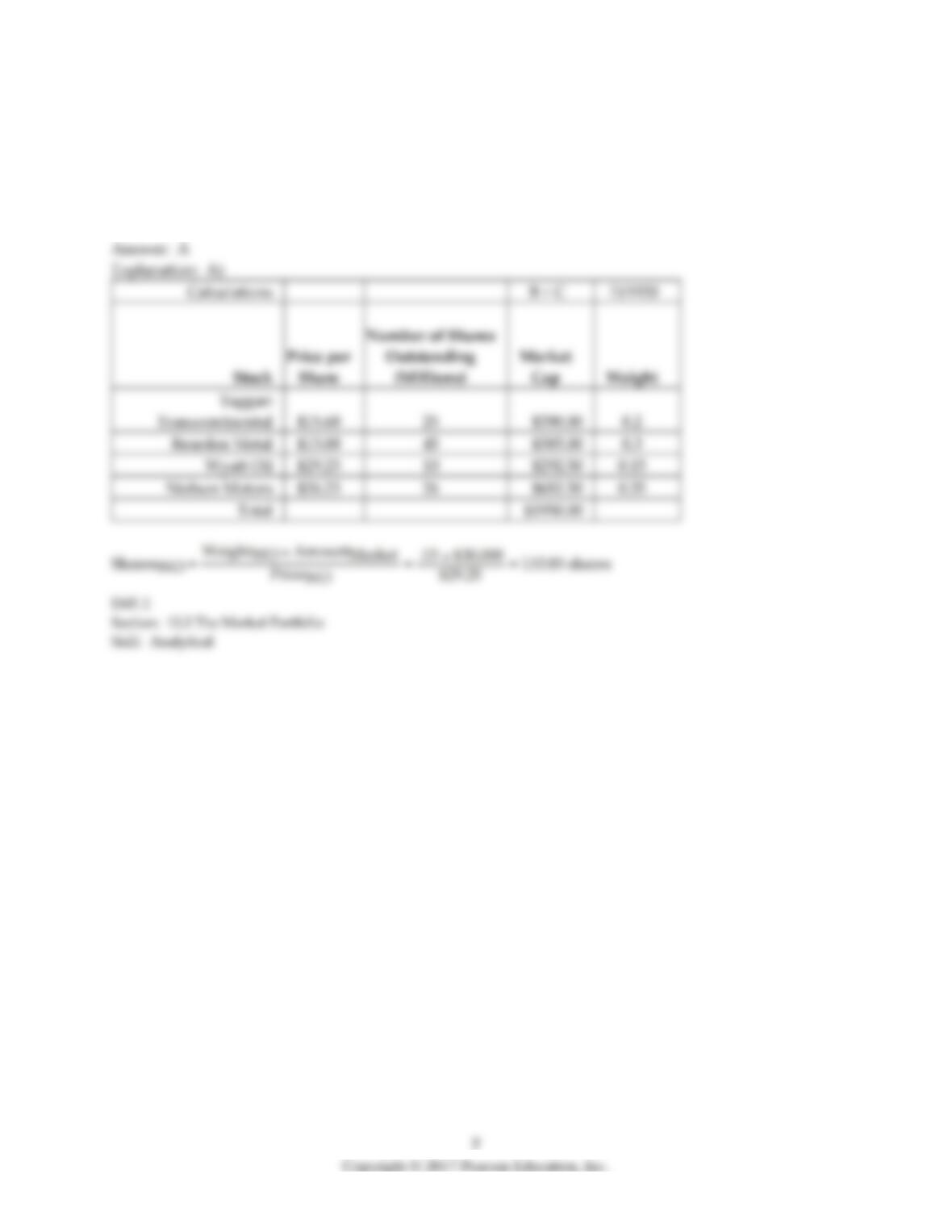
6) Suppose that you have invested $30,000 in the market portfolio. Then the number of shares of
Rearden Metal that you hold is closest to:
A) 450 shares
B) 700 shares
C) 1400 shares
D) 2300 shares
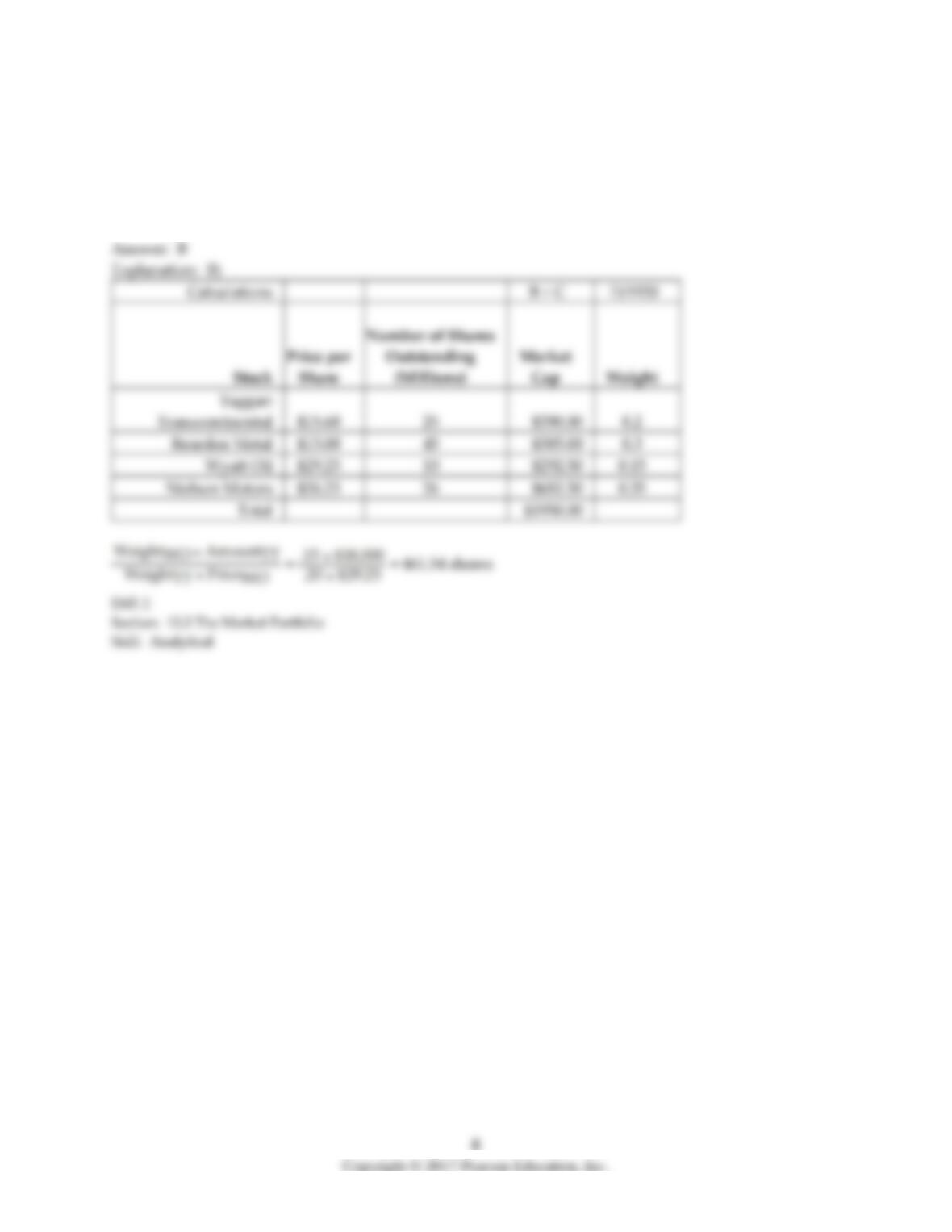
7) Suppose that you have invested $30,000 in the market portfolio. Then the number of shares of Wyatt
Oil that you hold is closest to:
A) 150 shares
B) 300 shares
C) 350 shares
D) 450 shares
8) Suppose that you are holding a market portfolio and you have invested $18,000 in Taggart
Transcontinental. The number of shares of Wyatt Oil that you hold is closest to:
A) 90 shares
B) 460 shares
C) 615 shares
D) 770 shares
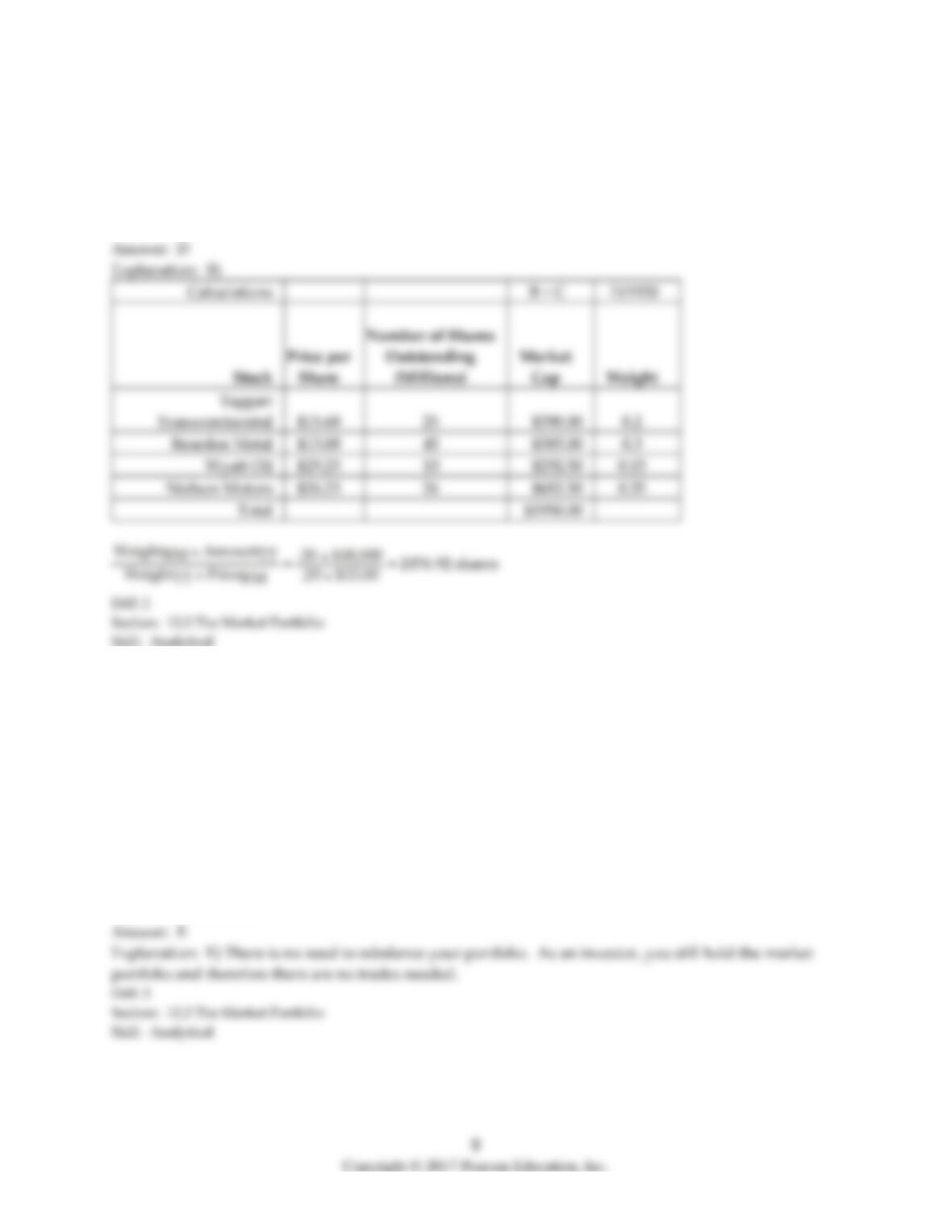
9) Suppose that you are holding a market portfolio and you have invested $18,000 in Taggart
Transcontinental. The number of shares of Rearden Metal that you hold is closest to:
A) 780 shares
B) 925 shares
C) 1730 shares
D) 2075 shares
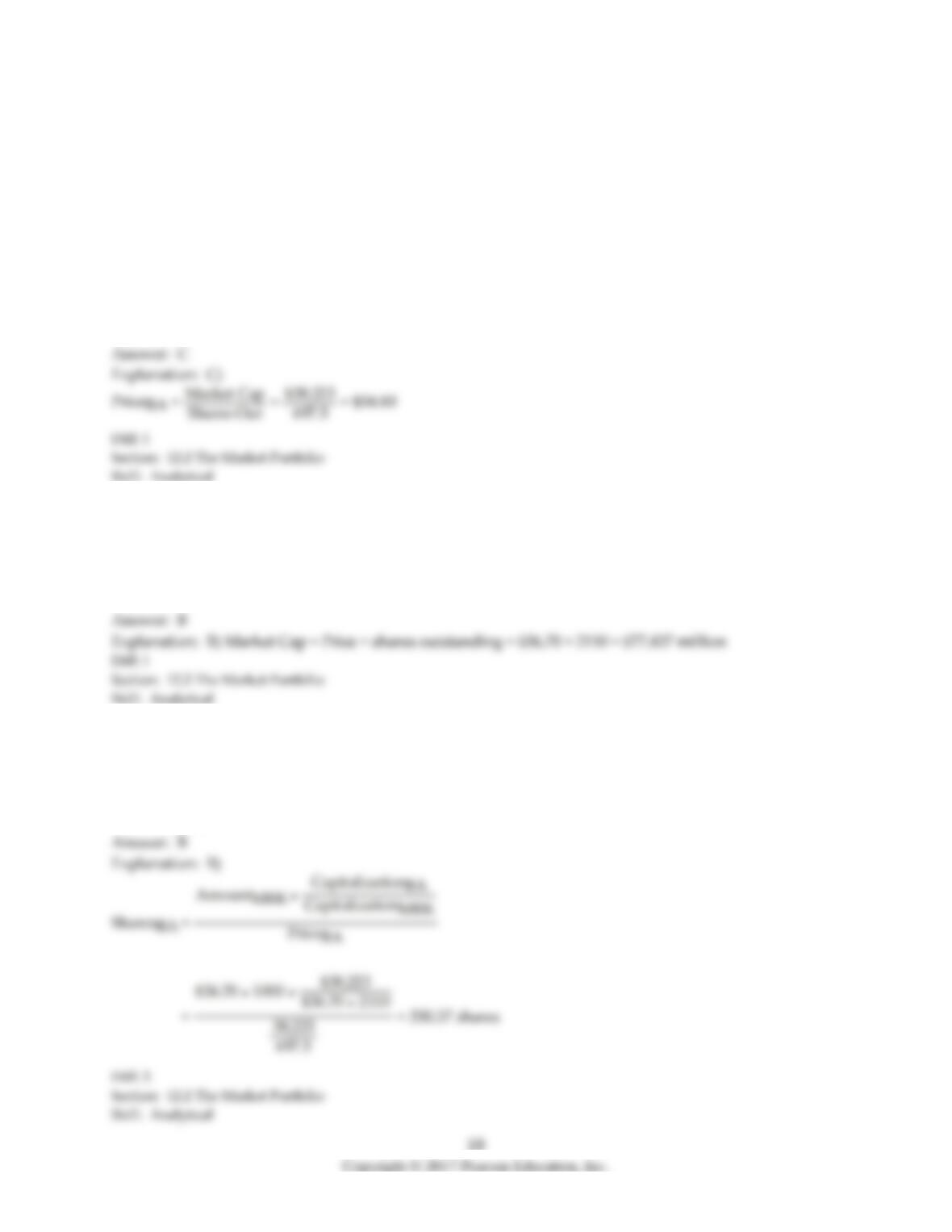
10) Suppose that you have $100,000 invested in the market portfolio and that the stock price of Taggart
Transcontinental suddenly drops to $7.80 per share. Which of the following trades would you need to
make in order to maintain your investment in the market portfolio:
1. Buy approximately 1140 shares of Taggart Transcontinental
2. Sell approximately 256 shares of Rearden Metal
3. Sell approximately 57 shares of Wyatt Oil
4. Sell approximately 148 shares of Nielson Motors
A) 1 only
B) 2 only
C) 2, 3, and 4 only
D) 1, 2, 3, and 4
E) None of the above
Use the following information to answer the question(s) below.
Suppose the market consists only of Merck (MRK) and Boeing (BA). Merck stock is trading for $36.70
per share with 2.11 billion shares outstanding while Boeing has 697.5 million shares outstanding and a
market capitalization of $38.223 billion. Assume that you hold the market portfolio.
11) Boeing’s stock price is closest to:
A) $18.25
B) $36.70
C) $54.80
D) $63.40
12) Merck’s market capitalization is closest to:
A) $38.2 billion
B) $77.4 billion
C) $89.4 billion
D) $115.6 billion
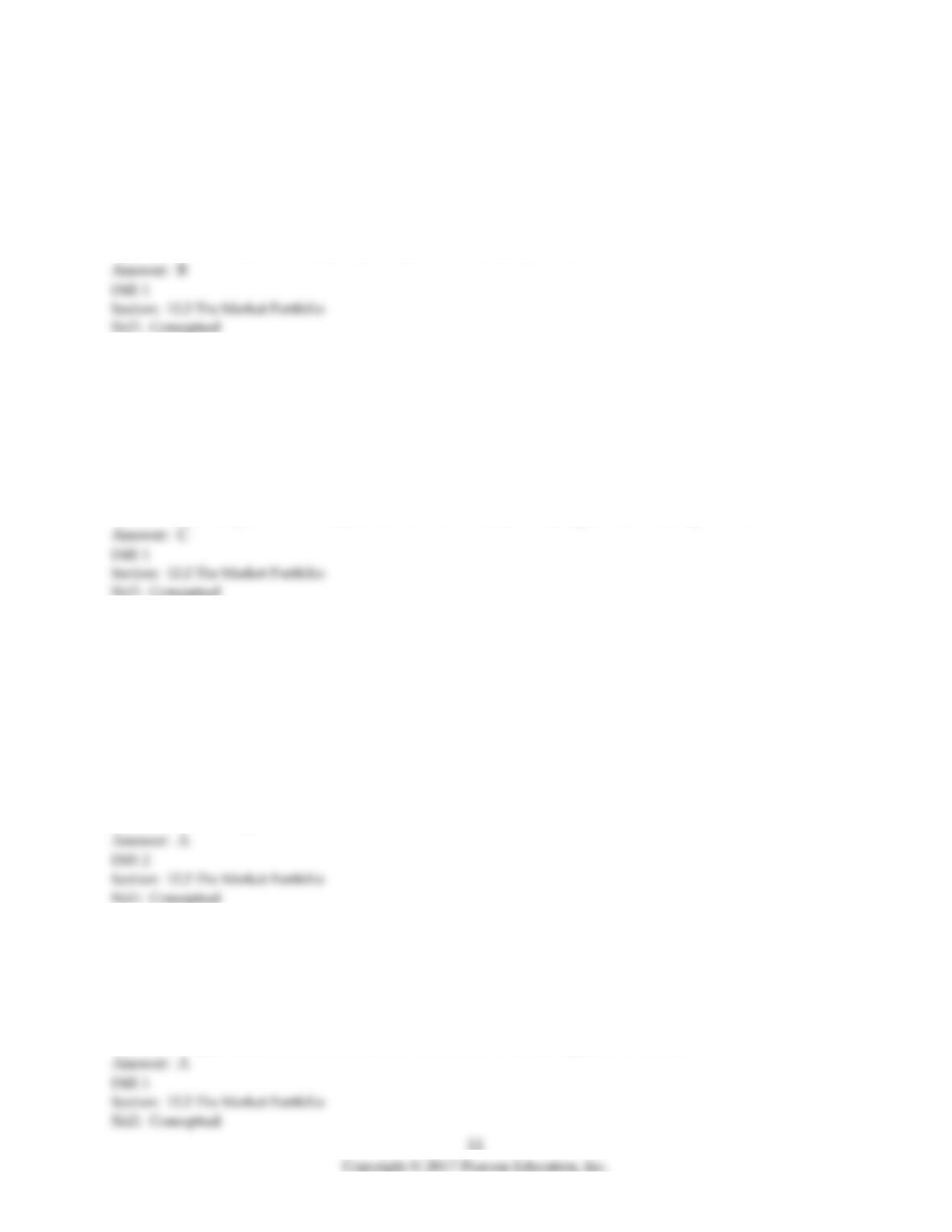
13) If you hold 1000 shares of Merck, then the number of shares of Boeing that you hold is closest to:
A) 240 shares
B) 330 shares
C) 510 shares
D) 780 shares
14) Which of the following statements is FALSE?
A) All investors should demand the same efficient portfolio of securities in the same proportions.
B) The Capital Asset Pricing Model (CAPM) allows corporate executives to identify the efficient
portfolio (of risky assets) by using knowledge of the expected return of each security.
C) If investors hold the efficient portfolio, then the cost of capital for any investment project is equal to
its required return calculated using its beta with the efficient portfolio.
D) The CAPM identifies the market portfolio as the efficient portfolio.
15) Which of the following statements is FALSE?
A) If investors have homogeneous expectations, then each investor will identify the same portfolio as
having the highest Sharpe ratio in the economy.
B) Homogeneous expectations are when all investors have the same estimates concerning future
investments and returns.
C) There are many investors in the world, and each must have identical estimates of the volatilities,
correlations, and expected returns of the available securities.
D) The combined portfolio of risky securities of all investors must equal the efficient portfolio.
16) Which of the following statements is FALSE?
A) If some security were not part of the efficient portfolio, then every investor would want to own it,
and demand for this security would increase causing its expected return to fall until it is no longer an
attractive investment.
B) The efficient portfolio, the portfolio that all investors should hold, must be the same portfolio as the
market portfolio of all risky securities.
C) Because every security is owned by someone, the sum of all investors’ portfolios must equal the
portfolio of all risky securities available in the market.
D) If all investors demand the efficient portfolio, and since the supply of securities is the market
portfolio, then two portfolios must coincide.
17) Which of the following statements is FALSE?
A) The market portfolio contains more of the smallest stocks and less of the larger stocks.
B) For the market portfolio, the investment in each security is proportional to its market capitalization.
C) Because the market portfolio is defined as the total supply of securities, the proportions should
correspond exactly to the proportion of the total market that each security represents.
D) Market capitalization is the total market value of the outstanding shares of a firm.
18) Which of the following statements is FALSE?
A) A value-weighted portfolio is an equal-ownership portfolio: We hold an equal fraction of the total
number of shares outstanding of each security in the portfolio.
B) When buying a value-weighted portfolio, we end up purchasing the same percentage of shares of
each firm.
C) To maintain a value-weighted portfolio, we do not need to trade securities and rebalance the
portfolio unless the number of shares outstanding of some security changes.
D) In a value weighted portfolio the fraction of money invested in any security corresponds to its share
of the total number of shares outstanding of all securities in the portfolio.
19) Which of the following statements is FALSE?
A) The most familiar stock index in the United States is the Dow Jones Industrial Average (DJIA).
B) A portfolio in which each security is held in proportion to its market capitalization is called a price–
weighted portfolio.
C) The Dow Jones Industrial Average (DJIA) consists of a portfolio of 30 large industrial stocks.
D) The Dow Jones Industrial Average (DJIA) is a price-weighted portfolio.
20) Which of the following statements is FALSE?
A) Because very little trading is required to maintain it, an equal–weighted portfolio is called a passive
portfolio.
B) If the number of shares in a value weighted portfolio does not change, but only the prices change, the
portfolio will remain value weighted.
C) The CAPM says that individual investors should hold the market portfolio, a value-weighted
portfolio of all risky securities in the market.
D) A price weighted portfolio holds an equal number of shares of each stock, independent of their size.
21) Which of the following statements is FALSE?
A) A market index reports the value of a particular portfolio of securities.
B) The S&P 500 is the standard portfolio used to represent “the market” when using the CAPM in
practice.
C) Even though the S&P 500 includes only 500 of the more than 7,000 individual U.S. Stocks in
existence, it represents more than 70% of the U.S. stock market in terms of market capitalization.
D) The S&P 500 is an equal-weighted portfolio of 500 of the largest U.S. stocks.
22) Which of the following statements is FALSE?
A) The S&P 500 and the Wilshire 5000 indexes are both well–diversified indexes that roughly
correspond to the market of U.S. stocks.
B) Practitioners commonly use the S&P 500 as the market portfolio in the CAPM because they believe
that this index is actually the market portfolio.
C) Standard & Poor’s Depository Receipts (SPDR, nicknamed “spider”) trade on the American Stock
Exchange and represent ownership in the S&P 500.
D) The S&P 500 was the first widely publicized value weighted index and it has become a benchmark
for professional investors.
23) In practice which market index is most widely used as a proxy for the market portfolio in the
CAPM?
A) Dow Jones Industrial Average
B) Wilshire 5000
C) S&P 500
D) U.S. Treasury Bill
24) In practice which market index would best be used as a proxy for the market portfolio in the
CAPM?
A) S&P 500
B) Dow Jones Industrial Average
C) U.S. Treasury Bill
D) Wilshire 5000
Use the table for the question(s) below.
Consider the following stock price and shares outstanding data:
Stock
Name
Price per
Share
Shares
Outstanding
(Billions)
Lowes
$28.80
1.53
Wal-Mart
$47.90
4.17
Intel
$19.60
5.77
Boeing
$75.00
0.79
25) The market capitalization for Wal-Mart is closest to:
A) $415 Billion
B) $276 Billion
C) $479 Billion
D) $200 Billion
Name
Share
Shares
(Billions)
Lowes
Wal-Mart
Boeing
26) The total market capitalization for all four stocks is closest to:
A) $479 Billion
B) $415 Billion
C) $2100 Billion
D) $200 Billion
27) If you are interested in creating a value-weighted portfolio of these four stocks, then the percentage
amount that you would invest in Lowes is closest to:
A) 25%
B) 11%
C) 20.0%
D) 12%
28) Assume that you have $100,000 to invest and you are interested in creating a value-weighted
portfolio of these four stocks. The number of shares of Wal-Mart that you would hold in your portfolio
is closest to:
A) 710
B) 1390
C) 1000
D) 870
29) Assume that you have $100,000 to invest and you are interested in creating a value-weighted
portfolio of these four stocks. The percentage of the shares outstanding of Boeing that you would hold
in your portfolio is closest to:
A) .000018%
B) .000020%
C) .000024%
D) .000031%
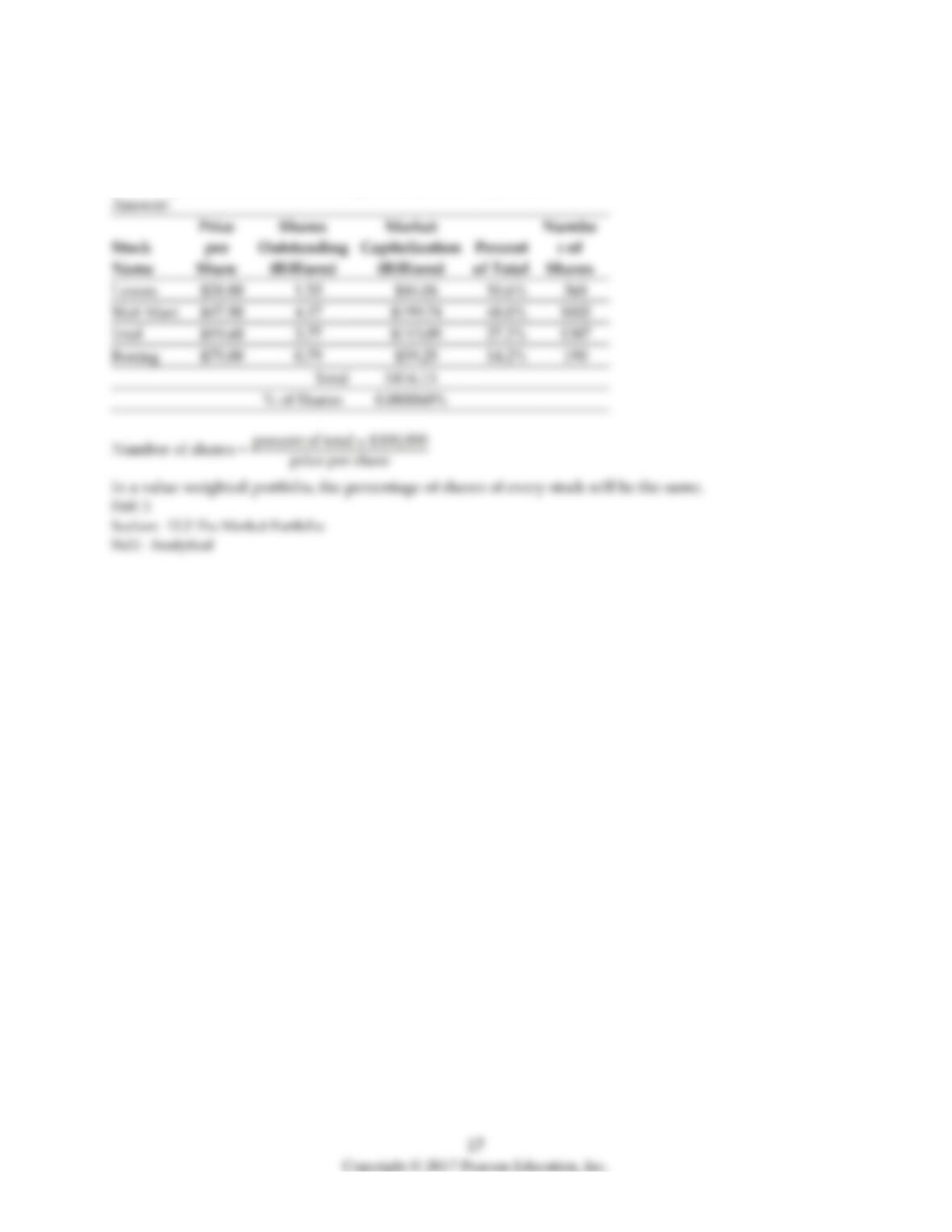
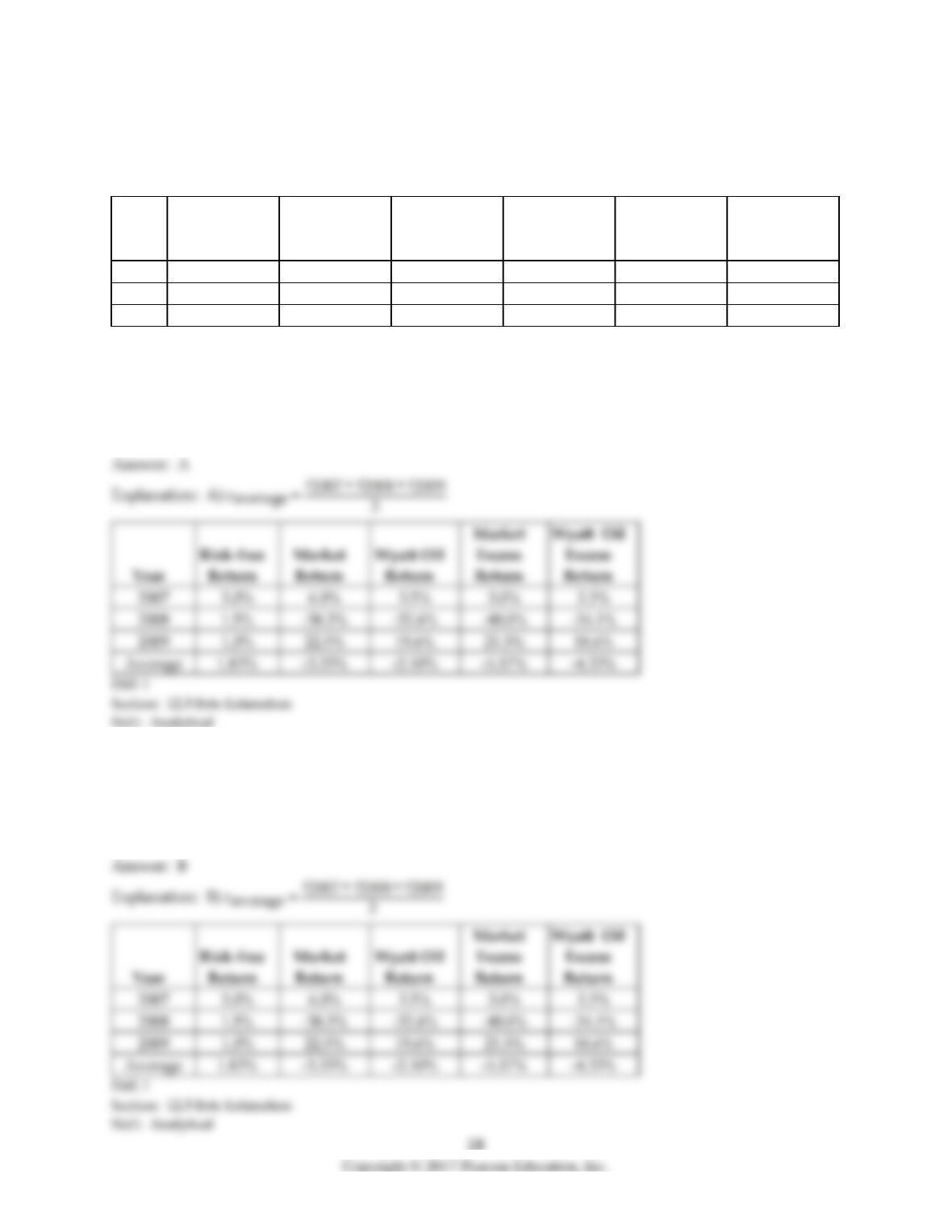
30) Assume that you have $250,000 to invest and you are interested in creating a value-weighted
portfolio of these four stocks. How many shares of each of the four stocks will you hold? What
percentage of the shares outstanding of each stock will you hold?
12.3 Beta Estimation
Use the following information to answer the question(s) below.
Year
Risk-free
Return
Market
Return
Wyatt Oil
Return
Market
Excess
Return
Wyatt Oil
Excess
Return
Beta
2007
3.0%
6.0%
5.5%
3.0%
2.5%
0.833
2008
1.5%
-38.5%
-32.6%
.40%
-34.1%
0.853
2009
1.0%
22.5%
19.6%
21.5%
18.6%
0.865
1) Wyatt Oil’s average historical return is closest to:
A) -2.50%
B) -3.33%
C) -4.33%
D) -5.17%
Excess
2) The Market’s average historical return is closest to:
A) -2.50%
B) -3.33%
C) -4.33%
D) -5.17%
Excess
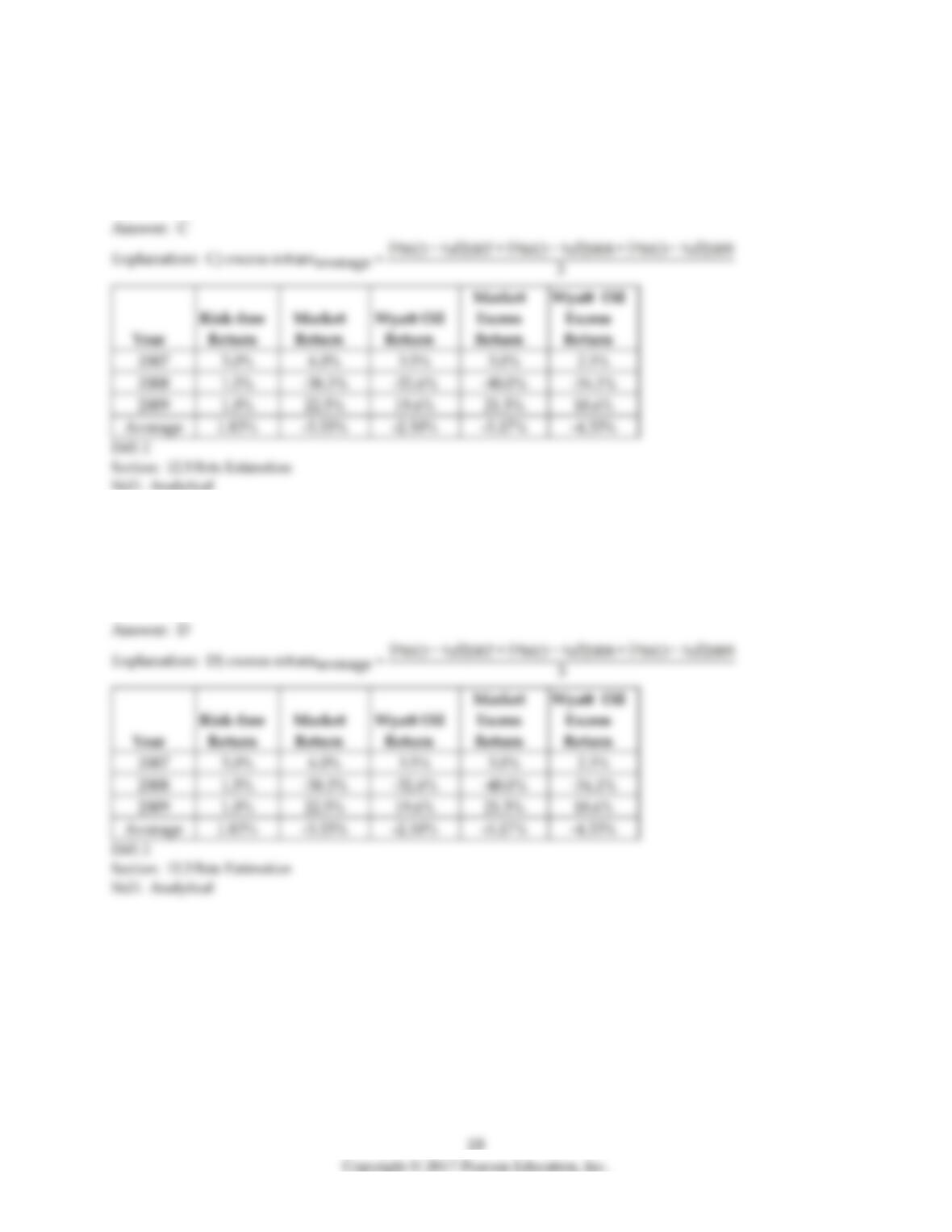
3) Wyatt Oil’s average historical excess return is closest to:
A) -2.50%
B) -3.33%
C) -4.33%
D) -5.17%
4) The Market’s average historical excess return is closest to:
A) -2.50%
B) -3.33%
C) -4.33%
D) -5.17%
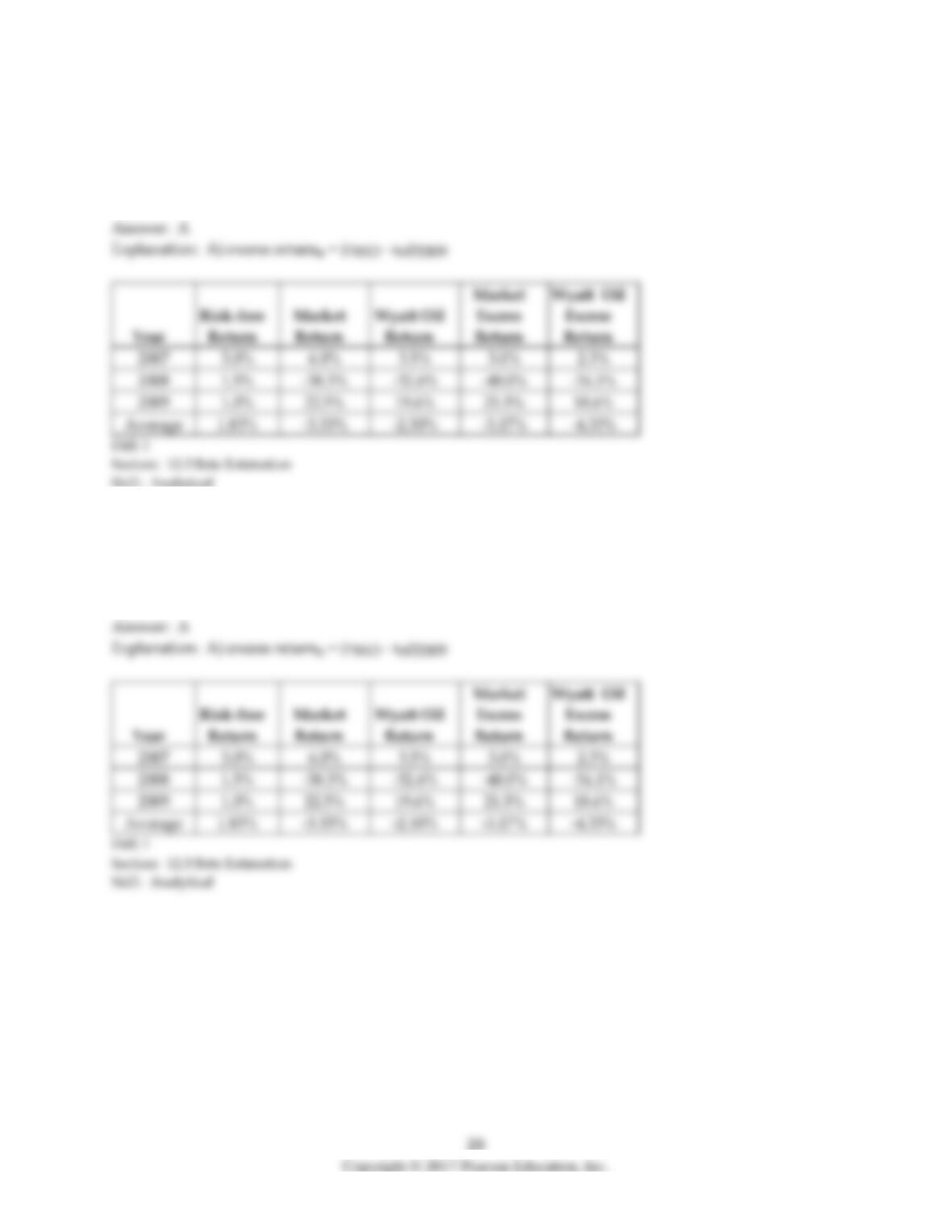
5) Wyatt Oil’s excess return for 2009 is closest to:
A) 18.6%
B) 19.6%
C) 20.0%
D) 21.5%
6) The Market’s excess return for 2008 is closest to:
A) -40.0%
B) -38.5%
C) -37.0%
D) -34.1%