Chapter 12—Investing in Stocks and Bonds
d. sinking funds are common.
e. all of the above except c.
129. Zero coupon bonds are issued by
a. federal agencies.
b. municipalities.
c. corporations.
d. all of these.
e. b and c only.
130. A convertible bond is usually a
a. government bond.
b. participating bond.
c. debenture in corporate market.
d. mortgage bond.
e. junk bond.
131. Your convertible bond has a conversion ratio of 15. The current market price of the common stock is $50/share. The
conversion value of this bond is
a. $150.
b. $500.
c. $650.
d. $750.
e. $900.
Chapter 12—Investing in Stocks and Bonds
132. The best returns in the stock market will be achieved by
a. remaining fully invested.
b. missing the five best months.
c. missing the ten best months.
d. missing the fifteen best months.
e. missing the twenty best months.
133. The relevant sale or invoice price of a bond to the buyer is its
a. par value.
b. clean price.
c. negotiated price.
d. dirty price.
e. discount price.
134. A bond is priced at 89 8/32. What is its price?
a. $89.25
b. $890.25
c. $898.32
d. $646.50
e. $892.50
135. Which of the following bond ratings would be for junk bonds?
a. BBB
Chapter 12—Investing in Stocks and Bonds
b. A
c. BB
d. AAA
e. AA
INSTRUCTIONS: Choose the word or phrase in [ ] which will correctly complete the statement. Select A for the first
item, B for the second item, and C if neither item will correctly complete the statement.
136. The possibility that a corporation might fail is [economic | business] risk.
137. [Market | Business] risk results from the behavior of investors that may cause security prices to fluctuate.
138. By holding stock in 5 companies, you are reducing [market | business] risk.
139. [Bond | Common stock] prices would be most affected by interest rate risk.
Chapter 12—Investing in Stocks and Bonds
140. A potential high return on an investment will signal a [high | low] risk exposure.
141. Past returns on an investment are [an indication | a guarantee] of future returns.
142. Preferred stockholders will receive their share of company earnings [before | after] bond interest is paid.
143. Common stockholders will receive their share of company earnings [before | after] bond interest is paid.
144. Stock dividends represent [taxable | nontaxable] income.
Chapter 12—Investing in Stocks and Bonds
145. Dividend income is taxed [as ordinary income | at capital gains rates].
146. Tax on capital gains is paid [as the stock appreciates | in the year the stock is sold].
147. Common stockholders usually receive one vote per [person | share].
148. Annual dividend per share divided by market price per share equals [total yield | dividend yield].
149. Dividends and earnings per share [refer | do not refer] to the same thing.
Chapter 12—Investing in Stocks and Bonds
150. The lower the P/E ratio, the [less | more] confidence investors are said to have in the corporation.
151. The stock market as a whole has a beta of [+1.0 | −1.0].
152. The lower a stock’s beta, the [less | more] volatile you can expect its price fluctuations to be.
153. More speculative investors would prefer stocks with [higher | lower] betas.
154. One should look for companies with steadily [increasing | decreasing] book value per share.
Chapter 12—Investing in Stocks and Bonds
155. Stocks of stable, older companies are called [earnings | blue chip] stocks.
156. A growth stock would be expected to pay a [high | low] level of dividends.
157. The best way to invest in foreign stocks is to buy [them directly on the foreign exchanges | ADR’s].
158. A cyclical stock’s price would tend to move in the [same | opposite] direction as the entire market.
159. Most publicly traded stocks represent [a liquid | an illiquid] investment.
Chapter 12—Investing in Stocks and Bonds
160. You are looking for a relatively steady stream of income with some potential for growth; you should invest in
[income stocks | growth stocks].
161. You are looking for a guaranteed steady stream of income; you should invest in [stocks | bonds].
162. ACE, Inc. has a market capitalization of $500 million. It would be classified as a [small-cap | mid-cap].
163. Treasury securities are yielding 6%. A growth stock with an expected return of 8% [would | would not] be considered
a viable investment candidate by most investors.
Chapter 12—Investing in Stocks and Bonds
164. The usual face value of a corporate bond is [$1,000 | $500].
165. The issuer of your corporate bond has the right to retire it before maturity. You have a [callable | retireable] bond.
166. The safest bond you could purchase would be a [corporate | Treasury] bond.
167. Most purchasers of [Treasury | municipal] bonds invest in them because of their tax-free interest.
168. Zero coupon bonds will pay interest [at maturity | annually].
Chapter 12—Investing in Stocks and Bonds
169. The [lower | higher] a bond’s rating, the more likely the issuer will default.
170. You would expect the higher rate of interest from a bond with a [AAA | C] bond rating.
171. [Raising | Lowering] a bond rating will result in higher current yields.
172. If you buy a bond at a discount, its yield to maturity will be [higher | lower] than the coupon yield.
173. Zero coupon bonds would be more appropriate for a [tax-deferred retirement account | taxable account].
Chapter 12—Investing in Stocks and Bonds
174. Annual interest income divided by market price of the bond equals [current yield | yield to maturity].
175. If the value of the underlying stock dropped drastically, the owner of a convertible bond [would still receive the face
value of the bond | would receive the market value of the stock] at maturity.
176. Individuals invest in preferred stock for its high [current income | potential gain].
177. Common stockholders will receive their share of company earnings [before | after] preferred dividends are paid.
178. Municipal bonds are exempt from [income tax | capital gains tax].
Chapter 12—Investing in Stocks and Bonds
179. The yields on municipal bonds are usually [lower | higher] than the returns available from fully taxable issues.
180. [General obligation bonds | revenue bonds] are the least risky municipal bond category.
181. When a bond is sold between coupon payment dates, the [buyer pays the seller | seller pays the buyer] for the
accrued interest.
182. The commonly cited price for a bond is usually its [clean | dirty] bond price.
183. Calculate the approximate yield on the common stock of Bowl Game that Matty Smelt has owned for 4 years. She
bought it for $10 per share and sold it for $25. The dividend was $1.50 each year. (Show all work.)
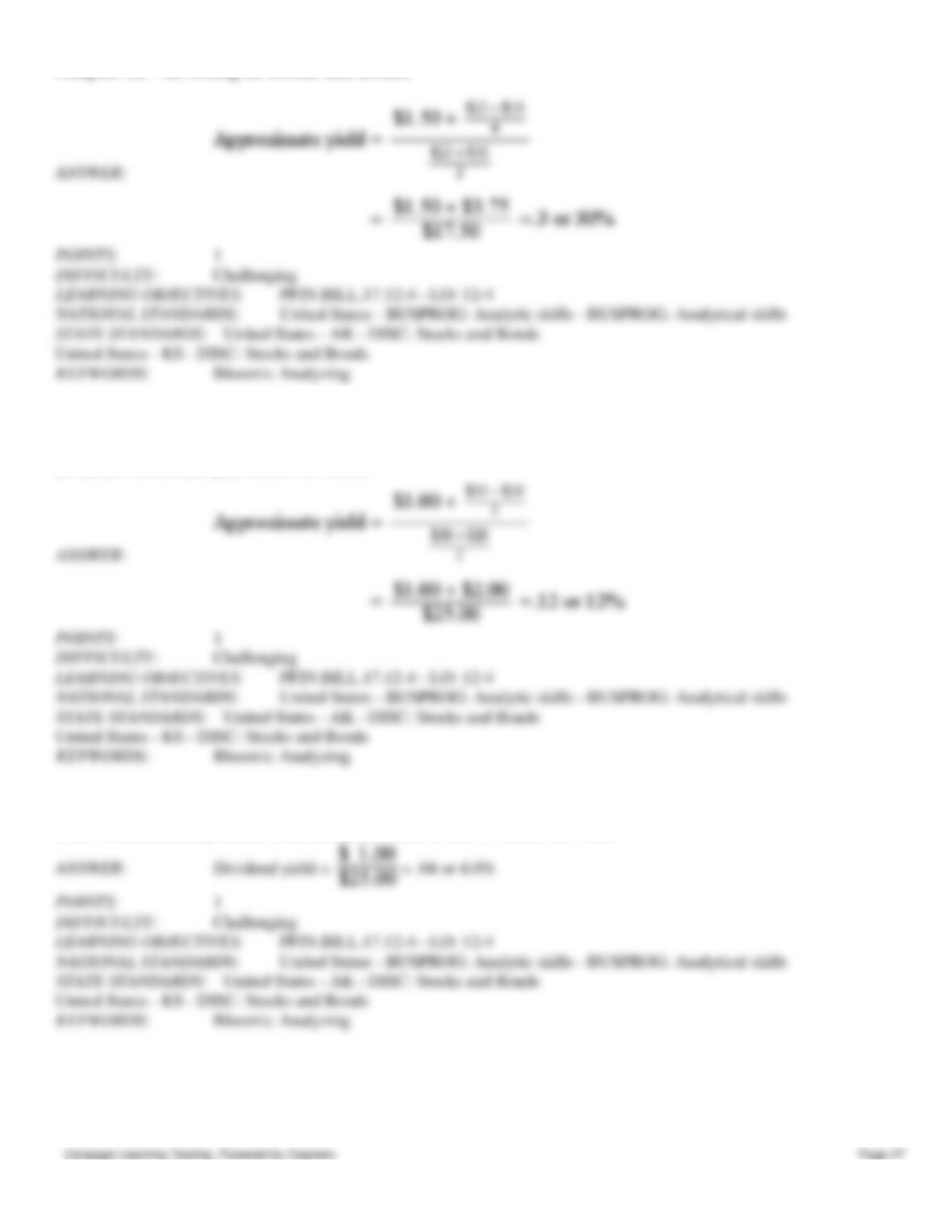
184. Monte Jackson is considering the purchase of XYZ stock and would like to estimate its approximate yield if he holds
it 5 years. The current price is $20 and Monte expects it would rise to $30 over the 5-year holding period. The expected
dividend is $1.00 each year. (Show all work.)
185. Calculate the dividend yield on OPQ stock. Earnings per share are $2.75 and the quarterly dividend is 25 cents. The
book value is $15.20 per share while the market value is $25.00. (Show all work.)
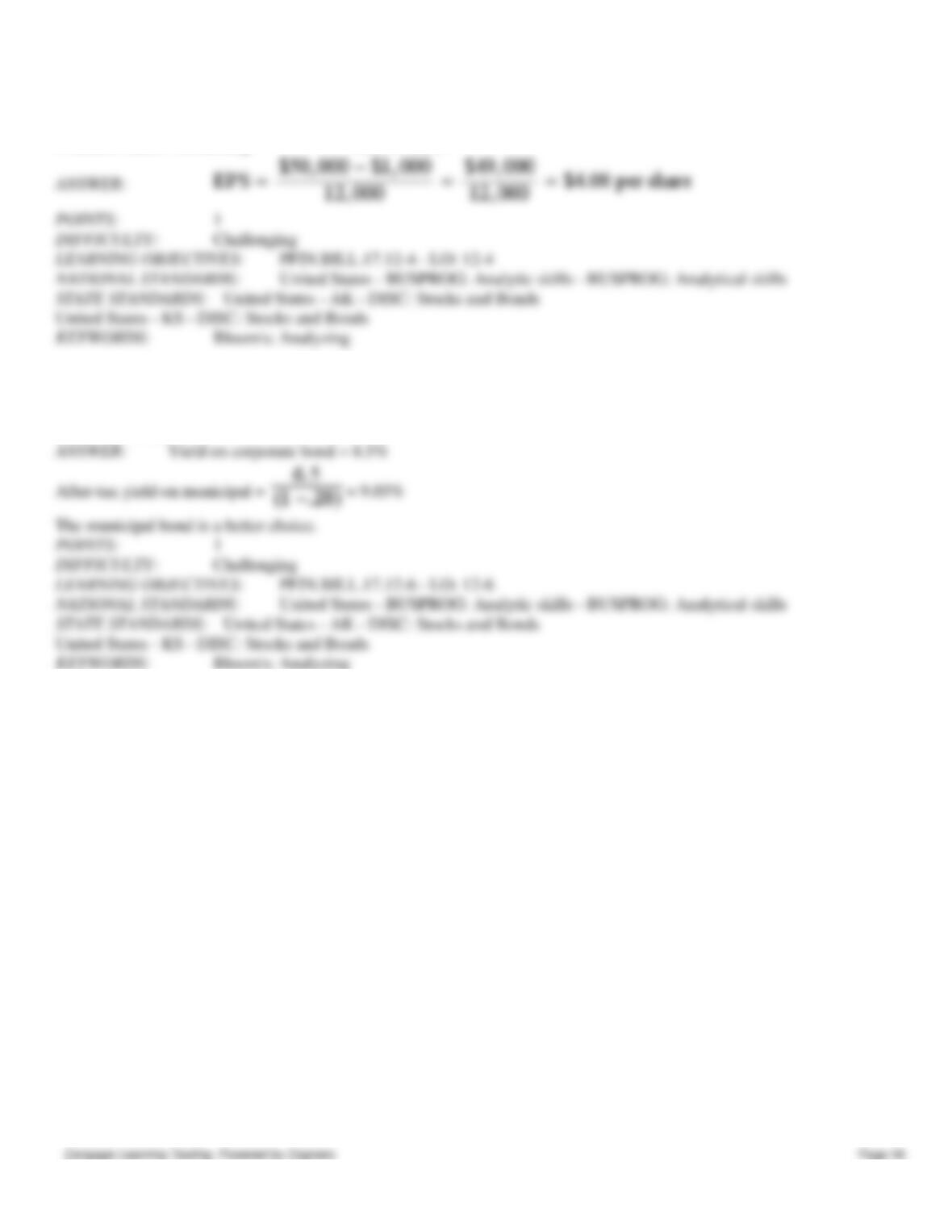
186. Calculate the earnings per share of a company with the following information? (Show all work.)
Sales $200,000
Net profits after taxes $50,000
Chapter 12—Investing in Stocks and Bonds
Preferred dividends paid $1,000
Common dividends paid $6,000
Common shares outstanding 12,000 shares
187. You have the chance to buy one of two bonds. The first is a municipal bond with a coupon yield of 6.5%. The second
is a corporate bond with a yield of 8.5%. Both bonds are rated AA. Your tax rate is 28%. Which should you choose?
(Show all work.)