19
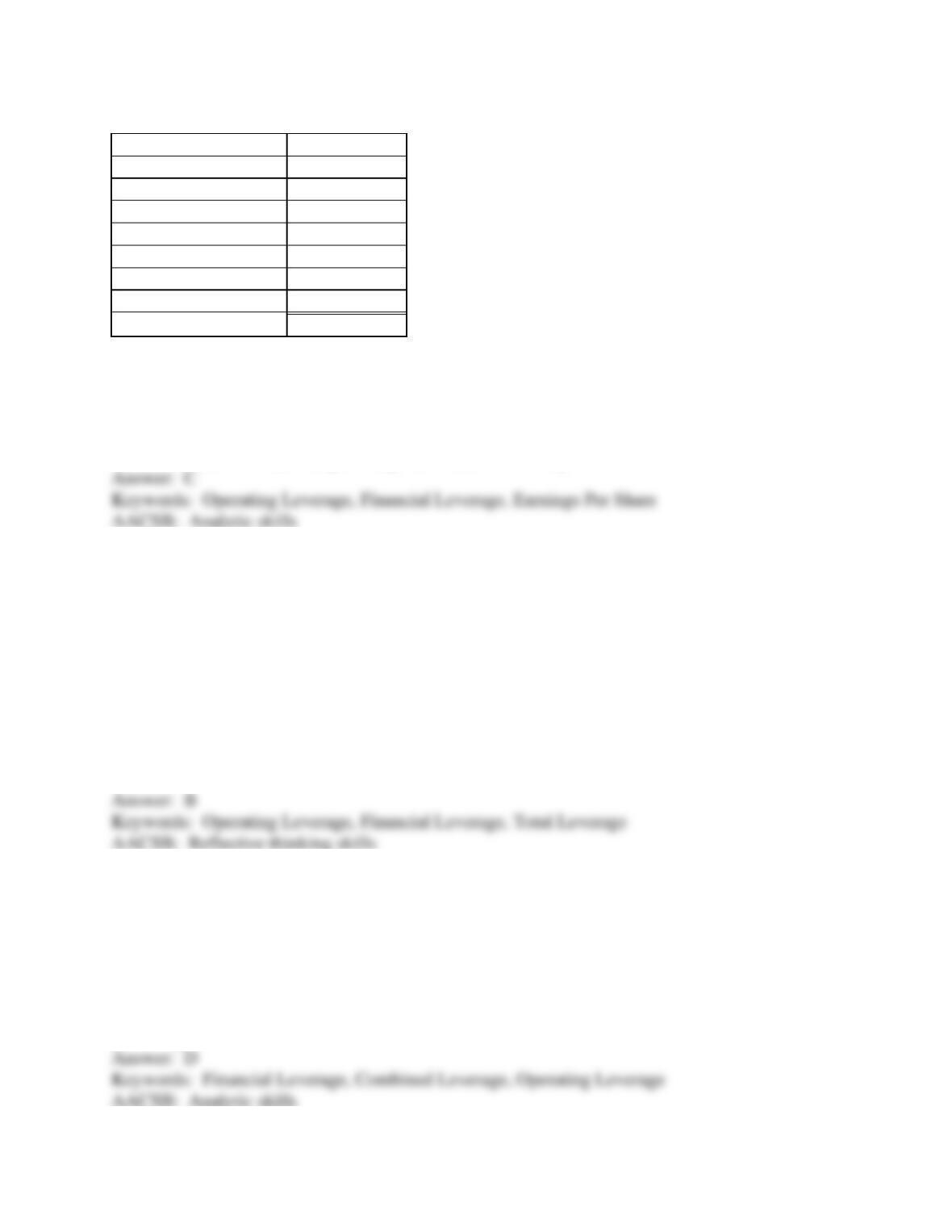
23) Bob’s Baked Goods Company reported the following income statement for 2009:
Sales
$2,500,000
Variable Costs
900,000
Fixed Operating Costs
700,000
EBIT
900,000
Interest Expense
200,000
EBT
700,000
Taxes (30%)
210,000
Net Income
$490,000
Earnings Per Share
$4.90
If Bob’s sales next year increase by 20%, Bob’s EBIT will increase:
A) 20%, showing no operating leverage.
B) 20%, showing no financial leverage.
C) over 35%, due to operating leverage.
D) over 35%, due to operating leverage and financial leverage.
24) Abrams Steel Company has very high operating leverage due to the capital intensive nature
of the steel business. Abrams’ CEO is concerned about the variability in the firm’s EPS if sales
should drop, and decides to take action. Which of the following will reduce the variability in the
firm’s EPS for a given change in sales?
A) The CEO may increase the firm’s financial leverage and hence reduce the variability by using
non-shareholder money to support the business.
B) The CEO may decrease the firm’s financial leverage, thus lowering the firm’s total leverage.
C) The CEO may increase the firm’s total leverage by raising money from the sale of common
stock.
D) The CEO may issue more corporate bonds and use the proceeds to pay off short-term
liabilities.
25) A corporation reports sales of $4,000,000, variable costs of $500,000, fixed operating costs
of $1,250,000, and interest expense of $350,000. The corporation’s EBIT is $3,250,000 and its
marginal tax rate is 30%. If the corporation is able to increase its sales by 25%, then
A) its EBIT will increase by 25% and its EPS will increase by 25%.
B) its EBIT will increase by more than 25% and its EPS will increase by less than 25%.
C) its EBIT and EPS will both increase, but less than 25% due to fixed costs and taxes.
D) its EBIT will increase by more than 25% and its EPS will increase by more than the
percentage increase in EBIT.
26) A firm that uses large amounts of debt financing in an industry characterized by a high
20
degree of business risk would have ________ earnings per share fluctuations resulting from
changes in levels of sales.
A) no
B) constant
C) large
D) small
27) Financial leverage could mean financing some of a firm’s assets with
A) preferred stock.
B) retained earnings.
C) private equity capital.
D) sales revenues.
28) Financing a portion of a firm’s assets with securities bearing a fixed rate of return in hopes of
increasing the return to stockholders refers to
A) business risk.
B) financial leverage.
C) operating leverage.
D) combined leverage.
29) Operating leverage refers to
A) financing a portion of the firm’s assets with securities bearing a fixed rate of return.
B) the additional chance of insolvency borne by the common shareholder.
C) the incurrence of fixed operating costs in the firm’s income stream.
D) a high degree of variable costs of production.
30) Financial leverage is distinct from operating leverage since it accounts for
A) use of debt and preferred stock.
B) variability in fixed operating costs.
C) variability in sales.
D) changes in EBIT.
31) If a firm has no operating leverage and no financial leverage, then a 10% increase in sales
21
will have what effect on EPS?
A) EPS will remain the same
B) EPS will increase by 10%
C) EPS will decrease by 10%
D) EPS will increase by less than 10%
32) Operating leverage has to do with
A) borrowing money to finance a firm’s growth.
B) using preferred stock to increase sales volume.
C) the incurrence of fixed operating costs in the firm’s income stream.
D) financing with fixed cost sources of capital.
33) Which of the following statements about operating leverage is true?
A) Operating leverage reduces a firm’s risk.
B) Operating leverage is the responsiveness of the firm’s EBIT to fluctuations in sales.
C) Operating leverage involves the usage of fixed cost financial securities in the operation of a
business.
D) Operating leverage is the responsiveness of the firm’s EPS to fluctuations in sales.
34) Financial leverage has to do with:
A) the usage of fixed cost financial securities to finance a portion of a firm’s assets.
B) using common stock to finance a portion of a firm’s assets.
C) the incurrence of fixed operating costs in the firm’s income stream.
D) a high gross profit margin.
35) Which of the following statements about financial leverage is true?
A) Financial leverage is the responsiveness of the firm’s EBIT to fluctuations in sales.
B) Financial leverage involves the incurrence of fixed operating costs in the firm’s income
stream.
C) Financial leverage is the responsiveness of the firm’s EPS to fluctuations in EBIT.
D) Financial leverage reduces a firm’s risk.
36) Which of the following statements about combined (operating & financial) leverage is true?
A) If a firm employs both operating and financial leverage, any percent change in sales will
produce a larger percent change in earnings per share.
B) A firm that is in a capital-intensive industry should use a higher level of financial leverage
than a firm that employs low levels of operating leverage.
C) Usage of both operating and financial leverage reduces a firm’s risk.
D) High operating leverage and high financial leverage offset one another, meaning that if sales
increase by 10%, then EPS will also increase by 10%.
37) The following information pertains to the Classic Burger Restaurant chain:
Sales
$600,000
Variable costs
300,000
Total contribution
margin
300,000
Fixed costs
100,000
EBIT
200,000
Interest expense
50,000
Earnings before taxes
150,000
Taxes (30%)
45,000
Net income
$105,000
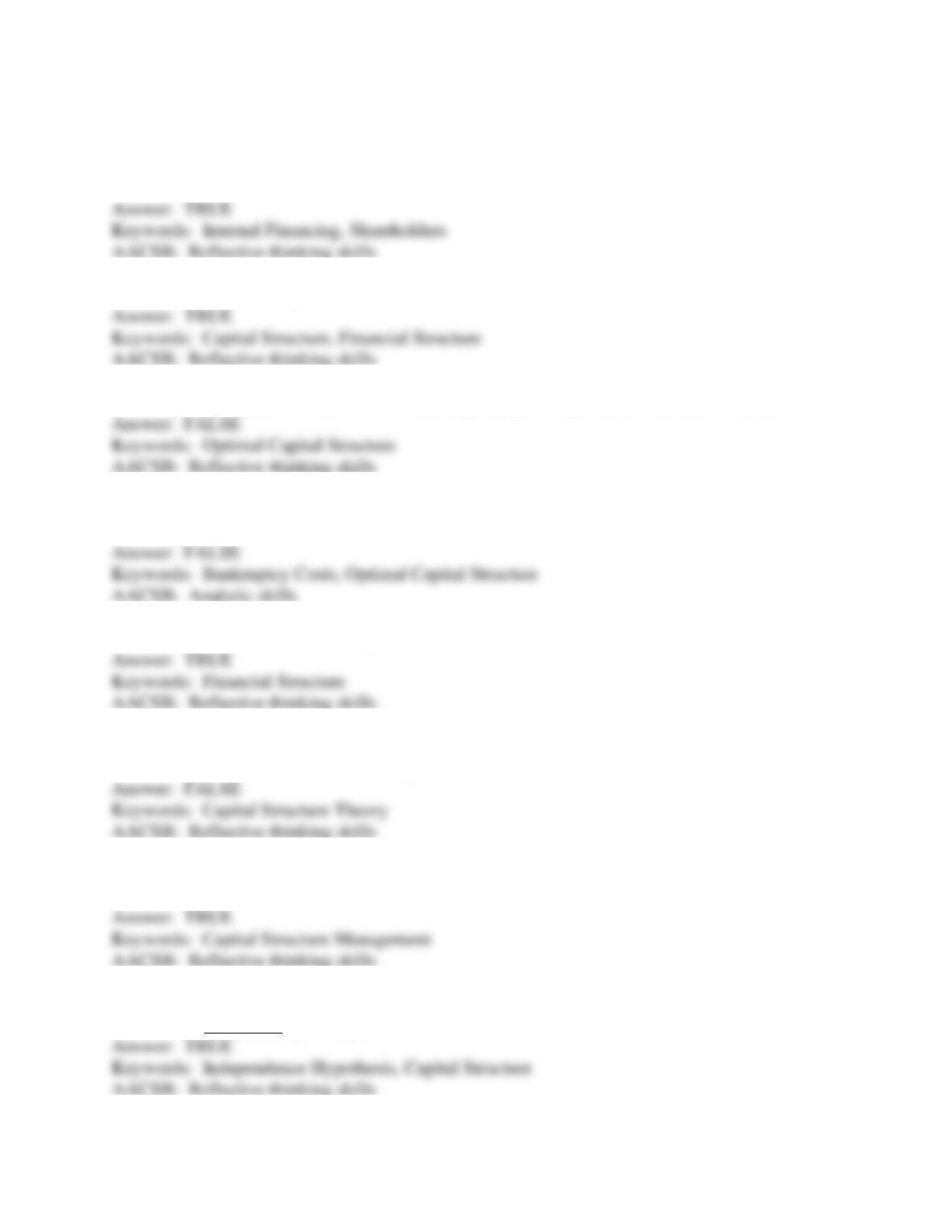
a. If sales increase by 10%, what will be the new level of EPS if the firm has 100,000 shares
outstanding?
b. What is the percentage increase in EPS? Explain the difference between the percentage
increase in sales and the percentage increase in EPS.
Sales
Variable costs
Total contribution
margin
300,000
330,000
Fixed costs
100,000
100,000
EBIT
200,000
230,000
Interest expense
50,000
50,000
Earnings before taxes
150,000
180,000
Taxes (30%)
45,000
54,000
Net income
$105,000
$126,000
Earnings Per Share
$10.50
$12.60
24
12.4 Learning Objective 4
1) Raising funds internally is effectively increasing the investment of the firm’s existing common
shareholders.
2) Capital structure is equal to financial structure minus current liabilities.
3) The optimal capital structure occurs when operating leverage equals financial leverage.
4) Higher bankruptcy costs will result in optimal capital structures using more long-term debt
financing.
5) Financial structure includes long- and short-term sources of funds.
6) According to the moderate view of capital structure theory, the cost of common equity is
constant regardless of the debt financing level.
7) The objective of capital structure management is to maximize the market value of the firm’s
common stock.
8) The independence hypothesis suggests that the total market value of the firm’s outstanding
securities is unaffected by its capital structure.
9) The moderate view of capital structure theory allows for the tax-deductibility of interest
25
expense.
10) Other things the same, the use of debt financing reduces the firm’s total tax bill resulting in a
higher total market value.
11) The tax shield on interest is calculated by multiplying the interest rate paid on debt by the
principal amount of the debt and the firm’s marginal tax rate.
12) A firm’s cost of capital is not affected by the composition of the right-hand side of the firm’s
balance sheet, but rather is determined by the firm’s mix of assets.
13) Financial structure is another term for capital structure.
14) Financial structure is equal to non-interest bearing liabilities, such as accounts payable and
accruals, plus capital structure, which includes short- and long-term debt, preferred stock, and
common equity.
15) Two key components of a prudent capital structure are the debt maturity composition and the
debt to equity composition.
16) Borrowing funds using short-term debt, such as commercial paper, and using the proceeds to
invest in long-term investments, creates a re-financing risk that can force firm’s to sell assets at
distressed prices if financing becomes unavailable.
17) Corporations that are heavily committed to investments in fixed assets that are expected to
produce cash flow over many years generally favor long-term debt to the extent that they borrow.
18) The optimal capital structure is the funds mix that will
A) minimize the use of debt.
B) achieve an equal proportion of debt, preferred stock, and common equity.
C) minimize the firm’s composite cost of capital.
D) maximize total leverage.
19) The Modigliani and Miller hypothesis suggests that capital structure doesn’t matter. All of
the following conditions need to be met for this hypothesis to be true except:
A) corporate income is not subject to taxation.
B) capital structure consists only of stocks and bonds.
C) securities are traded in perfect or efficient markets.
D) all corporate net income is paid out as dividends.
20) Assuming no corporate taxes, the independence hypothesis suggests that a firm’s weighted
average cost of capital will
A) remain constant regardless of capital structure because the cost of debt and the cost of equity
are the same.
B) remain constant because the cost of equity will be increasing as the amount of debt increases
due to the increased risk.
C) increase proportionally with the increase in the amount of debt a firm uses.
D) decrease proportionally with the increase in the amount of debt a firm uses.
21) Which of the following statements is most correct concerning a corporation’s optimal capital
structure?
A) The optimal capital structure maximizes the present value of the interest tax shield.
B) The optimal capital structure occurs at the point where the market value of the levered firm is
maximized.
C) The optimal capital structure minimizes the present value of financial distress costs and
agency costs.
D) The optimal capital structure occurs where the present value of the interest tax shield equals
the present value of the firm’s bankruptcy costs.
22) One component of a firm’s financial structure which is not a component of its capital
structure is:
A) common stock.
B) accounts payable.
C) long-term debt.
D) preferred stock.
23) According to the moderate view of capital costs and financial leverage, as the use of debt
financing increases:
A) the cost of capital continuously decreases.
B) the cost of capital remains constant.
C) the cost of capital continuously increases.
D) there is an optimal level of debt financing.
24) When deciding upon how much debt financing to employ, most practitioners would cite
which of the following as the most important influence on the level of the debt ratio?
A) providing a borrowing reserve
B) maintaining desired bond rating
C) ability to adequately meet financing charges
D) exploiting advantages of financial leverage
25) Optimal capital structure is:
A) the mix of permanent sources of funds used by the firm in a manner that will maximize the
company’s common stock price.
B) the mix of all items that appear on the right-hand side of the company’s balance sheet.
C) the mix of funds that will minimize the firm’s cost of equity capital.
D) the mix of funds that will maximize the firm’s interest tax shield.
26) Which of the following would not be a part of a firm’s capital structure?
A) Short-term notes payable
B) Long-term bonds
C) Preferred stock
D) Common stock
27) A firm’s optimal capital structure occurs where?
A) EPS are maximized, and WACC is minimized.
B) Stock price is maximized, and EPS are maximized.
C) Stock price is maximized, and WACC is maximized.
D) WACC is minimized, and stock price is maximized.
12.5 Learning Objective 5
1) Debt capacity is the maximum proportion of debt the firm can include in its capital structure
and still maintain its lowest composite cost of capital.
2) A saucer-shaped or U-shaped weighted average cost of capital curve results from the tax
deductibility of interest, which results in the downward slope, followed by the recognition of
potential financial distress costs, that cause the upward slope as the amount of debt ratio
increases.
3) A corporation’s debt capacity is the maximum proportion of debt that the corporation can
include in its capital structure and still maintain its lowest composite cost of capital.
4) Which of the following would be considered the firm’s optimal capital structure?
A) Stock Price = $25, Earnings Per Share = $10, Cost of Equity Capital = 15%
B) Stock Price = $23, Earnings Per Share = $11, Cost of Equity Capital = 18%
C) Stock Price = $24, Earnings Per Share = $12, Cost of Equity Capital = 17%
D) Stock Price = $20, Earnings Per Share = $12, Cost of Equity Capital = 20%
12.6 Learning Objective 6
1) The independence hypothesis allows for bankruptcy and agency costs.
2) The independence hypothesis suggests that the cost of equity decreases as financial leverage
increases.
3) If we ignore bankruptcy and agency costs then the optimal capital structure for a firm under
the moderate view would be 100% debt.
4) The implicit cost of debt takes into consideration the change in the cost of common equity
brought on by using additional debt.
5) The control hypothesis suggests that shareholders prefer an increase in the firm’s debt in order
to reduce the agency costs associated with excessive free cash flow.
6) The market value of a leveraged firm is equal to the market value of an unleveraged firm
A) plus the present value of tax shields minus the present value of financial distress costs plus
the present value of agency costs.
B) plus the present value of tax shields plus the present value of financial distress costs plus the
present value of agency costs.
C) minus the present value of tax shields minus the present value of financial distress costs
minus the present value of agency costs.
D) plus the present value of tax shields minus the present value of financial distress costs minus
the present value of agency costs.
7) The “threat hypothesis”
A) reduces management’s tendency to spend freely.
B) encourages management to use debt to further their own interests.
C) increases the agency problem.
D) increases agency monitoring costs.
12.7 Learning Objective 7
1) Given taxes and bankruptcy costs exist, as financial increases, the weighted average cost of
capital first decreases and then increases.
2) The EBIT-EPS indifference point is the level of production at which the company’s EBIT
equals its EPS.
3) An EBIT-EPS analysis allows the decision maker to visualize the impact of different
financing plans on EPS over a range of EBIT levels.
4) Because there are no fixed financing costs, a common stock plan line in an EBIT-EPS analysis
chart will have a less-steep slope than will a bond-plan line.
5) One danger of EBIT-EPS analysis is that it ignores the implicit cost of debt financing.
6) Above the EBIT-EPS indifference point a more heavily levered financial plan will produce
greater EPS.
7) Capital structure is the mix of the long-term sources of funds used by the firm.
8) The Modigliani and Miller hypothesis does not work in the “real world” because
A) interest expense is tax deductible, providing an advantage to debt financing.
B) higher levels of debt increase the likelihood of bankruptcy, and bankruptcy has real costs for
any corporation.
C) both A and B.
D) dividend payments are fixed and tax deductible for the corporation.
9) When using an EPS-EBIT chart to evaluate a pure debt financing and pure equity financing
plan
A) the debt financing plan line will graph with a steeper slope than the equity financing plan line.
B) the debt financing plan line will have a lower level of EBIT at EPS = 0.
C) the line of the two financing plans will intersect on the EBIT axis.
D) the slope of the equity financing plan line will be steeper than the debt financing plan line
below the intersection of the two lines.
10) The primary weakness of EBIT-EPS analysis is that
A) it ignores the implicit cost of debt financing.
B) it double counts the cost of debt financing.
C) it applies only to firms with large amounts of debt in their capital structure.
D) it may only be used by firms that are profitable this year.
11) Basic tools of capital-structure management include
A) EBIT-EPS analysis.
B) comparative leverage ratios.
C) capital budgeting techniques.
D) both A and B.
12) The EBIT-EPS indifference point
A) identifies the EBIT level at which the EPS will be the same regardless of the financing plan.
B) identifies the point at which the analysis can use EBIT and EPS interchangeably.
C) identifies the level of earnings at which the management is indifferent about the payments of
dividends.
D) identifies the sales level at which EBIT equals EPS.
13) Roberts, Inc. is trying to decide how best to finance a proposed $10,000,000 capital
investment. Under Plan I, the project will be financed entirely with long-term 9 percent bonds.
The firm currently has no debt or preferred stock. Under Plan II, common stock will be sold to
net the firm $20 a share; presently, 1,000,000 shares are outstanding. The corporate tax rate for
Roberts is 40 percent.
a. Calculate the indifference level of EBIT associated with the two financing plans.
b. Prepare an EBIT-EPS analysis chart, showing the intersection of the two financing plan lines.
c. Which financing plan would you expect to cause the greatest change in EPS relative to a
change in EBIT? Why?
d. If EBIT is expected to be $3.1 million, which plan will result in a higher EPS?
14) Young Enterprises is financed entirely with 3 million shares of common stock selling for $20
a share. Capital of $4 million is needed for this year’s capital budget. Additional funds can be
raised with new stock (ignore dilution) or with 13 percent 10-year bonds. Young’s tax rate is 40
percent.
a. Calculate the financing plan’s EBIT indifference point.
b. The expected level of EBIT is $10,320,000 with a standard deviation of $2,000,000. What is
the probability that EBIT will be above the indifference point?
c. Does the “indifference point” calculated in question (a) above truly represent a point where
stockholders are indifferent between stock and debt financing? Explain your answer.
15) The MAX Corporation is planning a $4,000,000 expansion this year. The expansion can be
financed by issuing either common stock or bonds. The new common stock can be sold for $60
per share. The bonds can be issued with a 12 percent coupon rate. The firm’s existing shares of
preferred stock pay dividends of $2.00 per share. The company’s corporate income tax rate is 46
percent. The company’s balance sheet prior to expansion is as follows:
MAX Corporation
Current Assets
$2,000,000
Fixed Assets
8,000,000
Total Assets
$10,000,000
Current Liabilities
$1,500,000
Bonds:
(8%, $1,000 par value)
1,000,000
(10%, $1,000 par value)
4,000,000
Preferred Stock:
($100 par value)
$500,000
Common Stock:
($2 par value)
700,000
Retained Earnings
2,300,000
Total Liabilities and
Equity
$10,000,000
a. Calculate the indifference level of EBIT between the two plans.
b. If EBIT is expected to be $3 million, which plan will result in higher EPS?
16) Sunshine Candy Company’s capital structure for the past year of operation is shown below.
First mortgage bonds at 12% $2,000,000
Debentures at 15% 1,500,000
Common stock (1,000,000 shares) 5,000,000
Retained earnings 500,000
TOTAL $9,000,000
The federal tax rate is 50 percent. Sunshine Candy Company, home-based in Orlando, wants to
raise an additional $1,000,000 to open new facilities in Tampa and Miami. The firm can
accomplish this via two alternatives: (1) It can sell a new issue of 20-year debentures with 16
percent interest; or (2) 20,000 new shares of common stock can be sold to the public to net the
candy company $50 per share. A recent study, performed by an outside consulting organization,
projected Sunshine Candy Company’s long-term EBIT level at approximately $6,800,000. Find
the indifference level of EBIT (with regard to earnings per share) between the suggested
financing plans.
17) Premium Lodging, Inc., is financed entirely with 3 million shares of common stock selling
for $50 a share. Capital of $10 million is needed for this year’s capital budget. Additional funds
can be raised with new stock (ignore dilution) or with 11 percent 12-year bonds. Premium
Lodging’s tax rate is 35 percent.
a. Calculate the financing plan’s EBIT indifference point.