
Chapter 12: Structuring the Deal:
Tax and Accounting Considerations
Answers to End of Chapter Discussion Questions
12.1 When does the IRS consider a transaction to be non–taxable to the target firm’s shareholders? What is the justification for the
IRS’ position?
12.2 What are the advantages and disadvantages of a tax-free transaction for the buyer? Be specific.
12.3 Under what circumstances can the assets of the acquired firm be increased to fair market value when the transaction is deemed a
taxable purchase of stock?
12.4 What is goodwill and how is it created?
12.5 Under what circumstances might an asset become impaired? How might this event affect the way in which acquirers bid for
target firms?
12.6 Why do boards of directors of both acquiring and target companies often obtain so–called “fairness opinions” from outside
investment advisors or accounting firms? What valuation methodologies might be employed in constructing these opinions?
Should stockholders have confidence in such opinions? Why/why not?
12.7 Archer Daniel Midland (ADM) wants to acquire AgriCorp to augment its ethanol manufacturing capability. AgriCorp wants
the transaction to be tax-free for its shareholders. ADM wants to preserve AgriCorp’s significant investment tax credits and tax
loss carryforwards so that they transfer in the transaction. Also, ADM plans on selling certain unwanted AgriCorp assets to help
finance the transaction. How would you structure the deal so that both parties’ objectives could be achieved?
12.8 Tangible assets are often increased to fair market value following a transaction and depreciated faster than their economic lives.
What is the potential impact on post-transaction EPS, cash flow, and balance sheet?
12.9 Discuss how the form of acquisition (i.e., asset purchase or stock deal) could impact the net present value or internal rate of
return of the deal calculated post-closing.
12.10 What are some of the important tax-related issues the boards of the acquirer and target companies may need to address prior to
entering negotiations? How might the resolution of these issues impact the form of payment and form of acquisition?

Solutions to Practice Problems and Exercises
12.11 Target Company has incurred $5,000,000 in losses during the past 3 years; Acquiring Company anticipates pre-tax earnings of
$3,000,000 in each of the next 3 years. What is the difference between total taxes that would have been paid before the merger
compared to actual taxes paid by the Acquiring Company after the merger assuming a marginal tax rate of 40 percent? Show
your work.
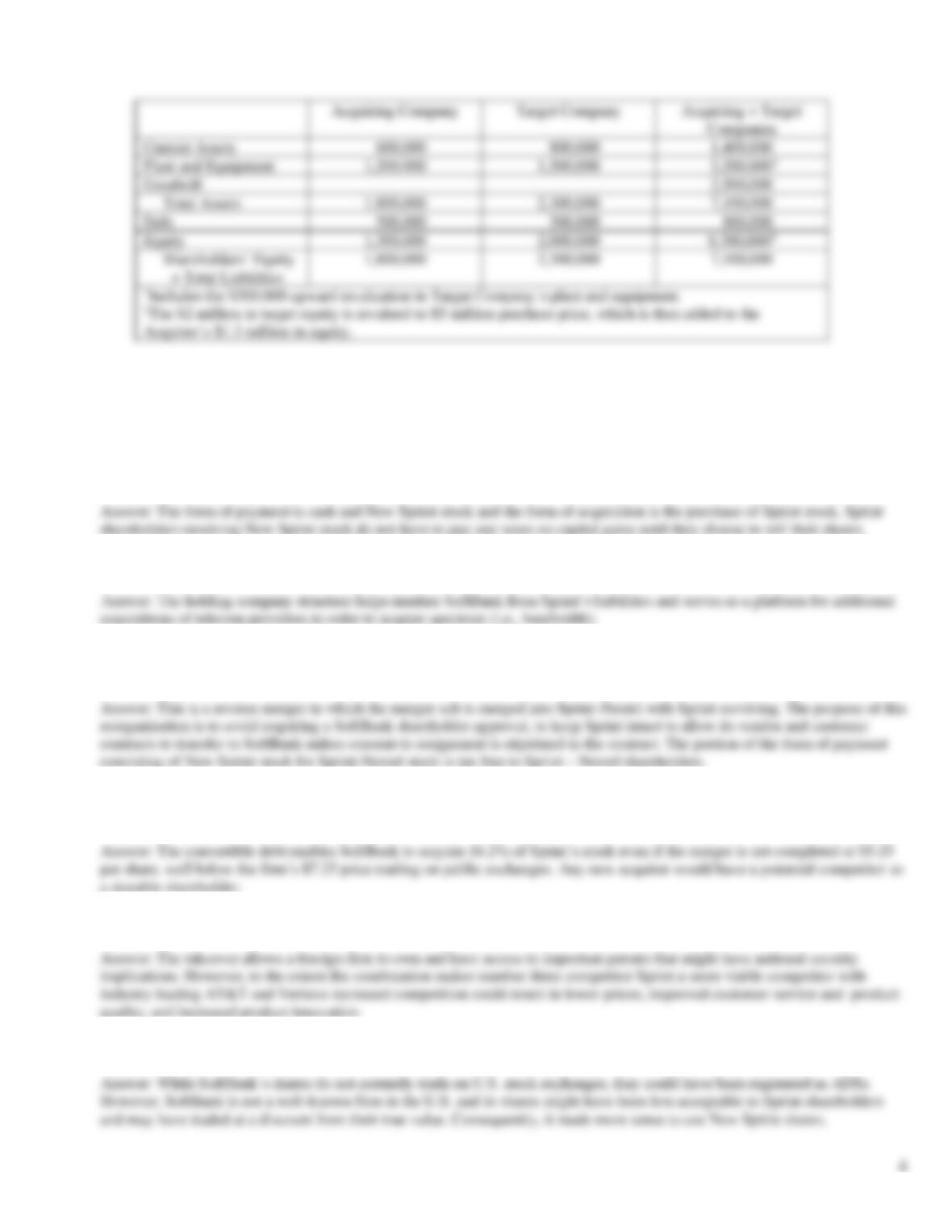
12.12 Acquiring Company buys 100% of Target Company’s equity for $5,000,000 in cash. As an analyst, you are given the
following pre-merger balance sheets for the two companies. Assuming plant and equipment is revalued upward by $500,000,
what will be the combined companies’ shareholders’ equity plus total liabilities? What is the difference between Acquiring
Company’s shareholders’ equity and the shareholders’ equity of the combined companies? Show your work.
Balance Sheets (Dollars)
Acquiring Company
Target Company
Current Assets
600,000
800,000
Plant and Equipment
1,200,000
1,500,000
Total Assets
1,800,000
2,300,000
Long-Term Debt
500,000
300,000
Shareholders’ Equity
1,300,000
2,000,000
Shareholders’ Equity + Total
Liabilities
1,800,000
2.300,000
Solutions to Chapter Case Study Questions
Softbank Places a Big Bet on the U.S. Telecom Market
Discussion Questions:
1. What is the form of payment and form of acquisition employed by SoftBank in its takeover of Sprint-Nextel? Is all or some of
the total consideration paid to Sprint shareholders tax free?
2. What is the purpose of the holding company structure adopted by SoftBank in this transaction?
3. Would you characterize this as a reverse or forward merger? Based on your answer why was this type of reorganization selected
by SoftBank? Will this takeover require a vote by Softbank shareholders?
4. The convertible debt is described as a “stock lockup.” How does the convertible debt discourage other interested parties from
bidding on Sprint?
5. What are the arguments for and against the proposed takeover being approved by U.S. regulators?
6. Why did SoftBank use New Sprint shares as part of the tender offer to Sprint shareholders rather than its own shares?

7. What is the purpose of the reverse termination and termination fees employed in the transaction?
Examination Questions and Answers
1. Taxes are an important consideration in almost any transaction, and they are often the primary motivation for an acquisition.
True or False
2. From the viewpoint of the seller or target company shareholder, transactions may be tax-free or entirely or partially taxable.
True or False
3. The sale of stock, rather than assets, is generally preferable to the target firm shareholders to avoid double taxation, if the target
firm is structured as a limited liability company.
True or False
4. A transaction generally will be considered non–taxable to the seller or target firm’s shareholder if it involves the purchase of the
target’s stock or assets for substantially all cash, notes, or some other nonequity consideration. True or False
5. In a triangular cash merger, the target firm may either be merged into an acquirer’s operating or shell acquisition subsidiary with
the subsidiary surviving or the acquirer’s subsidiary is merged into the target firm with the target surviving.
True or False
6. A transaction is usually taxable to the target firm’s shareholders, if the acquirer’s stock is used to purchase at least 30% of the
target firm’s stock or assets. True or False
7. The major advantages of using a triangular structure are limitations of the voting rights of acquiring shareholders and that the
acquirer gains control of the target through a subsidiary without being directly responsible for the target’s known and unknown
liabilities. True or False
8. It is seldom important that the buyer and seller agree on the allocation of the sales price among the assets being sold, since the
allocation will determine the potential tax liability that would be incurred by the seller but that could by passed on to the buyer
through to terms of the sales contract. True or False
9. The form of payment does not affect whether a transaction is taxable to the seller’s shareholders. True or False
10. If a transaction involves a cash purchase of target stock, the target company’s tax cost or basis in the acquired stock or assets is
increased or “stepped up” automatically to their fair market value (FMV), which is equal to the purchase price paid by the
acquirer.
True or False
11. In a cash purchase of assets. the target’s shareholders could be taxed twice, once when the firm pays taxes on any gains and a
second time when the proceeds from the sale are paid to the shareholders either as a dividend or distribution following
liquidation of the corporation.
True or False

12. Empirical studies generally show that the tax shelter resulting from the ability of the acquiring firm to increase the value of
acquired assets to their FMV is a highly important motivating factor for a takeover. True or False
13. Taxable transactions usually involve the purchase of the target’s voting stock, because the purchase of assets automatically will
trigger a taxable gain for the target if the fair market value of the acquired assets exceeds the target firm’s tax basis in the assets.
True or False
14. In a taxable purchase of target stock with cash, the target firm does not restate (i.e., revalue) its assets and liabilities for tax
purposes to reflect the amount that the acquirer paid for the shares of common stock. Rather, the tax basis (i.e., their value on the
target’s financial statements) of assets and liabilities of the target before the acquisition carries over to the acquirer after the
acquisition.
True or False
15. According to Section 338 of the U.S. tax code, a purchaser of 80% or more of the assets of the target may elect to treat the
acquisition as if it were an acquisition of the target’s assets for tax purposes.
True or False
16. The IRS generally views forward triangular cash mergers as a purchase of target stock followed by a liquidation of the target for
which target shareholders will recognize a taxable gain or loss as if they had sold their shares.
True or False
17. Under purchase accounting, the difference between the combined firm’s shareholders’ equity immediately following closing and
the acquiring firm’s shareholders’ equity equals the purchase price paid for the target firm.
True or False
18. Under purchase price accounting, the excess of the purchase price paid over the book value of equity of the target firm is
assigned only to the tangible assets up to their fair market value or to goodwill. True or False
19. Purchase accounting affects only the cash flow of the combined firms but not the reported net income. True or False
20. As a general rule, a transaction is taxable to the target company shareholders if they receive the acquiring firm’s stock and non–
taxable if they receive cash. True or False
21. Tax free reorganizations generally require that all or substantially all of the target company’s assets or shares be acquired in
order to ensure that the acquiring firm has a continuing ownership interest in the combined firms. True or False
22. Tax benefits that result from an acquisition should always be considered as among the most important justification for paying a
very high premium for the target firm. True or False
23. In a forward triangular merger, the target firm’s tax attributes in the form of any tax loss carry forwards or carrybacks or
investment tax credits carry over to the acquirer because the target ceases to exist. True or False
24. The IRS treats the reverse triangular cash merger as a purchase of target shares, with the target firm, including its assets,
liabilities, and tax attributes, ceasing to exist. True or False

25. If the acquirer invokes a 338 election no taxes will have to be paid on any gains on assets written up to their fair market value.
True or False
26. With the purchase of target stock, the acquirer retains the target’s tax attributes, but there is no step up in the basis of the
acquired assets unless the acquirer adopts a 338 election. True or False
27. As a result of a 338 election, the IRS treats the purchase of target shares as a taxable purchase of assets which can be stepped up
to fair market value. Only the buyer has to agree to the 338 election. True or False
28. In a purchase of assets, the buyer retains the target’s tax attributes. True or False
29. In a statutory merger, the buyer retains the target’s tax attributes. True or False
30. In a reverse triangular merger, the acquirer retains the target’s tax attributes. True or False
31. In a tax-free reorganization, the buyer is never required to get shareholder approval. True or False
32. Transactions may be partially taxable if the target shareholders receive some nonequity consideration, such as cash or debt, in
addition to the acquirer’s stock. True or False
33. Acquirers and targets planning to enter into a tax-free transaction seldom seek to get an advance ruling from the IRS to
determine its tax-free status. True or False
34. If the transaction is tax-free, the acquiring company is able to transfer or carry over the target’s tax basis to its own financial
statements. True or False
35. The tax-free structure is generally not suitable for the acquisition of a division within a corporation. True or False.
36. To demonstrate continuity of interests (COI), target shareholders must continue to own a substantial part of the value of the
combined target and acquiring firms. True or False
37. Nontaxable transactions also are called tax-free reorganizations. True or False
38. Tax-free reorganizations generally require that all or substantially all of the target company’s assets or shares be acquired. True
or False
39. A buyer may divest a significant portion of the acquired company immediately following closing without jeopardizing the tax–
free status of the transaction. True or False
40. Tax-free reorganizations require that substantially all of the consideration received by the target’s shareholders be paid in cash.
True or False

41. Tax-free reorganizations require that substantially all of the consideration received by the target’s shareholders be paid in
common or preferred stock. True or False
42. Since the IRS requires that target shareholders continue to hold a substantial equity interest in the acquiring company, the tax
code defines what constitutes a substantial equity interest. True or False
43. Triangular mergers are rarely used for tax-free transactions. True or False
44. To qualify for a Type A reorganization, the transaction must be either a merger or a consolidation. True or False
45. Type A reorganizations are generally viewed as the least flexible of the various types of tax-free reorganizations. True or False
46. The acquirer must be careful that not too large a proportion of the purchase price be composed of cash, because this might not
meet the IRS’s requirement for continuity of interests of the target shareholders and disqualify the transaction as a Type A
reorganization. True or False
47. In a type B stock-for-stock reorganization, the acquirer must purchase an amount of voting stock that comprises at least 50% of
the voting power of all of the target’s voting stock outstanding. True or False
48. A type C reorganization is a stock-for-assets reorganization with the requirement that at least 50% of the FMV of the target’s
assets, as well as the assumption of certain specified liabilities, are acquired solely in exchange for voting stock. True or False
49. The Type C reorganization is used when it is essential for the acquirer not to assume any undisclosed liabilities. True or False
50. A forward triangular merger is the most commonly used form of reorganization for tax-free stock acquisitions in which the form
of payment is acquirer stock. It involves three parties: the acquiring firm, the target firm, and a shell subsidiary of the target
firm. True or False
51. Asset sales by the target firm just prior to the transaction may threaten the tax-free status of the deal. Moreover, tax-free deals are
disallowed within ten-years of a spin-off. True or False
52. The disadvantages of the forward triangular merger may include the requirement of the buyer to get shareholder approval. True
or False
53. A section of the U.S. tax code known as 1031 forbids investors to make a “like kind” exchange of investment properties. True or
False
54. To qualify for a 1031 exchange, the property must be an investment property or one that is used in a trade or business (e.g., a
warehouse, store, or commercial office building). True or False
55. Although NOLs represent a potential source of value, their use must be monitored carefully to realize the full value resulting
from the potential for deferring income taxes. True or False

56. Subchapter S Corporation shareholders, and LLC members, are taxed at their personal tax rates. True or False
57. So-called Morris Trust transactions tax code rules restrict how certain types of corporate deals can be structured to avoid taxes.
True or False
58. Goodwill no longer has to be amortized over its projected life, but it must be written off if it is deemed to have been impaired.
Impairment reviews are to be taken annually or whenever the firm has experienced an event which materially affects the value of
its assets. True or False
59. For tax purposes, goodwill created after July 1993 may be amortized up to 15 years and is tax deductible. Goodwill booked
before July 1993 is also tax deductible. True or False
Multiple Choice (Circle only one)
1. Which of the following is not true about mergers and acquisitions and taxes?
a. Tax considerations and strategies are likely to have an important impact on how a deal is structured by affecting the
amount, timing, and composition of the price offered to a target firm.
b. Tax factors are likely to affect how the combined firms are organized following closing, as the tax ramifications of a
corporate structure are quite different from those of a limited liability company or partnership.
c. Potential tax savings are often the primary motivation for an acquisition or merger.
d. Transactions may be either partly or entirely taxable to the target firm’s shareholders or tax-free.
b. None of the above
2. Which of the following is not true about purchase accounting?
a. For financial reporting purposes, all M&As must be recorded using the purchase method of accounting.
b. Under the purchase method of accounting, the excess of the purchase price over the target’s net asset value is treated as
goodwill on the combined firm’s balance sheet.
c. Goodwill may be amortized up to 40 years.
d. If the fair value of the target’s net assets later falls below its carrying value, the acquirer must record a loss equal to the
difference.
e. None of the above
3. Which of the following is true about purchase accounting?
a. Cash and accounts receivable, reduced for bad debt and returns, are valued at their values on
the books of the target before the acquisition..
b. Marketable securities are valued at their realizable value after transactions costs.
c. Property, plant and equipment are valued at fair market value.
d. Intangible assets are booked at their appraised values.
e. All of the above.
4. Which of the following is not true about goodwill ?
a. Goodwill must be written off over 20 years.
b. Goodwill must be checked for impairment at least annually.
c. The loss of key customers could impair the value of goodwill.
d. Goodwill does not have to be amortized.
e. Goodwill is shown as an asset on the balance sheet.

10
5. Which of the following are not true of net operating loss carrybacks and carryforwards?
a. Net operating loss carrybacks enable firms to recover previous taxes paid.
b. Net operating loss carryforwards enable firms to shelter future taxable income.
c. Net operating loss carryforwards may be applied to income up to 5 years into the future.
d. Loss corporations” cannot use a net operating loss carry forward unless they remain viable and in essentially the same
business for at least 2 years following the closing of the acquisition.
e. None of the above
6. Which of the following is not considered a tax-free reorganization?
a. Type A transactions
b. Type B transactions
c. Type C Transactions
d. Forward triangular merger
e. Cash purchase of assets
7. Which of the following is not true of a 338 election ?
a. It applies to asset purchases only.
b. It applies to stock purchases only.
c. It allows a purchase of stock to be treated as an asset purchase for tax purposes.
d. The buyer must adopt the 338 election.
e. The seller must agree with the adoption of the 338 election.
8. Which of the following is not true of a forward triangular cash merger?
a. It is considered by the IRS as a purchase of target assets.
b. It is generally followed by a liquidation of the target firm.
c. Target shareholders must recognize a gain or loss as if they had sold their shares.
d. The target’s tax attributes carry over to the buyer.
e. Taxes are paid by the target firm on any gain on the sale of its assets and again by shareholders who receive a
liquidating dividend.
9. Which of the following is not true of purchase accounting?
a. Total purchase price paid for the target firm is reflected on the books of the combined companies
b. All liabilities are transferred at the NPV of their future cash payments
c. The cost of the acquired entity becomes the new basis for recording the acquirer’s investment in the assets of the target
company.
d. Goodwill equals the difference between the purchase price paid for the target firm and the book value of acquired
assets.
e. Goodwill must be reduced if it is believed to be impaired.
10. Which of the following is not true of taxable asset purchases?
a. Net operating losses carry over to the acquiring firm
b. The acquiring firm may step up its basis in the acquired assets.
c. The target firm is subject to recapture of tax credits and excess depreciation
d. Target firm shareholders’ are subject to a potential immediate tax liability
e. Target firm net operating losses and tax credits cannot be transferred to the acquiring firm
11. Which of the following is not true of a taxable purchase of stock?
a. Taxable transactions usually involve the purchase of the target’s voting stock with acquirer stock.
b. Taxable transactions usually involve the purchase of the target’s voting stock, because the purchase of assets
automatically will trigger a taxable gain for the target if the fair market value of the acquired assets exceeds the target
firm’s tax basis in the assets.

c. All stockholders are affected equally in a taxable purchase of assets.
d. The target firm does not pay any taxes on the transaction.
e. The effect of the tax liability will vary depending on the individual shareholder’s tax basis.
12. The tax status of the transaction may influence the purchase price by
a. Raising the price demanded by the seller to offset potential tax liabilities
b. Reducing the price demanded by the seller to offset potential tax liabilities
c. Causing the buyer to reduce the purchase price if the transaction is taxable to the target firm’s shareholders
d. Forcing the seller to agree to defer a portion of the purchase price
e. Forcing the buyer to agree to defer a portion of the purchase price
13. Which of the following represent taxable transactions?
a. Purchase of assets with cash
b. Purchase of stock with cash
c. Purchase of stock or assets with cash
d. Statutory cash merger or consolidation
e. All of the above
14. Which of the following are true?
a. Taxes are important in any transaction.
b. Taxes should never be the overarching reason for the transaction.
c. Tax savings accruing to the buyer should simply reinforce the decision to acquire.
d. The sale of stock, rather than assets, is generally preferable to the target firm shareholders to avoid double taxation, if
the target firm is structured as a C corporation.
e. All of the above.
15. Which of the following are non-taxable transactions?
a. Statutory stock merger or consolidation
b. Stock for stock merger
c. Stock for assets merger
d. Triangular reverse stock merger
e. All of the above
16. Which of the following are required for an acquisition to be considered tax–free?
a. Continuity of interest
b. A legitimate business purpose other than tax avoidance
c. The use of predominately acquirer shares to buy the target’s shares
d. An all cash acquisition of the target firm’s shares
e. A, B, and C only
17. Which one of the following statements is true?
a. Target firm shareholders may accept cash or acquirer stock in exchange for their shares for the transaction to be
considered tax free
b. To be tax free, the target firm shareholders must receive acquirer firm shares for all of the target firm’s shares
outstanding
c. At least one-half of the assets of the target firm are recorded on the balance sheet of the acquirer at their book rather
than market value in a tax free transaction
d. If the assets of a firm are written up to fair market value as part of the transaction, the increase in value is considered a
taxable gain
e. Target firm shareholders are required by law to pay taxes on any writeup of the firm’s assets to fair market value

12
18. Purchase accounting requires that
a. The excess amount paid for the target firm be recorded as an intangible asset on the books of the acquirer and
immediately written off
b. Target firm assets must be recorded on the acquirer’s balance sheet at their fair market value
c. The excess of the purchase price of the purchase price of the target firm must be recorded as asset and expensed over a
period of 10 years
d. Goodwill once established is never written off
e. Target firm liabilities are recorded on the balance sheet of the acquirer at their book value
19. For financial reporting purposes, goodwill resulting from an acquisition
a. Must equal the fair market value of the target firm’s assets
b. Immediately impacts the acquirer’s profits
c. Is expensed over 20 years
d. Is reviewed annually or whenever there is reason to believe it has lost value and amortized to the extent its value has
declined
e. Never affects the profits of the acquirer
Case Study Short Essay Examination Questions
Energy Transfer Outbids Williams Companies for Southern Union—Alternative Bidding Strategies
_____________________________________________________________________________
Key Points
Higher bids involving stock and cash may be less attractive than a lower all-cash bid due to the uncertain nature of the value of the
acquirer’s stock.
Master limited partnerships represent an alternative means for financing a transaction in industries in which cash flows are relatively
predictable.
______________________________________________________________________________
Energy pipeline company Southern Union (Southern) offered significant synergistic opportunities for competitors Energy Transfer Equity
(ETE) and The Williams Companies (Williams). Increasing interest in natural gas as a less polluting but still affordable alternative to coal
and oil motivated both ETE and Williams to pursue Southern in mid-2011. Williams, already the nation’s largest pipeline company,
accounting for about 12% of the nation’s natural gas distribution by volume, viewed the acquisition as a means of solidifying its premier
position in the energy distribution industry. ETE saw Southern as a way of doubling its pipeline capacity and catapulting itself into the
number-one position in the industry.
ETE is a publicly traded partnership and is the general partner and owns 100% of the incentive distribution rights of Energy Transfer
Partners, L.P. ( ETP), consisting of approximately 50.2 million ETP limited partnership units. The firm also is the general partner and
owns 100% of the distribution rights of Regency Energy Partners (REP), consisting of approximately 26.3 million REP limited
partnership units. Williams manages most of its pipeline assets through its primary publicly traded master limited partnership known as
Williams Partners. Southern owns and operates more than 20,000 miles of pipelines in the United States (Southeast, Midwest, and Great
lakes regions as well as Texas and New Mexico). It also owns local gas distribution companies that serve more than half a million end
users in Missouri and Massachusetts.
While both ETE and Williams were attracted to Southern because the firm’s shares were believed to be undervalued, the potential
synergies also are significant. ETE would transform the firm by expanding its business into the Midwest and Florida and offers a very
good complement to ETE’s existing Texas-focused operations. For Williams, it would create the dominant natural gas pipeline system for
the Midwest and Northeast and give it ownership interests in two pipelines running into Florida.
Despite the transition of exploration and production companies to liquids for distribution, Southern continued to trade, largely as an
annuity offering a steady, predictable financial return. During the six–month period prior to the start of the bidding war, Southern’s stock
was caught in a trading range between $27 and $30 per share. That changed in mid-June, when a $33-per-share bid from ETE, consisting
of both cash and stock valued by Southern at $4.2 billion, put Southern in “play.” The initial ETE offer was immediately followed by a
series of four offers and counteroffers, resulting in an all-cash counteroffer of $44 per share from The Williams Companies, valuing
Southern at $5.5 billion. This bid was later topped with an ETE offer of $44.25 per Southern share, boosting Southern’s valuation to
approximately $5.6 billion.

Williams’s $44 all-cash offer did not include a financing contingency, but it did include a “hell or high water” clause that would
commit the company to taking all necessary steps to obtain regulatory approval; later ETE added a similar provision to their proposal. The
clause is meant to assuage Southern shareholder concerns that a deal with Williams or ETE could lead to antitrust lawsuits in states like
Florida. The bidding boosted Southern’s shares from a prebid share price of $28 to a final purchase price of $44.25 per share.
Williams argued, to no avail, that its bid was superior to ETE’s, in that its value was certain, in contrast to ETE’s, which gave
Southern’s shareholders a choice to receive $40 per share or 0.903 ETE common units whose value was subject to fluctuations in the
demand for energy. ETE pointed out not only that their bid was higher than Williams’ but also that shareholders could choose to make
their payout tax free if they are paid in stock. The final ETE bid quickly received the backing of Southern’s two biggest shareholders, the
firm’s founder and chairman, George Lindemann, and its president, Eric D. Herschmann.
ETE removed any concerns about the firm’s ability to finance the cash portion of the transaction when it announced on August 5,
2011, that it had received financing commitments for $3.7 billion from a syndicate consisting of 11 U.S. and foreign banks. The firm also
announced that it had received regulatory approval from the Federal Trade Commission to complete the transaction.
As part of the agreement with ETE, Southern contributed its 50% interest in Citrus Corporation to Energy Transfer Partners for $2
billion. The cash proceeds from the transfer will be used to repay a portion of the acquisition financing and to repay existing Southern
Union debt in order for Southern to maintain its investment–grade credit rating. Following completion of the deal, ETE moved Southern’s
pipeline assets into Energy Transfer Partners and Regency Energy Partners, eliminating their being subject to double taxation. These
actions helped to offset a portion of the purchase price paid to acquire Southern Union.
In retrospect, ETE may have invited the Williams bid because of the confusing nature of its initial bid. According to the firm’s first
bid, Southern shareholders would receive Series B units that would yield at least 8.25%. However, depending on the outcome of a series
of subsequent events, they could end up getting a combination of cash, ETE common, and Energy Transfer Partners’ common or
continuing to hold those Series B units. Some of the possible outcomes would be tax free to Southern shareholders and some taxable. In
contrast, The Williams bid is a straightforward all-cash bid whose value is unambiguous and represented an 18% premium for Southern
shareholders. The disadvantage of the Williams bid is that it would be taxable; furthermore, it was contingent on Williams’ completing
full due diligence.
Discussion Questions
1. If you were a Southern shareholder, would you have found the Williams or the Energy Transfer Equity bid more attractive?
Explain your answer.
2. The all-cash Williams bid was contingent on the firm completing full due diligence on Southern Union. Why would this
represent a potential risk to Southern Union shareholders?
3. Energy Transfer Equity transferred Southern Union’s pipeline assets into its primary master limited partnerships in order to
finance a portion of the purchase price. In what way could this action be viewed as a means of offsetting a portion of the
purchase price? In what way may this action have created a tax liability for Energy Transfer Equity?

4. What do you believe are the key assumptions underlying either the Energy Transfer Equity or the Williams valuations of
Southern Union?
Teva Pharmaceuticals Buys Barr Pharmaceuticals to Create a Global Powerhouse
Key Points
Foreign acquirers often choose to own U.S. firms in limited liability corporations.
American Depository Shares (ADSs) often are used by foreign buyers, since their shares do not trade directly on U.S. stock exchanges.
Despite a significant regulatory review, the firms employed a fixed share-exchange ratio in calculating the purchase price, leaving each at
risk of Teva share price changes.
_____________________________________________________________________________________
On December 23, 2008, Teva Pharmaceuticals Ltd. completed its acquisition of U.S.-based Barr Pharmaceuticals Inc. The merged
businesses created a firm with a significant presence in 60 countries worldwide and about $14 billion in annual sales. Teva
Pharmaceutical Industries Ltd. is headquartered in Israel and is the world’s leading generic-pharmaceuticals company. The firm develops,
manufactures, and markets generic and human pharmaceutical ingredients called biologics as well as animal health pharmaceutical
products. Over 80% of Teva’s revenue is generated in North America and Europe.
Barr is a U.S.-headquartered global specialty pharmaceuticals company that operates in more than 30 countries. Barr’s operations are
based primarily in North America and Europe, with its key markets being the United States, Croatia, Germany, Poland, and Russia. With
annual sales of about $2.5 billion, Barr is engaged primarily in the development, manufacture, and marketing of generic and proprietary
pharmaceuticals and is one of the world’s leading generic-drug companies. Barr also is involved actively in the development of generic
biologic products, an area that Barr believes provides significant prospects for long-term earnings and profitability.
Based on the average closing price of Teva American Depository Shares (ADSs) on NASDAQ on July 16, 2008, the last trading day in
the United States before the merger’s announcement, the total purchase price was approximately $7.4 billion, consisting of a combination
of Teva shares and cash. Each ADS represents one ordinary share of Teva deposited with a custodian bank.1 As a result of the transaction,
Barr shareholders owned approximately 7.3% of Teva after the merger. The merger agreement provides that each share of Barr common
stock issued and outstanding immediately prior to the effective time of the merger was to be converted into the right to receive 0.6272
ordinary shares of Teva, which trade in the United States as American Depository Shares, and $39.90 in cash. The 0.6272 represents the
share-exchange ratio stipulated in the merger agreement. The value of the portion of the merger consideration comprising Teva ADSs
could have changed between signing and closing, because the share-exchange ratio was fixed, per the merger agreement.
By most measures, the offer price for Barr shares constituted an attractive premium over the value of Barr shares prior to the merger
announcement. Based on the closing price of a Teva ADS on the NASDAQ Stock Exchange on July 16, 2008, the consideration for each
outstanding share of Barr common stock for Barr shareholders represented a premium of approximately 42% over the closing price of
Barr common stock on July 16, 2008, the last trading day in the United States before the merger announcement. Since the merger
qualified as a tax-free reorganization under U.S. federal income tax laws, a U.S. holder of Barr common stock generally did not recognize
any gain or loss under U.S. federal income tax laws on the exchange of Barr common stock for Teva ADSs. A U.S. holder generally
would recognize a gain on cash received in exchange for the holder’s Barr common stock.
Teva was motivated to acquire Barr because of the desire to achieve increased economies of scale and scope as well as greater
geographic coverage, with significant growth potential in emerging markets. Barr’s U.S. generics drug offering in the United States is
highly complementary with Teva’s and extends Teva’s product offering and product development pipeline into new and attractive product