Foundations of Finance, 7e (Keown/Martin/Petty)
Chapter 12 Determining the Financing Mix
12.1 Learning Objective 1
1) Business risk refers to the relative dispersion of a firm’s earnings before interest and taxes.
2) Private equity funds tend to focus their investments in situations where promised returns are
very high and the need for funds is brief.
3) The three major components responsible for variation in a company’s income stream are
business risk, operating risk, and financial risk.
4) Sales of consumer durable goods, such as appliances, are more sensitive to swings in the
business cycle, and therefore companies in these industries face a higher level of operating risk.
5) Variation in a company’s income stream results from its choice of business line, its choice of
an operating cost structure, and its choice of a capital structure.
6) Business risk refers to the relative dispersion (variability) of a company’s net income.
7) Corporations utilize external financing either because they do not have sufficient earnings to
reinvest or they want to rebalance their capital structures.
8) Companies that sell basic necessities face the highest levels of business risk because
consumers will price shop aggressively for items they purchase on a regular basis.
9) The four basic determinants of business risk include all of the following except:
A) the stability of the domestic economy.
B) the level of fixed cost used in the company’s production process.
C) sensitivity to the business cycle.
D) competitive pressures in the firm’s industry.
10) A high degree of variability in a firm’s earnings before interest and taxes refers to
A) business risk.
B) financial risk.
C) financial leverage.
D) operating leverage.
11) Business risk refers to
A) the risk associated with financing a firm with debt.
B) the variability of a firm’s expected earnings before interest and taxes.
C) the uncertainty associated with a firm’s CAPM.
D) the variability of a firm’s stock price.
12.2 Learning Objective 2
1) A key tool for evaluating business risk is break-even analysis.
2) The break-even quantity of output is that quantity of output, in units, that results in an EBIT
equal to zero.
3) Break-even analysis is a short-term concept because, in the long run, all costs are variable.
4) As production levels increase, fixed costs stay the same in total, but decrease on a per unit
basis.
5) Break-even analysis ignores fixed costs because fixed costs do not change.
6) Fixed costs are called indirect costs while variable costs are called direct costs.
7) As the volume of production increases the variable cost-per unit of the product decreases.
8) A decrease in the level of production results in decreased fixed cost per unit.
9) If sales double, the break-even model assumes that total variable costs will double.
10) The break-even model assumes that selling price per unit and variable cost per unit of output
are constant over the relevant range of output.
11) If fixed costs are $150,000, price per unit is $10, and variable cost per unit is $4, the break-
even point is 15,000 units.
12) Fixed costs per unit vary inversely with production output.
13) Over the relevant range of output, fixed costs remain unchanged.
14) Jones Blanket Company sells blankets for $25 each. The variable cost of each blanket is $10.
If fixed cost is $4,500,000 then the break-even point is 300,000 units.
15) Depreciation is considered a fixed cost.
16) Fixed operating costs include charges incurred from the firm’s use of debt financing.
17) In break-even analysis, semivariable costs are segregated into their fixed and variable
components over the relevant range of output.
18) Kocher Steel typically achieves one of three production levels in any given year: 8 million
pounds of steel, 10 million pounds of steel, or 16 million pounds of steel. In tracking some of its
costs, Kocher Steel’s controller discovered one cost that was $10 per pound at a production level
of 8 million pounds, $8 per pound at a production level of 10 million pounds, and $5 per pound
at a production level of 16 million pounds. This is an example of a
A) variable cost.
B) fixed cost.
C) semivariable cost.
D) semifixed cost.
19) Kocher Steel typically achieves one of three production levels in any given year: 8 million
pounds of steel, 10 million pounds of steel, or 16 million pounds of steel. In tracking some of its
costs, Kocher Steel’s controller discovered one cost that was $10 per pound no matter what the
production level for the year. This is an example of a
A) variable cost.
B) fixed cost.
C) semivariable cost.
D) semifixed cost.
20) The break-even model enables the manager of the firm to
A) calculate the minimum price of common stock for certain situations.
B) set appropriate equilibrium thresholds.
C) determine the quantity of output that must be sold to cover all operating costs.
D) determine the optimal amount of debt financing to use.
21) As production levels increase,
A) variable costs per unit decrease.
B) fixed costs per unit increase.
C) fixed costs per unit stay the same and variable costs per unit increase.
D) fixed costs per unit decrease and variable costs per unit stay the same.
22) The break-even point is equal to
A) fixed costs divided by (sales price per unit — variable cost per unit).
B) fixed costs divided by unit variable costs.
C) fixed costs divided by selling price per unit.
D) (sales price per unit — variable cost per unit) times the fixed costs.
23) Amish Enterprises makes wooden play sets. The company pays annual rent of $400,000 per
year and pays administrative salaries totaling $150,000 per year. Each play set requires $400 of
wood, ten hours of labor at $70 per hour, and variable overhead costs of $100. Fixed advertising
expenses equal $100,000 per year. Each play set sells for $3,200. What is Amish Enterprises’
break-even output level?
A) 340 play sets
B) 325 play sets
C) 297 play sets
D) 258 play sets
24) Moline Manufacturing Corporation reported the following items: Sales = $6,000,000;
Variable Costs of Production = $1,500,000; Variable Selling and Administrative Expenses =
$550,000; Fixed Costs = $1,350,000; EBIT = $2,600,000; and the Marginal Tax Rate =35%.
Moline’s break-even point in sales dollars is
A) $2,050,633.
B) $2,197,500.
C) $2,438,750.
D) $2,785,000.
25) Variable costs include all of the following except:
A) property taxes.
B) direct labor.
C) sales commissions.
D) annual rent.
26) Which of the following is a fixed cost?
A) insurance
B) direct material
C) direct labor
D) freight costs on products
27) A plant may remain operating when sales are depressed
A) if the selling price per unit exceeds the variable cost per unit.
B) to help the local economy.
C) in an effort to cover at least some of the variable cost.
D) unless variable costs are zero when production is zero.
28) Potential applications of the break-even model include
A) replacement for time-adjusted capital budgeting techniques.
B) pricing policy.
C) optimizing the cash-marketable securities position of a firm.
D) all of the above.
29) Break-even analysis is used to study the effect on EBIT of changes in all of the following
except:
A) corporate taxes.
B) prices.
C) cost structure.
D) volume.
30) Based on the data contained in Table A, what is the break-even point in units produced and
sold?
TABLE A
Average selling price per unit $18.00
Variable cost per unit $13.00
Units sold 400,000
Fixed costs $650,000
Interest expense $ 50,000
A) 130,000
B) 140,000
C) 150,000
D) 180,000
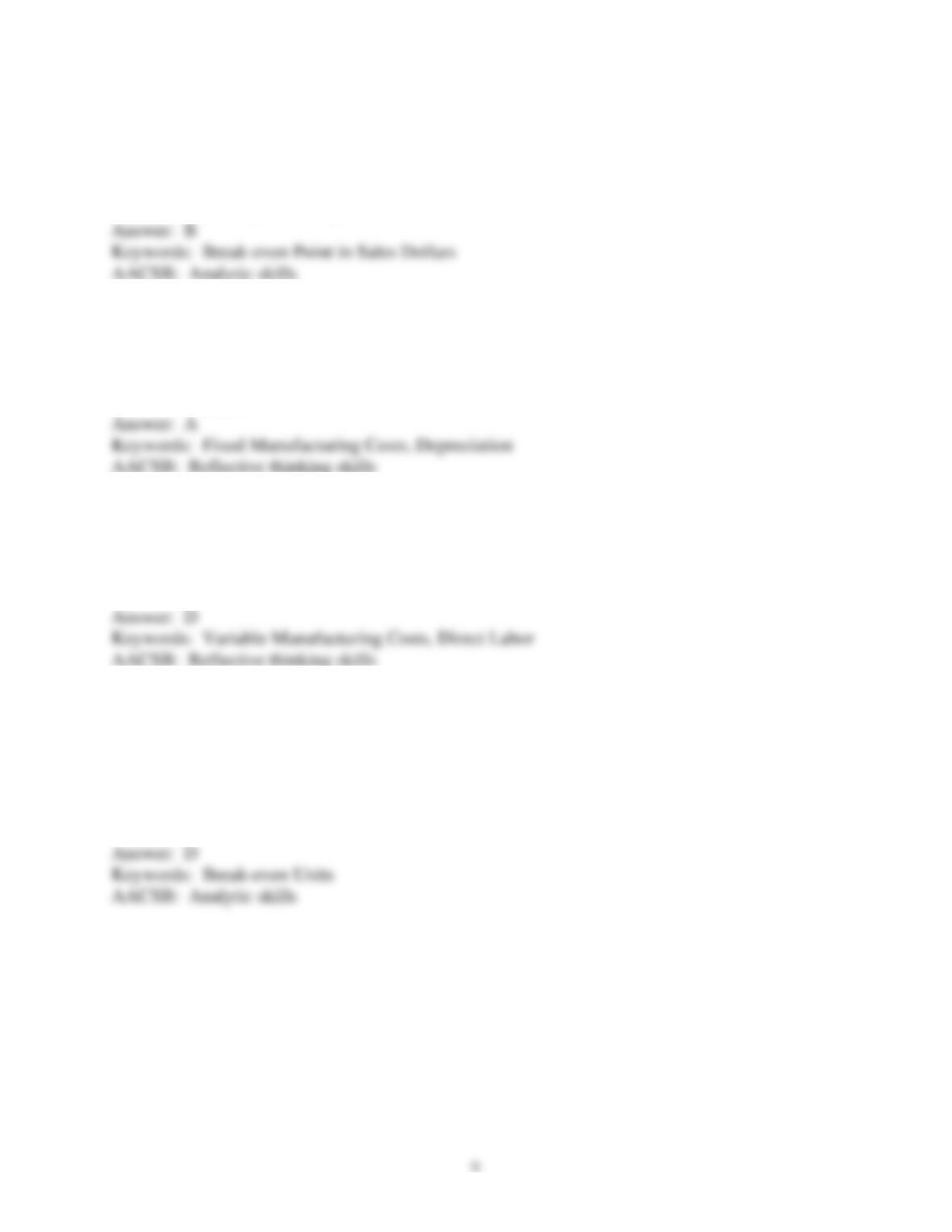
31) Based on the data contained in Table A, what is the break-even point in sales dollars?
TABLE A
Average selling price per unit $18.00
Variable cost per unit $13.00
Units sold 400,000
Fixed costs $650,000
Interest expense $ 50,000
A) $2,340,000
B) $1,850,000
C) $1,775,500
D) $700,000
32) Benkart’s Tire Store has fixed costs of $220,000. Tires sell for $95 each and have a unit
variable cost of $45. What is Benkart’s break-even point in units?
A) 4,000
B) 4,400
C) 5,200
D) 5,500
33) The break-even point in sales dollars is convenient if
A) the firm sells a large amount of one product.
B) the firm deals with more than one product.
C) the price per unit is very low.
D) depreciation expense is high.
34) Which of the following would be considered a fixed cost in a manufacturing setting?
A) Depreciation
B) Direct labor
C) Sales commissions
D) Direct materials
35) Which of the following would be considered a variable cost in a manufacturing setting?
A) Rent
B) Administrative salaries
C) Insurance
D) Direct labor
36) Sweet Tooth Bakery bakes and sells pies. Sweet Tooth has annual fixed costs of $880,000
and a variable cost per pie of $7.50. Each pie sells for $15.50 each. The firm expects to sell
500,000 pies annually. What is the break-even point in pies?
A) 190,440
B) 280,000
C) 200,000
D) 110,000
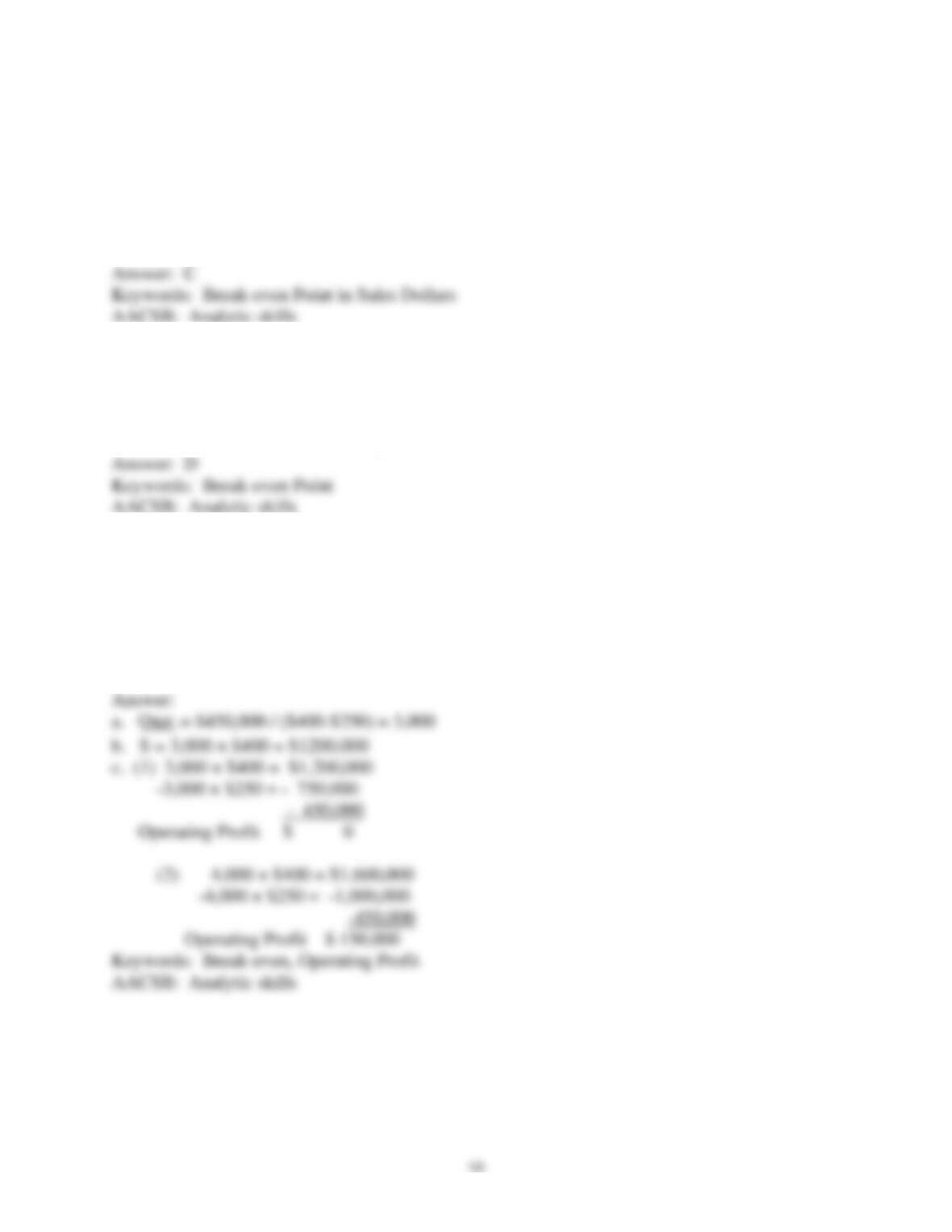
37) Sweet Tooth Bakery bakes and sells pies. Sweet Tooth has annual fixed costs of $880,000
and a variable cost per pie of $7.50. Each pie sells for $15.50 each. The firm expects to sell
500,000 pies annually. What is the break-even point in sales dollars?
A) $3,100,000
B) $2,875,000
C) $1,705,000
D) $1,625,000
38) All of the following will make the break-even point increase, other things equal, except:
A) fixed costs increase.
B) the sales price per unit is decreased due to competition.
C) variable costs increase due to higher direct labor cost.
D) the number of units sold for the year decreased.
39) Joe’s Furniture Co. produces inexpensive leather chairs. The average selling price for one of
the chairs is $400. The variable cost per chair is $250. Benny’s has average fixed costs per year
of $450,000.
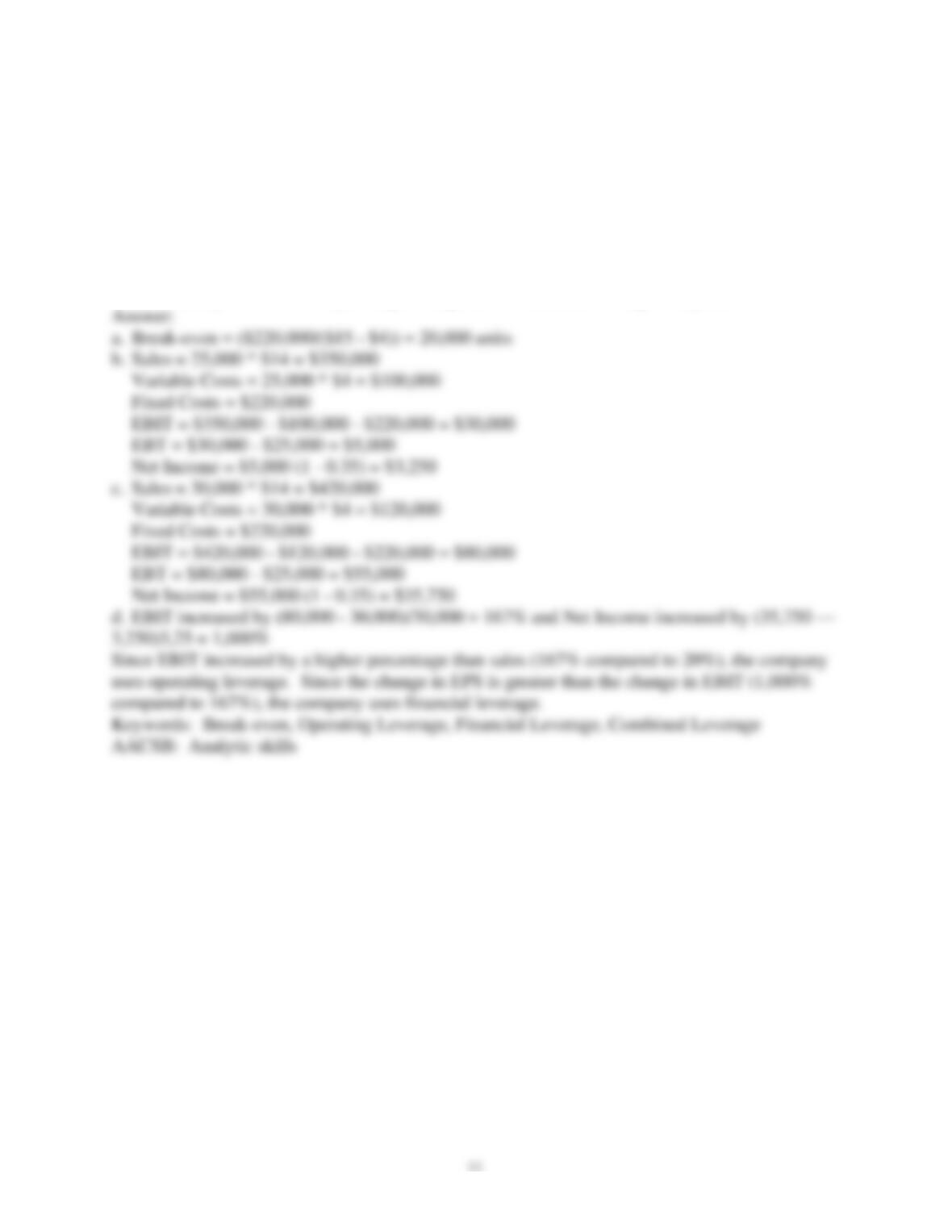
a. What is the break-even point in units?
b. What is the break-even point in dollar sales?
c. What would be the operating profit or loss associated with the production and sale of (1)
3,000 chairs, (2) 4,000 chairs?
40) Welker Products sells small kitchen gadgets for $15 each. The gadgets have a variable cost
of $4 per unit, and Welker Products’ fixed operating costs are $220,000 per year. Welker
Products’ capital structure includes 55% debt and 45% equity. Annual interest expense is
$25,000, and the corporate tax rate is 35%.
a. Calculate the break-even point in units.
b. If Welker Products sells 25,000 units, calculate the firm’s EBIT and net income.
c. If sales increase ten percent from 25,000 units to 30,000 units, estimate the firm’s expected
EBIT and net income.
d. Does Kelly Products use operating leverage and/or financial leverage? Explain.
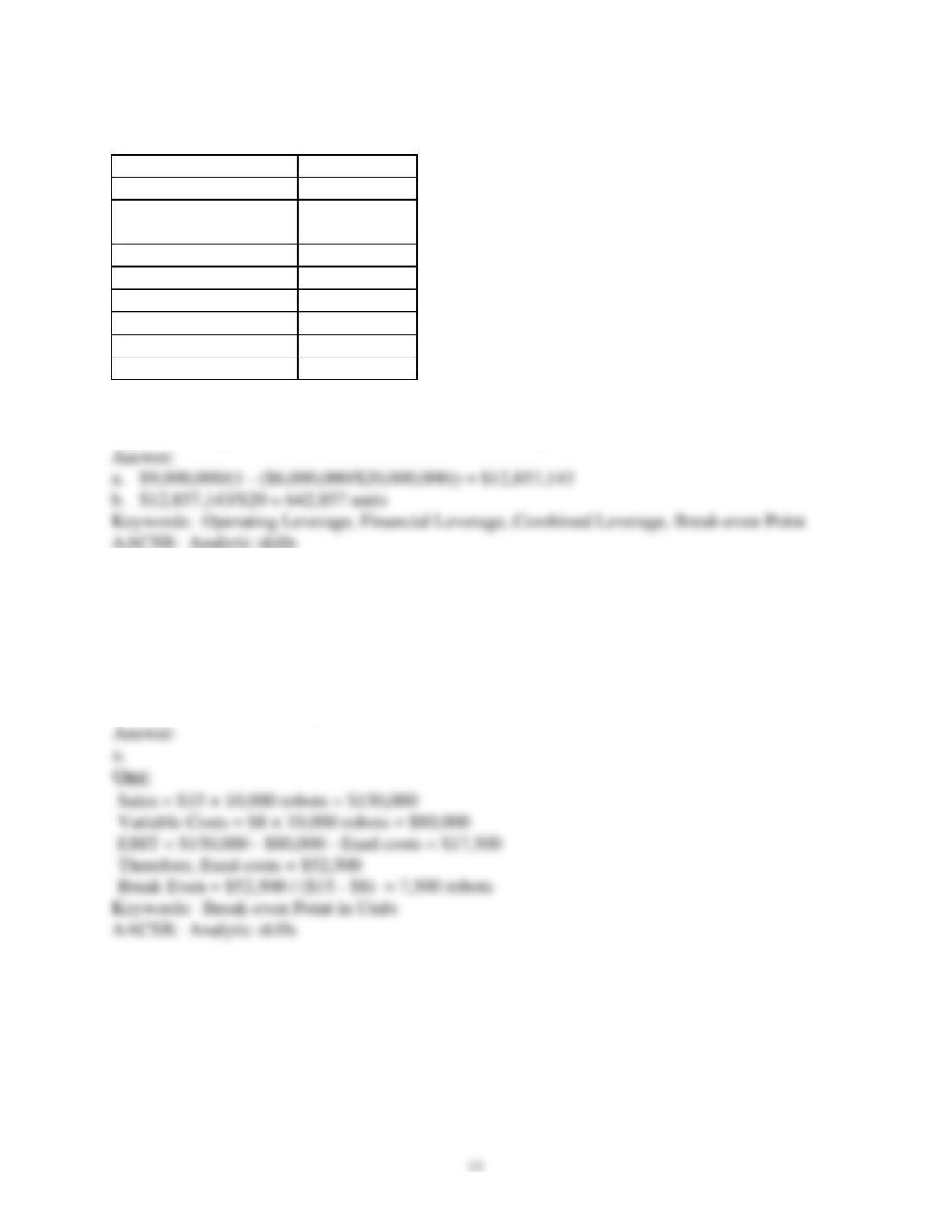
41) ABC Corp. has estimated the following income statement for its next fiscal year.
Sales
$20,000,000
Variable costs
6,000,000
Revenue before fixed
costs
14,000,000
Fixed costs
9,000,000
EBIT
5,000,000
Interest expense
900,000
Earnings before taxes
4,100,000
Taxes (35%)
1,435,000
Net income
$2,665,000
a. What is the break-even point in sales dollars for the firm?
b. If the average unit cost is $20, what is the break even point in units?
42) Techno Robots produces a functioning toy robot. At a production and sales level of 10,000
robots, the firm has the following information:
Selling price per unit = $15
Variable costs per unit = $8
EBIT = $17,500
a. What is the break-even point in units for the firm?
43) Wheely Bike Manufacturers expects to produce and sell 9,000 made-to-order bicycles this
year.Variable costs are 40 percent of sales while fixed costs total $600,000. At what price must
each bicycle be sold for Wheely to earn EBIT of $450,000?
44) JKE, Inc. has a break even sales level of $10,000,000 and has fixed costs of $4,000,000 per
year. The selling price per unit is $200. What is the variable cost per unit?
45) DXZ, Inc. currently produces one product which sells for $250 per unit. The company’s fixed
costs are $75,000 per year; variable costs are $205 per unit. A salesman has offered to sell the
company a new piece of equipment which will increase fixed costs to $100,000. The salesman
claims that the company’s break-even point will not be altered if the company purchases this
equipment. What will be the company’s new variable cost per unit?
46) Stan’s Cans, Inc. expects to earn $150,000 next year after taxes on sales of $2,200,000. Stan’s
manufactures only one size of garbage can. Stan sells his cans for $8 apiece and they have a
variable cost of $2.40 apiece. Stan’s tax rate is currently 34%.
a. What are the firm’s expected fixed costs for next year?
b. What is the break-even point in units?
47) The Western Boot Company will produce 94,000 pairs of boots next year. Variable costs are
35 percent of sales, while fixed costs total $223,000. At what price must each pair of boots be
sold for Western to obtain an EBIT of $1,391,500?
48) The Knight Corporation projects that next year its fixed costs will total $240,000. Its only
product sells for $34 per unit, of which $18 is a variable cost. The management of Knight is
considering the purchase of a new machine that will lower the variable cost per unit to $14. The
new machine, however, will add to fixed costs through an increase in depreciation expense. How
large can the addition to fixed costs be in order to keep the firm’s break-even point in units
produced and sold unchanged?
1) Operating leverage is easier to control and manage than financial leverage because operating
leverage deals with the internal workings of the company while financing deals with outside
parties.
2) A company that sells common stock and uses the money to pay off a loan is increasing its use
of financial leverage.
3) A company that sells preferred stock and uses the money to pay off a loan is decreasing its
amount of financial leverage.
4) Financial risk applies to both the additional variability in earnings available to common
shareholders and the additional chance of insolvency caused by the use of financial leverage.
5) A CEO concerned about variability of earnings per share may try to offset high operating
leverage with a capital structure that is mostly debt in order to take advantage of the interest tax
shield.
6) Operating leverage means financing a portion of a firm’s earnings per share with debt.
7) Operating leverage contributes ultimately to the variability of a firm’s earnings per share.
8) Operating leverage is measured as the responsiveness of the firm’s earnings before interest and
taxes relative to fluctuations in sales.
9) Financial leverage is typically more under the control of management than is operating
leverage because the nature of the product often dictates the type of production process needed.
10) Break-even analysis assumes that a multiproduct firm maintains a constant production and
sales mix.
11) Operating leverage is the responsiveness of a firm’s EBIT to changes in sales revenues.
12) The more fixed-charge securities (such as bonds and preferred stock) the firm employs in its
financial structure, the greater its financial leverage.
13) An increase in financial leverage will increase the absolute value of EPS, everything else
equal.
14) If a company sells bonds and uses the proceeds to buy back common stock, the company’s
financial leverage with increase.
15) The presence of debt and/or preferred stock in a firm’s financial structure means the firm is
using financial leverage.
16) Because fixed costs do not vary with a firm’s revenues, firm’s with high levels of fixed cost
enjoy lower levels of operating risk because their costs are more certain, making budgeting
easier.
17) If a firm’s production process requires high operating leverage (use of fixed costs), then the
firm should finance its assets with debt, so that the cost of capital will be reduced and financing
costs will remain fixed.
18) Because financial markets can be extremely volatile, with bond and stock prices changing
significantly from day to day, a firm’s management has much greater control over the firm’s
operating leverage than over its financial leverage.
19) All of the following are likely to result in the use of less debt in a company’s capital structure
except:
A) desire to maintain financial flexibility.
B) desire to maintain a high credit rating.
C) insufficient internal funds.
D) a decrease in a company’s marginal tax rate.
20) Which of the following transactions will lower a company’s financial leverage?
A) A mortgage loan is obtained and the proceeds are used to pay off existing short-term debt.
B) Preferred stock is sold and the proceeds are used to pay off existing short-term debt.
C) Common stock is sold and the proceeds are used to pay off existing short-term debt.
D) Short-term debt is obtained to get the company through a period of negative net income and
cash flow.
21) Ames Drilling Corp. reported that its sales and EBIT increased by 10%, but its EPS
increased by 30%. The much larger change in earnings per share could be the result of
A) high operating leverage.
B) high financial leverage.
C) a high percentage of credit sale collections from prior years.
D) high fixed costs of production.
22) Bob’s Baked Goods Company reported the following income statement for 2009:
Sales
$2,500,000
Variable Costs
900,000
Fixed Operating Costs
700,000
EBIT
900,000
Interest Expense
200,000
EBT
700,000
Taxes (30%)
210,000
Net Income
$490,000
Earnings Per Share
$4.90
If Bob’s sales next year increase by 20%, what will Bob’s earnings per share be?
A) $5.76
B) $6.45
C) $7.14
D) $7.58