Chapter 12 Test bank – Static Key
1.
The capital asset pricing model (CAPM) assumes that the stock market is dominated by well-diversified investors who are
concerned only with market risk.
2.
The CAPM states that the expected risk premium on any security equals its beta times the market risk premium.
3.
The security market line displays the relationship between expected return and beta.
4.
The security market line sets a standard for other investments—investors will be willing to hold other investments only if
they offer equally good prospects as shown by the points on the line.
5.
The required risk premium for any given investment is defined by the security market line.
6.
Empirical evidence suggests that over a long period of time returns are directly related to beta.
7.
There is little doubt that the CAPM captures everything that is going on in the market.
8.
Beta measures the total risk of an individual security.
9.
The security market line provides a standard that can be used to make project acceptance/rejection decisions.
10.
If a low-risk company invests in a high-risk project, those cash flows should be discounted at a high cost of capital.
11.
The project cost of capital depends on the risk of the company undertaking the project.
12.
Beta measures a stock’s sensitivity to market risks.
13.
The project cost of capital depends on how the capital is used.
14.
Investors expect aggressive stocks to outperform the market in periods of strong economic activity.
15.
Defensive stocks typically provide better returns during periods of economic downturn since they are not very sensitive to
market fluctuations.
16.
Diversification decreases the variability of both specific and market risk.
17.
Market risk premium is defined as the difference between the market rate of return and the risk-free interest rate.
18.
According to the CAPM, a stock’s expected return is positively related to its beta.
19.
The CAPM is a theory of the relationship between risk and return that states that the expected risk premium on any security
equals its beta times the market return.
20.
The stocks of gold-mining companies commonly have above-average volatility but relatively low betas.
21.
According to the capital asset pricing model, the expected rates of return for all projects lie on the security market line.
22.
As a project’s beta increases, the project’s opportunity cost of capital increases.
23.
A project should be accepted if its return plots below the security market line.
24.
The security market line shows how the expected rate of return depends on beta.
25.
The required risk premium for any investment is given by the security market line.

26.
Project cost of capital and company cost of capital are synonymous terms.
27.
The project cost of capital depends on the use to which that capital is put. Therefore, it depends on both the risk of the project
and also on the risk of the company.
28.
If a company with a low credit rating invests in a low-risk project, it should discount the cash flows at a relatively high cost
of capital.
29.
If a project has a risk of a bad outcome, the company should always set a higher discount rate to compensate.
30.
The expected return on a security includes a reward for:
31.
If a security plots below the security market line, it is:
32.
Macro events only are reflected in the performance of the market portfolio because:
33.
In practice, the market portfolio is often represented by:
34.
A stock’s beta measures the:
35.
In theory, the “market portfolio” should contain:
36.
When the overall market is up by 10%, investors with portfolios of defensive stocks will probably have:
37.
When the overall market experiences a decline of 8%, investors with portfolios of aggressive stocks will probably experience
portfolio:
38.
A stock with a beta greater than 1.0 would be termed:
39.
The average of the betas for all stocks is:
40.
The slope of the line fitted to a plot of a stock’s returns versus the market’s returns measures the:
41.
If a stock consistently goes down (up) by 1.6% when the market portfolio goes down (up) by 1.2%, then its beta equals:
42.
If the slope of the line measuring a stock’s returns against the market’s returns is positive, then the stock:
43.
If the line measuring a stock’s historic returns against the market’s historic returns has a slope greater than 1.0, then the:
Topic: Beta
44.
What is the most likely explanation for a +20.0% return on a stock with a beta of 1.0 in a month when the market returned
+10.0%?
45.
If a stock’s beta is 0.8 during a period when the market portfolio was down by 10%, then, a priori, we could expect this
individual stock to:
46.
A stock’s total risk depends on the stock‘s _________ and __________.
47.
Estimate a stock’s beta based on the following information: Month 1 = Stock + 1.5%, Market + 1.1%; Month 2 = Stock +
2.0%, Market + 1.4%; Month 3 = Stock − 2.5%, Market − 2.0%.
48.
If you were willing to bet that the overall stock market was heading up on a sustained basis, it would be more profitable to
invest in:
49.
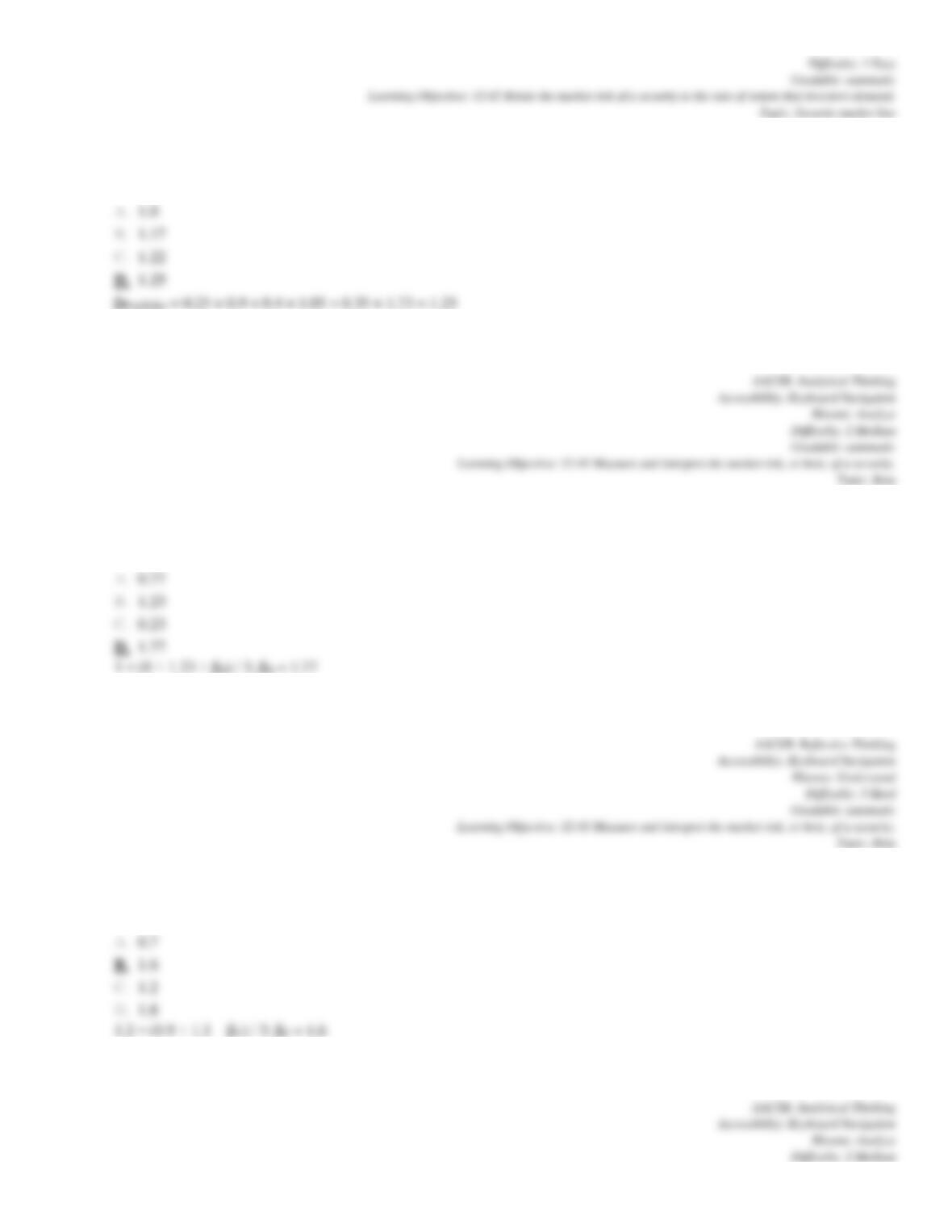
What is the beta of a 3-stock portfolio including 25% of stock A with a beta of 0.90, 40% of stock B with a beta of 1.05, and
35% of stock C with a beta of 1.73?
50.
You want to construct a portfolio containing equal amounts of U.S. Treasury bills and two stocks. If the beta of the first
stock is 1.23 and the beta of the portfolio is 1.0, what does the beta of the second stock have to be?
51.
An investor wishes to invest equal amounts in three stocks and to achieve a portfolio beta of 1.2. If stock A has a beta of 0.9
and stock B has a beta of 1.1, what must be the beta of stock C?
52.
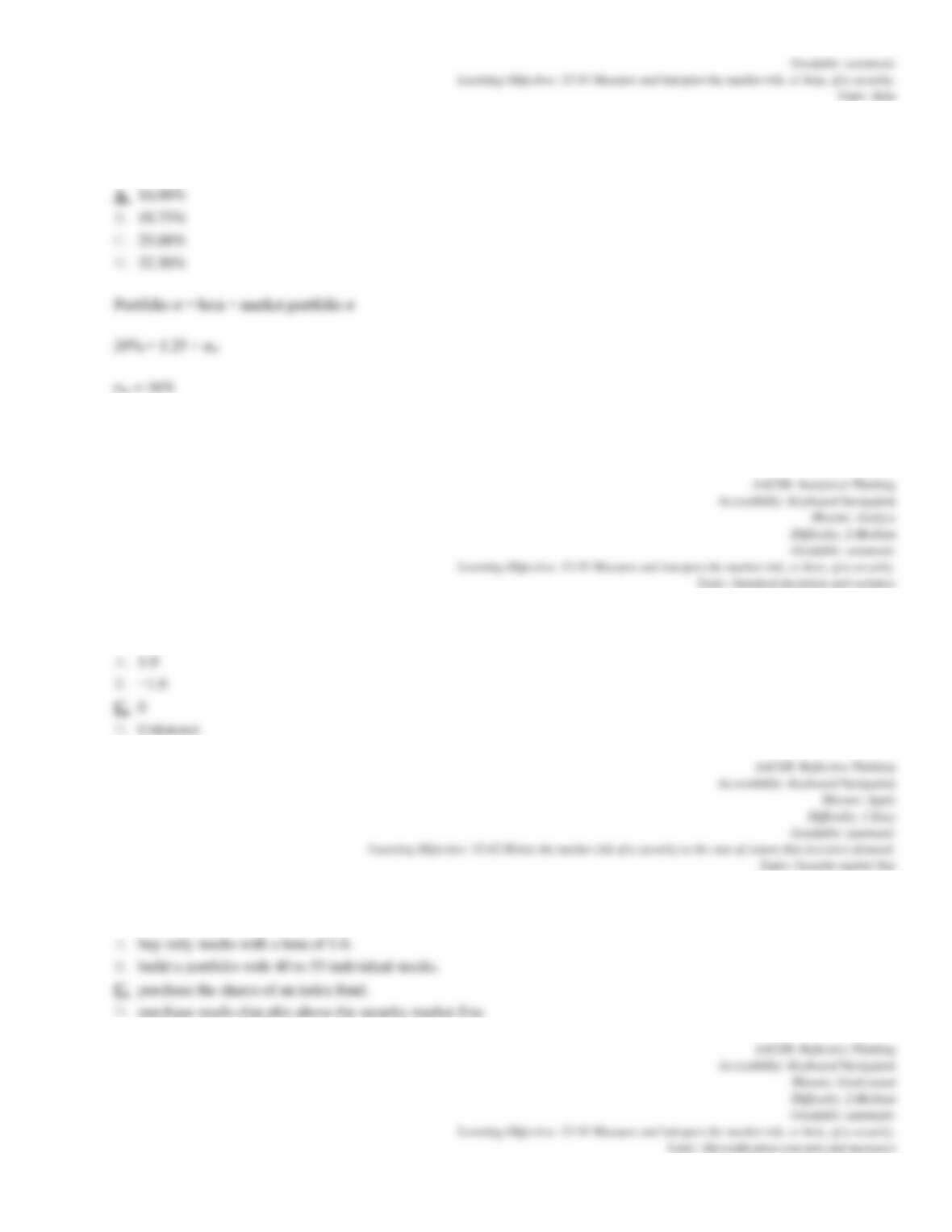
What is the standard deviation of the market portfolio if the standard deviation of a well-diversified portfolio with a beta of
1.25 equals 20%?
53.
What is the beta of a U.S. Treasury bill?
54.
One of the easiest methods of diversifying away firm-specific risks is to:
55.
A scatter in the plot of a stock’s returns versus the returns on the market reflects the:
56.
A project has a beta of 1.24, the risk-free rate is 3.8%, and the market rate of return is 9.2%. What is the project’s expected
rate of return?
57.
A project has a beta of 0.97, the risk-free rate is 4.1%, and the market risk premium is 8.1%. What is the project’s expected
rate of return?
58.
Which one of the following statements is correct when Treasury bills yield 7.5% and the market risk premium is 9.5%?
59.
If a well-diversified portfolio of stocks has an expected return of 25% when the expected return on the market portfolio is
15%, then
60.
The market rate of return is 12.5% and the risk-free rate is 3.1%. What will be the change in a stock’s expected rate of return
if its beta increases from 1.2 to 1.4?