
Chapter 12: Corporate Valuation and Financial Planning
1. Operating plans sketch out broad approaches for realization of the firm’s strategic vision. These plans usually are
developed for a period no longer than a 1-year time horizon because detail is “lost” by extending out the time horizon by
more than 1 year.
a. True
2. One of the necessary steps in the financial planning process is a forecast of financial statements under each alternative
version of the operating plan in order to analyze the effects of different operating procedures on projected profits and
financial ratios.
a. True
3. Which of the following is NOT one of the steps taken in the financial planning process?
a. Monitor operations after implementing the plan to spot any deviations and then take corrective actions.
b. Determine the amount of capital that will be needed to support the plan.
c. Develop a set of forecasted financial statements under alternative versions of the operating plan in order to analyze
the effects of different operating procedures on projected profits and financial ratios.
d. Consult with key competitors about the optimal set of prices to charge, i.e., the prices that will maximize profits
for our firm and its competitors.
e. Forecast the funds that will be generated internally. If internal funds are insufficient to cover the required new

Chapter 12: Corporate Valuation and Financial Planning
4. One of the first steps in arriving at a firm’s forecasted financial statements is a review of industry-average operating
ratios relative to these same ratios for the firm to determine whether changes to the ratios need to be made.
a. True
5. The fact that long-term debt and common stock are raised infrequently and in large amounts lessens the need for the
firm to forecast those accounts on a continual basis.
a. True
Chapter 12: Corporate Valuation and Financial Planning
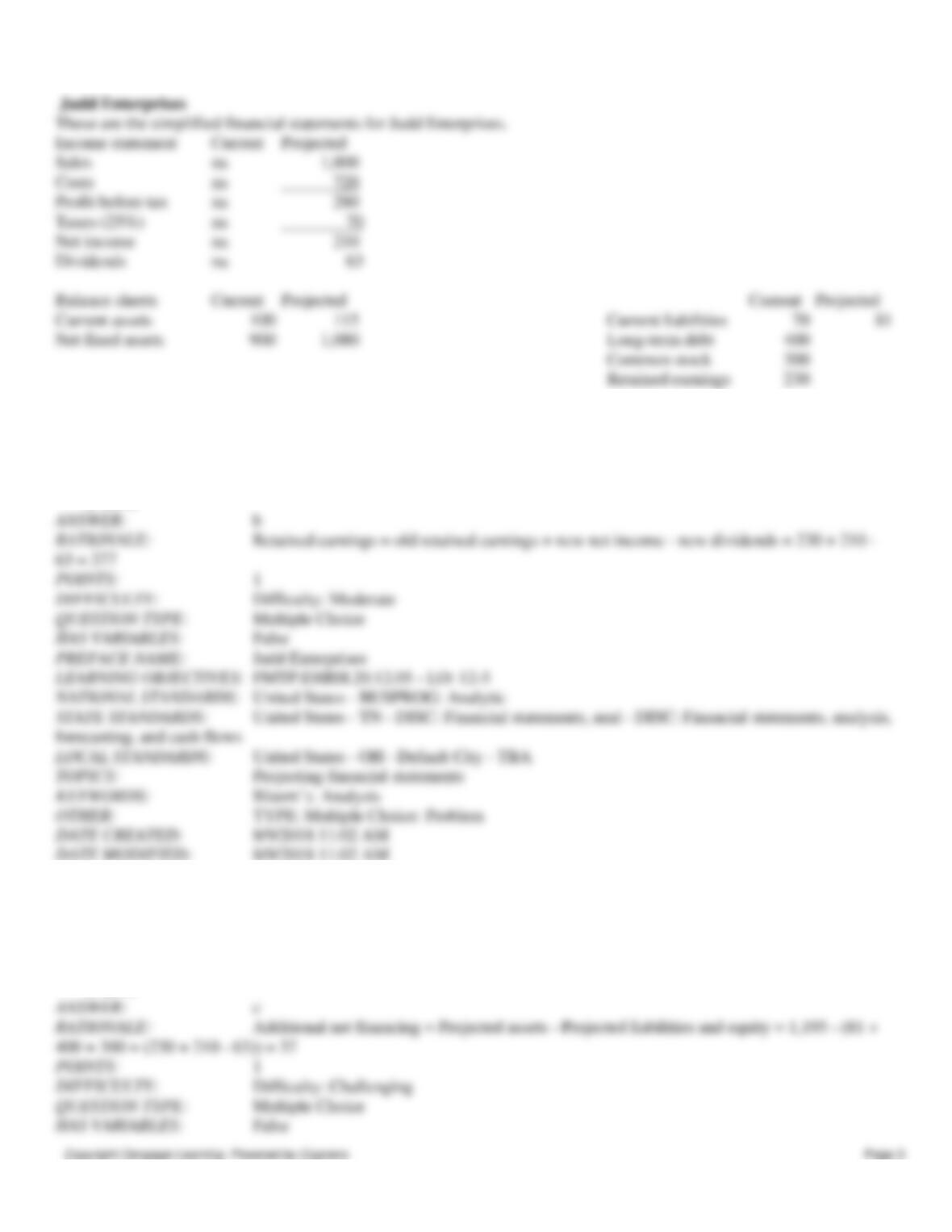
6. Refer to the Judd Enterprises financial statements. What is Judd’s projected retained earnings under this plan?
a. $339 b. $377
c. $396 d. $415
7. Refer to the Judd Enterprises financial statements. If Judd does not plan on issuing new stock or additional long-term
debt, then what is the additional net financing needed for the projected year?
a. $30 b. $33
c. $37 d. $339
Chapter 12: Corporate Valuation and Financial Planning
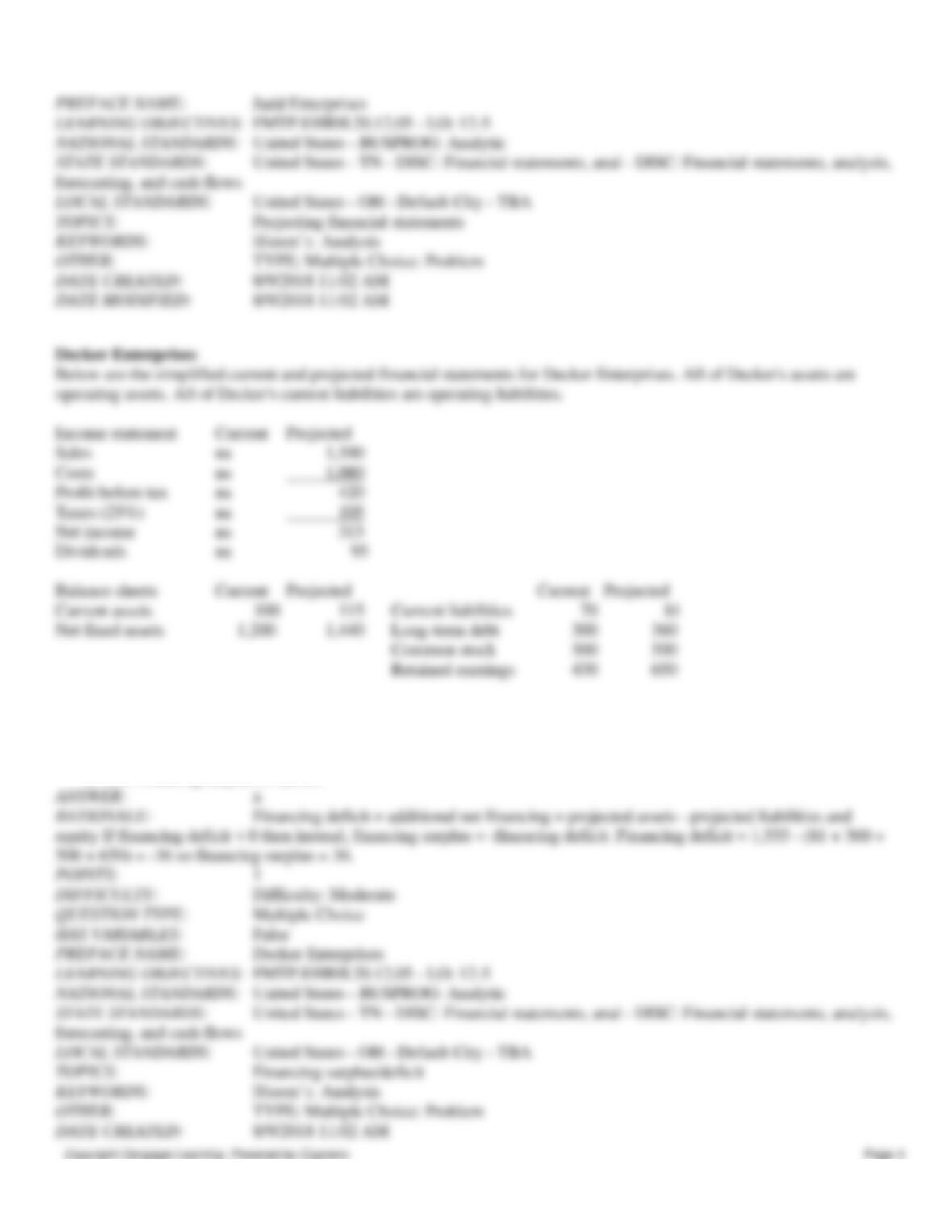
8. Based on the projections, Decker will have
a. a financing surplus of $36 b. a financing deficit of $36
c. a financing surplus of $255 d. a financing deficit of $255
Chapter 12: Corporate Valuation and Financial Planning
9. If Decker had a financing surplus, it could remedy the situation by
a. borrowing on its line of credit. b. issuing more common stock.
c. reducing its dividend. d. borrowing from its retained earnings
10. If Decker had a financing deficit, it could remedy the situation by
a. buying back common stock b. paying a special dividend
c. paying down its long-term debt d. borrowing on its line of credit
11. As a firm’s sales grow, its current assets also tend to increase. For instance, as sales increase, the firm’s inventories
generally increase, and purchases of inventories result in more accounts payable. Thus, spontaneous liabilities that reduce
AFN arise from transactions brought on by sales increases.
a. True
Chapter 12: Corporate Valuation and Financial Planning
12. Firms pay a low interest rate on spontaneous liabilities so these funds are its cheapest source of capital. Consequently,
the firm should make arrangements with its suppliers to use as much of this credit as possible.
a. True
13. A firm will use spontaneous funds to the extent possible; however, due to credit terms, contracts with workers, and tax
laws there is little flexibility in their usage.
a. True
Chapter 12: Corporate Valuation and Financial Planning
14. As long as a firm does not pay out 100% of its earnings, the firm’s annual profit that is retained in the business (i.e.,
the addition to retained earnings) is another source of funds for a firm’s expansion.
a. True
15. A rapid build-up of inventories normally requires additional financing, unless the increase is matched by an equally
large decrease in some other asset.
a. True
16. A firm’s AFN must come from external sources. Typical sources include short-term bank loans, long-term bonds,
preferred stock, and common stock.
a. True
Chapter 12: Corporate Valuation and Financial Planning
17. If a firm wants to maintain its ratios at their existing levels, then if it has a positive sales growth rate of any amount, it
will require some amount of external funding.
a. True
18. To determine the amount of additional funds needed (AFN), you may subtract the expected increase in liabilities,
which represents a source of funds, from the sum of the expected increases in retained earnings and assets, both of which
are uses of funds.
a. True
19. The capital intensity ratio is the amount of assets required per dollar of sales and it has a major impact on a firm’s
capital requirements.
a. True

Chapter 12: Corporate Valuation and Financial Planning
20. If a firm with a positive net worth is operating its fixed assets at full capacity, if its dividend payout ratio is 100%, and
if it wants to hold all financial ratios constant, then for any positive growth rate in sales, it will require external financing.
a. True
21. A firm’s profit margin is 5%, its debt/assets ratio is 56%, and its dividend payout ratio is 40%. If the firm is operating
at less than full capacity, then sales could increase to some extent without the need for external funds, but if it is operating
at full capacity with respect to all assets, including fixed assets, then any positive growth in sales will require some
external financing.
a. True

Chapter 12: Corporate Valuation and Financial Planning
22. Companies with relatively high assets-to-sales ratios require a relatively large amount of new assets for any given
increase in sales; hence, they have a greater need for external financing. There are currently no alternatives for these types
of firms to lower their asset requirements.
a. True
23. Firms with high capital intensity ratios have found ways to lower this ratio permitting them to achieve a given level of
growth with fewer assets and consequently less external capital. For example, just-in-time inventory systems, multiple
shifts for labor, and outsourcing production are all feasible ways for firms to reduce their capital intensity ratios.
a. True
24. Two firms with identical capital intensity ratios are generating the same amount of sales. However, Firm A is
operating at full capacity, while Firm B is operating below capacity. If the two firms expect the same growth in sales
during the next period, then Firm A is likely to need more additional funds than Firm B, other things held constant.
a. True

Chapter 12: Corporate Valuation and Financial Planning
25. If a firm’s capital intensity ratio (A0*/S0) decreases as sales increase, use of the AFN formula is likely to understate
the amount of additional funds required, other things held constant.
a. True
26. The minimum growth rate that a firm can achieve with no access to external capital is called the firm’s sustainable
growth rate. It can be calculated by using the AFN equation with AFN equal to zero and solving for g.
a. True
27. Which of the following assumptions is embodied in the AFN equation?
a. Accounts payable and accruals are tied directly to sales.
b. Common stock and long-term debt are tied directly to sales.
Chapter 12: Corporate Valuation and Financial Planning
d. Last year’s total assets were not optimal for last year’s sales.
28. F. Marston, Inc. has developed a forecasting model to estimate its AFN for the upcoming year. All else being equal,
which of the following factors is most likely to lead to an increase of the additional funds needed (AFN)?
a. A switch to a just-in-time inventory system and outsourcing production.
b. The company reduces its dividend payout ratio.
c. The company switches its materials purchases to a supplier that offers a longer credit period (with all other terms
held equal).
d. The company discovers that it has excess capacity in its fixed assets.
29. The term “additional funds needed (AFN)” is generally defined as follows:
a. Funds that a firm must raise externally from non-spontaneous sources, i.e., by borrowing or by selling new stock
to support operations.
b. The amount of assets required per dollar of sales.
c. The amount of internally generated cash in a given year minus the amount of cash needed to acquire the new