Part 5 Derivative Securities
CHAPTER 11
Forwards, Futures, and Swaps
CHAPTER LEARNING OBJECTIVES
11.1 Describe forward contracts, including how they are used and priced.
11.2 Explain what futures contracts are and why they can be viewed as the public
market version of forward contracts.
11.3 Describe the mechanics of simple swap structures, including interest rate
11.4 Explain how the credit default swap market contributed to the financial
11.5 Explain how the general principles of forward contracts can be applied to
fixed income securities.
Derivative Securities 11 – 2
MULTIPLE CHOICE QUESTIONS
1. A tailor-made contract with a price that is established today for future delivery is
called a ___________.
a) futures contract
b) forward contract
c) spot contract
d) call option
2. Forward contracts can be used either to hedge or to speculate. These actions:
a) increase risk in both cases.
b) decrease risk in both cases.
c) spread or minimize risk in both cases.
d) none of the above.
3. Forward contracts:
a) trade in an open market.
b) establish a price paid tomorrow for something today.
c) offer delivery of a commodity by sellers in the future.
d) are traded on OTC markets.
4. What condition is necessary to create a synthetic forward contract?
a) A hedging position.
b) Exposure to changes in exchange rates
c) Interest rate parity
d) Speculating in the market
5. Which of the following carries storage costs?
a) Futures on stocks
b) Futures on exchange rates
c) Futures on commodities
d) Futures on interest rates
6. Profit from a short position in a forward is:
a) (X – ST)
b) [ST – F] × n
c) (ST – X)
d) [F – ST] × n
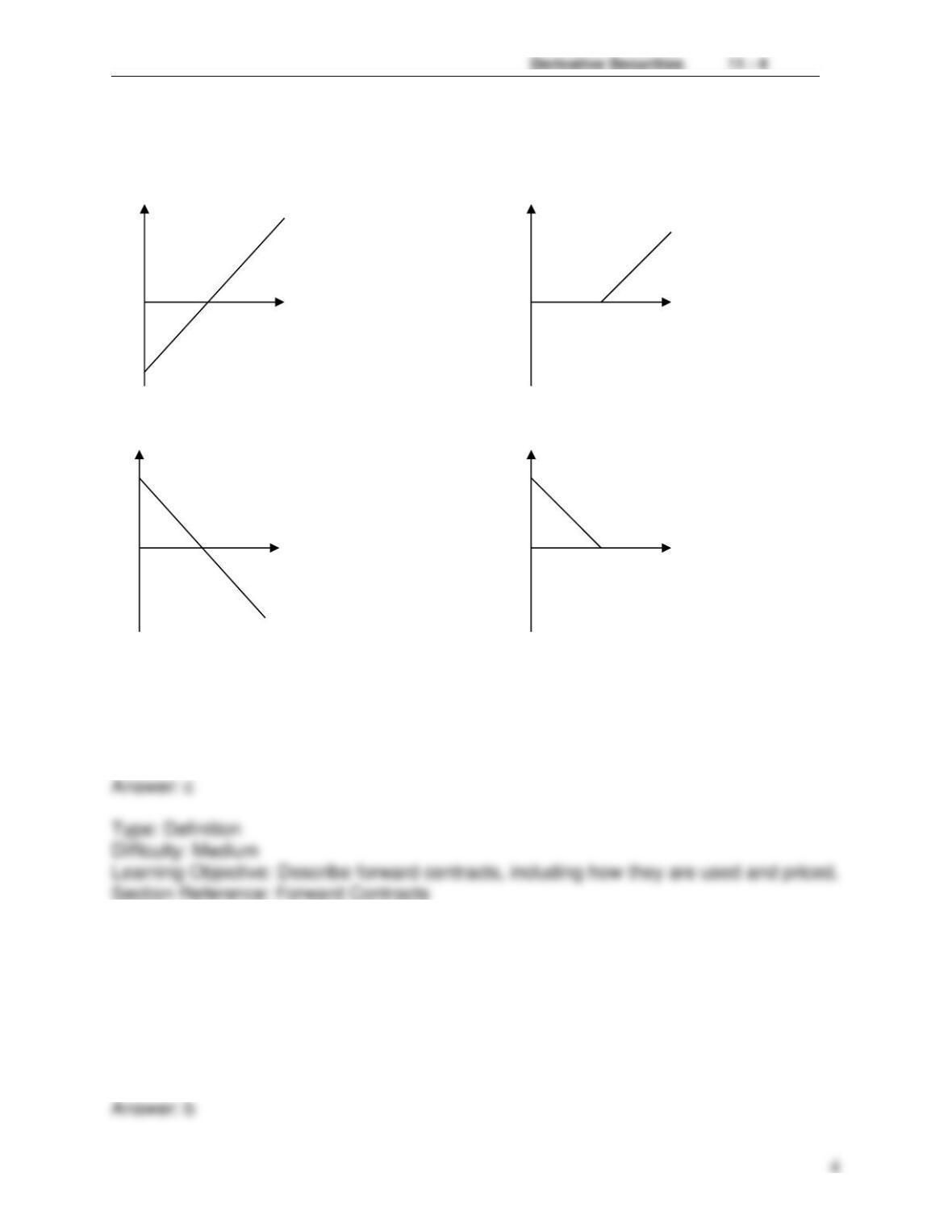
7. Which is a graph of a short position in a forward contract?
a) I
b) II
c) III
d) IV
8. Profit from a long position in a forward is:
a) (X – ST)
b) [ST – F] × n
c) (ST – X)
d) [F – ST] × n
I
II
III
IV
9. When does counterparty risk arise?
a) When the spot price increases.
b) When the investor takes a naked position.
c) When the speculator loses to the counter party.
d) When the counterparty defaults.
10. Marie has done some research and found that the spot rate is C$1.4039 per euro.
Her neighbour told her that the three-month forward rate is C$1.44 per euro. If Marie
assumes a 1,000 euro long position in the forward contract, what will her profit (loss) be
if the spot rate in 3 months is C$1.45 per euro?
a) C$46.10
b) – C$10.00
c) C$10.00
d) C$36.10
11. The six-month forward rate is C$ 1.00 per US$. Ahmed assumes a 1,000 long
position in the forward contract and his profit in six months is C$30.00. What is the spot
rate in six months?
a) C$ 1.030 per US$
b) C$ 1.031 per US$
Derivative Securities 11 – 6
c) C$ 1.029 per US$
d) C$ 0.970 per US$
12. What is the “cost of carry” equivalent for exchange rates?
a) The forward rate
b) The interest rate in the host country
c) The interest rate in the foreign country
d) The interest rate difference between the host and foreign countries
13. Magdalena assumes a US$ 2,000 short position in a 1-year US forward contract
(F = C$1.0312 per US). If the spot rate in one year is (a) C$1.04 per US (b) C$1.03 per
US, what will her profit (loss) be in each case?
a) – C$8.8, 1.2
b) – C$20, 2.4
c) C$17.6, – 2.4
d) – C$17.6, 2.4
14. Assume perfect foresight. The current spot rate is C$2.037 per British pound. The 3-
month forward rate is C$2.0383. The spot rate in three months will be C$2.04 per
pound. What position must an investor assume in order to make a profit of $17.00?
a) Pound 13,077 short position
b) Pound 10,000 long position
c) Pound 10,000 short position
d) Pound 13,077 long position
15. Suppose Montreal Import Company has to pay a foreign supplier 400,000 euros in
one year and decides to hedge their position by entering into a forward contract. What is
the appropriate forward position?
a) 400,000 short euro forward contract
b) 200,000 euro forward contract
c) 400,000 long euro forward contract
d) not enough information provided to identify an answer
16. Given: the future spot rate C$0.00965 per yen; the current spot rate C$0.0088 per
yen and the forward rate C$0.009721 per yen. Determine the cost (proceeds) in
Canadian dollars to eliminate foreign exchange exposure for 100,000 yen to be paid to
a foreign supplier.
a) Cost C$965.00
b) Cost C$880.00
c) Cost C$972.10
d) Proceeds C$880.00
8
17. Assume the spot exchange rate today is C$1.02 per $US, while the three-month
forward rate is C$1.06 per $US. What will be the profit for an investor who takes a
$US100,000 short position in the forward contract if the spot rate in three months equals
1.05?
a) C$1,000
b) – C$1,000
c) C$4,000
d) – C$4,000
18. Xin is selling his transformer over the internet for C$500. An interested buyer says
he is willing to pay 360 euro in six months. What position should Xin take to eliminate
his foreign exchange exposure?
a) 500 long Canadian forward contract
b) 500 short Canadian forward contract
c) 360 long euro forward contract
d) 360 short euro forward contract
19. Assume the following: Current Spot Rate C$1.10 per $US; Future Spot Rate
C$1.1063 per $US; Forward Rate C$1.1044 per $US; Exposure $100,000 US. What
are the profits in Canadian dollars of covering the long position?
a) C$110
11 – 9 Test Bank for Introduction to Corporate Finance, Fourth Canadian Edition
b) C$116
c) C$114
d) C$190
20. Assume the following: Current 1-year Japanese interest rate 3.0%; Current 1-year
Canadian interest rate 5.0%; Current spot rate C$0.01 per yen. Estimate the 1-year
forward exchange rate using interest rate parity.
a) C$0.0102 per yen
b) C$0.0098 per yen
c) C$1.0194 per yen
d) C$0.9810 per yen
21. David estimated a six-month forward rate of C$1.01 per US$. The six-month US$
interest rate is currently 4%. If David’s estimate is based on IRP, what was the observed
current six-month Canadian interest rate, if the spot rate is C$1.02 per US$?
a) 5.03%
b) 2.03%
c) 2.98%
d) 2.05%
10
22. Montreal First Bank is selling forward contracts on the USD/CAD exchange market.
What exchange rate would they require for a three-month forward rate, if the spot rate is
C$ 1.0200/USD and the interest rates are 3% and 2.5% in Canada and the US
respectively?
a) C$1.0249
b) C$1.0213
c) C$1.0187
d) C$1.0200
23. Montreal First Bank is selling forward contracts on the CAD/USD market. What
exchange rate will they require for a three-month forward rate, if the spot rate is
C$0.9800/USD, and the interest rates are 3% and 2.5% in Canada and the US
respectively?
a) C$0.9752
b) C$0.9788
c) C$0.9812
d) C$0.9800
24. Which of the following refers to the cost or benefits from a forward position in a
storable commodity?
I. Storage cost
11 – 11 Test Bank for Introduction to Corporate Finance, Fourth Canadian Edition
II. Convenience yield
III. Cost of carry
a) I, II, III
b) I, II
c) II, III
d) I, III
25. By definition LIBOR is:
a) the long-term inter-bank option rate
b) the London inter-bank optimal rate
c) the limited inter-bank offer rate
d) the London inter-bank offered rate
26. Assume the following: underlying asset spot $200, storage cost $20, and financing
costs 5% per year. Calculate the cost of carry.
a) $20
b) 0.15
c) 0.105
d) 0.10
27. Wheat is selling for $25 spot. Storage costs are $2 for the year, and financing costs
are 5% per year. What is the forward price for a one-year forward contract for wheat?
a) $25.00
b) $26.25
c) $25.13
d) $28.25
28. What is a relatively small (in terms of the contract value) deposit made with the
clearinghouse?
a) Maintenance margin
b) Margin call
c) Initial margin
d) Daily resettlement
29. The dollar amount upon which a contract is valued is referred to as:
a) settlement price
b) initial margin
c) strike price
d) notional amount
30. Which of the following are classified as commodities for the purpose of futures
contracts?
I. Silver
II. Wheat
III. Weather derivatives
a) I, II
b) II, III
c) I, III
d) I, II, III
31. Which of the following are classified as investment for the purpose of futures
contracts?
I. Silver
II. Wheat
III. Weather derivatives
IV. Bond
a) I, II
b) II, III
c) I, III
d) I, II, III
e) IV