a.
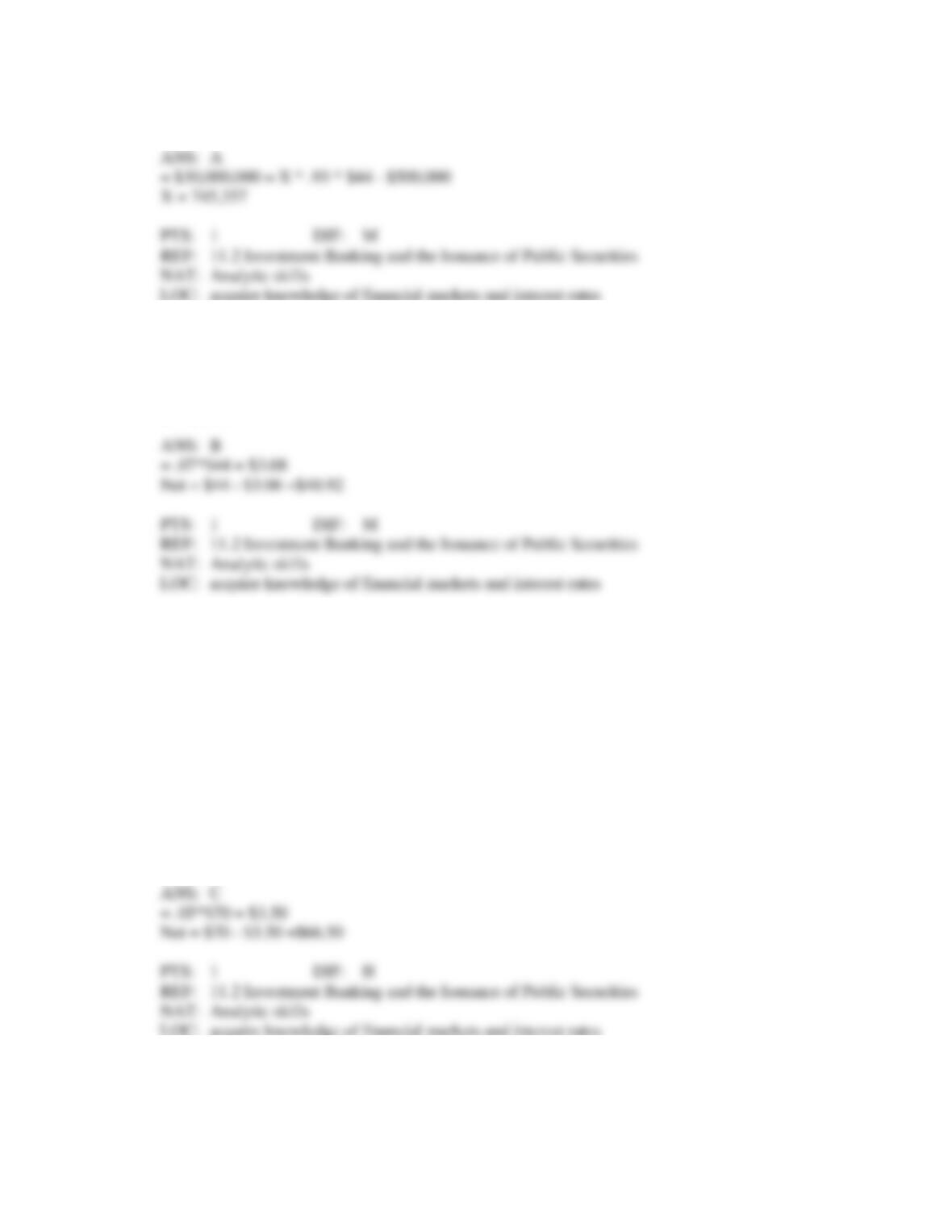
745,357
b.
745,857
c.
746,127
d.
746,327
58. What is the net price per share that Sea Grove Beach Company will receive from this offering?
a.
$40.24
b.
$40.92
c.
$42.24
d.
$43.93
NARRBEGIN: Panama City
Panama City Beach Company
Panama City Beach Company needs to raise $60 million of new equity capital. Its common stock is
currently selling for $70 per share. The investment bankers require an underwriting spread of 5 percent
of the offering price, and the company’s legal, accounting, and printing expenses associated with the
seasoned offering are estimated to be $200,000.
NARREND
59. What is the net price per share that Panama City Beach Company will receive from this offering?
a.
$66.00
b.
$66.20
c.
$66.50
d.
$67.00
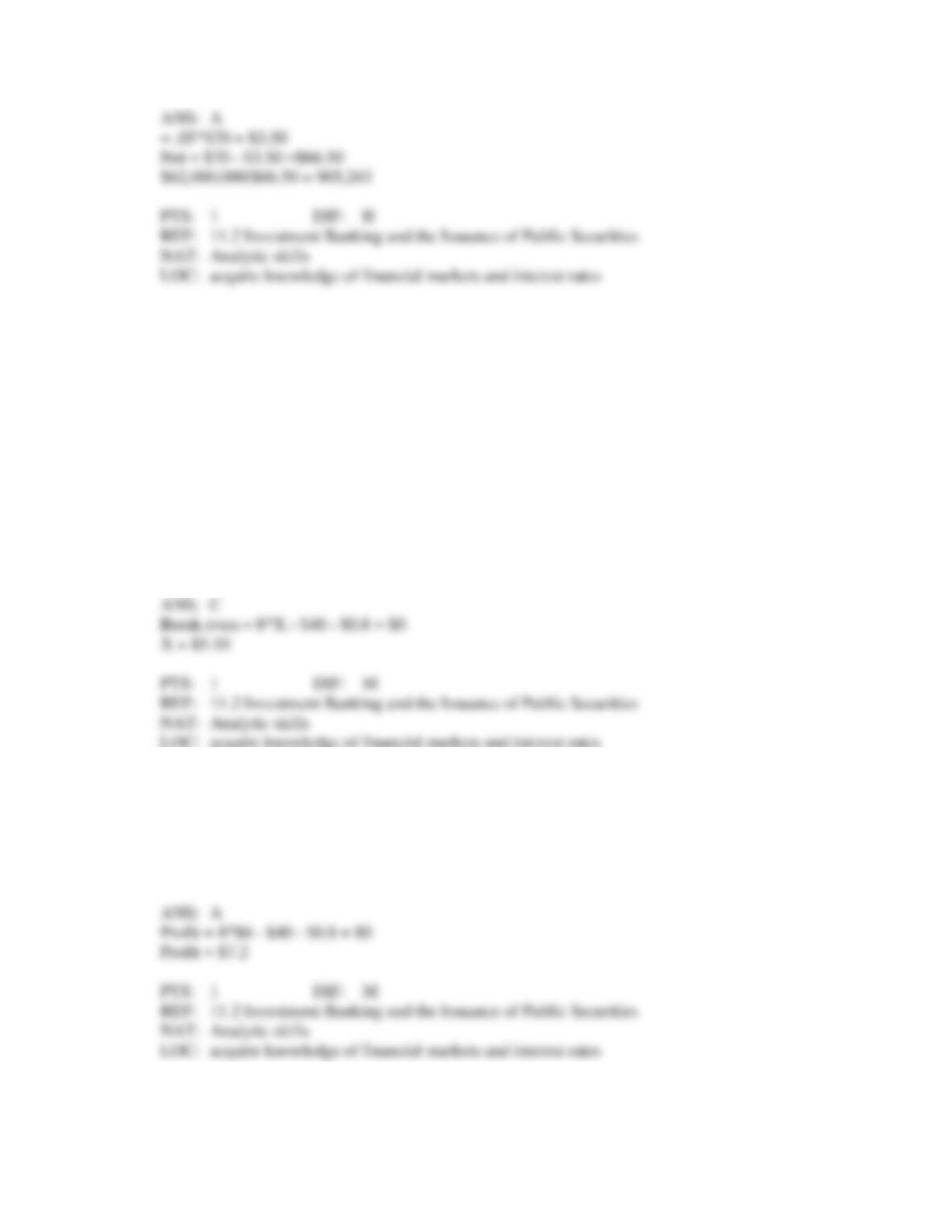
60. Refer to Panama City Beach Company. How many shares must be sold to net $60 million?
a.
905,263
b.
902,256
c.
885,715
d.
857,143
NARRBEGIN: Brooks Corporation
Brooks Corporation
Brooks Corporation has just received $40 million in net proceeds from a seasoned offering. The
offering was underwritten by ABC Investments, an investment bank that focuses on small company
offerings. For the offering, 8 million shares of stock were issued and the underwriting expenses for
ABC Investments were $800,000.
NARREND
61. Refer to Brooks Corporation. For ABC Investments to make a profit on this offering, what is the
minimum price they must sell the stock for on the secondary market?
a.
$5.00
b.
$5.04
c.
$5.10
d.
$5.15
62. Refer to Brooks Corporation. ABC Investments is able to sell the stock on the secondary market at
$6.00. What is the profit for ABC Investments for underwriting this seasoned offering?
a.
$7.2 million
b.
$7.6 million
c.
$8.0 million
d.
$8.8 million
NARRBEGIN: “Flip” shares 1
“Flip” shares 1
Three companies went public last month with initial public offerings (IPO). The offer price and first
day closing price are shown below for the three firms. An investor was able to purchase 100 shares of
each company at the offer price and then “flip” the shares at the end of the day for the full return.
Stock
Offer Price
Closing Price
A
$10
$12.50
B
$80
$96.00
C
$40
$55
NARREND
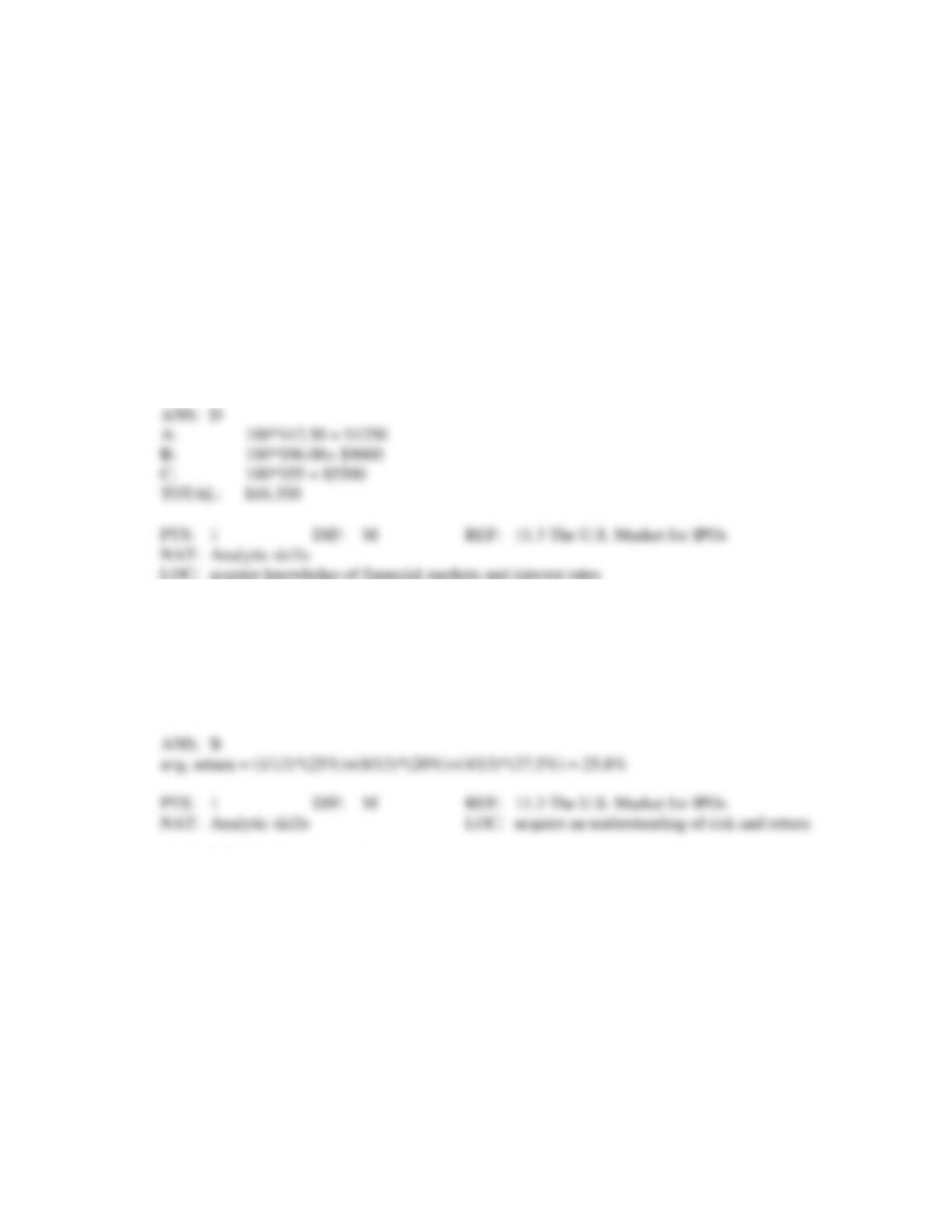
63. Refer to “Flip” shares 1. What was the total dollar value of this investment at the end of the first day?
(Ignore any tax implications for this question)
a.
$13,000
b.
$14,650
c.
$15,850
d.
$16,350
64. Refer to “Flip” shares 1. What was the return on this investment at the end of the first day? (Ignore any
tax implications for this question)
a.
23.1%
b.
25.8%
c.
27.5%
d.
29.1%
NARRBEGIN: “Flip” shares 2
“Flip” shares 2
Three companies went public last month with initial public offerings (IPO). An investor was able to
purchase shares of each company at the offer price and then “flip” the shares at the end of the day for
the full return. The shares of each company sold for a $20 offer price. The number of shares purchased
and the first day return are shown below.
Stock
Shares
Bought
First Day
Return
A
50
20%
B
75
12%
C
75
5%
100*$12.50 = $1250
100*$55 = $5500
NARREND
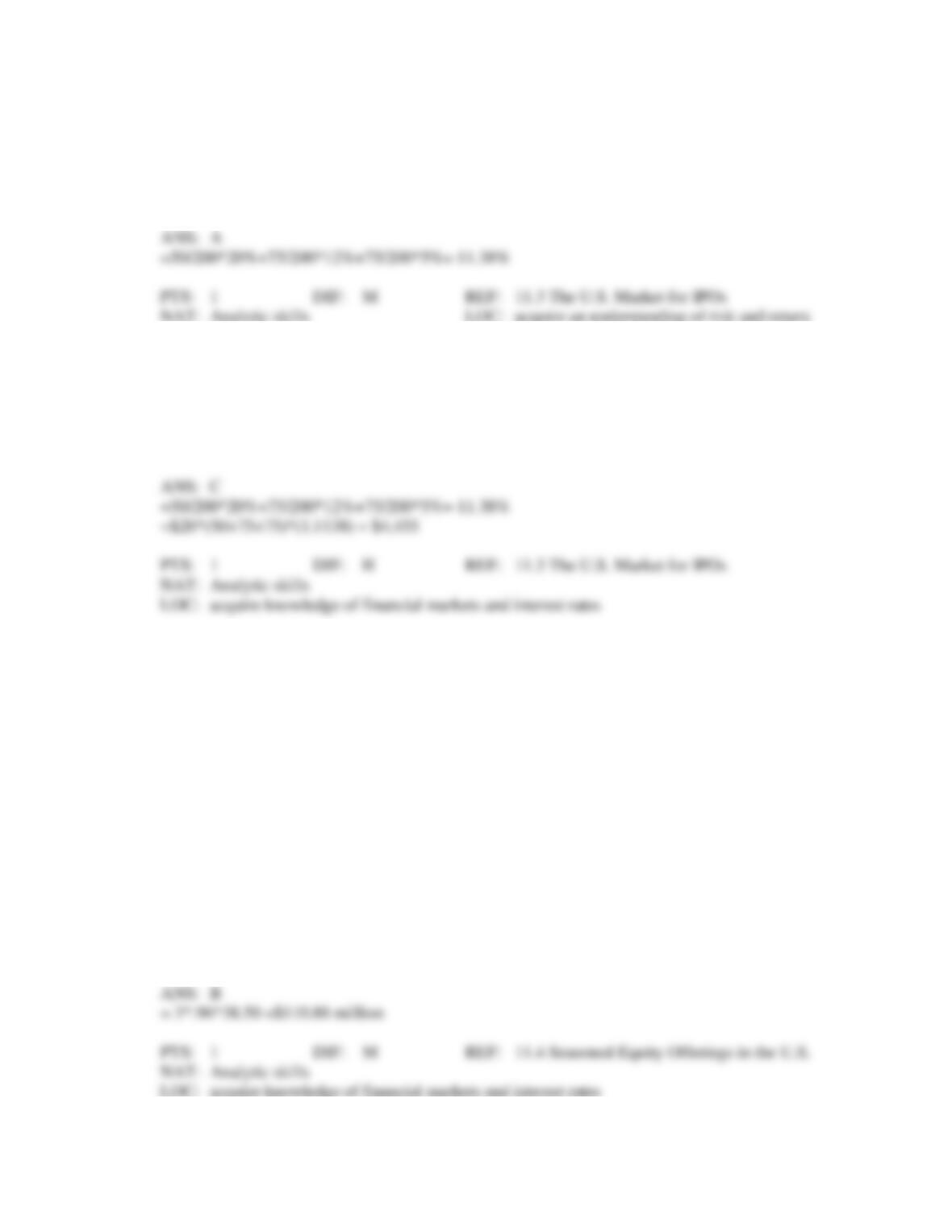
65. Refer to “Flip” shares 2. What was the return on this investment at the end of the first day? (Ignore any
tax implications for this question)
a.
11.38%
b.
11.61%
c.
11.88%
d.
12.33%
66. Refer to “Flip” shares 2. What was the dollar value of the IPO investment after the first day? (Ignore
any tax implications for this question)
a.
$4,493
b.
$4,477
c.
$4,455
d.
$4,400
NARRBEGIN: ABC Logistics
ABC Logistics
The managers of ABC Logistics (ABC) have decided to expand the company’s operations into a few
new markets. To fund this opportunity, ABC has decided to launch a seasoned equity offering to raise
new equity capital. ABC currently has 12 million shares outstanding, and yesterday’s closing market
price was $40.00 per ABC share. The company plans to sell 3 million newly issued shares in its
seasoned offering. The investment banking firm of Armstrong Incorporated has agreed to underwrite
the new stock issue for a 4 percent discount from the offering price, which ABC and Armstrong have
agreed should be $0.50 per share lower than ABC’s closing price the day before the offering is sold.
NARREND
67. If ABC’s stock price closes at $39.00 the day before the offering, what will be the net proceeds for
ABC from this offering?
a.
$109.55 million
b.
$110.88 million
c.
$112.32 million
d.
$117.00 million
68. If ABC’s stock price closes at $39.00 the day before the offering, calculate the return earned by ABC’s
existing stockholders on their shares from the time before the seasoned offering was announced
through the time it was actually sold for $38.50 per share.
a.
-3.75%
b.
-2.00%
c.
1.25%
d.
3.75%
69. If ABC’s stock price closes at $39.00 the day before the offering, calculate the total cost of the
seasoned equity offering to ABC’s existing stockholders as a percentage of the offering proceeds.
a.
16.23%
b.
18.51%
c.
20.10%
d.
20.40%
70. If ABC’s stock price closes at $46.75 the day before the offering, calculate the total cost of the
seasoned equity offering to ABC’s existing stockholders as a percentage of the offering proceeds.
a.
32.72%
b.
31.65%
c.
30.17%
d.
29.89%
71. What is the term for the repackaging of loans and other traditional bank-based credit products into
securities that can be sold to public investors?
a.
Privatization
b.
Asset Bundling
c.
Securitization
d.
Primary offering
72. Which statement is FALSE regarding the issuance of securities by investment banks?
a.
The profits for an investment bank are determined by the size of the underwriting spread.
b.
The prospectus is the legal document that describes the terms of the IPO.
c.
Banks charge higher spreads for seasoned equity offerings than unseasoned equity
offerings.
d.
Banks charge higher spreads on equity issues than debt issues.
73. What is the most important federal law regarding the issue of new securities?
a.
Securities Act of 1923
b.
Securities Act of 1933
c.
Securities Act of 1943
d.
Securities Act of 1953
74. Which of the following is NOT a benefit of going public for a private firm?
a.
New capital for the company.
b.
Publicly traded stock for acquisitions
c.
Personal wealth and liquidity
d.
Low managerial cost in issuing the IPO.
75. Which of the following key financial decisions depends upon the capital budgeting process of a
particular firm?
a.
How much capital must the company raise each year?
b.
How much of the needed capital must be raised externally rather than through retained
earnings?
c.
How much of the external funding should be raised through borrowing from a bank or
another financial intermediary, and how much capital should be raised by selling securities
directly to investors?
d.
What proportion of the external funding should be structured as common stock, preferred
stock or long-term debt?
76. While external funding needs can be approximated by subtracting cash dividend payments from cash
flow from operations, the decision is not simple because
a.
dividend policy is not fixed
b.
there are legal costs to raising capital externally than by retaining internal cash flow
c.
The Securities Act of 1933 only allows external capital to be raised during certain months
of the year. If a firm needs funds at another time it must use internal sources.
d.
None of the above
e.
both (a) and (b)
77. Conflicts of interest exist in the investment banking industry. In 2002 ten of the top U.S. investment
banking firms agreed to pay a total of $1.4 billion in fines and they are also required to
a.
use the Dutch auction process for any new IPOs.
b.
use the English auction process for any new IPOs.
c.
purchase independent research from third parties.
d.
all of the above
78. Shelf registration is popular because:
a.
the securities can ‘remain on the shelf’ for a decade before they expire.
b.
Only one SEC registration needs to be filed for the securities a company “places on the
shelf.”
c.
Firms can take issue securities “off the shelf” in response to changes in market conditions.
d.
all of the above
e.
Both (b) and (c)
79. Once a firm becomes publicly traded it must
a.
report any material change in operations, ownership and financing
b.
hold general shareholders’ meetings at least once a year
c.
use the shelf registration process to issue any new securities
d.
all of the above
e.
(a) and (b) only
80. Which of the following statements is true?
a.
Generally the IPO market collectively raises about half as much external capital as very
large corporations in the U.S.
b.
IPOs generally represent less than 10% of all new common equity raised yearly by U.S.
corporations.
c.
There is little competition in the U.S. stock markets for IPO listings.
d.
All of the above statements are true.
e.
Only statements (a) and (c) are true.
81. The drawbacks of going public include all but:
a.
financial costs of an IPO such as printing, accounting and legal costs and the underwriter’s
discount.
b.
managerial costs of an IPO such as new time constraints upon top executives
c.
the emphasis by the new owners upon the firm’s stock price.
d.
life in a fishbowl in the sense that certain information about the firm’s internal affairs must
now be released to the public.
e.
all of the above are potential drawbacks to going public
82. Which of the following statements is true?
a.
When a firm performs a spin-off the total stock value of the parent firm should drop by
approximately the market value of the new public spin-off.
b.
A reverse LBO is also known as a second IPO.
c.
Tracking stocks are designed to track the earnings of wholly-owned subsidiaries.
d.
all of the above statements are true
e.
Only statements (a) and (c) are true.
83. Analysis of long-run performance of IPOs:
a.
clearly shows returns in line with non-IPO equity returns
b.
is rather controversial and challenges the notion that investors are rational and that
financial markets are efficient
c.
has not been performed
d.
all of the above
e.
Both (b) and (c)
84. Which of the following statements is true?
a.
Rule 144A was instituted to decrease liquidity and increase issuing costs in the
private-placement market.
b.
Rule 144A was instituted to increase liquidity and decrease issuing costs in the
private-placement market.
c.
Rule 144A was instituted to increase liquidity and decrease issuing costs in the
public-placement market.
d.
Rule 144A was instituted to decrease liquidity and increase issuing costs in the
public-placement market.
85. Which of the following statements concerning non-U.S. IPOs is false?
a.
They are, on average, much smaller than those on the Nasdaq or NYSE.
b.
They offer significant first-day returns.
c.
It is difficult, on average, to find enough interested investors for non-U.S. IPOs.
d.
Taxation issues such as capital gains tax rules significantly impact how issues are priced
and which investors are targeted for the offer.
e.
All of the above statements are true.
86. Some top U.S. multi-national firms have listed their stock in numerous stock markets outside the U.S.
Which of the following are reasons for issuing a stock internationally?
a.
It broadens the ownership base and helps a company integrate itself into the local business
scene.
b.
It increases local press coverage and serves as corporate advertising.
c.
It can make corporate acquisitions easier because shares can be used as an acceptable
method of payment.
d.
all of the above are viable reasons
e.
Only (a) and (b) are viable reasons
87. Louis International needs $100 Million in new equity capital; currently shares are trading at $40 per
share. Morgan Steely (the investment banker) requires a 6% spread of the offer price which will be
$38 per share and is fully subsribed at that price. The fixes costs (legal, accounting, etc.) are
estimated at $250,000. What is the net price per share the firm will receive?
a.
$35.72
b.
$37.60
c.
$35.60
d.
$38.00
88. Roxy International needs $200 Million in new equity capital; currently shares are trading at $50 per
share. Morgan Steely (the investment banker) requires a 6% spread of the offer price which will be
$45 per share and is fully subsribed at that price. The fixes costs (legal, accounting, etc.) are
estimated at $750,000. What is the net price per share the firm will receive?
a.
$47.00
b.
$42.00
c.
$45.00
d.
$42.30
89. Emma International needs $250 Million in new equity capital; currently shares are trading at $20 per
share. Morgan Steely (the investment banker) requires a 4% spread of the offer price which will be
$19 per share and is fully subsribed at that price. The fixes costs (legal, accounting, etc.) are
estimated at $750,000. What is the net price per share the firm will receive?
a.
$19.20
b.
$18.20
c.
$18.24
d.
$19.00
90. Louis International needs $100 Million in new equity capital; currently shares are trading at $40 per
share. Morgan Steely (the investment banker) requires a 6% spread of the offer price which will be
$38 per share and is fully subsribed at that price. The fixes costs (legal, accounting, etc.) are
estimated at $250,000. How many shares must be sold for the $100 Million?
a.
2,659,574
b.
2,799,552
c.
2,808,989
d.
2,631,579
91. Roxy International needs $200 Million in new equity capital; currently shares are trading at $50 per
share. Morgan Steely (the investment banker) requires a 6% spread of the offer price which will be
$45 per share and is fully subsribed at that price. The fixes costs (legal, accounting, etc.) are
estimated at $750,000. How many shares must be sold for the $200 Million?
a.
4,255,319
b.
4,728,132
c.
4,761,905
d.
4,444,444
92. Emma International needs $250 Million in new equity capital; currently shares are trading at $20 per
share. Morgan Steely (the investment banker) requires a 4% spread of the offer price which will be
$19 per share and is fully subsribed at that price. The fixes costs (legal, accounting, etc.) are
estimated at $750,000. How many shares must be sold for the $250 Million?
a.
13,157,895
b.
13,736,264
c.
13,020,833
d.
13,706,140
93. Louis International recently conducted an IPO, Louis received $22 per share and the offer price was
$25 per share and the stock price rose to $35 per share. What was the underwriter discount?
a.
8.57%
b.
13.64%
c.
28.57%
d.
12.00%
94. Emma International recently conducted an IPO, Emma received $52 per share and the offer price was
$54 per share and the stock price rose to $59 per share. What was the underwriter discount?
a.
3.39%
b.
3.85%
c.
8.47%
d.
3.70%
95. Roxy International recently conducted an IPO, Roxy received $32 per share and the offer price was
$34 per share and the stock price rose to $35 per share. What was the underwriter discount?
a.
5.71%
b.
6.25%
c.
2.86%
d.
5.88%
96. Louis International recently conducted an IPO, Louis received $22 per share and the offer price was
$25 per share and the stock price rose to $35 per share. What was the one day return?
a.
45.45%
b.
40.00%
c.
52.00%
d.
37.14%
97. Roxy International recently conducted an IPO, Roxy received $32 per share and the offer price was
$34 per share and the stock price rose to $35 per share. What was the one day return?
a.
3.13%
b.
8.57%
c.
2.94%
d.
8.82%
98. Emma International recently conducted an IPO, Emma received $52 per share and the offer price was
$54 per share and the stock price rose to $59 per share. What was the one day return?
a.
9.26%
b.
9.62%
c.
12.96%
d.
11.86%
99. Louis International recently conducted an IPO, Louis received $22 per share and the offer price was
$25 per share and the stock price rose to $35 per share. What was the total percentage cost of the
IPO?
a.
45.45%
b.
52.00%
c.
59.09%
d.
40.00%
100. Roxy International recently conducted an IPO, Roxyr eceived $32 per share and the offer price was
$34 per share and the stock price rose to $35 per share. What was the total percentage cost of the IPO?
a.
3.13%
b.
8.82%
c.
2.94%
d.
9.38%
101. Emma International recently conducted an IPO, Emma received $52 per share and the offer price was
$54 per share and the stock price rose to $59 per share. What was the total percentage cost of the
IPO?
a.
9.62%
b.
12.96%
c.
9.26%
d.
13.46%