CHAPTER 11—DETERMINING THE COST OF CAPITAL
1. “Capital” is sometimes defined as funds supplied to a firm by investors.
a.
True
b.
False
True
Capital
2. The cost of capital used in capital budgeting should reflect the average cost of the various sources of long-term funds a
firm uses to acquire assets.
a.
True
b.
False
True
3. The component costs of capital are market-determined variables in the sense that they are based on investors’ required
returns.
a.
True
b.
False
True
4. Suppose you are the president of a small, publicly-traded corporation. Since you believe that your firm’s stock price is
CHAPTER 11—DETERMINING THE COST OF CAPITAL
temporarily depressed, all additional capital funds required during the current year will be raised using debt. In this case,
the appropriate marginal cost of capital for use in capital budgeting during the current year is the after-tax cost of debt.
a.
True
b.
False
False
capital
5. The before-tax cost of debt, which is lower than the after-tax cost, is used as the component cost of debt for purposes of
developing the firm’s WACC.
a.
True
b.
False
False
6. The cost of debt is equal to one minus the marginal tax rate multiplied by the average coupon rate on all outstanding
debt.
a.
True
b.
False
False
CHAPTER 11—DETERMINING THE COST OF CAPITAL
7. The cost of debt is equal to one minus the marginal tax rate multiplied by the interest rate on new debt.
a.
True
b.
False
True
8. The cost of preferred stock to a firm must be adjusted to an after-tax figure because 70% of dividends received by a
corporation may be excluded from the receiving corporation’s taxable income.
a.
True
b.
False
False
9. The cost of perpetual preferred stock is found as the preferred’s annual dividend divided by the market price of the
preferred stock. No adjustment is needed for taxes because preferred dividends, unlike interest on debt, is not deductible
by the issuing firm.
a.
True
b.
False
True
CHAPTER 11—DETERMINING THE COST OF CAPITAL
10. The cost of common equity obtained by retaining earnings is the rate of return the marginal stockholder requires on
the firm’s common stock.
a.
True
b.
False
True
capital
11. For capital budgeting and cost of capital purposes, the firm should always consider reinvested earnings as the first
source of capital⎯i.e., use these funds first⎯because reinvested earnings have no cost to the firm.
a.
True
b.
False
False
12. Funds acquired by the firm through retaining earnings have no cost because there are no dividend or interest payments
associated with them, and no flotation costs are required to raise them, but capital raised by selling new stock or bonds
does have a cost.
a.
True
b.
False
False
CHAPTER 11—DETERMINING THE COST OF CAPITAL
13. The cost of equity raised by retaining earnings can be less than, equal to, or greater than the cost of external equity
raised by selling new issues of common stock, depending on tax rates, flotation costs, the attitude of investors, and other
factors.
a.
True
b.
False
False
14. The firm’s cost of external equity raised by issuing new stock is the same as the required rate of return on the firm’s
outstanding common stock.
a.
True
b.
False
False
15. The higher the firm’s flotation cost for new common equity, the more likely the firm is to use preferred stock, which
has no flotation cost, and reinvested earnings, whose cost is the average return on the assets that are acquired.
a.
True
b.
False
False
CHAPTER 11—DETERMINING THE COST OF CAPITAL
16. For capital budgeting and cost of capital purposes, the firm should assume that each dollar of capital is obtained in
accordance with its target capital structure, which for many firms means partly as debt, partly as preferred stock, and
partly common equity.
a.
True
b.
False
True
WACC
17. In general, firms should use their weighted average cost of capital (WACC) to evaluate capital budgeting projects
because most projects are funded with general corporate funds, which come from a variety of sources. However, if the
firm plans to use only debt or only equity to fund a particular project, it should use the after-tax cost of that specific type
of capital to evaluate that project.
a.
True
b.
False
False
18. If a firm’s marginal tax rate is increased, this would, other things held constant, lower the cost of debt used to calculate
its WACC.
a.
True
b.
False
True
CHAPTER 11—DETERMINING THE COST OF CAPITAL
19. The reason why reinvested earnings have a cost equal to rs is because investors think they can (i.e., expect to) earn rs
on investments with the same risk as the firm’s common stock, and if the firm does not think that it can earn rs on the
earnings that it retains, it should distribute those earnings to its investors. Thus, the cost of reinvested earnings is based on
the opportunity cost principle.
a.
True
b.
False
True
Difficulty: Moderate
INTE.GENE.16.73 – LO: 11-6
United States – BUSPROG: Reflective Thinking
capital
United States – OH – Default City – TBA
20. When estimating the cost of equity by use of the CAPM, three potential problems are (1) whether to use long-term or
short-term rates for rRF, (2) whether or not the historical beta is the beta that investors use when evaluating the stock, and
(3) how to measure the market risk premium, RPM. These problems leave us unsure of the true value of rs.
a.
True
b.
False
True
Unfortunately, this is true.
Difficulty: Moderate
INTE.GENE.16.73 – LO: 11-6
United States – BUSPROG: Reflective Thinking
United States – OH – Default City – TBA
Cost of equity: CAPM
21. When estimating the cost of equity by use of the DCF method, the single biggest potential problem is to determine the
growth rate that investors use when they estimate a stock’s expected future rate of return. This problem leaves us unsure of
Difficulty: Moderate
INTE.GENE.16.71 – LO: 11-3
United States – BUSPROG: Reflective Thinking
United States – OH – Default City – TBA
After-tax cost of debt
CHAPTER 11—DETERMINING THE COST OF CAPITAL
the true value of rs.
a.
True
b.
False
True
Unfortunately, this is true.
22. When estimating the cost of equity by use of the bond-yield-plus-risk-premium method, we can generally get a good
idea of the interest rate on new long-term debt, but we cannot be sure that the risk premium we add is appropriate. This
problem leaves us unsure of the true value of rs.
a.
True
b.
False
True
Unfortunately, this is true.
23. The cost of external equity capital raised by issuing new common stock (re) is defined as follows, in words: “The cost
of external equity equals the cost of equity capital from retaining earnings (rs), divided by one minus the percentage
flotation cost required to sell the new stock, (1 − F).”
a.
True
b.
False
False
CHAPTER 11—DETERMINING THE COST OF CAPITAL
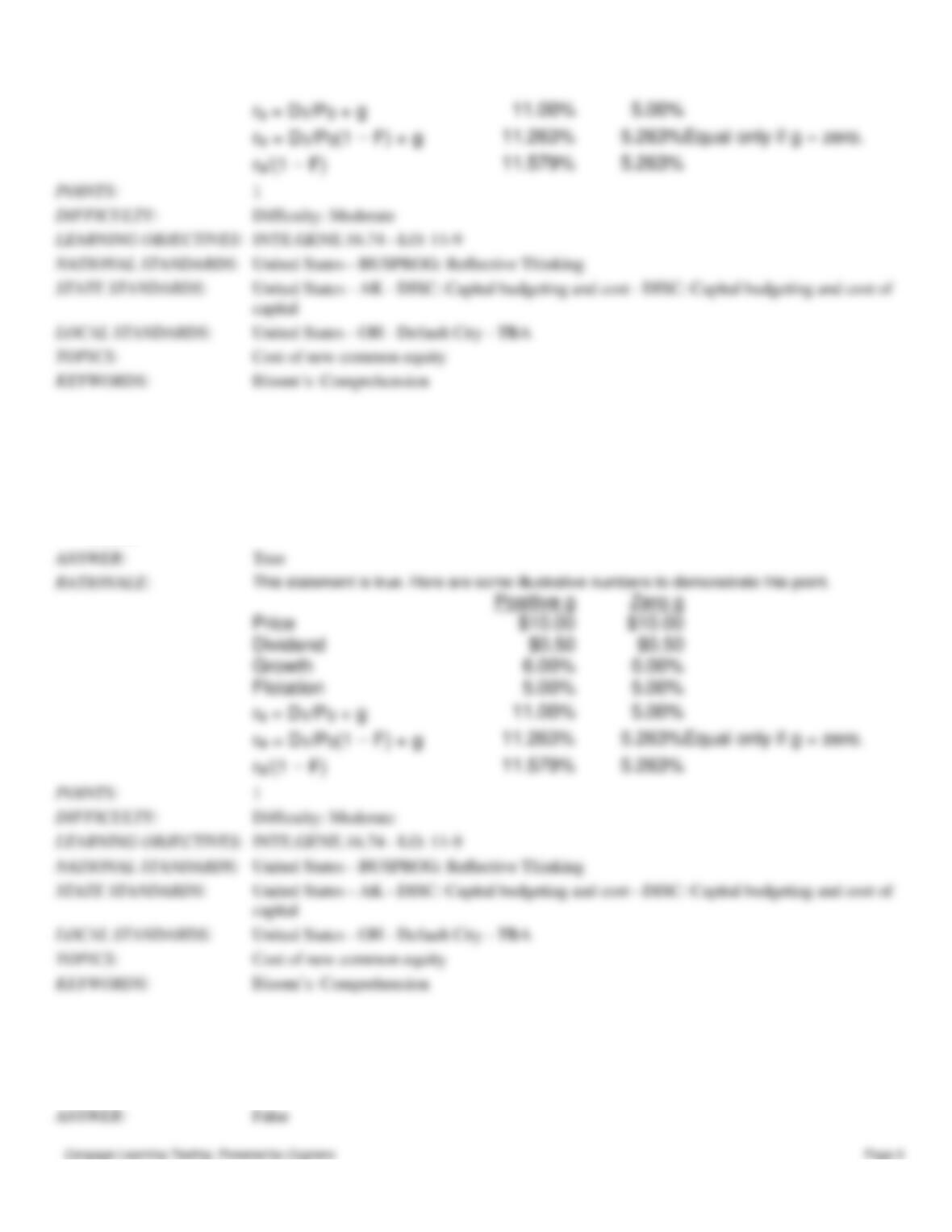
24. If the expected dividend growth rate is zero, then the cost of external equity capital raised by issuing new common
stock (re) is equal to the cost of equity capital from retaining earnings (rs) divided by one minus the percentage flotation
cost required to sell the new stock, (1 − F). If the expected growth rate is not zero, then the cost of external equity must be
found using a different formula.
a.
True
b.
False
True
25. Suppose the debt ratio (D/TA) is 50%, the interest rate on new debt is 8%, the current cost of equity is 16%, and the
tax rate is 40%. An increase in the debt ratio to 60% would decrease the weighted average cost of capital (WACC).
a.
True
b.
False
False
CHAPTER 11—DETERMINING THE COST OF CAPITAL
26. Firms raise capital at the total corporate level by retaining earnings and by obtaining funds in the capital markets.
They then provide funds to their different divisions for investment in capital projects. The divisions may vary in risk, and
the projects within the divisions may also vary in risk. Therefore, it is conceptually correct to use different risk-adjusted
costs of capital for different capital budgeting projects.
a.
True
b.
False
True
27. If a firm is privately owned, and its stock is not traded in public markets, then we cannot measure its beta for use in
the CAPM model, we cannot observe its stock price for use in the DCF model, and we don’t know what the risk premium
is for use in the bond-yield-plus-risk-premium method. All this makes it especially difficult to estimate the cost of equity
for a private company.
a.
True
b.
False
True
capital
CHAPTER 11—DETERMINING THE COST OF CAPITAL
28. The cost of debt, rd, is normally less than rs, so rd(1 − T) will normally be much less than rs. Therefore, as long as the
firm is not completely debt financed, the weighted average cost of capital (WACC) will normally be greater than rd(1 −
T).
a.
True
b.
False
True
WACC
29. The lower the firm’s tax rate, the lower will be its after-tax cost of debt and also its WACC, other things held constant.
a.
True
b.
False
False
30. The text identifies three methods for estimating the cost of common stock from reinvested earnings (not newly issued
stock): the CAPM method, the DCF method, and the bond-yield-plus-risk-premium method. However, only the DCF
method is widely used in practice.
a.
True
b.
False
False
CHAPTER 11—DETERMINING THE COST OF CAPITAL
31. The text identifies three methods for estimating the cost of common stock from reinvested earnings (not newly issued
stock): the CAPM method, the DCF method, and the bond-yield-plus-risk-premium method. However, only the CAPM
method always provides an accurate and reliable estimate.
a.
True
b.
False
False
32. The text identifies three methods for estimating the cost of common stock from reinvested earnings (not newly issued
stock): the CAPM method, the DCF method, and the bond-yield-plus-risk-premium method. Since we cannot be sure that
the estimate obtained with any of these methods is correct, it is often appropriate to use all three methods, then consider
all three estimates, and end up using a judgmental estimate when calculating the WACC.
a.
True
b.
False
True
Unfortunately, this is true.
33. Since 70% of the preferred dividends received by a corporation are excluded from taxable income, the component cost
of equity for a company that pays half of its earnings out as common dividends and half as preferred dividends should,
theoretically, be
Cost of equity = rs(0.30)(0.50) + rps(1 − T)(0.70)(0.50).
a.
True
b.
False
False
CHAPTER 11—DETERMINING THE COST OF CAPITAL
34. If expectations for long-term inflation rose, but the slope of the SML remained constant, this would have a greater
impact on the required rate of return on equity, rs, than on the interest rate on long-term debt, rd, for most firms.
Therefore, the percentage point increase in the cost of equity would be greater than the increase in the interest rate on
long-term debt.
a.
True
b.
False
False
capital
35. If investors’ aversion to risk rose, causing the slope of the SML to increase, this would have a greater impact on the
required rate of return on equity, rs, than on the interest rate on long-term debt, rd, for most firms. Other things held
constant, this would lead to an increase in the use of debt and a decrease in the use of equity. However, other things would
not stay constant if firms used a lot more debt, as that would increase the riskiness of both debt and equity and thus limit
the shift toward debt.
a.
True
b.
False
True
CHAPTER 11—DETERMINING THE COST OF CAPITAL
36. Which of the following is NOT a capital component when calculating the weighted average cost of capital (WACC)
for use in capital budgeting?
a.
Accounts payable.
b.
Common stock “raised” by reinvesting earnings.
c.
Common stock raised by new issues.
d.
Preferred stock.
e.
Long-term debt.
Difficulty: Easy
INTE.GENE.16.69 – LO: 11-1
United States – BUSPROG: Analytic
United States – OH – Default City – TBA
Capital components
TYPE: Multiple Choice: Conceptual
37. With its current financial policies, Flagstaff Inc. will have to issue new common stock to fund its capital budget. Since
new stock has a higher cost than reinvested earnings, Flagstaff would like to avoid issuing new stock. Which of the
following actions would REDUCE its need to issue new common stock?
a.
Increase the percentage of debt in the target capital structure.
b.
Increase the proposed capital budget.
c.
Reduce the amount of short-term bank debt in order to increase the current ratio.
d.
Reduce the percentage of debt in the target capital structure.
e.
Increase the dividend payout ratio for the upcoming year.
Difficulty: Easy
INTE.GENE.16.76 – LO: 11–11
United States – BUSPROG: Analytic
United States – OH – Default City – TBA
Factors affecting WACC
TYPE: Multiple Choice: Conceptual
38. Burnham Brothers Inc. has no retained earnings since it has always paid out all of its earnings as dividends. This same
Inflation and cap. costs
CHAPTER 11—DETERMINING THE COST OF CAPITAL
situation is expected to persist in the future. The company uses the CAPM to calculate its cost of equity, and its target
capital structure consists of common stock, preferred stock, and debt. Which of the following events would REDUCE its
WACC?
a.
The flotation costs associated with issuing new common stock increase.
b.
The company’s beta increases.
c.
Expected inflation increases.
d.
The flotation costs associated with issuing preferred stock increase.
e.
The market risk premium declines.
Difficulty: Easy
INTE.GENE.16.76 – LO: 11–11
United States – BUSPROG: Analytic
United States – OH – Default City – TBA
Factors affecting WACC
TYPE: Multiple Choice: Conceptual
39. For a typical firm, which of the following sequences is CORRECT? All rates are after taxes, and assume that the firm
operates at its target capital structure.
a.
re > rs > WACC > rd.
b.
WACC > re > rs > rd.
c.
rd > re > rs > WACC.
d.
WACC > rd > rs > re.
e.
rs > re > rd > WACC.
Difficulty: Easy
INTE.GENE.16.70 – LO: 11-8
United States – BUSPROG: Analytic
United States – OH – Default City – TBA
Capital components
TYPE: Multiple Choice: Conceptual
40. When working with the CAPM, which of the following factors can be determined with the most precision?
a.
The beta coefficient, bi, of a relatively safe stock.
b.
The most appropriate risk-free rate, rRF.
c.
The expected rate of return on the market, rM.
CHAPTER 11—DETERMINING THE COST OF CAPITAL
d.
The beta coefficient of “the market,” which is the same as the beta of an average stock.
e.
The market risk premium (RPM).
Difficulty: Moderate
INTE.GENE.16.73 – LO: 11-6
United States – BUSPROG: Analytic
United States – OH – Default City – TBA
Cost of equity: CAPM
TYPE: Multiple Choice: Conceptual
41. Bloom and Co. has no debt or preferred stock⎯it uses only equity capital, and has two equally-sized divisions.
Division X’s cost of capital is 10.0%, Division Y’s cost is 14.0%, and the corporate (composite) WACC is 12.0%. All of
Division X’s projects are equally risky, as are all of Division Y’s projects. However, the projects of Division X are less
risky than those of Division Y. Which of the following projects should the firm accept?
a.
A Division Y project with a 12% return.
b.
A Division X project with an 11% return.
c.
A Division X project with a 9% return.
d.
A Division Y project with an 11% return.
e.
A Division Y project with a 13% return.
Difficulty: Moderate
INTE.GENE.16.76 – LO: 11–11
United States – BUSPROG: Analytic
United States – OH – Default City – TBA
Divisional risk
TYPE: Multiple Choice: Conceptual
42. Taylor Inc. estimates that its average-risk projects have a WACC of 10%, its below-average risk projects have a
WACC of 8%, and its above-average risk projects have a WACC of 12%. Which of the following projects (A, B, and C)
should the company accept?
a.
Project C, which is of above-average risk and has a return of 11%.
b.
Project A, which is of average risk and has a return of 9%.
CHAPTER 11—DETERMINING THE COST OF CAPITAL
c.
None of the projects should be accepted.
d.
All of the projects should be accepted.
e.
Project B, which is of below-average risk and has a return of 8.5%.
Difficulty: Moderate
INTE.GENE.16.76 – LO: 11–11
United States – BUSPROG: Analytic
United States – OH – Default City – TBA
Risk and projects
TYPE: Multiple Choice: Conceptual
43. Weatherall Enterprises has no debt or preferred stock⎯it is an all-equity firm⎯and has a beta of 2.0. The chief financial
officer is evaluating a project with an expected return of 14%, before any risk adjustment. The risk-free rate is 5%, and the
market risk premium is 4%. The project being evaluated is riskier than an average project, in terms of both its beta risk
and its total risk. Which of the following statements is CORRECT?
a.
The project should definitely be rejected because its expected return (before risk adjustment) is less than its
required return.
b.
Riskier-than-average projects should have their expected returns increased to reflect their higher risk. Clearly,
this would make the project acceptable regardless of the amount of the adjustment.
c.
The accept/reject decision depends on the firm’s risk-adjustment policy. If Weatherall’s policy is to increase
the required return on a riskier-than-average project to 3% over rS, then it should reject the project.
d.
Capital budgeting projects should be evaluated solely on the basis of their total risk. Thus, insufficient
information has been provided to make the accept/reject decision.
e.
The project should definitely be accepted because its expected return (before any risk adjustments) is greater
than its required return.
Difficulty: Moderate
INTE.GENE.16.76 – LO: 11–11
United States – BUSPROG: Analytic
United States – AK – DISC: Capital budgeting and cost – DISC: Capital budgeting and cost of
United States – OH – Default City – TBA
Risk and projects
TYPE: Multiple Choice: Conceptual
CHAPTER 11—DETERMINING THE COST OF CAPITAL
44. The Anderson Company has equal amounts of low-risk, average-risk, and high-risk projects. The firm’s overall
WACC is 12%. The CFO believes that this is the correct WACC for the company’s average-risk projects, but that a lower
rate should be used for lower-risk projects and a higher rate for higher-risk projects. The CEO disagrees, on the grounds
that even though projects have different risks, the WACC used to evaluate each project should be the same because the
company obtains capital for all projects from the same sources. If the CEO’s position is accepted, what is likely to happen
over time?
a.
The company will take on too many low-risk projects and reject too many high-risk projects.
b.
Things will generally even out over time, and, therefore, the firm’s risk should remain constant over time.
c.
The company’s overall WACC should decrease over time because its stock price should be increasing.
d.
The CEO’s recommendation would maximize the firm’s intrinsic value.
e.
The company will take on too many high-risk projects and reject too many low-risk projects.
Difficulty: Moderate
INTE.GENE.16.76 – LO: 11–11
United States – BUSPROG: Analytic
United States – AK – DISC: Capital budgeting and cost – DISC: Capital budgeting and cost of
United States – OH – Default City – TBA
Risk-adjusted capital cost
TYPE: Multiple Choice: Conceptual
45. Suppose Acme Industries correctly estimates its WACC at a given point in time and then uses that same cost of capital
to evaluate all projects for the next 10 years, then the firm will most likely
a.
become less risky over time, and this will maximize its intrinsic value.
b.
accept too many low-risk projects and too few high-risk projects.
c.
become more risky and also have an increasing WACC. Its intrinsic value will not be maximized.
d.
continue as before, because there is no reason to expect its risk position or value to change over time as a
result of its use of a single cost of capital.
e.
become riskier over time, but its intrinsic value will be maximized.
Difficulty: Moderate
INTE.GENE.16.76 – LO: 11–11
CHAPTER 11—DETERMINING THE COST OF CAPITAL
46. Which of the following statements is CORRECT?
a.
All else equal, an increase in a company’s stock price will increase its marginal cost of reinvested earnings (not
newly issued stock), rs.
b.
All else equal, an increase in a company’s stock price will increase its marginal cost of new common equity, re.
c.
Since the money is readily available, the after-tax cost of reinvested earnings (not newly issued stock) is
usually much lower than the after-tax cost of debt.
d.
If a company’s tax rate increases but the YTM on its noncallable bonds remains the same, the after-tax cost of
its debt will fall.
e.
When calculating the cost of preferred stock, a company needs to adjust for taxes, because preferred stock
dividends are deductible by the paying corporation.
Difficulty: Moderate
INTE.GENE.16.74 – LO: 11-9
United States – BUSPROG: Analytic
United States – AK – DISC: Capital budgeting and cost – DISC: Capital budgeting and cost of
United States – OH – Default City – TBA
Capital components
TYPE: Multiple Choice: Conceptual
47. Which of the following statements is CORRECT?
a.
When calculating the cost of preferred stock, companies must adjust for taxes, because dividends paid on
preferred stock are deductible by the paying corporation.
b.
Because of tax effects, an increase in the risk-free rate will have a greater effect on the after-tax cost of debt
than on the cost of common stock as measured by the CAPM.
c.
If a company’s beta increases, this will increase the cost of equity used to calculate the WACC, but only if the
company does not have enough reinvested earnings to take care of its equity financing and hence must issue
new stock.
d.
Higher flotation costs reduce investors’ expected returns, and that leads to a reduction in a company’s WACC.
e.
When calculating the cost of debt, a company needs to adjust for taxes, because interest payments are
deductible by the paying corporation.
United States – BUSPROG: Analytic
United States – AK – DISC: Capital budgeting and cost – DISC: Capital budgeting and cost of
United States – OH – Default City – TBA
Risk-adjusted capital cost
TYPE: Multiple Choice: Conceptual
CHAPTER 11—DETERMINING THE COST OF CAPITAL
48. Which of the following statements is CORRECT?
a.
We should use historical measures of the component costs from prior financings that are still outstanding when
estimating a company’s WACC for capital budgeting purposes.
b.
The cost of new equity (re) could possibly be lower than the cost of reinvested earnings (rs) if the market risk
premium, risk-free rate, and the company’s beta all decline by a sufficiently large amount.
c.
A firm’s cost of reinvesting earnings is the rate of return stockholders require on a firm’s common stock.
d.
The component cost of preferred stock is expressed as rp(1 − T), because preferred stock dividends are treated
as fixed charges, similar to the treatment of interest on debt.
e.
In the WACC calculation, we must adjust the cost of preferred stock (the market yield) to reflect the fact that
70% of the dividends received by corporate investors are excluded from their taxable income.
Difficulty: Moderate
INTE.GENE.16.70 – LO: 11-8
United States – BUSPROG: Analytic
United States – AK – DISC: Capital budgeting and cost – DISC: Capital budgeting and cost of
United States – OH – Default City – TBA
Capital components
TYPE: Multiple Choice: Conceptual
49. Which of the following statements is CORRECT?
a.
The percentage flotation cost associated with issuing new common equity is typically smaller than the
flotation cost for new debt.
b.
The WACC as used in capital budgeting is an estimate of the cost of all the capital a company has raised to
acquire its assets.
c.
There is an “opportunity cost” associated with using reinvested earnings, hence they are not “free.”
d.
The WACC as used in capital budgeting would be simply the after-tax cost of debt if the firm plans to use only
debt to finance its capital budget during the coming year.
e.
The WACC as used in capital budgeting is an estimate of a company’s before-tax cost of capital.
Difficulty: Moderate
INTE.GENE.16.70 – LO: 11-8
United States – BUSPROG: Analytic
United States – AK – DISC: Capital budgeting and cost – DISC: Capital budgeting and cost of
United States – OH – Default City – TBA
Capital components
TYPE: Multiple Choice: Conceptual