CHAPTER 11—DETERMINING THE COST OF CAPITAL
Difficulty: Moderate
INTE.GENE.16.70 – LO: 11-8
United States – BUSPROG: Analytic
United States – AK – DISC: Capital budgeting and cost – DISC: Capital budgeting and cost of
United States – OH – Default City – TBA
TYPE: Multiple Choice: Conceptual
50. Which of the following statements is CORRECT?
a.
WACC calculations should be based on the before-tax costs of all the individual capital components.
b.
Flotation costs associated with issuing new common stock normally reduce the WACC.
c.
If a company’s tax rate increases, then, all else equal, its weighted average cost of capital will decline.
d.
An increase in the risk-free rate will normally lower the marginal costs of both debt and equity financing.
e.
A change in a company’s target capital structure cannot affect its WACC.
Difficulty: Moderate
INTE.GENE.16.70 – LO: 11-8
United States – BUSPROG: Analytic
United States – AK – DISC: Capital budgeting and cost – DISC: Capital budgeting and cost of
United States – OH – Default City – TBA
TYPE: Multiple Choice: Conceptual
51. Which of the following statements is CORRECT?
a.
The after-tax cost of debt usually exceeds the after-tax cost of equity.
b.
For a given firm, the after-tax cost of debt is always more expensive than the after-tax cost of non-convertible
preferred stock.
c.
Retained earnings that were generated in the past and are reported on the firm’s balance sheet are available to
finance the firm’s capital budget during the coming year.
d.
The WACC that should be used in capital budgeting is the firm’s marginal, after-tax cost of capital.
e.
The WACC is calculated using before-tax costs for all components.
Difficulty: Moderate
United States – BUSPROG: Analytic
United States – AK – DISC: Capital budgeting and cost – DISC: Capital budgeting and cost of
CHAPTER 11—DETERMINING THE COST OF CAPITAL
52. Which of the following statements is CORRECT? Assume a company’s target capital structure is 50% debt and 50%
common equity.
a.
The WACC is calculated on a before-tax basis.
b.
The WACC exceeds the cost of equity.
c.
The cost of equity is always equal to or greater than the cost of debt.
d.
The cost of reinvested earnings typically exceeds the cost of new common stock.
e.
The interest rate used to calculate the WACC is the average after-tax cost of all the company’s outstanding
debt as shown on its balance sheet.
Difficulty: Moderate
INTE.GENE.16.70 – LO: 11-8
United States – BUSPROG: Analytic
United States – AK – DISC: Capital budgeting and cost – DISC: Capital budgeting and cost of
United States – OH – Default City – TBA
WACC and cap. components
TYPE: Multiple Choice: Conceptual
53. Which of the following statements is CORRECT?
a.
The tax-adjusted cost of debt is always greater than the interest rate on debt, provided the company does in
fact pay taxes.
b.
If a company assigns the same cost of capital to all of its projects regardless of each project’s risk, then the
company is likely to reject some safe projects that it actually should accept and to accept some risky projects
that it should reject.
c.
Because no flotation costs are required to obtain capital as reinvested earnings, the cost of reinvested earnings
is generally lower than the after-tax cost of debt.
d.
Higher flotation costs tend to reduce the cost of equity capital.
e.
Since debt capital can cause a company to go bankrupt but equity capital cannot, debt is riskier than equity,
and thus the after-tax cost of debt is always greater than the cost of equity.
Difficulty: Moderate
INTE.GENE.16.70 – LO: 11-8
United States – BUSPROG: Analytic
United States – AK – DISC: Capital budgeting and cost – DISC: Capital budgeting and cost of
United States – OH – Default City – TBA
WACC and cap. components
TYPE: Multiple Choice: Conceptual
CHAPTER 11—DETERMINING THE COST OF CAPITAL
54. The Tierney Group has two divisions of equal size: an office furniture manufacturing division and a data processing
division. Its CFO believes that stand-alone data processor companies typically have a WACC of 9%, while stand-alone
furniture manufacturers typically have a 13% WACC. She also believes that the data processing and manufacturing
divisions have the same risk as their typical peers. Consequently, she estimates that the composite, or corporate, WACC is
11%. A consultant has suggested using a 9% hurdle rate for the data processing division and a 13% hurdle rate for the
manufacturing division. However, the CFO disagrees, and she has assigned an 11% WACC to all projects in both
divisions. Which of the following statements is CORRECT?
a.
The decision not to adjust for risk means, in effect, that it is favoring the data processing division. Therefore,
that division is likely to become a larger part of the consolidated company over time.
b.
The decision not to adjust for risk means that the company will accept too many projects in the manufacturing
division and too few in the data processing division. This will lead to a reduction in the firm’s intrinsic value
over time.
c.
The decision not to risk-adjust means that the company will accept too many projects in the data processing
business and too few projects in the manufacturing business. This will lead to a reduction in its intrinsic value
over time.
d.
The decision not to risk-adjust means that the company will accept too many projects in the manufacturing
business and too few projects in the data processing business. This may affect the firm’s capital structure but it
will not affect its intrinsic value.
e.
While the decision to use just one WACC will result in its accepting more projects in the manufacturing
division and fewer projects in its data processing division than if it followed the consultant’s recommendation,
this should not affect the firm’s intrinsic value.
Difficulty: Challenging
INTE.GENE.16.76 – LO: 11–11
United States – BUSPROG: Analytic
United States – OH – Default City – TBA
Risk-adjusted capital cost
TYPE: Multiple Choice: Conceptual
55. Careco Company and Audaco Inc are identical in size and capital structure. However, the riskiness of their assets and
cash flows are somewhat different, resulting in Careco having a WACC of 10% and Audaco a WACC of 12%. Careco is
considering Project X, which has an IRR of 10.5% and is of the same risk as a typical Careco project. Audaco is
considering Project Y, which has an IRR of 11.5% and is of the same risk as a typical Audaco project.
United States – OH – Default City – TBA
Cost of capital concepts
TYPE: Multiple Choice: Conceptual
CHAPTER 11—DETERMINING THE COST OF CAPITAL
Now assume that the two companies merge and form a new company, Careco/Audaco Inc. Moreover, the new company’s
market risk is an average of the pre-merger companies’ market risks, and the merger has no impact on either the cash
flows or the risks of Projects X and Y. Which of the following statements is CORRECT?
a.
If evaluated using the correct post-merger WACC, Project X would have a negative NPV.
b.
After the merger, Careco/Audaco would have a corporate WACC of 11%. Therefore, it should reject Project X
but accept Project Y.
c.
Careco/Audaco’s WACC, as a result of the merger, would be 10%.
d.
After the merger, Careco/Audaco should select Project Y but reject Project X. If the firm does this, its
corporate WACC will fall to 10.5%.
e.
If the firm evaluates these projects and all other projects at the new overall corporate WACC, it will probably
become riskier over time.
Difficulty: Challenging
INTE.GENE.16.76 – LO: 11–11
United States – BUSPROG: Analytic
United States – AK – DISC: Capital budgeting and cost – DISC: Capital budgeting and cost of
United States – OH – Default City – TBA
Div. risk and projects
TYPE: Multiple Choice: Conceptual
56. Which of the following statements is CORRECT?
a.
A cost should be assigned to reinvested earnings due to the opportunity cost principle, which refers to the fact
that the firm’s stockholders would themselves expect to earn a return on earnings that were distributed rather
than retained and reinvested.
b.
No cost should be assigned to reinvested earnings because the firm does not have to pay anything to raise
them. They are generated as cash flows by operating assets that were raised in the past; hence, they are “free.”
c.
Suppose a firm has been losing money and thus is not paying taxes, and this situation is expected to persist
into the foreseeable future. In this case, the firm’s before-tax and after-tax costs of debt for purposes of
calculating the WACC will both be equal to the interest rate on the firm’s currently outstanding debt, provided
that debt was issued during the past 5 years.
d.
If a firm has enough reinvested earnings to fund its capital budget for the coming year, then there is no need to
estimate either a cost of equity or a WACC.
e.
The component cost of preferred stock is expressed as rp(1 − T). This follows because preferred stock
dividends are treated as fixed charges, and as such they can be deducted by the issuer for tax purposes.
Difficulty: Challenging
INTE.GENE.16.70 – LO: 11-8
United States – BUSPROG: Analytic
United States – OH – Default City – TBA
CHAPTER 11—DETERMINING THE COST OF CAPITAL
57. Which of the following statements is CORRECT?
a.
The after-tax cost of debt that should be used as the component cost when calculating the WACC is the
average after-tax cost of all the firm’s outstanding debt.
b.
Suppose some of a publicly-traded firm’s stockholders are not diversified; they hold only the one firm’s stock.
In this case, the CAPM approach will result in an estimated cost of equity that is too low in the sense that if it
is used in capital budgeting, projects will be accepted that will reduce the firm’s intrinsic value.
c.
The cost of equity is generally harder to measure than the cost of debt because there is no stated, contractual
cost number on which to base the cost of equity.
d.
The bond-yield-plus-risk-premium approach is the most sophisticated and objective method for estimating a
firm’s cost of equity capital.
e.
The cost of capital used to evaluate a project should be the cost of the specific type of financing used to fund
that project, i.e., it is the after-tax cost of debt if debt is to be used to finance the project or the cost of equity if
the project will be financed with equity.
Difficulty: Challenging
INTE.GENE.16.70 – LO: 11-8
United States – BUSPROG: Analytic
United States – AK – DISC: Capital budgeting and cost – DISC: Capital budgeting and cost of
Cost of capital
TYPE: Multiple Choice: Conceptual
58. Which of the following statements is CORRECT?
a.
The DCF model is generally preferred by academics and financial executives over other models for estimating
the cost of equity. This is because of the DCF model’s logical appeal and also because accurate estimates for
its key inputs, the dividend yield and the growth rate, are easy to obtain.
b.
The bond-yield-plus-risk-premium approach to estimating the cost of equity may not always be accurate, but it
has the advantage that its two key inputs, the firm’s own cost of debt and its risk premium, can be found by
using standardized and objective procedures.
c.
Surveys indicate that the CAPM is the most widely used method for estimating the cost of equity. However,
other methods are also used because CAPM estimates may be subject to error, and people like to use different
methods as checks on one another. If all of the methods produce similar results, this increases the decision
maker’s confidence in the estimated cost of equity.
d.
The DCF model is preferred by academics and finance practitioners over other cost of capital models because
it correctly recognizes that the expected return on a stock consists of a dividend yield plus an expected capital
gains yield.
e.
Although some methods used to estimate the cost of equity are subject to severe limitations, the CAPM is a
simple, straightforward, and reliable model that consistently produces accurate cost of equity estimates. In
particular, academics and corporate finance people generally agree that its key inputs⎯beta, the risk-free rate,
and the market risk premium⎯can be estimated with little error.
Capital components
TYPE: Multiple Choice: Conceptual
CHAPTER 11—DETERMINING THE COST OF CAPITAL
c
Difficulty: Challenging
INTE.GENE.16.70 – LO: 11-8
United States – BUSPROG: Analytic
United States – AK – DISC: Capital budgeting and cost – DISC: Capital budgeting and cost of
United States – OH – Default City – TBA
Cost of equity
TYPE: Multiple Choice: Conceptual
59. Which of the following statements is CORRECT?
a.
If the calculated beta underestimates the firm’s true investment risk⎯i.e., if the forward-looking beta that
investors think exists exceeds the historical beta⎯then the CAPM method based on the historical beta will
produce an estimate of rs and thus WACC that is too high.
b.
Beta measures market risk, which is, theoretically, the most relevant risk measure for a publicly-owned firm
that seeks to maximize its intrinsic value. This is true even if not all of the firm’s stockholders are well
diversified.
c.
An advantage shared by both the DCF and CAPM methods when they are used to estimate the cost of equity is
that they are both “objective” as opposed to “subjective,” hence little or no judgment is required.
d.
The specific risk premium used in the CAPM is the same as the risk premium used in the bond-yield-plus-risk-
premium approach.
e.
The discounted cash flow method of estimating the cost of equity cannot be used unless the growth rate, g, is
expected to be constant forever.
Difficulty: Challenging
INTE.GENE.16.70 – LO: 11-8
United States – BUSPROG: Analytic
United States – AK – DISC: Capital budgeting and cost – DISC: Capital budgeting and cost of
United States – OH – Default City – TBA
CAPM and DCF
TYPE: Multiple Choice: Conceptual
60. Which of the following statements is CORRECT?
a.
The WACC is calculated using a before-tax cost for debt that is equal to the interest rate that must be paid on
new debt, along with the after-tax costs for common stock and for preferred stock if it is used.
b.
An increase in the risk-free rate is likely to reduce the marginal costs of both debt and equity.
c.
The relevant WACC can change depending on the amount of funds a firm raises during a given year.
Moreover, the WACC at each level of funds raised is a weighted average of the marginal costs of each capital
component, with the weights based on the firm’s target capital structure.
d.
Beta measures market risk, which is generally the most relevant risk measure for a publicly-owned firm that
seeks to maximize its intrinsic value. However, this is not true unless all of the firm’s stockholders are well
CHAPTER 11—DETERMINING THE COST OF CAPITAL
diversified.
e.
The bond-yield-plus-risk-premium approach to estimating the cost of common equity involves adding a risk
premium to the interest rate on the company’s own long-term bonds. The size of the risk premium for bonds
with different ratings is published daily in The Wall Street Journal.
c
Difficulty: Challenging
INTE.GENE.16.70 – LO: 11-8
United States – BUSPROG: Analytic
capital
United States – OH – Default City – TBA
WACC
TYPE: Multiple Choice: Conceptual
61. Which of the following statements is CORRECT?
a.
Since its stockholders are not directly responsible for paying a corporation’s income taxes, corporations should
focus on before-tax cash flows when calculating the WACC.
b.
An increase in a firm’s tax rate will increase the component cost of debt, provided the YTM on the firm’s
bonds is not affected by the change in the tax rate.
c.
When the WACC is calculated, it should reflect the costs of new common stock, reinvested earnings, preferred
stock, long-term debt, short-term bank loans if the firm normally finances with bank debt, and accounts
payable if the firm normally has accounts payable on its balance sheet.
d.
If a firm has been suffering accounting losses that are expected to continue into the foreseeable future, and
therefore its tax rate is zero, then it is possible for the after-tax cost of preferred stock to be less than the after-
tax cost of debt.
e.
Since the costs of internal and external equity are related, an increase in the flotation cost required to sell a
new issue of stock will increase the cost of reinvested earnings.
Difficulty: Challenging
INTE.GENE.16.70 – LO: 11-8
United States – BUSPROG: Analytic
United States – AK – DISC: Capital budgeting and cost – DISC: Capital budgeting and cost of
WACC
CHAPTER 11—DETERMINING THE COST OF CAPITAL
62. Which of the following statements is CORRECT? Assume that the firm is a publicly-owned corporation and is
seeking to maximize shareholder wealth.
a.
If a firm’s managers want to maximize the value of their firm’s stock, they should, in theory, concentrate on
project risk as measured by the standard deviation of the project’s expected future cash flows.
b.
If a firm evaluates all projects using the same cost of capital, and the CAPM is used to help determine that
cost, then its risk as measured by beta will probably decline over time.
c.
Projects with above-average risk typically have higher than average expected returns. Therefore, to maximize
a firm’s intrinsic value, its managers should favor high-beta projects over those with lower betas.
d.
Project A has a standard deviation of expected returns of 20%, while Project B’s standard deviation is only
10%. A’s returns are negatively correlated with both the firm’s other assets and the returns on most stocks in
the economy, while B’s returns are positively correlated. Therefore, Project A is less risky to a firm and should
be evaluated with a lower cost of capital.
e.
If a firm has a beta that is less than 1.0, say 0.9, this would suggest that the expected returns on its assets are
negatively correlated with the returns on most other firms’ assets.
Difficulty: Challenging
INTE.GENE.16.76 – LO: 11–11
United States – BUSPROG: Analytic
United States – AK – DISC: Capital budgeting and cost – DISC: Capital budgeting and cost of
capital
United States – OH – Default City – TBA
Beta and project risk
TYPE: Multiple Choice: Conceptual
63. Firm J’s earnings and stock price tend to move up and down with other firms in the S&P 500, while Firm F’s earnings
and stock price move counter cyclically with J and other S&P companies. Both J and F estimate their costs of equity using
the CAPM, they have identical market values, their standard deviations of returns are identical, and they both finance only
with common equity. Which of the following statements is CORRECT?
a.
J and F should have identical WACCs because their risks as measured by the standard deviation of returns are
identical.
b.
If J and F merge, then the merged firm MW should have a WACC that is a simple average of J’s and F’s
WACCs.
c.
Without additional information, it is impossible to predict what the merged firm’s WACC would be if J and F
merged.
d.
Since J and F move counter cyclically to one another, if they merged, the merged firm’s WACC would be less
than the simple average of the two firms’ WACCs.
e.
J should have the lower WACC because it is like most other companies, and investors like that fact.
TYPE: Multiple Choice: Conceptual
CHAPTER 11—DETERMINING THE COST OF CAPITAL
64. Perpetual preferred stock from Franklin Inc. sells for $97.50 per share, and it pays an $8.50 annual dividend. If the
company were to sell a new preferred issue, it would incur a flotation cost of 4.00% of the price paid by investors. What is
the company’s cost of preferred stock for use in calculating the WACC?
a.
8.72%
b.
9.08%
c.
9.44%
d.
9.82%
e.
10.22%
65. A company’s perpetual preferred stock currently sells for $92.50 per share, and it pays an $8.00 annual dividend. If the
company were to sell a new preferred issue, it would incur a flotation cost of 5.00% of the issue price. What is the firm’s
cost of preferred stock?
a.
7.81%
b.
8.22%
c.
8.65%
d.
9.10%
WACC
CHAPTER 11—DETERMINING THE COST OF CAPITAL
e.
9.56%
capital
66. Adams Inc. has the following data: rRF = 5.00%; RPM = 6.00%; and b = 1.05. What is the firm’s cost of common from
reinvested earnings based on the CAPM?
a.
11.30%
b.
11.64%
c.
11.99%
d.
12.35%
e.
12.72%
a
67. You have been hired as a consultant by Feludi Inc.’s CFO, who wants you to help her estimate the cost of capital. You
have been provided with the following data: rRF = 4.10%; RPM = 5.25%; and b = 1.30. Based on the CAPM approach,
what is the cost of common from reinvested earnings?
a.
9.67%
CHAPTER 11—DETERMINING THE COST OF CAPITAL
b.
9.97%
c.
10.28%
d.
10.60%
e.
10.93%
e
68. As a consultant to Basso Inc., you have been provided with the following data: D1 = $0.67; P0 = $27.50; and g =
8.00% (constant). What is the cost of common from reinvested earnings based on the DCF approach?
a.
9.42%
b.
9.91%
c.
10.44%
d.
10.96%
e.
11.51%
c
CHAPTER 11—DETERMINING THE COST OF CAPITAL
69. To help them estimate the company’s cost of capital, Smithco has hired you as a consultant. You have been provided
with the following data: D1 = $1.45; P0 = $22.50; and g = 6.50% (constant). Based on the DCF approach, what is the cost
of common from reinvested earnings?
a.
11.10%
b.
11.68%
c.
12.30%
d.
12.94%
e.
13.59%
70. Your consultant firm has been hired by Eco Brothers Inc. to help them estimate the cost of common equity. The yield
on the firm’s bonds is 8.75%, and your firm’s economists believe that the cost of common can be estimated using a risk
premium of 3.85% over a firm’s own cost of debt. What is an estimate of the firm’s cost of common from reinvested
earnings?
a.
12.60%
b.
13.10%
c.
13.63%
d.
14.17%
e.
14.74%
a
capital
CHAPTER 11—DETERMINING THE COST OF CAPITAL
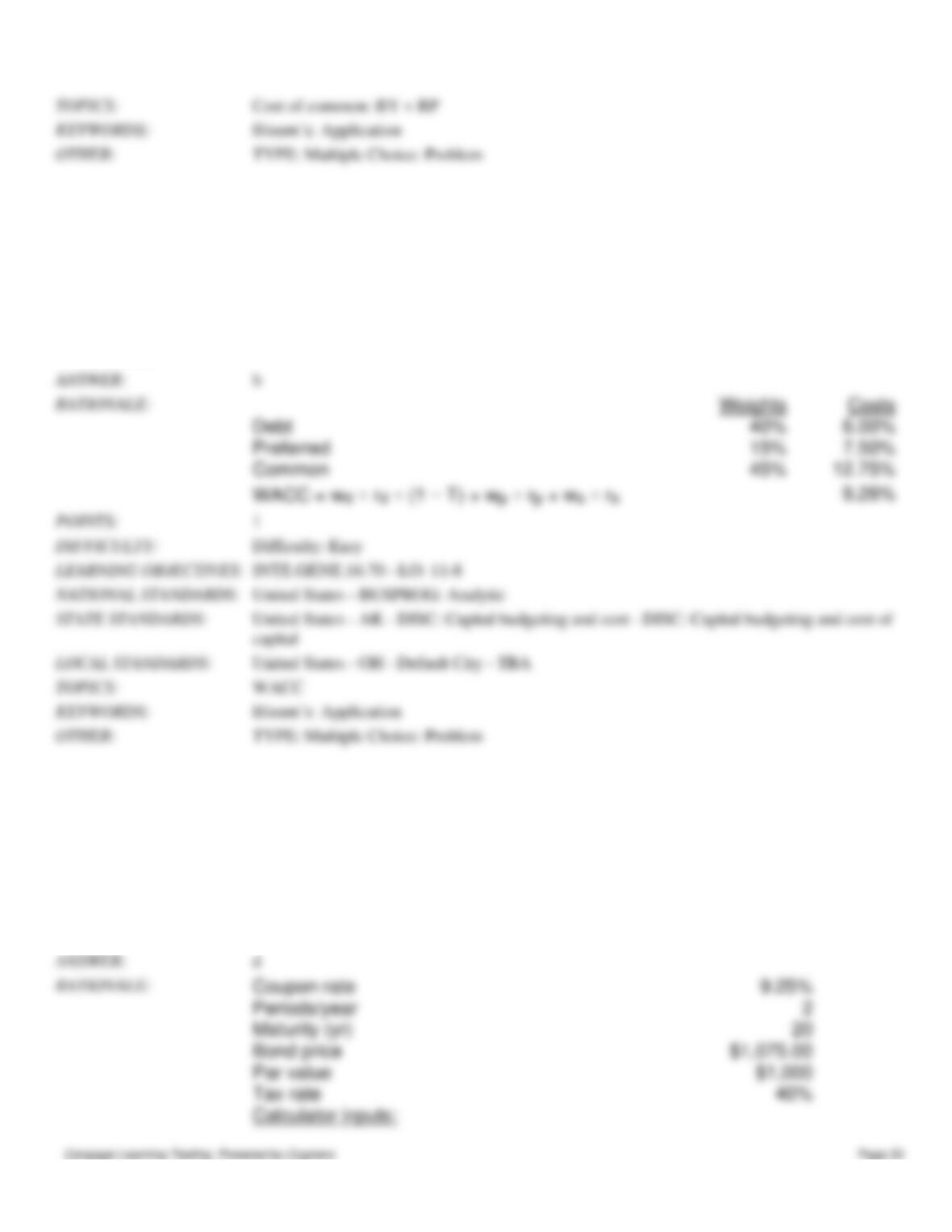
71. Bartlett Company’s target capital structure is 40% debt, 15% preferred, and 45% common equity. The after-tax cost of
debt is 6.00%, the cost of preferred is 7.50%, and the cost of common using reinvested earnings is 12.75%. The firm will
not be issuing any new stock. You were hired as a consultant to help determine their cost of capital. What is its WACC?
a.
8.98%
b.
9.26%
c.
9.54%
d.
9.83%
e.
10.12%
capital
WACC
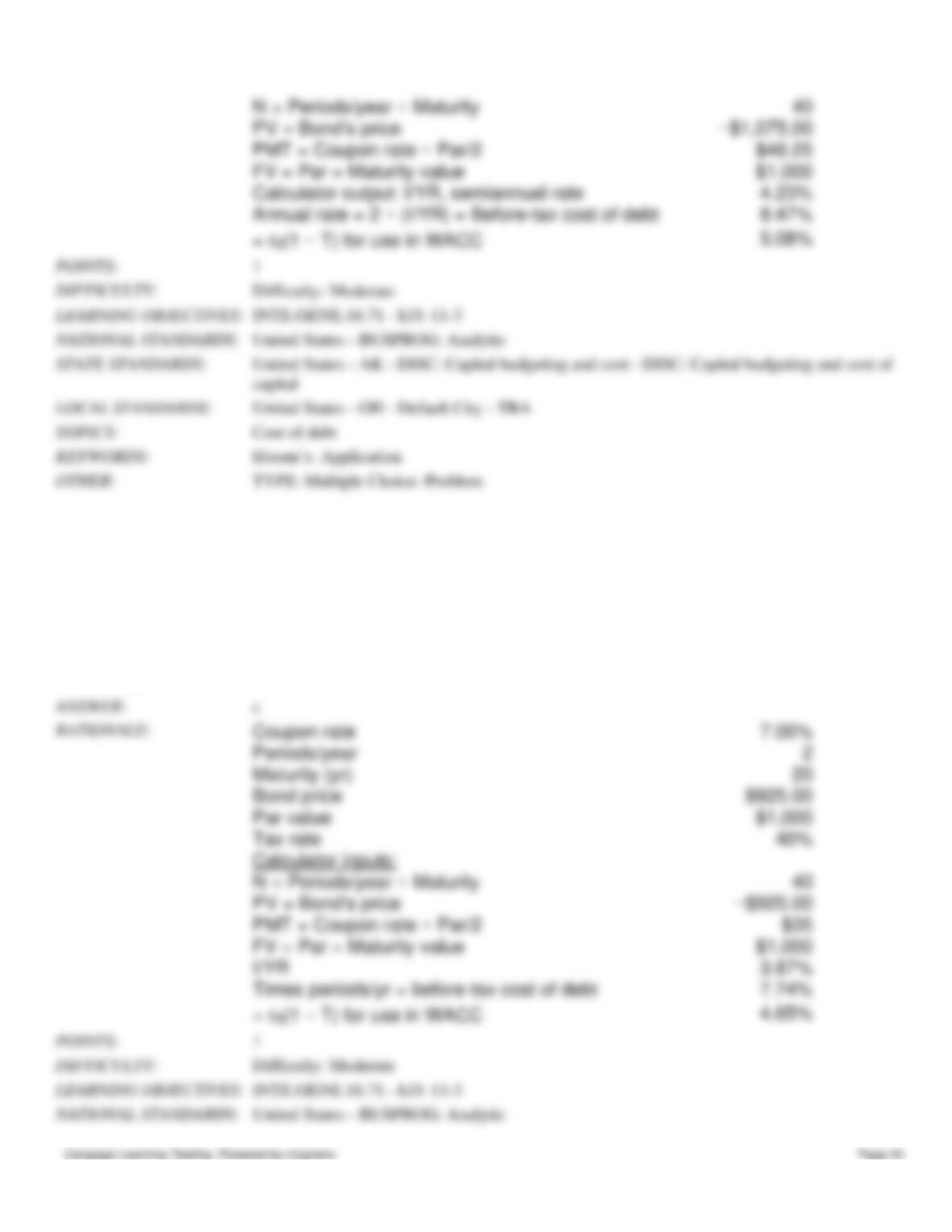
72. Kenny Electric Company’s noncallable bonds were issued several years ago and now have 20 years to maturity. These
bonds have a 9.25% annual coupon, paid semiannually, sells at a price of $1,075, and has a par value of $1,000. If the
firm’s tax rate is 40%, what is the component cost of debt for use in the WACC calculation?
a.
4.35%
b.
4.58%
c.
4.83%
d.
5.08%
e.
5.33%
CHAPTER 11—DETERMINING THE COST OF CAPITAL
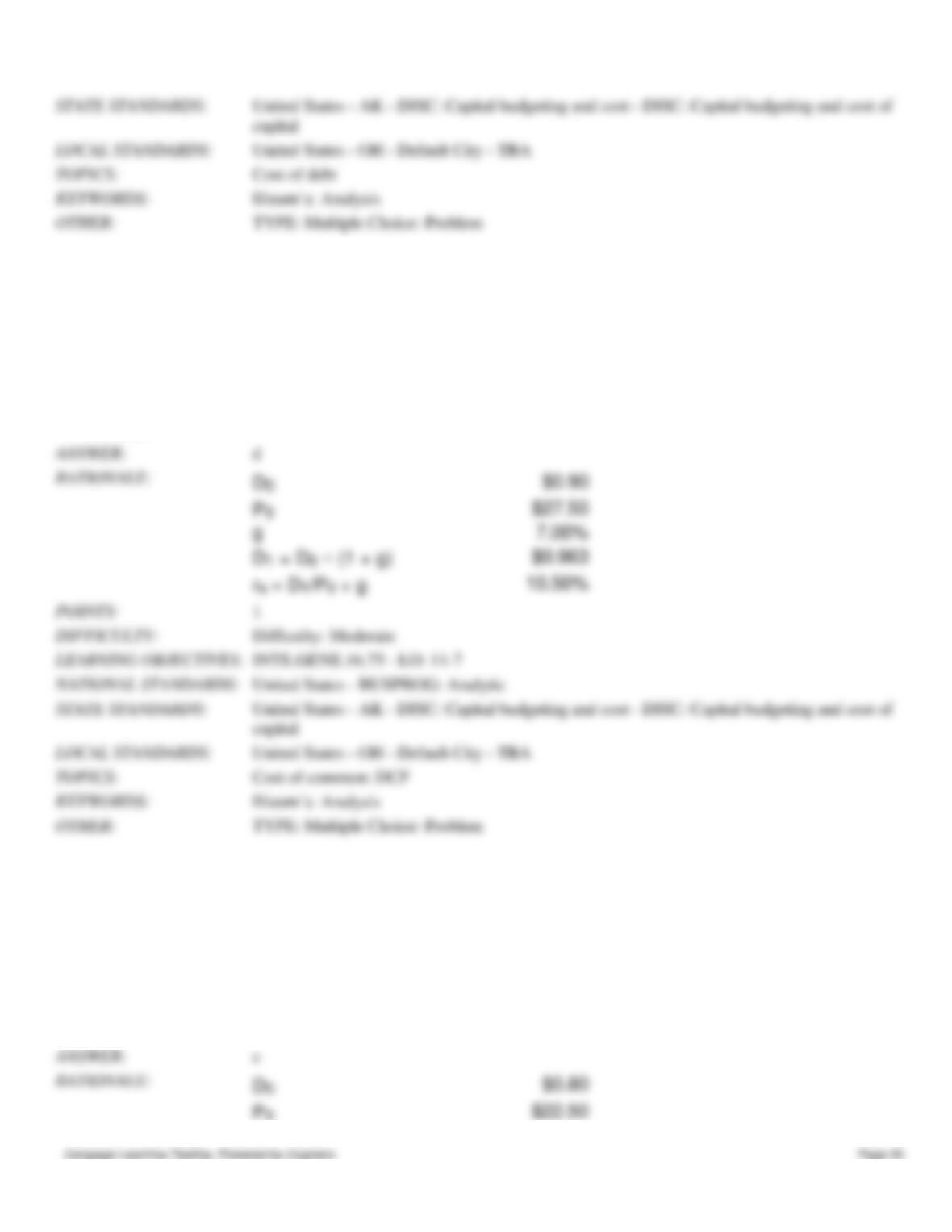
73. The Lincoln Company sold a $1,000 par value, noncallable bond several years ago that now has 20 years to maturity
and a 7.00% annual coupon that is paid semiannually. The bond currently sells for $925 and the company’s tax rate is
40%. What is the component cost of debt for use in the WACC calculation?
a.
4.28%
b.
4.46%
c.
4.65%
d.
4.83%
e.
5.03%
c
CHAPTER 11—DETERMINING THE COST OF CAPITAL
74. To help estimate its cost of common equity, Maxwell and Associates recently hired you. You have obtained the
following data: D0 = $0.90; P0 = $27.50; and g = 7.00% (constant). Based on the DCF approach, what is the cost of
common from reinvested earnings?
a.
9.29%
b.
9.68%
c.
10.08%
d.
10.50%
e.
10.92%
75. As the assistant to the CFO of Johnstone Inc., you must estimate its cost of common equity. You have been provided
with the following data: D0 = $0.80; P0 = $22.50; and g = 8.00% (constant). Based on the DCF approach, what is the cost
of common from reinvested earnings?
a.
10.69%
b.
11.25%
c.
11.84%
d.
12.43%
e.
13.05%
c