Derivative Securities 11 – 14
14
32. Use the following statements to answer this question:
I. Forward contacts are more affected by credit risk than future contracts.
II. Clearinghouses improve the level of risk associated with futures transactions.
a) I and II are correct
b) I and II are incorrect
c) I is correct and II is incorrect
d) I is incorrect and II is correct
33. An investor enters into a long position in 10,000 futures contracts of oil with a
$50,000 initial margin and has a maintenance margin that is 75 percent of this amount.
The futures price associated with this contract is $100. Assuming the price of the
underlying asset decreases to $98, what is the margin call?
a) $50,000
b) $37,500
c) $7,500
d) No margin required
34. LONG SHORT
A – 1 F – 3
B – 1 G – 3
C – 2
D – 2
What is the open interest in the market above?
11 – 15 Test Bank for Introduction to Corporate Finance, Fourth Canadian Edition
a) 6
b) 12
c) 0
d) more information required
35. Characteristics of futures contracts include
I. traded on an exchange
II. settled on maturity date
III. initial margin and maintenance margin required
IV. standardized contracts
a) I, II, III, IV
b) II, III, IV
c) I, III, IV
d) I, II,III, IV
36. If the bank could borrow at a fixed rate of 10% for 5 years, what is the notional
principal of the swap if the interest fixed payment is $5 million per year?
a) $80 million
b) $50 million
c) $75 million
d) $80 million
16
37. A “fixed for floating” interest rate swap is also referred to as:
a) plain vanilla
b) fixed swap
c) currency swap
d) plain swap
38. Interest rate swaps allow one party to exchange:
a) a floating interest rate for a fixed interest rate over the contract term.
b) a fixed interest rate for a lower fixed interest rate over the contract term.
c) a floating interest rate for a lower floating value over the contract term.
d) all of the above.
39. Use the following statements to answer this question:
I. Credit default swaps (CDS) is a default premium on debt issue.
II. Credit default swaps (CDS) are insurance on the default of issuers of the debt.
a) I is correct, II is incorrect
b) I and II are correct
c) I and II are incorrect
d) I is incorrect, and II is correct
11 – 17 Test Bank for Introduction to Corporate Finance, Fourth Canadian Edition
40. Use the following statements to answer this question:
I. Credit default swaps (CDS) are insurance on the default of issuers of the debt.
II. The CDS market is heavily regulated to limit excessive exposure to risk.
a) I is correct, II is incorrect
b) I and II are correct
c) I and II are incorrect
d) I is incorrect, and II is correct
41. Credit default swap is classified as:
a) an exchange-traded transaction.
b) an over-the-counter transaction.
c) none of the above.
42. An exchange of an interest rate return for the total return on an equity index, plus or
minus a spread is called:
a) a total return swap.
Derivative Securities 11 – 18
b) an interest rate swap.
c) a credit default swap.
d) a return forward.
43. The interest rate parity formula can be written as
I. (1 + c) = (1 + Kdomestic)/ (1 + Kforeign)
II. (1 + Kforeign) (1 + Kdomestic) = (1 + c)
III. (1 + c) (1 + Kdomestic) = (1 + Kforeign)
IV. (1 + c) – (1 + Kdomestic) = (1 + Kforeign)
a) II
b) III
c) I
d) IV
44. In order to estimate the forward rate for year 1.5 one needs
I. 1-year zero
II. 1.5-year zero
III. 2-year zero
a) I, III
b) I, II, III
c) I, II
d) II, III
45. In order to estimate the forward rate for year six one needs
I. 5-year zero
II. 6-year zero
III. 4-year zero
a) I, III
b) I, II, III
c) I, II
d) II, III
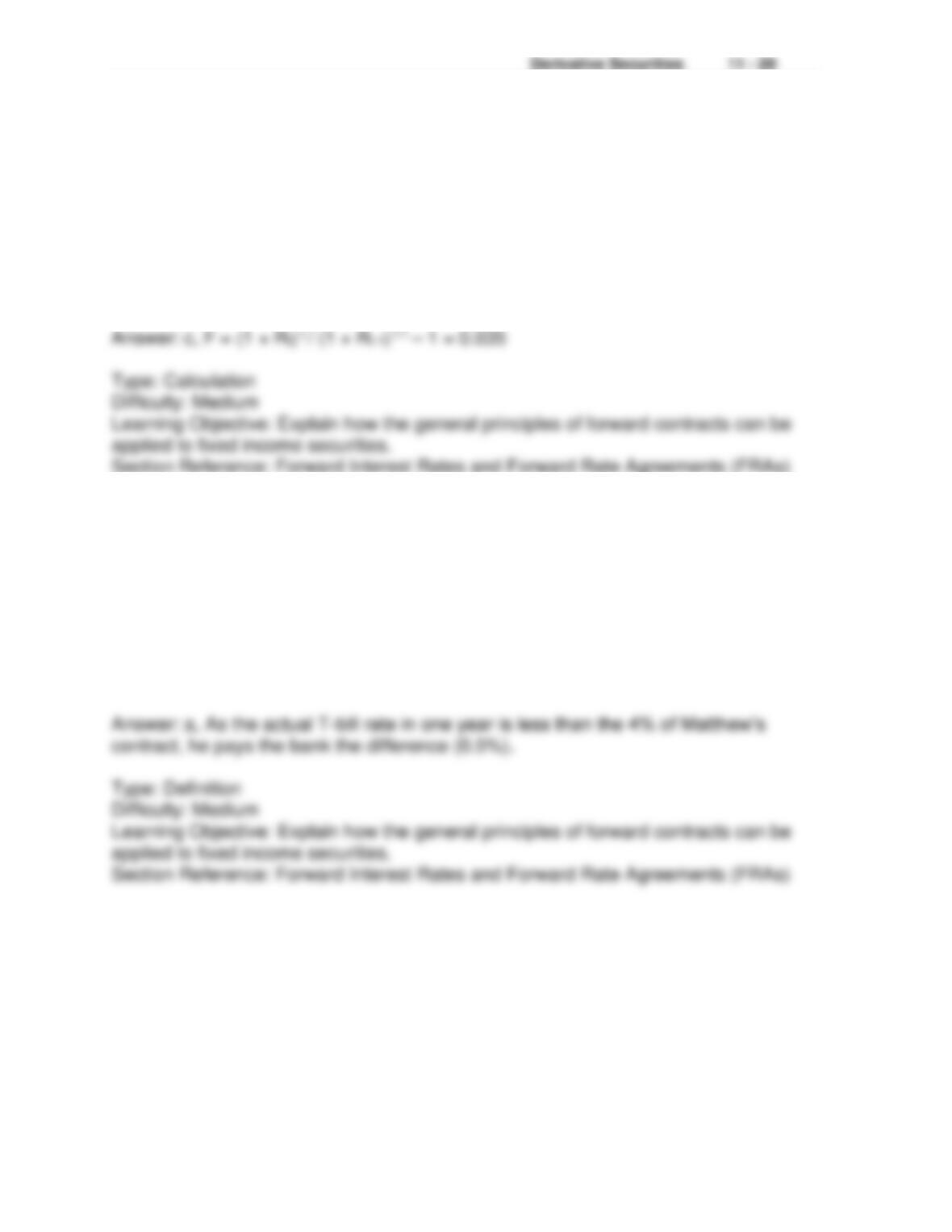
46. Find the one-year forward rate for year three given the following zero coupon rates:
Maturity Rate
One year 2.00 %
Two year 2.75 %
Three year 3.25 %
Four year 3.65 %
a) 3.51%
b) 4.26%
c) 4.86%
d) 4.56%
20
47. Estimate the year 1 forward rate given:
2 year zero will earn 3%
1 year zero will earn 2.5%
a) 2.0%
b) 0.5%
c) 3.5%
d) – 3.4%
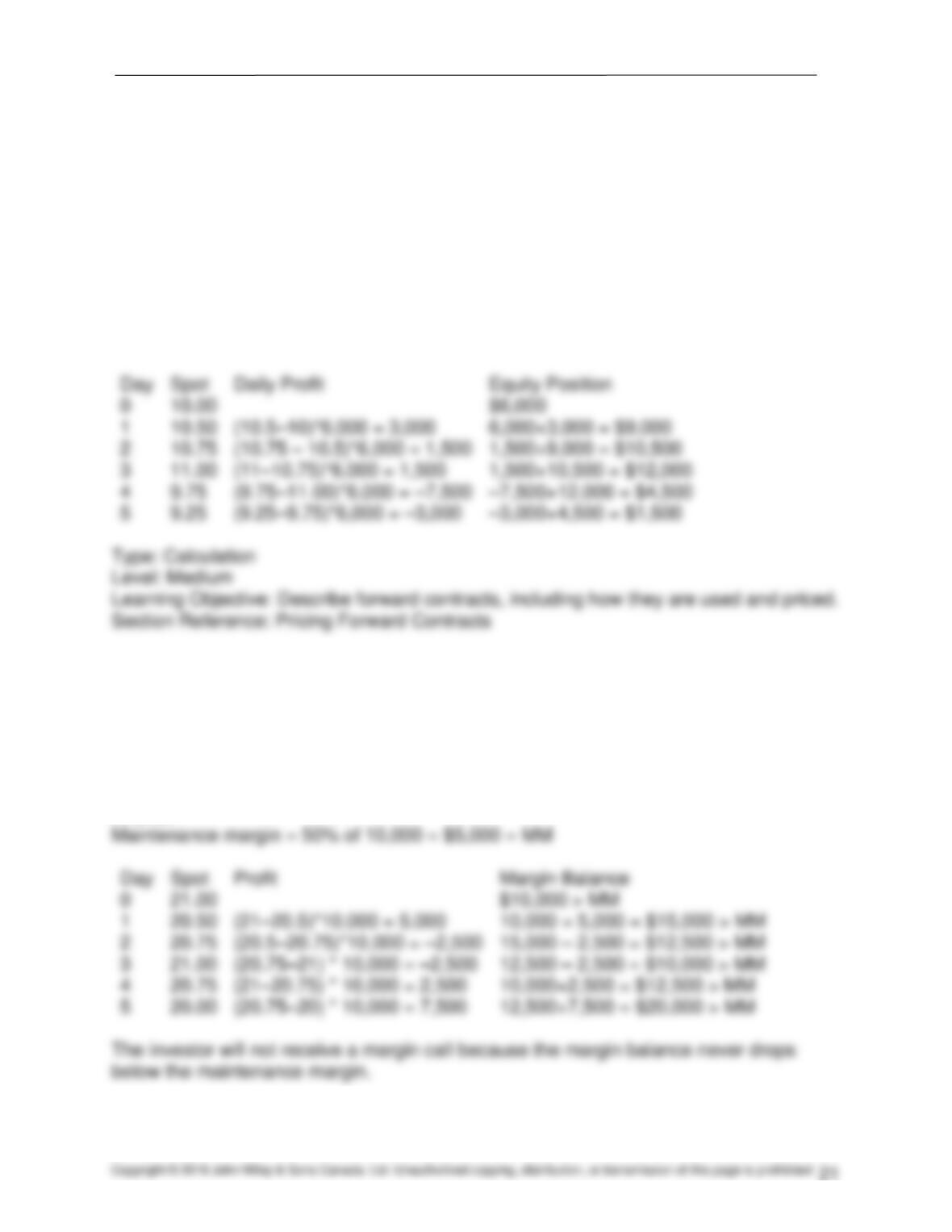
48. Matthew enters into an FRA with the local bank. The current one year forward rate
is 4%. If the yield on a one year T-Bill in one year is 3.5%, what payment will be made
to settle the agreement?
a) Matthew would pay the bank 0.5%.
b) Matthew will use the market rate rather than the FRA rate.
c) The bank would pay Matthew 0.5%.
d) Matthew would not exercise his option.
11 – 21 Test Bank for Introduction to Corporate Finance, Fourth Canadian Edition
PRACTICE PROBLEMS
49. Nanci enters into a long position in 6,000 futures contracts that require a $6,000
initial margin and has a maintenance margin that is 75% of this amount. The futures
price associated with this contract is $10. Assume that the spot price of the underlying
asset closes at the following prices for the next five days: $10.50, $10.75, $11.00, $9.75
and $9.25. Estimate the daily profit (loss) for Nanci as well as her equity position.
(Assume no cash deposits or withdrawals are made from the account.)
Answer:
50. An investor enters a short position worth $10,000 in futures contracts that require a
maintenance margin that is 50% of this amount. The spot price of the underlying asset
closes at the following prices for the next five days: $20.50, $20.75, $21.00, $20.75 and
$20.00, and the current spot is $21.00. On what days will the investor receive a margin
call and why? (Assume no deposits or withdrawals.)
Answer:
Derivative Securities 11 – 22
22
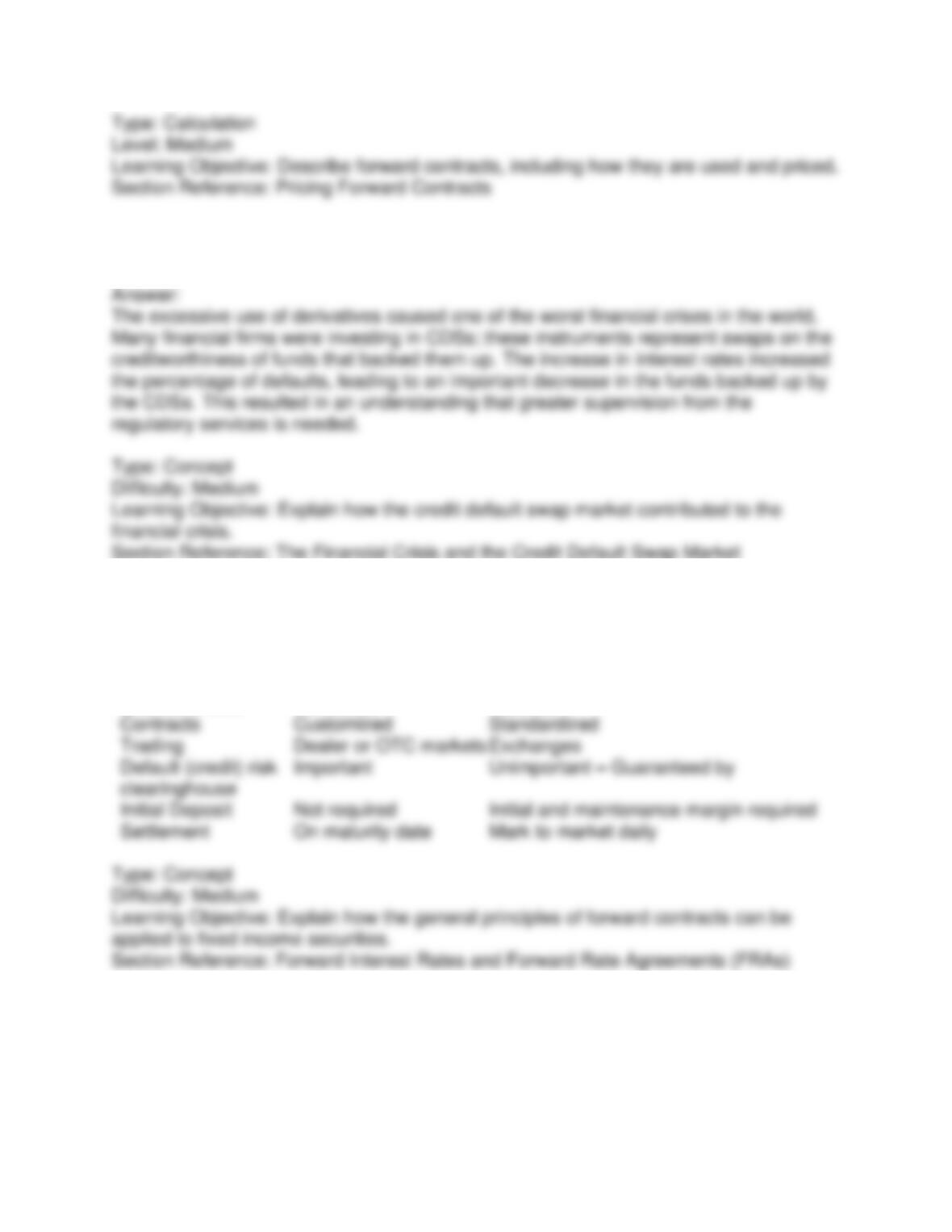
51. Explain how derivatives led to the worst recession in the post second world war era.
52. What are the differences between forwards and futures contracts?
Answer:
Characteristic Forwards Futures
53. Assume company L wants to pay a floating rate and company N wants to pay a
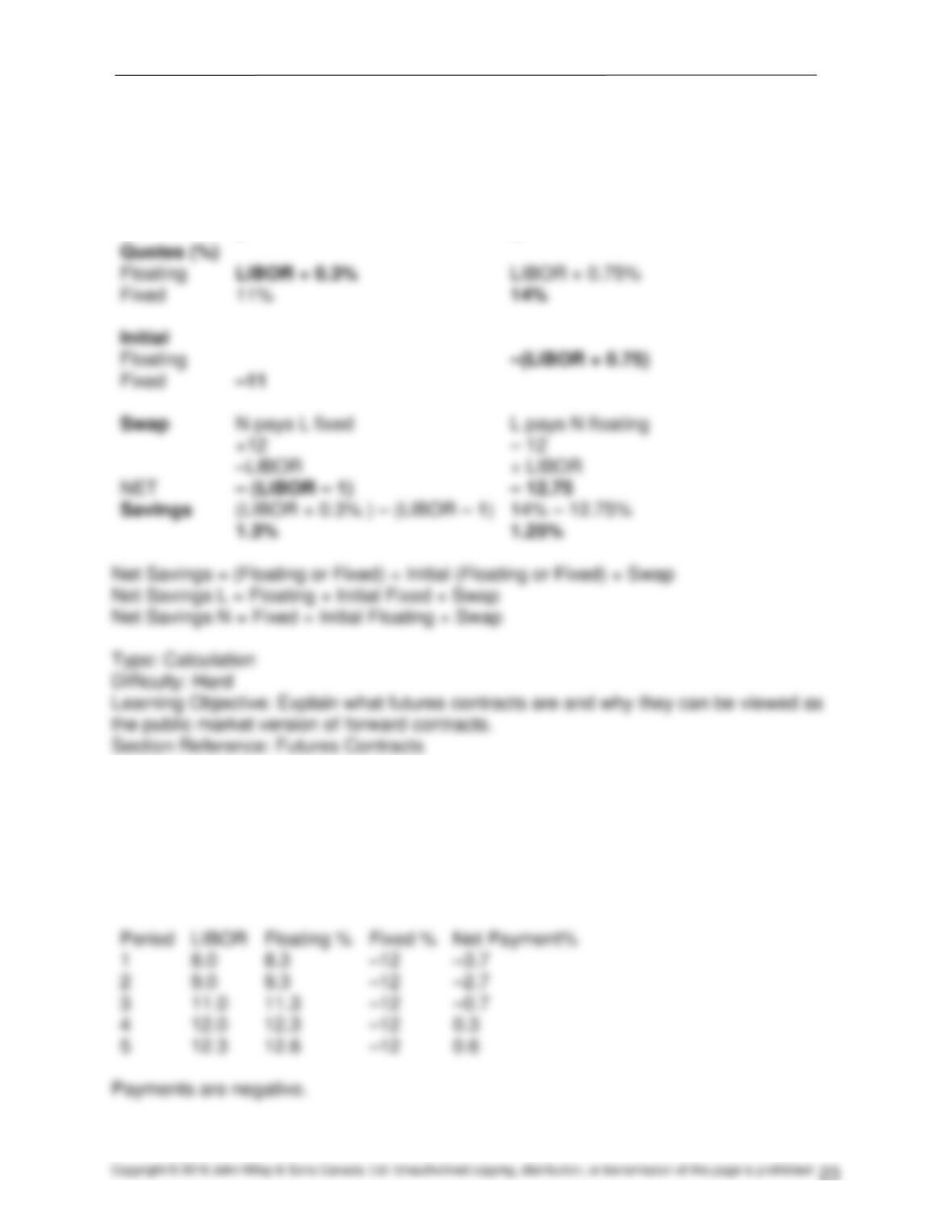
fixed rate. Company L is quoted 11% fixed-rate financing or a floating rate of LIBOR +
0.3%. In contrast, company N is quoted a fixed-rate financing at 14% and a floating rate
11 – 23 Test Bank for Introduction to Corporate Finance, Fourth Canadian Edition
financing at LIBOR + 0.75%. Calculate the net savings (%) to both parties if a swap is
entered into between L and N if N pays L 12.0% and L pays N LIBOR.
Answer:
L N
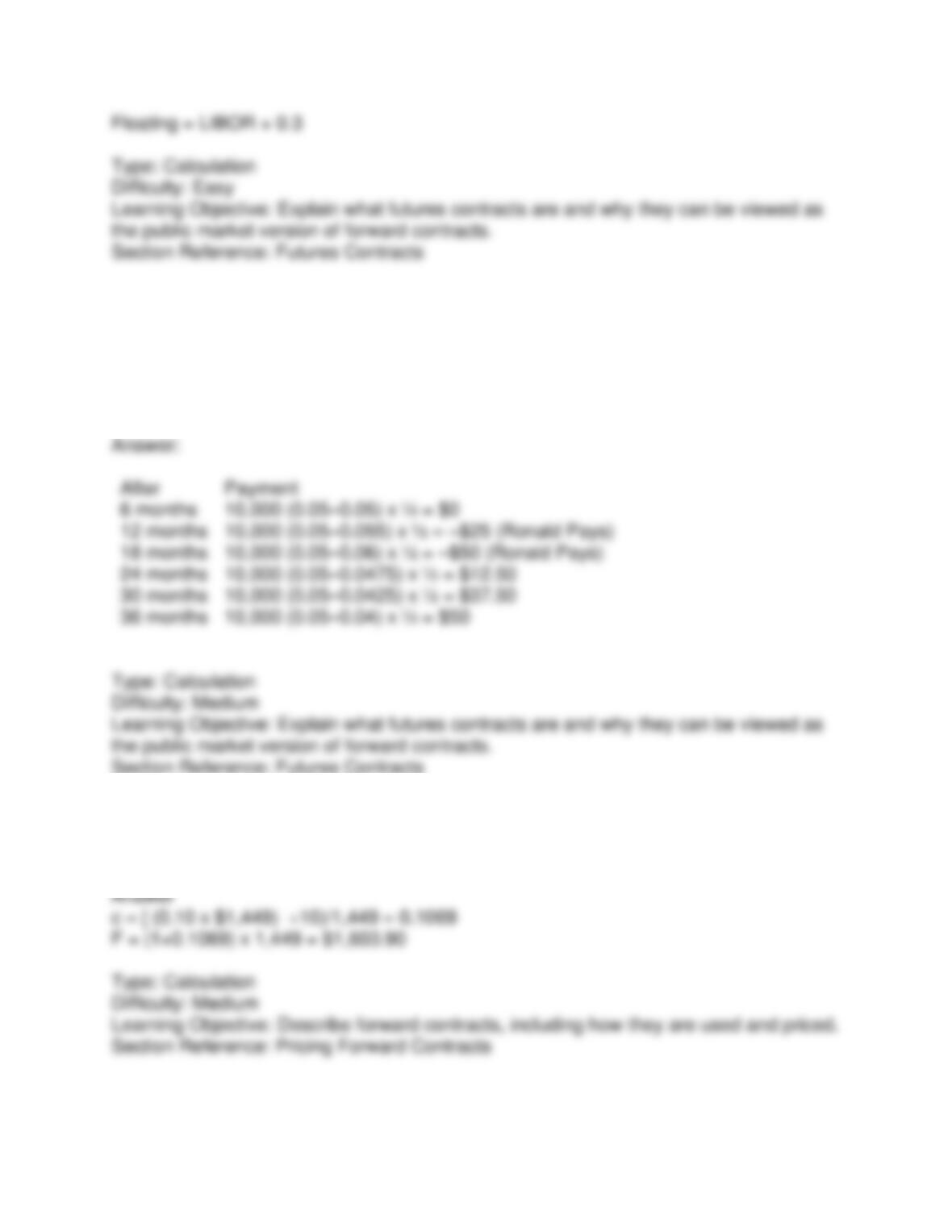
54. Company JH enters a swap to pay a fixed rate of 12% and the counterparty MI will
pay a floating rate of LIBOR + 0.3%. What are the net payments (in %) from JH’s point
of view given that LIBOR for the next five periods equals: 8.0, 9.0, 11.0, 12.0, 12.3
Answer:
Derivative Securities 11 – 24
24
55. Ronald’s company enters a 3-year, $10,000 plain vanilla interest rate swap and
agrees to pay LIBOR and receive a fixed rate of 5%. Payments are to be exchanged
every six months. Determine the semi-annual payments that Ronald must receive,
assuming LIBOR has the following values for each six-month period beginning now:
5%, 5.5%, 6%, 4.75%, 4.25%, 4%.
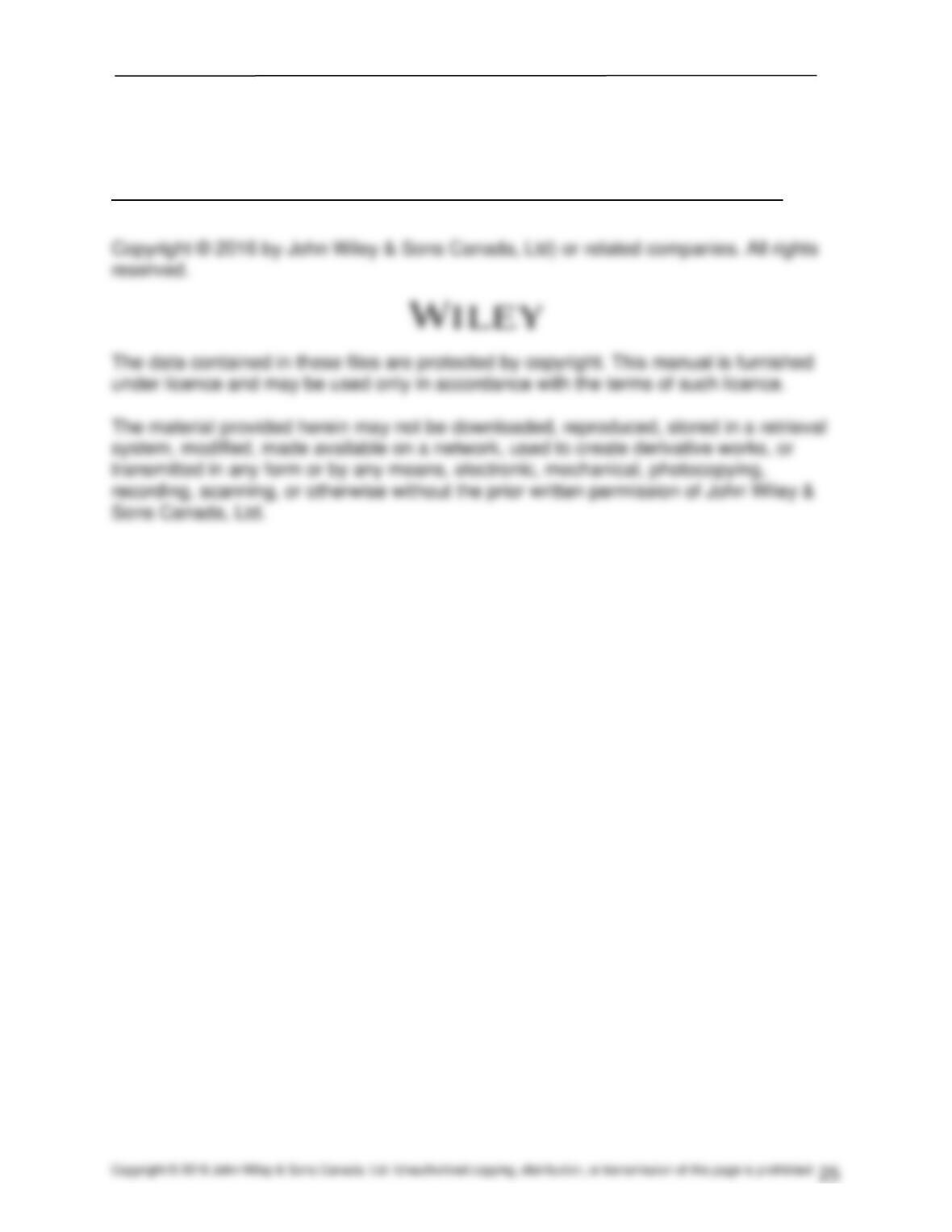
56. Find the forward price for one forward contract for gold that is selling for $1,449
spot, if the storage cost is $10 for the year and financing cost is 10% per year.
11 – 25 Test Bank for Introduction to Corporate Finance, Fourth Canadian Edition
LEGAL NOTICE