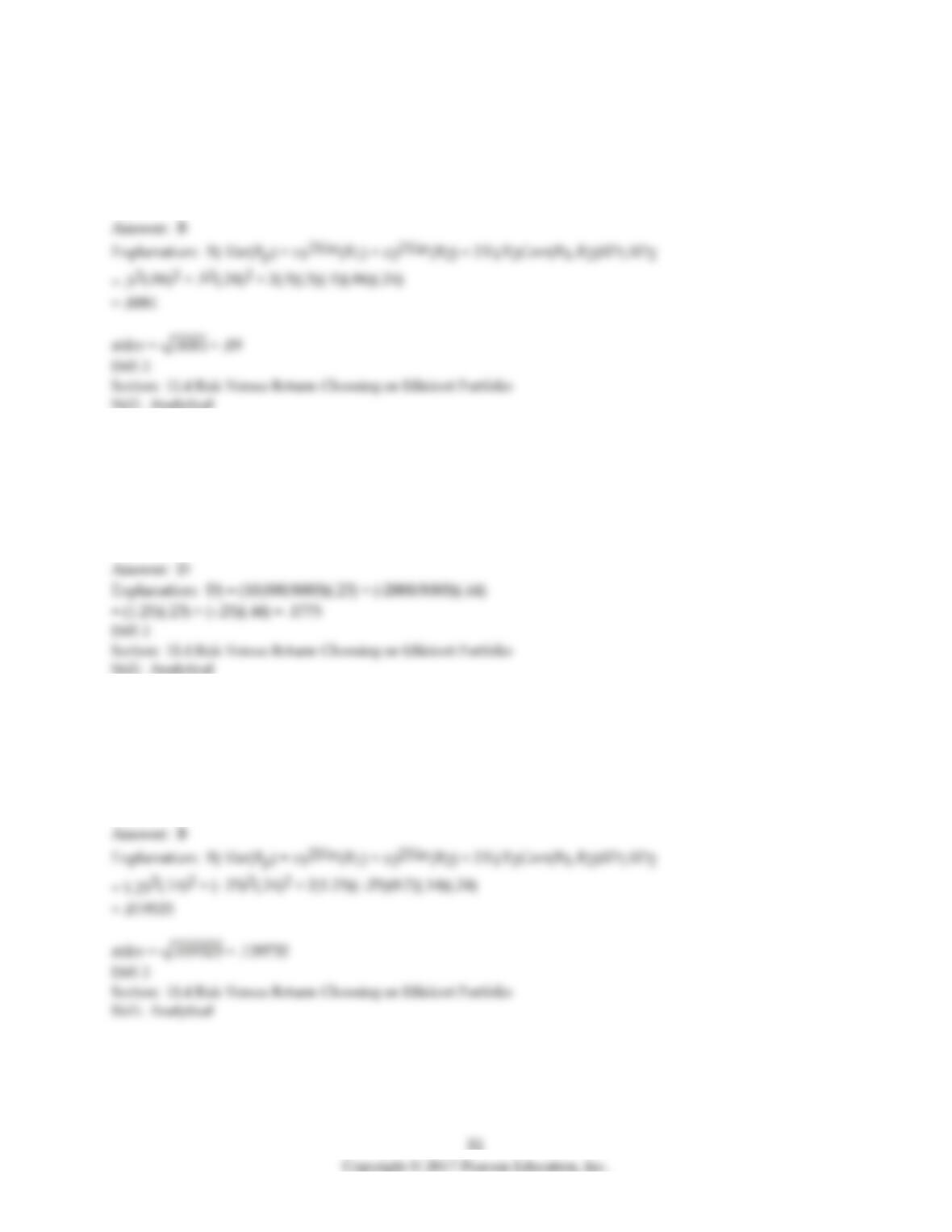
21) Calculate the variance on a portfolio that is made up of equal investments in Stock Y and Stock Z
stock.
Use the table for the question(s) below.
Consider the following covariances between securities:
Duke
Microsoft
Wal-Mart
Duke
0.0568
-0.0193
0.0037
Microsoft
-0.0193
0.2420
0.1277
Wal-Mart
0.0037
0.1277
0.1413
22) The variance on a portfolio that is made up of a $6000 investments in Microsoft and a $4000
investment in Wal-Mart stock is closest to:
11.3 The Volatility of a Large Portfolio
1) Which of the following statements is FALSE?
A) The variance of a portfolio is equal to the weighted average correlation of each stock within the
portfolio.
B) The variance of a portfolio is equal to the sum of the covariances of the returns of all pairs of stocks in
the portfolio multiplied by each of their portfolio weights.
C) The variance of a portfolio is equal to the weighted average covariances of each stock within the
portfolio.
D) The volatility declines as the number of stocks in a portfolio grows.
2) Which of the following statements is FALSE?
A) The volatility declines as the number of stocks in a portfolio grows.
B) An equally weighted portfolio is a portfolio in which the same amount is invested in each stock.
C) As the number of stocks in a portfolio grows large, the variance of the portfolio is determined
primarily by the average covariance among the stocks.
D) When combining stocks into a portfolio that puts positive weight on each stock, unless all of the
stocks are uncorrelated with the portfolio, the risk of the portfolio will be lower than the weighted
average volatility of the individual stocks.

3) Which of the following statements is FALSE?
A) The expected return of a portfolio is equal to the weighted average expected return, but the volatility
of a portfolio is less than the weighted average volatility.
B) Each security contributes to the volatility of the portfolio according to its volatility, scaled by its
covariance with the portfolio, which adjusts for the fraction of the total risk that is common to the
portfolio.
C) Nearly half of the volatility of individual stocks can be eliminated in a large portfolio as a result of
diversification.
D) The overall variability of the portfolio depends on the total co–movement of the stocks within it.
4) Which of the following formulas is INCORRECT?
A) Variance of an equally Weighted Portfolio = (1 – )(Average Variance of Individual Stocks) +
(Average covariance between the stocks)
B) Variance of a portfolio =
C) Variance of a portfolio =
D) Variance of a portfolio =
5) Consider an equally weighted portfolio that contains five stocks. If the average volatility of these
stocks is 40% and the average correlation between the stocks is .5, then the volatility of this equally
weighted portfolio is closest to:
A) .17
B) .03
C) .41
D) .19
6) Consider an equally weighted portfolio that contains 20 stocks. If the average volatility of these
stocks is 35% and the average correlation between the stocks is .4, then the volatility of this equally
weighted portfolio is closest to:
A) .17
B) .41
C) .14
D) .37
7) Consider an equally weighted portfolio that contains 100 stocks. If the average volatility of these
stocks is 50% and the average correlation between the stocks is .7, then the volatility of this equally
weighted portfolio is closest to:
A) .72
B) .63
C) .40
D) .50
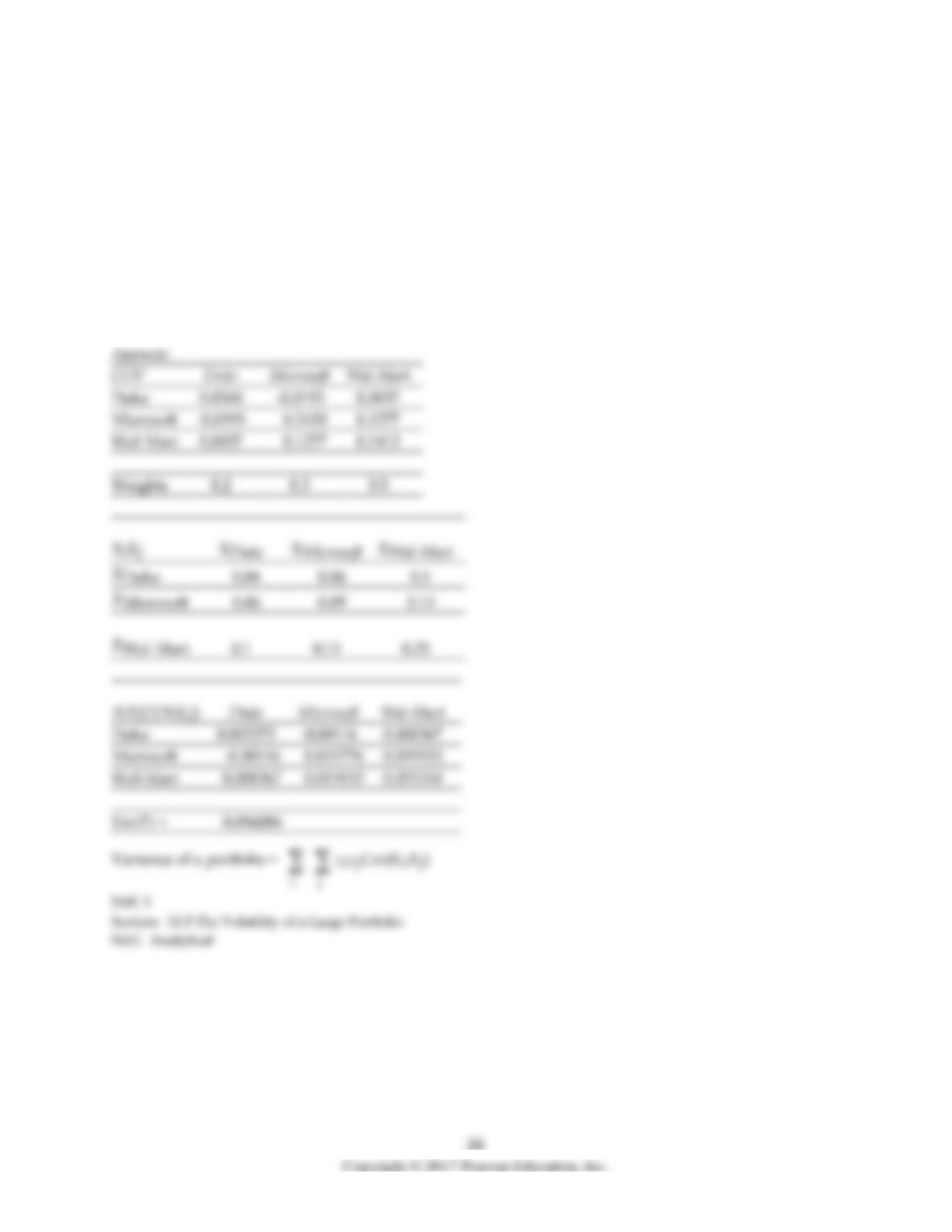
Use the table for the question(s) below.
Consider the following covariances between securities:
Duke
Microsoft
Wal-Mart
Duke
0.0568
-0.0193
0.0037
Microsoft
-0.0193
0.2420
0.1277
Wal-Mart
0.0037
0.1277
0.1413
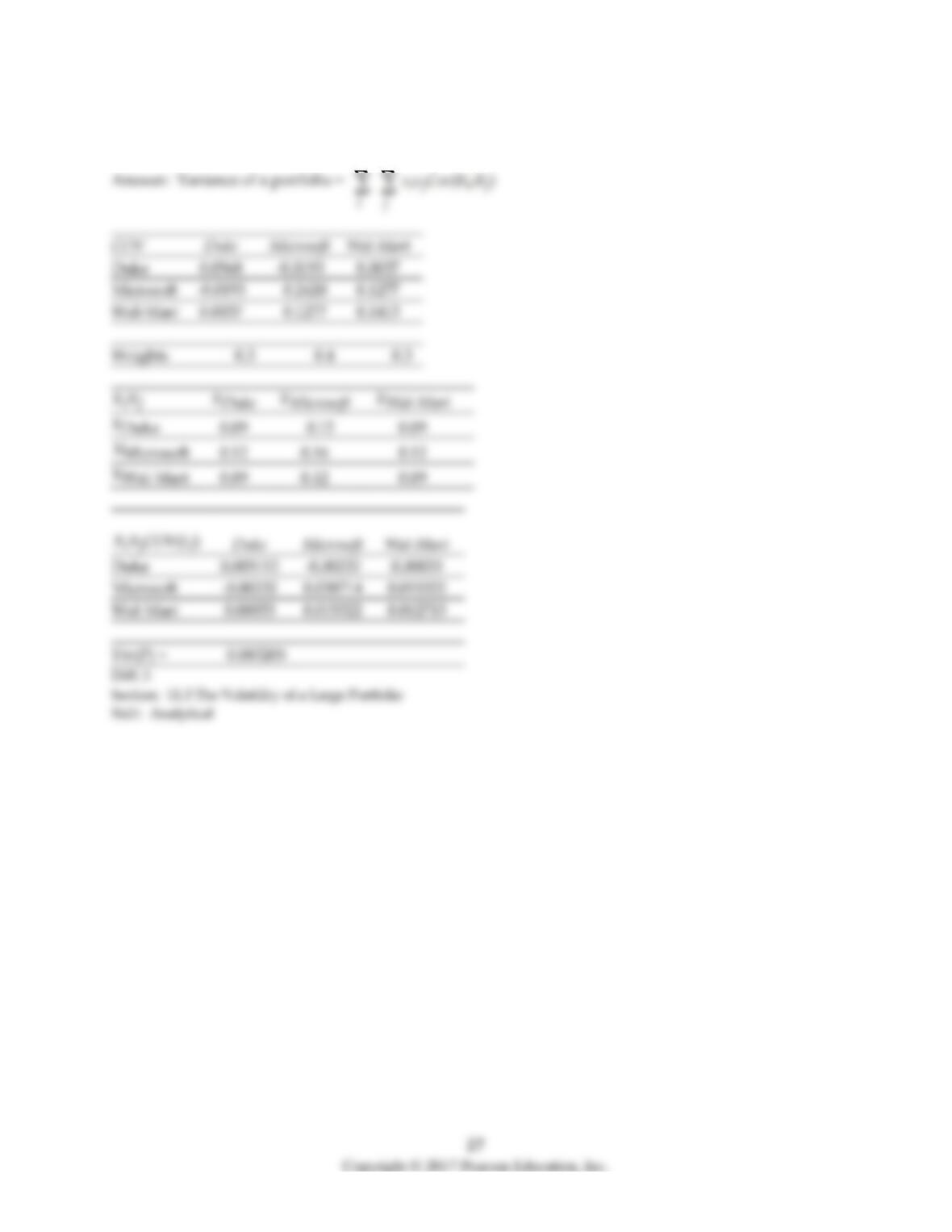
8) What is the variance on a portfolio that has $2000 invested in Duke Energy, $3000 invested in
Microsoft, and $5000 invested in Wal-Mart stock?
Duke
0.0568
-0.0193
0.0037
Microsoft
-0.0193
0.2420
0.1277
Wal-Mart
0.0037
0.1413
Weights
Duke
Microsoft
Wal-Mart
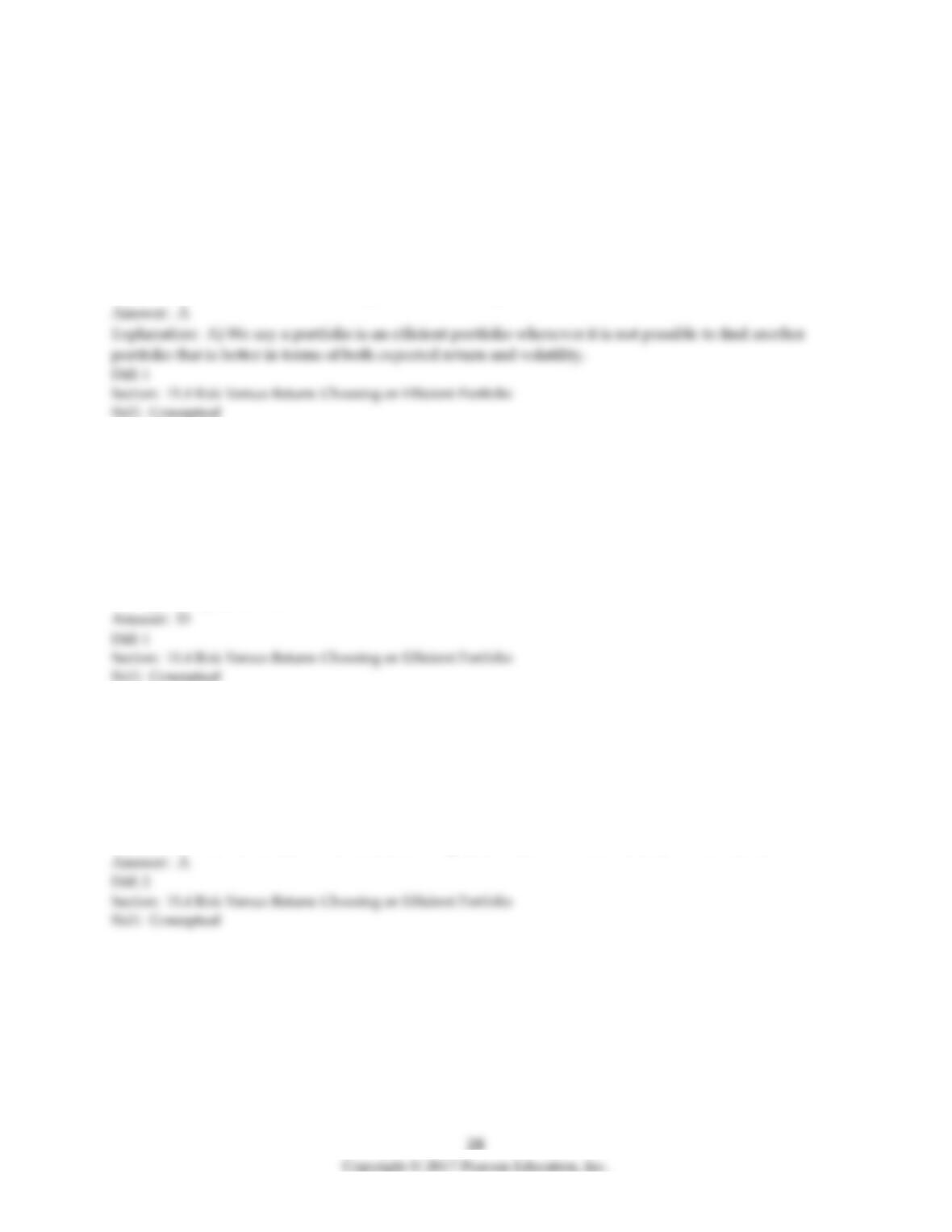
9) What is the variance on a portfolio that has $3000 invested in Duke Energy, $4000 invested in
Microsoft, and $3000 invested in Wal-Mart stock?
11.4 Risk Versus Return: Choosing an Efficient Portfolio
1) Which of the following statements is FALSE?
A) We say a portfolio is an efficient portfolio whenever it is possible to find another portfolio that is
better in terms of both expected return and volatility.
B) We can rule out inefficient portfolios because they represent inferior investment choices.
C) The volatility of the portfolio will differ, depending on the correlation between the securities in the
portfolio.
D) Correlation has no effect on the expected return on a portfolio.
2) Which of the following statements is FALSE?
A) When stocks are perfectly positively correlated, the set of portfolios is identified graphically by a
straight line between them.
B) An investor seeking high returns and low volatility should only invest in an efficient portfolio.
C) When the correlation between securities is less than 1, the volatility of the portfolio is reduced due to
diversification.
D) Efficient portfolios can be easily ranked, because investors will choose from among them those with
the highest expected returns.
3) Which of the following statements is FALSE?
A) We say a portfolio is long those stocks that have negative portfolio weights.
B) The efficient portfolios are those portfolios offering the highest possible expected return for a given
level of volatility.
C) When two stocks are perfectly negatively correlated, it becomes possible to hold a portfolio that
bears absolutely no risk.
D) The lower the correlation of the securities in a portfolio the lower the volatility we can obtain.
4) Which of the following statements is FALSE?
A) A short sale is a transaction in which you buy a stock that you do not own and then agree to sell that
stock back in the future.
B) The efficient portfolios are those portfolios offering the lowest possible level of volatility for a given
level of expected return.
C) A positive investment in a security can be referred to as a long position in the security.
D) It is possible to invest a negative amount in a stock or security, which is called a negative position.
5) Which of the following statements is FALSE?
A) Graphically, the efficient portfolios are those on the northeast edge of the set of possible portfolios,
an area which we call the efficient frontier.
B) To arrive at the best possible set of risk and return opportunities, we should keep adding stocks until
all investment opportunities are represented.
C) We say a portfolio is short those stocks that have negative portfolio weights.
D) Adding new investment opportunities allows for greater diversification and improves the efficient
frontier.
6) Suppose you have $10,000 in cash to invest. You decide to sell short $5000 worth of Kinston stock
and invest the proceeds from your short sale, plus your $10,000 into one-year U.S. treasury bills earning
5%. At the end of the year, you decide to liquidate your portfolio. Kinston Industries has the following
realized returns:
P0
Div1
P1
Kinston
$25.00
$1.00
$29.00
The return on your portfolio is closest to:
A) -0.5%
B) 13.5%
C) -2.5%
D) 14.5%

Use the table for the question(s) below.
Consider the following expected returns, volatilities, and correlations:
Stock
Expected
Return
Standard
Deviation
Correlation
with Duke
Energy
Correlation
with Microsoft
Correlation
with Wal-Mart
Duke
Energy
14%
6%
1.0
-1.0
0.0
Microsoft
44%
24%
-1.0
1.0
0.7
Wal-Mart
23%
14%
0.0
0.7
1.0
7) Consider a portfolio consisting of only Duke Energy and Microsoft. The percentage of your
investment (portfolio weight) that you would place in Duke Energy stock to achieve a risk-free
investment would be closest to:
A) 15%
B) 40%
C) 23%
D) 10%
8) The expected return of a portfolio that is equally invested in Duke Energy and Microsoft is closest to:
A) 28%
B) 29%
C) 24%
D) 23%
9) The volatility of a portfolio that is equally invested in Duke Energy and Microsoft is closest to:
A) 8%
B) 9%
C) 11%
D) 6%
10) The expected return of a portfolio that consists of a long position of $10,000 in Wal-Mart and a short
position of $2000 in Microsoft is closest to:
A) 21%
B) 12%
C) 27%
D) 18%
11) The volatility of a portfolio that consists of a long position of $10,000 in Wal-Mart and a short
position of $2000 in Microsoft is closest to:
A) 9%
B) 14%
C) 11%
D) 12%
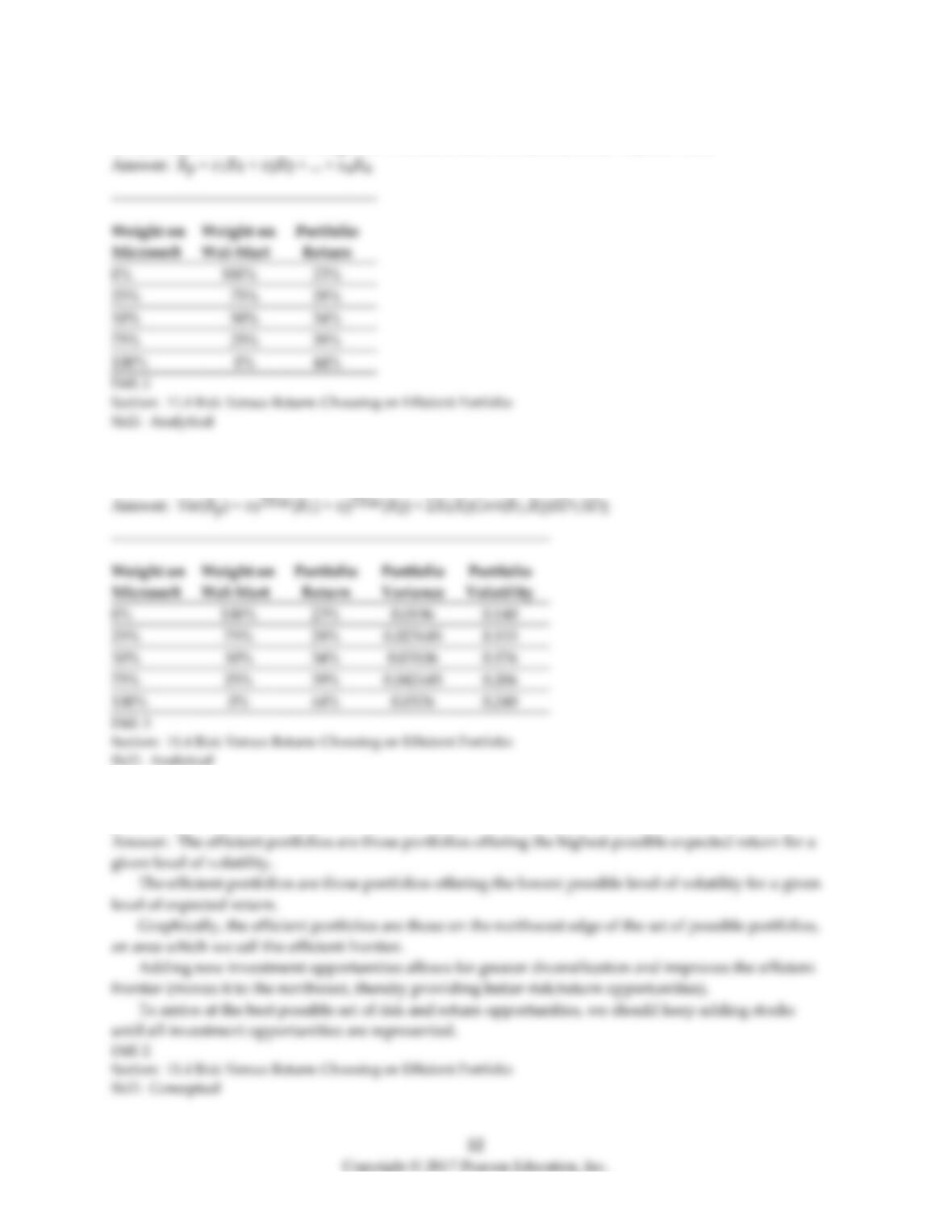
12) Consider a portfolio consisting of only Microsoft and Wal-Mart stock. Calculate the expected return
on such a portfolio when the weight on Microsoft stock is 0%, 25%, 50%, 75%, and 100%
13) Consider a portfolio consisting of only Microsoft and Wal-Mart stock. Calculate the volatility of
such a portfolio when the weight on Microsoft stock is 0%, 25%, 50%, 75%, and 100%
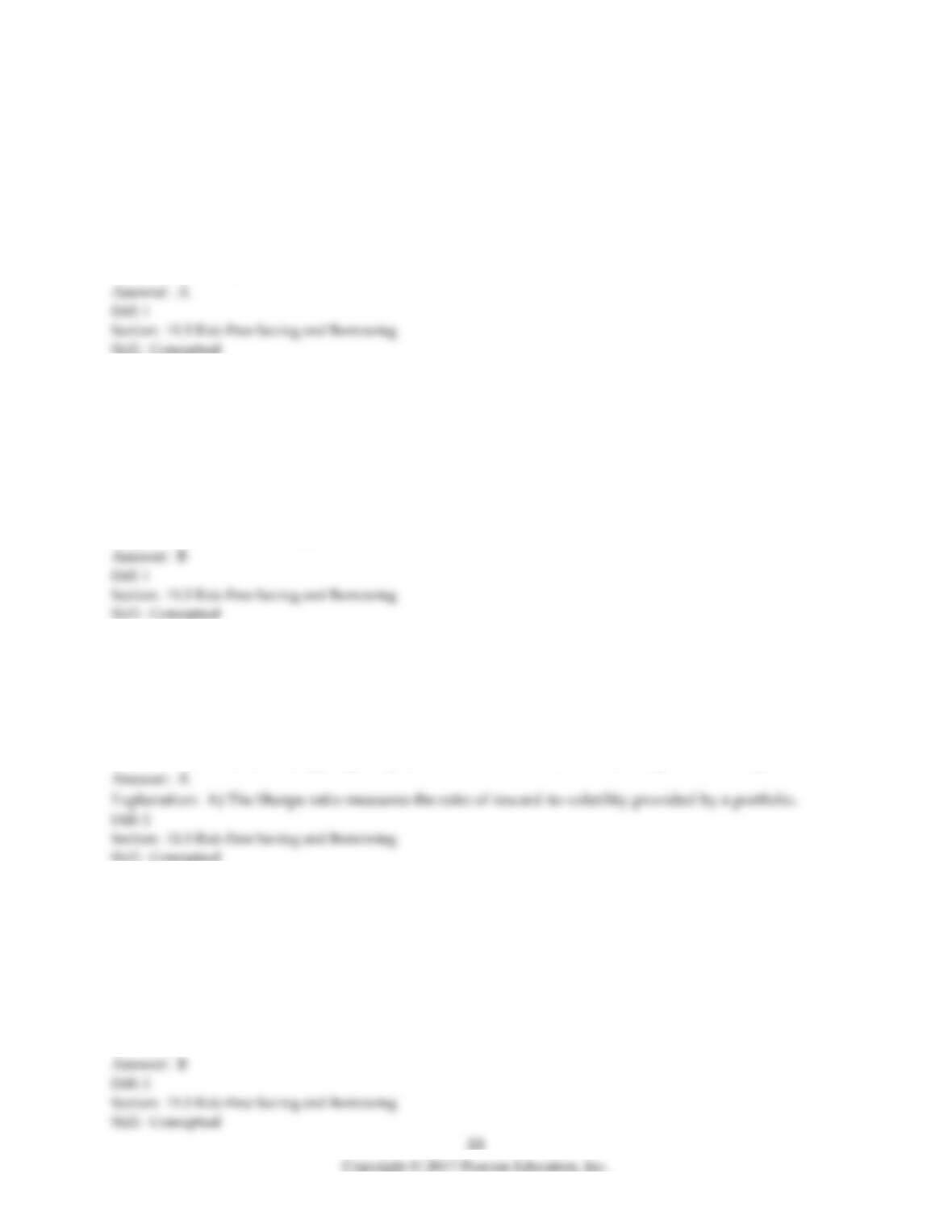
14) What is the efficient frontier and how does it change when more stocks are used to construct
portfolios?
11.5 Risk-Free Saving and Borrowing
1) Which of the following statements is FALSE?
A) A portfolio that consists of a long position in the risk-free investment is known as a levered portfolio.
B) The optimal portfolio will not depend on the investor’s personal tradeoff between risk and return.
C) The volatility of the risk-free investment is zero.
D) Our total volatility is only a fraction of the volatility of the efficient portfolio, based on the amount
we invest in the risk free asset.
2) Which of the following statements is FALSE?
A) Margin investing is a risky investment strategy.
B) Because our return on the risk-free investments is fixed and does not move with (or against) our
portfolio, the correlation between the risk-free investment and the portfolio is always equal to one.
C) Short selling the risk free investment is equivalent to borrowing money at the risk-free interest rate
through a standard loan.
D) Margin investing can provide higher expected returns than investing in the efficient portfolio using
only the funds we have available.
3) Which of the following statements is FALSE?
A) The Sharpe ratio measures the ratio of volatility–to-reward provided by a portfolio.
B) Borrowing money to invest in stocks is referred to as buying stocks on margin.
C) The Sharpe ratio is the number of stand deviations the portfolio’s return would have to fall to under–
perform the risk-free investment.
D) The slope of the line through a given portfolio is often referred to as the Sharpe ratio of the portfolio.
4) Which of the following statements is FALSE?
A) The tangent portfolio is efficient and that, once we include the risk-free investment, all efficient
portfolios are combinations of the risk-free investment and the tangent portfolio.
B) The optimal portfolio of risky investments depends on how conservative or aggressive the investor is.
C) By combining the efficient portfolio with the risk-free investment, an investor will earn the highest
possible expected return for any level of volatility her or she is willing to bear.
D) The efficient portfolio is the tangent portfolio, the portfolio with the highest Sharpe ratio in the
economy.

5) Which of the following statements is FALSE?
A) If we increase the fraction invested in the efficient portfolio beyond 100% we are short selling the
risk-free investment.
B) As we increase the fraction invested in the efficient portfolio, we increase our risk premium but not
our risk proportionately.
C) To earn the highest possible expected return for any level of volatility we must find the portfolio that
generates the steepest possible line when combined with the risk-free investment.
D) Every investor should invest in the tangent portfolio independent of his or her taste for risk.
6) Which of the following statements is FALSE?
A) An investor’s preferences will determine only how much to invest in the tangent or efficient portfolio
versus the risk-free investment.
B) Conservative investors will invest a small amount in the tangent or efficient portfolio, choosing a
portfolio on the line near the risk-free investment.
C) Only aggressive investors will choose to hold the portfolio of risky assets, the tangent or efficient
portfolio.
D) Aggressive investors will invest more in the tangent portfolio choosing a portfolio that is near the
tangent portfolio or even beyond it by buying stocks on margin.
7) Which of the following equations is INCORRECT?
A) E[Rxp] = rf + x(E[Rp] – rf)
B) E[Rxp] = (1 – x)rf + xE[Rp]
C) Sharpe ratio =
D) SD( Rxp) = xSD(Rp)
Use the information for the question(s) below.
Suppose you have $10,000 in cash and you decide to borrow another $10,000 at a 6% interest rate to
invest in the stock market. You invest the entire $20,000 in an exchange traded fund (ETF) with a 12%
expected return and a 20% volatility.
8) The expected return on your investment is closest to:
A) 18%
B) 20%
C) 12%
D) 24%
9) The volatility of your investment is closest to:
A) 40%
B) 20%
C) 30%
D) 24%
10) Assume that the EFT you invested in returns -10%, then the realized return on your investment is
closest to:
A) -20%
B) –10%
C) –24%
D) –26%
Use the information for the question(s) below.
Suppose that you currently have $250,000 invested in a portfolio with an expected return of 12% and a
volatility of 10%. The efficient (tangent) portfolio has an expected return of 17% and a volatility of 12%.
The risk-free rate of interest is 5%.
11) The Sharpe ratio for your portfolio is closest to:
A) 1.2
B) 0.6
C) 1.0
D) 0.7
12) The Sharpe ratio for the efficient portfolio is closest to:
A) 0.7
B) 1.0
C) 1.4
D) 1.2
13) You want to maximize your expected return without increasing your risk. Without increasing your
volatility beyond its current 10%, the maximum expected return you could earn is closest to:
A) .12.0%
B) 12.5%
C) 13.4%
D) 15.0%
14) Suppose that you want to maximize your expected return without increasing your risk. How can you
achieve this goal? Without increasing your risk, what is the maximum expected return you can expect?
11.6 The Efficient Portfolio and Required Returns
1) Which of the following statements is FALSE?
A) A portfolio is efficient if it has the highest possible Sharpe ratio; that is it is efficient if it provides the
largest increase in expected return possible for a given increase in volatility.
B) The required return for an investment is equal to a risk premium that is equal to the risk premium of
the investor’s current portfolio scaled by .
C) Increasing the investment in investment I will increase the Sharpe ratio of portfolio P if its expected
return E[Ri] exceeds the required return ri, which is given by ri = rf + × (E[Rp] – rf).
D) If a security i‘s expected return is less than the required return ri, we should reduce our holding of
security i.
2) Which of the following statements is FALSE?
A) The Sharpe ratio of the portfolio tells us how much our expected return will increase for a given
increase in volatility.
B) We should continue to trade securities until the expected return of each security equals its required
return.
C) The required return is the expected return that is necessary to compensate for the risk that an
investment will contribute to the portfolio.
D) If security i‘s required return exceeds its expected return, then adding more of it will improve the
performance of the portfolio.

3) Which of the following statements is FALSE?
A) Because all other risk is diversifiable, it is an investment’s beta with respect to the efficient portfolio
that measures its sensitivity to systematic risk, and therefore determines its cost of capital.
B) If a security’s expected return exceeds its required return given our current portfolio, then we can
improve the performance of our portfolio by adding more of the security.
C) The appropriate risk premium for an investment can be determined from its beta with the efficient
portfolio.
D) As we buy shares of a security i, its correlation with our portfolio P will increase, ultimately raising
its required return until E[Ri] = Rp.
Use the following information to answer the question(s) below.
Firm
Portfolio
Weight
Volatility
Correlation w/
Market Portfolio
Taggart Transcontinental
0.25
14%
0.7
Wyatt Oil
0.35
18%
0.6
Rearden Metal
0.40
15%
0.5
The volatility of the market portfolio is 10%, the expected return on the market is 12%, and the risk-free
rate of interest is 4%.
4) The Sharpe Ratio for the market portfolio is closest to:
A) 0.40
B) 0.48
C) 0.56
D) 0.80
Use the information for the question(s) below.
You are presently invested in the Luther Fund, a broad based mutual fund that invests in stocks and
other securities. The Luther Fund has an expected return of 14% and a volatility of 20%. Risk-free
Treasury bills are currently offering returns of 4%. You are considering adding a precious metals fund
to your current portfolio. The metals fund has an expected return of 10%, a volatility of 30%, and a
correlation of -.20 with the Luther Fund.
5) The beta of the precious metals fund with the Luther Fund is closest to:
A) -0.3
B) -0.6
C) 0.3
D) 0.6
6) The expected return on the precious metals fund is closest to:
A) –3%
B) 4%
C) 1%
D) 10%
40
Use the information for the question(s) below.
Sisyphean industries is seeking to raise capital from a large group of investors to fund a new project.
Suppose that the efficient portfolio has an expected return of 14% and a volatility of 20%. Sisyphean’s
new project is expected to have a volatility of 40% and a 70% correlation with the efficient portfolio.
The risk-free rate is 4%.
7) The beta for Sisyphean’s new project is closest to:
A) 1.25
B) 1.40
C) 0.70
D) 1.75
8) The required return for Sisyphean’s new project is closest to:
A) 24%
B) 14%
C) 18%
D) 10%
Use the information for the question(s) below.
You are presently invested in the Luther Fund, a broad based mutual fund that invests in stocks and
other securities. The Luther Fund has an expected return of 14% and a volatility of 20%. Risk-free
Treasury bills are currently offering returns of 4%. You are considering adding a precious metals fund
to your current portfolio. The metals fund has an expected return of 10%, a volatility of 30%, and a
correlation of -.20 with the Luther Fund.