
Chapter 11: Cash Flow Estimation and Risk Analysis
DATE MODIFIED: 1/27/2019 8:44 PM
60. Sylvester Media is analyzing an average-risk project, and the following data have been developed. Unit sales will be
constant, but the sales price should increase with inflation. Fixed costs will also be constant, but variable costs should rise
with inflation. The project should last for 3 years, it will be depreciated on a straight-line basis, and there will be no
salvage value. This is just one of many projects for the firm, so any losses can be used to offset gains on other firm
projects. The marketing manager does not think it is necessary to adjust for inflation since both the sales price and the
variable costs will rise at the same rate, but the CFO thinks an adjustment is required. What is the difference in the
expected NPV if the inflation adjustment is made vs. if it is not made?
Project cost of capital (r) 10.0%
Net investment cost (depreciable basis) $200,000
Units sold 50,000
Average price per unit, Year 1 $25.00
Fixed op. cost excl. deprec. (constant) $150,000
Variable op. cost/unit, Year 1 $20.20
Annual depreciation rate 33.333%
Expected inflation 4.00%
Tax rate 25.0%
a. $15,330
b. $16,136
c. $16,986
d. $17,835
e. $18,727

Chapter 11: Cash Flow Estimation and Risk Analysis
61. If a firm’s projects differ in risk, then one way of handling this problem is to evaluate each project with the appropriate
risk-adjusted discount rate.
a. True
b. False
62. Which of the following procedures best accounts for the relative risk of a proposed project?
a. Adjusting the discount rate downward if the project is judged to have above-average risk.
b. Reducing the NPV by 10% for risky projects.
c. Picking a risk factor equal to the average discount rate.
d. Ignoring risk because project risk cannot be measured accurately.
e. Adjusting the discount rate upward if the project is judged to have above-average risk.

Chapter 11: Cash Flow Estimation and Risk Analysis
63. Puckett Inc. risk-adjusts its WACC to account for project risk. It uses a risk-adjusted project cost of capital of 8% for
below-average risk projects, 10% for average-risk projects, and 12% for above-average risk projects. Which of the
following independent projects should Puckett accept, assuming that the company uses the NPV method when choosing
projects?
a. Project B, which has below-average risk and an IRR = 8.5%.
b. Project C, which has above-average risk and an IRR = 11%.
c. Without information about the projects’ NPVs we cannot determine which project(s) should be accepted.
d. All of these projects should be accepted.
e. Project A, which has average risk and an IRR = 9%.
64. Tallant Technologies is considering two potential projects, X and Y. In assessing the projects’ risks, the company
estimated the beta of each project versus both the company’s other assets and the stock market, and it also conducted
thorough scenario and simulation analyses. This research produced the following data:
Project X Project Y
Expected NPV $500,000 $500,000
Standard deviation (σNPV) $200,000 $250,000
Project beta (vs. market) 1.4 0.8
Correlation of the project cash flows with cash flows from currently existing projects. Cash flows are not correlated with
the cash flows from existing projects. Cash flows are highly correlated with the cash flows from existing projects.

Chapter 11: Cash Flow Estimation and Risk Analysis
Which of the following statements is CORRECT?
a. Project X has more corporate (or within-firm) risk than Project Y.
b. Project X has more market risk than Project Y.
c. Project X has the same level of corporate risk as Project Y.
d. Project X has less market risk than Project Y.
e. Project X has more stand-alone risk than Project Y.
65. Wansley Enterprises is considering a new project. The company has a beta of 1.0, and its sales and profits are
positively correlated with the overall economy. The company estimates that the proposed new project would have a higher
standard deviation and coefficient of variation than an average company project. Also, the new project’s sales would be
countercyclical in the sense that they would be high when the overall economy is down and low when the overall
economy is strong. On the basis of this information, which of the following statements is CORRECT?
a. The proposed new project would increase the firm’s corporate risk.
b. The proposed new project would increase the firm’s market risk.
c. The proposed new project would not affect the firm’s risk at all.
d. The proposed new project would have less stand-alone risk than the firm’s typical project.
e. The proposed new project would have more stand-alone risk than the firm’s typical project.

Chapter 11: Cash Flow Estimation and Risk Analysis
66. A firm is considering a new project whose risk is greater than the risk of the firm’s average project, based on all
methods for assessing risk. In evaluating this project, it would be reasonable for management to do which of the
following?
a. Increase the estimated NPV of the project to reflect its greater risk.
b. Reject the project, since its acceptance would increase the firm’s risk.
c. Ignore the risk differential if the project would amount to only a small fraction of the firm’s total assets.
d. Increase the cost of capital used to evaluate the project to reflect its higher-than-average risk.
e. Increase the estimated IRR of the project to reflect its greater risk.
67. Laramie Labs uses a risk-adjustment when evaluating projects of different risk. Its overall (composite) WACC is 10%,
which reflects the cost of capital for its average asset. Its assets vary widely in risk, and Laramie evaluates low-risk
projects with a risk-adjusted project cost of capital of 8%, average-risk projects at 10%, and high-risk projects at 12%.
The company is considering the following projects:
Project Risk Expected Return
A High 15%
B Average 12%
C High 11%
D Low 9%
E Low 6%
Which set of projects would maximize shareholder wealth?
a. A and B.
b. A, B, and C.
c. A, B, and D.
d. A, B, C, and D.
e. A, B, C, D, and E.

Chapter 11: Cash Flow Estimation and Risk Analysis
68. Because of differences in the expected returns on different investments, the standard deviation is not always an
adequate measure of risk. However, the coefficient of variation adjusts for differences in expected returns and thus allows
investors to make better comparisons of investments’ stand-alone risk.
a. True
b. False
69. Sensitivity analysis measures a project’s stand-alone risk by showing how much the project’s NPV (or IRR) is affected
by a small change in one of the input variables, say sales. Other things held constant, with the size of the independent
variable graphed on the horizontal axis and the NPV on the vertical axis, the steeper the graph of the relationship line, the
more risky the project, other things held constant.
a. True
b. False

Chapter 11: Cash Flow Estimation and Risk Analysis
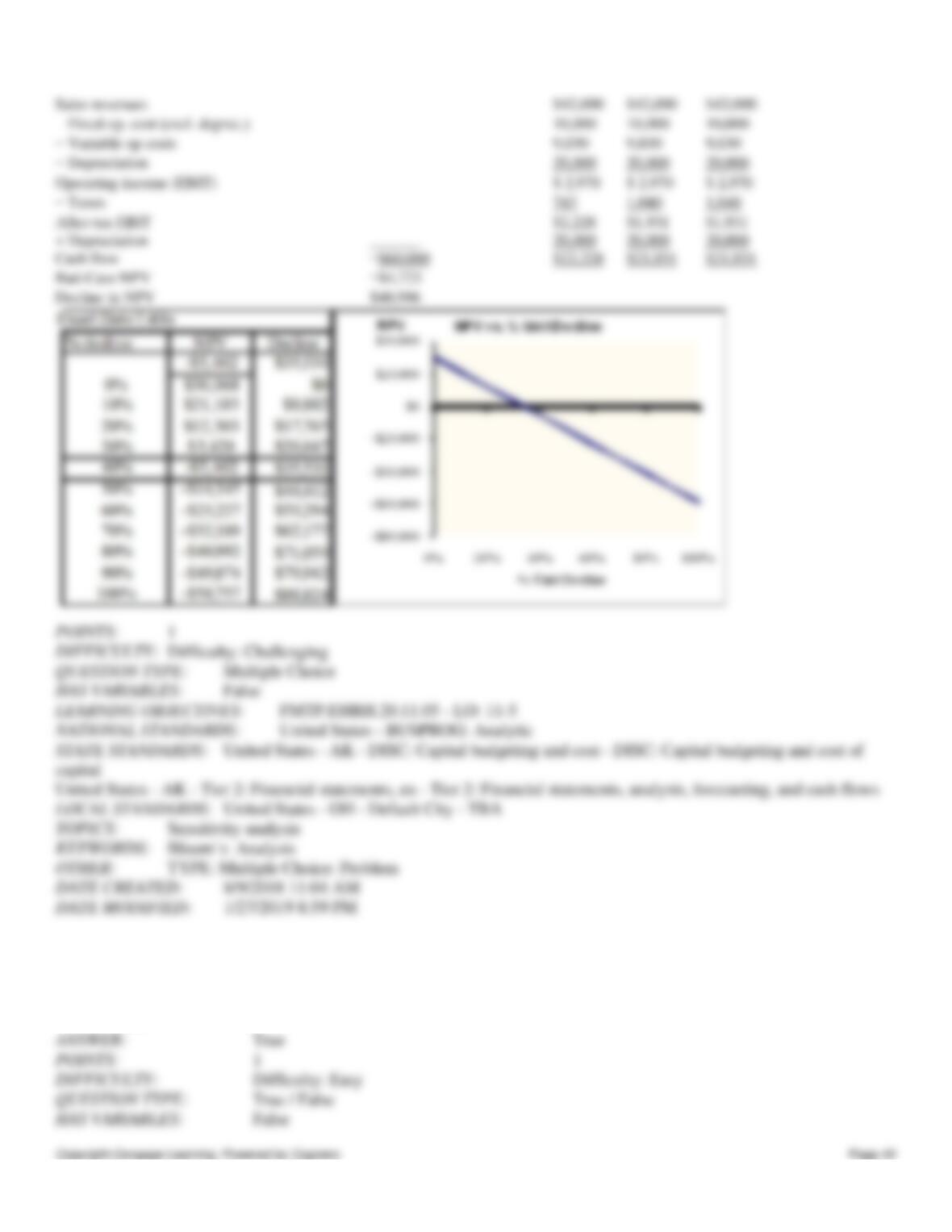
70. Spot-Free Car Wash is considering a new project whose data are shown below. The equipment to be used has a 3-year
tax life, would be depreciated on a straight-line basis over the project’s 3-year life, and would have a zero salvage value
after Year 3. No new working capital would be required. Revenues and other operating costs will be constant over the
project’s life, and this is just one of the firm’s many projects, so any losses on it can be used to offset profits in other units.
If the number of cars washed declined by 40% from the expected level, by how much would the project’s NPV decline?
(Hint: Note that cash flows are constant at the Year 1 level, whatever that level is.)
Project cost of capital (r) 10.0%
Net investment cost (depreciable basis) $60,000
Number of cars washed 2,800
Average price per car $25.00
Fixed op. cost (excl. deprec.) $10,000
Variable op. cost/unit (i.e., VC per car washed) $5.375
Annual depreciation $20,000
Tax rate 25.0%
a. $33,391
b. $35,149
c. $36,999
d. $38,946
e. $40,996
Chapter 11: Cash Flow Estimation and Risk Analysis
71. The coefficient of variation, calculated as the standard deviation of expected returns divided by the expected return, is
a standardized measure of the risk per unit of expected return.
a. True
b. False

Chapter 11: Cash Flow Estimation and Risk Analysis
72. The standard deviation is a better measure of risk than the coefficient of variation if the expected returns of the
securities being compared differ significantly.
a. True
b. False
73. Erickson Inc. is considering a capital budgeting project that has an expected return of 25% and a standard deviation of
30%. What is the project’s coefficient of variation?
a. 1.20
b. 1.26
c. 1.32
d. 1.39
e. 1.46

Chapter 11: Cash Flow Estimation and Risk Analysis
74. McLeod Inc. is considering an investment that has an expected return of 15% and a standard deviation of 10%. What
is the investment’s coefficient of variation?
a. 0.67
b. 0.73
c. 0.81
d. 0.89
e. 0.98
75. Which of the following statements is CORRECT?
a. One advantage of sensitivity analysis relative to scenario analysis is that it explicitly takes into account the
probability of specific effects occurring, whereas scenario analysis cannot account for probabilities.
b. Well-diversified stockholders do not need to consider market risk when determining required rates of return.
c. Market risk is important, but it does not have a direct effect on stock prices because it only affects beta.
d. Simulation analysis is a computerized version of scenario analysis where input variables are selected randomly on
the basis of their probability distributions.
e. Sensitivity analysis is a good way to measure market risk because it explicitly takes into account diversification
effects.

Chapter 11: Cash Flow Estimation and Risk Analysis
76. Which of the following statements is CORRECT?
a. In comparing two projects using sensitivity analysis, the one with the steeper lines would be considered less risky,
because a small error in estimating a variable such as unit sales would produce only a small error in the project’s NPV.
b. The primary advantage of simulation analysis over scenario analysis is that scenario analysis requires a relatively
powerful computer, coupled with an efficient financial planning software package, whereas simulation analysis can be
done efficiently using a PC with a spreadsheet program or even with just a calculator.
c. Sensitivity analysis is a type of risk analysis that considers both the sensitivity of NPV to changes in key input
variables and the probability of occurrence of these variables’ values.
d. As computer technology advances, simulation analysis becomes increasingly obsolete and thus less likely to be
used as compared to sensitivity analysis.
e. Sensitivity analysis as it is generally employed is incomplete in that it fails to consider the probability of
occurrence of the key input variables.
77. Which of the following procedures does the text say is used most frequently by businesses when they do capital
budgeting analyses?
a. Differential project risk cannot be accounted for by using “risk-adjusted discount rates” because it is highly
subjective and difficult to justify. It is better to not risk adjust at all.
b. Other things held constant, if returns on a project are thought to be positively correlated with the returns on other
firms in the economy, then the project’s NPV will be found using a lower discount rate than would be appropriate if the
project’s returns were negatively correlated.
c. Monte Carlo simulation uses a computer to generate random sets of inputs, those inputs are then used to
determine a trial NPV, and a number of trial NPVs are averaged to find the project’s expected NPV. Sensitivity and
scenario analyses, on the other hand, require much more information regarding the input variables, including probability
distributions and correlations among those variables. This makes it easier to implement a simulation analysis than a
scenario or a sensitivity analysis, hence simulation is the most frequently used procedure.
d. DCF techniques were originally developed to value passive investments (stocks and bonds). However, capital
budgeting projects are not passive investments⎯managers can often take positive actions after the investment has been
made that alter the cash flow stream. Opportunities for such actions are called real options. Real options are valuable, but
this value is not captured by conventional NPV analysis. Therefore, a project’s real options must be considered separately.
e. The firm’s corporate, or overall, WACC is used to discount all project cash flows to find the projects’ NPVs.
Then, depending on how risky different projects are judged to be, the calculated NPVs are scaled up or down to adjust for
differential risk.
Chapter 11: Cash Flow Estimation and Risk Analysis
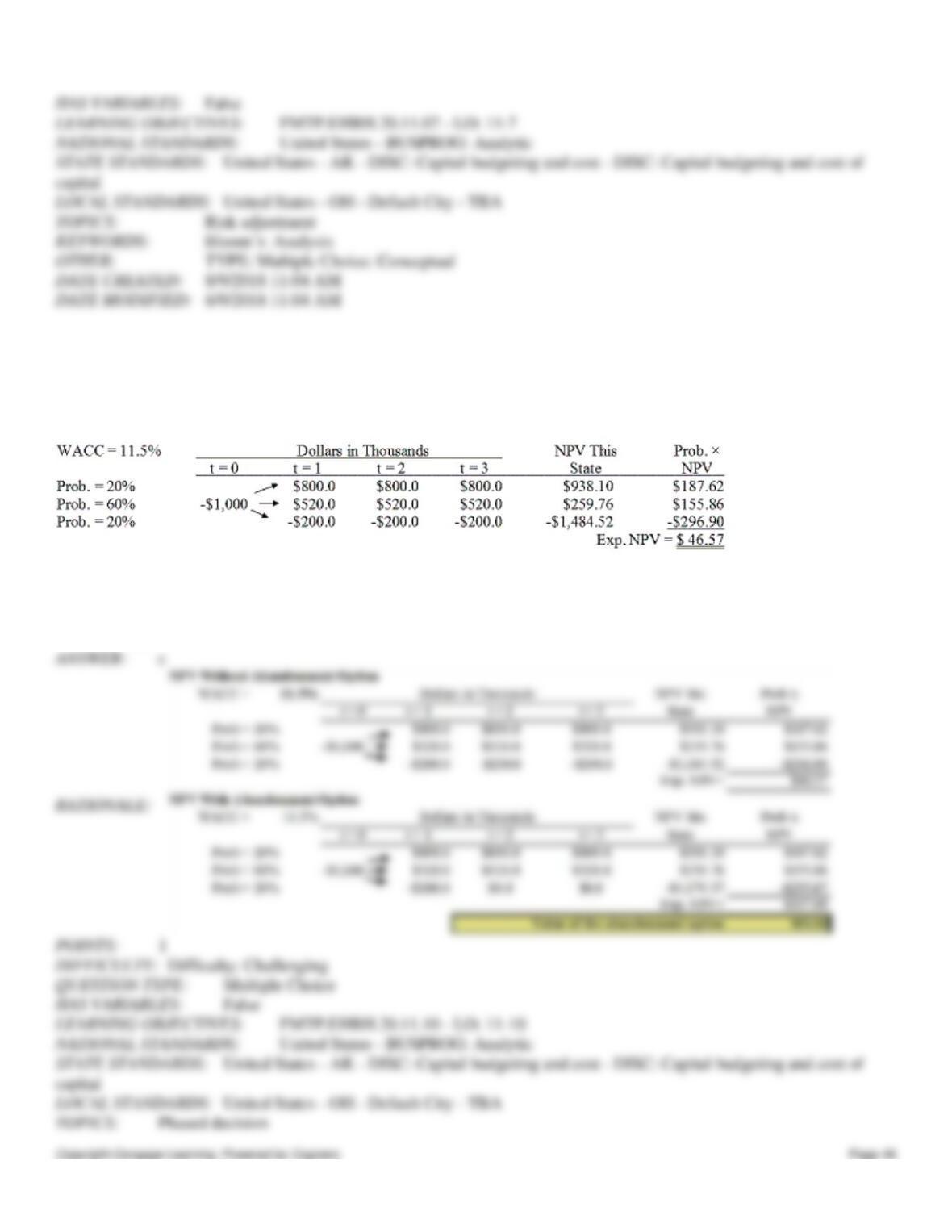
78. Brandt Enterprises is considering a new project that has a cost of $1,000,000, and the CFO set up the following simple
decision tree to show its three most likely scenarios. The firm could arrange with its work force and suppliers to cease
operations at the end of Year 1 should it choose to do so, but to obtain this abandonment option, it would have to make a
payment to those parties. How much is the option to abandon worth to the firm?
a. $55.08
b. $57.98
c. $61.03
d. $64.08
e. $67.29

Chapter 11: Cash Flow Estimation and Risk Analysis