Chapter 11: Cash Flow Estimation and Risk Analysis
e. If an asset is sold for less than its book value at the end of a project’s life, it will generate a loss for the firm, hence
its terminal cash flow will be negative.
45. You have just landed an internship in the CFO’s office of Hawkesworth Inc. Your first task is to estimate the Year 1
cash flow for a project with the following data. What is the Year 1 cash flow?
Sales revenues $13,000
Depreciation $4,000
Other operating costs $6,000
Tax rate 25.0%
a. $6,250
b. $6,406
c. $6,566
d. $6,731
e. $6,899
Chapter 11: Cash Flow Estimation and Risk Analysis
46. In your first job with TBL Inc. your task is to consider a new project whose data are shown below. What is the
project’s Year 1 cash flow?
Sales revenues $22,250
Depreciation $8,000
Other operating costs $12,000
Tax rate 25.0%
a. $9,115
b. $9,397
c. $9,688
d. $9,978
e. $10,277
47. Fitzgerald Computers is considering a new project whose data are shown below. The required equipment has a 3-year
tax life, after which it will be worthless, and it will be depreciated by the straight-line method over 3 years. Revenues and
other operating costs are expected to be constant over the project’s 3-year life. What is the project’s Year 1 cash flow?
Equipment cost (depreciable basis) $65,000
Straight-line depreciation rate 33.333%
Chapter 11: Cash Flow Estimation and Risk Analysis
Sales revenues, each year $60,000
Operating costs (excl. deprec.) $25,000
Tax rate 25.0%
a. $29,351
b. $30,103
c. $30,875
d. $31,667
e. $32,458
48. VR Corporation has the opportunity to invest in a new project, the details of which are shown below. What is the Year
1 cash flow for the project?
Sales revenues, each year $42,500
Depreciation $10,000
Other operating costs $17,000
Interest expense $4,000
Tax rate 25.0%
a. $17,614
b. $18,541
c. $19,517
d. $20,544
e. $21,625
Chapter 11: Cash Flow Estimation and Risk Analysis
49. Taylor Inc., the company you work for, is considering a new project whose data are shown below. What is the
project’s Year 1 cash flow?
Sales revenues, each year $62,500
Depreciation $8,000
Other operating costs $25,000
Interest expense $8,000
Tax rate 25.0%
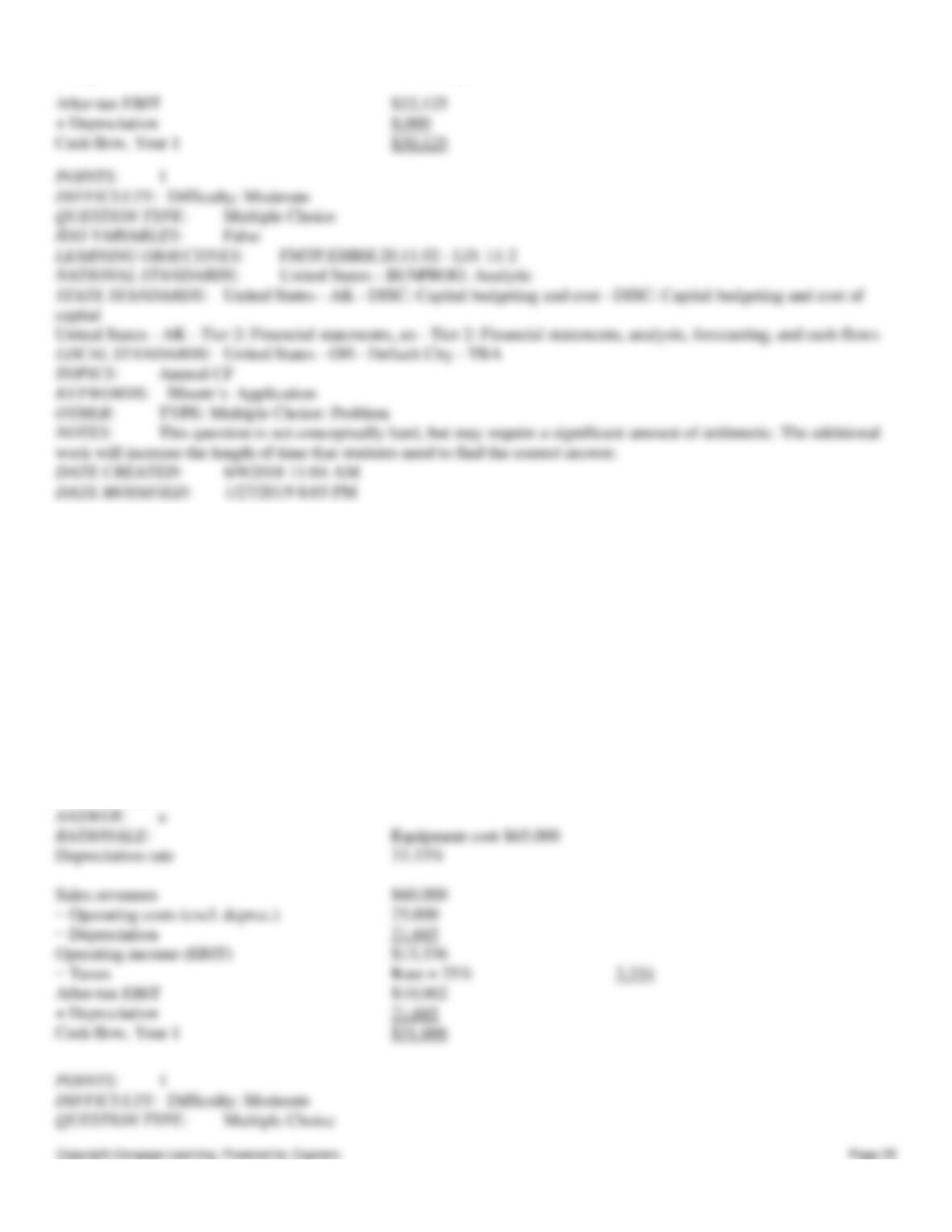
a. $28,619
b. $30,125
c. $31,631
d. $33,213
e. $34,873
Chapter 11: Cash Flow Estimation and Risk Analysis
50. Your new employer, Freeman Software, is considering a new project whose data are shown below. The equipment
that would be used has a 3-year tax life, and the allowed depreciation rates for such property are 33.33%, 44.45%,
14.81%, and 7.41% for Years 1 through 4. Revenues and other operating costs are expected to be constant over the
project’s 10-year expected life. What is the Year 1 cash flow?
Equipment cost (depreciable basis) $65,000
Sales revenues, each year $60,000
Operating costs (excl. deprec.) $25,000
Tax rate 25.0%
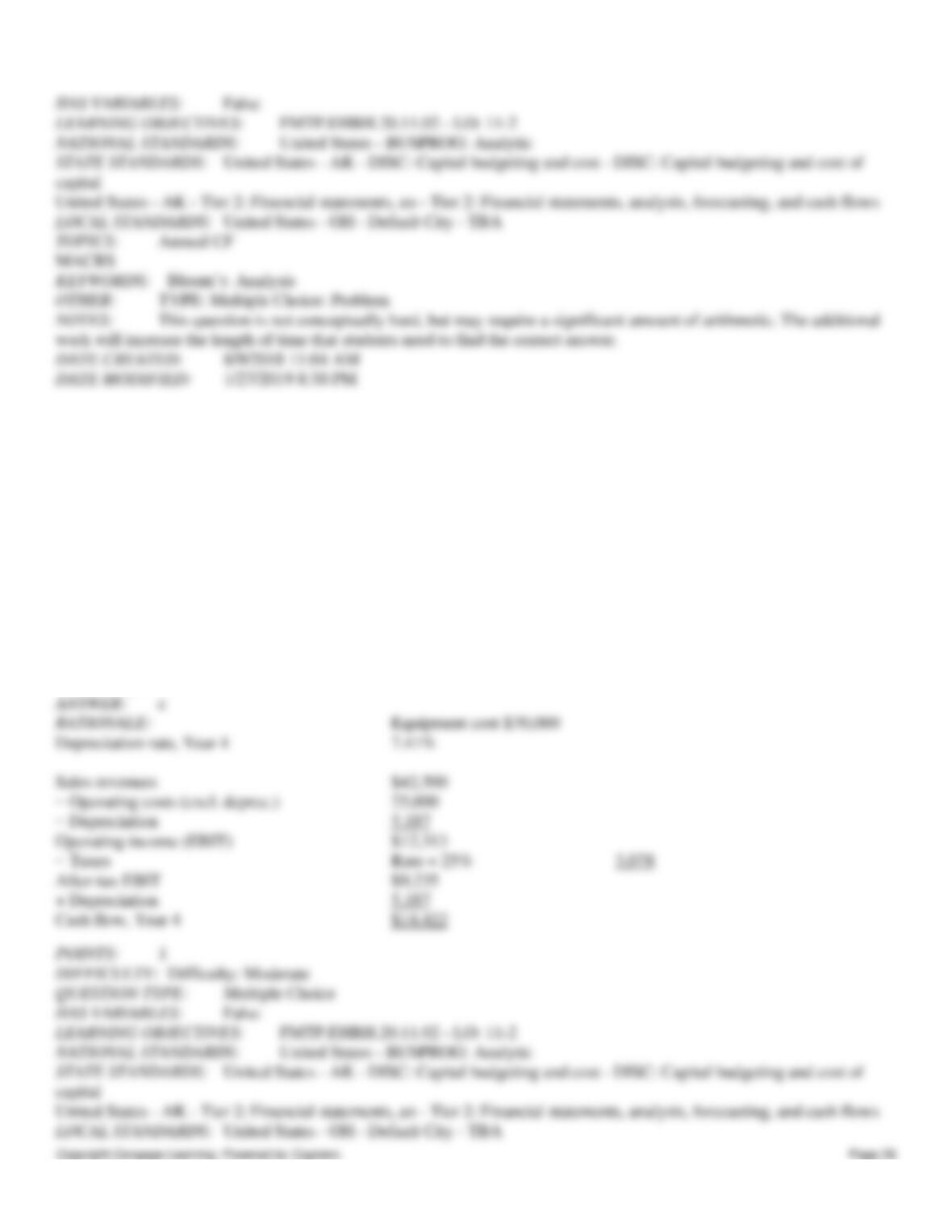
a. $31,666
b. $31,849
c. $33,442
d. $35,114
e. $36,869
Chapter 11: Cash Flow Estimation and Risk Analysis
51. Whitestone Products is considering a new project whose data are shown below. The required equipment has a 3-year
tax life, and the accelerated rates for such property are 33.33%, 44.45%, 14.81%, and 7.41% for Years 1 through 4.
Revenues and other operating costs are expected to be constant over the project’s 10-year expected operating life. What is
the project’s Year 4 cash flow?
Equipment cost (depreciable basis) $70,000
Sales revenues, each year $42,500
Operating costs (excl. deprec.) $25,000
Tax rate 25.0%
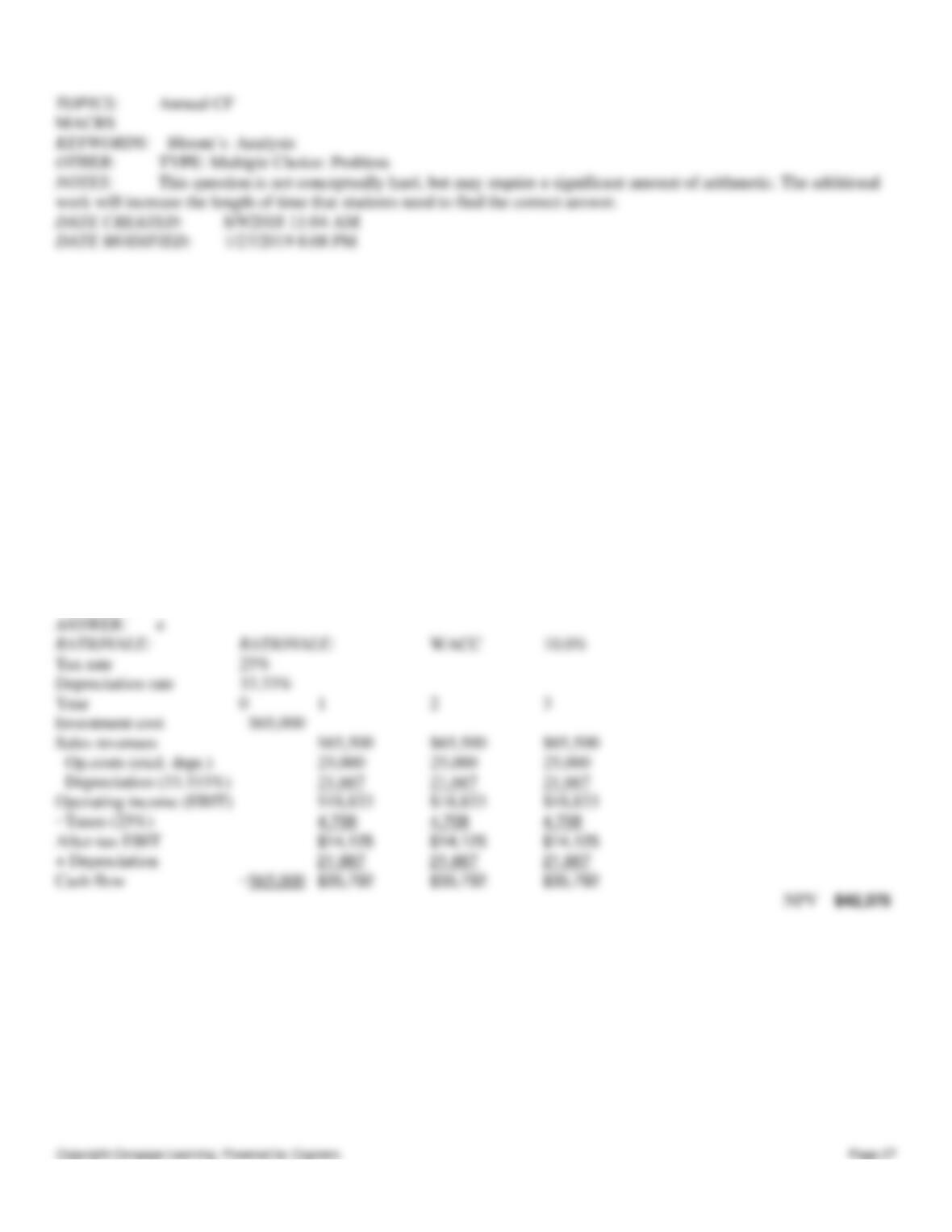
a. $13,016
b. $13,701
c. $14,422
d. $15,143
e. $15,900
Chapter 11: Cash Flow Estimation and Risk Analysis
52. DeVault Services recently hired you as a consultant to help with its capital budgeting process. The company is
considering a new project whose data are shown below. The equipment that would be used has a 3-year tax life, would be
depreciated by the straight-line method over its 3-year life, and would have a zero salvage value. No new working capital
would be required. Revenues and other operating costs are expected to be constant over the project’s 3-year life. What is
the project’s NPV?
Risk-adjusted cost of capital 10.0%
Net investment cost (depreciable basis) $65,000
Straight-line deprec. rate 33.3333%
Sales revenues, each year $65,500
Operating costs (excl. deprec.), each year $25,000
Tax rate 25.0%
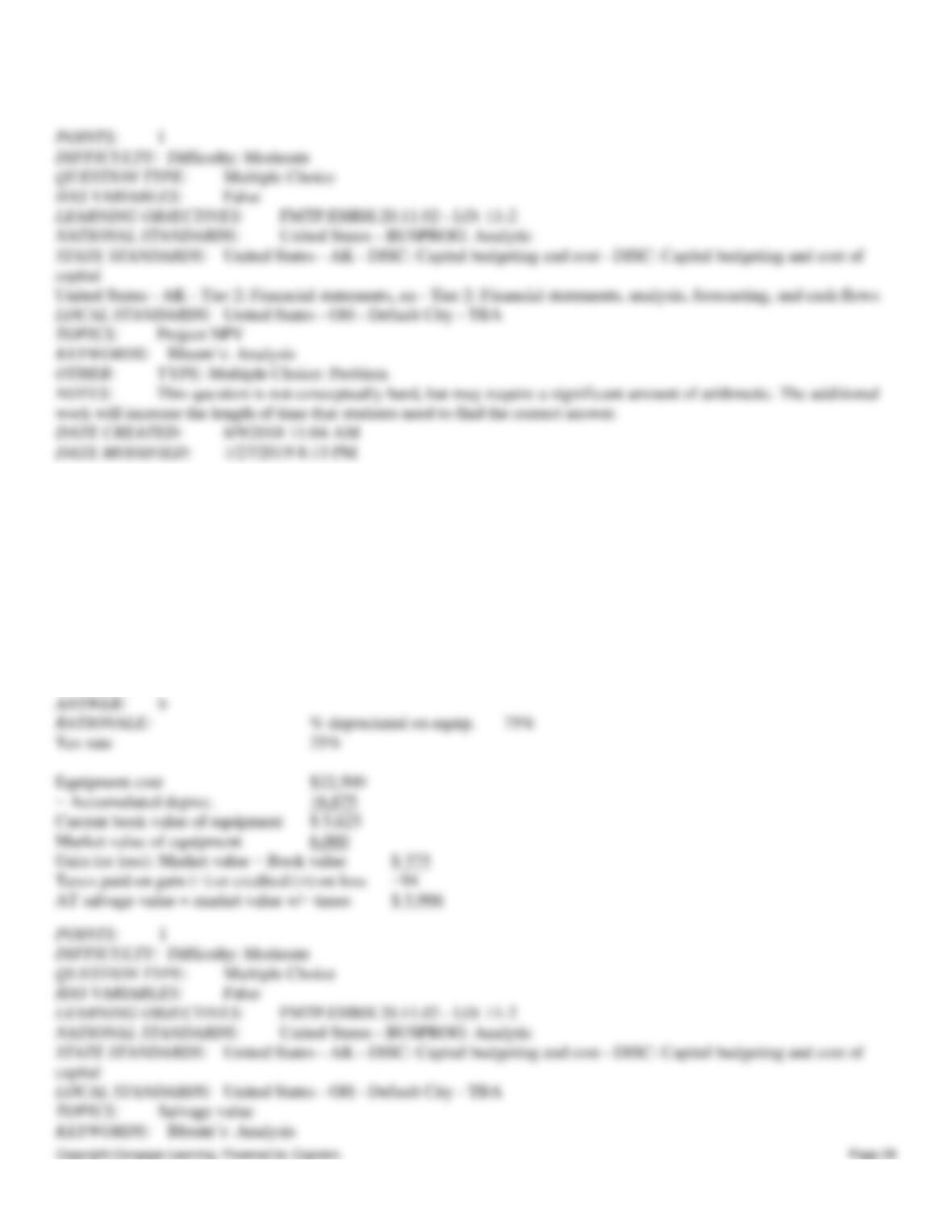
a. $34,515
b. $36,331
c. $38,243
d. $40,256
e. $42,375
Chapter 11: Cash Flow Estimation and Risk Analysis
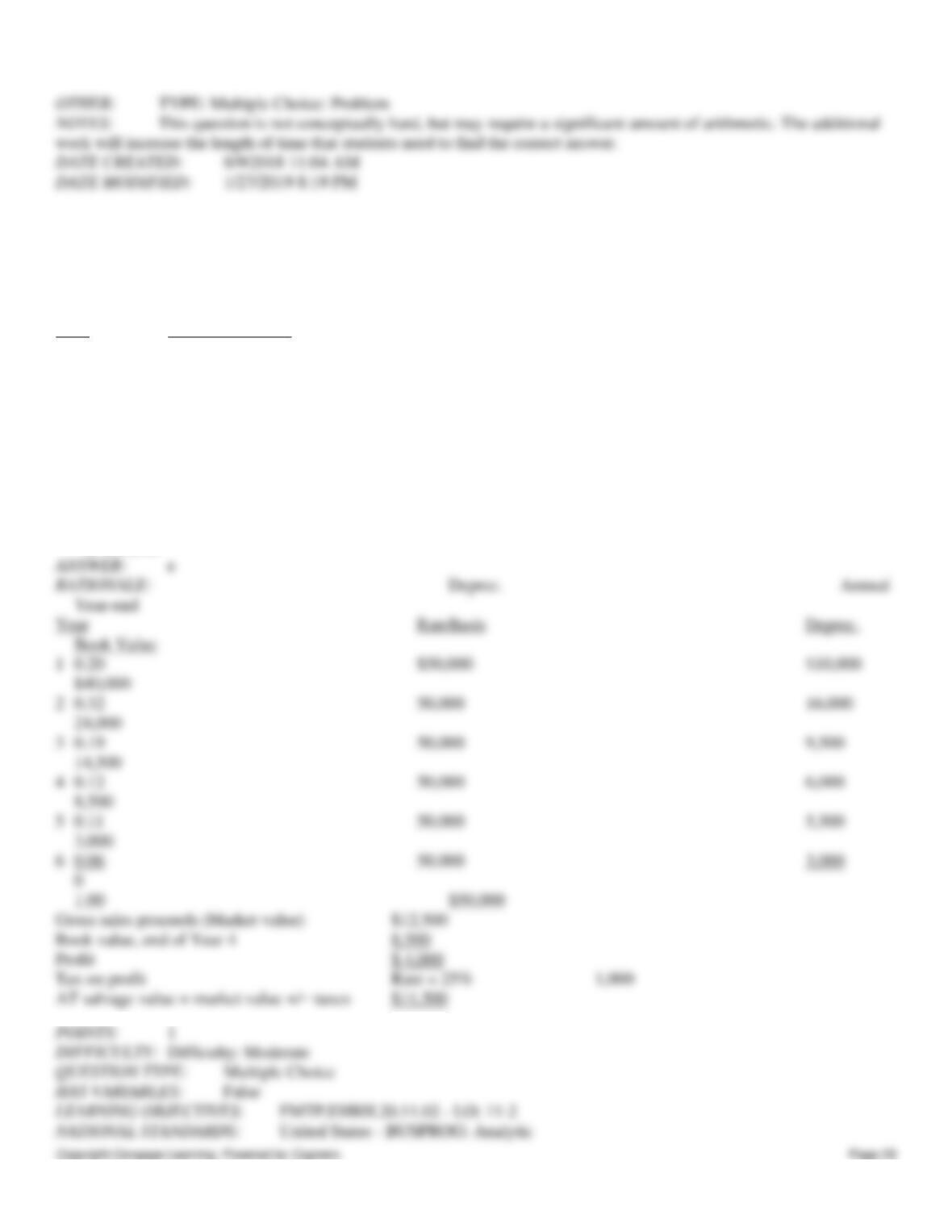
53. Kasper Film Co. is selling off some old equipment it no longer needs because its associated project has come to an
end. The equipment originally cost $22,500, of which 75% has been depreciated. The firm can sell the used equipment
today for $6,000, and its tax rate is 25%. What is the equipment’s after-tax salvage value for use in a capital budgeting
analysis? Note that if the equipment’s final market value is less than its book value, the firm will receive a tax credit as a
result of the sale.
a. $5,611
b. $5,906
c. $6,202
d. $6,512
e. $6,837
Chapter 11: Cash Flow Estimation and Risk Analysis
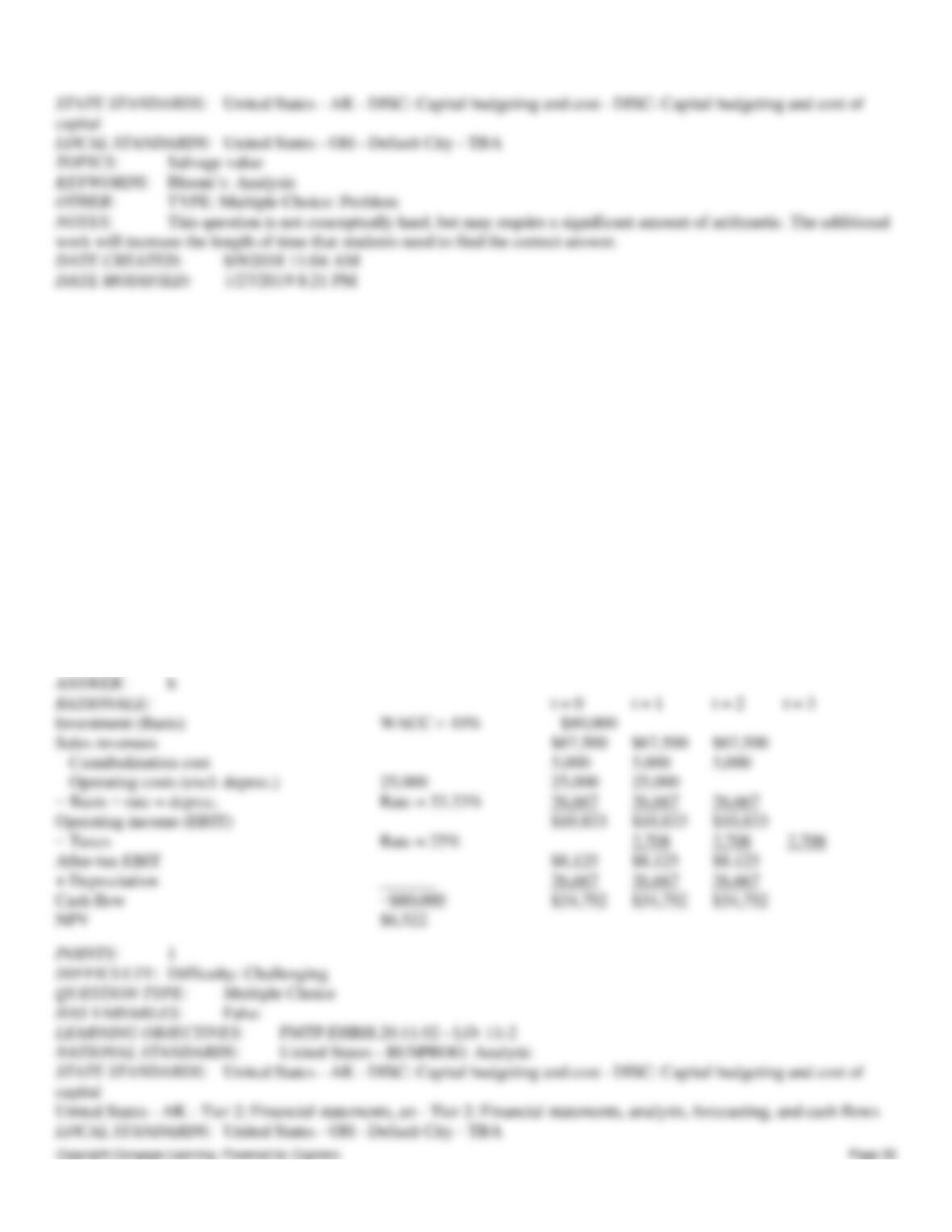
54. McPherson Company must purchase a new milling machine. The purchase price is $50,000, including installation.
The machine has a tax life of 5 years, and it can be depreciated according to the following rates. The firm expects to
operate the machine for 4 years and then to sell it for $12,500. If the marginal tax rate is 25%, what will the after-tax
salvage value be when the machine is sold at the end of Year 4?
Year Depreciation Rate
1 0.20
2 0.32
3 0.19
4 0.12
5 0.11
6 0.06
a. $9,367
b. $9,860
c. $10,379
d. $10,925
e. $11,500
Chapter 11: Cash Flow Estimation and Risk Analysis
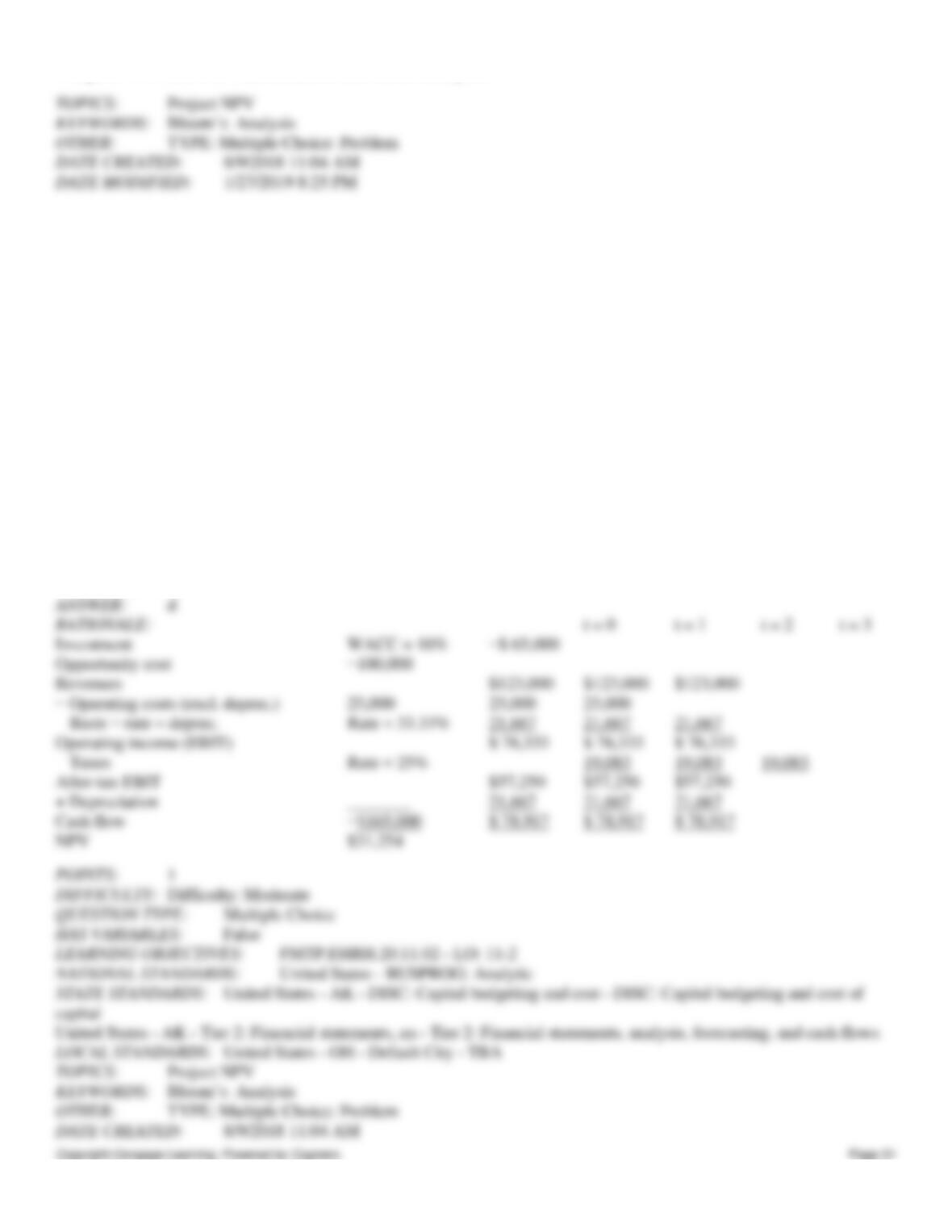
55. Weston Clothing Company is considering manufacturing a new style of shirt, whose data are shown below. The
equipment to be used would be depreciated by the straight-line method over its 3-year life and would have a zero salvage
value, and no new working capital would be required. Revenues and other operating costs are expected to be constant over
the project’s 3-year life. However, this project would compete with other Weston’s products and would reduce their pre-
tax annual cash flows. What is the project’s NPV? (Hint: Cash flows are constant in Years 1-3.)
Cost of capital 10.0%
Pre-tax cash flow reduction for other products (cannibalization) $5,000
Investment cost (depreciable basis) $80,000
Straight-line deprec. rate 33.333%
Sales revenues, each year for 3 years $67,500
Annual operating costs (excl. deprec.) $25,000
Tax rate 25.0%
a. $6,196
b. $6,522
c. $6,848
d. $7,190
e. $7,550
Chapter 11: Cash Flow Estimation and Risk Analysis
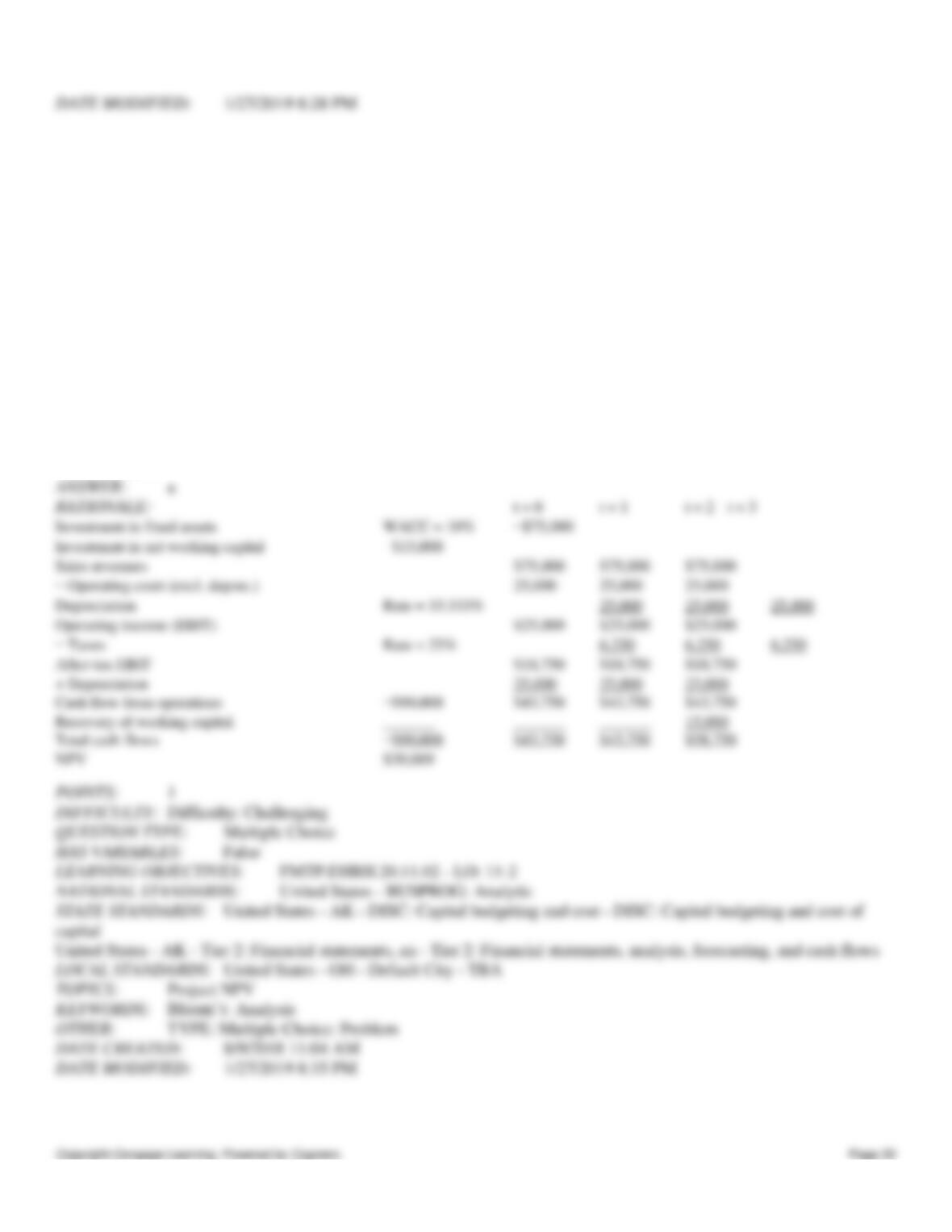
56. Century Roofing is thinking of opening a new warehouse, and the key data are shown below. The company owns the
building that would be used, and it could sell it for $100,000 after taxes if it decides not to open the new warehouse. The
equipment for the project would be depreciated by the straight-line method over the project’s 3-year life, after which it
would be worth nothing and thus it would have a zero salvage value. No new working capital would be required, and
revenues and other operating costs would be constant over the project’s 3-year life. What is the project’s NPV? (Hint: Cash
flows are constant in Years 1-3.)
Project cost of capital (r) 10.0%
Opportunity cost $100,000
Net equipment cost (depreciable basis) $65,000
Straight-line deprec. rate for equipment 33.333%
Sales revenues, each year $123,000
Operating costs (excl. deprec.), each year $25,000
Tax rate 25%
a. $26,796
b. $28,207
c. $29,691
d. $31,254
e. $32,817
Chapter 11: Cash Flow Estimation and Risk Analysis
57. Garden-Grow Products is considering a new investment whose data are shown below. The equipment would be
depreciated on a straight-line basis over the project’s 3-year life, would have a zero salvage value, and would require some
additional working capital that would be recovered at the end of the project’s life. Revenues and other operating costs are
expected to be constant over the project’s life. What is the project’s NPV? (Hint: Cash flows are constant in Years 1 to 3.)
Project cost of capital (r) 10.0%
Net investment in fixed assets (basis) $75,000
Required new working capital $15,000
Straight-line deprec. rate 33.333%
Sales revenues, each year $75,000
Operating costs (excl. deprec.), each year $25,000
Tax rate 25.0%
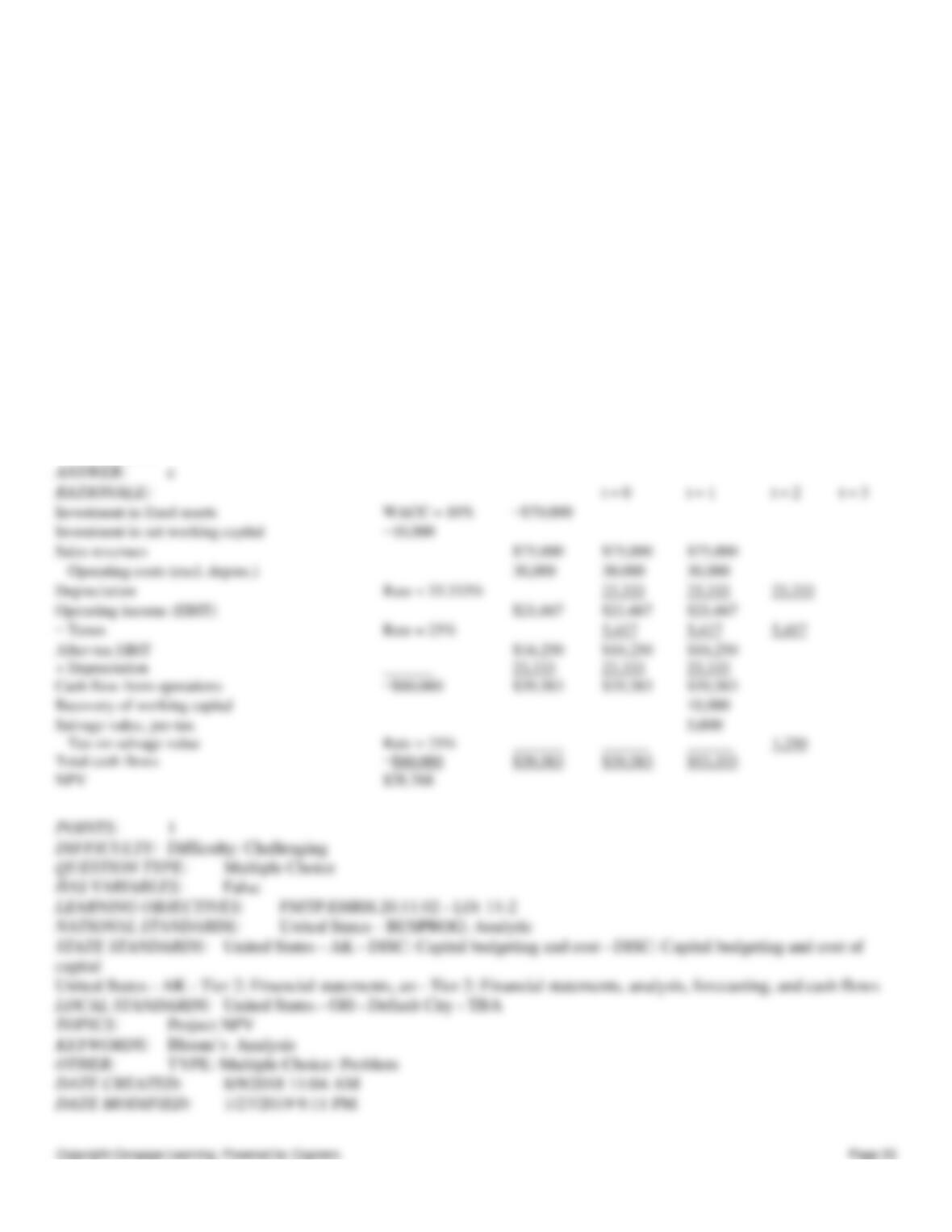
a. $30,069
b. $31,573
c. $33,152
d. $34,809
e. $36,550
Chapter 11: Cash Flow Estimation and Risk Analysis
58. Sheridan Films is considering some new equipment whose data are shown below. The equipment has a 3-year tax life
and would be fully depreciated by the straight-line method over 3 years, but it would have a positive pre-tax salvage value
at the end of Year 3, when the project would be closed down. Also, some new working capital would be required, but it
would be recovered at the end of the project’s life. Revenues and other operating costs are expected to be constant over the
project’s 3-year life. What is the project’s NPV?
Project cost of capital (r) 10.0%
Net investment in fixed assets (depreciable basis) $70,000
Required new working capital $10,000
Straight-line deprec. rate 33.333%
Sales revenues, each year $75,000
Operating costs (excl. deprec.), each year $30,000
Expected pretax salvage value $5,000
Tax rate 25.0%
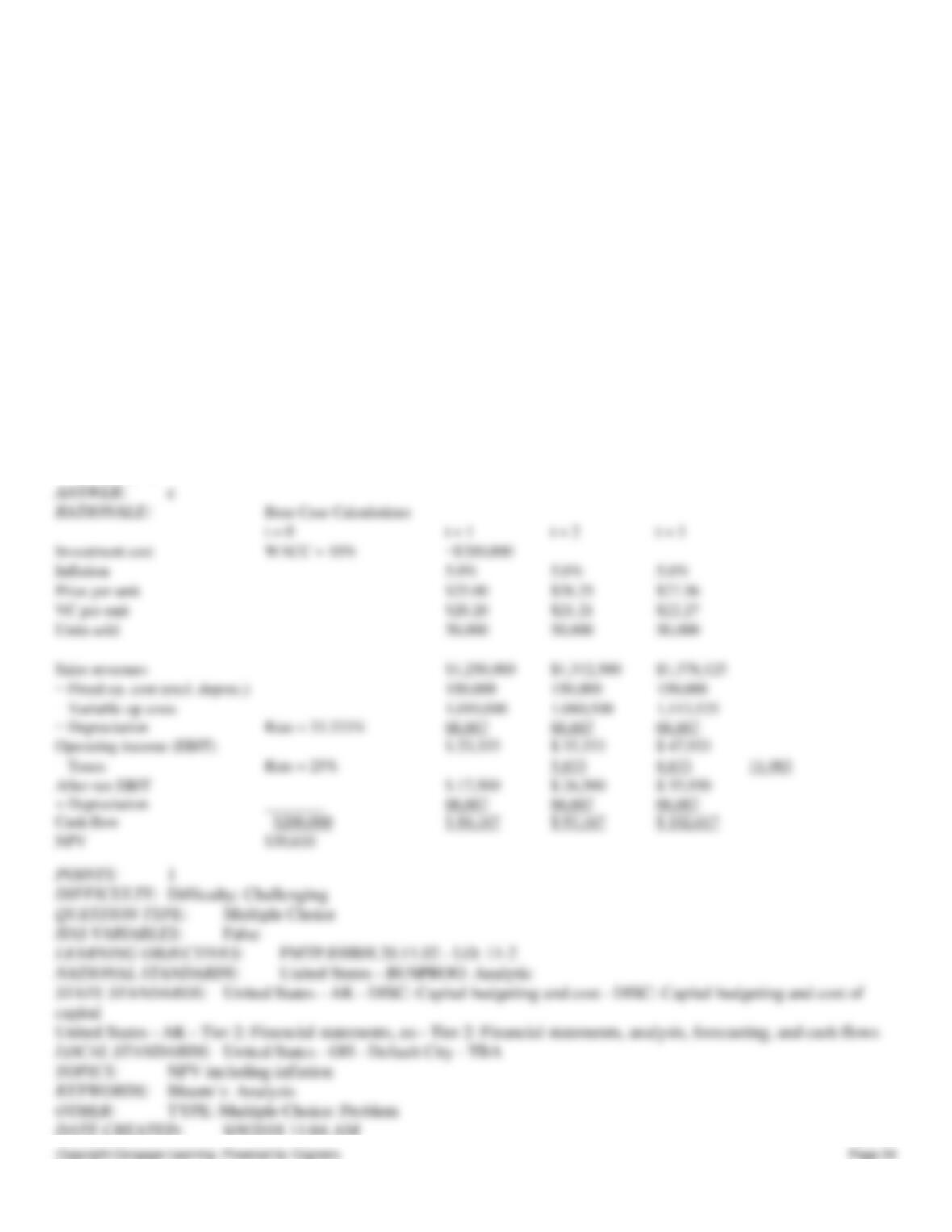
a. $25,964
b. $27,330
c. $28,768
d. $30,207
e. $31,717
Chapter 11: Cash Flow Estimation and Risk Analysis
59. Shultz Business Systems is analyzing an average-risk project, and the following data have been developed. Unit sales
will be constant, but the sales price should increase with inflation. Fixed costs will also be constant, but variable costs
should rise with inflation. The project should last for 3 years, it will be depreciated on a straight-line basis, and there will
be no salvage value. This is just one of many projects for the firm, so any losses can be used to offset gains on other firm
projects. What is the project’s expected NPV?
Project cost of capital (r) 10.0%
Net investment cost (depreciable basis) $200,000
Units sold 50,000
Average price per unit, Year 1 $25.00
Fixed op. cost excl. deprec. (constant) $150,000
Variable op. cost/unit, Year 1 $20.20
Annual depreciation rate 33.333%
Expected inflation rate per year 5.00%
Tax rate 25.0%
a. $27,625
b. $29,079
c. $30,610
d. $32,140
e. $33,747