19) A) Describe three types of sample selection methods commonly associated with statistical
audit sampling.
B) Explain the difference between sampling with replacement and without replacement. Which
method is more common in audit practice?
C) Describe the steps involved in systematic sampling.
20) You have recently been hired as an audit trainee with an internal audit department. Your first
assignment will be to select the sample for a test of new capital assets acquired over the last two
years. Your review of the internal audit files indicates that the last time this work was done the
sample to be tested was selected on a judgmental nonstatistical basis.
However, based on your university/college audit course, you believe the work offers good
potential for the use of statistical sampling techniques. You know that you will have to be able to
explain and justify your opinion to the internal audit manager.
Required:
Both statistical sampling as well as nonstatistical or judgmental sampling have advantages and
disadvantages. Briefly state two advantages and two disadvantages of statistical sampling and
one advantage and one disadvantage of nonstatistical sampling.
11.3 Describe the 14 steps in planning and selecting a sample, performing the tests, and
evaluating the sample
1) The overall objectives of the audit test must be stated in terms of the
A) anticipated results.
B) transaction cycle being tested.
C) risks addressed and the transaction cycle being tested.
D) risk addressed and the anticipated results.
2) As part of the audit program for the audit of sales, the auditor will “review sales transactions
for large and unusual amounts.” Which of the following types of sampling would be suitable for
this audit procedure?
A) systematic
B) attribute
C) block
D) directed
3) During the audit of the fixed asset section, the auditor decided to inspect source documents
supporting all fixed asset additions exceeding $3,000. This type of audit procedure is called a
A) census of the strata over $3,000
B) analytical review
C) attribute sample
D) monetary unit sample
4) As part of the audit of sales, the auditor has used attribute sampling to select a sample of sales
invoices. The auditor has examined the duplicate sales invoice to determine whether it was
approved for credit. Which of the following would be termed the “attribute?” The
A) sales invoice number
B) approval initials
C) name of the person who approves credit
D) absence of an authorization
5) As part of the audit of sales, the auditor has used attribute sampling to select a sample of sales
invoices. The auditor has examined the duplicate sales invoice to determine whether it was
approved for credit. Which of the following would be termed the “exception?” The
A) sales invoice number.
B) approval initials.
C) name of the person who approves credit.
D) absence of an authorization.
6) As part of the audit of sales, the auditor has used attribute sampling to select a sample of sales
invoices. The auditor has examined the duplicate sales invoice to determine whether it was
approved for credit. The client has a December year end. In October, the auditor conducted the
interim audit and drew a sample of 40 items that covered the period from January to September.
In order to be able to generalize to the sales population, the auditor should also
A) select sample items from the rest of the year.
B) increase the sample size in proportion to the total population size.
C) use statistical methods to calculate sampling risk.
D) use statistical methods to calculate non-sampling risk.
7) To ensure that all the population items will be properly subjected to the sample selection
process, the auditor should
A) use a random number generator for sample selection.
B) use monetary unit sample selection methods.
C) document the range of document numbers in use by the client.
D) test the population for completeness.
8) The exception rate the auditor will permit in the population and still be willing to use the
assessed level of control risk is called the
A) tolerable exception rate.
B) estimated population exception rate.
C) acceptable risk of overreliance.
D) sample exception rate.
9) Establishing the tolerable exception rate (TER) requires
A) statistical frequency probability tables.
B) random number tables.
C) a computer program.
D) professional judgment.
10) The tolerable exception rate (TER) has a significant effect on sample size. The relationship
of TER to sample size is
A) direct (larger TER = larger sample).
B) inverse (larger TER = smaller sample).
C) variable (sometimes larger, sometimes smaller).
D) not determinable.
11) In statistical terms, acceptable risk of assessing control risk too low (ARACR) corresponds
with
A) sampling risk.
B) inherent risk.
C) control risk.
D) nonsampling risk.
12) The acceptable risk of incorrect acceptance (ARIA) has a significant effect on sample size.
The relationship of ARIA to sample size is
A) direct (larger ARIA = larger sample).
B) inverse (larger ARIA = smaller sample).
C) variable (sometimes larger, sometimes smaller).
D) not determinable.
13) In attribute sampling, an advance estimate of the expected population exception rate is
necessary to plan the appropriate sample size. The relationship of expected population exception
rate (EPER) to sample size is
A) direct (small EPER = small sample).
B) inverse (small EPER = large sample).
C) a variable (sometimes small, sometimes large) dependent on other factors present.
D) indeterminate.
14) If all other factors specified in a sampling plan remain constant, changing the estimated
population exception rate (EPER) from 2% to 4% would cause the required sample size to
A) increase.
B) remain the same.
C) decrease.
D) become indeterminate.
15) The sample exception rate equals the number of
A) exceptions in the population divided by the sample size.
B) items in the population multiplied by the number of exceptions in the sample.
C) exceptions in the sample divided by the sample size.
D) exceptions in the population divided by the population size.
16) Helen found that the expense reports were not properly approved while the senior accounts
payable clerk was on vacation in July. Helen decided to perform a test of control on the
authorization of expense reports for all the months except for July which she will test
substantively. Helen is allowed to do this because
A) the authorized expense reports for July are not material.
B) it would not be cost beneficial to test the entire population substantively.
C) the authorizations for the month of July are not representative of the population as a whole.
D) compensating controls exist in the payroll reconciliation process.
17) The final step in the evaluation of the audit results is the decision to
A) determine the acceptability of the population.
B) determine sampling error and calculate the estimated total population error.
C) analyze exceptions or misstatements.
D) determine the error in each sample.
18) An increase in the sample size has the effect of decreasing the sampling error if the
A) actual sample exception rate increases.
B) actual sample exception rate does not increase.
C) number of exceptions in the sample does not increase.
D) number of exceptions in the sample increases.
19) An auditor who uses statistical sampling for attributes in testing internal controls should
increase the assessed level of control risk when the
A) sample rate of exceptions is less than the expected rate of exception used in planning the
sample.
B) tolerable exception rate less the allowance for sampling risk exceeds the sample rate of
deviation.
C) sample rate of exceptions plus the allowance for sampling risk exceeds the tolerable exception
rate.
D) sample rate of exceptions plus the allowance for sampling risk equals the tolerable exception
rate.
20) There are 14 steps to audit sampling, divided into four sections: plan the sample, select the
sample, perform the audit procedures, and evaluate the results. Discuss each of the steps that
comprise the “plan the sample” section for attribute sampling.
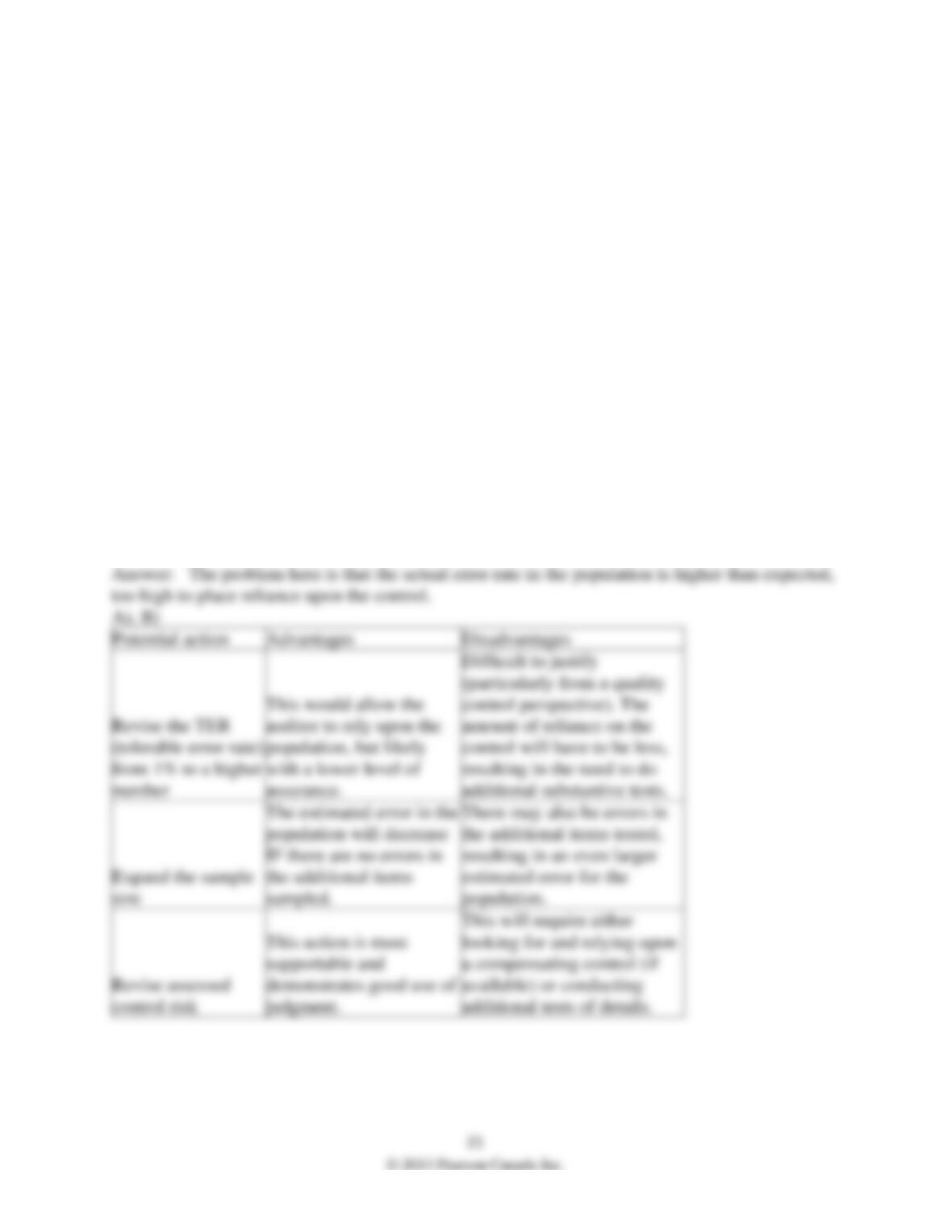
21) You are working on the testing of internal controls over price changes in the inventory
system. You completed the controls testing to determine whether all price changes were
approved by the senior accountant, by reference to master file change forms.
In order to place reliance on this control, your audit supervisor has decided that the error rate in
the population should be less than 1%. When you calculated your sample size, you used a
confidence level of 90% and predicted an error rate in the population of less than one percent.
Based on these decisions, you examined 150 inventory price master file change forms.
In your testing, you uncovered two deviations. Based on these results, you calculate that the
actual error rate in the population could be as high as 2.33 %.
Required:
A) What actions are available to you regarding your planned reliance on the master file change
controls?
B) What are the advantages and disadvantages of each action?
C) How would you decide which action to take?
22) You have just been given the approval to conduct statistical sampling for the audit of capital
assets acquisitions. Previously, this work was completed using a judgmental sample.
Required:
Explain the key areas where decisions need to be made when conducting audit work using a
statistical sample.
23) You are analyzing the exceptions that arose after your control testing of credit limit
approvals. There were four exceptions where credit had not been approved. One was for a
customer that was subsequently placed on C.O.D. (cash on delivery), and three occurred while
the business was in the middle of its busy season, processing three times more transactions than
most other times of the year. The company’s busy season normally lasts about two months.
Required:
A) What is an anomaly?
B) Are any of the exceptions that you found anomalous? Why or why not?
C) Provide an example of a credit approval testing exception that would be anomalous.