66) Which of the following should be excluded in an analysis of a new project’s cash flows?
A) Additional investment in fixed assets
B) Additional investment in accounts receivable
C) Additional investment in inventory
D) Additional interest expenses on debt financing
67) Which of the following expenses associated with a project should not be included in a capital
budgeting analysis?
A) Additional allocated fixed overhead from corporate headquarters
B) Additional maintenance expenses associated with new equipment
C) Reengineering of a production line associated with a new project
D) Training sales staff on a new product
68) A new machine can be purchased for $1,200,000. It will cost $35,000 to ship and $15,000 to
modify the machine. A $12,000 recently completed feasibility study indicated that the firm can
employ an existing factory owned by the firm, which would have otherwise been sold for
$180,000. The firm will borrow $750,000 to finance the acquisition. Total interest expense for 5-
years is expected to approximate $350,000. What is the investment cost of the machine for
capital budgeting purposes?
A) $2,180,000
B) $1,780,000
C) $1,442,000
D) $1,430,000
69) Zinc, Inc. is considering the acquisition of a new processing line. The processor can be
purchased for $4,550,000. It will cost $65,000 to ship and $190,500 to install the processor. A
recently completed feasibility study that was performed at a cost of $45,000 indicated that the
processor would produce a positive NPV. Studies have shown that employee-training expenses
will be $150,000. What is the total investment in the processing line for capital budgeting
purposes?
A) $4,550,000
B) $4,700,000
C) $4,955,500
D) $5,000,500
70) Which of the following should not be included as investment costs in evaluating a capital
asset?
A) Interest payments and other financing cash flows that result from raising funds to finance a
project
B) Employee training expenses
C) Shipping expenses
D) Installation expenses
71) A new machine can be purchased for $1,800,000. It will cost $35,000 to ship and $15,000 to
fine-tune the machine. The new machine will replace an older version that is fully depreciated
and will be sold for $200,000. The firm’s income tax rate is 35%. What is the initial outlay for
capital budgeting purposes?
A) $1,580,000
B) $1,630,000
C) $1,650,000
D) $1,720,000
72) Blue Jay Industries is considering the purchase of a new machine. It will replace an existing
but obsolete machine that will be sold for $50,000. The existing machine is 8 years old, cost
$200,000, had a 10-year useful life, and is being depreciated to zero using the straight-line
method. Blue Jay’s income tax rate is 35%. What is the after-tax salvage value of the old
machine?
A) $42,000
B) $46,500
C) $50,000
D) $53,500
73) Zinc, Inc. is considering the acquisition of a new processing line. The processor can be
purchased for $3,750,000; it will have a 10-year useful life. It will cost $165,000 to ship and
$85,250 to install the processor. A recently completed feasibility study that was performed at a
cost of $65,000 indicated that the processor would produce a positive NPV. The processor will
be depreciated using the straight-line method to zero expected salvage value. Studies have shown
that employee-training expenses will be $125,000. What will be the annual depreciation expense
of the processing line for capital budgeting purposes?
A) $375,000
B) $419,025
C) $390,000
D) $400,025
74) Nickel Industries is considering the purchase of a new machine that will cost $178,000, plus
an additional $12,000 to ship and install. The new machine will have a 5-year useful life and will
be depreciated using the straight-line method. The machine is expected to generate new sales of
$85,000 per year and is expected to increase operating costs by $10,000 annually. Nickel’s
income tax rate is 40%. What is the projected incremental cash flow of the machine for year 1?
A) $54,800
B) $60,200
C) $66,350
D) $68,200
75) Crighton Industries is considering the purchase of a new machine that will cost $250,000,
plus an additional $10,000 to ship and install. The new machine will have a 5-year useful life and
will be depreciated to zero using the straight-line method. The machine is expected to have a
salvage value of $30,000 at the end of year five. Crighton’s income tax rate is 40%. The
additional net working capital from this project of $50,000 is expected to return to its pre-project
level upon termination. What is the non-operating terminal cash flow of the machine?
A) -$32,000
B) $48,000
C) $68,000
D) $80,000
76) Creighton Industries is considering the purchase of a new strapping machine, which will cost
$150,000, plus an additional $10,500 to ship and install. The new machine will have a 5-year
useful life and will be depreciated to zero using the straight-line method. The machine is
expected to generate new sales of $45,000 per year and is expected to save $16,000 in labor and
electrical expenses over the next 5-years. The machine is expected to have a salvage value of
$20,000. Creighton’s income tax rate is 35%. What is the machine’s IRR?
A) 15.75%
B) 18.86%
C) 19.15%
D) 20.03%
77) A company is expanding and has already signed a lease on new office space that costs
$10,000 per month. The company also needs a new information system and hired a consultant to
recommend new software. The consultant was paid $5,000 for her recommendation. Now the
company is trying to make a choice between three competing software products. In the capital
budgeting decision to purchase new software, the monthly rent for the office space is ________
and the consultant’s fee is ________.
A) a sunk cost; a sunk cost
B) an opportunity cost; a sunk cost
C) incremental cash outflow; an opportunity cost
D) a sunk cost; a part of the initial outlay
78) As part of its expansion project, A.J. Industries Equipment Division has expanded its office
space by 200 square feet. The company’s administrative overhead is allocated based on the
square footage of each business segment. Although the total administrative overhead for the
company will remain the same, the Equipment Division will be charged more for administrative
overhead. For the Equipment Division expansion project, the administrative overhead is an
example of a(n)
A) incremental cash flow.
B) sunk cost.
C) opportunity cost.
D) incremental opportunity cash flow.
79) An asset with an original cost of $100,000 and a current book value of $20,000 is sold for
$50,000 as part of a capital budgeting project. The company has a tax rate of 30%. This
transaction will have what impact on the project’s initial outlay?
A) reduce it by $20,000
B) reduce it by $50,000
C) reduce it by $6,000
D) reduce it by $15,000
80) PDF Corp. needs to replace an old lathe with a new, more efficient model. The old lathe was
purchased for $50,000 nine years ago and has a current book value of $5,000. (The old machine
is being depreciated on a straight-line basis over a ten-year useful life.) The new lathe costs
$100,000. It will cost the company $10,000 to get the new lathe to the factory and get it
installed. The old machine will be sold as scrap metal for $2,000. The new machine is also
being depreciated on a straight-line basis over ten years. Sales are expected to increase by
$8,000 per year while operating expenses are expected to decrease by $12,000 per year. PDF’s
marginal tax rate is 40%. Additional working capital of $3,000 is required to maintain the new
machine and higher sales level. The new lathe is expected to be sold for $5,000 at the end of the
project’s ten-year life. What is the incremental free cash flow during years 2 through 10 of the
project?
A) $13,600
B) $14,400
C) $15,800
D) $16,400
81) PDF Corp. needs to replace an old lathe with a new, more efficient model. The old lathe was
purchased for $50,000 nine years ago and has a current book value of $5,000. (The old machine
is being depreciated on a straight-line basis over a ten-year useful life.) The new lathe costs
$100,000. It will cost the company $10,000 to get the new lathe to the factory and get it
installed. The old machine will be sold as scrap metal for $2,000. The new machine is also
being depreciated on a straight-line basis over ten years. Sales are expected to increase by
$8,000 per year while operating expenses are expected to decrease by $12,000 per year. PDF’s
marginal tax rate is 40%. Additional working capital of $3,000 is required to maintain the new
machine and higher sales level. The new lathe is expected to be sold for $5,000 at the end of the
project’s ten-year life. What is the project’s terminal cash flow?
A) $3,000
B) $5,000
C) $6,000
D) $8,000
82) Premium Pie Company needs to purchase a new baking oven to replace an older oven that
requires too much energy to run. The industrial size oven will cost $1,200,000. The oven will
be depreciated on a straight-line basis over its six-year useful life. The old oven cost the
company $800,000 just four years ago. The old oven is being depreciated on a straight-line basis
over its expected ten-year useful life. (That is, the old oven is expected to last six more years if it
is not replaced now.) Due to changes in fuel costs, the old oven may only be sold today for
$100,000. The new oven will allow the company to expand, increasing sales by $300,000 per
year. Expenses will also decrease by $50,000 per year due to the more energy efficient design of
the new oven. Premium Pie Company is in the 40% marginal tax bracket and has a required rate
of return of 10%.
a. Calculate the net present value and internal rate of return of replacing the existing machine
b. Explain the impact on NPV of the following:
i. Required rate of return increases
ii. Operating costs of new machine are increased
iii. Existing machine sold for less
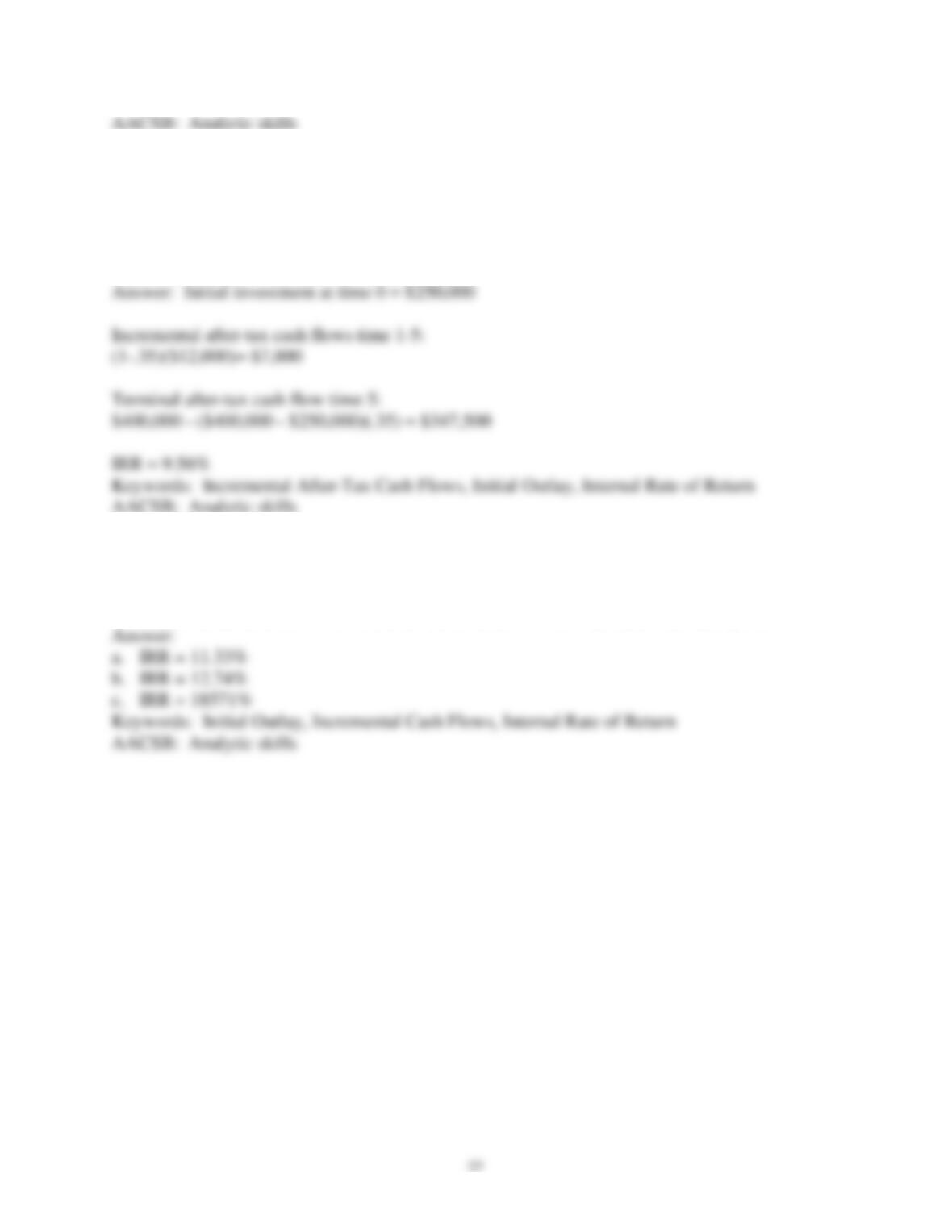
83) Agri-Industries purchased some agricultural land at the edge of a large metropolitan area for
$250,000 five years ago. In order to have the land classified as agricultural for property tax
purposes, the company has been leasing the property to neighboring farmers. The before-tax
return from leasing the property is $12,000 per year. This company’s corporate tax rate is 35
percent. If the company sells the land for $400,000 today, what is the internal rate of return on
this investment?
84) Calculate the internal rate of return on the following projects:
a. Initial outlay of $60,500 with an after-tax cash flow of $11,897 per year for eight years.
b. Initial outlay of $647,000 with an after-tax cash flow of $118,000 per year for ten years.
c. Initial outlay of $25,400 with an after-tax cash flow $11,788 per year for three years.
85) Kelly Corporation is considering an investment proposal that requires an initial investment of
$150,000 in equipment. Fully depreciated existing equipment may be disposed of for $40,000
pre-tax. The proposed project will have a five-year life, and is expected to produce additional
revenue of $65,000 per year. Expenses other than depreciation will be $15,000 per year. The new
equipment will be depreciated to zero over the five-year useful life, but it is expected to actually
be sold for $20,000. Kelly has a 35% tax rate.
a. What is the net initial outlay for the proposed project?
b. What is the operating cash flow for years 1-4?
c. What is the total cash flow at the end of year five (operating cash flow for year 5 plus
terminal cash flow)?
86) Dave Company, Inc. is considering purchasing a new grinding machine with a useful life of
five years. The initial outlay for the machine is $165,000. The expected cash inflows are as
follows:
Year
After-tax Expected
Cash Flow
1
15,000
2
35,000
3
70,000
4
90,000
5
70,000
Given that the firm has a 10% required rate of return, what is the NPV?
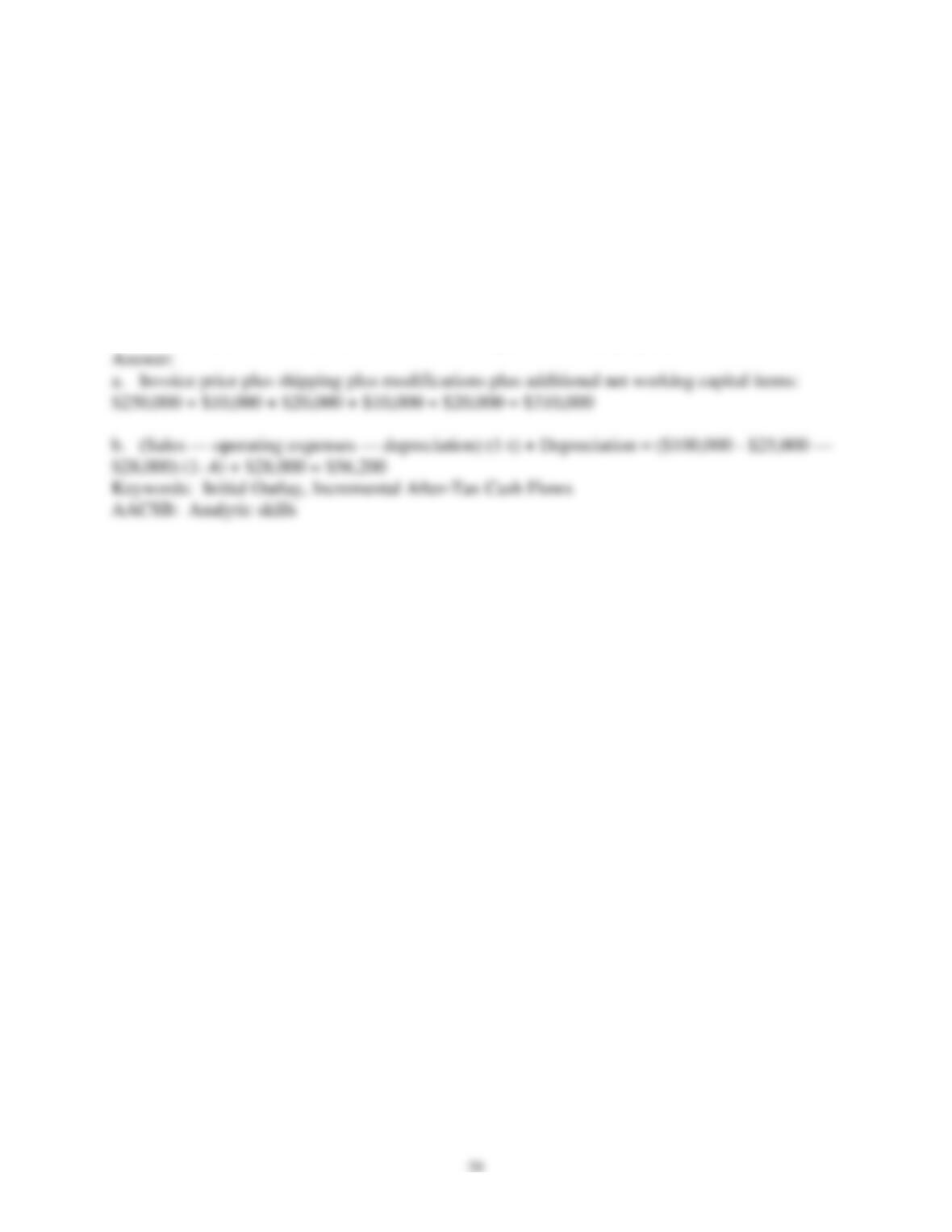
87) P.D. Corporation is considering the purchase of a high-speed lathe that has an invoice price
of $250,000. The cost to ship the lathe to P.D.’s factory is $10,000, and the existing facilities
will require modifications that are expected to cost $20,000. The machine will be depreciated on
a straight-line basis over its useful life of 10 years, assuming no salvage value. P.D. Corporation
is planning on paying for the lathe using a line of credit at the bank that has an interest rate of 6
percent per year. The lathe is expected to increase production and sales. Sales are expected to
increase by $100,000 per year. Inventory and accounts receivable balances are expected to
increase by $10,000 and $20,000 respectively. Expenses to operate the lathe are $25,000 per
year. P.D.’s marginal tax rate is 40%.
a. Calculate the initial outlay required to fund this project.
b. Calculate the incremental after-tax cash flow in year one of the project.
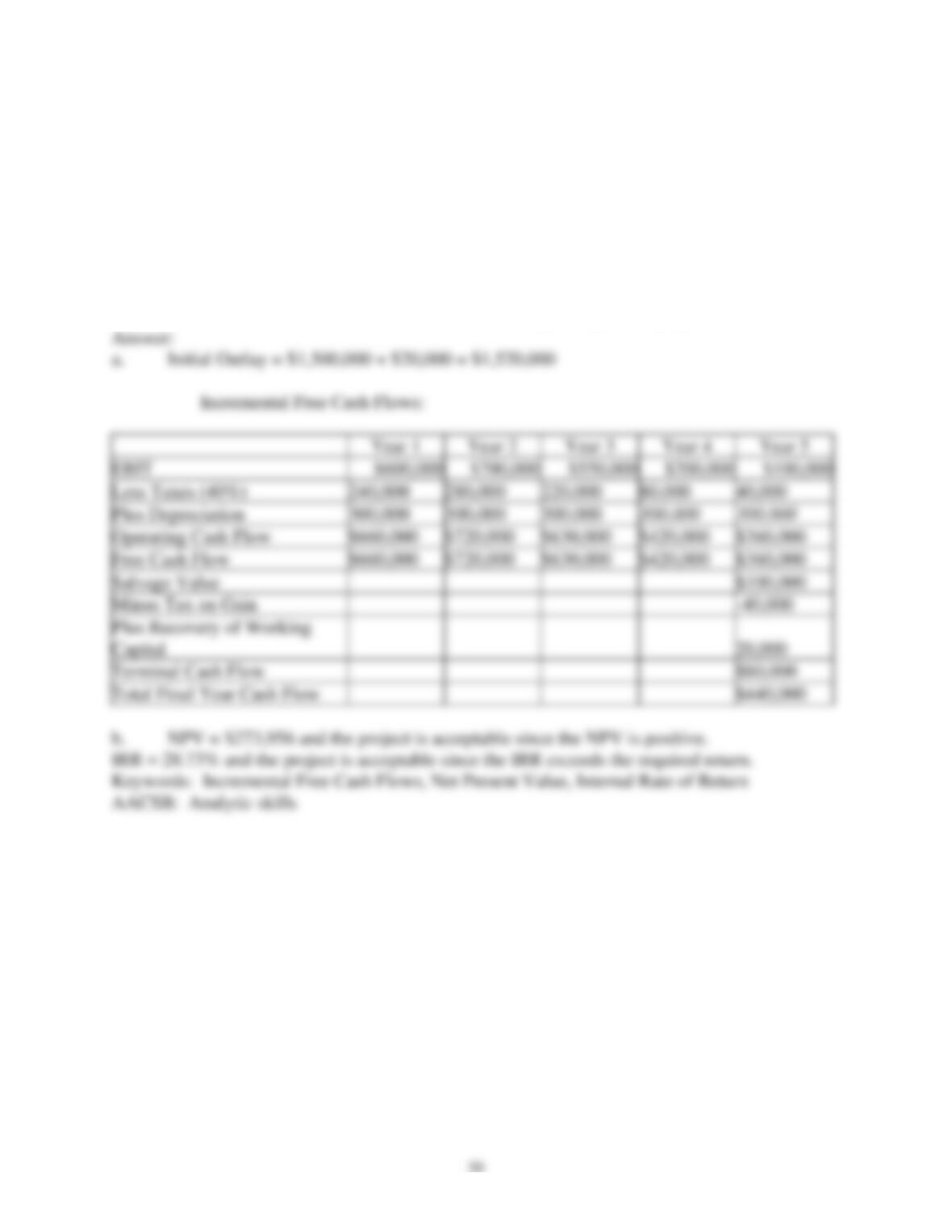
88) LEE Corporation intends to purchase equipment for $1,500,000. The equipment has a 5-year
useful life and will be depreciated on a straight-line basis. Addition of the equipment requires
additional working capital of $20,000. The $20,000 is expected to be recaptured at the end of the
project. LEE’s marginal tax rate is 40%. Use of the equipment is expected to change the
company’s reported EBIT by $600,000 in year one, $700,000 in year two, $550,000 in year three,
$200,000 in year four, and $100,000 in year five. Due to changing market conditions, the
equipment did have a salvage value of $100,000 at the end of year five.
a. Calculate the initial outlay and the incremental free cash flows over the life of the project.
b. If the risk-adjusted discount rate for this project is 20%, calculate the project’s net present
value and internal rate of return and comment on the acceptability of the project.
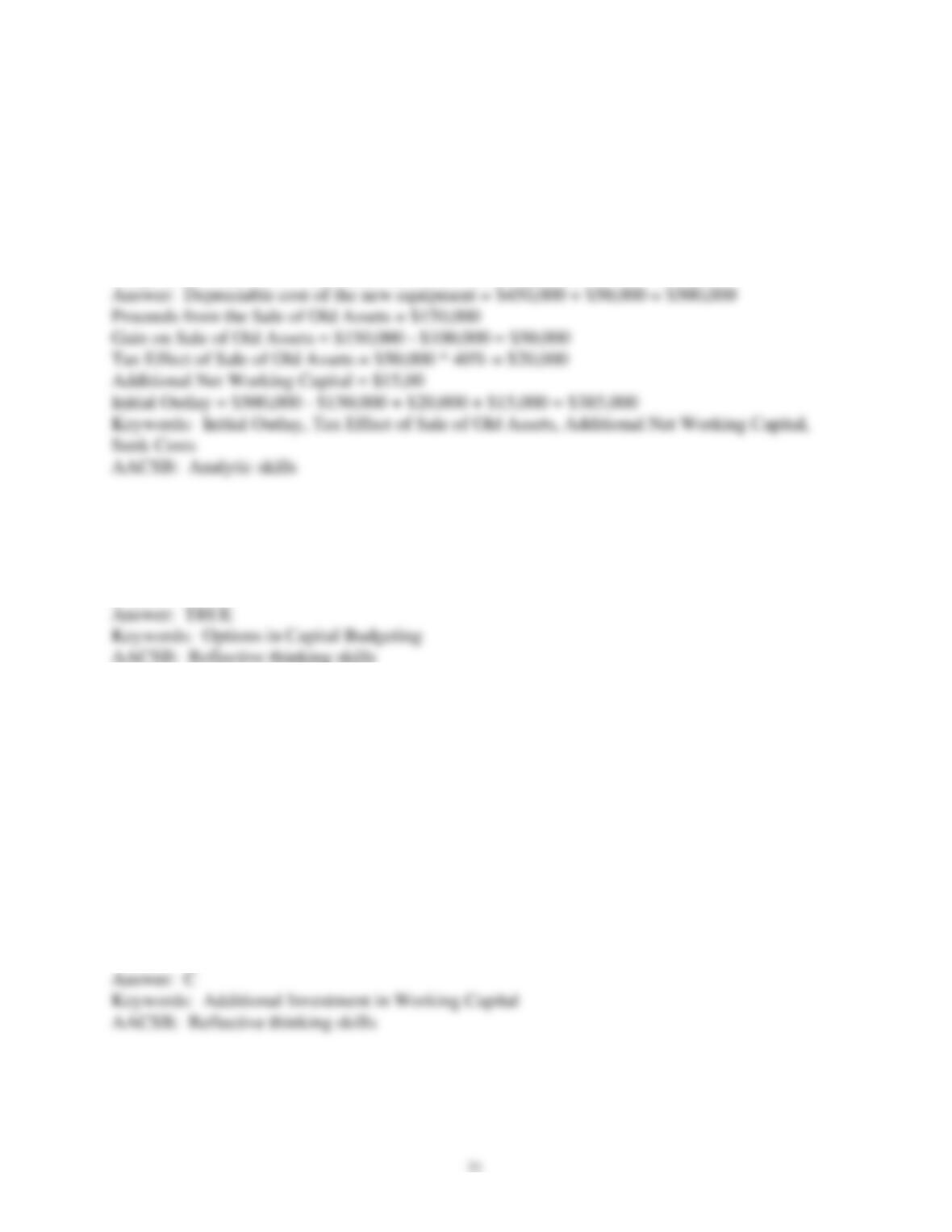
89) J.B. Corporation is considering the purchase of equipment that has an invoice price of
$450,000. The equipment was recommended by a consulting firm that did an analysis for J.B.
Corporation. J.B. paid the consulting firm $12,000 for its report. The cost of shipping and
installation is $50,000. The equipment will be depreciated on a straight-line basis over its useful
life of 10 years, assuming no salvage value. The equipment will replace existing assets that have
a current book value of $100,000 and which could be sold for $150,000. Additional net working
capital of $15,000 will be required to maintain the equipment and to support higher sales. J.B.’s
marginal tax rate is 40%. Calculate the initial outlay required to fund this project.
11.3 Learning Objective 3
1) Three of the most common options that can add value to a capital budgeting project are the
option to delay the project, the option to expand the project, and the option to abandon the
project.
2) Ames Manufacturing is considering the purchase of new, sophisticated machinery for a
special three-year project. The machinery requires a special lubricating oil that probably will
never be used, but must be available at all times should the machine break down. Ames
purchases $2,000 of lubricating oil to keep on hand just in case it is needed. At the end of the
three-year project, it is expected the lubricating oil can be sold back to the distributor for $2,000.
Which of the following statements is most correct?
A) The lubricating oil is a sunk cost that should be excluded from the analysis.
B) The $2,000 for the lubricating oil should be excluded from the analysis because it is
recovered at the end of three years, so the final cost is zero.
C) The $2,000 represents an additional investment in working capital that should be included in
the capital budgeting analysis.
D) The $2,000 for lubricating oil is simply an accounting entry and does not represent a real cash
flow.
3) A major corporation is considering a capital budgeting project that involves the development
of a new technology. The controller estimates the net present value to be negative, yet argues that
the company should invest in the project. Which of the following statements is most correct?
A) The controller should be fired for making such a poor decision.
B) The controller may be considering the option to expand or modify the project in the future.
C) The profitability index may be greater than one, giving an accept decision.
D) Capital rationing may exist for the current year.
4) Your company is considering the replacement of an old delivery van with a new one that is
more efficient. The old van cost $40,000 when it was purchased 5 years ago. The old van is
being depreciated using the simplified straight-line method over a useful life of 8 years. The old
van could be sold today for $7,000. The new van has an invoice price of $80,000, and it will
cost $6,000 to modify the van to carry the company’s products. Cost savings from use of the
new van are expected to be $28,000 per year for 5 years, at which time the van will be sold for
its estimated salvage value of $18,000. The new van will be depreciated using the simplified
straight-line method over its 5-year useful life. The company’s tax rate is 35%. Working capital
is expected to increase by $5,000 at the inception of the project, but this amount will be
recaptured at the end of year five. What is the tax effect of selling the old machine?
A) a savings of $2,800
B) a savings of $2,450
C) additional taxes paid of $2,450
D) a tax savings of $1,400
5) Your company is considering the replacement of an old delivery van with a new one that is
more efficient. The old van cost $40,000 when it was purchased 5 years ago. The old van is
being depreciated using the simplified straight-line method over a useful life of 8 years. The old
van could be sold today for $7,000. The new van has an invoice price of $80,000, and it will
cost $6,000 to modify the van to carry the company’s products. Cost savings from use of the
new van are expected to be $28,000 per year for 5 years, at which time the van will be sold for
its estimated salvage value of $18,000. The new van will be depreciated using the simplified
straight-line method over its 5-year useful life. The company’s tax rate is 35%. Working capital
is expected to increase by $5,000 at the inception of the project, but this amount will be
recaptured at the end of year five. What is the initial outlay required to fund this replacement
project?
A) $81,200
B) $78,600
C) $74,500
D) $73,580
11.4 Learning Objective 4
1) A small, family-owned corporation would be more likely to use the contribution–to-firm risk
criteria rather than the systematic risk to evaluate capital budgeting projects.
2) Since stockholders are able to reduce their exposure to risk by efficiently diversifying their
holdings of securities, there is no reason for individual firms to seek diversification of their
holdings of assets.
3) According to the CAPM, systematic risk is the only relevant risk for capital budgeting
purposes.
4) A project’s contribution-to-firm risk does allow for diversification within the firm.
5) A project’s standing alone risk allows for diversification within a sole firm.
6) The most relevant measure of risk for capital budgeting is project standing alone risk.
7) A project’s contribution to firm risk is relevant for undiversified investors or when bankruptcy
costs exist.
8) A wildcat oil driller has enough capital to invest in only one project, that is, to drill one well in
an East Texas oil field. A major oil company is drilling 100 wells in the same field. The
probability of successfully striking oil is 10% for any well drilled in this field. Which of the
following statements is most correct concerning the risk involved in these capital budgeting
projects?
A) The risk for the wildcat driller is the same as the risk for the major oil company since they are
both drilling in the same oilfield.
B) The appropriate risk for the wildcat driller is systematic risk.
C) The appropriate risk for the major oil company is contribution-to-firm risk, if all shareholders
of the firm are well diversified.
D) The best measure of risk for the wildcat oil driller is project standing alone risk.
9) Bill and Mary own a small chain of high fashion boutiques that represent almost 100% of their
net worth. When considering capital budgeting projects for their boutiques, the appropriate
measure of risk is
A) Project standing alone risk.
B) Systematic risk.
C) Contribution-to-firm risk.
D) Beta risk.
10) If bankruptcy costs and/or shareholder underdiversification are an issue, what measure of
risk is relevant when evaluating project risk in capital budgeting?
A) Total project risk
B) Contribution-to-firm risk
C) Systematic risk
D) Capital rationing risk
11) Which of the following is the most relevant measure of risk for capital budgeting purposes?
A) Project standing alone risk
B) Contribution-to-firm risk
C) Symbiotic risk
D) Unsystematic risk
12) Which of the following statements about project standing alone risk is true?
A) It ignores the fact that much of the risk of a project will be diversified away as the project is
combined with the firm’s other projects.
B) It ignores the cash flows that are associated with a project that occur beyond the payback
period.
C) It takes into consideration the effects of diversification of the firm’s shareholders.
D) It provides the best measure of project risk for a large, widely-held company.
11.5 Learning Objective 5
1) Interest expenses are not included as incremental free cash flows because the cost of funds is
recognized as cash flows are discounted back to present value.
2) The use of risk-adjusted discount rates is based on the concept that investors require a higher
rate of return for more risky projects.
3) The risk-adjusted discount rate method implicitly assumes that distant cash flows have the
same risk as near cash flows.
4) If the cash flows of an accepted investment project are negatively correlated with the average
cash flow of the firm’s existing assets, then the company’s total exposure to risk can decrease.
5) Financial theory assumes that individuals are risk averse.
6) The risk-adjusted discount rate for a replacement decision will be less than the rate used by
the same firm when considering a new product line.
7) The less-risky investment is always the more desirable choice.
8) A method for estimating a project’s beta that attempts to identify publicly traded firms engage
solely in the same business as the project is called the pure play method.
9) A bakery company is considering one capital budgeting project involving the replacement of a
sophisticated brick oven, and another capital budgeting project involving research and
development into synthetic food substitutes. Which of the following statements is most correct
concerning the risk-adjusted discount rate(s) for the projects?
A) The rate will likely be higher for the replacement project because the likelihood of success is
higher.
B) The rate will likely be higher for the research and development project because of the
uncertainty involved with research and development projects.
C) The rate should be the same for both projects because they are being considered by one
company with the same common shareholders.
D) The rate should be higher for the replacement project because the company is more certain of
the returns from a project similar to their existing business.
10) The pure play method
A) calculates beta using only project returns.
B) uses the beta of a firm that is similar to the project being analyzed to determine the required
rate of return for the project.
C) selects a firm similar to the project being analyzed and uses its returns as the market return in
estimating a project beta.
D) selects one of the firm’s existing projects that is similar to the project being analyzed and uses
that project’s required rate of return.
11) Which of the following is NOT an important consideration in measuring risk for a capital
budgeting project for a well-diversified firm?
A) Systematic risk
B) Contribution to firm risk
C) Total project risk
D) None of the above – all may be important in measuring project risk
12) Humongous Corporation is a multidivisional conglomerate. The Food Division is undergoing
a capital budgeting analysis and must estimate the division’s beta. This division has a different
level of systematic risk than is typical for Humongous Corporation as a whole. The most
appropriate method for estimating this beta is
A) the regression coefficient from a time series regression of Humongous Corporation stock
returns on a market index.
B) to multiply the company’s beta by the ratio of the Food Division’s total assets/Humongous
Corporation total assets.
C) the regression coefficient from a time series regression of Food Division’s net income on the
Humongous Corporation’s return on assets.
D) the regression coefficient from a time series regression of Food Division’s return on assets on
a market index.
13) One method of accounting for systematic risk for a project involves identifying a publicly
traded firm that is engaged in the same business as that project and using its required rate of
return to evaluate the project. This method is referred to as
A) the accounting beta method.
B) scenario analysis.
C) the pure play method.
D) sensitivity analysis.
14) Creighton Industries is considering the purchase of a new strapping machine, which will cost
$150,000, plus an additional $10,500 to ship and install. The new machine will have a 5-year
useful life and will be depreciated to zero using the straight-line method. The machine is
expected to generate new sales of $45,000 per year and is expected to save $16,000 in labor and
electrical expenses over the next 5-years. The machine is expected to have a salvage value of
$20,000. Creighton’s income tax rate is 35%. Creighton uses a 12.5% discount rate for capital
budgeting purposes. What is the machine’s NPV?
A) $29,888
B) $25,062
C) $22,153
D) $27,894
15) KLE Holdings is considering a capital budgeting project with a life of 7 years that requires
an initial outlay of $277,400. The probability distribution for annual incremental cash flows is as
follows:
Probability
Incremental Free Cash
Flow
4%
-$15,000
16%
18,000
55%
65,000
25%
99,000
a. The risk-adjusted required rate of return for this project is 12%. Calculate the risk-adjusted
net present value of the project and the project’s IRR.
b. Should the project be accepted?
16) John Q. Enterprises is considering two potential investments. The probability distributions of
annual end-of-year cash flows for the respective projects are:
Project A
Project B
Probability
Outcome
Probability
Outcome
0.25
$10,000
0.25
$12,000
0.50
$15,000
0.50
$15,000
0.25
$20,000
0.25
$18,000
Both projects will require an initial outlay of $45,000 and will have an estimated life of 6 years.
Project A is considered a riskier investment and will have to have a risk-adjusted required rate of
return of 15%, while Project B’s risk-adjusted required rate of return is 12%.
a. Determine the expected value of each project’s annual cash flow.
b. Determine each project’s risk-adjusted net present value.
11.6 Learning Objective 6
1) Sensitivity analysis involves changing one variable at a time.
2) A typical decision rule used in simulation is to accept the project if the probability is
sufficiently high that the net present value is positive.
3) Reducing the probability of bankruptcy is a benefit of diversification.
4) Using simulation provides the financial manager with a probability distribution of an
investment’s net present value or internal rate of return.
5) Advantages of using simulation include
A) adjustment for risk in the resulting distribution of net present values.
B) a range of possible outcomes presented.
C) is good only for single period investments since discounting is not possible.
D) graphically displays all possible outcomes of the investment.
6) What method is used for calculation of the accounting beta?
A) simulation
B) regression analysis
C) sensitivity analysis
D) both A and C
7) The simulation approach provides us with
A) a single value for the risk-adjusted net present value.
B) an approximation of the systematic risk level.
C) a probability distribution of the project’s net present value or internal rate of return.
D) a graphic exposition of the year-by-year sequence of possible outcomes.
8) Which of the following is not an acceptable method of measuring risk for capital budgeting
purposes?
A) Modified internal rate of return
B) Sensitivity analysis
C) Using a risk-adjusted discount rate
D) Proxy, or pure play method for estimating a project’s beta
11.7 Learning Objective 7
1) Fluctuating currency exchange rates should be ignored in capital budgeting because for a U.S.
firm, all incremental cash flows will be properly measured in dollars.