Chapter 10—Risk and Capital Budgeting
MULTIPLE CHOICE
1. Operating leverage describes the relationship between…
a.
EBIT and sales
b.
taxes and sales
c.
debt and equity
d.
fixed costs and variable costs
2. Everything else being equal a higher corporate tax rate…
a.
will increase the WACC of a firm with debt and equity in its capital structure
b.
will not affect the WACC of a firm with debt in its capital structure
c.
will decrease the WACC of a firm with some debt in its capital structure
d.
will decrease the WACC of a firm with only equity in its capital structure
3. Which of the following is considered a type of real options
a.
expansion option
b.
abandonment option
c.
flexibility option
d.
all of the above
4. A manager who wants to find out at which point a project’s profits and costs are equal will conduct
a(n)
a.
sensitivity analysis
b.
scenario analysis
c.
breakeven analysis
d.
none of the above
5. The appropriate cost of capital for a project depends on . . .
a.
the type of assets used in the project (that is, whether they are current or fixed assets)
b.
the interest rate on the firm’s outstanding long-term bonds
c.
the type of security issued to finance the project
d.
the risk associated with the project
6. The following data have been computed for a firm: when sales are $20,000, EBIT is $5,000 and
operating leverage is 2.5. Suppose sales increase to $23,000; what is the new level of EBIT?
a.
$1,875
b.
$6,875
c.
$3,000
d.
$8,435
7. Bavarian Sausage, Inc. has a cost equity of 22% and a beta of 1.8. The expected market return is 14%.
What is the risk-free rate?
a.
4%
b.
22%
c.
8%
d.
12%
8. Bavarian Sausage has a beta of 1.8. The risk free rate is 5% and the expected market risk premium is
12%. What is the company’s cost of equity?
a.
17.0%
b.
26.6%
c.
21.6%
d.
13.5%
NARRBEGIN: Never-crash Airlines
Never-crash Airline
Never-crash Airline has a capital structure that consists of 30% debt and 70% equity. The company’s
cost of debt is 7%. The company has a beta of 1.9. The risk free rate equals 4.5% and the expected
return on the market portfolio is 15%.
NARREND
9. Assuming no taxes, what is Never-crash Airline’s WACC?
a.
7%
b.
19.22%
c.
24.45%
d.
17.12%
10. What is Never-crash Airline’s WACC, if their marginal tax rate equals 34%?
a.
19.22%
b.
24.45%
c.
18.50%
d.
4.62%
11. What is the Never-crash Airline’s after tax cost of debt?
a.
7.00%
b.
4.62%
c.
2.38%
d.
4.50%
12. What is the Never-crash Airline’s cost of equity?
a.
33.00%
b.
7.05%
c.
24.45%
d.
28.50%
NARRBEGIN: Bavarian Brewhouse
Bavarian Brewhouse
Capital Structure Information for Bavarian Brewhouse
Debt ( in million)
$25
Preferred Stock (in million)
$ 5
Common Stock (in million)
$45
Total Capital
$75
Cost of debt
8%
Annual Preferred Stock Dividend
$ 2.50
Preferred Stock Market Price
$16.13
Common Stock Beta
0.85
Risk free rate
3.75%
Expected return on market portfolio
17.55%
NARREND
13. What is Bavarian Brewhouse’s cost of preferred stock?
a.
8.00%
b.
15.5%
c.
10.7%
d.
12.6%
14. What is Bavarian Brewhouse’s cost of common equity?
a.
10.67%
b.
12.55%
c.
16.23%
d.
15.48%
15. What is Bavarian Brewhouse’s after tax cost of debt, if their marginal tax rate equals 34%?
a.
8.00%
b.
5.28%
c.
6.95%
d.
2.72%
16. What percentage of Bavarian Brewhouse’s capital structure consists of total equity?
a.
6.67%
b.
60.00%
c.
33.33%
d.
66.67%
17. Assuming no corporate taxes, what is Bavarian Brewhouse’s WACC?
a.
16.23%
b.
12.99%
c.
13.44%
d.
5.28%
18. What is Bavarian Brewhouse’s WACC if their marginal tax rate equals 34%
a.
12.08%
b.
12.99%
c.
13.44%
d.
5.28%
19. As a result of a company’s 15% increase in sales their EBIT increased by 25%. What is the company’s
operating leverage?
a.
2.33
b.
1.67
c.
1.50
d.
3.33
20. Miller’s Dairy Products reported sales of $1.5 million in 2002 and $2.25 million in 2003. Their EBIT
in 2002 was $550,000 and in 2003 the EBIT rose to $925,000. What is the company’s operating
leverage?
a.
2.36
b.
1.36
c.
1.96
d.
2.86
21. Find the break even point given the following information: sale price per unit = $50, variable cost per
unit = $35; fixed costs = $50,000.
a.
2,298
b.
3,000
c.
3,333
d.
4,000
22. Find the break even point given the following information: total costs: $135,000; variable costs per
unit = $10; sale price per unit = $25; sales = 10,000 units.
a.
3,000
b.
2,333
c.
1,667
d.
1,886
NARRBEGIN: Bavarian Sausage Scenario
Bavarian Sausage Scenario
Bavarian Sausage is considering starting the production of a new chocolate filled sausage. The
company is not sure yet what the exact sales potential and costs of the product will be. Bavarian
Sausage has determined the following three possible scenarios:
Best case
Most likely
Worst case
Price/unit
$ 10
$ 7
$ 4
Variable cost/unit
$ 3
$ 3
$ 3
Fixed costs
$4,000
$4,500
$5,000
NARREND
23. What is the best case scenario break even point for Bavarian Sausage?
a.
572
b.
1,125
c.
5,000
d.
2,526
24. What is Bavarian Sausage’s breakeven point in the most likely scenario?
a.
572
b.
1,125
c.
5,000
d.
2,526
25. What is Bavarian Sausage’s breakeven point in the worst case scenario?
a.
572
b.
1,125
c.
5,000
d.
2,526
26. If each of Bavarian Sausage’s three scenarios is equally likely, what is the expected breakeven point?
a.
5,000
b.
2,233
c.
572
d.
1,125
27. By how much would Bavarian Sausage’s breakeven point change in the best case scenario if variable
cost increase by $2?
a.
increase by 228
b.
decrease by 228
c.
remain unchanged
d.
increase by 95
28. By how much would Bavarian Sausage’s breakeven point change in the most likely scenario if the
price/unit turns out to be only $6?
a.
decrease by 375
b.
remain unchanged
c.
increase by 375
d.
decrease by 228
29. What is the percentage change in Bavarian Sausage’s breakeven point in the worst case scenario if it
turns out that they can charge $5 per unit?
a.
increase by 50%
b.
decrease by 50%
c.
increase by 100%
d.
decrease by 100%
30. How much would Bavarian Sausage have to charge per unit in the most likely scenario to break even if
they expected to be able to sell 1,000 units (everything else being equal)?
a.
$7
b.
$7.50
c.
$8.50
d.
$6.50
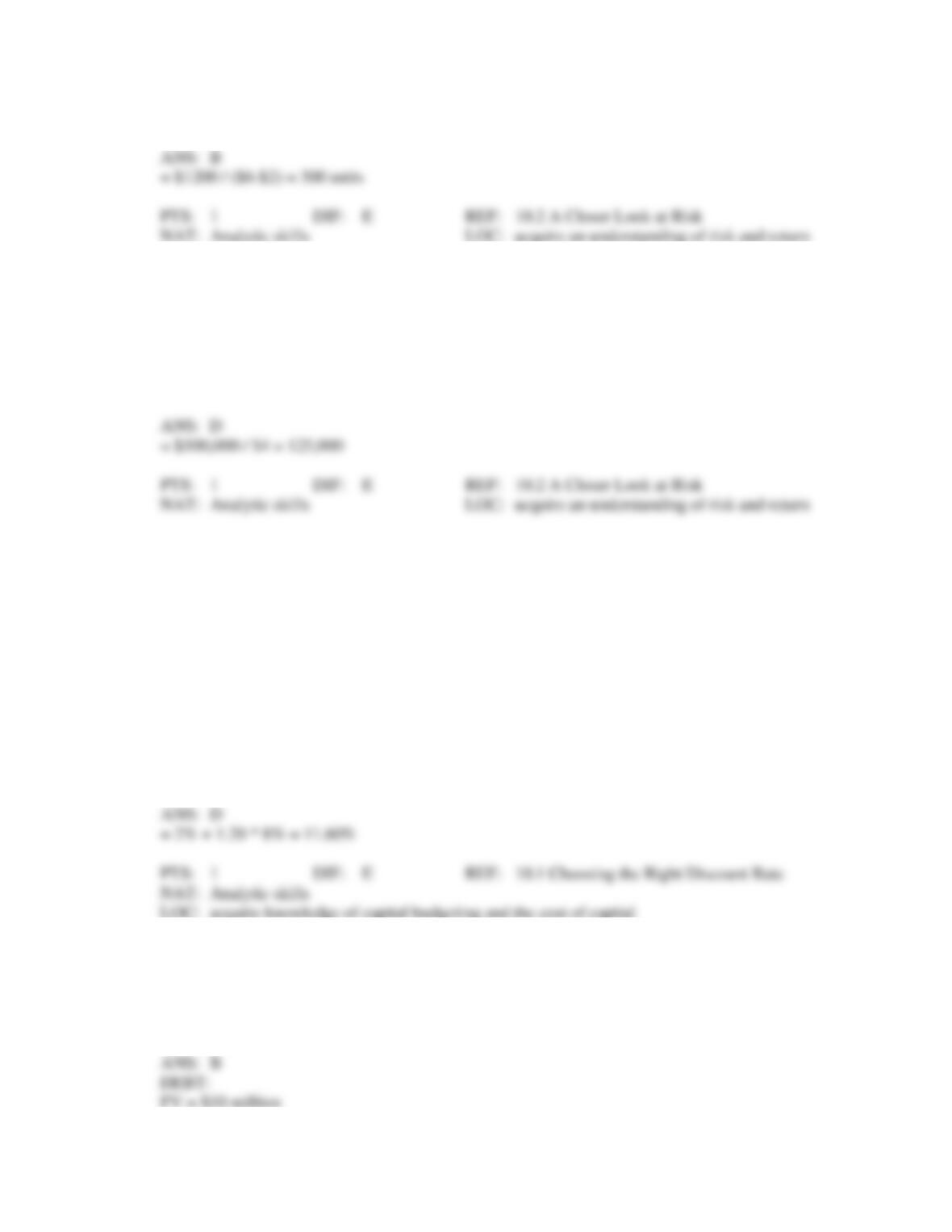
31. A company can sell its product for $6 per unit. The variable costs for each unit are $2, while the fixed
costs of operation are $1200. What is the break-even point for this product?
a.
200 units
b.
300 units
c.
450 units
d.
550 units
32. Hollywood Productions has a $4 contribution margin for the new DVD they are releasing to the
general public. The DVD sells for $20. If the fixed costs to produce the DVD were $500,000, how
many units must be sold for Hollywood Productions to break even?
a.
25,000 units
b.
31,250 units
c.
75,000 units
d.
125,000 units
NARRBEGIN: Running Shoes, Inc.
Running Shoes, Inc.
Running Shoes, Inc. has 2 million shares of stock outstanding. The stock currently sells for $12.50 per
share. The firm’s debt is publicly traded and was recently quoted at 90% of face value. It has a total
face value of $10 million, and it is currently priced to yield 8%. The risk free rate is 2% and the market
risk premium is 8%. You’ve estimated that the firm has a beta of 1.20. The corporate tax rate is 40%.
NARREND
33. Refer to Running Shoes, Inc. What is the cost of equity?
a.
9.20%
b.
9.60%
c.
10.40%
d.
11.60%
34. What is the percentage of equity used by Running Shoes, Inc.?
a.
74.63%
b.
73.53%
c.
72.46%
d.
68.97%
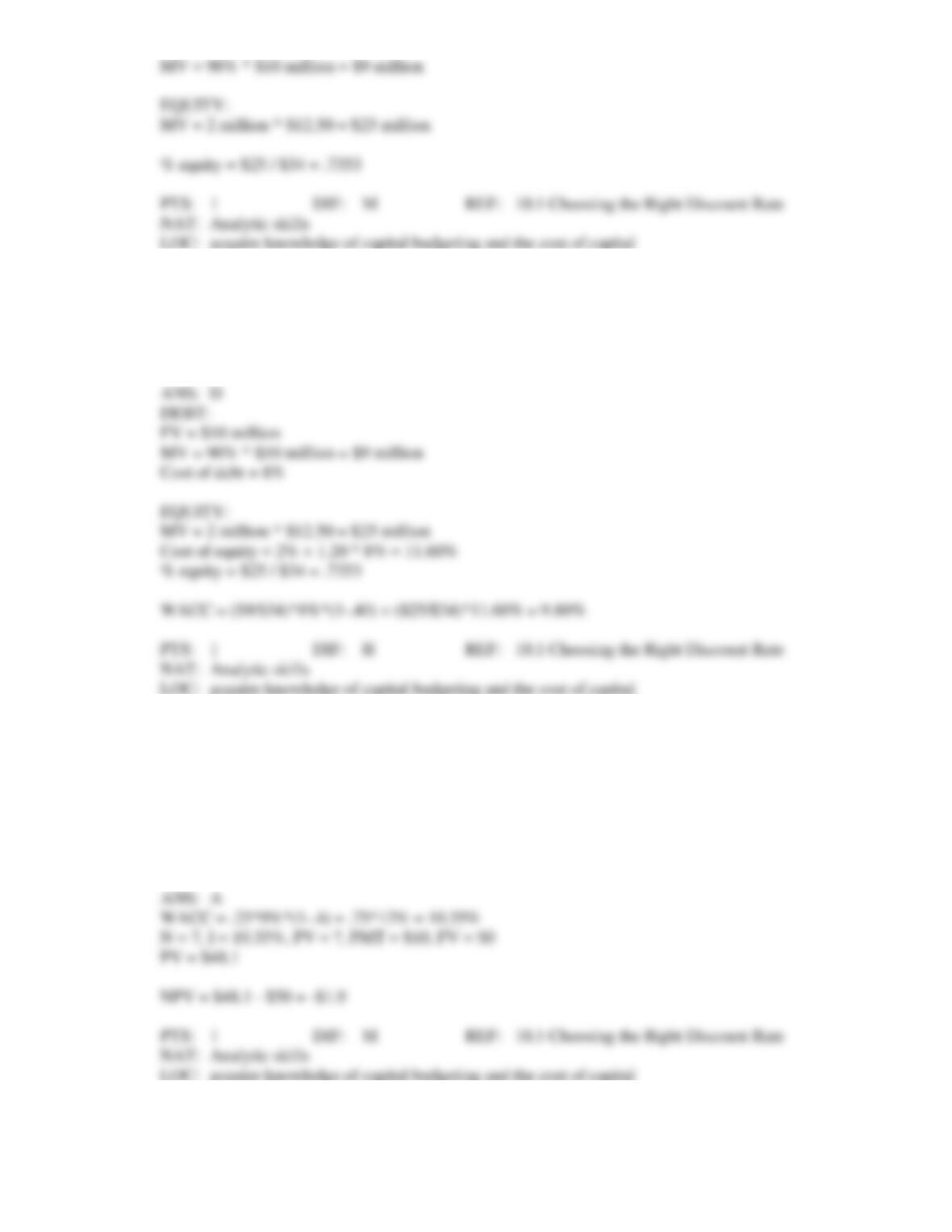
35. What is the WACC for Running Shoes, Inc.?
a.
7.97%
b.
9.15%
c.
9.58%
d.
9.80%
36. A firm has a capital structure of 25% debt and 75% equity. Debt can be issued at a return of 9%, while
the cost of equity for the firm is 12%. The firm is considering a $50 million expansion of their
production facility. The project has the same risk as the firm overall and will earn $10 million per year
for 7 years. What is the NPV of the expansion if the tax rate facing the firm is 40%?
a.
-$1.9 million
b.
-$1.4 million
c.
$0.4 million
d.
$1.4 million
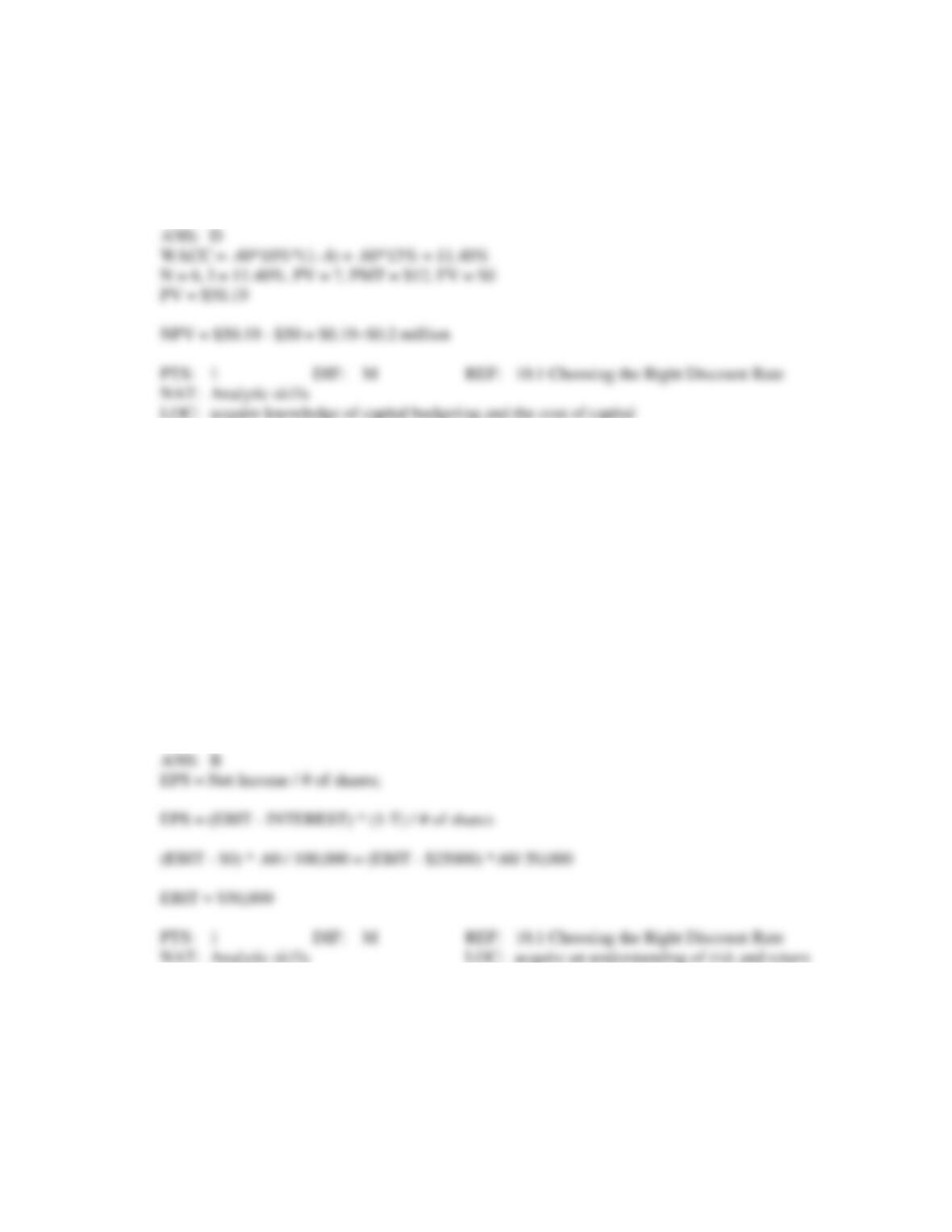
37. A firm has a capital structure of 40% debt and 60% equity. Debt can be issued at a return of 10%,
while the cost of equity for the firm is 15%. The firm is considering a $50 million expansion of their
production facility. The project has the same risk as the firm overall and will earn $12 million per year
for 6 years. What is the NPV of the expansion if the tax rate facing the firm is 40%?
a.
-$0.4 million
b.
-$0.2 million
c.
$0 million
d.
$0.2 million
38. Consider the following financial leverage information for ABC Corporation. The debt pays 10%
annually in interest and the tax rate is 40%. For what EBIT will the EPS be equal for either capital
structure?
All Equity Firm
50% Debt/ 50% Equity Firm
Total Assets
$500,000
$500,000
Equity
$500,000
$250,000
# of shares
100,000
50,000
Debt
$ 0
$250,000
Interest payment
$ 0
$ 25,000
a.
$25,000
b.
$50,000
c.
$75,000
d.
$90,000
39. The operating leverage for ABC Corporation is currently 125%. Given the information below, what
was the growth rate in sales for 2004?
Category
Value
2003 EBIT
$12 million
2004 EBIT
$15 million
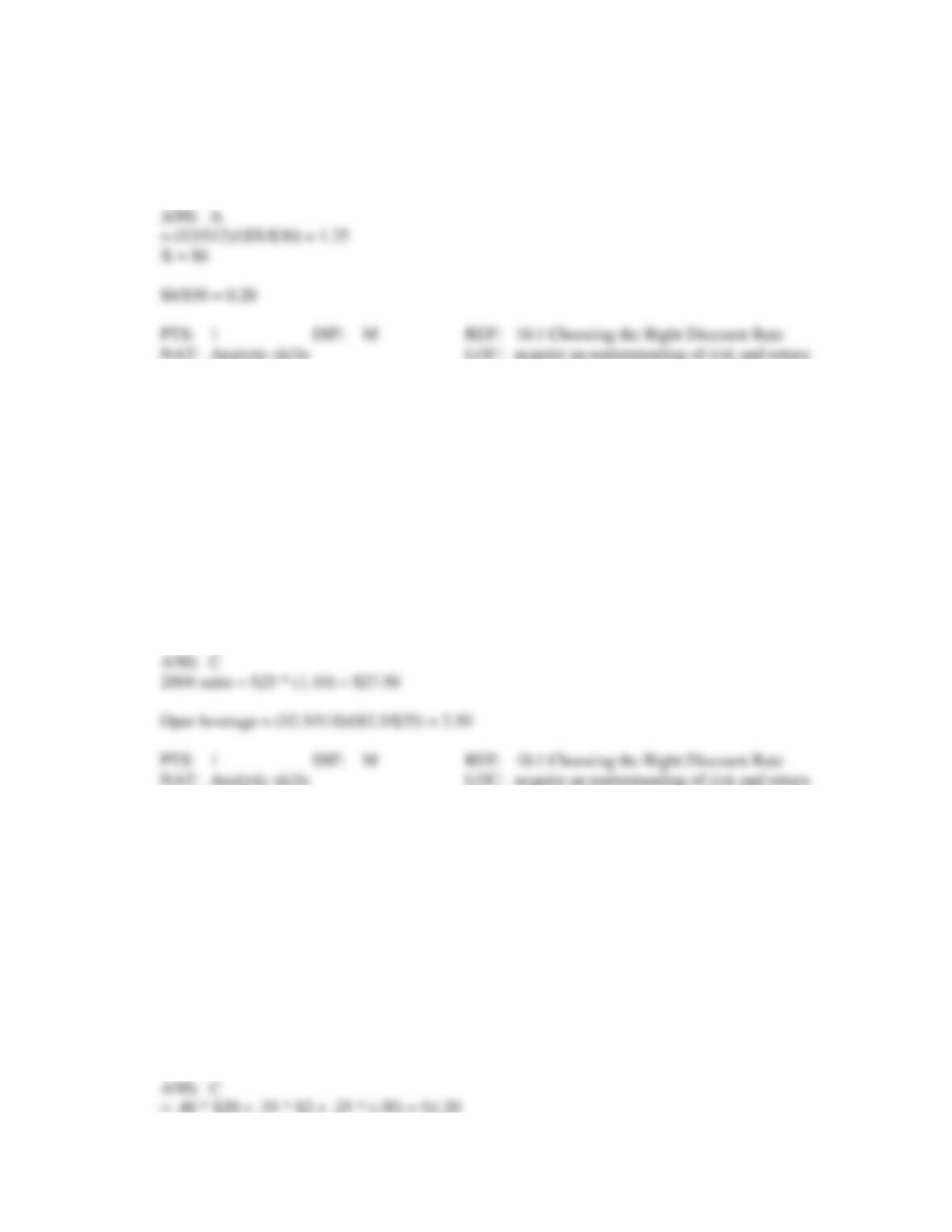
2003 Sales
$30 million
2004 Sales
$?? million
a.
20%
b.
18%
c.
16%
d.
12%
40. The EBIT for ABC Corporation for 2003 and 2004 is shown below. Sales grew at a rate of 10% for
2004. If 2003 sales were $25 million, what is the operating leverage for ABC?
Category
Value
2003 EBIT
$10 million
2004 EBIT
$12.50 million
2003 Sales
$25 million
2004 Sales
$?? million
a.
200%
b.
225%
c.
250%
d.
275%
41. A project under consideration for a firm has several possible outcomes shown in the table below.
Given the assumptions below, what is the expected NPV for the project?
Project
Chance of
NPV of
Outcome
Outcome
Outcome
GOOD
40%
$20.00
AVERAGE
35%
$2.00
BAD
25%
($30.00)
a.
-$8.00
b.
-$2.50
c.
$1.20
d.
$1.40
42. A project under consideration for a firm has several possible outcomes shown in the table below.
Given the assumptions below, what is the expected NPV for the project?
Project
Chance of
NPV of
Outcome
Outcome
Outcome
GOOD
25%
$25.00
AVERAGE
50%
$6.00
BAD
25%
($40.00)
a.
-$9.00
b.
-$3.00
c.
-$0.75
d.
$1.20
43. A firm is considering investing $10 million today to start a new product line. The future of the project
is unclear however and depends on the state of the economy. The project will last 5 years. The yearly
cash flows for the project are shown below for the different states of the economy. What is the
expected NPV for the project if the cost of capital is 12%?
Project
Chance of
Yearly
Outcome
Outcome
Cash Flow
GOOD
25%
$8.00
AVERAGE
50%
$3.00
BAD
25%
($2.00)
a.
-$2.23 million
b.
-$1.15 million
c.
-$0.75 million
d.
$0.81 million
44. A firm is considering investing $10 million today to start a new product line. The future of the project
is unclear however and depends on the state of the economy. The project will last 4 years. The yearly
cash flows for the project are shown below for the different states of the economy. What is the
expected NPV for the project if the cost of capital is 15%?
Project
Chance of
Yearly
Outcome
Outcome
Cash Flow
GOOD
25%
$7.00
BAD
75%
-$2.50
a.
-$17.14 million
b.
-$12.13 million
c.
-$10.36 million
d.
-$4.25 million
45. Which answer describes an analysis of what happens to NPV estimates when we change the values of
one variable at a time?
a.
Forecasting simulation
b.
Monte Carlo simulation
c.
Sensitivity analysis
d.
Scenario analysis
46. Which approach estimates NPV by taking a distribution of values for each of the model’s
assumptions?
a.
Forecasting simulation
b.
Monte Carlo simulation
c.
Sensitivity analysis
d.
Scenario analysis
47. Which approach estimates NPV by changing the value of several assumptions at once to represent
possible outcomes of the project?
a.
Forecasting simulation
b.
Monte Carlo simulation
c.
Sensitivity analysis
d.
Scenario analysis
48. As a young entreprenuer, you are considering opening a new restaurant in your hometown. You plan
on operating the restaurant for four years and then either expand the business or close the restaurant
and move onto something else. An economist has estimated the value of your option to expand at
$300,000 in today’s dollars. Given the estimates below, what is the project value of the new restaurant
business if cash flows are discounted at 12%?
YEAR
0
1
2
3
4
Cash flow
-$200,000
$25,000
25,000
25,000
25,000
a.
-$124,066
b.
$75,933
c.
$175,933
d.
$275,933
49. A firm has estimated the NPV of a new product release as -$100,000. However, if the product is a
failure, the firm estimates it can sell off the equipment to help cash flow. An analyst estimates the
value of abandoning the product release at $125,000. The cost of capital for the firm is 10%. What is
the project value for the firm?
a.
-$100,000
b.
$10,000
c.
$25,000
d.
$225,000
50. A firm has a capital structure containing 40 percent debt, 10 percent preferred stock, and 50 percent
common stock equity. The firm’s debt has a yield to maturity of 9.50 percent. Its preferred stock’s
annual dividend is $7.50 and the preferred stock’s current market price is $50.00 per share. The firm’s
common stock has a beta of 0.90 and the risk-free rate and the market return are currently 4.0 percent
and 13.5 percent, respectively. The firm is subject to a 40 percent marginal tax rate. The market value
of debt is $100 million. How many shares of preferred stock should be outstanding for the capital
structure to be correct?
a.
125,000 shares
b.
250,000 shares
c.
500,000 shares
d.
625,000 shares
51. A firm has a capital structure containing 40 percent debt, 10 percent preferred stock, and 50 percent
common stock equity. The firm’s debt has a yield to maturity of 9.50 percent. Its preferred stock’s
annual dividend is $7.50 and the preferred stock’s current market price is $50.00 per share. The firm’s
common stock has a beta of 0.90 and the risk-free rate and the market return are currently 4.0 percent
and 13.5 percent, respectively. The firm is subject to a 40 percent marginal tax rate. What is the
WACC for the firm?
a.
8.75%
b.
8.93%
c.
9.16%
d.
10.06%
52. A firm has a capital structure of 40% debt and 60% equity. The firm has bonds outstanding with a face
value of $20 million. The bonds pay, on average, a 8% annual coupon and have an average maturity
length of 7 years. The market value of the bonds is 110% of face value and the tax rate facing the firm
is 40%. The firm has common stock with a beta of 1.25. The risk free rate on Treasury bonds is 2%,
while the market risk premium is 8%. What is the WACC for the firm?
a.
8.69%
b.
9.13%
c.
9.68%
d.
11.15%