Reporting and Analyzing Liabilities
10–41
207. In a recent year Hart Corporation had net income of $125,000, interest expense of
$30,000, and tax expense of $40,000. What was Hart Corporation’s times interest earned
for the year?
a. 6.50
b. 4.17
c. 5.17
d. 5.50
208. In a recent year Ley Corporation had net income of $150,000, interest expense of
$30,000, and a times interest earned ratio of 8. What was Ley Corporation’s income
before taxes for the year?
a. $270,000
b. $240,000
c. $210,000
d. None of these answer choices are correct.
209. The adjusted trial balance for Hamilton Corp. at the end of the current year, 2014,
contained the following accounts.
5-year Bonds Payable 8% $1,200,000
Bond Interest Payable 50,000
Premium on Bonds Payable 100,000
Notes Payable (3 mo.) 40,000
Notes Payable (5 yr.) 165,000
Mortgage Payable ($15,000 due currently) 200,000
Salaries and Wages Payable 18,000
Taxes Payable (due 3/15 of next yr) 25,000
The total long-term liabilities reported on the balance sheet are
a. $1,565,000
b. $1,550,000
c. $1,665,000
d. $1,650,000
Test Bank for Accounting: Tools for Business Decision Making, Fifth Edition
FOR INSTRUCTOR USE ONLY
10–42
210. The 2014 financial statements of Harper Co. contain the following selected data (in
millions).
Current assets $ 90
Total assets 160
Current liabilities 40
Total liabilities 75
Cash 8
Interest expense 5
Income taxes 10
Net income 16
The debt to assets ratio is
a. 46.9%.
b. 44.4%.
c. 2.13%.
d. 6.2 times.
*211. Oliver Company issued $800,000 of 6%, 5-year bonds at 98. Assuming straight-line
amortization and annual interest payments, how much bond interest expense is recorded
on the next interest date?
a. $48,000
b. $24,000
c. $49,600
d. $51,200
*212. Foley Company issued $800,000 of 6%, 5-year bonds at 98, which pays interest annually.
Assuming straight-line amortization, what is the total interest cost of the bonds?
a. $240,000
b. $256,000
c. $224,000
d. $232,000
*213. Neufeld Company issued $800,000 of 6%, 5-year bonds at 98, which pays interest
annually. Assuming straight-line amortization, what is the carrying value of the bonds after
one year?
a. $784,000
b. $785,600
c. $787,200
d. $790,400
Reporting and Analyzing Liabilities
FOR INSTRUCTOR USE ONLY
10–43
*214. Scribner Company issued $400,000 of 8%, 5-year bonds at 106. Assuming straight-line
amortization and annual interest payments, how much bond interest expense is recorded
on the next interest date?
a. $32,000
b. $36,800
c. $27,200
d. $4,800
*215. Downs Company issued $400,000 of 8%, 5-year bonds at 106, which pays interest
annually. Assuming straight-line amortization, what is the total interest cost of the bonds?
a. $184,000
b. $136,000
c. $112,000
d. $160,000
*216. Morales Company issued $400,000 of 8%, 5-year bonds at 106, which pays interest
annually. Assuming straight-line amortization, what is the carrying value of the bonds after
one year?
a. $424,000
b. $421,600
c. $419,200
d. $426,400
*217. Larson Company issued $750,000 of 8%, 5-year bonds at 106. Assuming straight-line
amortization and annual interest payments, what is the amount of the amortization at each
interest payment point?
a. $4,500
b. $9,000
c. $60,000
d. $51,000
*218. Parker Company issued ten-year, 9%, bonds payable in 2014 at a premium. During 2014,
the company’s accountant failed to amortize any of the bond premium. The omission of
the premium amortization will
a. not affect net income for 2014.
b. cause retained earnings at the end of 2014 to be overstated.
c. cause net income for 2014 to be overstated.
d. cause net income for 2014 to be understated.
Test Bank for Accounting: Tools for Business Decision Making, Fifth Edition
10–44
*219. When the straight-line method of amortization is used for a bond premium, the amount of
interest expense for an interest period is calculated by
a. adding the amount of premium amortized for that period to the amount of cash paid for
interest during the period.
b. subtracting the amount of premium amortized for that period from the amount of cash
paid for interest during the period.
c. multiplying the face value of the bonds by the stated interest rate.
d. multiplying the face value of the bonds by the market interest rate.
*220. When the straight-line method of amortization is used for a bond discount, the amount of
interest expense for an interest period is calculated by
a. adding the amount of discount amortized for that period to the amount of cash paid for
interest during the period.
b. subtracting the amount of discount amortized for that period from the amount of cash
paid for interest during the period.
c. multiplying the face value of the bonds by the stated interest rate.
d. multiplying the face value of the bonds by the market interest rate.
*221. On January 1, Sewell Corporation issues $2,000,000, 5-year, 12% bonds at 96 with
interest payable on January 1. The entry on December 31 to record accrued bond interest
and the amortization of bond discount using the straight-line method will include a
a. debit to Interest Expense, $120,000.
b. debit to Interest Expense, $240,000.
c. credit to Discount on Bonds Payable, $16,000.
d. credit to Discount on Bonds Payable, $8,000.
*222. On January 1, Sewell Corporation issues $2,000,000, 5-year, 12% bonds at 96 with
interest payable on January 1. What is the carrying value of the bonds at the end of the
third interest period?
a. $1,968,000
b. $1,952,000
c. $1,888,000
d. $1,856,000
223. If bonds are originally sold at a discount using the straight-line amortization method
a. interest expense in the earlier years of the bond’s life will be less that the interest to be
paid.
b. interest expense in the earlier years of the bond’s life will be the same as interest to be
paid.
c. unamortized discount is subtracted from the face value of the bond to determine its
carrying value.
d. unamortized discount is added to the face value of the bond to determine its carrying
value.
Reporting and Analyzing Liabilities
10–45
224. The following partial amortization schedule is available for Courtney Company who sold
$500,000, five-year, 10% bonds on January 1, 2014 for $520,000 and uses annual
straight-line amortization.
BOND AMORTIZATION SCHEDULE
Interest Periods
Interest
to be paid
Interest
expense
Premium
Amortization
Unamortized
Premium
Bond Carrying
Value
January 1, 2014
$20,000
$520,000
January 1, 2015
(i)
(ii)
(iii)
(iv)
(v)
Which of the following amounts should be shown in cell (i)?
a. $52,000
b. $54,000
c. $50,000
d. $10,000
225. The following partial amortization schedule is available for Courtney Company who sold
$500,000, five-year, 10% bonds on January 1, 2014 for $520,000 and uses annual
straight-line amortization.
BOND AMORTIZATION SCHEDULE
Interest Periods
Interest
to be paid
Interest
expense
Premium
Amortization
Unamortized
Premium
Bond Carrying
Value
January 1, 2014
$20,000
$520,000
January 1, 2015
(i)
(ii)
(iii)
(iv)
(v)
Which of the following amounts should be shown in cell (ii)?
a. $54,000
b. $46,000
c. $52,000
d. $40,000
226. The following partial amortization schedule is available for Courtney Company who sold
$500,000, five-year, 10% bonds on January 1, 2014 for $520,000 and uses annual
straight-line amortization.
BOND AMORTIZATION SCHEDULE
Interest Periods
Interest
to be paid
Interest
expense
Premium
Amortization
Unamortized
Premium
Bond Carrying
Value
January 1, 2014
$20,000
$520,000
January 1, 2014
(i)
(ii)
(iii)
(iv)
(v)
Which of the following amounts should be shown in cell (iii)?
a. $10,000
b. $20,000
c. $4,000
d. $2,000
Test Bank for Accounting: Tools for Business Decision Making, Fifth Edition
10–46
227. The following partial amortization schedule is available for Courtney Company who sold
$500,000, five-year, 10% bonds on January 1, 2014 for $520,000 and uses annual
straight-line amortization.
BOND AMORTIZATION SCHEDULE
Interest Periods
Interest
to be paid
Interest
expense
Premium
Amortization
Unamortized
Premium
Bond Carrying
Value
January 1, 2014
$20,000
$520,000
January 1, 2015
(i)
(ii)
(iii)
(iv)
(v)
Which of the following amounts should be shown in cell (iv)?
a. $22,000
b. $18,000
c. $24,000
d. $16,000
228. The following partial amortization schedule is available for Courtney Company who sold
$500,000, five-year, 10% bonds on January 1, 2014 for $520,000 and uses annual
straight-line amortization.
BOND AMORTIZATION SCHEDULE
Interest Periods
Interest
to be paid
Interest
expense
Premium
Amortization
Unamortized
Premium
Bond Carrying
Value
January 1, 2014
$20,000
$520,000
January 1, 2015
(i)
(ii)
(iii)
(iv)
(v)
Which of the following amounts should be shown in cell (v)?
a. $524,000
b. $522,000
c. $516,000
d. $518,000
229. Which of the following statements regarding the effective interest method of accounting for
bonds characteristics is false?
a. GAAP requires use of the effective interest method.
b. The amount of periodic interest expense decreases over the life of a discounted bond
issue when the effective interest method is used.
c. Over the life of the bond, the carrying value increases for discounted bonds when
using the effective interest method.
d. The effective interest method applies a constant percentage to the bond carrying
value to compute interest expense.
Reporting and Analyzing Liabilities
FOR INSTRUCTOR USE ONLY
10–47
*230. On January 1, Weatherholt Inc. issued $4,000,000, 9% bonds for $3,756,000. The market
rate of interest for these bonds is 10%. Interest is payable annually on December 31. Jean
Loptein uses the effective-interest method of amortizing bond discount. At the end of the
first year, Weatherholt should report unamortized bond discount of
a. $219,600.
b. $228,400.
c. $206,440.
d. $204,000.
*231. On January 1, Thompson Corporation issued $3,000,000, 14%, 5-year bonds with interest
payable on December 31. The bonds sold for $3,216,288. The market rate of interest for
these bonds was 12%. On the first interest date, using the effective-interest method, the
debit entry to Interest Expense is for
a. $360,000.
b. $376,743.
c. $385,955.
d. $420,000.
*232. Warner Company issued $4,000,000 of 6%, 10-year bonds on one of its interest dates for
$3,454,800 to yield an effective annual rate of 8%. The effective-interest method of
amortization is to be used. What amount of discount (to the nearest dollar) should be
amortized for the first interest period?
a. $112,710
b. $54,520
c. $72,770
d. $36,384
*233. Warner Company issued $4,000,000 of 6%, 10-year bonds on one of its interest dates for
$3,454,800 to yield an effective annual rate of 8%. The effective-interest method of
amortization is to be used. The journal entry on the first interest payment date, to record
the payment of interest and amortization of discount will include a
a. debit to Bond Interest Expense for $240,000.
b. credit to Cash for $276,385.
c. credit to Discount on Bonds Payable for $36,384.
d. debit to Bond Interest Expense for $320,000.
Test Bank for Accounting: Tools for Business Decision Making, Fifth Edition
FOR INSTRUCTOR USE ONLY
10–48
*234. Warner Company issued $4,000,000 of 6%, 10-year bonds on one of its interest dates for
$3,454,800 to yield an effective annual rate of 8%. The effective-interest method of
amortization is to be used. How much bond interest expense (to the nearest dollar) should
be reported on the income statement for the end of the first year?
a. $277,110
b. $276,384
c. $275,655
d. $240,000
*235. Warner Company issued $4,000,000 of 6%, 10-year bonds on one of its interest dates for
$3,454,800 to yield an effective annual rate of 8%. The effective-interest method of
amortization is to be used. The journal entry to be recorded at the end of the second year
for the payment of interest and the amortization of discount will include a
a. debit to Bond Interest Expense for $240,000.
b. credit to Cash for $279,295.
c. credit to Discount on Bonds Payable for $36,384.
d. credit to Discount on Bonds Payable for $39,295.
*236. When the effective-interest method of amortization is used for a bond premium, the
amount of interest expense for an interest period is calculated multiplying the
a. face value of the bonds at the beginning of the period by the contractual interest rate.
b. face value of the bonds at the beginning of the period by the effective interest rate.
c. carrying value of the bonds at the beginning of the period by the contractual interest
rate.
d. carrying value of the bonds at the beginning of the period by the effective interest rate.
*237. The amortization of a bond premium will result in reporting an amount of interest expense
for an interest period that
a. is less than the amount of cash to be paid for interest for the period.
b. exceeds the amount of cash to be paid for interest for the period.
c. equals the amount of cash to be paid for interest for the period.
d. has no predictable relationship with the amount of cash to be paid for interest for the
*238. The effective-interest method of amortization of bond premiums and discounts is
considered superior to the straight-line method because it results in a(n)
a. interest rate that is close to the market interest rate.
b. uniform rate of interest.
c. more variable interest rate.
d. interest rate that increases or decreases slightly over time.
Reporting and Analyzing Liabilities
FOR INSTRUCTOR USE ONLY
10–49
*239. Which of the following statements best describes the behavior over time of the
components of equal mortgage payments?
a. The proportion of interest expense to payment of principal remains the same.
b. Interest expense increases and payment of principal decreases.
c. Payment of principal increases and interest expense decreases.
d. Both payment of principal and interest expense decrease.
*240. Thayer Company purchased a building on January 2 by signing a long-term $2,520,000
mortgage with monthly payments of $23,100. The mortgage carries an interest rate of 10
percent. The entry to record the mortgage will include a
a. debit to the Cash account for $2,520,000.
b. credit to the Cash account for $2,520,000.
c. debit to the Mortgage Payable account for $2,520,000.
d. credit to the Mortgage Payable account for $2,520,000.
*241. Thayer Company purchased a building on January 2 by signing a long-term $2,520,000
mortgage with monthly payments of $23,100. The mortgage carries an interest rate of 10
percent. The entry to record the first monthly payment will include a
a. debit to the Cash account for $23,100.
b. credit to the Cash account for $21,000.
c. debit to the Interest Expense account for $21,000.
d. credit to the Mortgage Payable account for $23,100.
*242. Thayer Company purchased a building on January 2 by signing a long-term $2,520,000
mortgage with monthly payments of $23,100. The mortgage carries an interest rate of 10
percent. The amount owed on the mortgage after the first payment will be
a. $2,520,000.
b. $2,517,900.
c. $2,499,000.
d. $2,496,900.
*243. Collins Company borrowed $750,000 from BankTwo on January 1, 2013 in order to
expand its mining capabilities. The five-year note required annual payments of $195,327
and carried an annual interest rate of 9.5%. What is the amount of expense Collins must
recognize on its 2014 income statement?
a. $71,250.
b. $59,463.
c. $52,693.
d. $46,555.
Test Bank for Accounting: Tools for Business Decision Making, Fifth Edition
FOR INSTRUCTOR USE ONLY
10–50
*244. Collins Company borrowed $750,000 from BankTwo on January 1, 2013 in order to
expand its mining capabilities. The five-year note required annual payments of $195,327
and carried an annual interest rate of 9.5%. What is the balance in the notes payable
account at December 31, 2014?
a. $750,000
b. $490,059
c. $625,923
d. $607,500
*245. Fornelli Corporation borrowed $480,000 from Central Bank on May 31, 2013. The three-
year, 7% note required annual payments of $182,904 beginning May 31, 2014. Interest
expense for the year ended December 31, 2013 was
a. $19,600.
b. $22,400.
c. $33,600.
d. $0.
*246. Fornelli Corporation borrowed $480,000 from Central Bank on May 31, 2013. The three-
year, 7% note required annual payments of $182,904 beginning May 31, 2014. The total
amount of interest to be paid over the life of the loan is
a. $33,600.
b. $68,712.
c. $134,082.
d. $100,800.
*247. Wolford Company borrowed $1,000,000 from U.S. Bank on January 1, 2013 in order to
expand its mining capabilities. The five-year note required annual payments of $260,436
and carried an annual interest rate of 9.5%. What is the amount of expense Wolford must
recognize on its 2014 income statement?
a. $95,000
b. $79,284
c. $70,259
d. $62,073
Reporting and Analyzing Liabilities
FOR INSTRUCTOR USE ONLY
10–51
*248. Wolford Company borrowed $1,000,000 from U.S. Bank on January 1, 2013 in order to
expand its mining capabilities. The five-year note required annual payments of $260,436
and carried an annual interest rate of 9.5%. What is the balance in the notes payable
account at December 31, 2014?
a. $1,000,000
b. $653,412
c. $834,564
d. $810,000
*249. Sielert Corporation borrowed $900,000 from National Bank on May 31, 2013. The three-
year, 7% note required annual payments of $342,945 beginning May 31, 2014. Interest
expense for the year ended December 31, 2013 was
a. $36,750.
b. $42,000.
c. $63,000.
d. $0.
*250. Sielert Corporation borrowed $900,000 from National Bank on May 31, 2013. The three-
year, 7% note required annual payments of $342,945 beginning May 31, 2014. The total
amount of interest to be paid over the life of the loan is
a. $63,000.
b. $128,835.
c. $251,403.
d. $189,000.
Test Bank for Accounting: Tools for Business Decision Making, Fifth Edition
FOR INSTRUCTOR USE ONLY
10–52
Answers to Multiple Choice Questions
Reporting and Analyzing Liabilities
FOR INSTRUCTOR USE ONLY
10–53
BRIEF EXERCISES
Be. 251
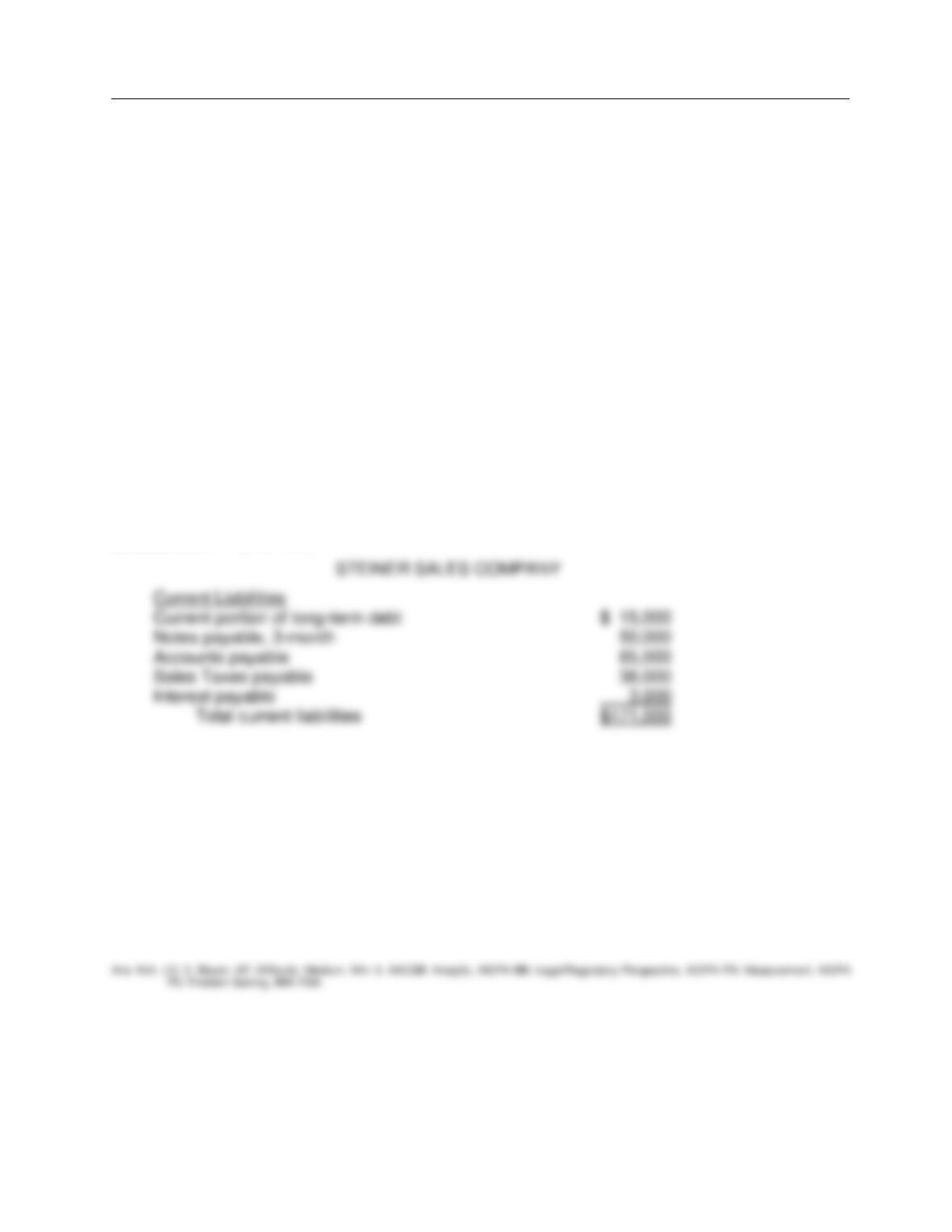
Steiner Sales Company has the following selected accounts after posting adjusting entries:
Accounts Payable $ 65,000
Notes Payable, 3-month 50,000
Accumulated Depreciation—Equipment 14,000
Notes Payable, 5-year, 6% 80,000
Payroll Tax Expense 4,000
Interest Payable 3,000
Mortgage Payable 120,000
Sales Taxes Payable 38,000
Instructions
Prepare the current liability section of Steiner Sales Company’s balance sheet, assuming $15,000
of the mortgage is payable next year.
Ans: N/A, LO: 1, Bloom: AP, Difficulty: Medium, Min: 5, AACSB: Analytic, AICPA BB: Legal/Regulatory Perspective, AICPA FN: Reporting, AICPA PC:
Problem Solving, IMA: Reporting
Solution 251 (5-8 min.)
Be. 252
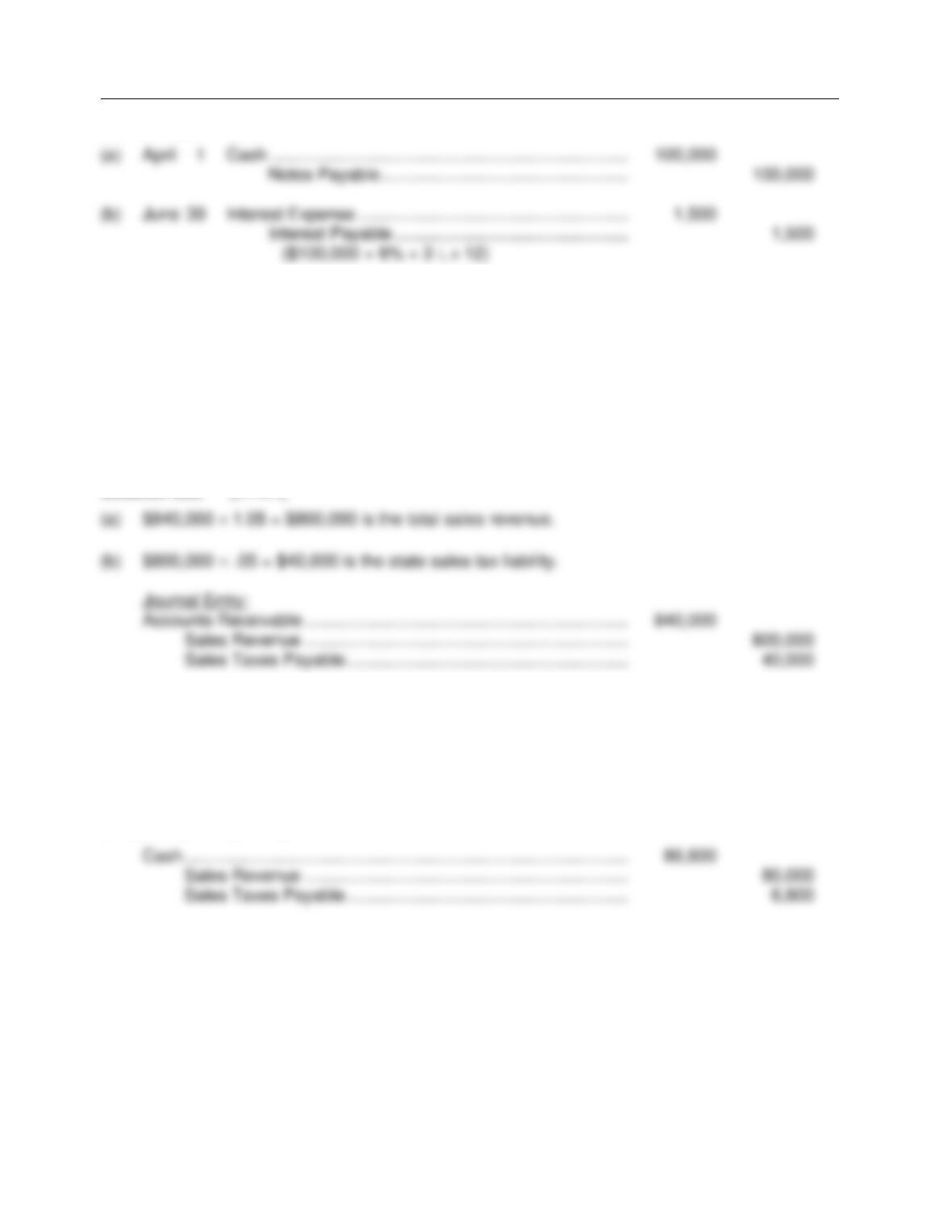
On April 1, Holton Company borrows $100,000 from West Bank by signing a 6-month, 6%,
interest-bearing note.
Instructions
Prepare the necessary entries below associated with the note payable on the books of Holton
Company.
(a) Prepare the entry on April 1 when the note was issued.
(b) Prepare any adjusting entries necessary on June 30 in order to prepare the semiannual
financial statements. Assume no other interest accrual entries have been made.
Test Bank for Accounting: Tools for Business Decision Making, Fifth Edition
FOR INSTRUCTOR USE ONLY
10–54
Solution 252 (5-8 min.)
Be. 253
Peterson Company billed its customers a total of $840,000 for the month of November. The total
includes a 5% state sales tax.
Instructions
(a) Determine the proper amount of revenue to report for the month.
(b) Prepare the general journal entry to record the revenue and related liabilities for the month.
Ans: N/A, LO: 3, Bloom: AP, Difficulty: Medium, Min: 5, AACSB: Analytic, AICPA BB: Legal/Regulatory Perspective, AICPA FN: Measurement, AICPA
PC: Problem Solving, IMA: FSA
Solution 253 (5 min.)
Be. 254
Manuel Company had cash sales of $86,800 (including taxes) for the month of June. Sales are
subject to 8.5% sales tax. Prepare the entry to record the sale.
Ans: N/A, LO: 3, Bloom: AN, Difficulty: Medium, Min: 3, AACSB: Analytic, AICPA BB: Legal/Regulatory Perspective, AICPA FN: Measurement, AICPA
PC: Problem Solving, IMA: FSA
Solution 254 (3 min.)
Be. 255
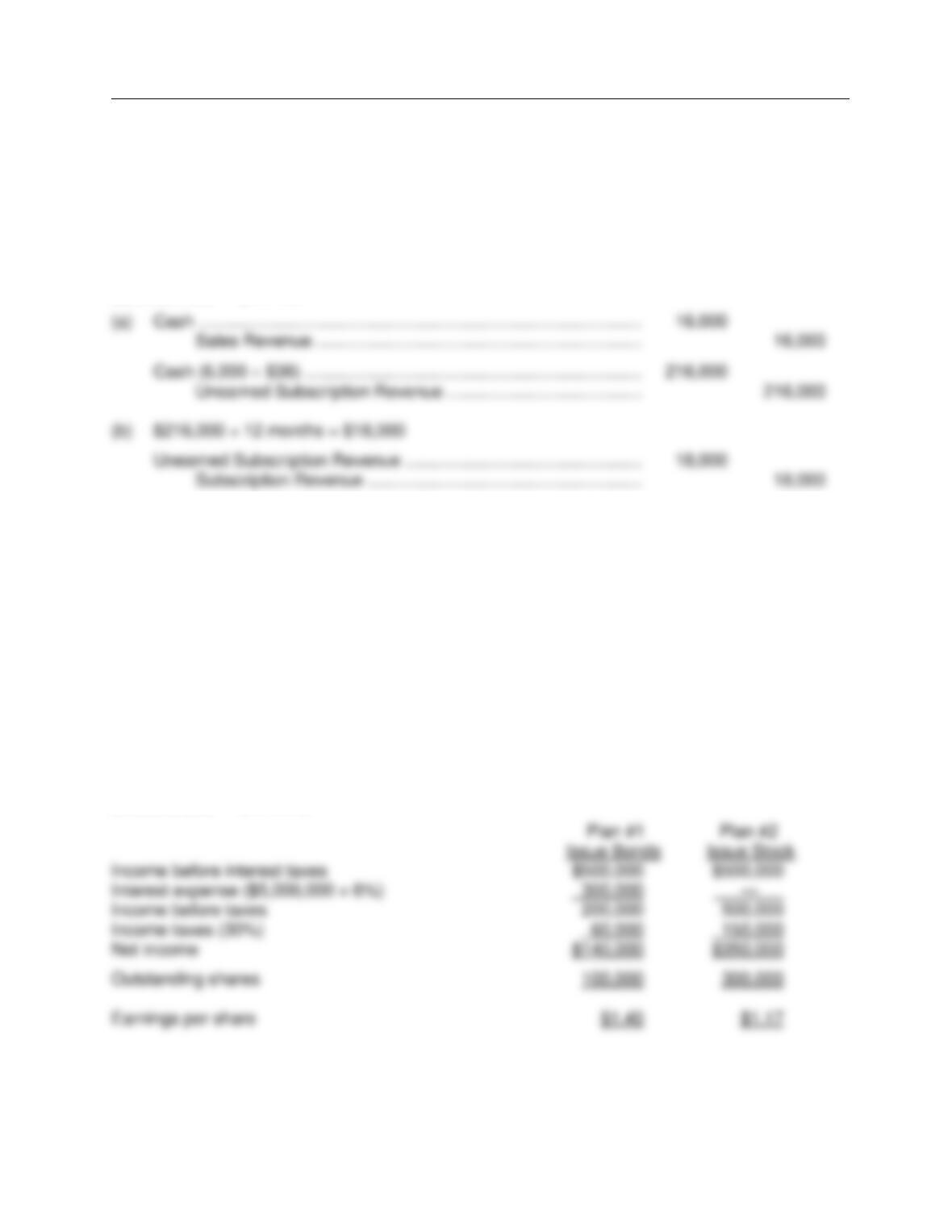
Mantle Publications publishes a golf magazine for women. The magazine sells for $4.00 a copy
on the newsstand. Yearly subscriptions to the magazine cost $36 per year (12 issues). During
December 2013, Expert Publications sells 4,000 copies of the golf magazine at newsstands and
receives payment for 6,000 subscriptions for 2014. Financial statements are prepared monthly.
Reporting and Analyzing Liabilities
FOR INSTRUCTOR USE ONLY
10–55
Instructions
(a) Prepare the December 2013 journal entries to record the newsstand sales and subscriptions
received.
(b) Prepare the necessary adjusting entry on January 31, 2014. The January 2014 issue has
been mailed to subscribers.
Ans: N/A, LO: 3, Bloom: AP, Difficulty: Medium, Min: 5, AACSB: Analytic, AICPA BB: Legal/Regulatory Perspective, AICPA FN: Measurement, AICPA
PC: Problem Solving, IMA: FSA
Solution 255 (5 min.)
Be. 256
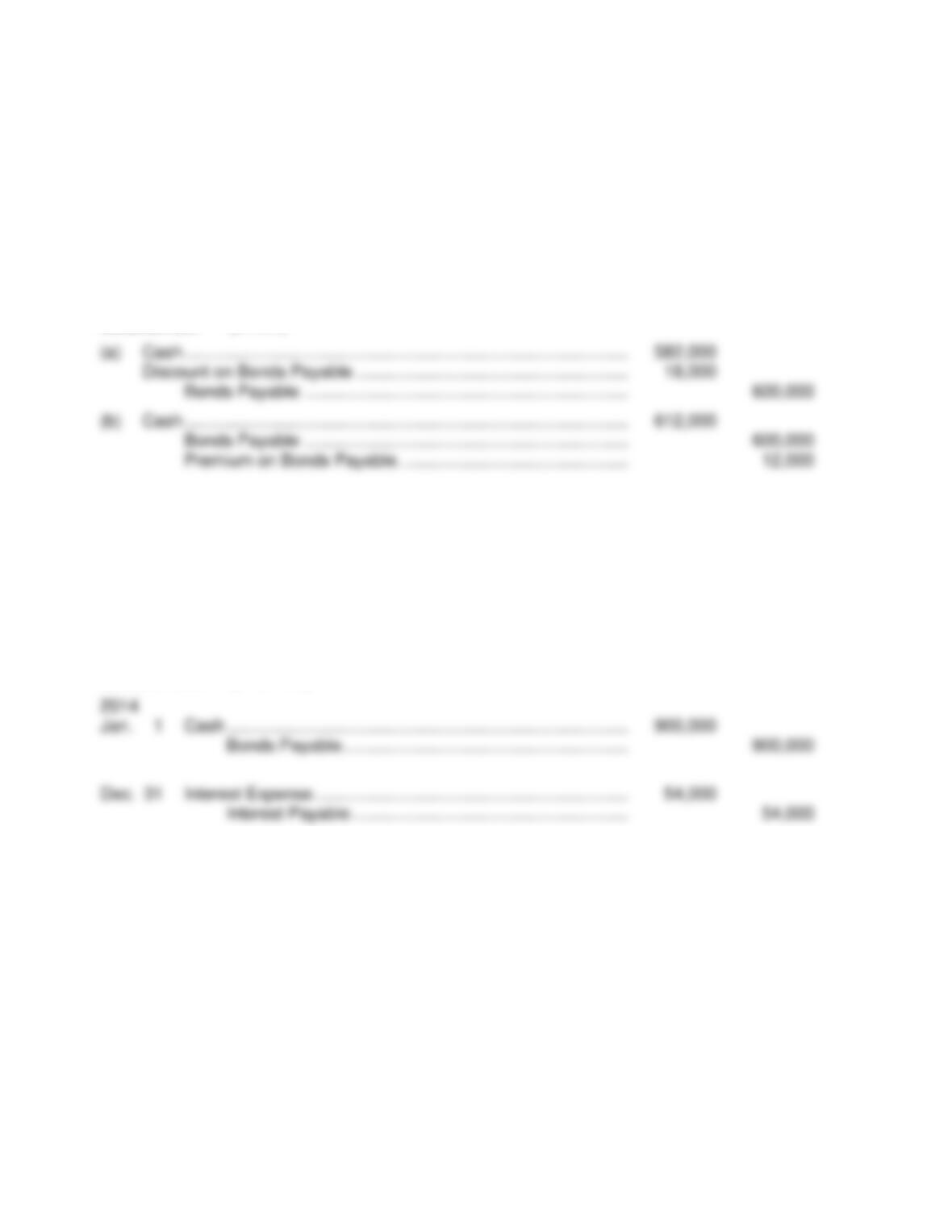
The board of directors of Lauber Corporation are considering two plans for financing the purchase
of new plant equipment. Plan #1 would require the issuance of $5,000,000, 6%, 20-year bonds at
face value. Plan #2 would require the issuance of 200,000 shares of $5 par value common stock
that is selling for $25 per share on the open market. Lauber Corporation currently has 100,000
shares of common stock outstanding and the income tax rate is expected to be 30%. Assume
that income before interest and income taxes is expected to be $500,000 if the new factory
equipment is purchased.
Instructions
Prepare a schedule that shows the expected net income after taxes and the earnings per share
on common stock under each of the plans that the board of directors is considering.
Ans: N/A, LO: 4, Bloom: AP, Difficulty: Medium, Min: 10, AACSB: Analytic, AICPA BB: Legal/Regulatory Perspective, AICPA FN: Reporting, AICPA PC:
Problem Solving, IMA: Business Economics
Solution 256 (10 min.)
Test Bank for Accounting: Tools for Business Decision Making, Fifth Edition
FOR INSTRUCTOR USE ONLY
10–56
Be. 257
On January 1, 2014, Hannigan Company issued bonds with a face value of $600,000. The bonds
carry a stated interest of 7% payable each January 1.
a. Prepare the journal entry for the issuance assuming the bonds are issued at 97.
b. Prepare the journal entry for the issuance assuming the bonds are issued at 102.
Ans: N/A, LO: 5, Bloom: AP, Difficulty: Medium, Min: 5, AACSB: Analytic, AICPA BB: Legal/Regulatory Perspective, AICPA FN: Measurement, AICPA
PC: Problem Solving, IMA: FSA
Solution 257 (5 min.)
Be. 258
On January 1, 2014, Hauke Corporation issued $900,000, 6%, 10-year bonds at face value.
Interest is payable annually on January 1. Hauke Corporation has a calendar year end.
Instructions
Prepare all entries related to the bond issue for 2014.
Ans: N/A, LO: 5, Bloom: AP, Difficulty: Medium, Min: 6, AACSB: Analytic, AICPA BB: Legal/Regulatory Perspective, AICPA FN: Measurement, AICPA
PC: Problem Solving, IMA: FSA
Solution 258 (6-10 min.)
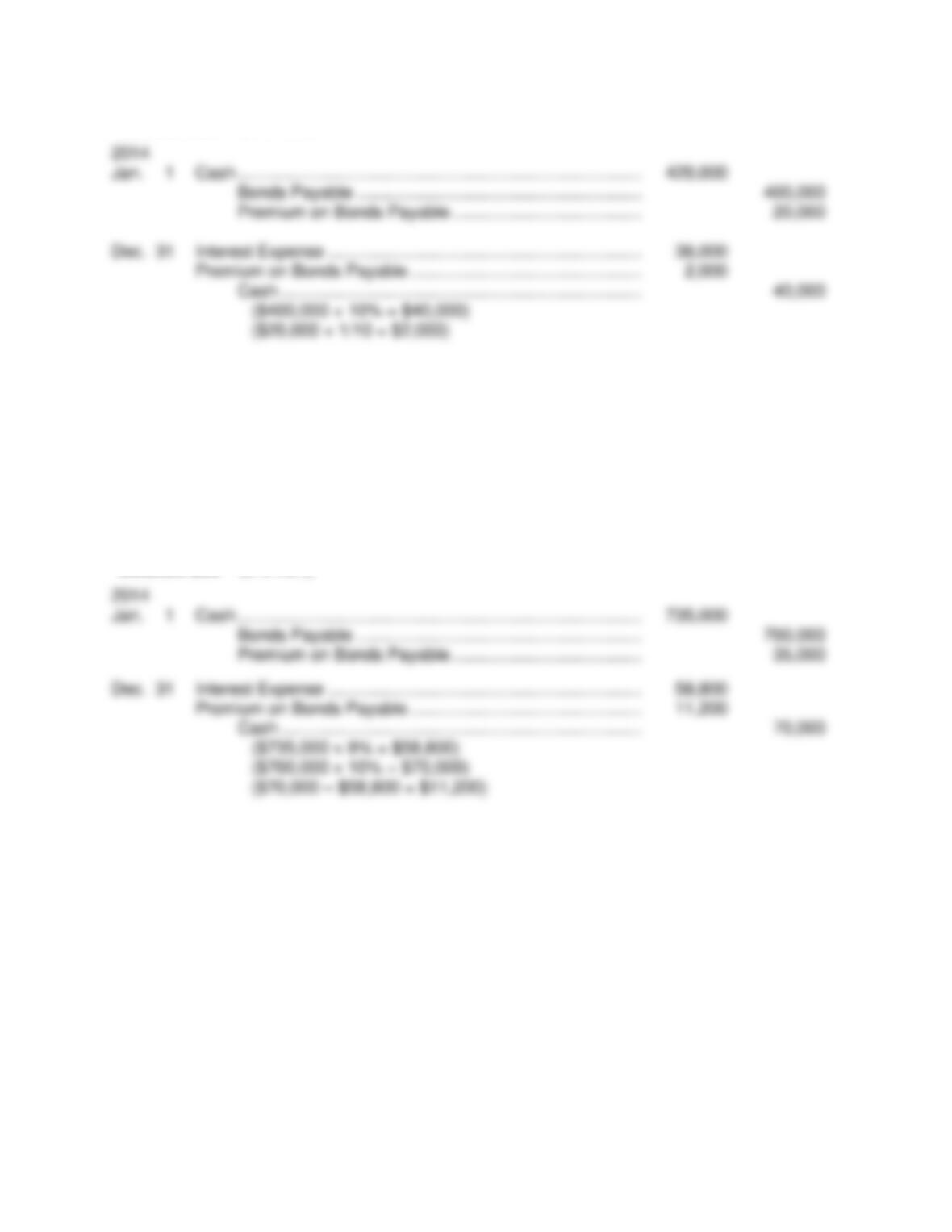
*Be. 259
Mintz Company issued $400,000, 10%, 10-year bonds on January 1, 2014, at 105. Interest is
payable annually. Mintz uses the straight-line method of amortization and has a calendar year
end.
Instructions
Prepare all journal entries made in 2014 related to the bond issue.
Ans: N/A, LO: 8, Bloom: AP, Difficulty: Medium, Min: 5, AACSB: Analytic, AICPA BB: Legal/Regulatory Perspective, AICPA FN: Measurement, AICPA
PC: Problem Solving, IMA: FSA
Reporting and Analyzing Liabilities
FOR INSTRUCTOR USE ONLY
10–57
*Solution 259 (5-8 min.)
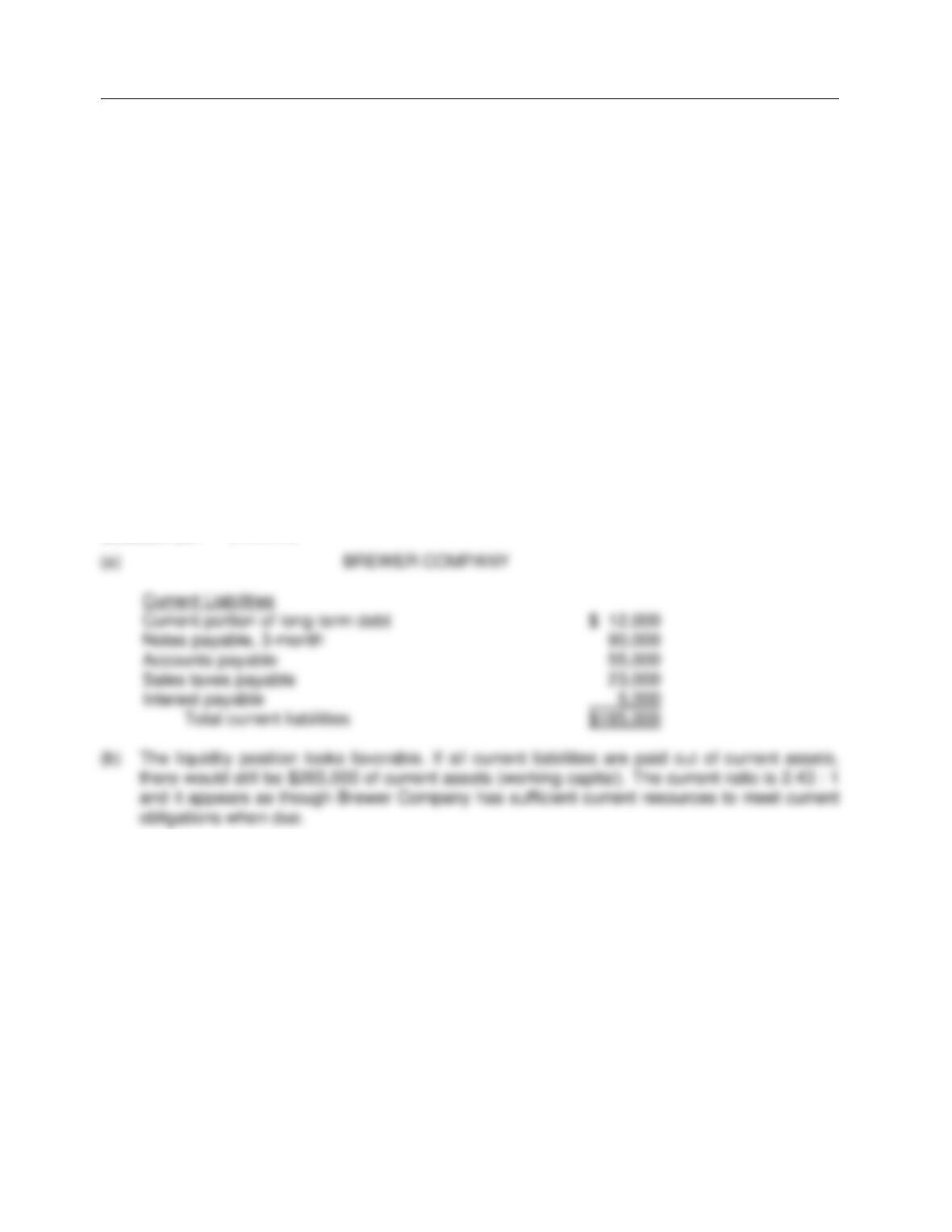
*Be. 260
Frye Company issued $700,000, 10%, 10-year bonds on January 1, 2014, at 105. Interest is
payable annually. Frye uses the effective-interest method of amortization and has a calendar year
end and the bonds were issued for an effective interest rate of 8%.
Instructions
Prepare all journal entries made in 2014 related to the bond issue.
Ans: N/A, LO: 9, Bloom: AP, Difficulty: Medium, Min: 5, AACSB: Analytic, AICPA BB: Legal/Regulatory Perspective, AICPA FN: Measurement, AICPA
PC: Problem Solving, IMA: FSA
*Solution 260 (5-8 min.)
Test Bank for Accounting: Tools for Business Decision Making, Fifth Edition
FOR INSTRUCTOR USE ONLY
10–58
EXERCISES
Ex. 261
Brewer Company has the following selected accounts after posting adjusting entries:
Accounts Payable $ 55,000
Notes Payable, 3-month 90,000
Accumulated Depreciation—Equipment 14,000
Notes Payable, 5-year, 8% 75,000
Payroll Taxes Expense 6,000
Interest Payable 5,000
Mortgage Payable 180,000
Sales Taxes Payable 23,000
Instructions
(a) Prepare the current liability section of Brewer Company’s balance sheet, assuming $12,000
of the mortgage is payable next year.
(b) Comment on Brewer’s liquidity, assuming total current assets are $450,000.
Ans: N/A, LO: 1,7, Bloom: AP, Difficulty: Medium, Min: 10, AACSB: Analytic, AICPA BB: Legal/Regulatory Perspective, AICPA FN: Reporting, AICPA PC:
Problem Solving, IMA: Reporting
Solution 261 (10 min.)
Ex. 262
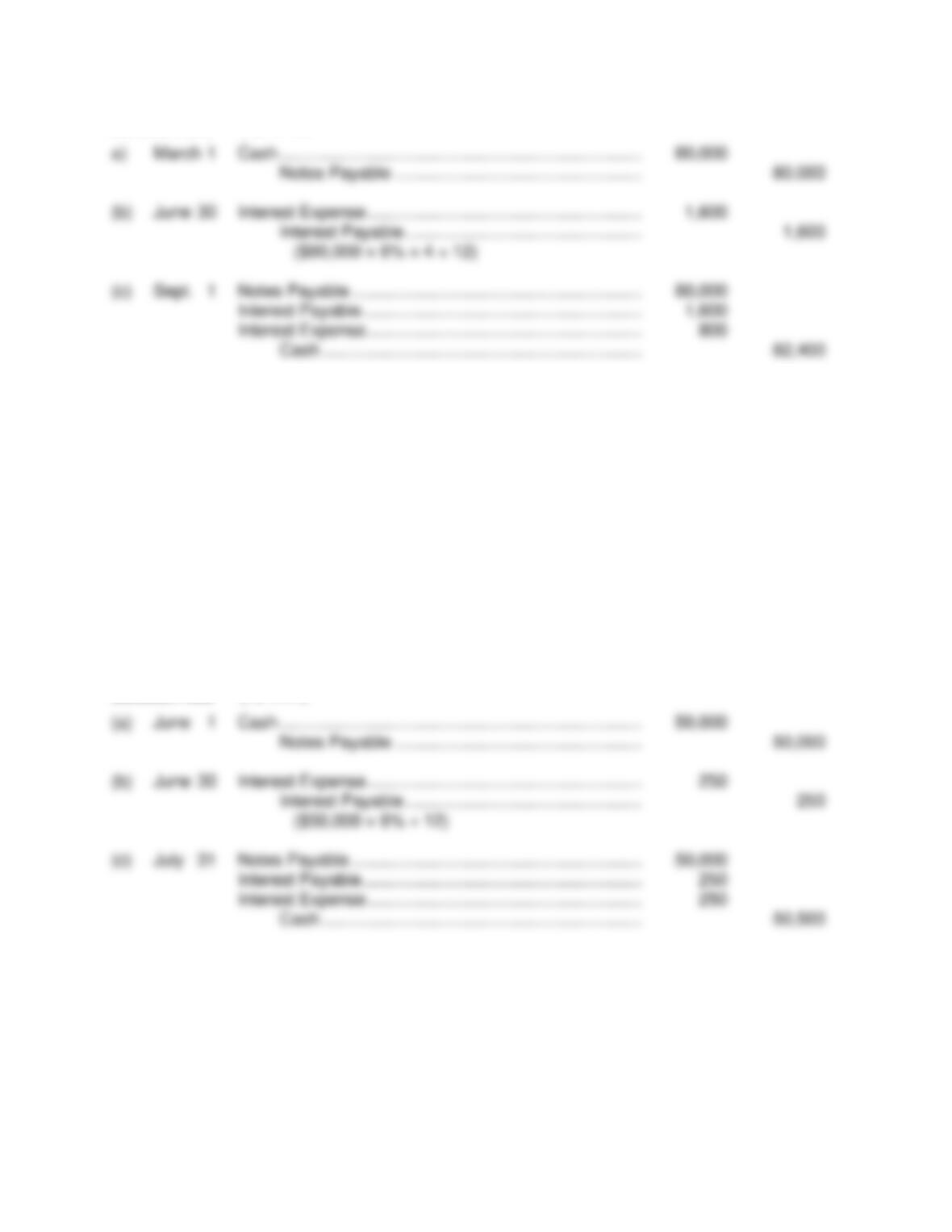
On March 1, Cooper Company borrows $80,000 from New National Bank by signing a 6-month,
6%, interest-bearing note.
Instructions
Prepare the necessary entries below associated with the note payable on the books of Cooper
Company.
(a) Prepare the entry on March 1 when the note was issued.
(b) Prepare any adjusting entries necessary on June 30 in order to prepare the semiannual
financial statements. Assume no other interest accrual entries have been made.
(c) Prepare the entry to record payment of the note at maturity.
Ans: N/A, LO: 2, Bloom: AP, Difficulty: Medium, Min: 10, AACSB: Analytic, AICPA BB: Legal/Regulatory Perspective, AICPA FN: Measurement, AICPA
PC: Problem Solving, IMA: FSA
Reporting and Analyzing Liabilities
FOR INSTRUCTOR USE ONLY
10–59
Solution 262 (10 min.)
Ex. 263
On June 1, Huntley Company borrows $50,000 from the bank by signing a 60-day, 6%, interest-
bearing note.
Instructions
Prepare the necessary entries below associated with the note payable on the books of Huntley
Company.
(a) Prepare the entry on June 1 when the note was issued.
(b) Prepare any adjusting entries necessary on June 30 in order to prepare the monthly
financial statements. Assume no other interest accrual entries have been made.
(c) Prepare the entry to record payment of the note at maturity.
Ans: N/A, LO: 2, Bloom: AP, Difficulty: Medium, Min: 10, AACSB: Analytic, AICPA BB: Legal/Regulatory Perspective, AICPA FN: Measurement, AICPA
PC: Problem Solving, IMA: FSA
Solution 263 (10 min.)