Ch 10 The Basics of Capital Budgeting: Evaluating Cash Flows
1. A firm should never accept a project if its acceptance would lead to an increase in the firm’s cost of capital (its WACC).
a.
True
b.
False
False
False
JFND-GO4G-EO5U-QPJI
2. Because “present value” refers to the value of cash flows that occur at different points in time, a series of present values
of cash flows should not be summed to determine the value of a capital budgeting project.
a.
True
b.
False
False
False
JFND-GO4G-EO5U-QPJW
Ch 10 The Basics of Capital Budgeting: Evaluating Cash Flows
3. Assuming that their NPVs based on the firm’s cost of capital are equal, the NPV of a project whose cash flows accrue
relatively rapidly will be more sensitive to changes in the discount rate than the NPV of a project whose cash flows come
in later in its life.
a.
True
b.
False
False
False
NPV
JFND-GO4G-EO4D-OOKN
4. A basic rule in capital budgeting is that if a project’s NPV exceeds its IRR, then the project should be accepted.
a.
True
b.
False
False
False
capital
NPV
JFND-GO4G-EO4D-OOKB
GCID-E7BW-1TBP-CWAD-RCBW–GR4G-GQDF-CIT1-43JZ-GITN-4PBW-GO4N-4QBW-

Ch 10 The Basics of Capital Budgeting: Evaluating Cash Flows
5. Conflicts between two mutually exclusive projects occasionally occur, where the NPV method ranks one project higher
but the IRR method ranks the other one first. In theory, such conflicts should be resolved in favor of the project with the
higher positive NPV.
a.
True
b.
False
True
False
JFND-GO4G-EO4D-OOJ3
4OTI-GO4W-NQNBEE
6. Conflicts between two mutually exclusive projects occasionally occur, where the NPV method ranks one project higher
but the IRR method ranks the other one first. In theory, such conflicts should be resolved in favor of the project with the
higher positive IRR.
a.
True
b.
False
False
False
GO4W-NQNBEE
Ch 10 The Basics of Capital Budgeting: Evaluating Cash Flows
7. When considering two mutually exclusive projects, the firm should always select the project whose internal rate of
return is the highest, provided the projects have the same initial cost. This statement is true regardless of whether the
projects can be repeated or not.
a.
True
b.
False
False
Difficulty: Moderate
True / False
False
FMTP.EHRH.17.10.03 – LO: 10-3
United States – BUSPROG: Reflective Thinking
United States – OH – Default City – TBA
Mutually exclusive projects
8/26/2015 10:46 AM
8/26/2015 10:46 AM
JFND-GO4G-EO4D-OOKG
GO4W-NQNBEE
8. Which of the following statements is CORRECT? Assume that the project being considered has normal cash flows,
with one outflow followed by a series of inflows.
a.
The lower the cost of capital used to calculate a project’s NPV, the lower the calculated NPV will be.
b.
If a project’s NPV is less than zero, then its IRR must be less than the cost of capital.
8/26/2015 10:46 AM
8/26/2015 10:46 AM
JFND-GO4G-EO4D-OOJA
Ch 10 The Basics of Capital Budgeting: Evaluating Cash Flows
c.
If a project’s NPV is greater than zero, then its IRR must be less than zero.
d.
The NPV of a relatively low-risk project should be found using a relatively high cost of capital.
e.
A project’s NPV is found by compounding the cash inflows at the IRR to find the terminal value (TV), then
discounting the TV at the cost of capital.
Difficulty: Easy
Multiple Choice
FMTP.EHRH.17.10.03 – LO: 10-3
United States – BUSPROG: Analytic
United States – AK – DISC: Capital budgeting and cost – DISC: Capital budgeting and cost of
United States – OH – Default City – TBA
TYPE: Multiple Choice: Conceptual
8/26/2015 10:46 AM
8/27/2015 6:40 PM
9. Which of the following statements is CORRECT? Assume that the project being considered has normal cash flows,
with one outflow followed by a series of inflows.
a.
The higher the cost of capital used to calculate the NPV, the lower the calculated NPV will be.
b.
If a project’s NPV is greater than zero, then its IRR must be less than the cost of capital.
c.
If a project’s NPV is greater than zero, then its IRR must be less than zero.
d.
The NPVs of relatively risky projects should be found using relatively low costs of capital.
e.
A project’s NPV is generally found by compounding the cash inflows at the cost of capital to find the terminal
value (TV), then discounting the TV at the IRR to find its PV.
Difficulty: Moderate
Multiple Choice
FMTP.EHRH.17.10.03 – LO: 10-3
United States – BUSPROG: Analytic
United States – AK – DISC: Capital budgeting and cost – DISC: Capital budgeting and cost of
United States – OH – Default City – TBA
Ch 10 The Basics of Capital Budgeting: Evaluating Cash Flows
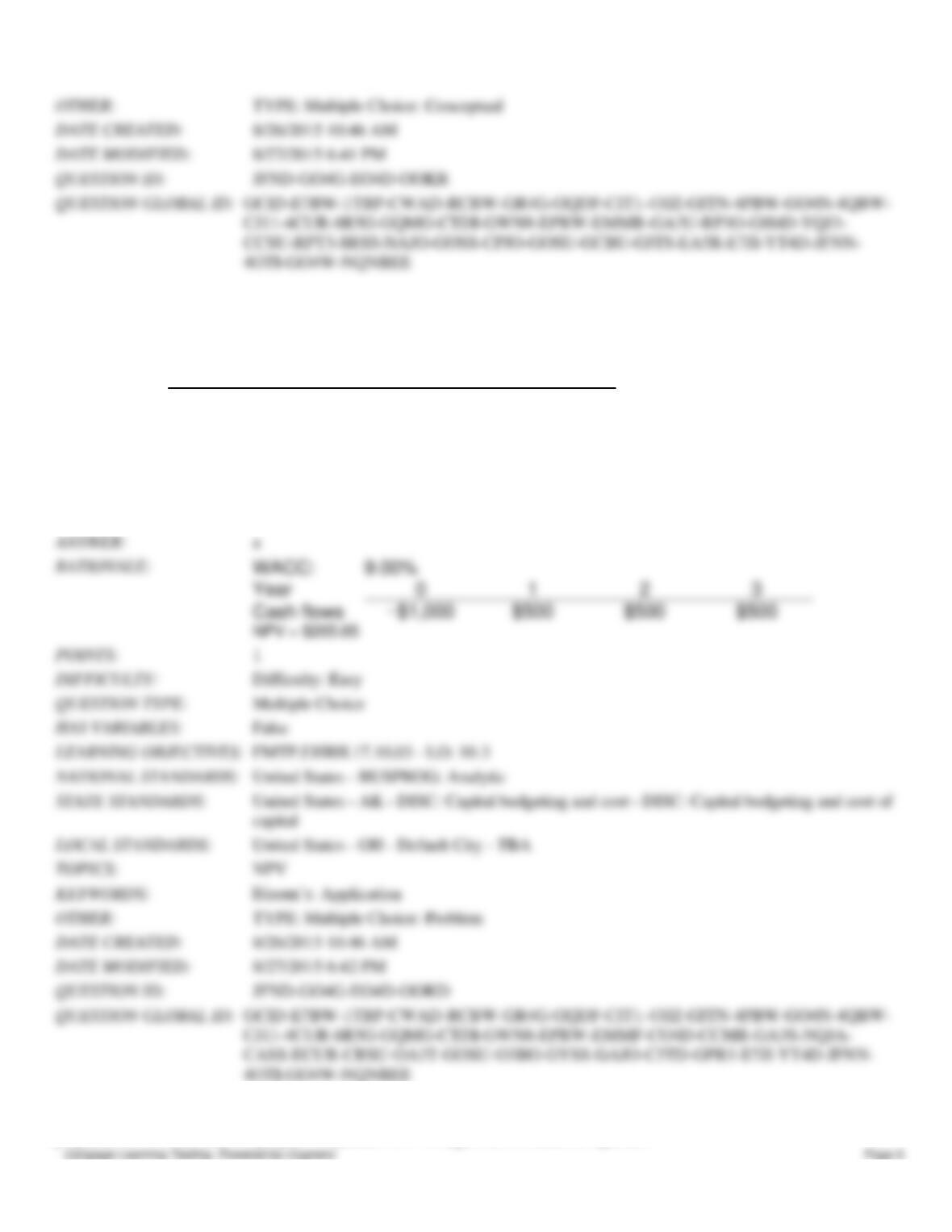
10. Ellmann Systems is considering a project that has the following cash flow and cost of capital (r) data. What is the
project’s NPV? Note that if a project’s expected NPV is negative, it should be rejected.
r:
9.00%
Year
0
1
2
3
Cash flows
−$1,000
$500
$500
$500
a.
$265.65
b.
$278.93
c.
$292.88
d.
$307.52
e.
$322.90
a
Difficulty: Easy
Multiple Choice
False
FMTP.EHRH.17.10.03 – LO: 10-3
United States – BUSPROG: Analytic
United States – OH – Default City – TBA
NPV
TYPE: Multiple Choice: Problem
8/26/2015 10:46 AM
8/27/2015 6:42 PM
JFND-GO4G-EO4D-OOKD
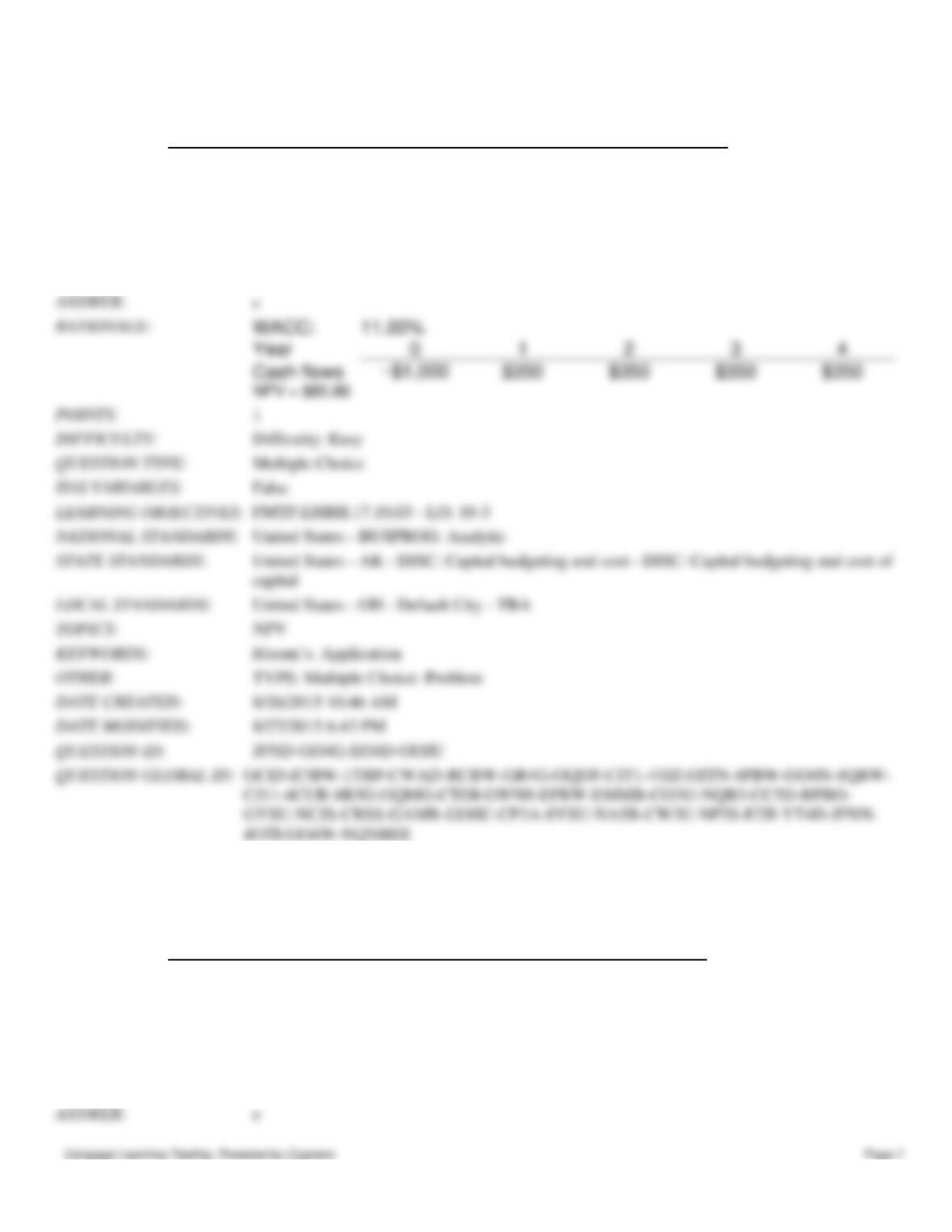
11. Scott Enterprises is considering a project that has the following cash flow and cost of capital (r) data. What is the
project’s NPV? Note that if a project’s expected NPV is negative, it should be rejected.
TYPE: Multiple Choice: Conceptual
8/26/2015 10:46 AM
8/27/2015 6:41 PM
JFND-GO4G-EO4D-OOKR
Ch 10 The Basics of Capital Budgeting: Evaluating Cash Flows
r:
11.00%
Year
0
1
2
3
4
Cash flows
−$1,000
$350
$350
$350
$350
a.
$77.49
b.
$81.56
c.
$85.86
d.
$90.15
e.
$94.66
c
Difficulty: Easy
Multiple Choice
False
FMTP.EHRH.17.10.03 – LO: 10-3
United States – BUSPROG: Analytic
United States – OH – Default City – TBA
NPV
TYPE: Multiple Choice: Problem
8/26/2015 10:46 AM
8/27/2015 6:43 PM
JFND-GO4G-EO4D-OOJU
4OTI-GO4W-NQNBEE
12. Robbins Inc. is considering a project that has the following cash flow and cost of capital (r) data. What is the project’s
NPV? Note that if a project’s expected NPV is negative, it should be rejected.
r:
10.25%
Year
0
1
2
3
4
5
Cash flows
−$1,000
$300
$300
$300
$300
$300
a.
$105.89
b.
$111.47
c.
$117.33
d.
$123.51
e.
$130.01
e
Ch 10 The Basics of Capital Budgeting: Evaluating Cash Flows
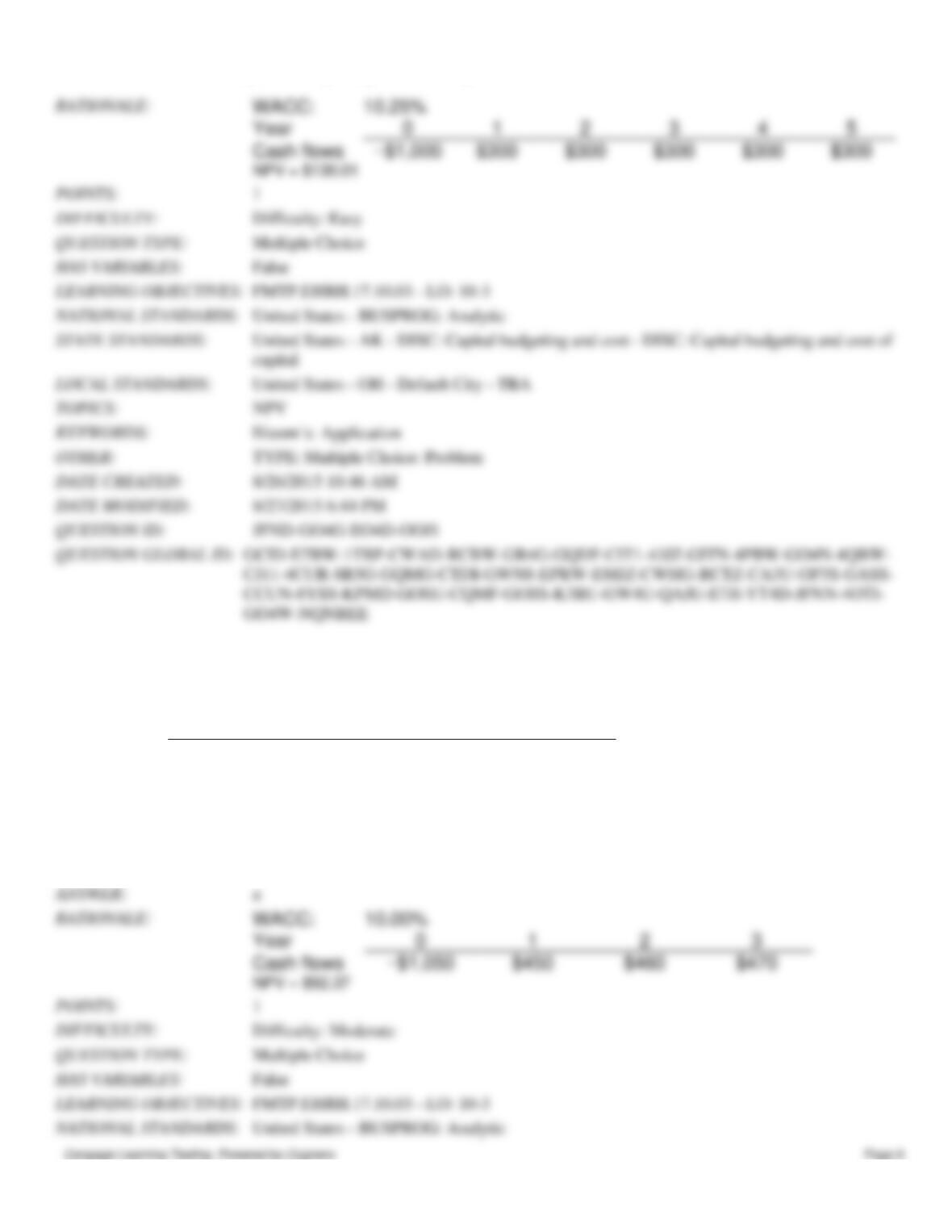
13. Reed Enterprises is considering a project that has the following cash flow and cost of capital (r) data. What is the
project’s NPV? Note that a project’s expected NPV can be negative, in which case it will be rejected.
r:
10.00%
Year
0
1
2
3
Cash flows
−$1,050
$450
$460
$470
a.
$92.37
b.
$96.99
c.
$101.84
d.
$106.93
e.
$112.28
a
Difficulty: Moderate
Multiple Choice
False
FMTP.EHRH.17.10.03 – LO: 10-3
United States – BUSPROG: Analytic
Difficulty: Easy
Multiple Choice
False
FMTP.EHRH.17.10.03 – LO: 10-3
United States – BUSPROG: Analytic
United States – OH – Default City – TBA
NPV
TYPE: Multiple Choice: Problem
8/26/2015 10:46 AM
8/27/2015 6:44 PM
JFND-GO4G-EO4D-OOJ1
Ch 10 The Basics of Capital Budgeting: Evaluating Cash Flows
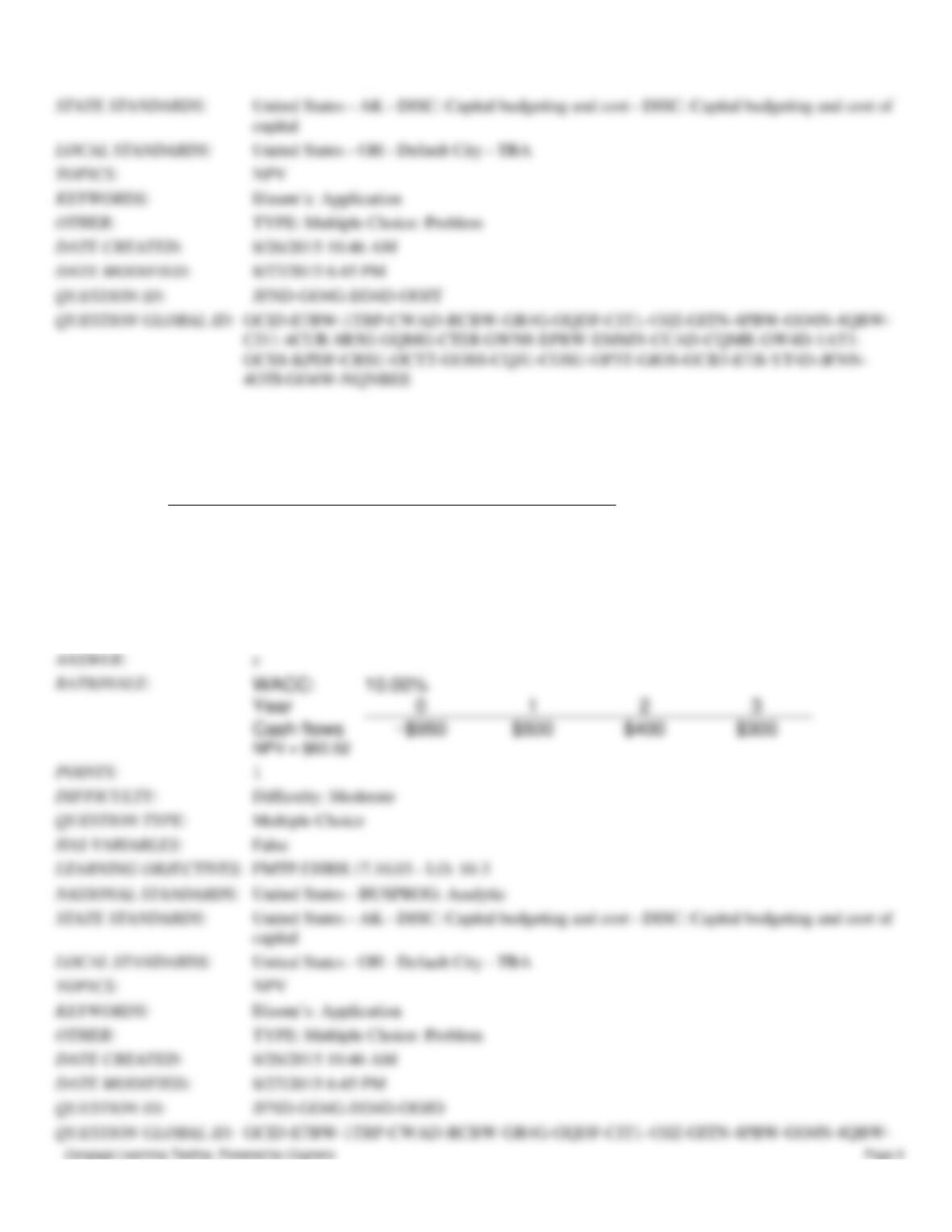
14. Patterson Co. is considering a project that has the following cash flow and cost of capital (r) data. What is the project’s
NPV? Note that a project’s expected NPV can be negative, in which case it will be rejected.
r:
10.00%
Year
0
1
2
3
Cash flows
−$950
$500
$400
$300
a.
$54.62
b.
$57.49
c.
$60.52
d.
$63.54
e.
$66.72
c
Difficulty: Moderate
Multiple Choice
False
FMTP.EHRH.17.10.03 – LO: 10-3
United States – BUSPROG: Analytic
United States – OH – Default City – TBA
NPV
TYPE: Multiple Choice: Problem
8/26/2015 10:46 AM
8/27/2015 6:45 PM
JFND-GO4G-EO4D-OOJO
GCID-E7BW-1TBP-CWAD-RCBW–GR4G-GQDF-CIT1-43JZ-GITN-4PBW-GO4N-4QBW-
United States – OH – Default City – TBA
NPV
TYPE: Multiple Choice: Problem
8/26/2015 10:46 AM
8/27/2015 6:45 PM
JFND-GO4G-EO4D-OOJT
4OTI-GO4W-NQNBEE
Ch 10 The Basics of Capital Budgeting: Evaluating Cash Flows
15. Yoga Center Inc. is considering a project that has the following cash flow and cost of capital (r) data. What is the
project’s NPV? Note that a project’s expected NPV can be negative, in which case it will be rejected.
r:
14.00%
Year
0
1
2
3
4
Cash flows
−$1,200
$400
$425
$450
$475
a.
$41.25
b.
$45.84
c.
$50.93
d.
$56.59
e.
$62.88
e
Difficulty: Moderate
Multiple Choice
False
FMTP.EHRH.17.10.03 – LO: 10-3
United States – BUSPROG: Analytic
United States – OH – Default City – TBA
NPV
TYPE: Multiple Choice: Problem
8/26/2015 10:46 AM
8/27/2015 6:46 PM
JFND-GO4G-EO4D-OOJZ
4OTI-GO4W-NQNBEE
16. Dickson Co. is considering a project that has the following cash flow and cost of capital (r) data. What is the project’s
NPV? Note that a project’s expected NPV can be negative, in which case it will be rejected.
r:
12.00%
Year
0
1
2
3
4
5
Cash flows
−$1,100
$400
$390
$380
$370
$360
a.
$250.15
Ch 10 The Basics of Capital Budgeting: Evaluating Cash Flows
b.
$277.94
c.
$305.73
d.
$336.31
e.
$369.94
Difficulty: Moderate
Multiple Choice
False
FMTP.EHRH.17.10.03 – LO: 10-3
United States – BUSPROG: Analytic
United States – OH – Default City – TBA
NPV
TYPE: Multiple Choice: Problem
8/26/2015 10:46 AM
8/27/2015 6:47 PM
JFND-GO4G-EO4D-OOJS
17. Last month, Standard Systems analyzed the project whose cash flows are shown below. However, before the decision
to accept or reject the project took place, the Federal Reserve changed interest rates and therefore the firm’s cost of capital
(r). The Fed’s action did not affect the forecasted cash flows. By how much did the change in the r affect the project’s
forecasted NPV? Note that a project’s expected NPV can be negative, in which case it should be rejected.
Old r:
10.00%
New r:
11.25%
Year
0
1
2
3
Cash flows
−$1,000
$410
$410
$410
a.
−$18.89
b.
−$19.88
c.
−$20.93
d.
−$22.03
e.
−$23.13
Old r:
10.00%
New r:
11.25%
Year
1
2
3
Cash flows
−$1,000
$410
$410
$410

Ch 10 The Basics of Capital Budgeting: Evaluating Cash Flows
Old NPV = $19.61 New NPV = −$2.42 Change = −$22.03
Difficulty: Moderate
Multiple Choice
False
FMTP.EHRH.17.10.03 – LO: 10-3
United States – BUSPROG: Analytic
United States – OH – Default City – TBA
NPV sensitivity to WACC
TYPE: Multiple Choice: Problem
8/26/2015 10:46 AM
8/27/2015 6:48 PM
JFND-GO4G-EO4D-OOJI
18. Corner Jewelers, Inc. recently analyzed the project whose cash flows are shown below. However, before the company
decided to accept or reject the project, the Federal Reserve changed interest rates and therefore the firm’s cost of capital
(r). The Fed’s action did not affect the forecasted cash flows. By how much did the change in the r affect the project’s
forecasted NPV? Note that a project’s expected NPV can be negative, in which case it should be rejected.
Old r:
8.00%
New r:
11.25%
Year
0
1
2
3
Cash flows
−$1,000
$410
$410
$410
a.
−$59.03
b.
−$56.08
c.
−$53.27
d.
−$50.61
e.
−$48.08
a
Old r:
8.00%
New r:
11.25%
Year
1
2
3
Cash flows
−$1,000
$410
$410
$410
Old NPV = $56.61 New NPV = −$2.42 Change = −$59.03
Difficulty: Moderate
Multiple Choice
False
United States – BUSPROG: Analytic
United States – AK – DISC: Capital budgeting and cost – DISC: Capital budgeting and cost of
Ch 10 The Basics of Capital Budgeting: Evaluating Cash Flows
19. The internal rate of return is that discount rate that equates the present value of the cash outflows (or costs) with the
present value of the cash inflows.
a.
True
b.
False
True
False
JFND-GO4G-EO4D-OO1N
20. Other things held constant, an increase in the cost of capital will result in a decrease in a project’s IRR.
a.
True
b.
False
False
False
capital
JFND-GO4G-EO4D-OOJW
4OTI-GO4W-NQNBEE
Ch 10 The Basics of Capital Budgeting: Evaluating Cash Flows
21. A project’s IRR is independent of the firm’s cost of capital. In other words, a project’s IRR doesn’t change with a
change in the firm’s cost of capital.
a.
True
b.
False
True
False
JFND-GO4G-EO4D-OOT3
GO4W-NQNBEE
22. Under certain conditions, a project may have more than one IRR. One such condition is when, in addition to the initial
investment at time = 0, a negative cash flow (or cost) occurs at the end of the project’s life.
a.
True
b.
False
True
JFND-GO4G-EO4D-OO1B
Ch 10 The Basics of Capital Budgeting: Evaluating Cash Flows
23. The phenomenon called “multiple internal rates of return” arises when two or more mutually exclusive projects that
have different lives are compared to one another.
a.
True
b.
False
False
False
JFND-GO4G-EO4D-OO1G
24. The NPV method is based on the assumption that projects’ cash flows are reinvested at the project’s risk-adjusted cost
of capital.
a.
True
False
8/26/2015 10:46 AM
JFND-GO4G-EO4D-OOTA
Ch 10 The Basics of Capital Budgeting: Evaluating Cash Flows
b.
False
True
False
JFND-GO4G-EO4D-OO1F
25. The IRR method is based on the assumption that projects’ cash flows are reinvested at the project’s risk-adjusted cost
of capital.
a.
True
b.
False
False
False
JFND-GO4G-EO4D-OO1R
Ch 10 The Basics of Capital Budgeting: Evaluating Cash Flows
26. The NPV method’s assumption that cash inflows are reinvested at the cost of capital is generally more reasonable than
the IRR’s assumption that cash flows are reinvested at the IRR. This is an important reason why the NPV method is
generally preferred over the IRR method.
a.
True
b.
False
True
False
JFND-GO4G-EO4D-OO1D
GO4W-NQNBEE
27. Project S has a pattern of high cash flows in its early life, while Project L has a longer life, with large cash flows late
in its life. Neither has negative cash flows after Year 0, and at the current cost of capital, the two projects have identical
NPVs. Now suppose interest rates and money costs decline. Other things held constant, this change will cause L to
become preferred to S.
a.
True
b.
False
True
False
Ch 10 The Basics of Capital Budgeting: Evaluating Cash Flows
JFND-GO4G-EO4D-OOTU
28. An increase in the firm’s cost of capital will decrease projects’ NPVs, which could change the accept/reject decision
for any potential project. However, such a change would have no impact on projects’ IRRs. Therefore, the accept/reject
decision under the IRR method is independent of the cost of capital.
a.
True
b.
False
False
False
JFND-GO4G-EO4D-OOT1
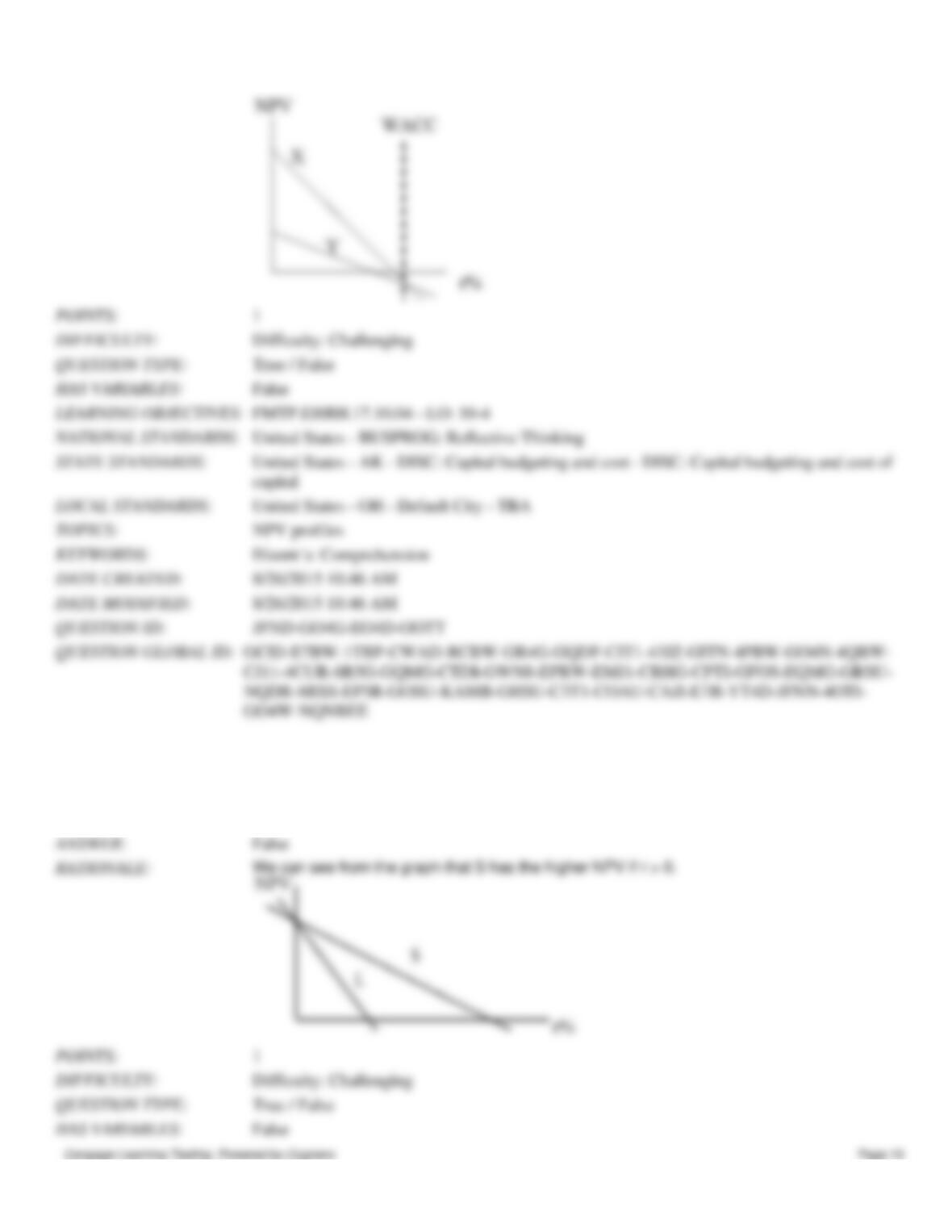
29. The IRR of normal Project X is greater than the IRR of normal Project Y, and both IRRs are greater than zero. Also,
the NPV of X is greater than the NPV of Y at the cost of capital. If the two projects are mutually exclusive, Project X
should definitely be selected, and the investment made, provided we have confidence in the data. Put another way, it is
impossible to draw NPV profiles that would suggest not accepting Project X.
a.
True
b.
False
False
Ch 10 The Basics of Capital Budgeting: Evaluating Cash Flows
False
JFND-GO4G-EO4D-OOTT
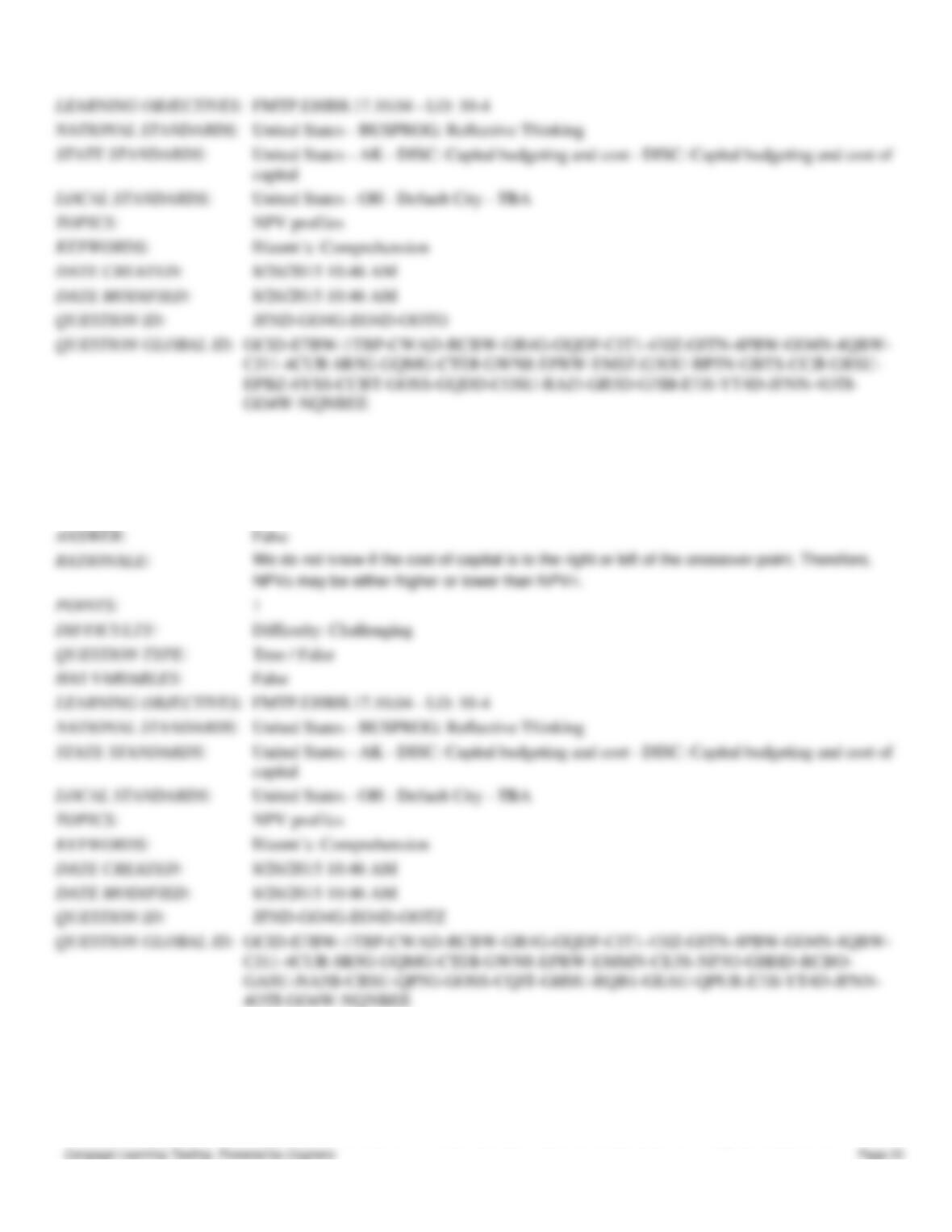
30. Normal Projects S and L have the same NPV when the discount rate is zero. However, Project S’s cash flows come in
faster than those of L. Therefore, we know that at any discount rate greater than zero, L will have the higher NPV.
a.
True
b.
False
False
False
Ch 10 The Basics of Capital Budgeting: Evaluating Cash Flows
31. If the IRR of normal Project X is greater than the IRR of mutually exclusive (and also normal) Project Y, we can
conclude that the firm should always select X rather than Y if X has NPV > 0.
a.
True
b.
False
False
Difficulty: Challenging
True / False
False
FMTP.EHRH.17.10.04 – LO: 10-4
United States – BUSPROG: Reflective Thinking
United States – OH – Default City – TBA
NPV profiles
8/26/2015 10:46 AM
8/26/2015 10:46 AM
JFND-GO4G-EO4D-OOTZ
32. Which of the following statements is CORRECT?
a.
One defect of the IRR method versus the NPV is that the IRR does not take account of the time value of
money.
b.
One defect of the IRR method versus the NPV is that the IRR does not take account of the cost of capital.
c.
One defect of the IRR method versus the NPV is that the IRR values a dollar received today the same as a
FMTP.EHRH.17.10.04 – LO: 10-4
United States – BUSPROG: Reflective Thinking
United States – OH – Default City – TBA
NPV profiles
8/26/2015 10:46 AM
8/26/2015 10:46 AM
JFND-GO4G-EO4D-OOTO