Chapter 10—Protecting Your Property
125. Auto insurance premiums are generally reduced by
a. choosing a higher deductible.
b. buying a sporty “high powered” car.
c. moving to a larger city.
d. avoiding carpooling to work.
e. all of the above
126. You could save money on your car insurance premiums by
a. buying a 4-door sedan rather than a high-performance vehicle.
b. choosing a $1,000 deductible rather than a $100 deductible.
c. moving to a small town with a low accident rate.
d. b and c.
e. none of these would make any difference.
127. Auto insurance companies may offer premium discounts for
a. being a good student.
b. installing anti-theft devices.
c. taking a defensive driving course.
d. all of these.
e. none of these.
128. A(n) ____ agent represents multiple insurance companies.
Chapter 10—Protecting Your Property
a. captive
b. business
c. good
d. independent
e. employed
129. An automobile covered under a policy with a $500 collision deductible is damaged in a collision with a fence. It
could be repaired for $15,000, replacement cost is $25,000, and the depreciation and physical condition deduction is
$5,000. How much will the insurance company pay?
a. $24,500
b. $7,500
c. $15,000
d. $14,500
e. Some other amount
130. What factor affects insurance premiums the most?
a. Style of home
b. Age of home
c. Brick or wood exterior
d. Credit score
e. Detached or attached garage
131. The advisable dollar coverage for any one auto accident is no less than
a. $50,000. b. $100,000.
c. $200,000. d. $300,000.
e. $500,000.
Chapter 10—Protecting Your Property
132. The best place to buy automobile insurance is
a. insurance agent b. auto dealer
c. finance company d. state insurance commission
e. none of the above
133. Section I of a homeowner’s insurance policy covers all of the following except
a. personal liability b. dwelling
c. other structures d. personal property
INSTRUCTIONS: Choose the word or phrase in [ ] that will correctly complete the statement. Select A for the first item,
B for the second item, and C if neither item will correctly complete the statement.
134. The principle of [indemnity | peril] states that the insured may not be compensated by the insurance company in an
amount exceeding the insured’s economic loss.
135. When considering your possible losses as a property owner, you would be more likely to suffer a very severe loss
from [loss of property | liability claims].
Chapter 10—Protecting Your Property
136. [Negligence | Indemnity] is the failure to act in a reasonable manner or take necessary steps to protect others from
harm.
137. An HO-2 policy will protect your property from losses due to [all perils except those listed | listed perils only].
138. Bill was the at-fault party when you and he collided. Your insurance company has paid for the damages to your car.
Now, it intends to recover this money from Bill. This is the right of [subrogation | indemnification].
139. An HO-3 policy will protect your property from losses due to [all perils except those listed | listed perils only].
140. Actual cash value is calculated by subtracting depreciation from the [purchase price | replacement cost] of an item.
Chapter 10—Protecting Your Property
141. Most HO policies [would | would not] contain a clause requiring you to carry insurance equal to a minimum percent
of the replacement value of your home in order to be paid in full for small losses.
142. Your house has a replacement value of $120,000. Your HO policy has an 80% co–insurance clause. In order to
receive full compensation if your house is totally destroyed, you must carry insurance for [$96,000 | $120,000].
143. [Comprehensive | Named peril] policy covers all perils unless they are specifically excluded.
144. [HO-2 | HO-3] is an example of a named peril policy.
Chapter 10—Protecting Your Property
145. Earthquake policy and flood protection [would | would not] be provided by the standard HO policy.
146. Negligent acts must be [intentional | unintentional] in order to be insured.
147. You own your house. The amount of HO insurance coverage you will have on your furniture will be dependent upon
[the replacement value of your house | the amount of insurance on your home].
148. You use a small building on your property to manufacture widgets. This building [will | will not] be covered by your
standard HO policy.
149. The personal property of your [boarder | visiting mother-in-law] would be covered by your HO policy.
Chapter 10—Protecting Your Property
150. Your $10,000 stamp collection would be best protected under [your HO policy | a personal property floater].
151. [Most | Few] tenants carry renters insurance.
152. If your furniture in your rented apartment is destroyed by a fire, it [would | would not] be covered by your landlord’s
policy.
153. A renter’s policy typically [does | does not] provide protection against liability claims.
154. If you are sued, the liability portion of your property insurance [covers | does not cover] your defense.
Chapter 10—Protecting Your Property
155. Decreasing the amount of deductibles will [increase | decrease] your insurance premiums.
156. The insurance company [will | will not] provide liability coverage if your dog bites the neighbor.
157. Medical payments coverage [would | would not] pay for the medical bills of passengers in your car who are not
related to you.
158. Uninsured motorist insurance is relatively [expensive | inexpensive].
159. If a large wild animal damages your car, payment will come from your [collision | comprehensive] protection.
Chapter 10—Protecting Your Property
160. Buying collision and comprehensive auto insurance from the dealer selling you the car is considered to be a [good |
bad] idea.
161. The theft of your favorite jacket from your locked car [would be | would not be] taken care of by your renter’s policy.
162. Sally drove Jessie’s car to the mall and was involved in an accident that was her fault. The primary auto insurance
that will cover this accident is [Sally’s | Jessie’s].
163. The type of car you drive will have [no | a large] effect on the premiums you pay.
164. Most insurance companies [will | will not] offer good student discounts on car insurance premiums.
Chapter 10—Protecting Your Property
165. A personal liability umbrella policy is designed to [replace | supplement] HO and car liability coverage.
166. Umbrella liability insurance is more likely to be needed by [higher | lower] income persons.
167. An insurance adjustor is working for the [insurance company | claimant].
168. The professional designation you want your property insurance agent to have is the [ACLU | CPCU].
Chapter 10—Protecting Your Property
169. Research shows that people with [lower | higher] credit scores tend to file more insurance claims.
170. The advisable dollar coverage for any one auto accident is at least [$100,000 | $300,000].
171. The best way to buy automobile insurance is through your [finance company | independent agent].
172. Section I of a homeowner’s insurance policy covers [medical payments | dwelling].
173. Section II of a homeowner’s insurance policy covers [personal property | personal liability].
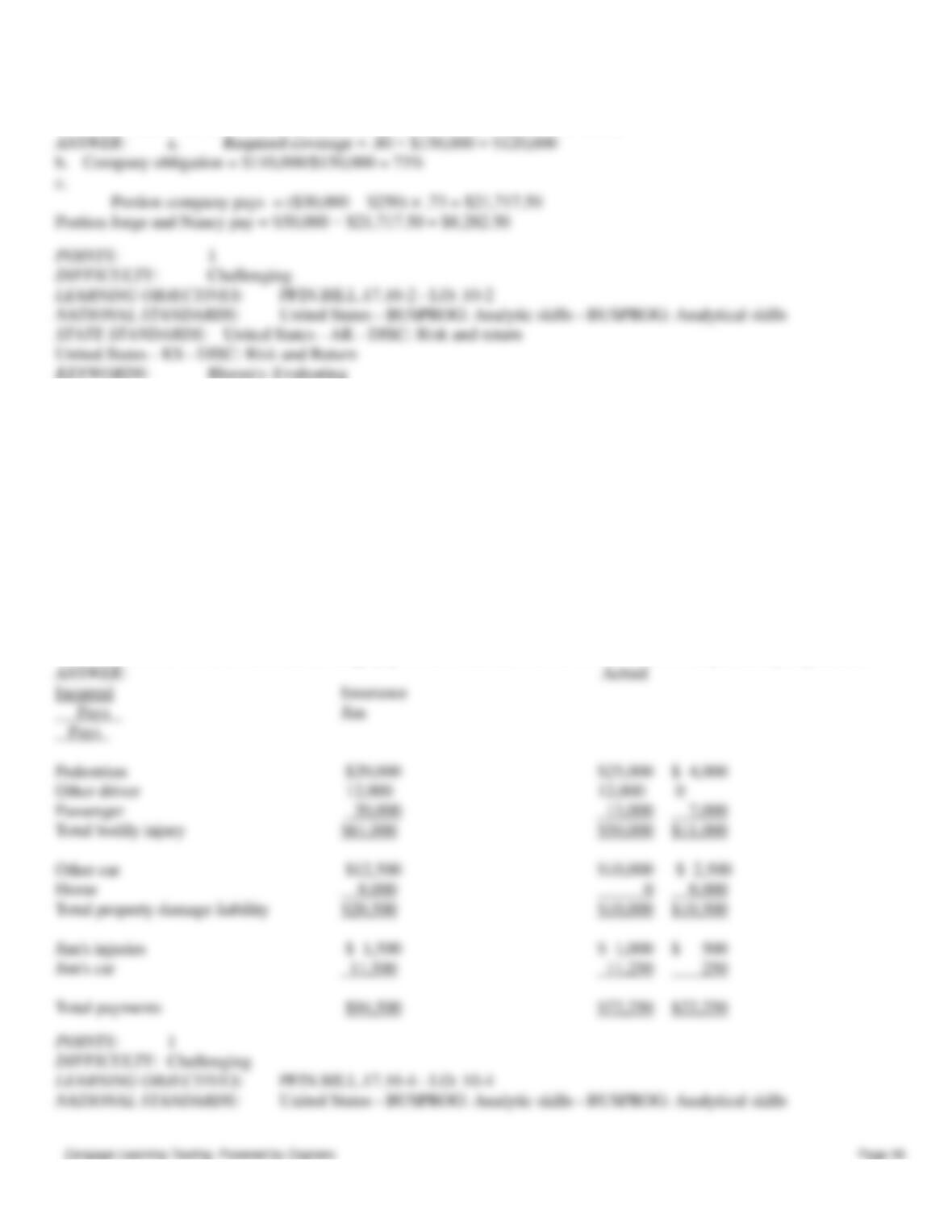
174. Jorge and Nancy had a $30,000 repair bill on their home after the tornado went through town. Their policy contained
the usual 80% co-insurance clause. Their home’s replacement value was $150,000; their policy coverage was $110,000
with a $250 deductible.
a. How much insurance should they have carried to meet the co-insurance obligation?
Chapter 10—Protecting Your Property
b. What percentage of this loss will the insurance company pay?
c. How much of the loss will Jorge and Nancy have to absorb? (Show all work.)
175. Jim lost control of his car. He wiped out the car in front of him, hit a pedestrian, and then drove into a home. Jim has
auto liability insurance of 25,000/50,000/10,0000. He also has medical payments coverage of $1,000 and a $250
deductible on his collision coverage. The following damage resulted:
Pedestrian’s claims $29,000
Jim’s injuries 1,500
Other driver’s claims 12,000
Passenger’s (in other car) claims 20,000
Damage to Jim’s car 11,500
Damage to other car 12,500
Damage to the home 8,000
How much will Jim’s auto insurance coverage pay for this accident? For how much will Jim be personally responsible?
Chapter 10—Protecting Your Property