Chapter 10: The Basics of Capital Budgeting: Evaluating Cash Flows
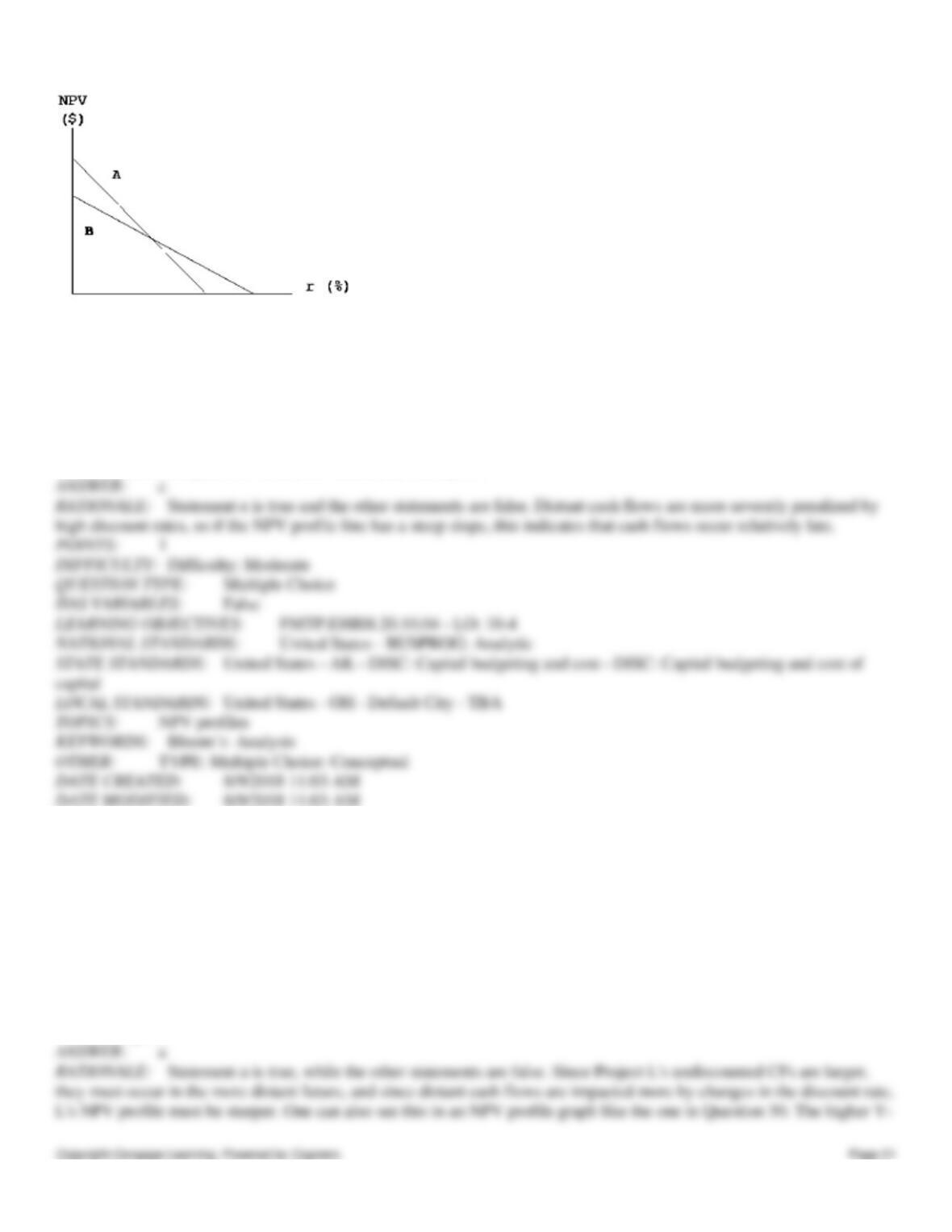
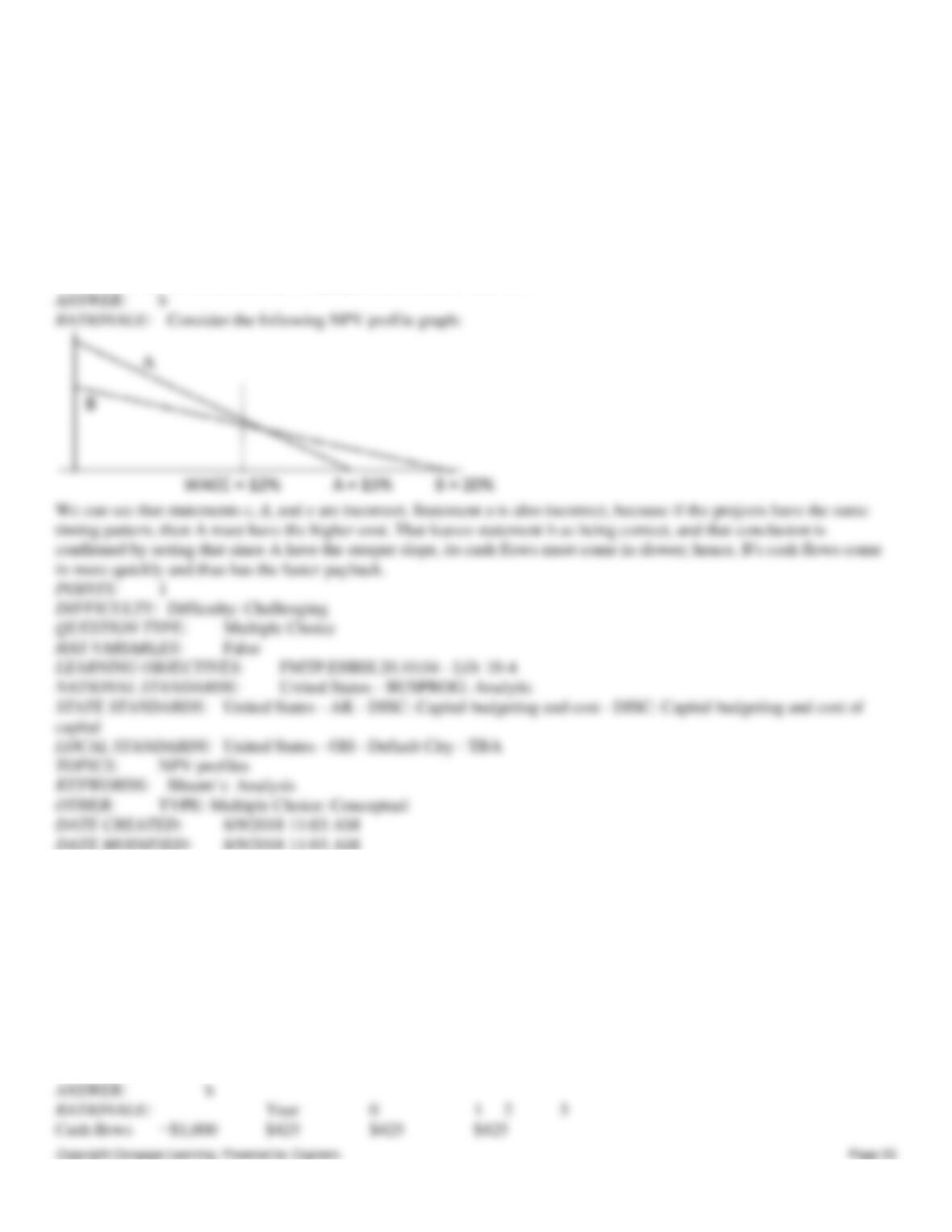
Which of the following statements is CORRECT?
a. More of Project B’s cash flows occur in the later years.
b. We must have information on the cost of capital in order to determine which project has the larger early cash
flows.
c. The NPV profile graph is inconsistent with the statement made in the problem.
d. The crossover rate, i.e., the rate at which Projects A and B have the same NPV, is greater than either project’s
IRR.
e. More of Project A’s cash flows occur in the later years.
44. Projects S and L are both normal projects with an initial cost of $10,000, followed by a series of positive cash inflows.
Project S’s undiscounted net cash flows total $20,000, while L’s total undiscounted flows are $30,000. At a cost of capital
of 10%, the two projects have identical NPVs. Which project’s NPV is more sensitive to changes in the cost of capital?
a. Project L.
b. Both projects are equally sensitive to changes in the cost of capital since their NPVs are equal at all costs of
capital.
c. Neither project is sensitive to changes in the discount rate, since both have NPV profiles that are horizontal.
d. The solution cannot be determined because the problem gives us no information that can be used to determine the
projects’ relative IRRs.
e. Project S.
Chapter 10: The Basics of Capital Budgeting: Evaluating Cash Flows
45. Projects C and D both have normal cash flows and are mutually exclusive. Project C has a higher NPV if the cost of
capital is less than 12%, whereas Project D has a higher NPV if the cost of capital exceeds 12%. Which of the following
statements is CORRECT?
a. Project D is probably larger in scale than Project C.
b. Project C probably has a faster payback.
c. Project C probably has a higher IRR.
d. The crossover rate between the two projects is below 12%.
e. Project D probably has a higher IRR.
46. The cost of capital for two mutually exclusive projects that are being considered is 8%. Project K has an IRR of 20%
while Project R’s IRR is 15%. The projects have the same NPV at the 8% current cost of capital. However, you believe
that money costs and thus your cost of capital will also increase. You also think that the projects will not be funded until
the cost of capital has increased, and their cash flows will not be affected by the change in economic conditions. Under
these conditions, which of the following statements is CORRECT?
a. You should delay a decision until you have more information on the projects, even if this means that a competitor
might come in and capture this market.
b. You should recommend Project R, because at the new cost of capital it will have the higher NPV.
c. You should recommend Project K, because at the new cost of capital it will have the higher NPV.
Chapter 10: The Basics of Capital Budgeting: Evaluating Cash Flows
d. You should recommend Project K because it has the higher IRR and will continue to have the higher IRR even at
the new cost of capital.
e. You should reject both projects because they will both have negative NPVs under the new conditions.
47. The cost of capital for two mutually exclusive projects that are being considered is 12%. Project K has an IRR of 20%
while Project R’s IRR is 15%. The projects have the same NPV at the 12% current cost of capital. Interest rates are
currently high. However, you believe that money costs and thus your cost of capital will soon decline. You also think that
the projects will not be funded until the cost of capital has decreased, and their cash flows will not be affected by the
change in economic conditions. Under these conditions, which of the following statements is CORRECT?
a. You should delay a decision until you have more information on the projects, even if this means that a competitor
might come in and capture this market.
b. You should recommend Project R, because at the new cost of capital it will have the higher NPV.
c. You should recommend Project K, because at the new cost of capital it will have the higher NPV.
d. You should recommend Project R because it will have both a higher IRR and a higher NPV under the new
conditions.
e. You should reject both projects because they will both have negative NPVs under the new conditions.
48. Which of the following statements is CORRECT?
a. If Project A’s IRR exceeds Project B’s, then A must have the higher NPV.
b. A project’s MIRR can never exceed its IRR.
c. If a project with normal cash flows has an IRR less than the cost of capital, the project must have a positive NPV.
d. If the NPV is negative, the IRR must also be negative.
Chapter 10: The Basics of Capital Budgeting: Evaluating Cash Flows
e. If a project with normal cash flows has an IRR greater than the cost of capital, the project must also have a
positive NPV.
49. Which of the following statements is CORRECT?
a. The IRR method can never be subject to the multiple IRR problem, while the MIRR method can be.
b. One reason some people prefer the MIRR to the regular IRR is that the MIRR is based on a generally more
reasonable reinvestment rate assumption.
c. The higher the cost of capital, the shorter the discounted payback period.
d. The MIRR method assumes that cash flows are reinvested at the crossover rate.
e. The MIRR and NPV decision criteria can never conflict.
50. Which of the following statements is CORRECT?
a. To find the MIRR, we first compound cash flows at the regular IRR to find the TV, and then we discount the TV
at the cost of capital to find the PV.
b. The NPV and IRR methods both assume that cash flows can be reinvested at the cost of capital. However, the
MIRR method assumes reinvestment at the MIRR itself.
c. If two projects have the same cost, and if their NPV profiles cross in the upper right quadrant, then the project
with the higher IRR probably has more of its cash flows coming in the later years.
d. If two projects have the same cost, and if their NPV profiles cross in the upper right quadrant, then the project
with the lower IRR probably has more of its cash flows coming in the later years.
e. For a project with normal cash flows, any change in the cost of capital will change both the NPV and the IRR.
Chapter 10: The Basics of Capital Budgeting: Evaluating Cash Flows
51. Which of the following statements is CORRECT?
a. One advantage of the NPV over the IRR is that NPV assumes that cash flows will be reinvested at the cost of
capital, whereas IRR assumes that cash flows are reinvested at the IRR. The NPV assumption is generally more
appropriate.
b. One advantage of the NPV over the MIRR method is that NPV takes account of cash flows over a project’s full
life whereas MIRR does not.
c. One advantage of the NPV over the MIRR method is that NPV discounts cash flows whereas the MIRR is based
on undiscounted cash flows.
d. Since cash flows under the IRR and MIRR are both discounted at the same rate (the cost of capital), these two
methods always rank mutually exclusive projects in the same order.
e. One advantage of the NPV over the IRR is that NPV takes account of cash flows over a project’s full life whereas
IRR does not.
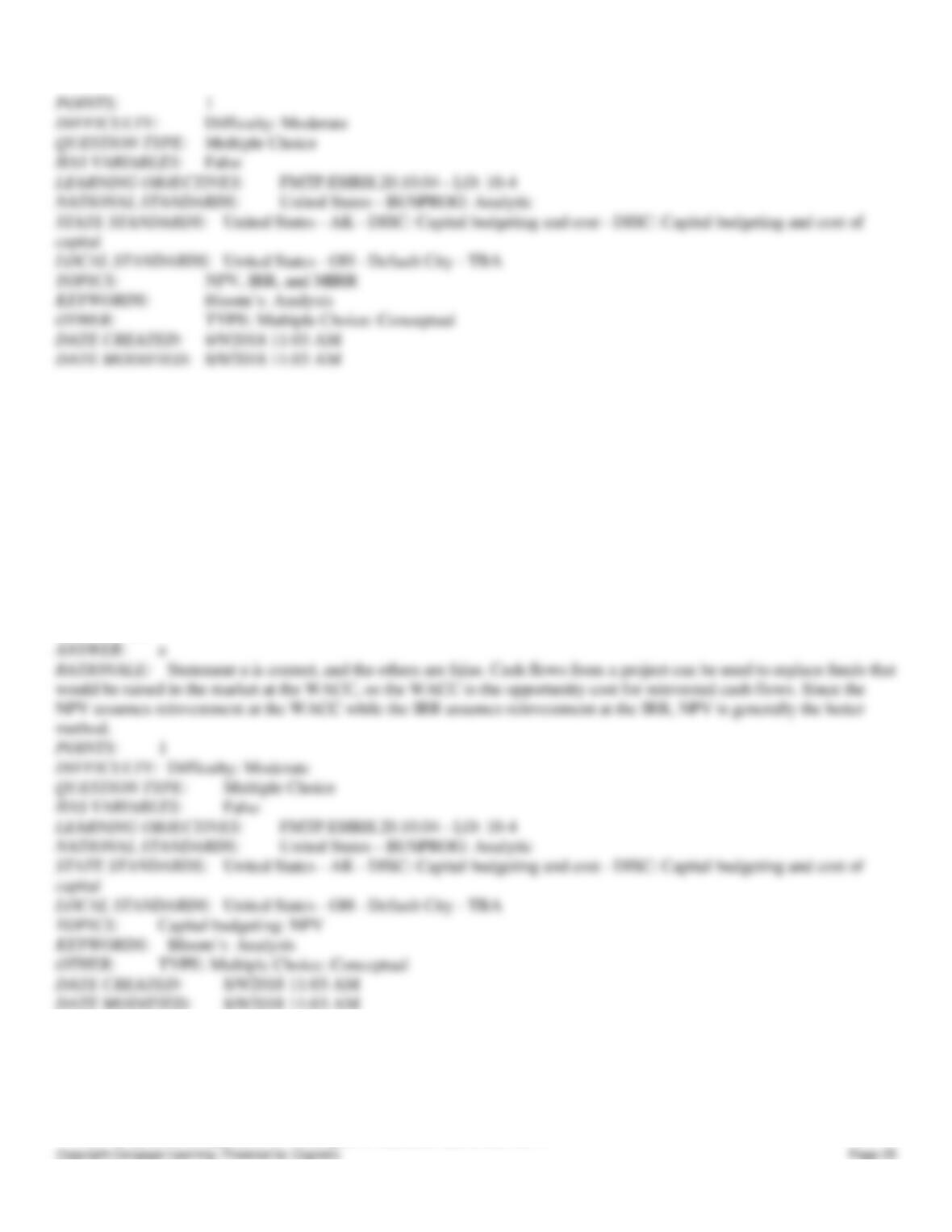
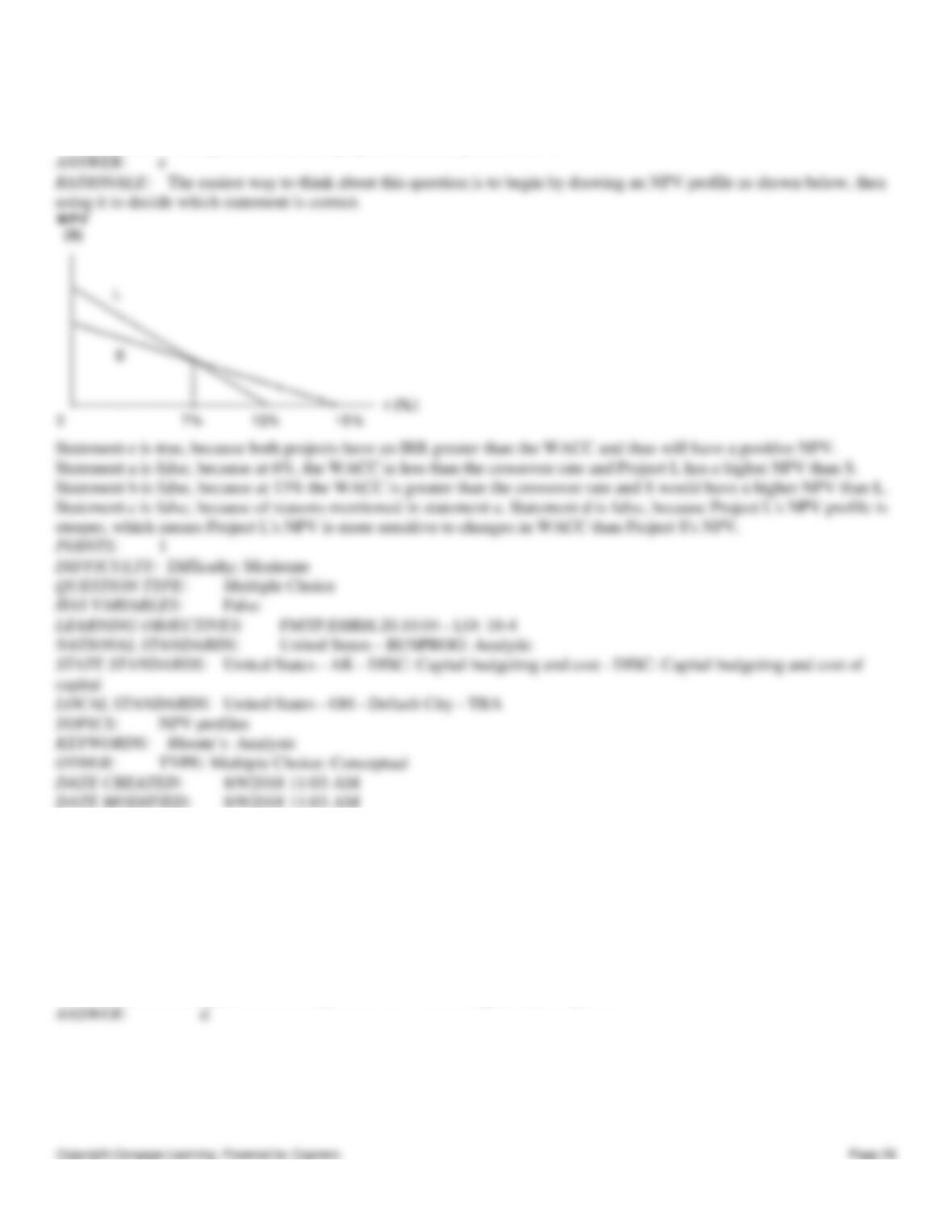
52. Projects S and L are equally risky, mutually exclusive, and have normal cash flows. Project S has an IRR of 15%,
while Project L’s IRR is 12%. The two projects have the same NPV when the cost of capital is 7%. Which of the
following statements is CORRECT?
a. If the cost of capital is 6%, Project S will have the higher NPV.
b. If the cost of capital is 13%, Project S will have the lower NPV.
Chapter 10: The Basics of Capital Budgeting: Evaluating Cash Flows
c. If the cost of capital is 10%, both projects will have a negative NPV.
d. Project S’s NPV is more sensitive to changes in cost of capital than Project L’s.
e. If the cost of capital is 10%, both projects will have positive NPVs.
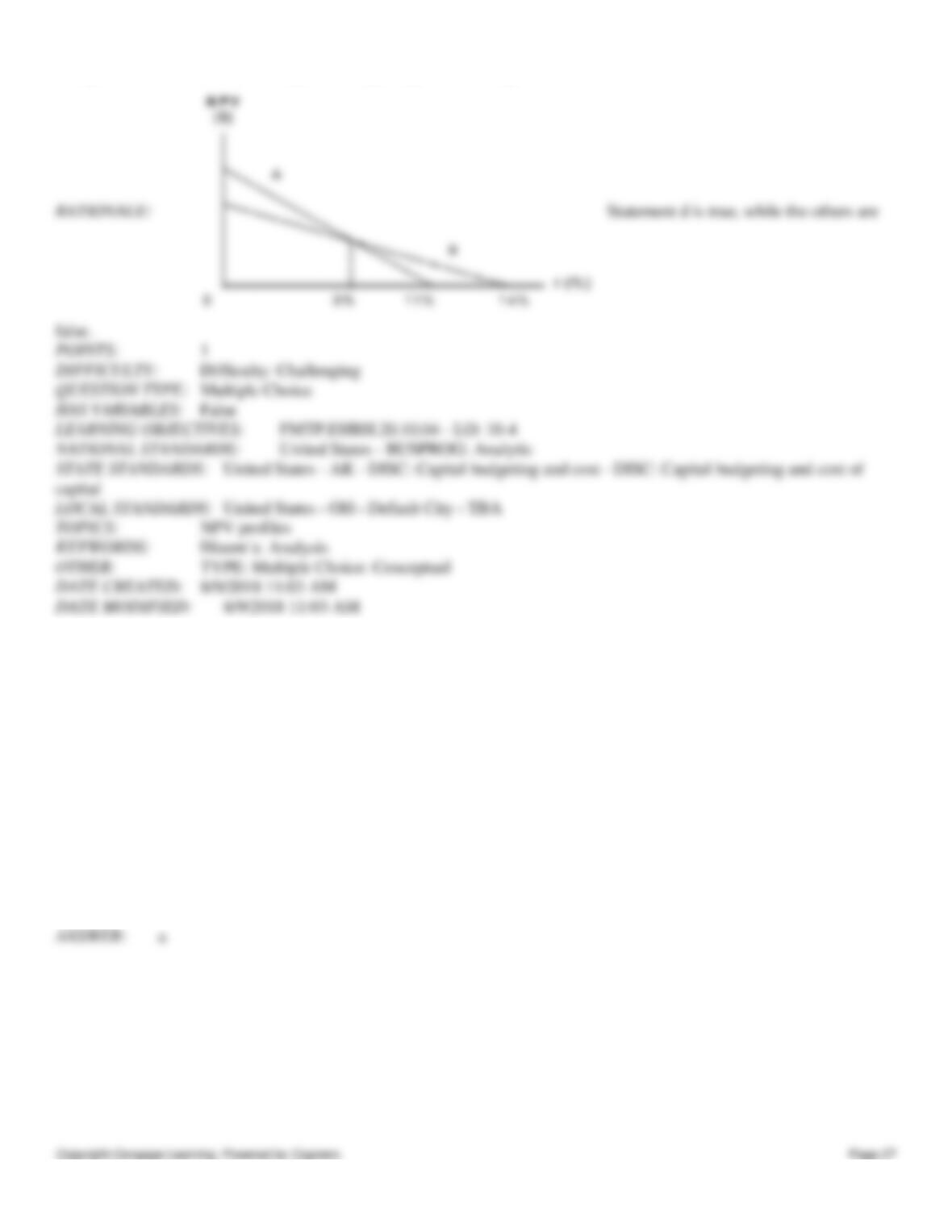
53. Lancaster Corp. is considering two equally risky, mutually exclusive projects, both of which have normal cash flows.
Project A has an IRR of 11%, while Project B’s IRR is 14%. When the cost of capital is 8%, the projects have the same
NPV. Given this information, which of the following statements is CORRECT?
a. If the cost of capital is 9%, Project A’s NPV will be higher than Project B’s.
b. If the cost of capital is 6%, Project B’s NPV will be higher than Project A’s.
c. If the cost of capital is greater than 14%, Project A’s IRR will exceed Project B’s.
d. If the cost of capital is 9%, Project B’s NPV will be higher than Project A’s.
e. If the cost of capital is 13%, Project A’s NPV will be higher than Project B’s.
Chapter 10: The Basics of Capital Budgeting: Evaluating Cash Flows
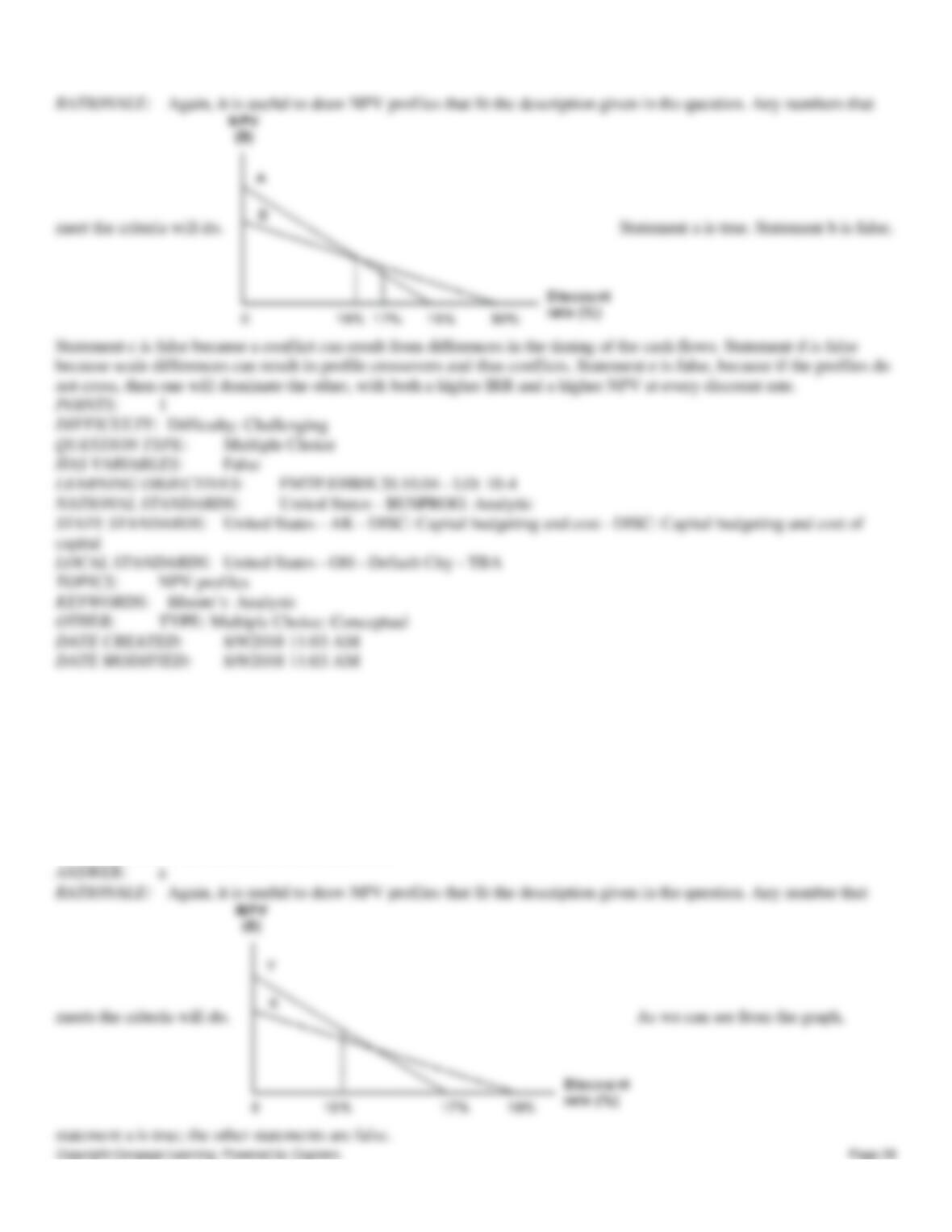
54. You are considering two mutually exclusive, equally risky, projects. Both have IRRs that exceed the cost of capital.
Which of the following statements is CORRECT? Assume that the projects have normal cash flows, with one outflow
followed by a series of inflows.
a. If the cost of capital is greater than the crossover rate, then the IRR and the NPV criteria will not result in a
conflict between the projects. The same project will rank higher by both criteria.
b. If the cost of capital is less than the crossover rate, then the IRR and the NPV criteria will not result in a conflict
between the projects. The same project will rank higher by both criteria.
c. For a conflict to exist between NPV and IRR, the initial investment cost of one project must exceed the cost of the
other.
d. For a conflict to exist between NPV and IRR, one project must have an increasing stream of cash flows over time
while the other has a decreasing stream. If both sets of cash flows are increasing or decreasing, then it would be
impossible for a conflict to exist, even if one project is larger than the other.
e. If the two projects’ NPV profiles do not cross, then there will be a sharp conflict as to which one should be
selected.
Chapter 10: The Basics of Capital Budgeting: Evaluating Cash Flows
55. Consider two projects, X and Y. Project X’s IRR is 19% and Project Y’s IRR is 17%. The projects have the same risk
and the same lives, and each has constant cash flows during each year of their lives. If the cost of capital is 10%, Project Y
has a higher NPV than X. Given this information, which of the following statements is CORRECT?
a. The crossover rate must be greater than 10%.
b. If the cost of capital is 8%, Project X will have the higher NPV.
c. If the cost of capital is 18%, Project Y will have the higher NPV.
d. Project X is larger in the sense that it has the higher initial cost.
e. The crossover rate must be less than 10%.
Chapter 10: The Basics of Capital Budgeting: Evaluating Cash Flows
56. You are on the staff of O’Hara Inc. The CFO believes project acceptance should be based on the NPV, but Andrew
O’Hara, the president, insists that no project should be accepted unless its IRR exceeds the project’s risk-adjusted cost of
capital. Now you must make a recommendation on a project that has a cost of $15,000 and two cash flows: $110,000 at
the end of Year 1 and −$100,000 at the end of Year 2. The president and the CFO both agree that the appropriate cost of
capital for this project is 10%. At 10%, the NPV is $2,355.37, but you find two IRRs, one at 6.33% and one at 527%, and
a MIRR of 11.32%. Which of the following statements best describes your optimal recommendation, i.e., the analysis and
recommendation that is best for the company and least likely to get you in trouble with either the CFO or the president?
a. You should recommend that the project be rejected because, although its NPV is positive, it has an IRR that is
less than the cost of capital.
b. You should recommend that the project be accepted because (1) its NPV is positive and (2) although it has two
IRRs, in this case it would be better to focus on the MIRR, which exceeds the cost of capital. You should explain this to
the president and tell him that the firm’s value will increase if the project is accepted.
c. You should recommend that the project be rejected. Although its NPV is positive it has two IRRs, one of which is
less than the cost of capital, which indicates that the firm’s value will decline if the project is accepted.
d. You should recommend that the project be rejected because, although its NPV is positive, its MIRR is less than
the cost of capital, and that indicates that the firm’s value will decline if it is accepted.
e. You should recommend that the project be rejected because its NPV is negative and its IRR is less than the cost of
capital.
Chapter 10: The Basics of Capital Budgeting: Evaluating Cash Flows
57. Consider projects S and L. Both have normal cash flows, and the projects have the same risk, hence both are evaluated
with the same cost of capital, 10%. However, S has a higher IRR than L. Which of the following statements is
CORRECT?
a. If Project S has a positive NPV, Project L must also have a positive NPV.
b. If the cost of capital falls, each project’s IRR will increase.
c. If the cost of capital increases, each project’s IRR will decrease.
d. If Projects S and L have the same NPV at the current cost of capital, 10%, then Project L, the one with the lower
IRR, would have a higher NPV if the cost of capital used to evaluate the projects declined.
e. Project S must have a higher NPV than Project L.
58. Which of the following statements is CORRECT? Assume that all projects being considered have normal cash flows
and are equally risky.
a. If a project’s IRR is equal to its cost of capital, then under all reasonable conditions, the project’s IRR must be
negative.
Chapter 10: The Basics of Capital Budgeting: Evaluating Cash Flows
b. If a project’s IRR is equal to its cost of capital, then under all reasonable conditions the project’s NPV must be
zero.
c. There is no necessary relationship between a project’s IRR, its cost of capital, and its NPV.
d. When evaluating mutually exclusive projects, those projects with relatively long lives will tend to have relatively
high NPVs when the cost of capital is relatively high.
e. If a project’s IRR is equal to its cost of capital, then, under all reasonable conditions, the project’s NPV must be
negative.
59. Clifford Company is choosing between two projects. The larger project has an initial cost of $100,000, annual cash
flows of $30,000 for 5 years, and an IRR of 15.24%. The smaller project has an initial cost of $50,000, annual cash flows
of $16,000 for 5 years, and an IRR of 16.63%. The projects are equally risky. Which of the following statements is
CORRECT?
a. Since the smaller project has the higher IRR, the two projects’ NPV profiles will cross, and the larger project will
look better based on the NPV at all positive values of the cost of capital.
b. If the company uses the NPV method, it will tend to favor smaller, shorter-term projects over larger, longer-term
projects, regardless of how high or low the cost of capital is.
c. Since the smaller project has the higher IRR but the larger project has the higher NPV at a zero discount rate, the
two projects’ NPV profiles will cross, and the larger project will have the higher NPV if the cost of capital is less than the
crossover rate.
d. Since the smaller project has the higher IRR and the larger NPV at a zero discount rate, the two projects’ NPV
profiles will cross, and the smaller project will look better if the cost of capital is less than the crossover rate.
e. Since the smaller project has the higher IRR, the two projects’ NPV profiles cannot cross, and the smaller project’s
NPV will be higher at all positive values of the cost of capital.
Chapter 10: The Basics of Capital Budgeting: Evaluating Cash Flows
60. Martin Manufacturing is considering two normal, equally risky, mutually exclusive, but not repeatable projects.
Martin’s cost of capital is 10%. The two projects have the same investment costs, but Project A has an IRR of 15%, while
Project B has an IRR of 20%. Assuming the projects’ NPV profiles cross in the upper right quadrant, which of the
following statements is CORRECT?
a. Since the projects are mutually exclusive, the firm should always select Project B.
b. If the crossover rate is 8%, Project B will have the higher NPV.
c. Only one project has a positive NPV.
d. If the crossover rate is 8%, Project A will have the higher NPV.
e. Each project must have a negative NPV.
Chapter 10: The Basics of Capital Budgeting: Evaluating Cash Flows
61. Projects A and B are mutually exclusive and have normal cash flows. Project A has an IRR of 15% and B’s IRR is
20%. The company’s cost of capital is 12%, and at that rate Project A has the higher NPV. Which of the following
statements is CORRECT?
a. Assuming the timing pattern of the two projects’ cash flows is the same, Project B probably has a higher cost (and
larger scale).
b. Assuming the two projects have the same scale, Project B probably has a faster payback than Project A.
c. The crossover rate for the two projects must be 12%.
d. Since B has the higher IRR, then it must also have the higher NPV if the crossover rate is less than the cost of
capital of 12%.
e. The crossover rate for the two projects must be less than 12%.
62. Hart Corp. is considering a project that has the following cash flow data. What is the project’s IRR? Note that a
project’s IRR can be less than the cost of capital or negative, in both cases it will be rejected.
Year 0 1 2 3
Cash flows −$1,000 $425 $425 $425
a. 12.55%
b. 13.21%
c. 13.87%
d. 14.56%
e. 15.29%
Chapter 10: The Basics of Capital Budgeting: Evaluating Cash Flows
63. Spence Company is considering a project that has the following cash flow data. What is the project’s IRR? Note that a
project’s IRR can be less than the cost of capital or negative, in both cases it will be rejected.
Year 0 1 2 3 4
Cash flows −$1,050 $400 $400 $400 $400
a. 14.05%
b. 15.61%
c. 17.34%
d. 19.27%
e. 21.20%
64. Nichols Inc. is considering a project that has the following cash flow data. What is the project’s IRR? Note that a
project’s IRR can be less than the cost of capital or negative, in both cases it will be rejected.
Year 0 1 2 3 4 5
Cash flows −$1,250 $325 $325 $325 $325 $325
a. 9.43%
b. 9.91%
Chapter 10: The Basics of Capital Budgeting: Evaluating Cash Flows
c. 10.40%
d. 10.92%
e. 11.47%
65. Kiley Electronics is considering a project that has the following cash flow data. What is the project’s IRR? Note that a
project’s IRR can be less than the cost of capital (and even negative), in which case it will be rejected.
Year 0 1 2 3
Cash flows −$1,100 $450 $470 $490
a. 9.70%
b. 10.78%
c. 11.98%
d. 13.31%
e. 14.64%
Chapter 10: The Basics of Capital Budgeting: Evaluating Cash Flows
66. Modern Refurbishing Inc. is considering a project that has the following cash flow data. What is the project’s IRR?
Note that a project’s IRR can be less than the cost of capital (and even negative), in which case it will be rejected.
Year 0 1 2 3 4
Cash flows −$850 $300 $290 $280 $270
a. 13.13%
b. 14.44%
c. 15.89%
d. 17.48%
e. 19.22%
67. Pet World is considering a project that has the following cash flow data. What is the project’s IRR? Note that a
project’s IRR can be less than the cost of capital (and even negative), in which case it will be rejected.
Year 0 1 2 3 4 5
Cash flows −$9,500 $2,000 $2,025 $2,050 $2,075 $2,100
a. 2.08%
b. 2.31%
c. 2.57%
d. 2.82%
e. 3.10%
Chapter 10: The Basics of Capital Budgeting: Evaluating Cash Flows
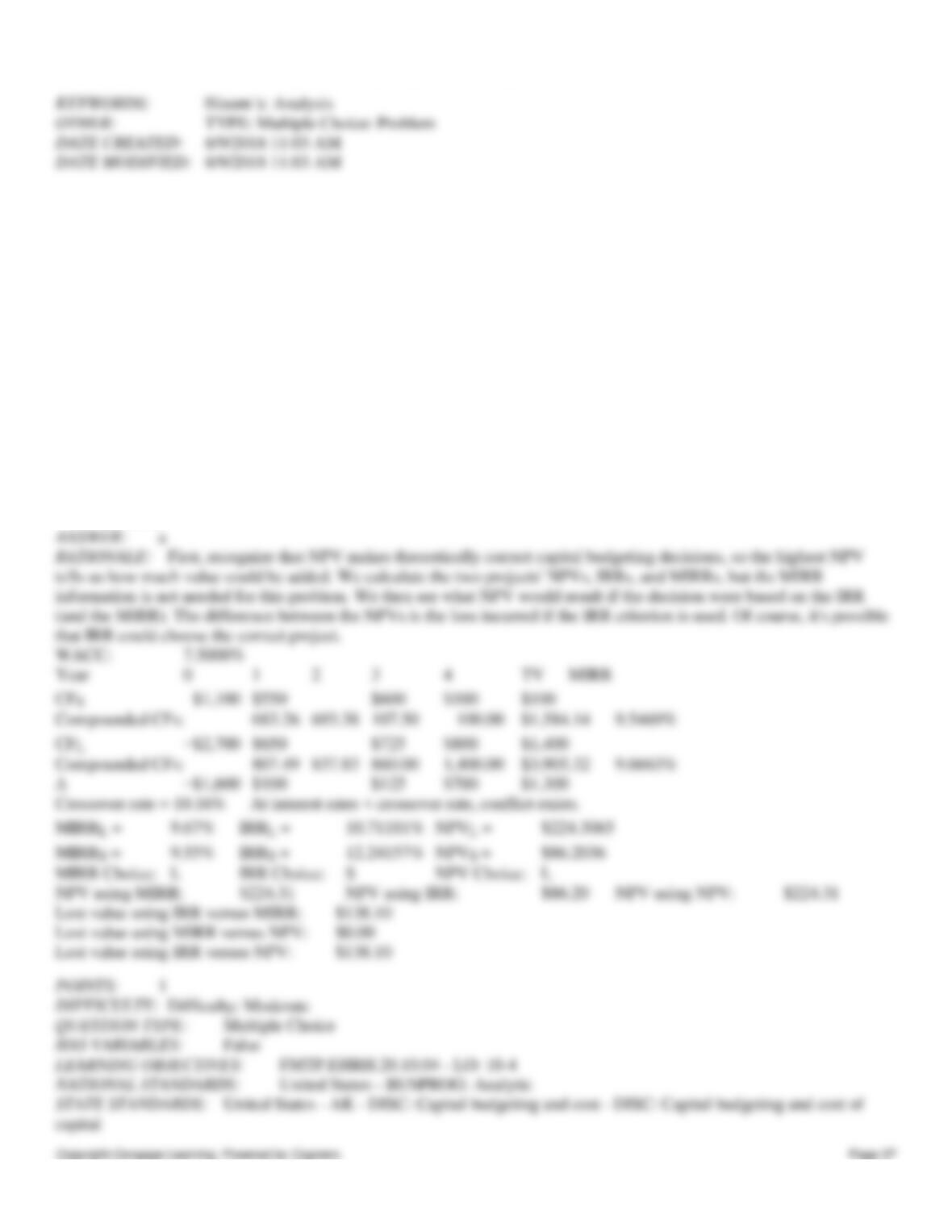
68. Current Design Co. is considering two mutually exclusive, equally risky, and not repeatable projects, S and L. Their
cash flows are shown below. The CEO believes the IRR is the best selection criterion, while the CFO advocates the NPV.
If the decision is made by choosing the project with the higher IRR rather than the one with the higher NPV, how much, if
any, value will be forgone, i.e., what’s the chosen NPV versus the maximum possible NPV? Note that (1) “true value” is
measured by NPV, and (2) under some conditions the choice of IRR vs. NPV will have no effect on the value gained or
lost.
r: 7.50%
Year 0 1 2 3 4
CFS −$1,100 $550 $600 $100 $100
CFL −$2,700 $650 $725 $800 $1,400
a. $138.10
b. $149.21
c. $160.31
d. $171.42
e. $182.52
Chapter 10: The Basics of Capital Budgeting: Evaluating Cash Flows
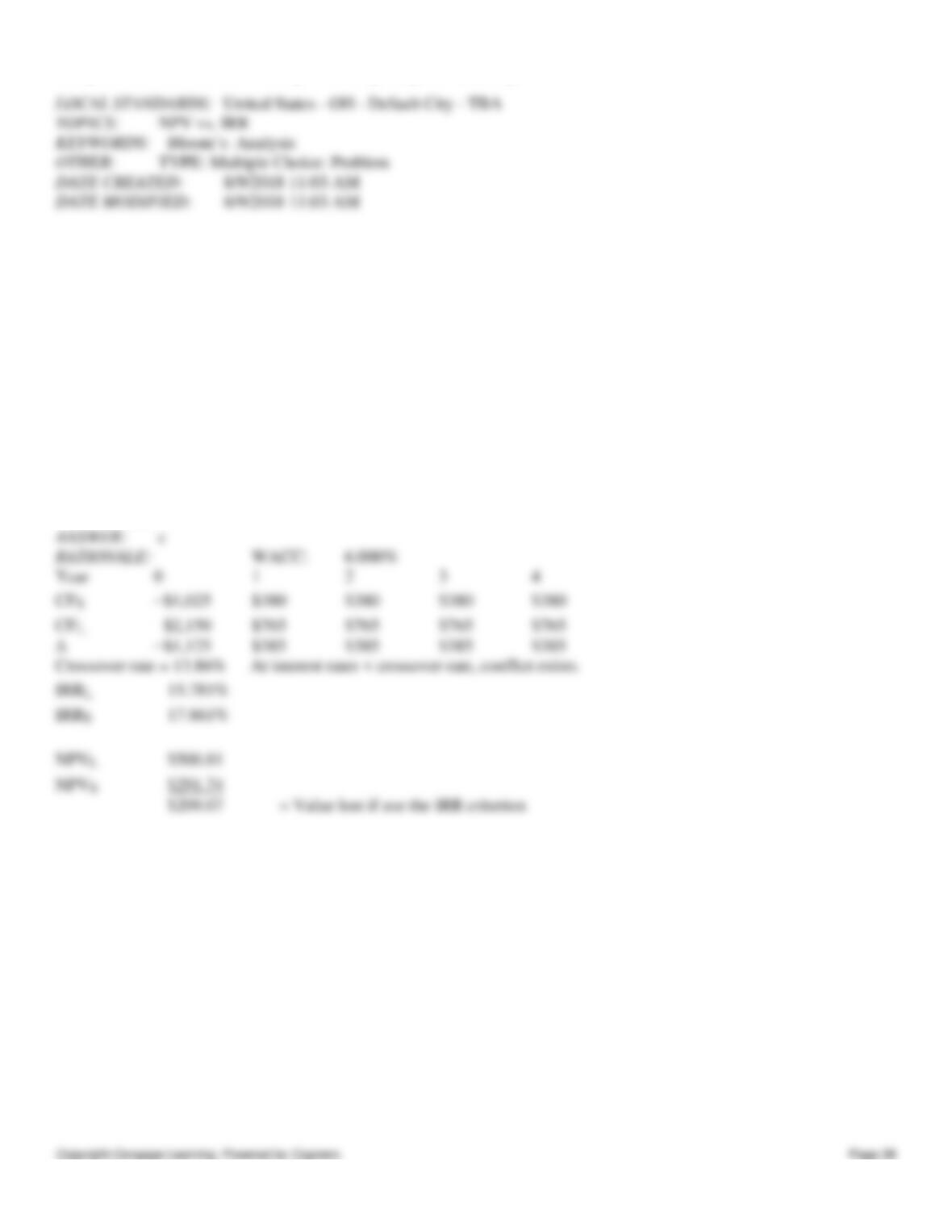
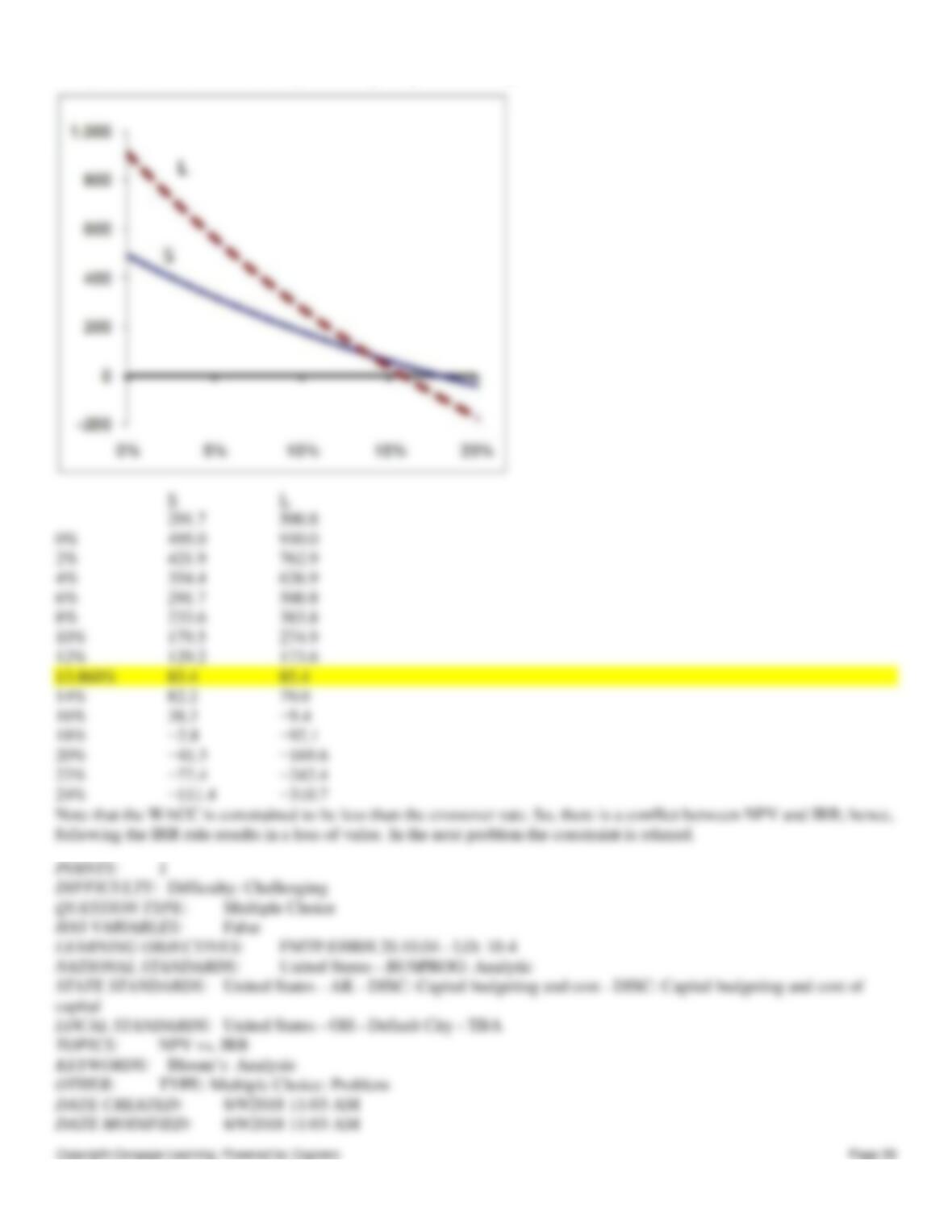
69. Murray Inc. is considering Projects S and L, whose cash flows are shown below. These projects are mutually
exclusive, equally risky, and not repeatable. The CEO wants to use the IRR criterion, while the CFO favors the NPV
method. You were hired to advise Murray on the best procedure. If the wrong decision criterion is used, how much
potential value would Murray lose?
r: 6.00%
Year 0 1 2 3 4
CFS −$1,025 $380 $380 $380 $380
CFL −$2,150 $765 $765 $765 $765
a. $188.68
b. $198.61
c. $209.07
d. $219.52
e. $230.49
Chapter 10: The Basics of Capital Budgeting: Evaluating Cash Flows
Chapter 10: The Basics of Capital Budgeting: Evaluating Cash Flows
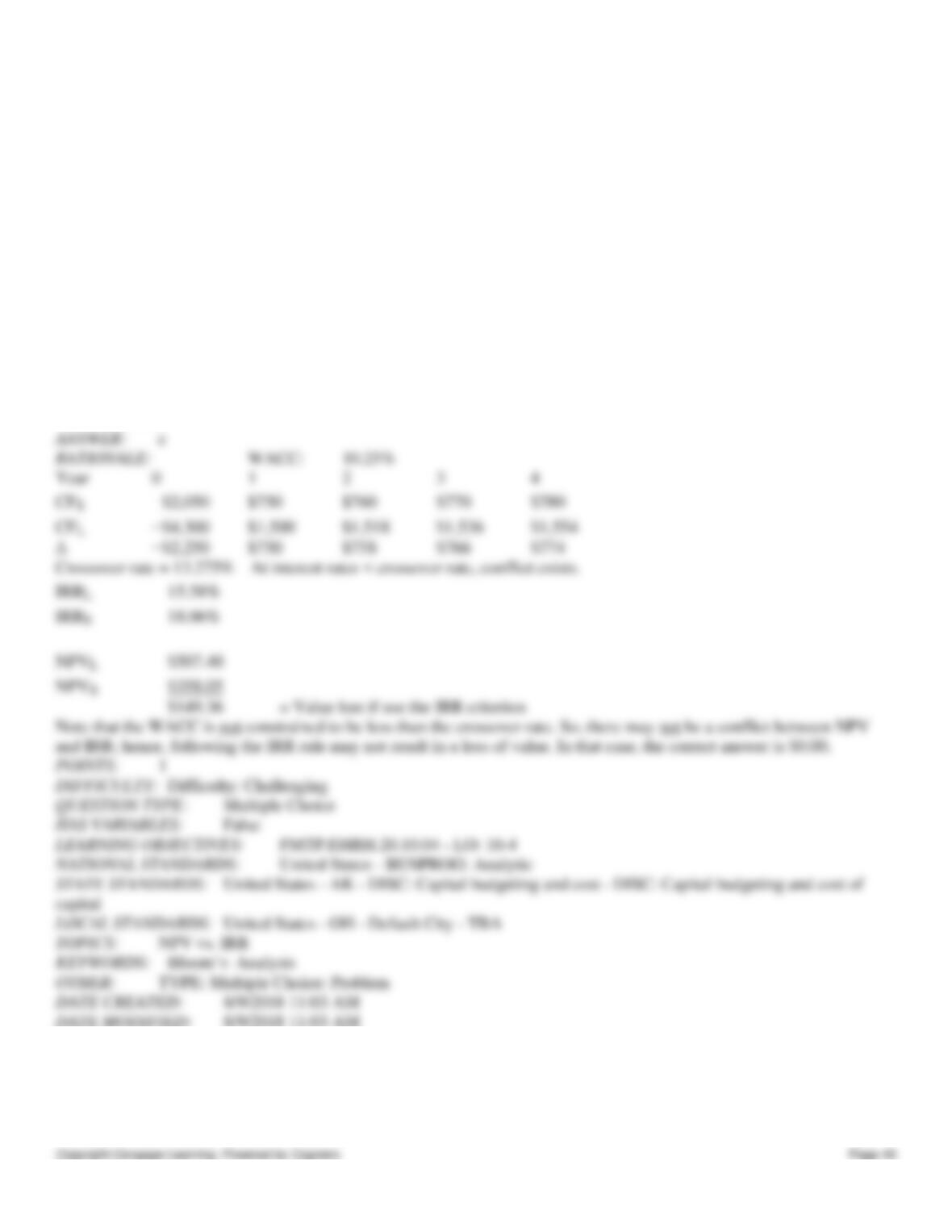
70. Projects S and L, whose cash flows are shown below, are mutually exclusive, equally risky, and not repeatable.
Hooper Inc. is considering which of these two projects to undertake. If the decision is made by choosing the project with
the higher IRR, how much value will be forgone? Note that under certain conditions choosing projects on the basis of the
IRR will not cause any value to be lost because the project with the higher IRR will also have the higher NPV, so no value
will be lost if the IRR method is used.
r: 10.25%
Year 0 1 2 3 4
CFS −$2,050 $750 $760 $770 $780
CFL −$4,300 $1,500 $1,518 $1,536 $1,554
a. $134.79
b. $141.89
c. $149.36
d. $164.29
e. $205.36
71. Markman & Sons is considering Projects S and L. These projects are mutually exclusive, equally risky, and not
repeatable and their cash flows are shown below. If the decision is made by choosing the project with the higher IRR, how
much value will be forgone? Note that under certain conditions choosing projects on the basis of the IRR will not cause