Chapter 10 Test bank – Static Key
1.
A capital budget shows a proposed list of investments.
2.
The strategic planning portion of the capital budgeting process is essentially a “bottom-up” process.
3.
Competitive advantage is an important element of many successful capital budgeting proposals.
4.
While sensitivity analysis is forward-looking, scenario analysis attempts to reconstruct and analyze the past.
5.
The level of sales that produces a zero project NPV is referred to as the accounting break–even point.
6.
The NPV break-even level of sales will be higher than the accounting break-even level.
7.
The degree of operating leverage (DOL) shows the relationship between sales and profits.
8.
Operating leverage increases with fixed cost.
9.
If a large proportion of a firm’s costs is fixed, a shortfall in sales will have a magnified effect on the firm’s profits.
10.
The greater the DOL, the greater the protection against operating losses during economic downturns.
11.
A firm that employs largely agency staff is likely to have higher operating leverage than one that employs its staff on long–
term contracts.
12.
The option to abandon a project becomes more valuable as the possible outcomes become more varied.
13.
Conflicts of interest between shareholders and managers may result in the sacrifice of attractive capital budgeting
proposals.
14.
Sensitivity analysis takes into consideration the interrelationship of variables.
15.
Scenario analysis allows managers to look at different and sometimes inconsistent combinations of variables.
16.
“What-if” questions ask what will happen to a project in various circumstances.
17.
What-if analysis is not crucial to capital budgeting.
18.
What-if analysis can help identify the inputs that are most worth refining before you commit to a project.
19.
The inputs that are most worth refining before you commit to a project are the ones that have the greatest potential to alter
project NPV.
20.
Scenario analysis allows managers to look at different but consistent combinations of interrelated variables.
21.
A project that breaks even in accounting terms will surely have a negative NPV.
22.
A project that simply breaks even on an accounting basis gives you your money back but does not cover the opportunity cost
of the capital tied up in the project.
23.
Managers that accept projects that only break even on an accounting basis are helping their shareholders.
24.
What level of management is responsible for originating capital budgeting proposals?
25.
The capital budget should be consistent with the firm’s:
26.
Which one of the following would not be included as a traditional capital budgeting project?
27.
Which company is likely to have high operating leverage?
28.
Which one of the following capital budgeting proposals is most apt to be associated with a conflict of interests?
29.
Analysis indicates that a project’s level of success is primarily dependent upon the firm controlling the variable costs. What
type of analysis was conducted?
30.
Soft capital rationing may be beneficial to a firm if it:
31.
The purpose of sensitivity analysis is to show:
32.
Sensitivity analysis evaluates projects by:
33.
What is the change in the NPV of a one-year project if fixed costs are increased from $400 to $600, assuming the firm is
profitable, has a 35% tax rate, and a 12% cost of capital?
34.
What happens to the NPV of a two-year project if sales less costs are increased in each year from $1,000 to $1,500? Assume
the firm has a 35% tax rate, and a 15% cost of capital.
35.
Which one of the following appears to be a more likely result from using sensitivity analysis?
36.
If a 20% reduction in a project’s forecast sales would still result in a positive NPV, then sensitivity analysis would suggest:
37.
If sensitivity analysis concludes that the largest impact on profits would come from changes in the sales level, then:
38.
Which one of the following statements is correct concerning sensitivity analysis?
39.
Sensitivity analysis:
40.
Which one of the following techniques may be more appropriate to analyze projects with interrelated variables?
41.
Which one of the following descriptions is representative of scenario analysis?
42.
Which statement is not correct?
43.
Assume a 5-year project has a base-case NPV of $213,000, a tax rate of 34%, and a cost of capital of 14%. What will be the
worst-case NPV if the annual after-tax cash flows are reduced in that scenario by $35,000 for each of the 5 years?
44.
Which one of the following variables would you suspect to be least significant in a sensitivity analysis of a fast-food
establishment?
45.
A firm has fixed costs of $1.2 million and depreciation of $1 million. Variable costs are 64% of sales. What is the accounting
break-even level of sales?
46.
Weston’s has variable costs that average 68% of sales. If fixed costs increase by $1, what will be the increase in the break–
even level of revenues?
47.
The accounting break-even level of sales represents the point where:
48.
The Corner Market has fixed costs of $1,600, depreciation of $1,200, a tax rate of 35%, and a cost of capital of 12%.
Variable costs represent 67% of sales. What minimum level of sales must the market obtain to avoid a net loss on its income
statement?
49.
Calculate the accounting break-even level of sales assuming $865,000 of fixed costs, $400,000 depreciation expense, and a
variable costs-to-sales ratio of 65%.
50.
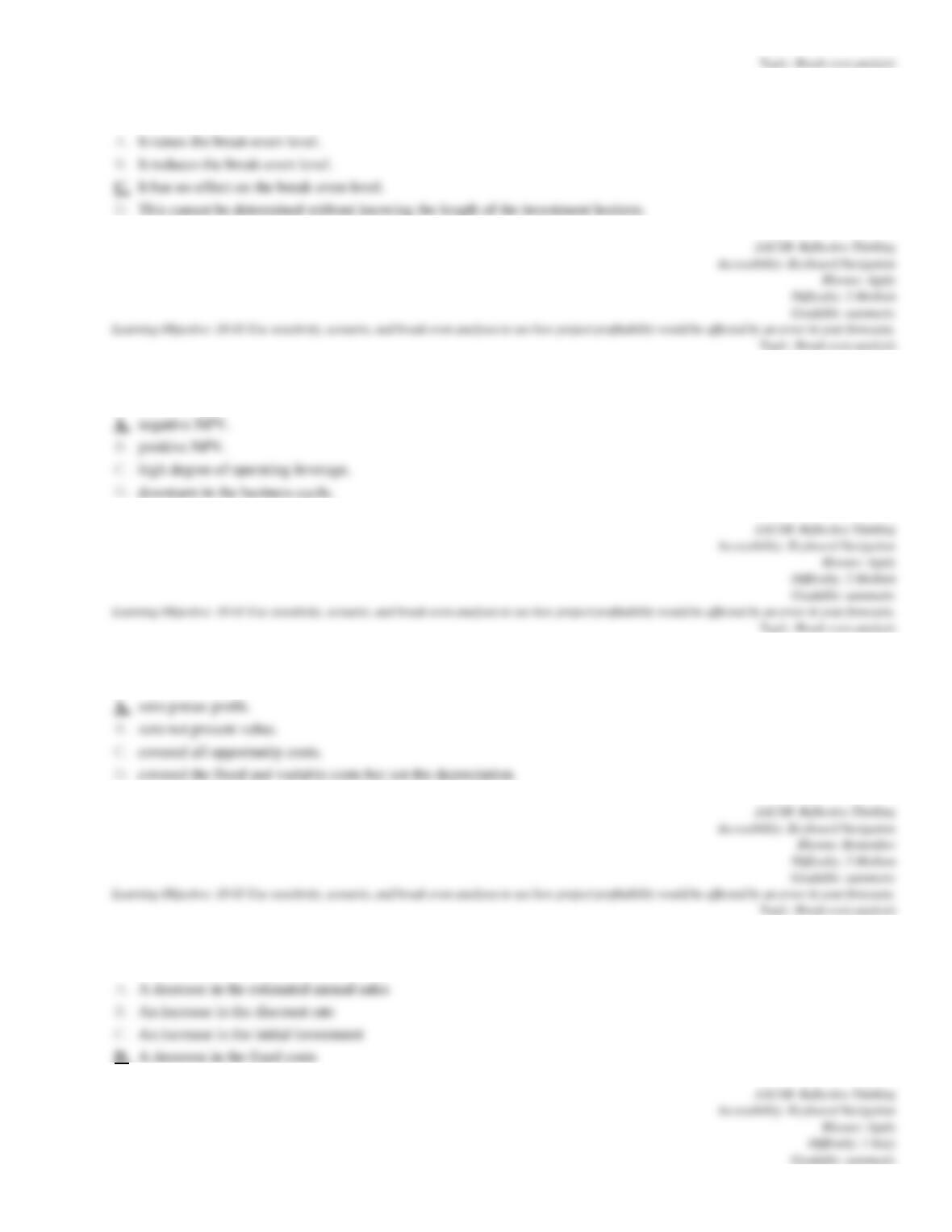
What effect will a reduction in the cost of capital have on the accounting break-even level of revenues?
51.
Break-even revenues on an accounting basis typically indicate a:
52.
The accounting break-even level of revenues represents the point at which the project has:
53.
Which one of the following changes might turn a negative NPV project into a positive NPV project?
54.
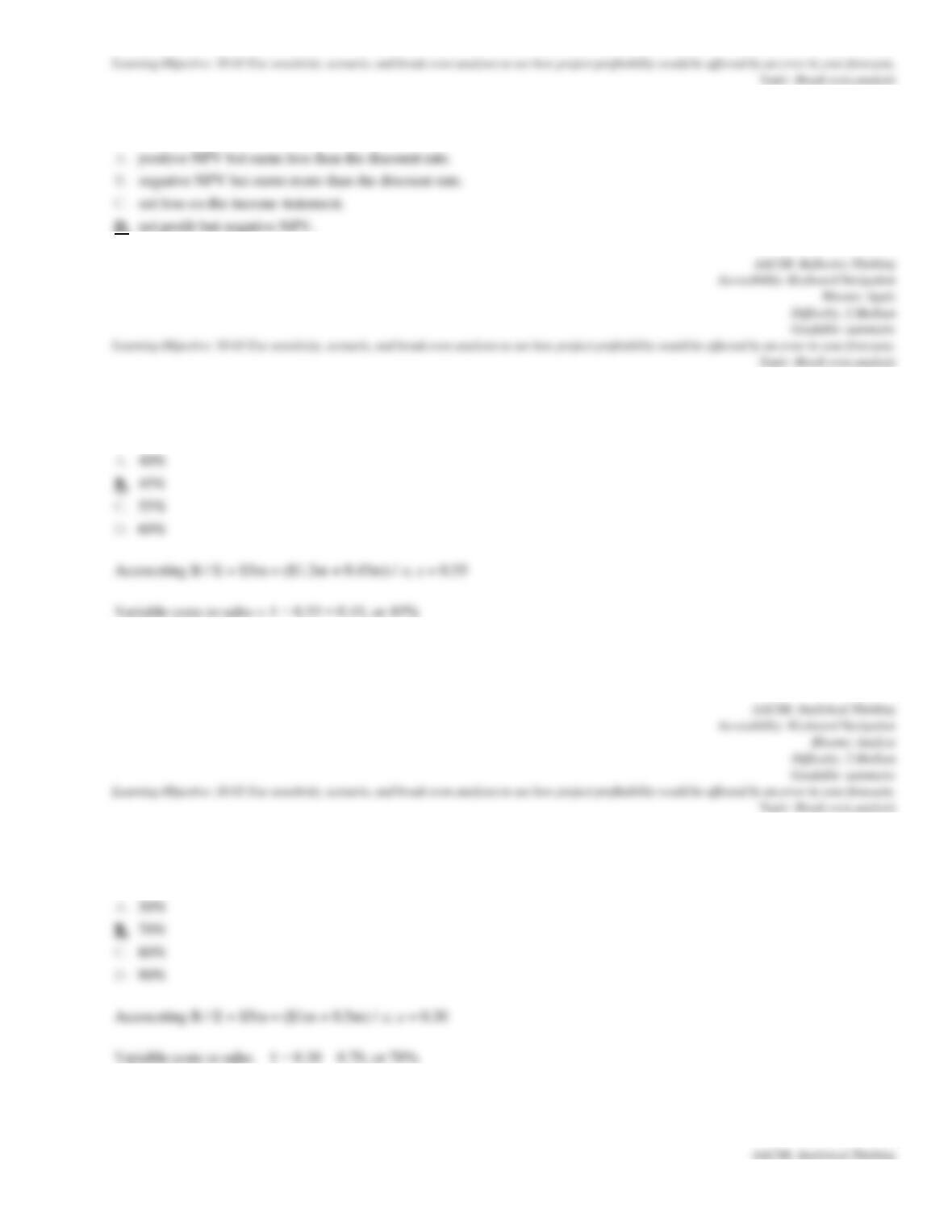
If project sales exceed the accounting break-even point, but the project has a negative EVA, then the project has a:
55.
Calculate the ratio of variable costs to sales for a firm with a $3 million accounting break-even revenue point, $1.2 million
fixed costs, and $450,000 depreciation.
56.
What is the maximum percentage of variable costs to sales that a firm could have and still break even with $5 million in
revenues, $1 million in fixed costs, and $500,000 of depreciation?
57.
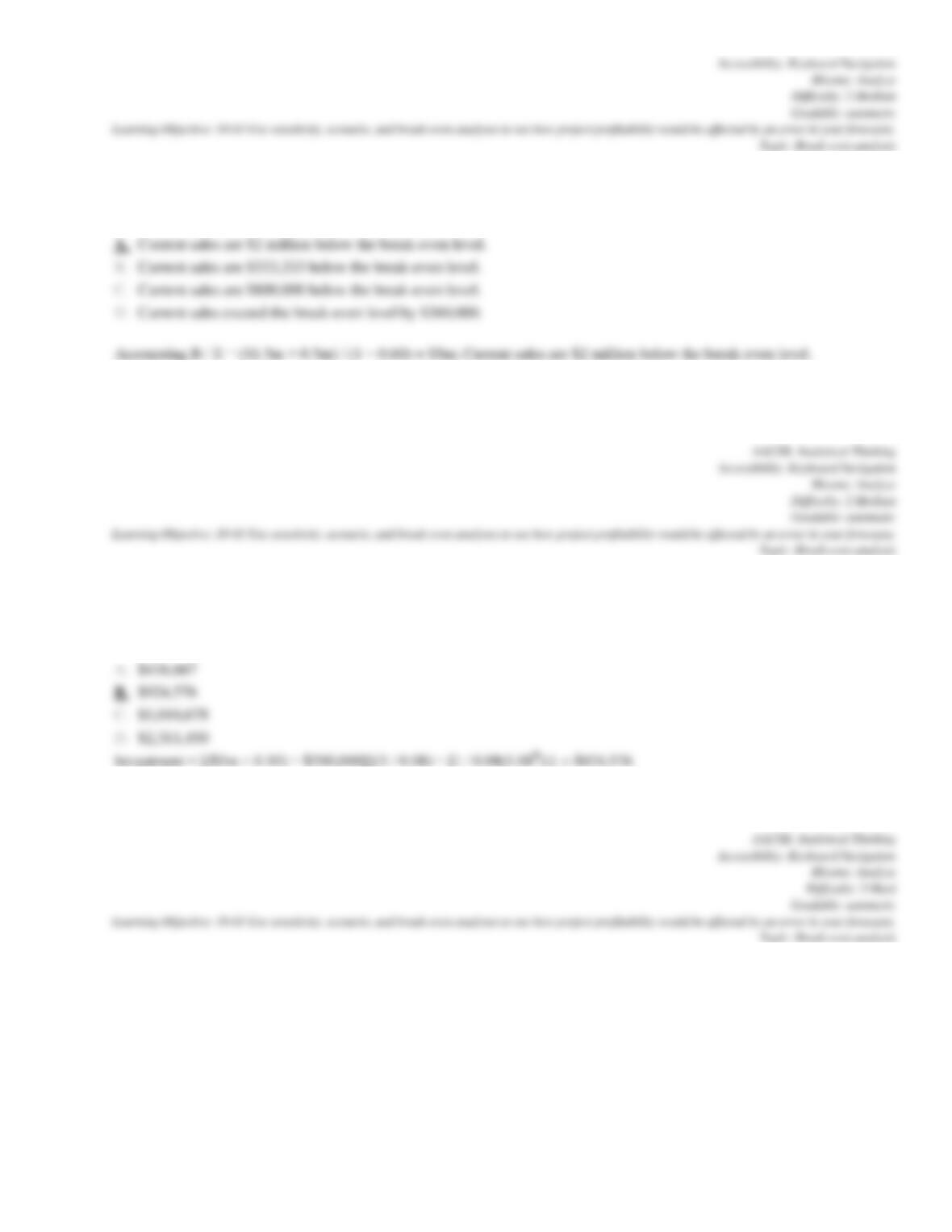
A firm with 60% of sales going to variable costs, $1.5 million fixed costs, and $500,000 depreciation and sales of $3 million.
How does the current level of sales compare to the accounting break-even sales level?
58.
A 6-year project has a zero NPV with sales of $5 million and a discount rate of 8%. The annual cash inflows are equal to
10% of sales minus $300,000. What was the initial investment in the project assuming that none of the investment is
recoverable when the project ends?