Test Bank Questions, Web Chapter A
1. What is the third step of the educational policy statement process?
a. Estimate the total cost for parents.
b. Calculate the cost of education.
c. Establish investment policy.
d. Project the potential for financial aid.
e. None of the above.
2. What is the overall goal of educational planning?
a. To provide the highest quality education possible regardless of costs.
b. To choose the education that enables the recipient to minimize educational costs.
c. To provide a quality education that enables the recipient to receive a high return
on investment.
d. To provide the least education possible for a given return on investment
objective.
e. None of the above.
3. Which of the following is not a variable that influences the selection of the type of
schooling?
a. Household resources.
b. Parental values.
c. Child’s wishes.
d. Child’s talents.
e. All of the above are variables that influence the selection of the type of
schooling.
4. Over the period 1999-2003, what was the rate of college costs inflation?
a. 2.9%.
b. 4.2%.
c. 4.9%.
d. 5.5%.
e. None of the above.

5. Federal Supplementary Education Opportunity Grants are for undergraduates with:
a. Particularly low family income.
b. Particularly low SAT scores.
c. Particularly high SAT scores.
d. All of the above.
e. None of the above.
6. The interest rate on which of the following is a maximum of 8.3 percent regardless of
market rates?
a. Federal PLUS loans.
b. Federal Perkins loans.
c. Stafford loans.
d. All of the above.
e. None of the above.
7. For which of the following loans are the student’s parents liable to repay?
a. Federal PLUS loans.
b. State PLUS loans.
c. Stafford loans.
d. All of the above.
e. None of the above.
8. What is the maximum reduction of financial aid associated with money in the
student’s parents’ account?
a. 5.6%.
b. 12.4%
c. 29.4%.
d. 35%.
e. None of the above.

9. Private school payments for the period before college are:
a. Eligible for Coverdells if student is a minor when attending private school.
b. Eligible for Coverdells.
c. Ineligible for Coverdells.
d. Ineligible for Coverdells if student is a minor when attending private school.
e. None of the above.
10. Qualified tuition plans are also known as:
a. Section 529 plans.
b. Coverdell Education Savings Accounts.
c. Stafford plans.
d. All of the above.
e. Both a and b.
11. Which of the following is not a qualified withdrawal associated with qualified tuition
plans?
a. Tuition.
b. Supplies required by the college.
c. Reasonable costs for room and board for students attending college at least half
time.
d. Reasonable costs for room and board for students attending college at least one
quarter time.
e. All of the above are qualified withdrawals.
12. Can funds in a Section 529 plan be used to attend a foreign school?
a. No.
b. Yes.
c. Yes, if the foreign schools can participate in the Department of Education’s
student aid program.
d. Yes, unless the foreign schools can participate in the Department of Education’s
student aid program.
e. None of the above.

13. In which of the following situations is there a 10% penalty incurred when
withdrawing funds in Section 529 plans?
a. If the withdrawal from the account is due to the death of the designated
beneficiary.
b. If the withdrawal from the account is due to the disability of the designated
beneficiary.
c. Withdrawals of excess funds due to receipt of a scholarship.
d. Non-college expense withdrawals arising from attendance at a U.S. military
academy.
e. None of the above.
14. For which of the following relatives of the beneficiary can funds left over in a
qualified tuition plan not be rolled over?
a. Uncle.
b. First cousin.
c. Brother.
d. Father.
e. Both a and b.
15. UGMAs are:
a. Unrestricted.
b. Restricted to financial assets as investment vehicles.
c. Restricted to limited partnerships as investment vehicles.
d. Restricted to real estate as investment vehicles.
e. Both c and d.
16. As the starting date of the education approaches, allocation of education savings to
bond and money markets should:
a. Not change
b. Decrease
c. Increase.
d. Represent 13.3% of the portfolio.
e. None of the above.

17. Which of the following educational saving alternatives allows pre-tax deposits?
a. Series EE.
b. Coverdell education savings.
c. 529 plans.
d. All of the above.
e. None of the above.
18. For which of the following educational saving alternatives is there an age limitation
for use?
a. Series EE.
b. Coverdell education savings.
c. 529 plans.
d. All of the above.
e. None of the above.
19. What are the disadvantages for educational savings associated with Series EE?
a. Little investment flexibility.
b. Income limitation.
c. Small amount of deposit allowed.
d. Both a and b.
e. Both b and c.
20. In practice, what is financial literacy?
a. Working to understand personal financial terms.
b. Making sure to read the business section of the newspaper on a frequent basis.
c. Being able to make financial decisions capably.
d. All of the above.
e. None of the above.

21. From an economic standpoint, financial literacy is important as:
a. Its absence can lead to a misallocation of resources that affects society’s
productivity.
b. Its absence can lead to financial ruin for the household.
c. Its absence can lead to lower accumulation of wealth for the household.
d. All of the above.
e. None of the above.
22. Which of the following is not a reason why individuals are not adept in financial
matters?
a. Lack of exposure to financial issues as a child.
b. Belief that financial issues cannot be handled capably.
c. Poor mathematical skills.
d. Lack of interest in the subject.
e. All of the above are reasons why individuals are not adept in financial matters.
23. For Series EE, what was the income eligibility for a joint filing in 2014?
a. $91,850-$121,850.
b. $76,000–$91,000
c. $113,950–$143,950
d. $61,200-$121,850.
e. None of the above.
24. For a Roth IRA, what was the income eligibility for a single filing in 2014?
a. $91,850-$121,850.
b. $114,000 – 129,000
c. $95,000-$121,850.
d. $61,000-$129,000.
e. None of the above.
25. For which of the following educational savings alternatives is there a penalty for
unused money?

a. Series EE.
b. Traditional savings.
c. 529 plans.
d. There are penalties associated with all of the above.
e. There are penalties associated with none of the above.
26. For which of the following educational savings alternatives is there no limitation?
a. Series EE.
b. IRA.
c. 529 plans.
d. There are limitations associated with all of the above.
e. There are limitations associated with none of the above.
27. Which of the following is not a topic that should be discussed to assist clients in
financial literacy in the area of debt?
a. The appropriate use of borrowed funds.
b. How to get out of debt.
c. Establishing a formal or informal family budget.
d. What is the best source of credit?
e. All of the above should be discussed to assist clients in financial literacy in the
area of debt.
28. Which of the following is not a topic that should be discussed to assist clients in
financial literacy in the area of investments?
a. Appreciating diversification and the benefits of long term investing.
b. Understanding the advantage of index funds for low maintenance supervision.
c. How to deal with impulsive investment behavior.
d. Explaining the most attractive way to purchase investment selections.
e. All of the above should be discussed to assist clients in financial literacy in the
area of debt.
Essay questions:
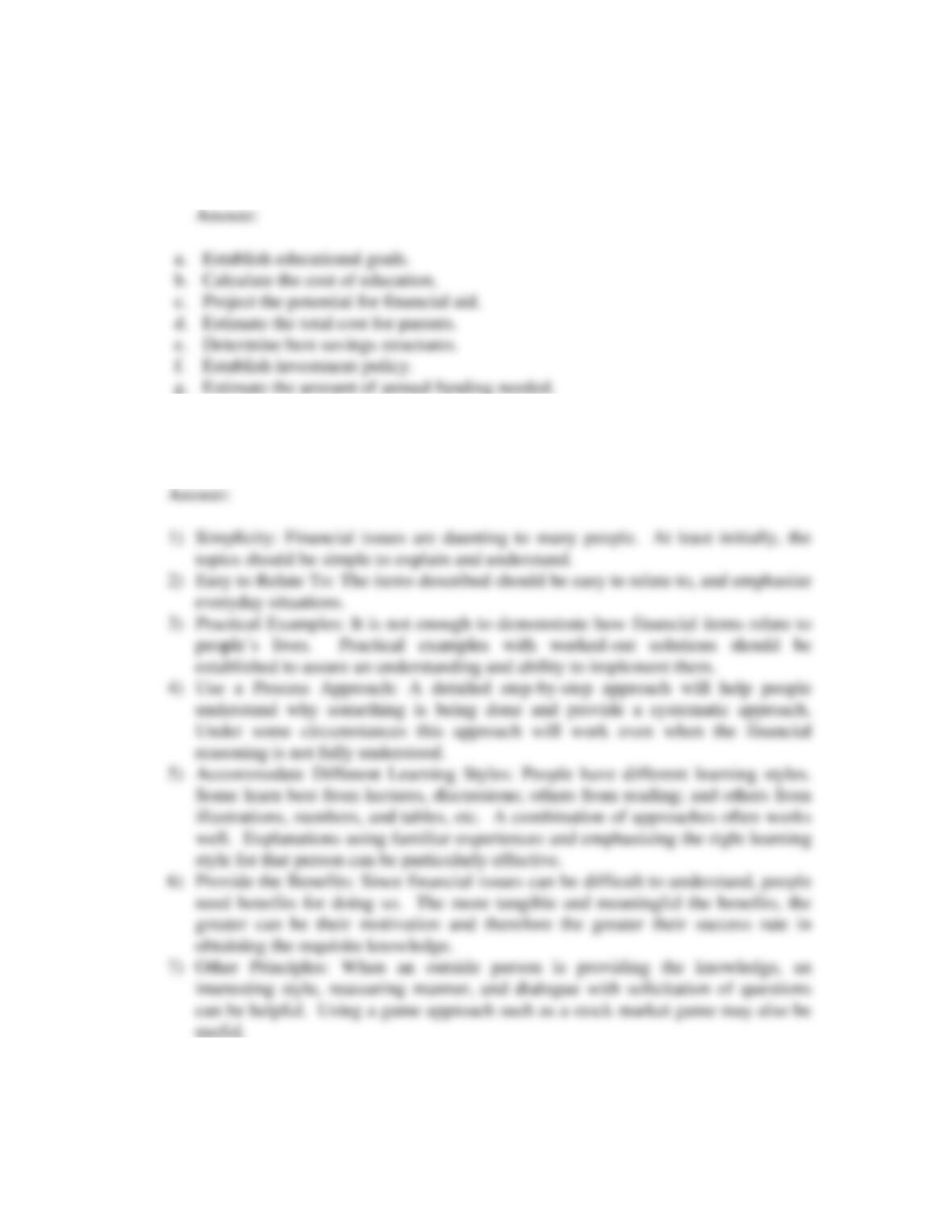
29. What are the steps in the educational policy statement process?
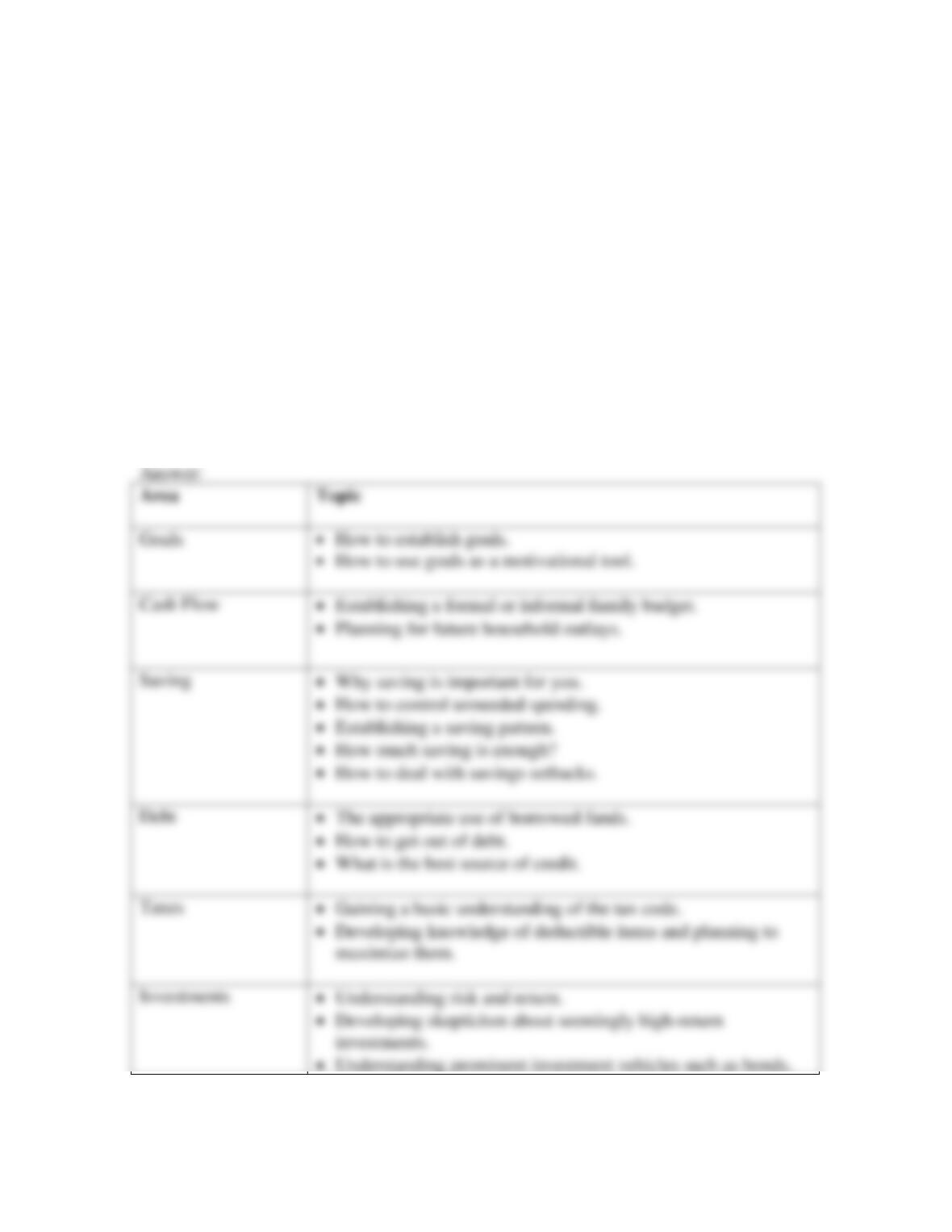
30. Please list and explain seven basic financial literacy principles.
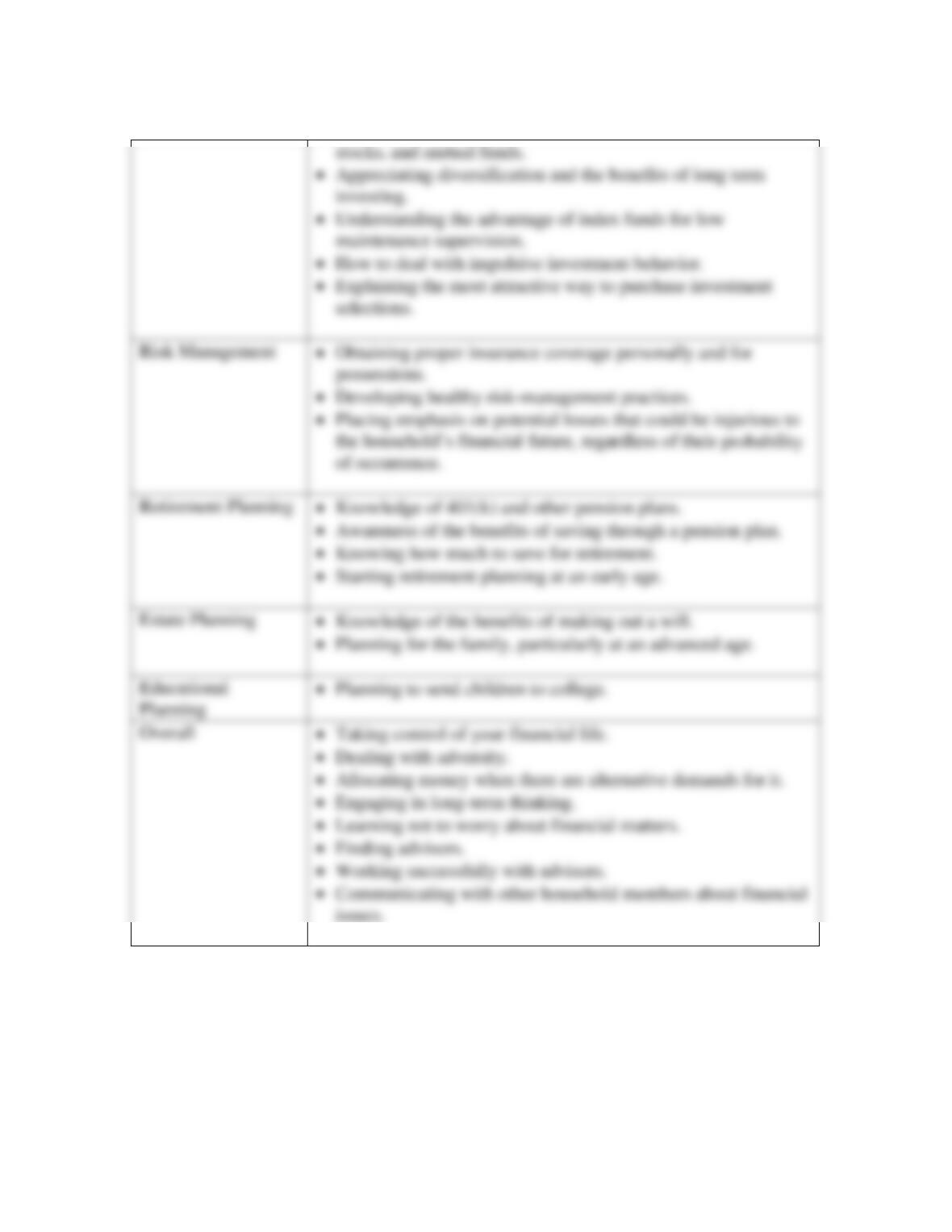
31. For each of the following areas, please list important topics that should be discussed
to help client’s become financial literate:
• Goals
• Cash Flow
• Saving
• Debt
• Taxes
• Investments
• Risk Management
• Retirement Planning
• Estate Planning
• Educational Planning
• Overall