
COMPREHENSIVE EXAMINATION G
(Chapters 22 – 24)
Approximate
Problem Topic Points Minutes
G – I Multiple Choice ……………………………………… 16 16
G – II Variance Analysis ………………………………….. 12 12
G – III Capital Budgeting ………………………………….. 16 16
G – IV Flexible Overhead Budget ………………………. 15 15
59 59
Checking Work ……………………………………… 5
64

Test Bank for Kimmel Accounting, Fifth Edition
G – 2
Problem G – I — Multiple Choice (16 points)
Circle the one best answer.
1. The standard number of hours that should have been worked for output attained is 5,100
direct labor hours, and the actual number of hours worked was 5,200. If the direct labor
price variance was $520 unfavorable, and the standard rate of pay was $14.20 per direct
labor hour, what was the actual rate of pay for direct labor?
a. $14.30 per direct labor hour
b. $14.20 per direct labor hour
c. $14.10 per direct labor hour
d. $14.00 per direct labor hour
2. Which one of the following does not affect cash?
a. Acquisition of bonds payable
b. Depreciation expense
c. Acquisition of treasury stock
d. Payment of cash dividend
3. Equipment was purchased for $122,400 and it is estimated to have a $6,000 salvage
value at the end of its estimated 8-year life. The equipment is estimated to generate cash
inflows of $18,000 each year and will be depreciated by using the straight-line method.
How long is the payback period on this investment?
a. 7.3 years
b. 7.6 years
c. 6.5 years
d. 6.8 years
4. DataStore purchased a new truck for $30,000 and will use the straight-line method of
depreciation over 6 years with no salvage value. The company expects to generate
$9,500 of operating cash flows per year. The company’s minimum annual rate of return is
9%. How much is the annual rate of return on this investment?
a. 63.3%
b. 15.0%
c. 19.0%
d. 30.0%
5. Items from Freedman Company’s budget for March in which 2,400 units were produced
and sold appear below:
Direct materials $12,000
Indirect materials—variable 2,100
Supervisor salaries 17,000
Depreciation on factory equipment 5,000
Direct labor 13,500
Property taxes on factory 1,500
Total $51,100
At 2,500 units, how much are budgeted variable manufacturing costs?
a. $28,750
b. $27,600
c. $53,225
d. $26,563
Comprehensive Examination G
G – 3
6. A company developed the following per-unit standards for its product: 2.4 pounds of direct
materials at $2 per pound. Last month, 700 pounds of direct materials were purchased
and used for $1,470. The company produced 290 units of product. How much is the direct
materials price variance for last month?
a. $8 unfavorable
b. $78 unfavorable
c. $70 unfavorable
d. $61.60 unfavorable
7. The per-unit standards for direct materials are 1.5 gallons at $2.50 per gallon. Last month,
4,180 gallons of direct materials that actually cost $10,659 were used to produce 3,000
units of product. How much is the direct materials standard?
a. $4,500
b. $11,250
c. $3.75
d. Not enough information
8. Wilson, Inc. budgeted production of 24,000 units during the period, but actually produced
22,000 units. Actual costs and standard costs for the month are as follows:
X
Actual
Standard
Materials
4 lbs. @ $10.00 per lb.
41,800 lbs. @ $9.80 per lb.
Labor
.50 hours @ $30.00 per hour
5,400 hours @ $30.60 per hour
Variable OH
$6.50 per unit
$73,000
Fixed OH
$3.00 per unit
$34,500
What is the standard cost per unit?
a. $61.50
b. $49.50
c. $64.50
d. $55.00

Test Bank for Kimmel Accounting, Fifth Edition
G – 4
Problem G – II — Variance Analysis (12 points)
Pillow Talk manufactures luxury down bed pillows. Each pillow requires 3.9 pounds of down and
takes 0.25 hours of direct labor. The standard cost of the down used is $6.50 per pound, and the
standard labor cost is $12 per hour. In November, Pillow Talk purchased and used 25,000
pounds of down for $157,500. It manufactured 6,200 pillows. Payroll reported a total of 1,520
direct labor hours at a cost of $17,936.
Instructions
(a) Compute the materials price and quantity variances and indicate whether the variances are
favorable or unfavorable.
(b) Compute the labor price and quantity variances and indicate whether the variances are
favorable or unfavorable.
Problem G – III — Capital Budgeting (16 points)
Weston Company is considering a capital investment of $145,000 in new equipment. The
equipment is expected to have a useful life of 10 years with no salvage value. Depreciation is
computed by the straight-line method. During the life of the investment, annual net income and
cash inflows are expected to be $11,000 and $25,500, respectively. Weston requires either a
10% cost of capital “hurdle” rate, or a payback period of 7 years.
Instructions
Compute the (a) cash payback period, (b) net present value, (c) internal rate of return (to the
nearest percent), and (d) annual rate of return. Show all computations. State whether the project
should be accepted or rejected for each of the four capital budgeting techniques.
Present Value of an Annuity of 1
(n)
Periods 5% 6% 8% 9% 10% 11% 12% 15%
10 7.72173 7.36009 6.71008 6.41766 6.14457 5.88923 5.65022 5.01877

Comprehensive Examination G
G – 5
Problem G – IV — Flexible Overhead Budget (15 points)
Lawrence Company budgeted a level of activity of 8,000 machine hours to be worked each month
in the Machining Department. At this level of activity, manufacturing overhead costs were
budgeted as follows:
Variable manufacturing overhead
Indirect materials $ 12,000
Indirect labor 18,000
Repairs 6,400
Utilities 9,600
Fixed manufacturing overhead
Supervisory salaries 7,000
Property taxes 1,000
Depreciation 4,000
Total manufacturing overhead $58,000
Instructions
The actual manufacturing costs incurred for the month of March, when 8,200 machine hours were
worked, are listed below on a partially completed budget report. Complete the budget report in a
manner that would be most useful for evaluating the performance of the Machining Department
manager for the month of March, 2014.
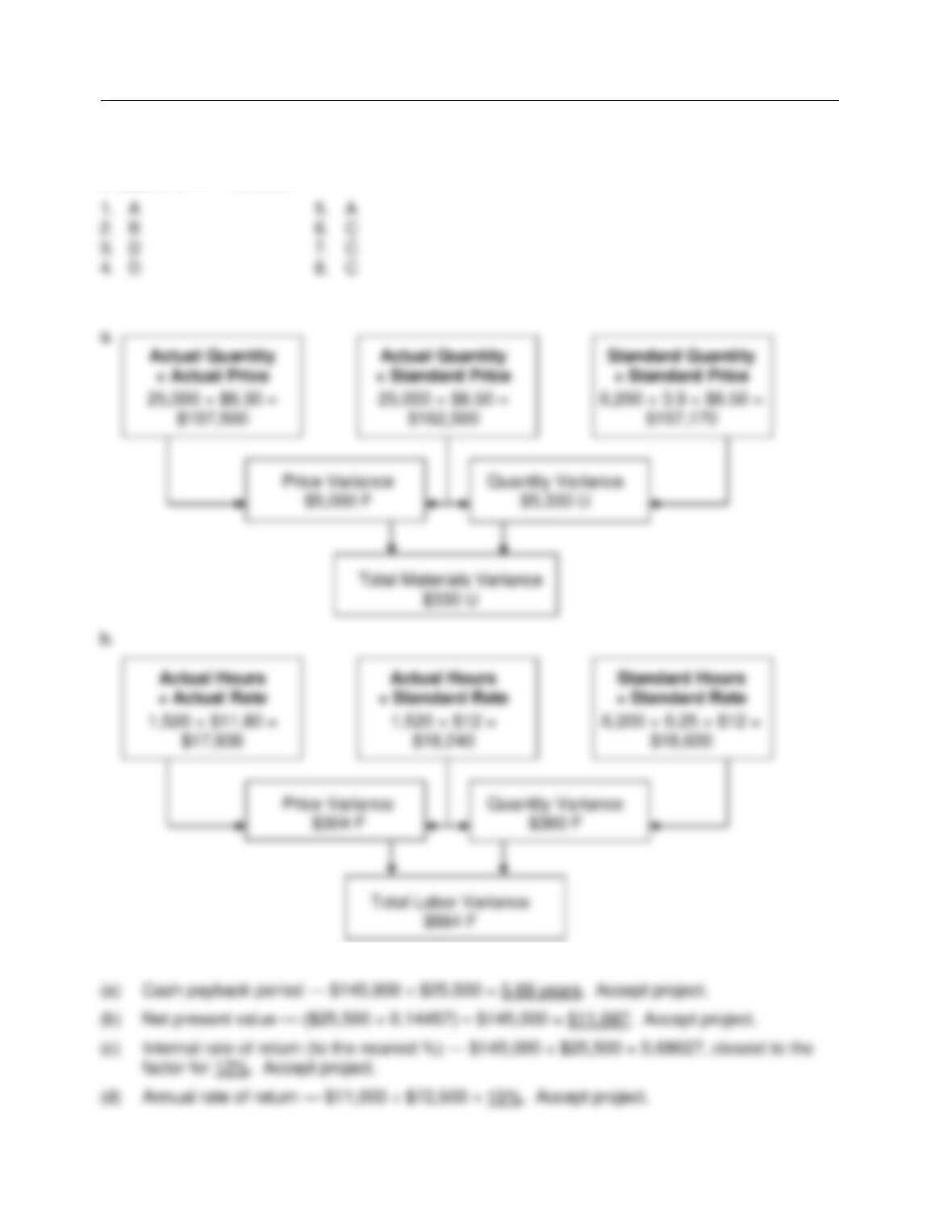
LAWRENCE COMPANY
Manufacturing Overhead Budget Report
Machining Department
For the Month Ended March 31, 2014
Difference
Budget at Actual at Favorable F
Unfavorable U
Variable manufacturing overhead
Indirect materials $ $ 11,500 $
Indirect labor 17,800
Repairs 7,400
Utilities 11,150
Total variable 47,850
Fixed manufacturing overhead
Supervisory salaries 6,800
Property taxes 1,100
Depreciation 4,050
Total fixed 11,950
Total costs $ $59,800 $
Test Bank for Kimmel Accounting, Fifth Edition
G – 6
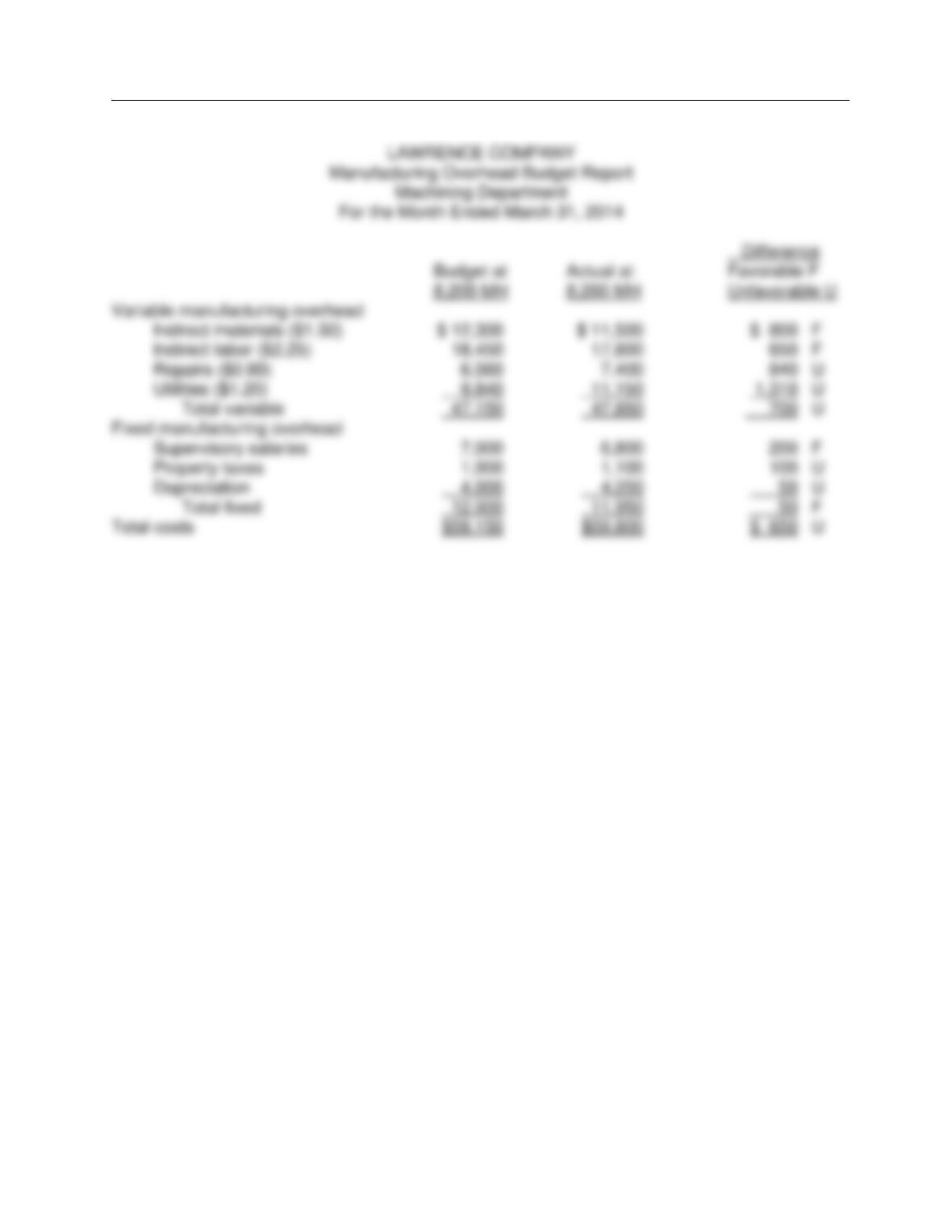
Solutions — Comprehensive Examination G
Problem G – I — Solution
Problem G – II — Solution
Problem G – III — Solution
Comprehensive Examination G
G – 7
Problem G – IV — Solution