Test Bank Questions, Web Chapter B
1. Which of the following is not an inflation factor?
a. Excess of supply for a good or goods as compared with the demand
b. Increases in the cost of items needed to produce a good
c. Lack of competition arising from few producers for that item and barriers to new
companies entering the market
d. An excess supply of money in the economy
e. All of the above are inflation factors
2. Which of the following is not an effect of inflation?
a. Redistribute wealth.
b. Change economic behavior and bring about inefficient economic activity
c. Result in action by the Federal Reserve to stop the inflationary spiral
d. Increased uncertainty about the future
e. All of the above are effects of inflation
3. The rate of inflation is equal to which of the following?
a. 100 x current price – (price in previous periods x price in previous periods).
b. 100 x (price in previous periods – current price)/price in previous periods
c. 100 x (current price – price in previous periods)/price in previous periods
d. 100 x price in previous periods – (current price/price in previous periods)
e. None of the above
4. What was the highest annual inflation in a given year in the U.S. during the period
1950-2014?
a. 10.4%
b. 11.0%
c. 11.2%
d. 13.5%
e. None of the above.
5. During which of the followings decades was the average inflation highest in the U.S.?
a. 1950-1959
b. 1960-1969
c. 1970-1979
d. 1980-1989
e. 1990-1999
6. If the current amount is $100,000, the inflation rate is 4% and the number of periods
is 2, what is the real amount?
a. $74,545.34
b. $92,455.62
c. $104,567.32
d. $88,455.32
e. None of the above
7. What is the purchasing power of $100,000 at an inflation rate of 10% over 20 years?
a. $62,092
b. $38,554
c. $100,000
d. $14,864
e. $98,039
8. What is disinflation?
a. A period in which inflation is rising but at a rate of increase that is declining.
b. A period in which the absolute level of prices declines.
c. A period in which inflation is declining but at a rate of decline that is increasing.
d. A period in which the absolute level of prices increases.
e. None of the above.
9. A recession is defined as:
a. A three-quarter or longer decline in real overall output for the nation
b. A two-quarter or longer decline in real overall output for the nation
c. A three-quarter or longer decline in real industrial output for the nation
d. A two-quarter or longer decline in real industrial output for the nation
e. None of the above
10. When the economy reaches bottom, it is in a:
a. Trough
b. Gutter
c. Ditch
d. Depression
e. Recession
11. Which period of time is associated with the longest expansion in the U.S. economy
between 1945 and 2001?
a. November 1973-March 1985
b. July 1981-November 1994
c. March 1991-March 2001
d. Both a and b
e. None of the above
12. The measure of overall U.S. economic activity produced by U.S. businesses is the:
a. Gross Domestic Product
b. Gross National Product
c. Net Domestic Product
d. Net National Product
e. None of the above
13. During which of the followings decades was the average real GDP growth highest in
the U.S.?
a. 1950-1959
b. 1960-1969
c. 1970-1979
d. 1980-1989
e. 1990-1999
14. Which of the following is not one of the factors in the index of leading indicators?
a. Stock prices
b. Consumer expectations
c. Money supply
d. Initial unemployment claims
e. All of the above are factors
15. What is the goal of fiscal policy?
a. To increase economic fluctuations and have the GNP grow close to full
employment
b. To increase economic fluctuations and have the GDP grow close to the GNP
c. To lessen economic fluctuations and have the GDP grow close to the GNP
d. To lessen economic fluctuations and have the economy grow close to full
employment
e. None of the above
16. Which of the following is an advantage associated with increased government
spending?
a. The government is relatively assured that the money will result in a change in
economic output
b. The government is relatively assured that the money will not result in a change in
economic output
c. Implementation is often delayed
d. Implementation is rarely delayed
e. None of the above
17. Which of the following is not an action that the Federal Reserve can take to influence
economic activity?
a. Open market operations
b. Changes in the inflation rate
c. Changes in the reserve ratio
d. Moral suasion
e. All of the above are actions that the Federal Reserve can take
18. Which of the following categories of financial are the largest depository institutions
in the U.S.?
a. Savings banks
b. Savings and loans
c. Commercial banks
d. Insurance companies
e. Credit unions
19. Which of the following provides regulatory services for securities traded in over-the-
counter markets?
a. SEC
b. NASD
c. NYSE
d. Both a and b
e. Both a and c
20. For which of the following financial institutions is the owner money not at risk?
a. Brokerage company
b. Mutual fund company
c. Trust company
d. Owner money is not at risk for all of the above
e. Owner money is at risk for all of the above
21. Which of the following financial institutions provide both deposits and loans?
a. Credit unions
b. Trust companies
c. Finance companies
d. Both a and b
e. All of the above
22. A grouping of individuals or businesses that share a common interest or goal and that
generally finance an organization is:
a. A corporation
b. An association
c. A family limited partnership
d. An individual proprietorship
e. None of the above
23. Economic characteristics of subchapter S corporations do not include which of the
following?
a. Specialization
b. Economics of scale
c. Reduction in income fluctuation
d. Can pass along greater assets to the next generation
e. All of the above are characteristics of subchapter S corporations
24. Which of the following is characterized by limited liability?
a. Individual proprietorship
b. Partnership
c. Family limited partnership
d. Both a and b
e. Both b and c
25. For which of the following is income not taxed on the individual return?
a. Subchapter S corporation
b. Limited liability partnership
c. Partnership
d. Income is taxed on the individual return for all of the above
e. Income is not taxed on the individual return for all of the above
26. Which of the following is characterized by a limited life cycle?
a. Subchapter S corporation
b. Limited liability partnership
c. Partnership
d. All of the above
e. None of the above
27. Giving up something that has value in return for an act or promise is:
a. Compromise
b. Consideration
c. Contract
d. Offer
e. Acceptance
28. An act of wrongdoing against a person or a business or their property for which
compensation is sought is:
a. A tort
b. Negligence
c. Belligerence
d. All of the above
e. None of the above
29. Which of the following is not required for a contract to be negotiable?
a. Written
b. Signed by maker
c. An unconditional promise to pay an exact amount of money
d. Paid to a specific person or to anyone presenting the contract
e. All of the above are required
30. What is a fiduciary?
a. An officer of the law.
b. A trusted party who acts as an agent for another person.
c. A lawyer designated by the courts.
d. All of the above.
e. None of the above.
Essay questions:
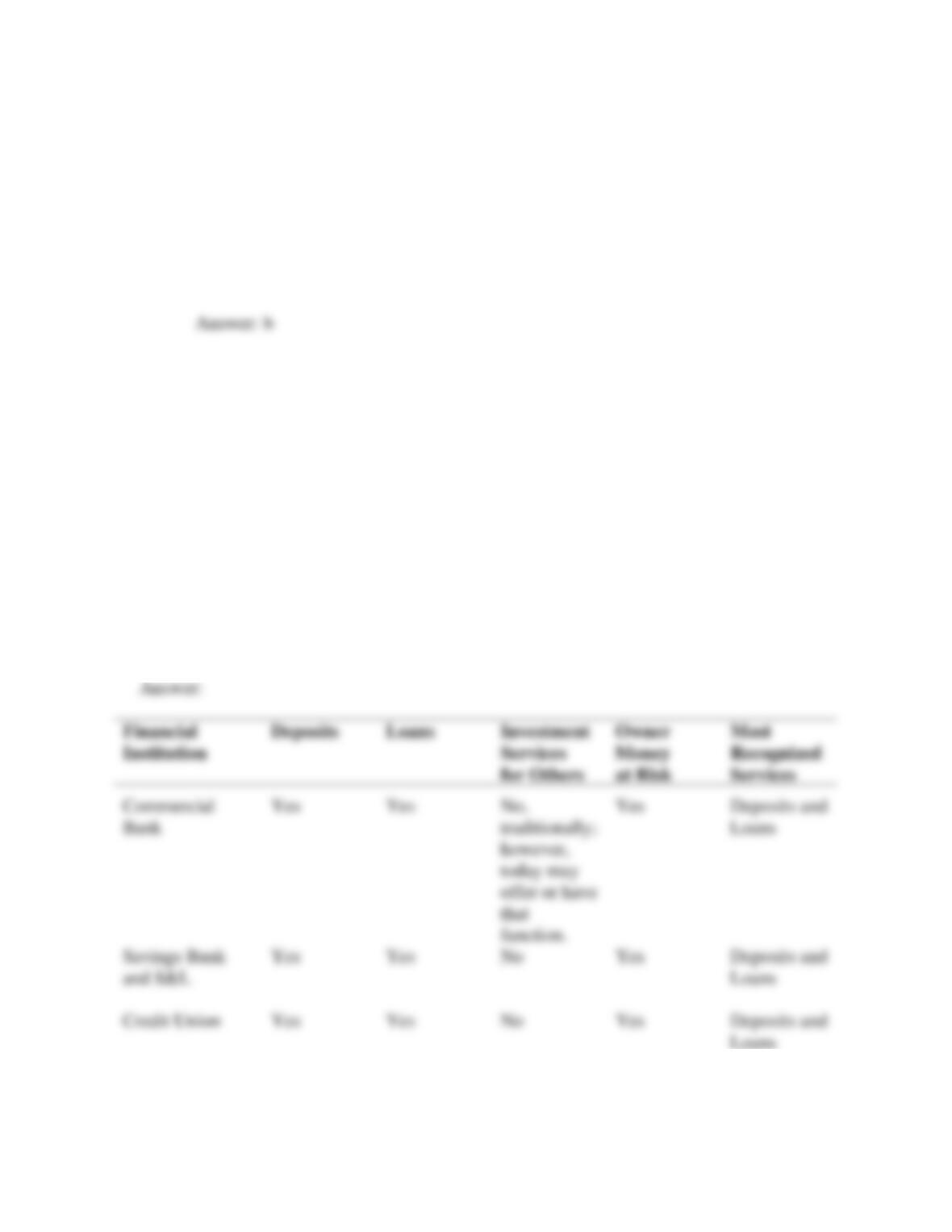
31. For each of the following financial institutions, detail whether each is characterized
by deposits, loans, and investment services for others. In addition, indicate whether
owner money is at risk and the institution’s most recognized services.
a. Commercial Bank
b. Savings Bank and S&L
c. Credit Union
d. Brokerage Company
e. Insurance Company
f. Mutual Fund Company
g. Finance Company
h. Trust Company
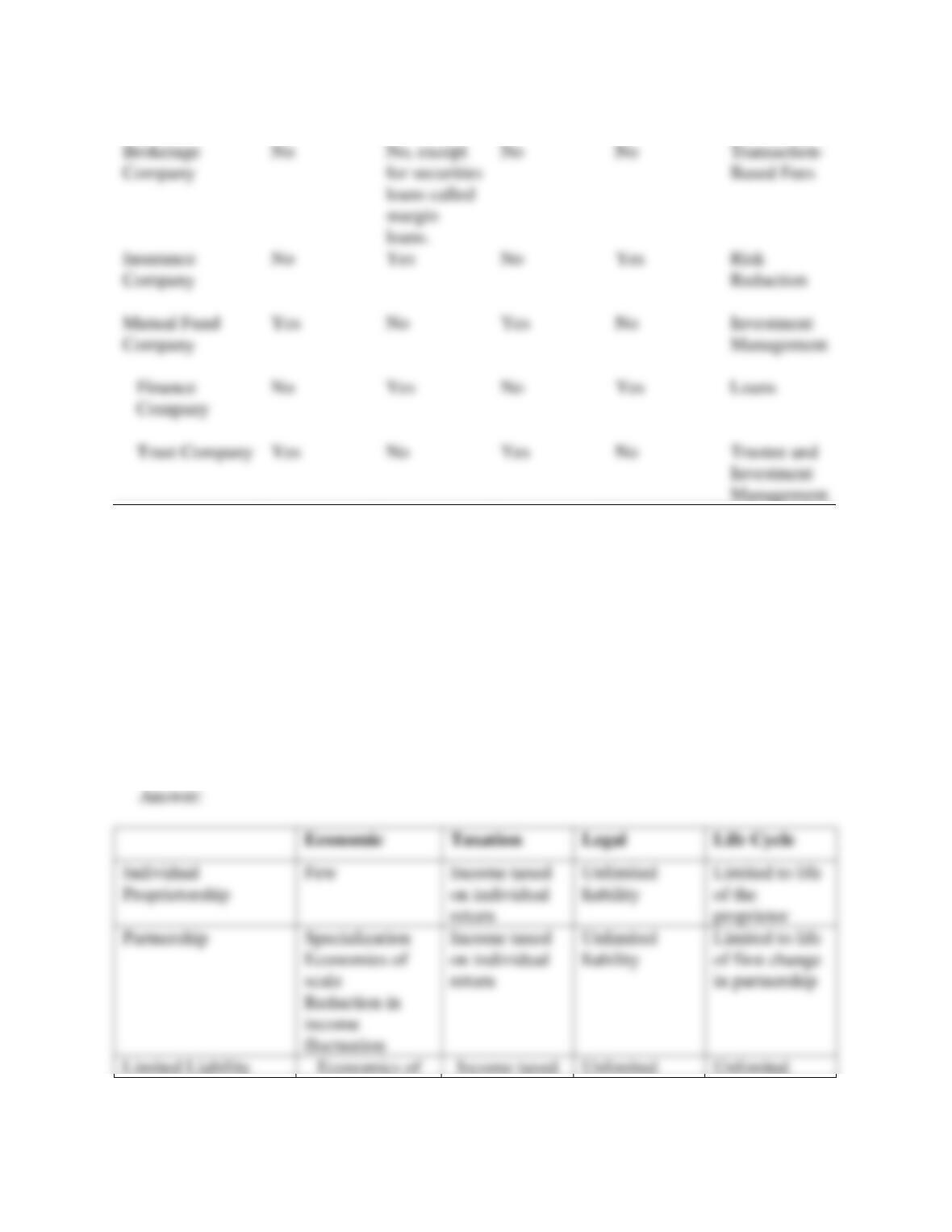
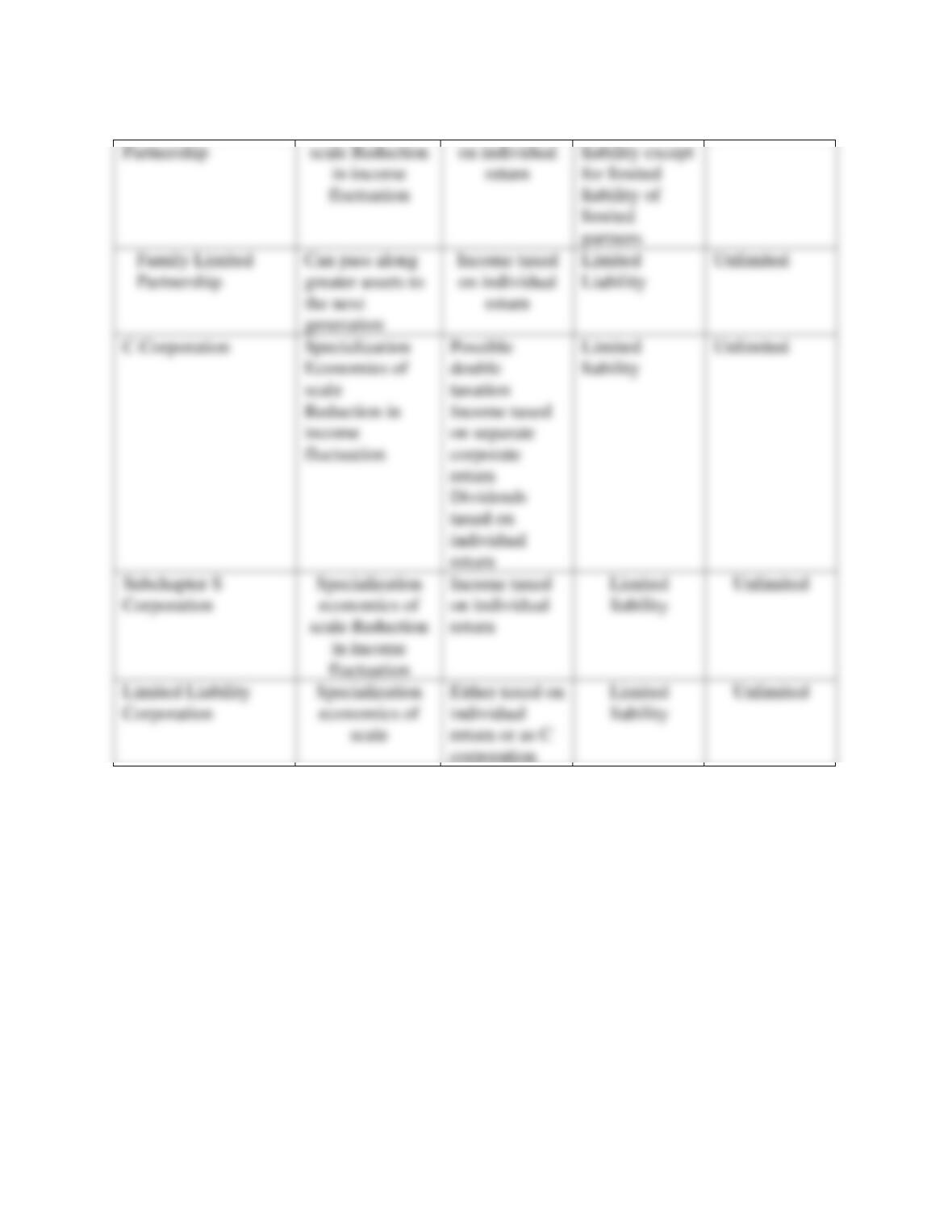
32. For each of the following types of business organizations, detail the organization’s
economic, taxation, legal, and life cycle characteristics.
• Individual Proprietorship
• Partnership
• Limited Liability Partnership
• Family Limited Partnership
• C Corporation
• Subchapter S Corporation
• Limited Liability Corporation