TEST NUMBER 1
Question 1 (32 Points)
The following are partial financial statements for an industrial firm that you
are required to analyze and value. All amounts are in millions of dollars.
Income Statement for Fiscal Year 2004
Sales 2,000
Cost of goods sold 1,500
Gross margin 500
Selling and general expenses 300
Operating income 200
Interest income 5
205
Interest expense 21
Restructuring charge 14
Income before tax 170
Income taxes 60
Net income J

2004 2003 2004 2003
Operating assets A 910 Operating liabilities 113 C
Debt securities 110 B Financing debt 360 340
Perferred stock 100 100
Common equity E 500
1,146 1,000 D1,000
Balance Sheet, Year 2004
Assets
Liabilities and Equity
Balance, end of 2003 F
Net income G
Common dividends (30)
Preferred dividends H
Unrealized loss on debt securities held (5)
Foreign currency translation gain 4
Balance, end of 2004 I
Statement of Common Shareholders Equity, Year 2004
_________________________________________________________________
The firm’s statutory tax rate is 35.3%.
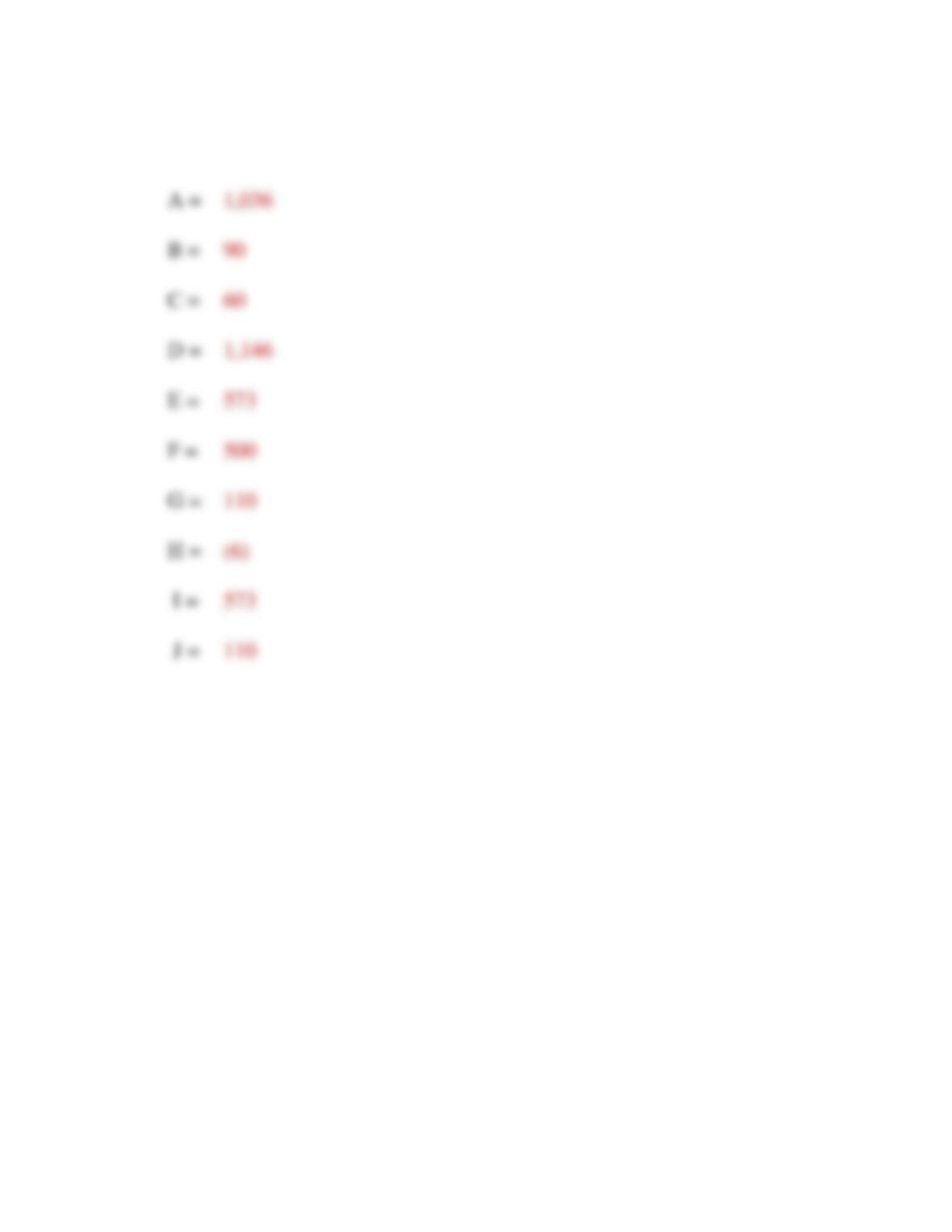
(a.) Supply the missing numbers, A to J.
(If you are unable to calculate one of these numbers, make a reasonable guess before
proceeding to part (b) of the question.)
To answer the remainder of the questions, prepare the reformulated income
statement and balance sheet:

Core operating income 200.00
Tax reported 60.00
Tax on unusual item 4.94
Tax on NFE 5.65 70.59
Core OI after tax 129.41 (ii)
Unusual item (restructuring)
14.00
Tax on UI (@ 0.353) 4.94
9.06
Foreign currency gain 4.00 5.06
Operating income 124.35
Net financial expense:
Interest expense
21.00
Interest income
5.00
16.00
Tax (@ 0.353) 5.65
10.35
Unrealized loss on debt 5.00
Preferred dividends 6.00 21.35 (iii)
Comprehensive income 103.00 (i)
Income Statement, 2004
2004 2003
NOA 923 850
NFO 350 350
CSE 573 500
OA 1,036 910
-OL 113 60
NOA 923 850
FL 460 440
FA 110 90
NFO 350 350
Balance Sheet
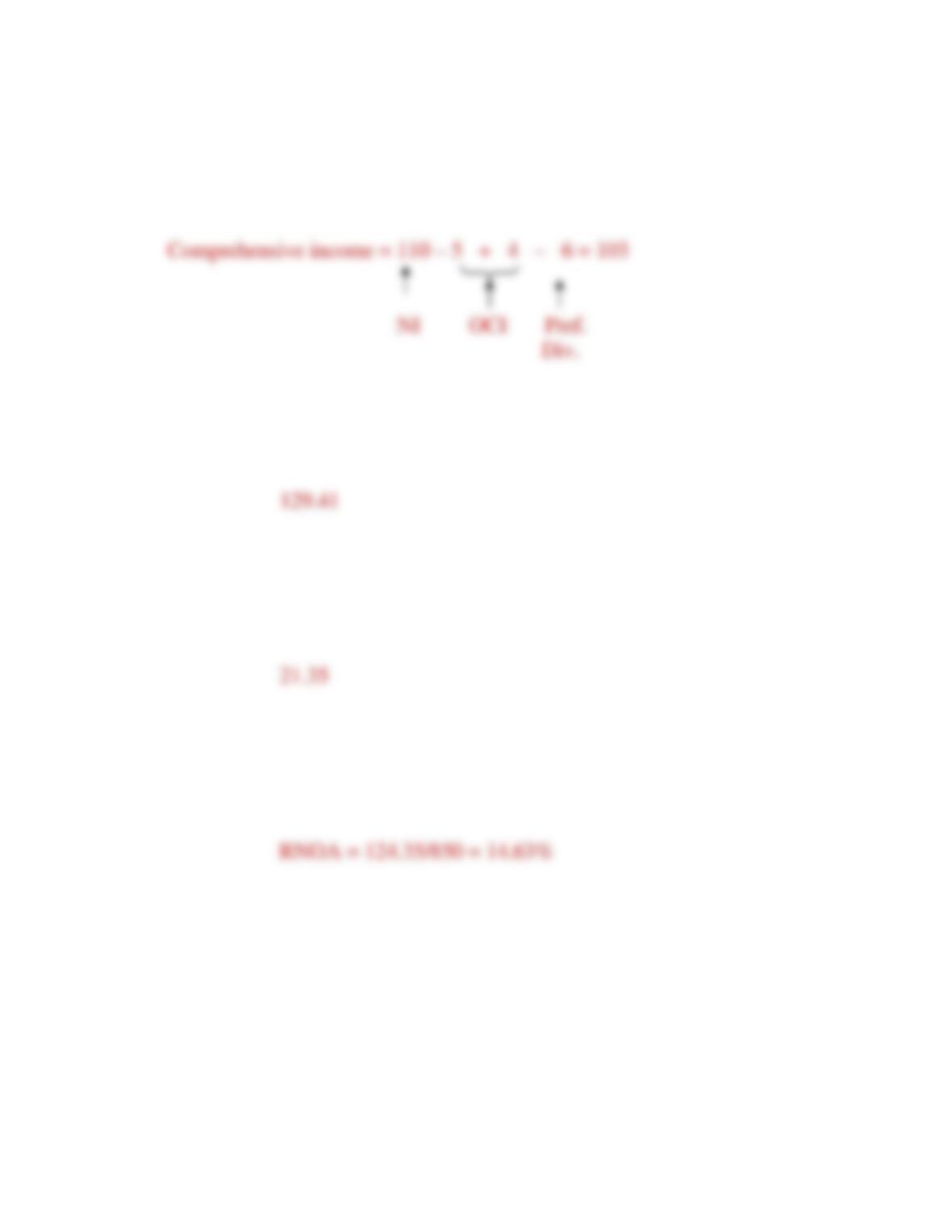
(b) Calculate the following for 2004. Use beginning of year balance sheet
numbers in denominators.
(ix) Comprehensive income
(x) Core operating income, after tax
(xi) Net financial expense, after tax
21.35
(xii) Return on net operating assets (RNOA)
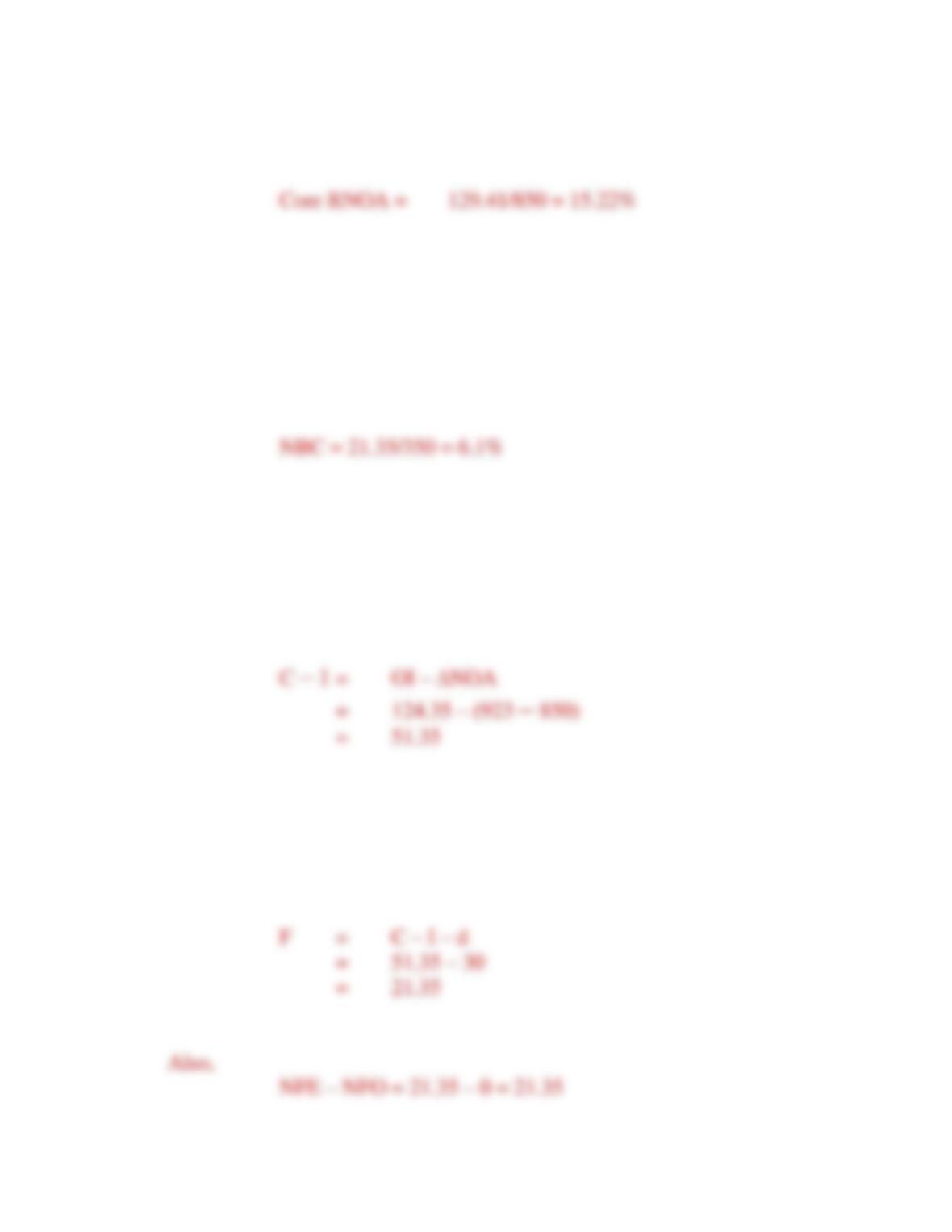
(xiii) Core return on net operating assets (Core RNOA)
(xiv) Net borrowing cost (NBC)
(xv) Free cash flow
(xvi) Net payments to debt holders and debt issuers
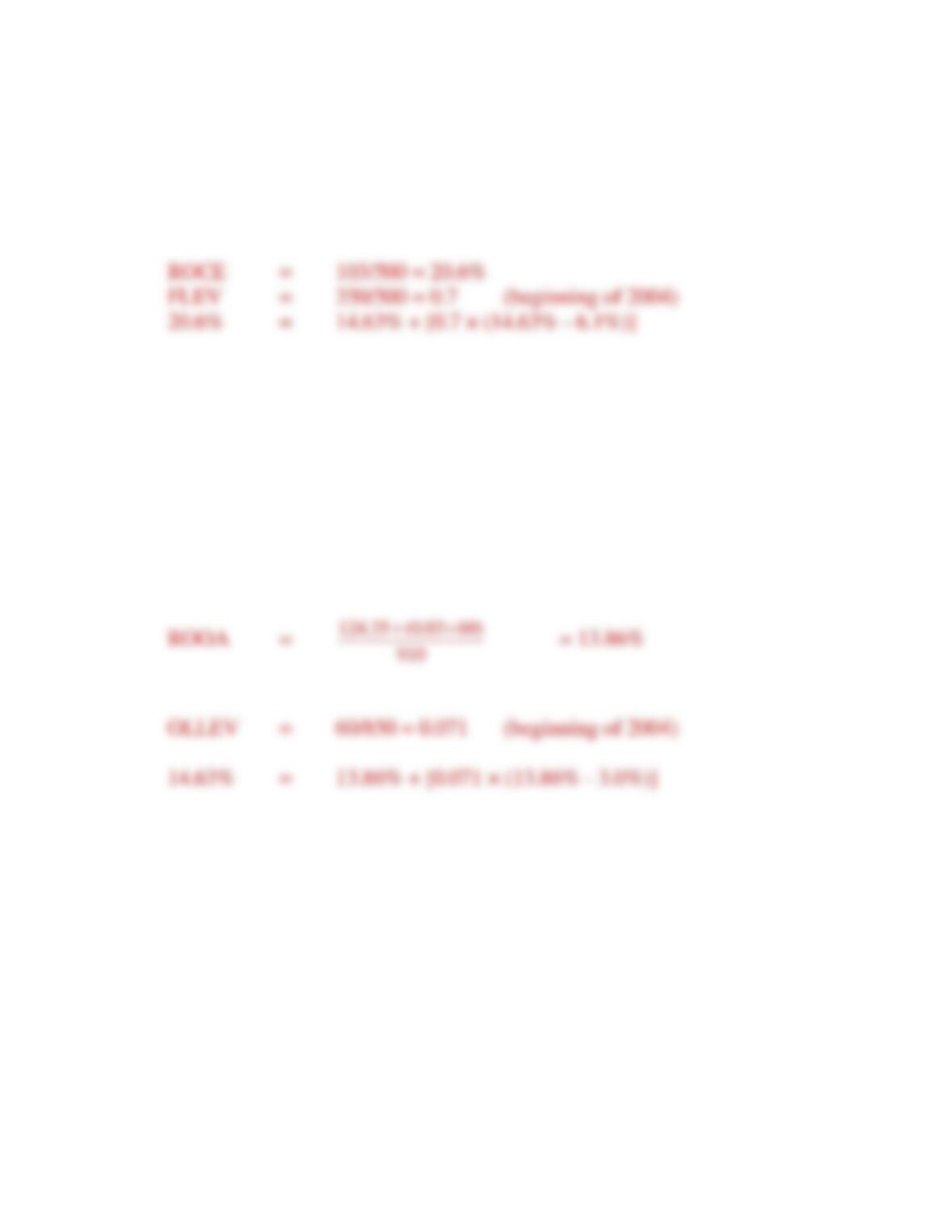
(c) Show that the following relation holds for this firm:
ROCE = RNOA + (Financial Leverage x Operating Spread)
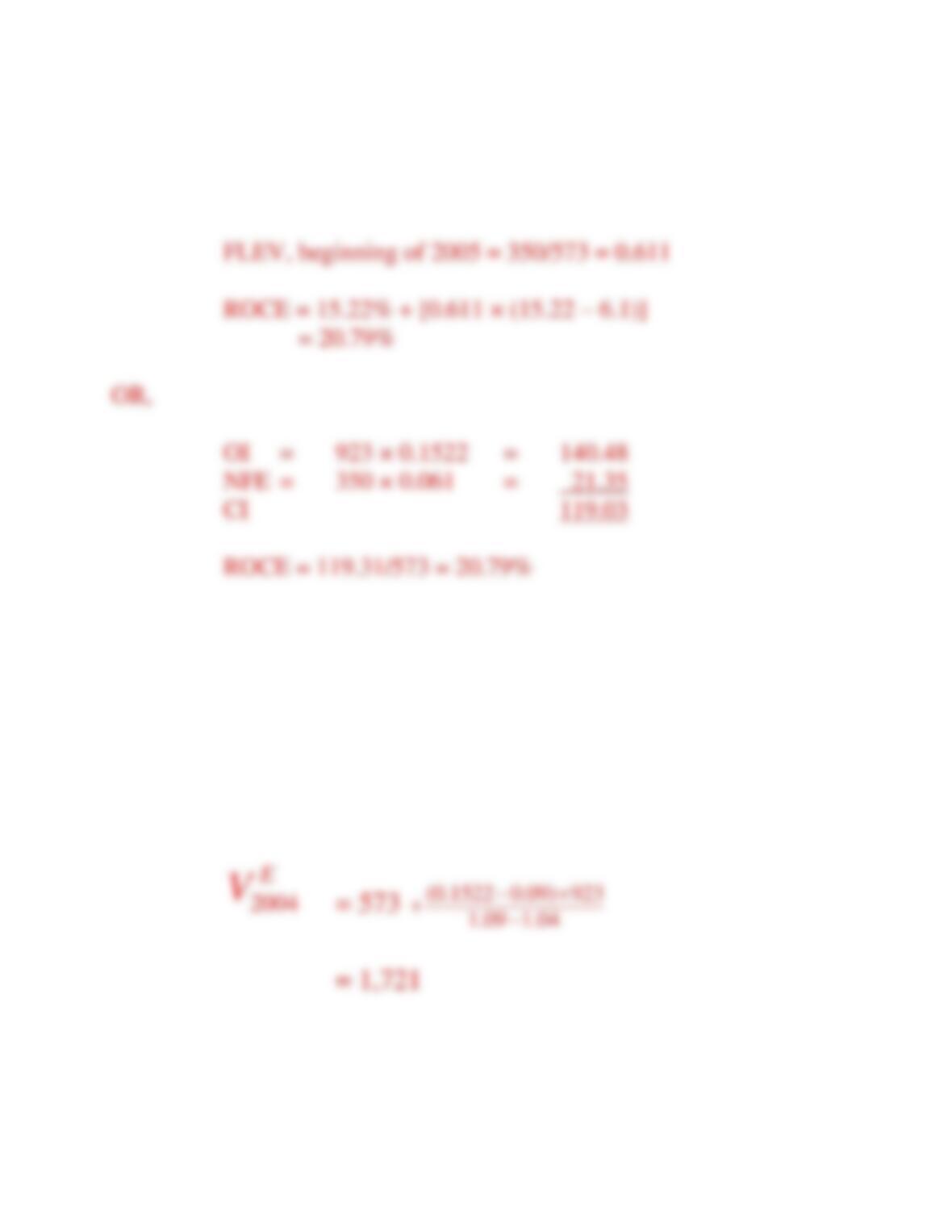
(d) Show that the following relation holds for this firm. Use 3% for the short-term
borrowing rate. ROOA is return on operating assets.
RNOA = ROOA + [Operating Liability Leverage x (ROOA – Short-term
Borrowing Rate)]
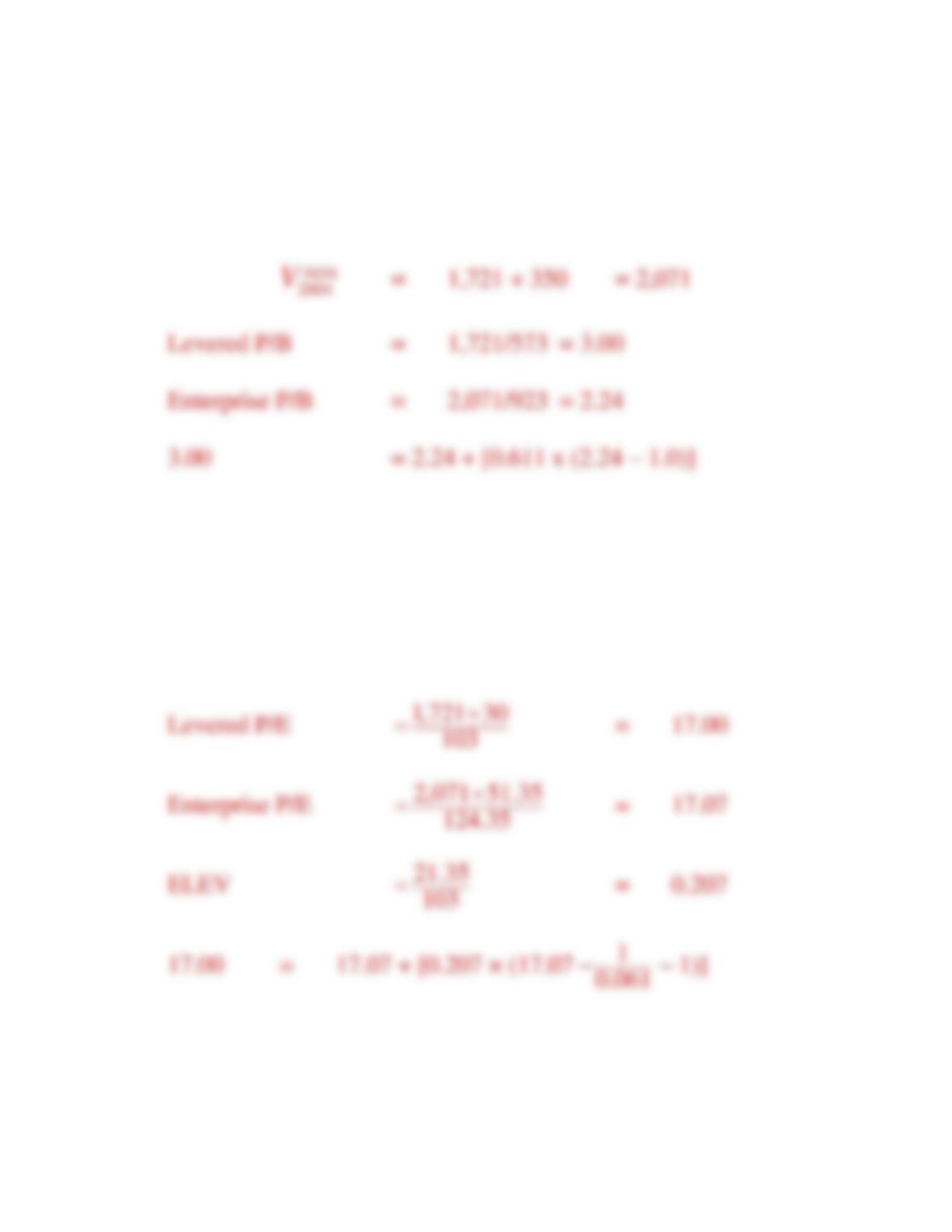
(e) Forecast ROCE for 2005 for the case where RNOA is expected to be the same
as core RNOA in 2004 and the net borrowing cost is expected to be the
same as in 2004.
(f) Value the equity under a forecast that
(i) Return on net operating assets in the future will be the same as core
RNOA in 2004.
(ii) Sales are expected to grow at 4% per year.
(iii) Asset turnovers will be the same as in 2004.
The required return for operations is 9%.
(g) Calculate the intrinsic levered price–to-book ratio and enterprise price-to-book
and show that the two are related in the following way:
Levered P/B = Enterprise P/B + [Financial Leverage × (Enterprise P/B – 1)]
(h) Calculate the intrinsic trailing levered P/E and the trailing enterprise P/E. Show
that the two are related in the following way:
Levered P/E = Enterprise P/E + [Earnings Leverage ×
(Enterprise P/E – 1/NBC – 1)]
Question 2 (8 points)
At the end of the fiscal year ending June 30, 2003, Microsoft reported
common equity of $64.9 billion on its balance sheet, with $49.0 billion invested in
financial assets (in the form of cash equivalents and short term investments) and no
financing debt. For fiscal year 2004, the firm reported $7.4 billion in
comprehensive income, of which $1.1 billion was after-tax earnings on the
financial assets.
This month Microsoft is distributing $34 billion of financial assets to
shareholders in the form of a special dividend.
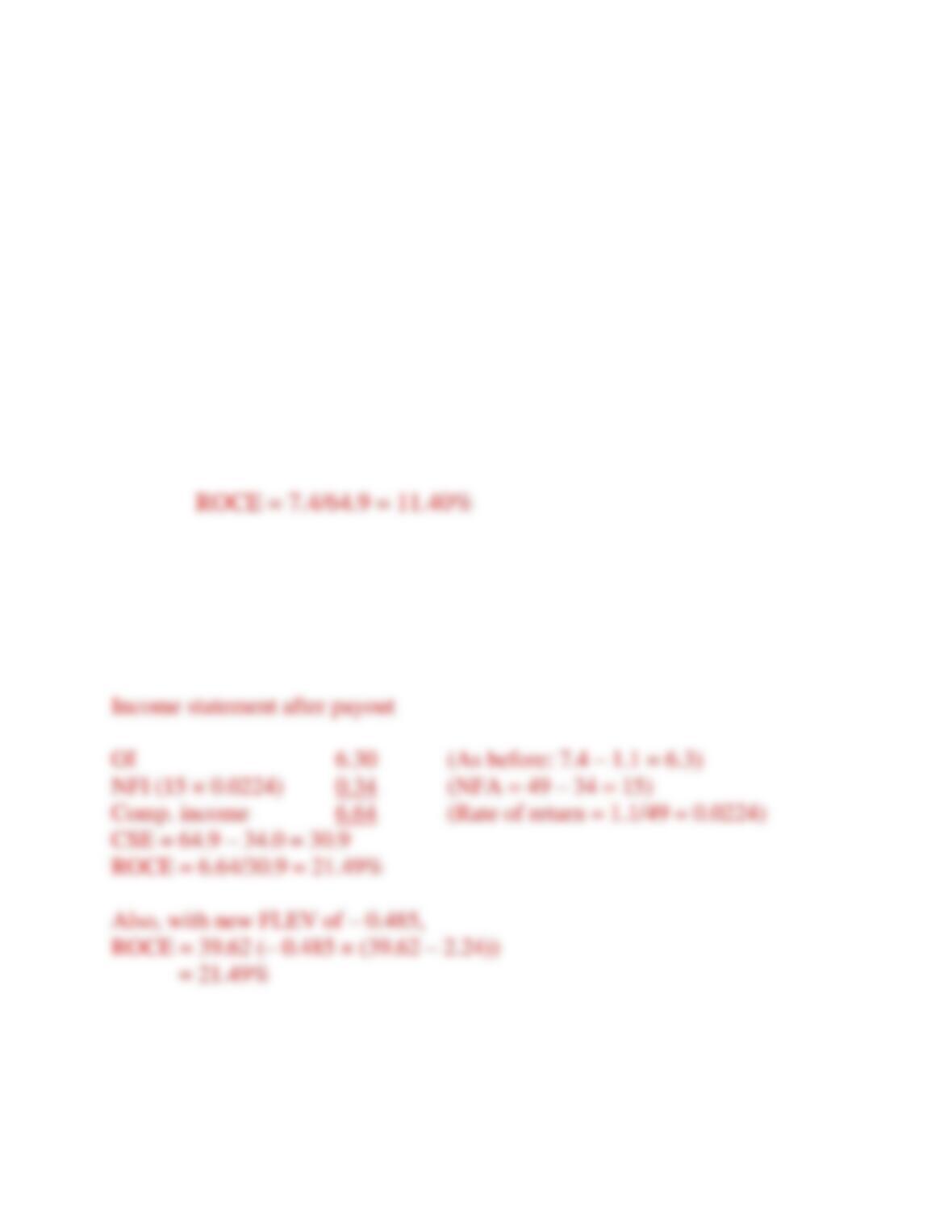
a. Calculate Microsoft’s return on common equity (ROCE) for 2004.
b. Holding all else constant what would Microsoft’s ROCE be after the
payout of $34 billion?
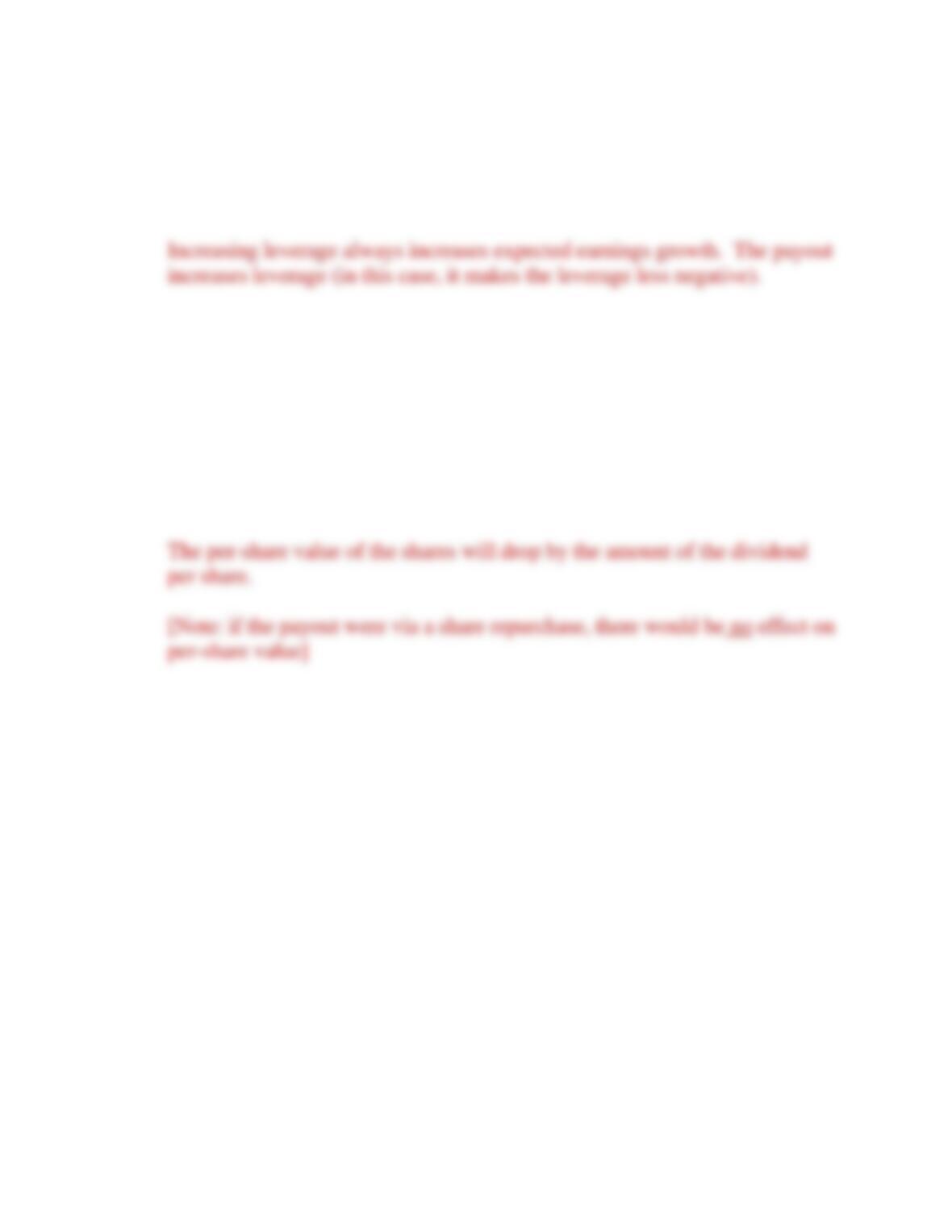
c. Would you expect the payout to increase or decrease earnings growth
in the future? Why?
d. What effect would you expect the payout to have on the value of a Microsoft
share?