
Part 4 Portfolio and Capital Market Theory
CHAPTER 9
THE CAPITAL ASSET PRICING MODEL (CAPM)
CHAPTER LEARNING OBJECTIVES
9.1 Describe how the efficient frontier is affected once the possibility of risk-free
9.2 Explain how modern portfolio theory is extended to develop the capital market
line (CML).
9.3 Explain how the capital asset pricing model’s (CAPM) security market line
(SML) is developed from the capital market line (CML), and how the SML can be
9.4 List alternative risk-based pricing models and describe how they differ from
the CAPM.
Portfolio and Capital Market Theory 9 – 2
MULTIPLE CHOICE QUESTIONS
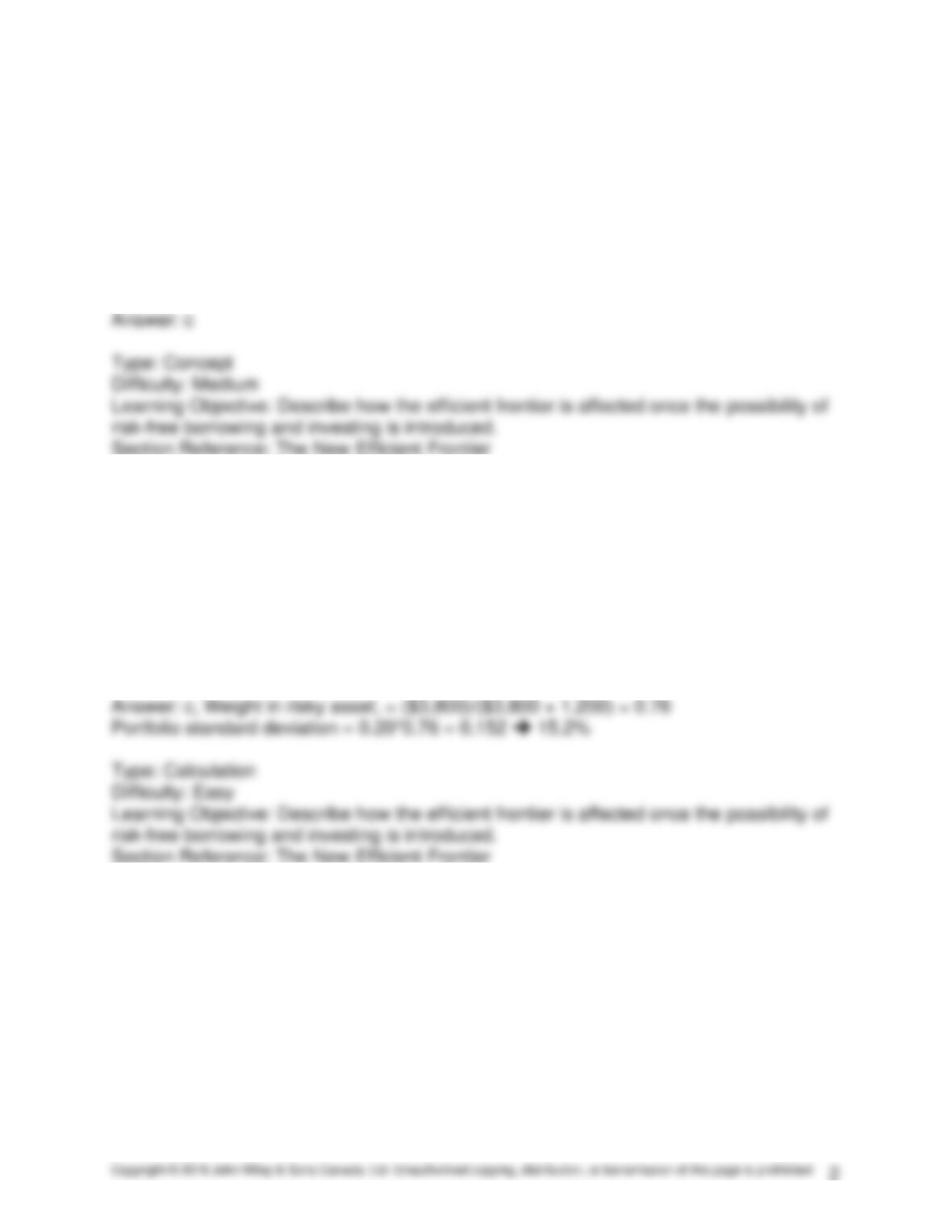
1. The market portfolio is most accurately described as:
a) The portfolio that follows market averages like the S&P/TSX or the S&P 500
b) The portfolio similar to the MSCI AC World index
c) The portfolio of all risky assets in the world weighted in their own proportions
d) The portfolio of all assets including risk-free assets
2. A portfolio has $1,200 invested in a risk-free asset with a 5 percent rate of return, and
$3,800 invested in a risky asset with a 15 percent rate of return and a 20% standard
deviation. What is the standard deviation of the portfolio?
a) 4.80%
b) 8.75%
c) 15.20%
d) 16.77%
3. Use the following statements to answer this question:
I. The risk premium is the expected payoff needed to get out of a risky situation.
II. The insurance premium is the payment needed to get into a risky situation.
III. Risk-averse investors willingly take fair gambles.
a) I, II, and III are correct.
b) I, II, and III are incorrect.
c) I, II are correct, and III is incorrect.
d) I, II are incorrect, and III is correct.
9 – 3 Test Bank for Introduction to Corporate Finance, Fourth Canadian Edition
4. Which of the following is NOT a correct statement?
a) Risk-averse investors will not willingly undertake fair gambles.
b) Risk-averse investors prefer to gamble on a risky situation where there is an equal
probability of winning or losing the same amount of money.
c) Risk-averse investors require a risk premium to bear risk; the more risk averse they
are, the higher the risk premium they require.
d) Risk-averse investors are willing to pay an insurance premium to get out of a risky
situation.
5. Which one of the following is NOT true?
a) Insurance premiums change with the level of risk aversion of the investor.
b) Risk premiums change with the level of risk aversion of the investor.
c) All investors are sitting at the same point on the efficient frontier.
d) T-bills represent the lowest level of return that an investor expects to get.
6. Which of the following is a TRUE statement?
Portfolio and Capital Market Theory 9 – 4
a) The tangent portfolio is the risky portfolio on the efficient frontier whose tangent line
cuts the horizontal axis at the risk-free rate.
b) The new (or super) efficient frontier represents the portfolios composed of the risk–
free rate and the tangent portfolio that offers the highest expected rate of return for any
given level or risk.
c) The separation theorem states that the investment decision, (how to construct the
portfolio of risky assets), is not separate from the financing decision, (how much should
be invested or borrowed in the risk-free asset).
d) The market portfolio is a portfolio that contains some risky securities in the market.
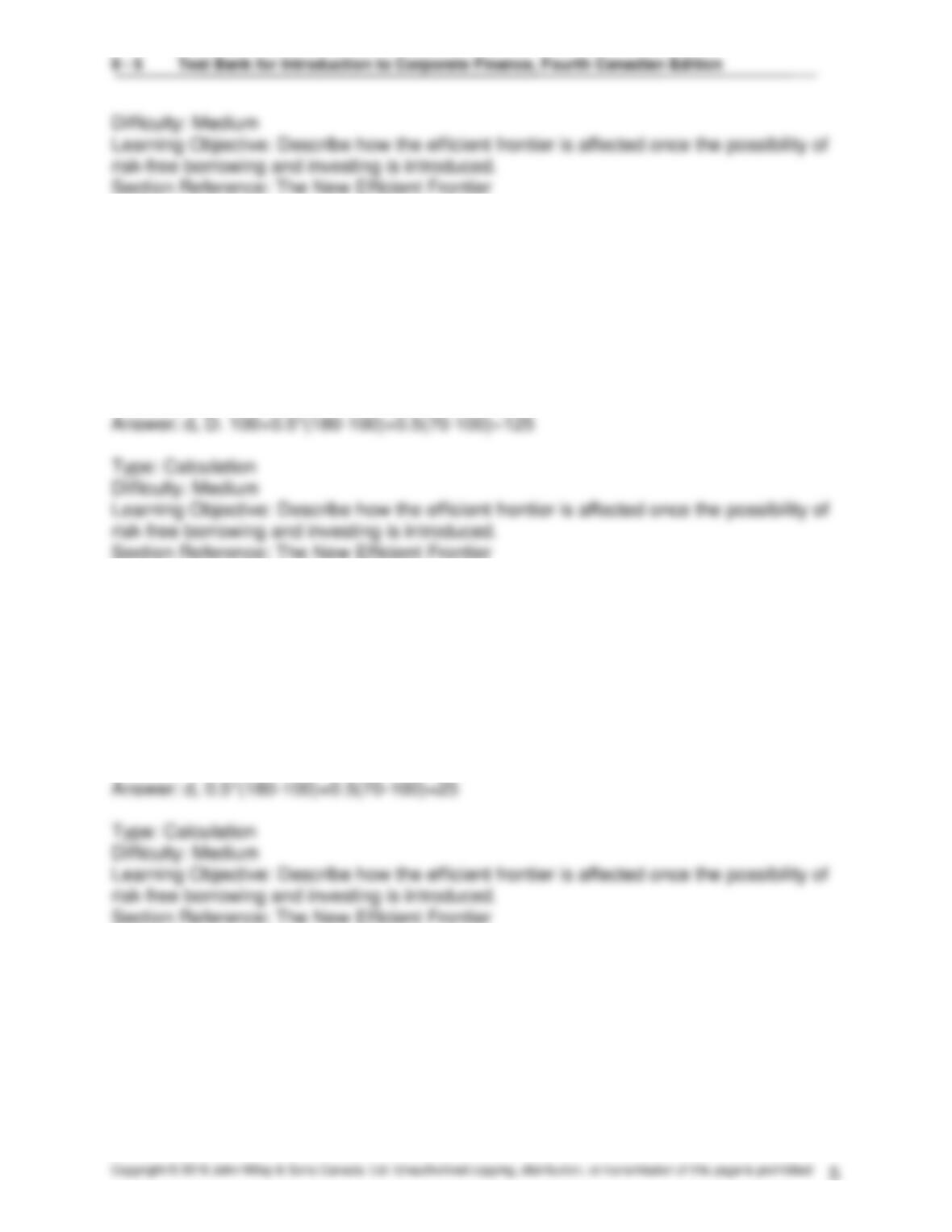
7. Which of the following investments would a risk-averse investor prefer if the risk-free
rate is zero?
Value of Investment if:
Investment Cost
Today Market Return > 0%
Probability: 40% Market Return < 0%
Probability: 60%
I $20 $20 $20
II $15 $30 $0
III $0 –$10 $10
a) I only
b) II only
c) III only
d) I and III only
8. What is the expected value from an investment that is equally likely to move from
$100 to $180 or $100 to $70?
a) $ 140
b) $ 115
c) $ 85
d) $ 125
9. What is the expected payoff from an investment that is equally likely to move from
$100 to $180 or $100 to $70?
a) 40
b) 15
c) –15
d) 25
10. A risk-averse investor has an opportunity to invest in the following securities:
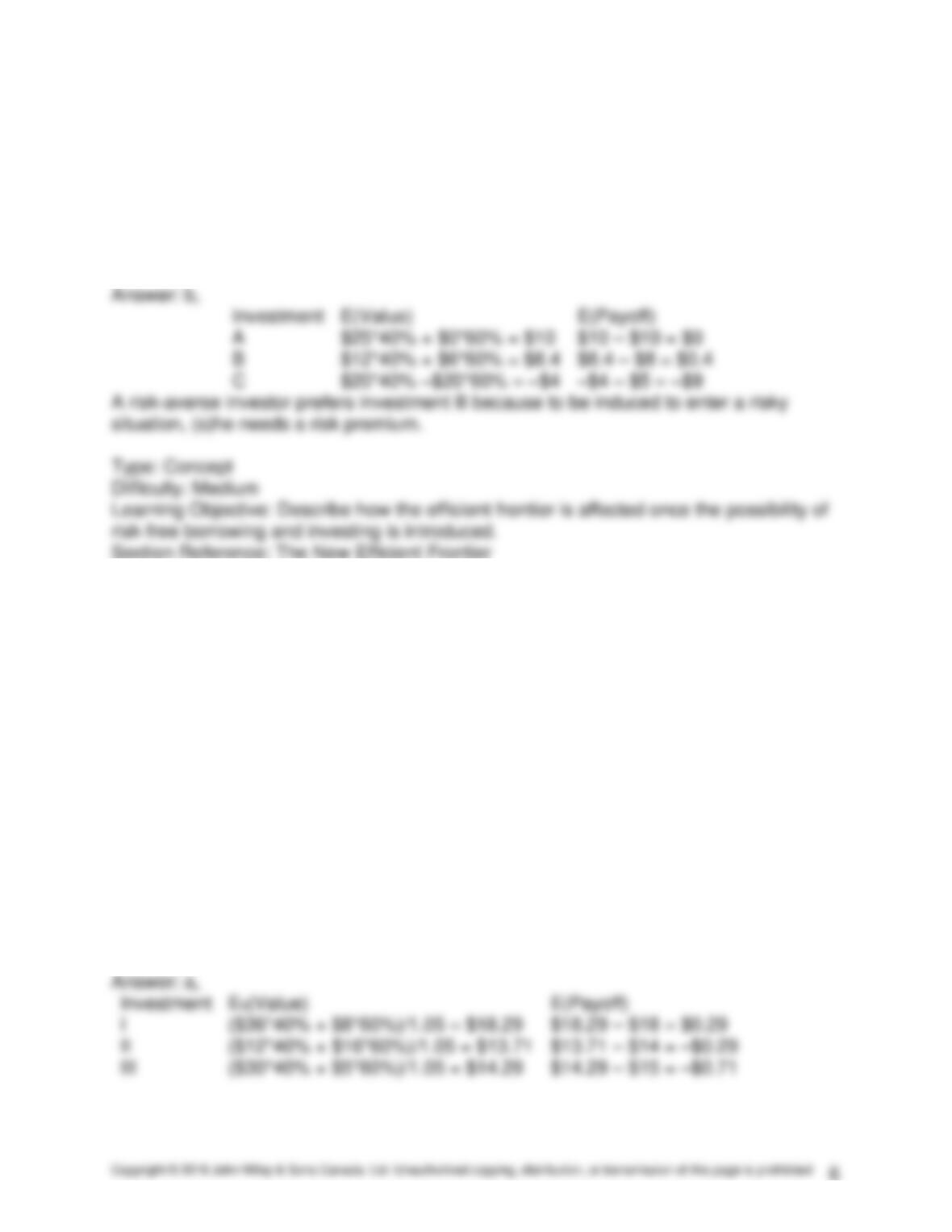
Security A costs $10 today and will have a value of $25 if the market goes up and $0 if
the market goes down; Security B costs $8 today and will have a value of $12 if the
market goes up and $6 if the market goes down; and Security C costs $5 today and will
have a value of $20 if the market goes up and –$20 if the market goes down. If there is
Portfolio and Capital Market Theory 9 – 6
a 40 percent chance that the market will go up and the risk-free rate is zero, which
security(ies) will the investor prefer?
a) A only
b) B only
c) C only
d) A and B only
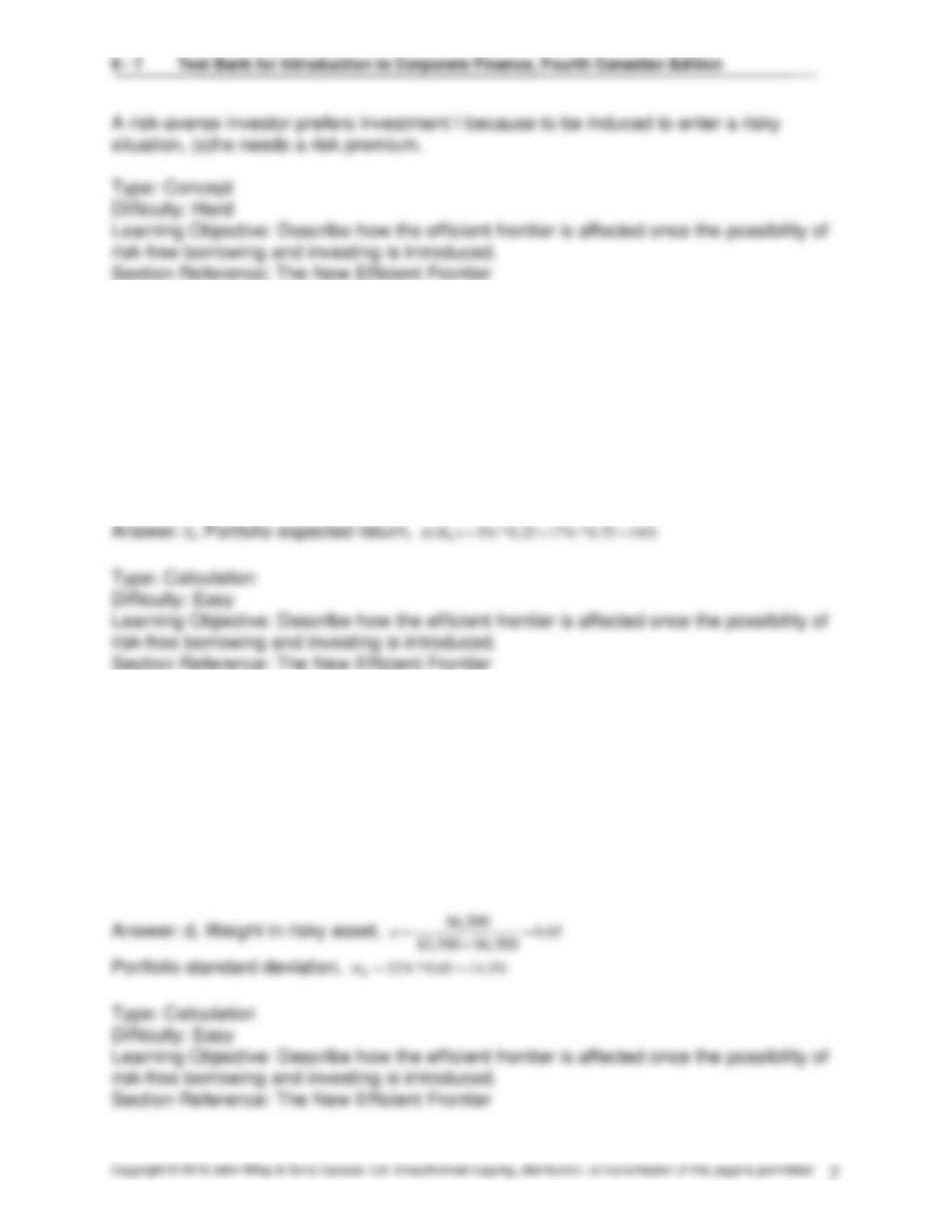
11. Given the following information, which investment(s) would risk-averse investors
prefer if the risk-free rate is 5 percent?
Value of Investment after one year if:
Investment Cost
Today Market Return > 0%
Probability: 40% Market Return < 0%
Probability: 60%
I $18 $36 $8
II $14 $12 $16
III $15 $30 $5
a) I only
b) II only
c) III only
d) I and II only
12. What is the expected return for a portfolio that has $2,500 invested in a risk-free
asset with a 5 percent rate of return, and $7,500 invested in a risky asset with a 17
percent rate of return and a 28 percent standard deviation?
a) 8.00%
b) 10.75%
c) 14.00%
d) 22.25%
13. What is the standard deviation for a portfolio that has $3,500 invested in a risk-free
asset with 5 percent rate of return, and $6,500 invested in a risky asset with a 15
percent rate of return and a 22 percent standard deviation?
a) 7.70%
b) 9.75%
c) 5.25%
d) 14.30%
14. What are the expected return and standard deviation for a portfolio that has $2,000
invested in a risk-free asset with 5.25 percent rate of return, and $8,000 invested in a
risky asset with a 21 percent rate of return and a 35 percent standard deviation?
a) Expected return = 17.85%; standard deviation = 28.00%
b) Expected return = 28.00%; standard deviation = 17.85%
c) Expected return = 7.00%; standard deviation = 8.40%
d) Expected return = 8.40%; standard deviation = 7.00%
15. A portfolio consists of two securities: a 90-day T-bill and the S&P/TSX Composite.
The expected return on the T-bill is 4.5 percent. The expected return on the S&P/TSX
Composite is 12 percent with a standard deviation of 20 percent. What is the portfolio
standard deviation if the expected return for this portfolio is 15 percent?
a) 8.13%
b) 12.00%
c) 16.80%
d) 28.00%
16. A portfolio consists of two securities: a 90-day T-bill and the S&P/TSX Composite.
The expected return on the T-bill is 4.5 percent. The expected return of the S&P/TSX
9 – 9 Test Bank for Introduction to Corporate Finance, Fourth Canadian Edition
Composite is 18 percent with a standard deviation of 30 percent. What is the portfolio
expected return if the standard deviation for this portfolio is 50 percent?
a) 12.60%
b) 27.00%
c) 30.00%
d) 47.00%
17. Which one of the following is NOT true?
a) The separation theorem states that the borrowing decision and investment decision
are separate.
b) Investors should look at investments in terms of their prospective return, not their
cost
c) The separation theorem states that you cannot separate your risk-free and stock
investments.
d) The market portfolio is the tangent line that goes through the risk-free rate.
18. A portfolio consists of two securities: a risk-free asset and an equity security. The
expected return on the risk-free asset is 4.25 percent. The expected return of the equity
security is 16 percent with a standard deviation of 22 percent. What is the portfolio
standard deviation if the expected return for the portfolio is 12 percent?
a) 6.99%
b) 7.49%
Portfolio and Capital Market Theory 9 – 10
c) 10.55%
d) 14.51%
19. Theoretically, what is meant by the market portfolio?
a) The market index portfolio similar to the S&P 500 or S&P/TSX Composite
b) The world index portfolio similar to the MSCI AC World index
c) All risky assets in the world with their own proportions
d) All assets including risk-free assets
20. A portfolio consists of two securities: a risk-free asset and an equity security. The
expected return on the risk-free asset is 4.75 percent. The expected return of the equity
security is 17 percent with a standard deviation of 23 percent. What is the portfolio
expected return if the standard deviation for the portfolio is 18 percent?
a) 7.41%
b) 14.34%
c) 18.00%
d) 20.40%
9 – 11 Test Bank for Introduction to Corporate Finance, Fourth Canadian Edition
21. The CAPM Model makes all the assumptions below EXCEPT:
a) Assuming no transactional costs.
b) Assuming no personal income taxes.
c) Assuming all investors have different expectations about expected returns, and
standard deviations for all traded securities.
d) Assuming all investors can borrow/lend at the risk-free rate.
22. An efficient portfolio has a 18% expected return. If the expected market return is
11% (with a standard deviation of 18%), and the risk-free rate is 5.5 %, what is the
standard deviation of the portfolio?
a) 9.33%
b) 11.12%
c) 19.37%
d) 40.91%
23. The CML relates:
Portfolio and Capital Market Theory 9 – 12
a) expected return to beta.
b) the risk-free rate to the market portfolio’s rate of return.
c) risk to beta.
d) expected return to standard deviation.
24. Which of the following is a NOT an assumption of the CAPM?
a) All investors have different expectations about expected returns, standard deviations,
and correlation coefficients for all securities.
b) All investors can borrow or lend money at the risk-free rate of return.
c) There are no transaction costs.
d) There are no personal income taxes so that investors are indifferent between capital
gains and dividends.
25. By combining the risk-free asset and the efficient frontier, the _____________ will
be created.
a) capital market line
b) efficient frontier
c) security market line
d) attainable set
26. What does the capital market line represent?
a) The highest attainable expected return for any given risk level that includes only
efficient portfolios.
b) The frontier of efficient portfolios of risky assets.
c) The best return portfolio.
d) The lowest variance portfolios.
27. Which of the following is NOT an implication resulting from the assumption that
capital markets are in equilibrium?
a) All assets are assumed to be bought and sold at the equilibrium price established by
supply and demand.
b) All assets are not correctly priced to adequately compensate investors for the
associated risks.
c) The price for an overpriced asset would eventually fall to an equilibrium level so that
the asset is held by all investors.
d) The market portfolio will be the most efficient portfolio, with respect to the weights
attached to the individual securities composing it.
28. Which of the following is a FALSE statement of the market price of risk?
a) It is the incremental risk divided by the incremental expected return.
b) It is the slope of the capital market line.
c) It is the equilibrium price of risk in the capital market.
Portfolio and Capital Market Theory 9 – 14
d) It indicates the additional expected return that the market demands for an increase in
a portfolio’s risk.
29. Use the following three statements to answer this question:
I. The CML must always be upward sloping, and it predicts required returns.
II. The CML is based on expected rates of return, so it is ex post.
III. The CML slope is the Sharpe ratio.
a) I, II, and III are correct.
b) I, II, and III are incorrect.
c) I and III are correct and II is incorrect.
d) I is incorrect, II and III are correct.
30. Which of the following is a FALSE statement about the Sharpe ratio?
a) It is used to assess the performance of portfolios.
b) It describes how well an asset’s return compensates investors for the risk taken.
c) It is the slope of the CML when the portfolio is not the market portfolio.
d) It is a “risk-adjusted” measure of portfolio performance.
31. The risk-free rate is 5.25 percent. The expected return on the market is 12 percent
with a standard deviation of 18 percent. What is the standard deviation of an efficient
portfolio with a 16 percent expected return?
a) 7.33%
b) 10.12%
c) 19.11%
d) 28.67%
32. The expected return on the market is 12.5 percent with a standard deviation of 25
percent. The risk-free rate is 5.5 percent. What is the expected return on an efficient
portfolio with a standard deviation of 30 percent?
a) 4.10%
b) 11.33%
c) 13.90%
d) 28.90%
33. The expected return of a portfolio on the CML is 14 percent with a standard
deviation of 25 percent. The risk-free rate is 6 percent. What is the expected return on
an efficient portfolio with a standard deviation of 30 percent?
Portfolio and Capital Market Theory 9 – 16
a) 9.6%
b) 15.6%
c) 22.8%
d) 16.8%
34. The expected return of the market portfolio is 14 percent with a standard deviation
of 25 percent. The risk-free rate is 6 percent. What is the weight of the market portfolio
in an efficient portfolio with a standard deviation of 30 percent?
a) 120%
b) 83.33%
c) 20%
d) 16.78%
35. The expected return of the market portfolio is 14 percent with a standard deviation
of 25 percent. The risk-free rate is 6 percent. What would be the weight of the market
portfolio in an efficient portfolio with a standard deviation of 30 percent, if borrowing is
not allowed?
a) 16.78%
b) 83.33%
c) 20%
d) Cannot be constructed
36. What is the standard deviation of an efficient portfolio with an 8 percent expected
return? Assume the risk-free rate is 3.75 percent and the expected return on the market
portfolio is 10 percent with a standard deviation of 20 percent.
a) 2.62%
b) 6.40%
c) 6.80%
d) 13.60%
37. What is the expected return on an efficient portfolio with a standard deviation of 15
percent? Assume the risk-free rate is 6 percent and the expected return on the market
portfolio is 14.8 percent with a standard deviation of 20 percent.
a) 8.20%
b) 12.60%
c) 16.50%
d) 17.73%
38. If the market portfolio’s return is 15 percent and its standard deviation is 20%, which
one of the following is NOT efficient, if the risk-free rate is 5%?
a) 𝐸(𝑟)=11.25% 𝜎 = 12.5%
b) 𝐸(𝑟)=20% 𝜎 = 30%
c) 𝐸(𝑟)=13% 𝜎 = 17%
d) 𝐸(𝑟)=12% 𝜎 = 14%
39. If the market portfolio’s return is 15 percent and its standard deviation is 20%, which
one of the following efficient portfolios requires borrowing, if the risk-free rate is 5%?
a) 𝐸(𝑟)=11.25% 𝜎 = 12.5%
b) 𝐸(𝑟)=20% 𝜎 = 30%
c) 𝐸(𝑟)=11.5% 𝜎 = 13%
d) 𝐸(𝑟)=12% 𝜎 = 14%
40. Greg has $10,000 to invest in a risk-free asset and the market portfolio. The risk–
free rate is 4.8 percent. The market portfolio has an expected return of 13.6 percent
with a standard deviation of 15 percent. What are the expected return and standard
deviation for a portfolio with 30 percent of the funds invested in the risk-free asset?
9 – 19 Test Bank for Introduction to Corporate Finance, Fourth Canadian Edition
a) Expected return = 10.50%; standard deviation = 10.96%
b) Expected return = 10.96%; standard deviation = 10.50%
c) Expected return = 4.50%; standard deviation = 7.44%
d) Expected return = 7.44%; standard deviation = 4.50%
41. The expected return on the market is 12 percent with a standard deviation of 20
percent. The risk-free rate is 4.5 percent. What is the Sharpe ratio of a portfolio with an
expected return of 10.5 percent and a standard deviation of 12 percent?
a) 0.38
b) 0.50
c) 0.70
d) 0.88
42. The expected return on the market is 12 percent with a standard deviation of 15
percent and the risk-free rate is 5 percent. What is the required return on an efficient
portfolio that has a standard deviation of 18 percent?
a) 10.83%
b) 12.67%
c) 13.40%
d) 14.40%
43. Min has $5,000 to invest. The expected return on the market portfolio is 11 percent
with a standard deviation of 15 percent. What are the expected return and standard
deviation for the portfolio if she borrowed $2,000 at the risk-free rate of 4 percent to
invest in the market portfolio?
a) Expected return = 19.40%; standard deviation = 15.40%
b) Expected return = 15.40%; standard deviation = 19.40%
c) Expected return = 13.80%; standard deviation = 21.00%
d) Expected return = 21.00%; standard deviation = 13.80%
44. Suppose you have $5,000 to invest in a risk-free asset and the market portfolio.
The expected return on the market portfolio is 13.5 percent with a standard deviation of
18 percent. The risk-free rate is 4.25 percent. How much of your funds should be in the
risk-free asset if the portfolio has an expected return of 10 percent?
a) $1,892
b) $2,091
c) $2,909
d) $3,108