9 – 21 Test Bank for Introduction to Corporate Finance, Fourth Canadian Edition
45. Suppose you have $2,000 to invest. The market portfolio has an expected return of
10.5 percent and a standard deviation of 16 percent. The risk-free rate is 3.75 percent.
How much should you invest in the risk-free asset if you wish to have a 15 percent
return on the portfolio?
a) $667
b) –$667
c) $1,333
d) –$1,333
46. Marie has $10,000 to invest. She decided to borrow some funds at the risk-free rate
of 6 percent to increase her investment in a portfolio with an expected return of 25
percent and a standard deviation of 30 percent. What is the expected return and
standard deviation for her portfolio if she borrowed 50 percent of the portfolio value?
a) Expected return = 34.50%; standard deviation = 45.00%
b) Expected return = 45.00%; standard deviation = 34.50%
c) Expected return = 44.00%; standard deviation = 60.00%
d) Expected return = 60.00%; standard deviation = 44.00%
47. The expected return on the market portfolio is 13 percent with a standard deviation
of 16 percent. What are the expected return and standard deviation for a portfolio with
40 percent of the investment in the market portfolio borrowed at the risk-free rate of 5
percent?
a) Expected return = 26.67%; expected return = 18.33%
b) Expected return = 18.33%; standard deviation = 26.67%
c) Expected return = 22.40%; standard deviation = 16.20%
d) Expected return = 16.20%; standard deviation = 22.40%
48. The expected return of Security A is 12 percent with a standard deviation of 15
percent. The expected return of Security B is 9 percent with a standard deviation of 10
percent. Securities A and B have a correlation of 0.4. The market return is 11 percent
with a standard deviation of 13 percent and the risk-free rate is 4 percent. What is the
Sharpe ratio of a portfolio if 35 percent of the portfolio is in Security A and the remainder
in Security B?
a) 0.54
b) 0.61
c) 0.86
d) 1.02
49. The expected return of Security A is 12 percent with a standard deviation of 15
percent. The expected return of Security B is 9 percent with a standard deviation of 10
percent. Securities A and B have a correlation of 0.4. The market return is 11 percent
with a standard deviation of 13 percent and the risk-free rate is 4 percent. Which one of
the following is not an efficient portfolio, as determined by the lowest Sharpe ratio?
a) 100% invested in A is efficient
b) 100% invested in B is efficient
c) 41% in A and 59% B is efficient
d) 59% in A and 41% B is efficient
50. The expected returns for Securities ABC and XYZ are 8 percent and 13 percent,
respectively. The standard deviation is 12 percent for ABC and 18 percent for XYZ.
There is no relationship between the returns on the two securities. The market return is
12.5 percent with a standard deviation of 16 percent. The risk-free rate is 5 percent.
What is the Sharpe ratio of a portfolio with 40 percent of the funds in ABC and 60
percent in XYZ?
a) 0.47
b) 0.51
c) 0.75
d) 0.93
51. The expected returns for Securities ABC and XYZ are 8 percent and 13 percent,
respectively. The standard deviation is 12 percent for ABC and 18 percent for XYZ.
There is no relationship between the returns on the two securities. The market return is
12.5 percent with a standard deviation of 16 percent. The risk-free rate is 5 percent.
Which of the following is not an efficient portfolio as determined by the lowest Sharpe
ratio?
a) 100% invested in ABC is efficient
b) 100% invested in XYZ is efficient
c) 52% in ABC and 48% XYZ is efficient
d) 48% in ABC and 52% XYZ is efficient
52. The expected return on the market is 11.5 percent with a standard deviation of 13
percent and the risk-free rate is 4 percent. Which of the following portfolios are
undervalued?
Portfolio Expected Return Standard Deviation
1 9% 7%
2 10% 15%
3 15% 20%
4 18% 24%
a) 1 and 2 only
b) 1 and 4 only
c) 2 and 3 only
d) 3 and 4 only
53. The expected return on the market is 15 percent with a standard deviation of 12.5
percent and the risk-free rate is 5 percent. Which of the following portfolios are correctly
priced?
Portfolio Expected Return Standard Deviation
1 30.00% 28.75%
2 25.00% 25.00%
3 10.00% 6.25%
4 9.00% 5.50%
a) 1 and 3 only
b) 1 and 4 only
c) 2 and 3 only
d) 3 and 4 only
54. The expected return on the market is 12 percent with a standard deviation of 15
percent and the risk-free rate is 4.5 percent. Which of the following portfolios are
overvalued?
Portfolio Expected Return Standard Deviation
1 19% 20%
2 18% 19%
3 10% 13%
4 9% 12%
a) 1 and 2 only
b) 1 and 4 only
c) 2 and 3 only
d) 3 and 4 only
55. The ____________ measures the sensitivity of the portfolio to changes in the
overall market.
a) risk-free rate
b) beta
c) risk
d) market premium
56. Which of the following describes how the portfolio changes relative to changes in
the overall market?
a) market risk premium
b) beta
c) risk-free rate
d) systematic risk
57. Under the CAPM, an investor should be compensated for bearing:
a) total risk
b) diversifiable risk
c) systematic risk
d) unsystematic risk
58. Beta is a measure of:
a) Total risk.
Portfolio and Capital Market Theory 9 – 28
b) Diversifiable risk.
c) Systematic risk.
d) Unsystematic risk.
59. Assume that the CAPM holds. If a security has a beta of 1, its expected return is:
a) the risk-free rate
b) 1 percent
c) the return on the market portfolio
d) cannot be determined with the above information
60. Use the following three statements to answer this question:
I. The capital market line (CML) depicts the highest attainable expected return for any
given risk level that includes only efficient portfolios.
II. The security market line (SML) depicts the required rate of return for any given risk
level that includes only individual securities.
III. The Security Market Line (SML) measures the price of systematic risk.
a) I, II and III are correct.
b) I, II and III are incorrect.
c) I and III are correct, II is incorrect.
d) I is incorrect, II and III are correct.
61. Use the following three statements to answer this question:
I. The CAPM points out that rational investors should be compensated for unique risk.
II. The CAPM implies that non-systematic risk is the appropriate measure of risk to
determine the risk premium required by investors for holding a risky security.
III. The expected return from non-systematic risk is zero.
a) I, II and III are correct.
b) I and II are incorrect, III is correct.
c) I, II are correct, III is incorrect.
d) I, III are incorrect, II is correct.
62. Use the following three statements to answer this question:
I. A security with a beta of zero implies that all of the variability in this security’s return is
diversifiable by any investor holding a well-diversified portfolio.
II. A security with a beta of 1 implies that if the market increased (or decreased) by 1
percent, the return on the security would increase (decrease) by more than 1 percent on
average.
III. A security that has a beta cannot be priced.
a) I, II and III are correct.
b) I, II and III are incorrect.
c) I is correct, II and III are incorrect.
d) I, II are incorrect, III is correct.
63. Which of the following is NOT a correct statement of beta?
a) It is a measure of market risk.
b) It measures the risk of an individual stock or portfolio relative to the market portfolio.
c) It is the slope of the capital market line.
d) It changes through time as the risk of the underlying security or portfolio changes.
64. Which of the following is a FALSE statement about the security market line (SML)?
a) It is upward sloping, which indicates that investors require a higher expected return
on riskier securities.
b) It represents the trade off between total risk and the required rate of return for any
risky security.
c) It indicates that the size of the risk premium varies directly with a security’s market
risk, as measured by beta.
d) It implies that securities with betas less than the market beta of 1.0 are less risky than
the “average” stock and will therefore have lower required rates of return.
65. Use the following two statements to answer this question:
I. In equilibrium, the expected return on all properly priced securities will lie on the SML.
9 – 31 Test Bank for Introduction to Corporate Finance, Fourth Canadian Edition
II. Securities that are undervalued will lie below the SML.
a) I and II are correct.
b) I and II are incorrect.
c) I is correct, II is incorrect.
d) I is incorrect, II is correct.
66. Assuming the CAPM is valid, _____________ securities lie _____________the
security market line.
a) undervalued, below
b) overvalued, on
c) undervalued, on
d) overvalued, below
67. _____________ is a measure of the risk of a security that cannot be avoided
through diversification.
a) Variance
b) Standard deviation
c) Total risk
d) Beta
68. The beta of a portfolio can be calculated as:
a) A sum of the betas of the stocks in the portfolio.
b) The weighted sum of the betas in the portfolio.
c) The average of the betas in the portfolios.
d) The weighted sum of the betas plus the correlation between betas.
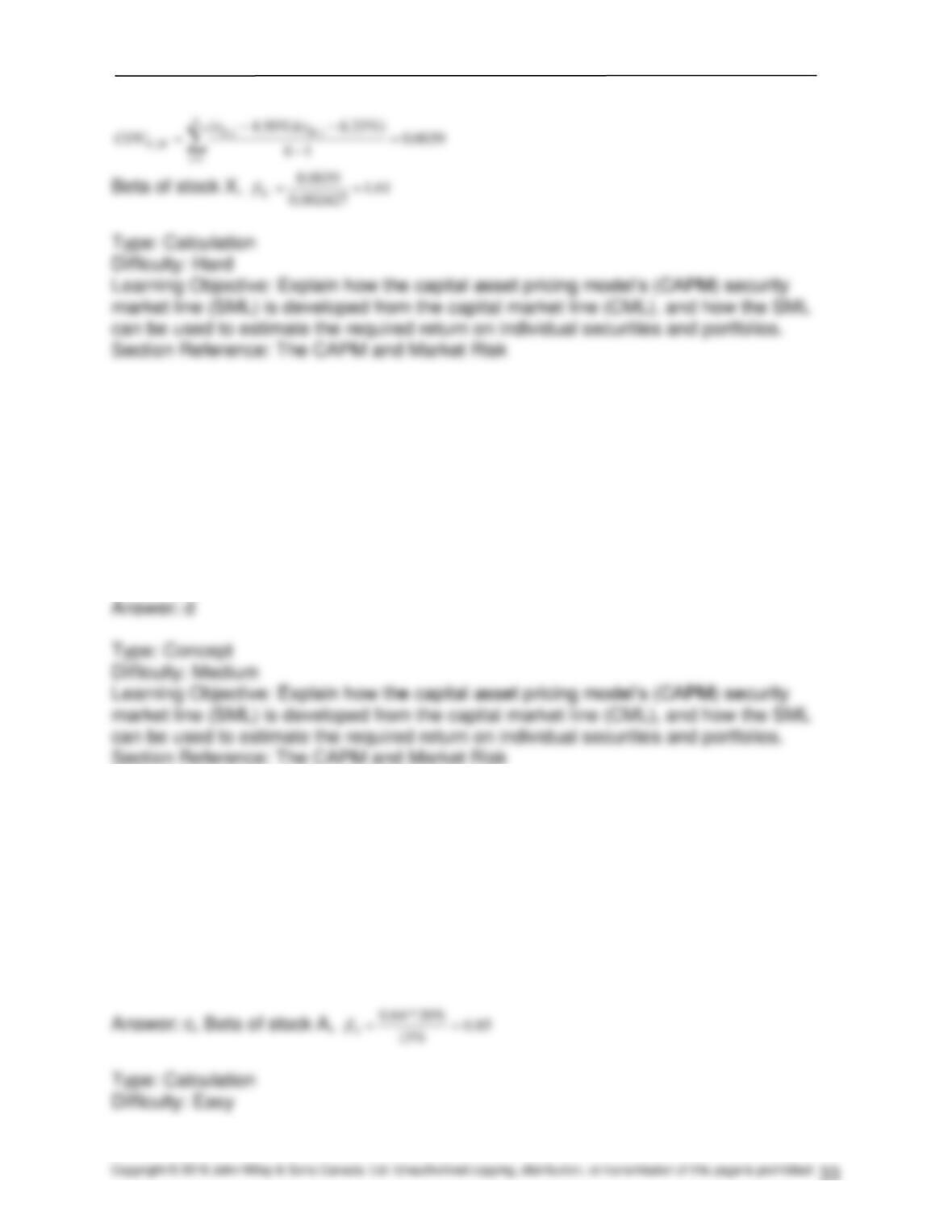
69. Given the following information, what is the beta of Stock X?
Month Stock X Return S&P/TSX Return
January 10% 8%
February 8% 12%
March –5% 5%
April –10% –2%
May 9% 5%
June 15% 10%
a) 0.08
b) 0.41
c) 0.62
d) 1.61
9 – 33 Test Bank for Introduction to Corporate Finance, Fourth Canadian Edition
70. Use the following two statements to answer this question:
I. The characteristic line is a statistical approximation of the SML.
II. The SML ignores the non-systematic risk of a security.
a) I and II are correct
b) I is correct, II is incorrect
c) I and II are incorrect
d) I is incorrect and II is correct
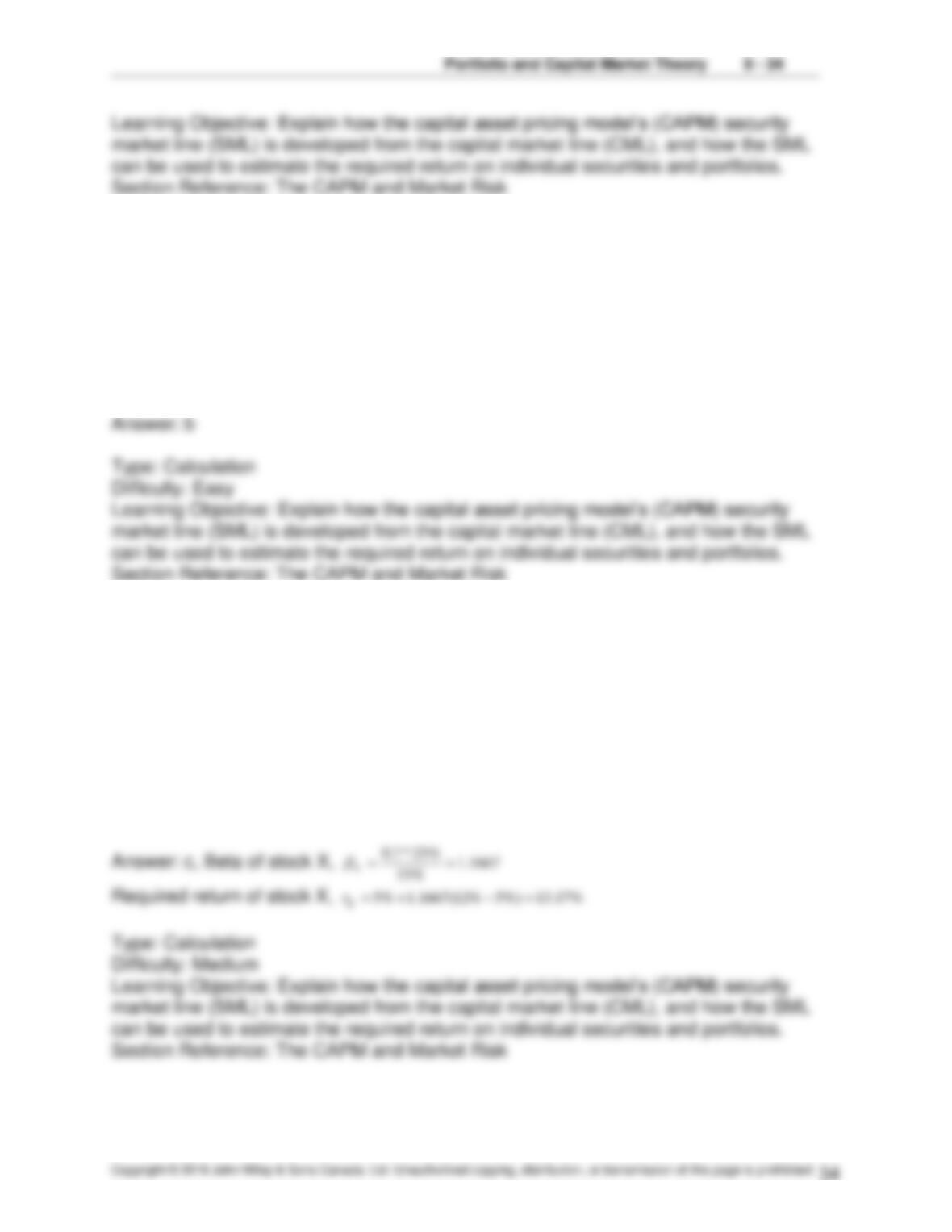
71. Stock A has a standard deviation of 20 percent and a correlation coefficient of 0.64
with market returns. The expected return of the market is 12 percent with a standard
deviation of 15 percent. The risk-free rate is 5 percent. What is the beta of Stock A?
a) 0.48
b) 0.75
c) 0.85
d) 1.33
72. What is the difference between the security market line (SML) and the capital
market line (CML)?
a) SML prices total risk where CML prices non-systematic risk
b) SML prices systematic risk where CML prices total risk
c) SML prices total risk where CML prices systematic risk
d) SML prices systematic risk where CML prices non-systematic risk
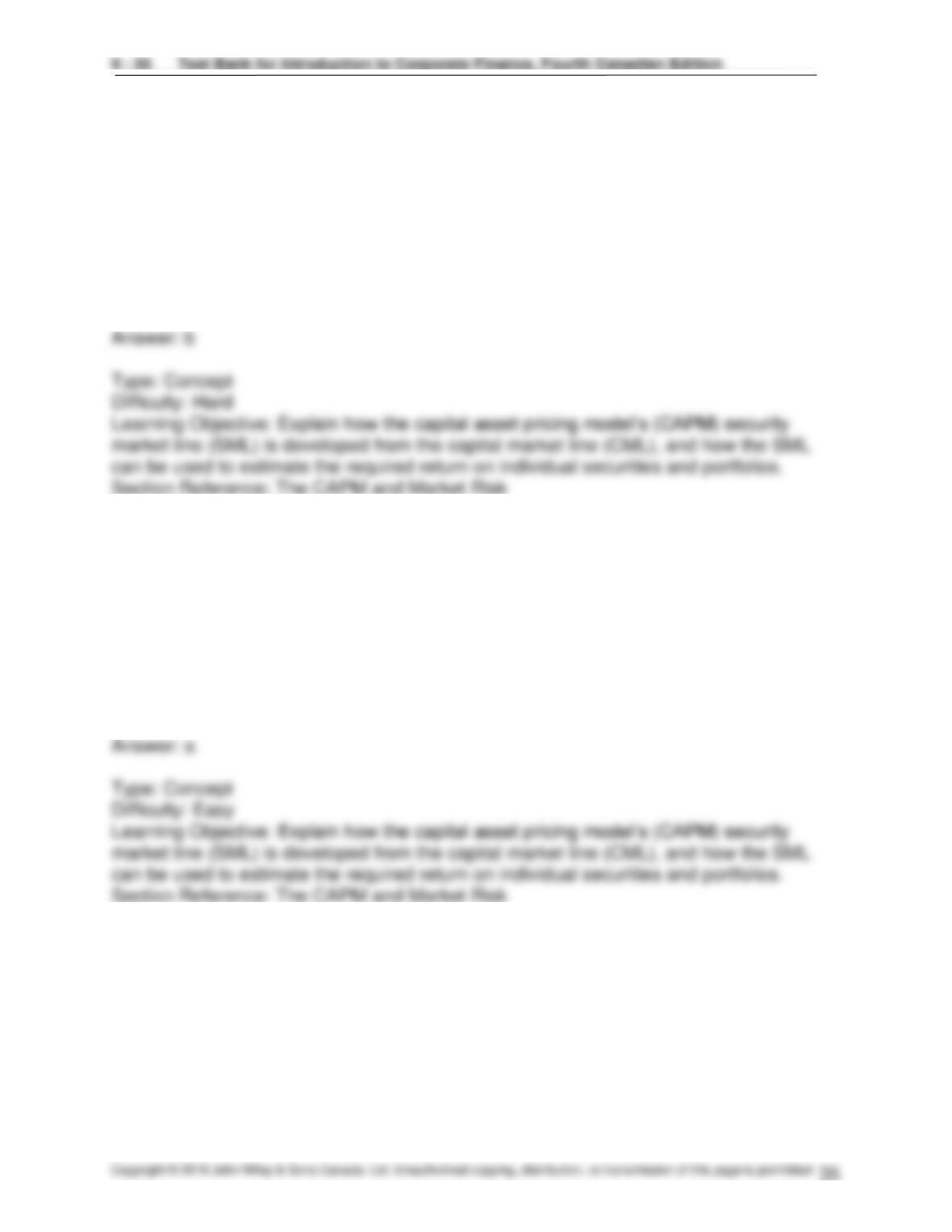
73. Stock X has a standard deviation of 25 percent and a correlation coefficient of 0.7
with market returns. The expected return of the market is 12 percent with a standard
deviation of 15 percent. The risk-free rate is 5 percent. What is the required return of
Stock X?
a) 7.94%
b) 9.56%
c) 13.17%
d) 15.28%
74. Use the following three statements to answer this question:
I. Beta is constant over time.
II. Empirically beta is never negative.
III. Negative beta implies a negative standard deviation.
a) I, II and III are correct.
b) I, II and III are incorrect.
c) I is correct, II and III are incorrect.
d) I, II are incorrect, III is correct.
75. According to the Capital Asset Pricing Model (CAPM), which one of the following
statements is NOT true?
a) The expected rate of return of a security decreases proportionally with a decrease in
the risk-free rate.
b) The expected rate of return of a security increases as its beta increases.
c) A fairly priced security has an alpha of zero.
d) In equilibrium, all securities lie on the security market line.
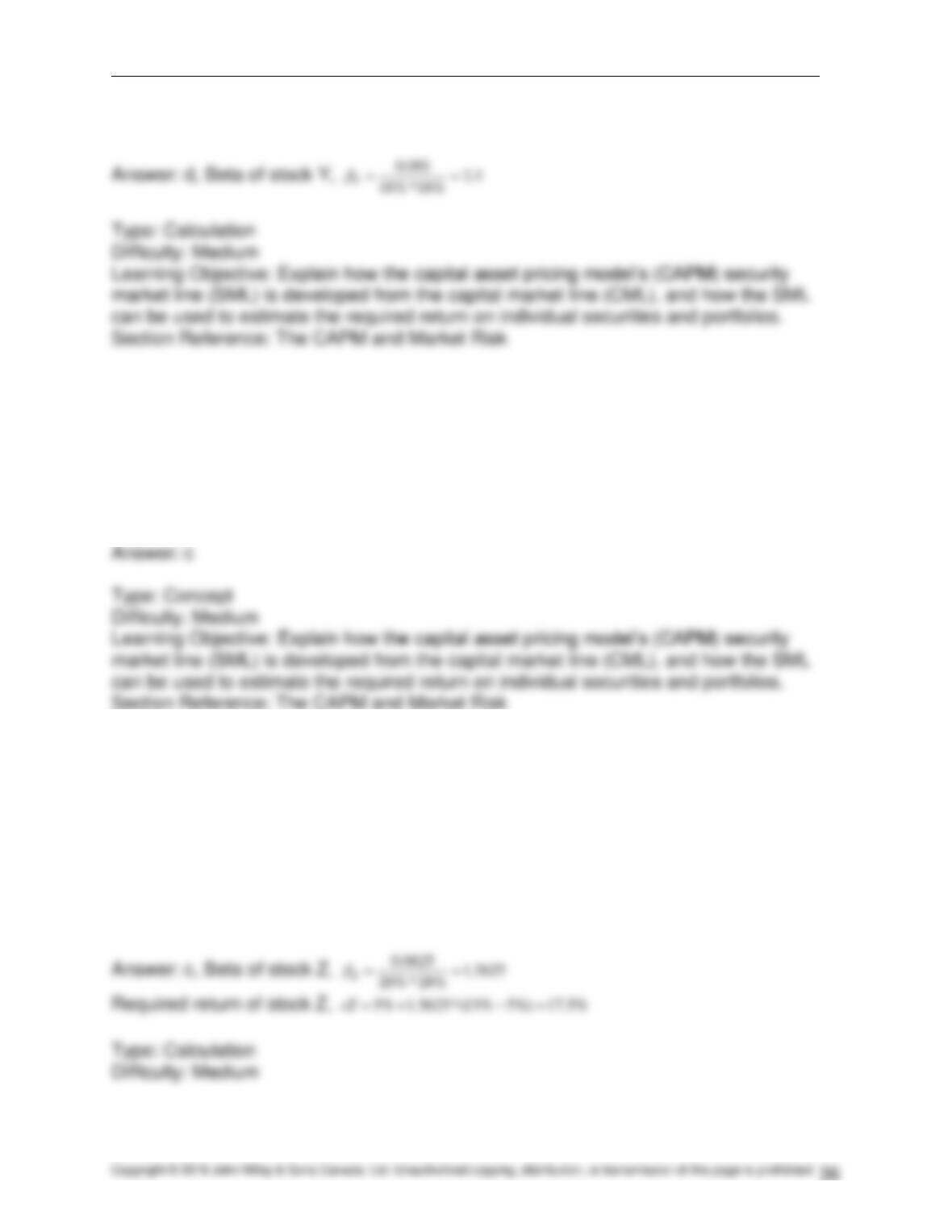
76. Stock Y has a standard deviation of 22 percent and a covariance with the market of
0.081. The expected return of the market is 14 percent with a standard deviation of 18
percent. The risk-free rate is 5.25 percent. What is the beta of Stock Y?
a) 0.37
b) 0.45
c) 1.67
Portfolio and Capital Market Theory 9 – 36
d) 2.50
77. Which one of the following stocks does NOT have a beta close to 1?
a) A stock that is part of the most dominant industry.
b) A stock that has a very high capitalization.
c) A newly listed stock.
d) The stock of a well-established firm.
78. Stock Z has a standard deviation of 18 percent and a covariance with the market of
0.0625. The expected return of the market is 13 percent with a standard deviation of 20
percent. The risk-free rate is 5 percent. What is the required return of Stock Z?
a) 7.50%
b) 7.78%
c) 17.50%
d) 20.43%
9 – 37 Test Bank for Introduction to Corporate Finance, Fourth Canadian Edition
79. The current price of Stock Y is $12. It is expected that the stock will pay an annual
dividend of $0.60 and sell for $13.50 in one year. The risk-free rate is 6 percent. The
expected return on the market portfolio is 14 percent with a standard deviation of 17
percent. Assume the market is in equilibrium. What is the beta of Stock Y?
a) 0.70
b) 0.96
c) 1.25
d) 1.44
80. What is the beta of a portfolio if 40 percent of the funds are invested in a risk-free
asset and the balance of the funds is invested in the market portfolio?
a) 0.4
b) 0.6
c) 0.8
d) 1.0
81. What is the beta of a portfolio if 40 percent of the funds invested in the market
portfolio are borrowed at the risk-free rate?
a) 0.60
b) 0.83
c) 1.40
d) 1.67
82. What is the beta of a portfolio if 30 percent of the funds are invested in a risk-free
asset, 40 percent in the market portfolio, and the balance in a portfolio that has three
times the risk of the market portfolio?
a) 0.4
b) 0.7
c) 1.3
d) 1.8
83. What is the beta of a portfolio if 20 percent of the funds are invested in Stock A with
a beta of 2, 30 percent in Stock B with a beta of 0.8, 15 percent in Stock C with a beta
of 2.2, and the remainder in Stock D with a beta of 1.4?
a) 1.23
9 – 39 Test Bank for Introduction to Corporate Finance, Fourth Canadian Edition
b) 1.46
c) 1.74
d) 1.98
84. Suppose the beta of a four-asset portfolio is 1.8. The portfolio is composed of
$1,500 invested in Stock W, $2,000 in Stock X, $2,500 in Stock Y, and $3,000 in Stock
Z. What is the beta of Stock Z if the betas of Stock W, X, and Y are 0.7, 1.3, and 2.5,
respectively?
a) 0.7
B) 1.1
c) 1.6
d) 2.1
85. A portfolio is composed of $2,000 invested in Stock A, $3,000 in Stock B, $4,000 in
Stock C, and $5,000 in Stock D. What is the beta of the portfolio if the betas of Stock A,
B, C, and D are 0.9, 1.6, 1.8 and 1.2, respectively?
a) 1.03
b) 1.26
c) 1.41
d) 1.65