Portfolio and Capital Market Theory 9 – 40
86. Suppose you have $4,000 to invest in Stocks X and Y. Stock X has an expected
return of 13.5 percent and a beta of 1.2. Stock Y has an expected return of 18 percent
and a beta of 2. How much should you invest in Stock X if you wish to have a portfolio
beta of 1.8?
a) $1,000
b) $1,750
c) $2,250
d) $2,500
87. Suppose you have $3,600 to invest in Securities A and B. Security A has an
expected return of 6 percent and a beta of 0.5. Stock B has an expected return of 20
percent and a beta of 1.8. What is the expected return on the portfolio if the portfolio
beta is 2.0?
a) 24.00%
b) 23.65%
c) 22.15%
d) 22.22%
9 – 41 Test Bank for Introduction to Corporate Finance, Fourth Canadian Edition
88. The expected return on the market is 12 percent with a standard deviation of 16
percent and the risk-free rate is 4.5 percent. Which of the following portfolios are
overpriced?
Portfolio Expected Return Beta
1 15% 1.2
2 12% 1.1
3 10% 0.9
4 9% 0.6
a) 1 and 3 only
b) 1 and 4 only
c) 2 and 3 only
d) 2 and 4 only
89. The expected return on the market is 14 percent with a standard deviation of 18
percent and the risk-free rate is 5 percent. Which of the following portfolios are
underpriced?
Portfolio Expected Return Beta
1 18% 1.3
2 14% 1.1
3 12% 0.7
4 8% 0.6
a) 1 and 2 only
b) 1 and 3 only
c) 2 and 3 only
d) 3 and 4 only
90. The expected return on the market is 12 percent with a standard deviation of 20
percent and the risk-free rate is 4 percent. Which of the following portfolios are correctly
priced?
Portfolio Expected Return Beta
1 8% 0.9
2 14% 1.2
3 16% 1.5
4 20% 2.0
a) 1 and 2 only
b) 1 and 4 only
c) 2 and 3 only
d) 3 and 4 only
91. The risk-free rate is 4.5 percent. The expected return on the market is 13 percent
with a standard deviation of 15 percent. What is the required rate of return for Stock X if
it has a beta of 1.4?
a) 16.40%
b) 18.20%
c) 20.50%
d) 22.70%
92. Stock Y has a beta of 0.8 and a required rate of return of 10 percent. What is the
market risk premium if the risk-free rate is 5 percent?
a) 5.00%
b) 4.75%
c) 6.25%
d) 7.50%
93. Stock Z has a beta of 0.9 and a required rate of return of 12 percent. What is the
market expected return if the risk-free rate is 5.25 percent?
a) 7.50%
b) 12.75%
c) 13.33%
d) 18.58%
94. Stock XYZ has a beta of 1.6 and a required rate of return of 15.75 percent. What is
the risk-free rate if the market return is 12 percent?
a) 3.25%
b) 3.75%
c) 4.50%
d) 5.75%
95. The market expected return is 14 percent with a standard deviation of 18 percent.
The risk-free rate is 6 percent. Security XYZ has just paid a dividend of $1 and has a
current price of $13.95. What is the beta of Security XYZ if its dividend is expected to
grow at 6 percent per year indefinitely?
a) 0.85
b) 0.90
c) 0.95
d) 1.05
96. The market expected return is 14 percent with a standard deviation of 12 percent.
The risk-free rate is 5.5 percent. Security A has just paid a dividend of $1.50, which is
expected to grow at a rate of 10 percent per year indefinitely. What is the current price
of Security A if it has a beta of 1.4?
a) $9.93
b) $10.93
c) $20.27
d) $22.30
97. Security A is estimated to be linearly related to four risk factors: F1, F2, F3, and F4
such that its required rate of return can be expressed as ER(A) = mo + n1F1 + n2F2 + n3F3
+ n4F4, where mo is the risk-free rate. If the risk-free rate is 5.5 %, what is the required
rate of return of Security A, where n1, n2, n3, and n4 are 0.3, 0.6, 0.9, and 0.12,
respectively, and F1, F2, F3, and F4 are 6 %, 7 %, 10 %, and 8 %, respectively?
a) 19.22%
b) 21.46%
c) 22.90%
d) 27.11%
98. In the above question, F1 F2, and F3 were reasonably accurate estimates based on
previous analysis and F4 was not. Empirical data showed that the return on security A
was actually 24.50%. What is a reasonable estimate for F4? (Assume reasonable
values for n1, n2, n3, and n4)
a) 27.11%
b) 33.33%
c) 31.25%
d) 40.37%
99. What is the main criticism of the CAPM referred to as Roll’s critique?
a) The stock market is not efficient.
b) The CAPM does not hold because beta is not a good measure of risk.
c) The market portfolio is impossible to estimate.
9 – 47 Test Bank for Introduction to Corporate Finance, Fourth Canadian Edition
d) The CAPM does not hold empirically.
100. Suppose the returns on Security A are linearly related to four risk factors: F1, F2,
F3, and F4. The required rate of return on Security A can be determined as follows:
0 1 1 2 2 3 3 4 4
()
A
E R a b F b F b F b F= + + + +
. The risk-free rate is 4.5 percent. What is the required
rate of return of Security A, where b1, b2, b3, and b4 are 0.4, 0.8, 0.6, and 0.7,
respectively, and F1, F2, F3, and F4 are 5 percent, 6 percent, 10 percent, and 8
percent, respectively?
a) 18.40%
b) 20.60%
c) 22.90%
d) 24.30%
101. Which one of the following is NOT part of the Fama French factor model?
a) Market portfolio
b) Book to market value
c) Inflation
d) Size of stock
102. Which one of the following is NOT a difference between APT and CAPM models?
a) Risk factors
b) Arbitrage principle
c) Market portfolio
d) Pricing risk
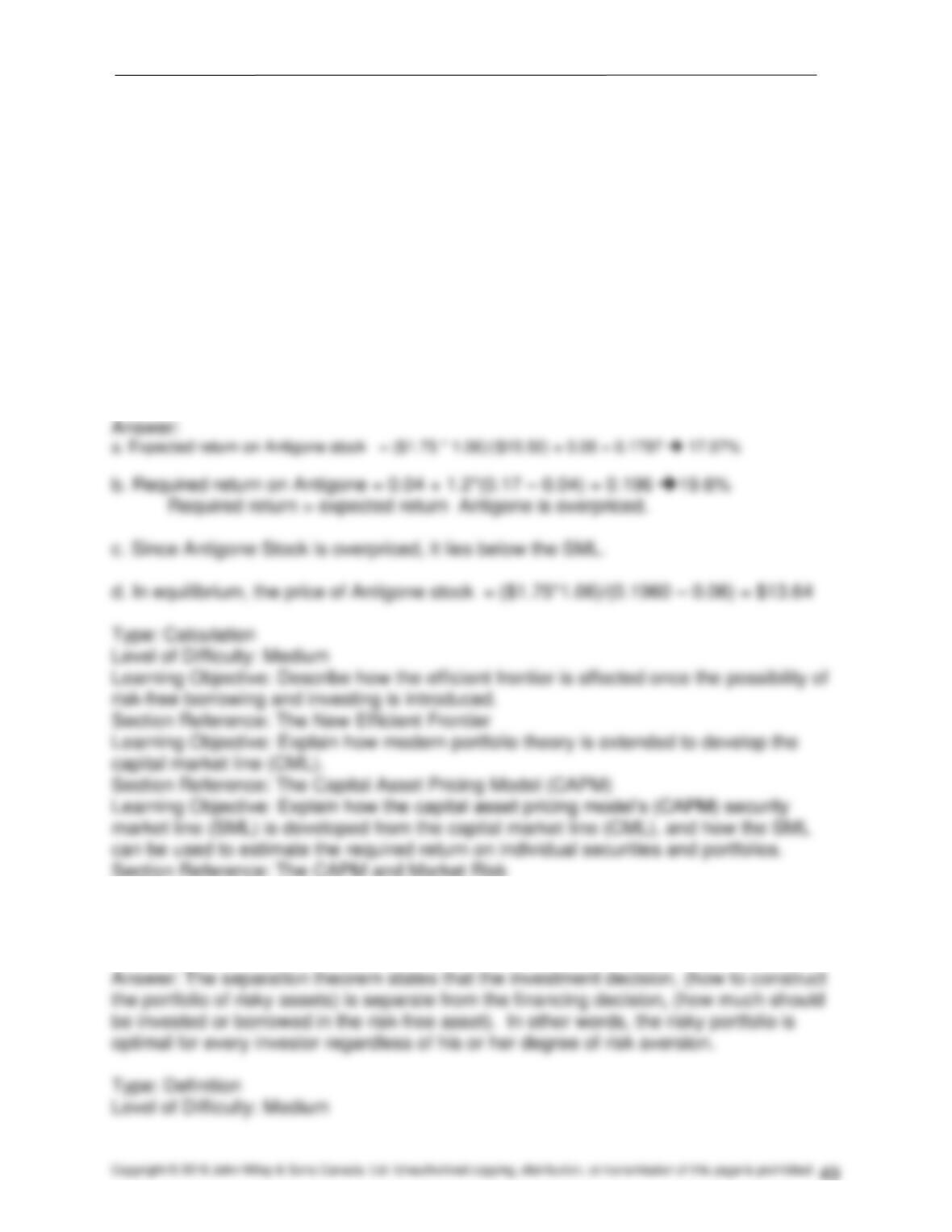
103. Suppose the returns on Security B are linearly related to four risk factors: F1, F2,
F3, and F4. The required rate of return on Security B can be determined as follows:
0 1 1 2 2 3 3 4 4
()
B
E R a b F b F b F b F= + + + +
. The risk-free rate is 5 percent. What is the risk premium
for F4, if the required return of Security B is 20 percent, b1, b2, b3, and b4 are 0.5, 0.7,
0.6, and 0.9, respectively, and F1, F2, and F3 are 4.25 percent, 5.75 percent, and 6.5
percent, respectively?
a) 4.95%
b) 5.50%
c) 7.42%
d) 11.06%
9 – 49 Test Bank for Introduction to Corporate Finance, Fourth Canadian Edition
PRACTICE PROBLEMS
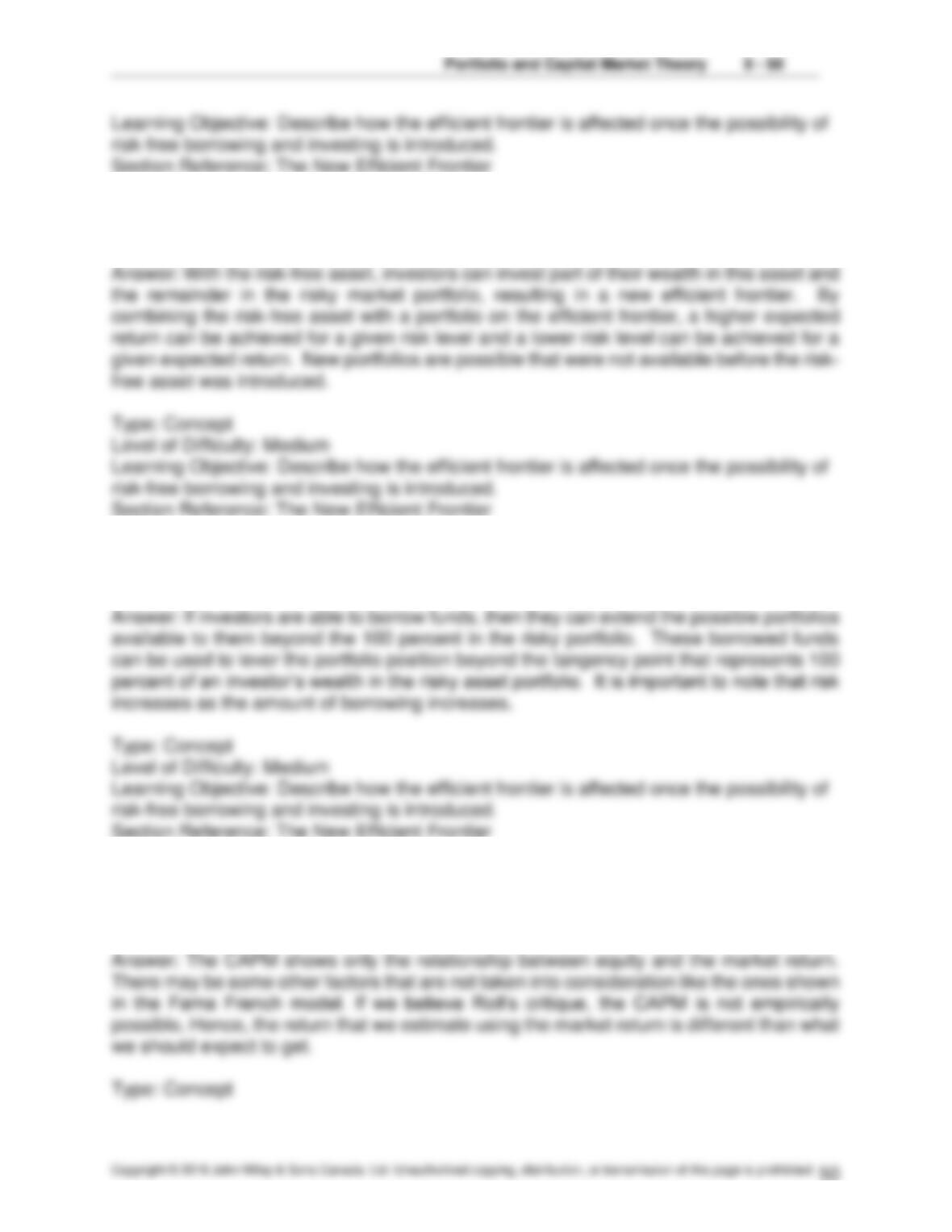
104. SML-CAPM Question:
Antigone Inc. paid out a dividend of $1.75, and analysts expect it to grow at 6% for the
foreseeable future. The market rate is 17%, the T-Bill rate is quoted at 4%, and
Antigone stock is selling at $15.50 (beta 1.2). Answer the following questions:
a) What is the expected return on Antigone stock?
b) Are Antigone shares overpriced, underpriced, or correctly priced?
c) Is Antigone stock above, below, or on the SML?
d) What is the equilibrium price of Antigone stock?
105. Explain the separation theorem.
106. What is the role of the risk-free asset in the efficient portfolio?
107. Is it possible to invest more than 100 percent of your available funds?
108. How do you explain a stock that earns a return higher than the required rate of
return from the CAPM?
109. “There may be some truth in the CAPM, but my sister–in-law bought a stock last
year that earned a 20 percent return, much higher than what was expected using the
CAPM.” Evaluate this criticism.
110. What is the difference between the capital market line (CML) and the security
market line (SML)?
111. What is beta?
112. You have two portfolios, A and B. Portfolio A has an expected return of 20 percent
and a beta of 1.4. Portfolio B has an expected return of 25 percent and a beta of 1.2. Is
this scenario consistent with the CAPM? Why or why not?
113. If two stocks had the same beta, but Stock A had high non-systematic risk and
Stock B had low non-systematic risk, would rational investors expect a higher return
from holding one of these securities?
114. What is the difference between CAPM and APT?
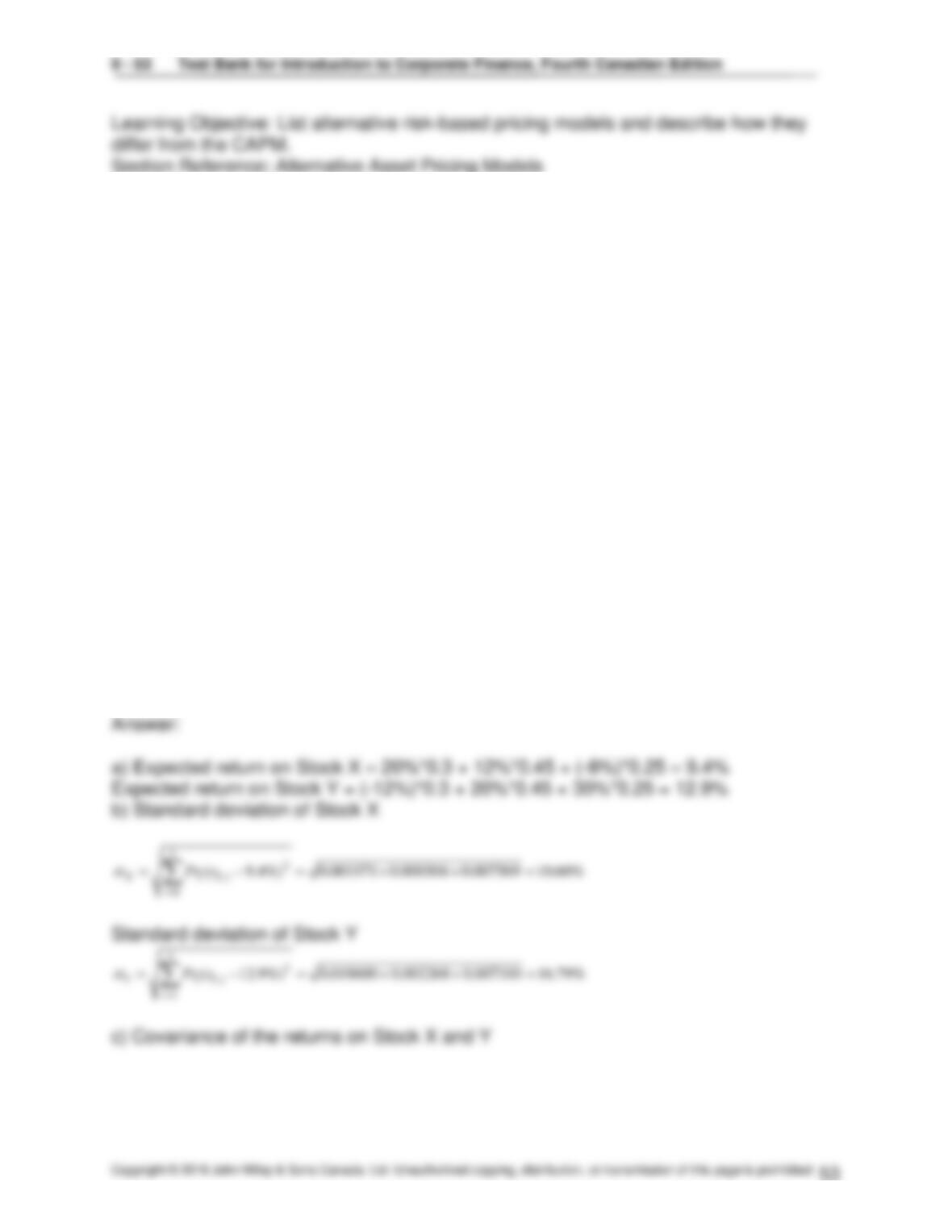
115. After you have done an extensive analysis of the economy, Stock X, and Stock Y,
you make the following forecasts:
State of
Economy Probability of
Occurrence Stock X
Expected Return Stock Y
Expected Return
Boom 30% 20% –12%
Normal 45% 12% 20%
Bust 25% –8% 30%
Suppose you plan to invest in a portfolio with 40 percent of the funds in Stock X and 60
percent in Stock Y. The market return is 12 percent with a standard deviation of 16
percent. The risk-free rate is 5 percent.
a) What are the expected returns of Stock X and Stock Y?
b) What are the standard deviation of the returns of Stock X and Stock Y?
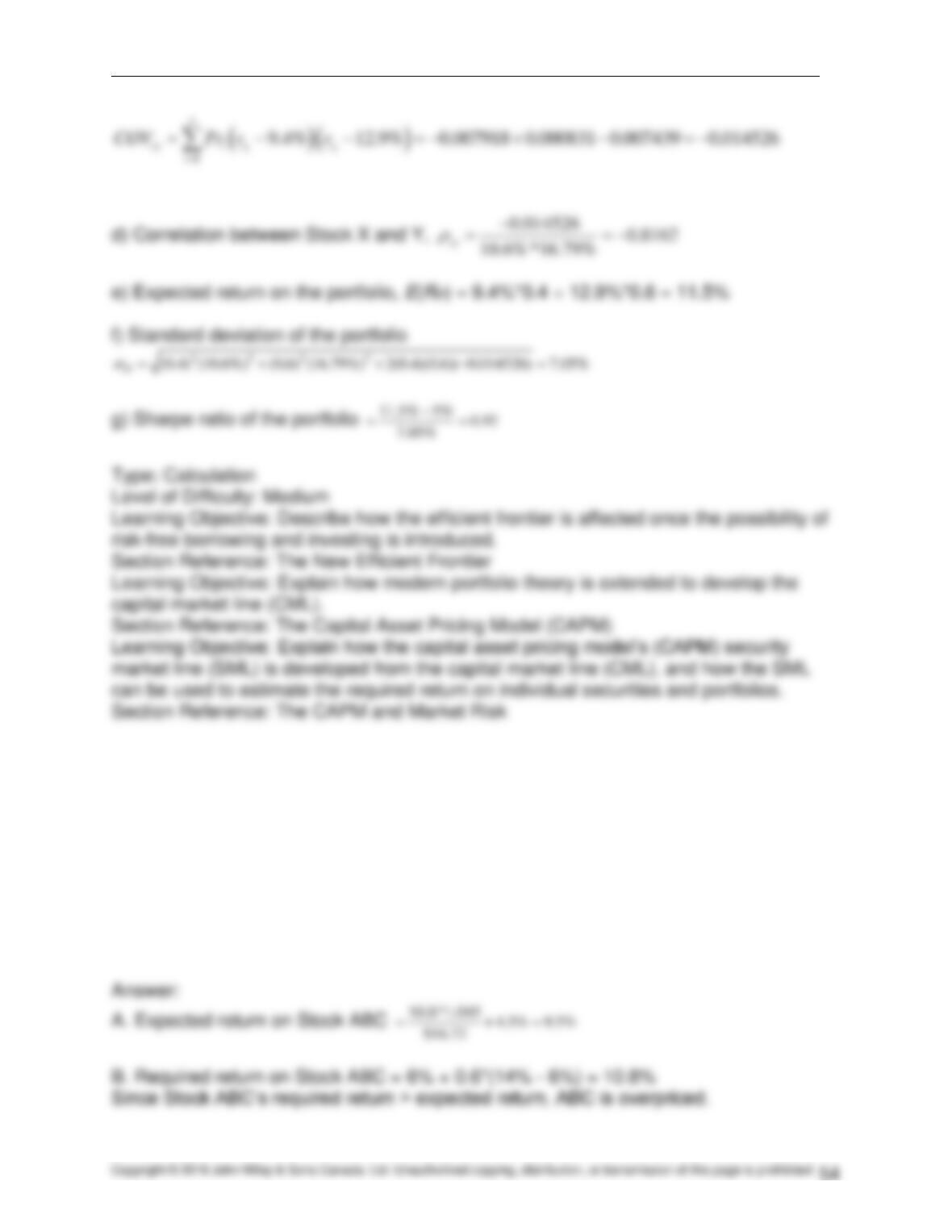
c) What is the covariance of the returns on Stock X and Stock Y?
d) What is the correlation between Stock X and Stock Y?
e) What is the expected return on the portfolio?
f) What is the standard deviation of the portfolio?
g) What is the Sharpe ratio of the portfolio?
Portfolio and Capital Market Theory 9 – 54
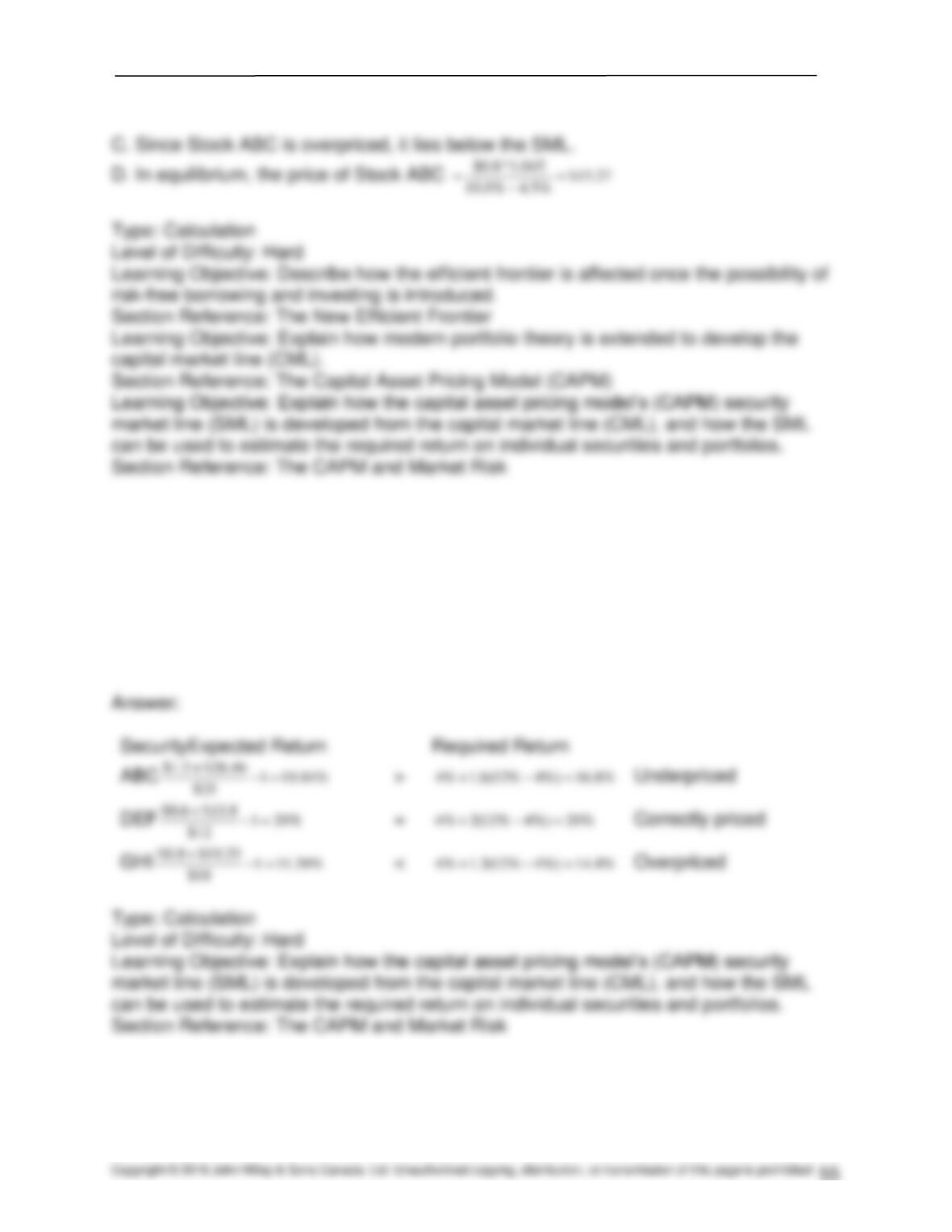
116. Stock ABC is currently selling for $16.72. It has just paid an annual dividend of
$0.80 per share, which is expected to grow at 4.5 percent indefinitely. The risk-free rate
is 6 percent. The expected return on the market portfolio is 14 percent with a standard
deviation of 17 percent.
a) What is the expected return on Stock ABC?
b) Is Stock ABC overpriced, underpriced, or correctly priced if it has a beta of 0.6?
c) Is Stock ABC above, below, or on the SML?
d) What is the equilibrium price of Stock ABC? Assume the dividend grow rate remains
at 4.5 percent.
9 – 55 Test Bank for Introduction to Corporate Finance, Fourth Canadian Edition
117. The risk-free rate is 4 percent. The expected return on the market portfolio is 12
percent with a standard deviation of 16 percent. Which security is over, under, or
correctly priced?
Security P0 D1 P1 Beta
ABC $25.00 $1.50 $28.46 1.6
DEF $12.00 $0.60 $13.80 2.0
GHI $18.00 $0.80 $19.25 1.3
118. Given the following information:
Portfolio and Capital Market Theory 9 – 56
Month Stock X Return S&P/TSX Return
January 10% 12%
February 8% 7%
March 12% 8%
April –5% 10%
May –8% –5%
June 4% 8%
July 9% 11%
August 8% –7%
September –4% 6%
October 6% 8%
November 3% 5%
December 2% 6%
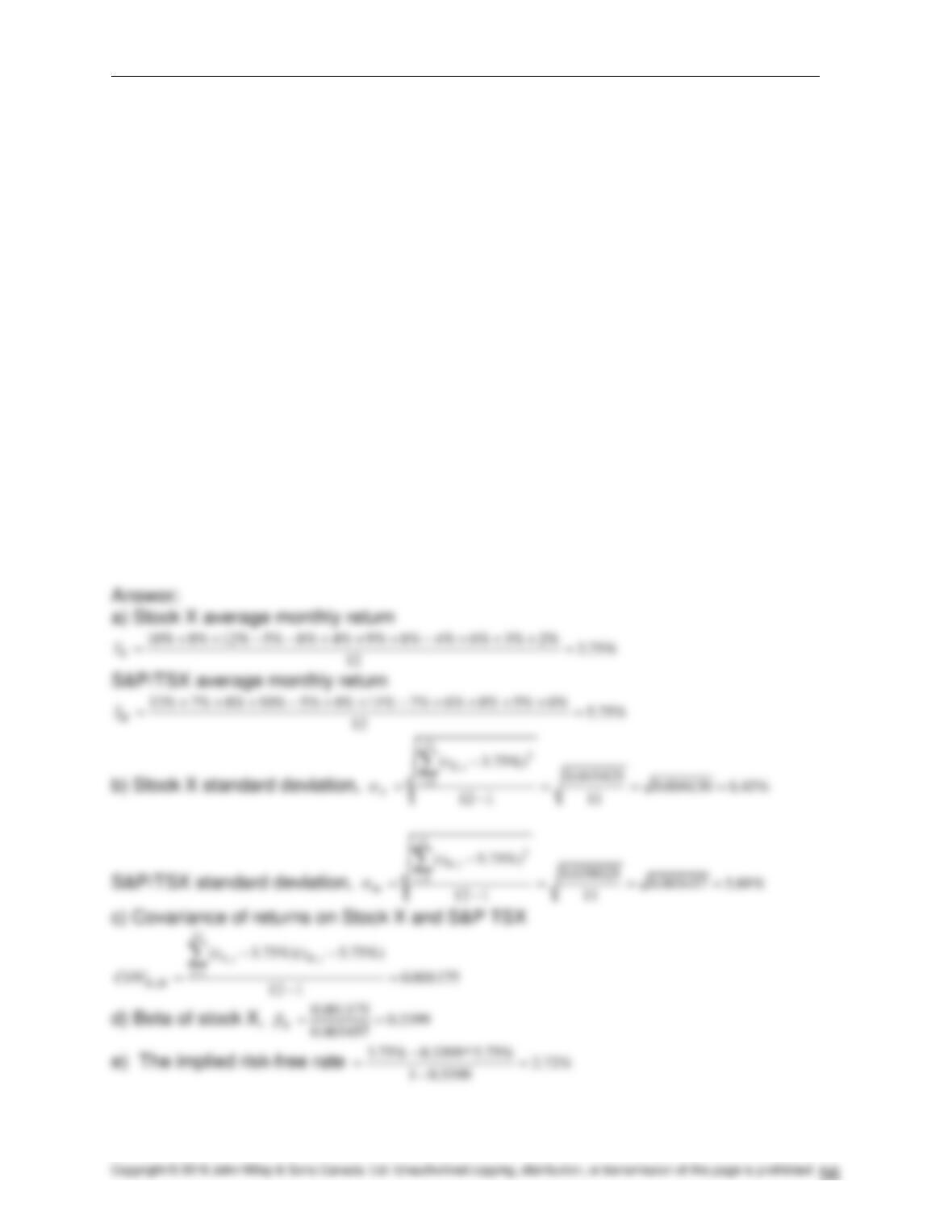
a) What are the average monthly returns on Stock X and the S&P TSX?
b) What are the standard deviations of the monthly returns on Stock X and the S&P
TSX?
c) What is the covariance of the returns on Stock X and the S&P TSX?
d) What is the beta of Stock X?
e) What is the implied risk-free rate?
9 – 57 Test Bank for Introduction to Corporate Finance, Fourth Canadian Edition
Portfolio and Capital Market Theory 9 – 58
LEGAL NOTICE