8 – 41 Test Bank for Introduction to Corporate Finance, Fourth Canadian Edition
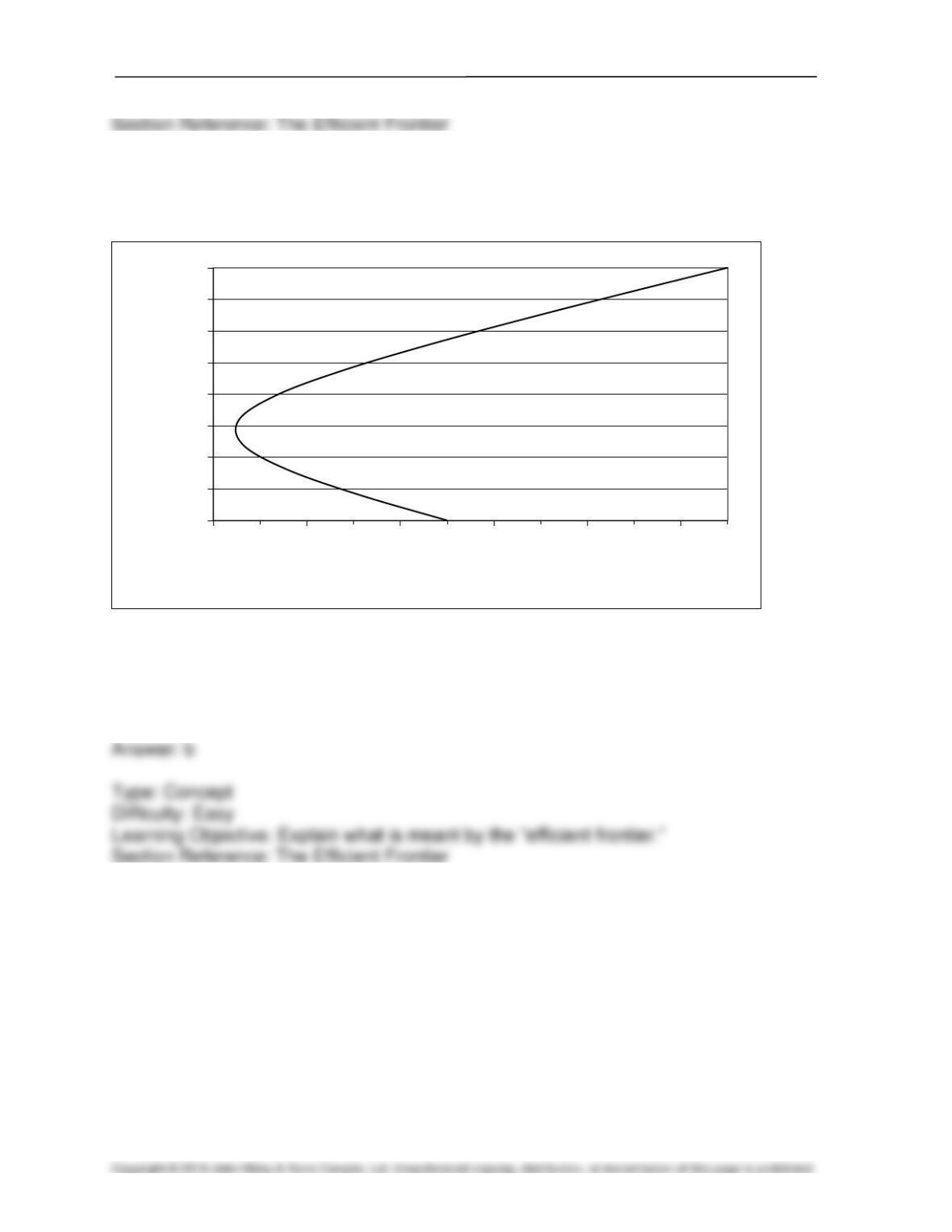
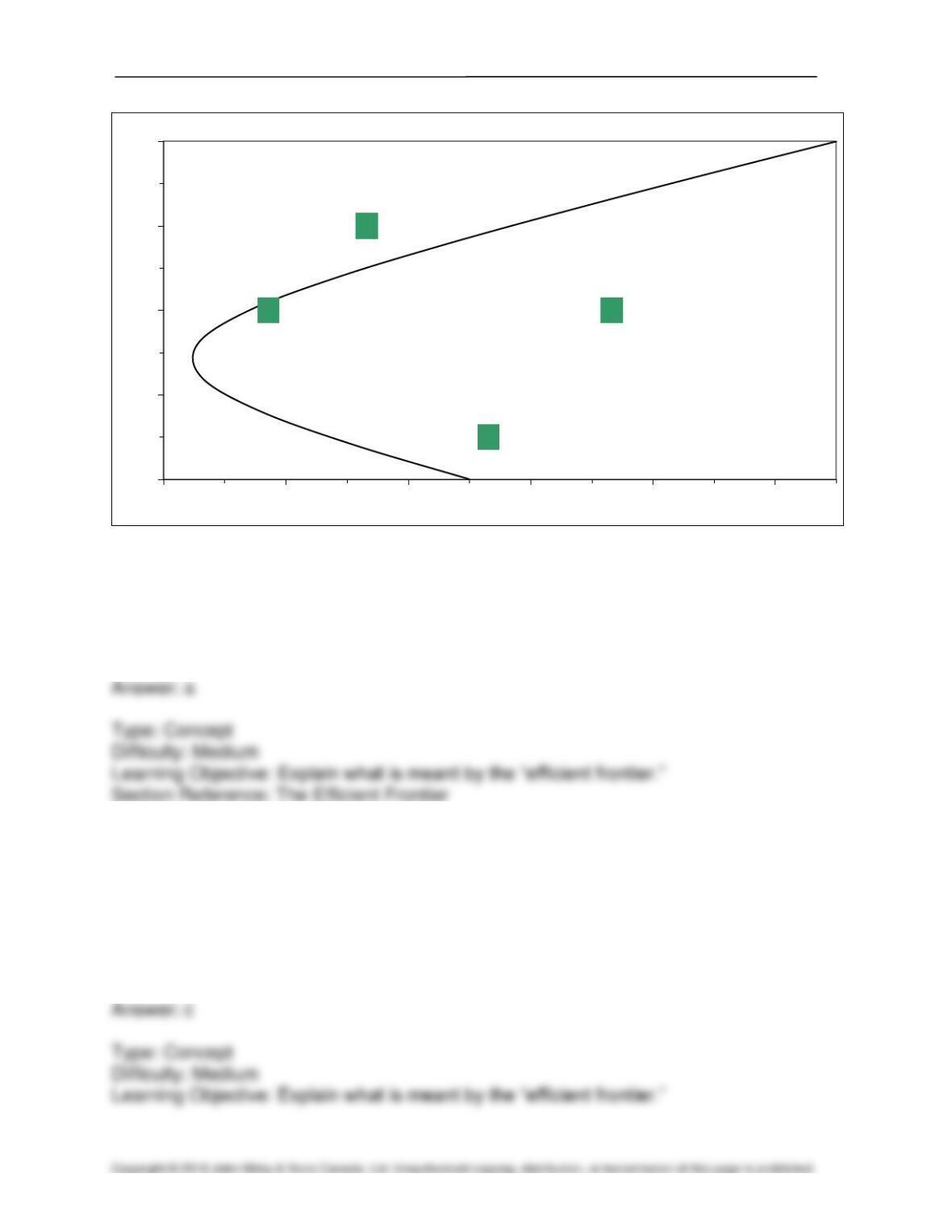
87. For the following efficient frontier, the expected return of the minimum variance
portfolio is:
a) <3.0%
b) Between 3.0% and 4.0%
c) Between 4.0% and 5.0%
d) >5.0%
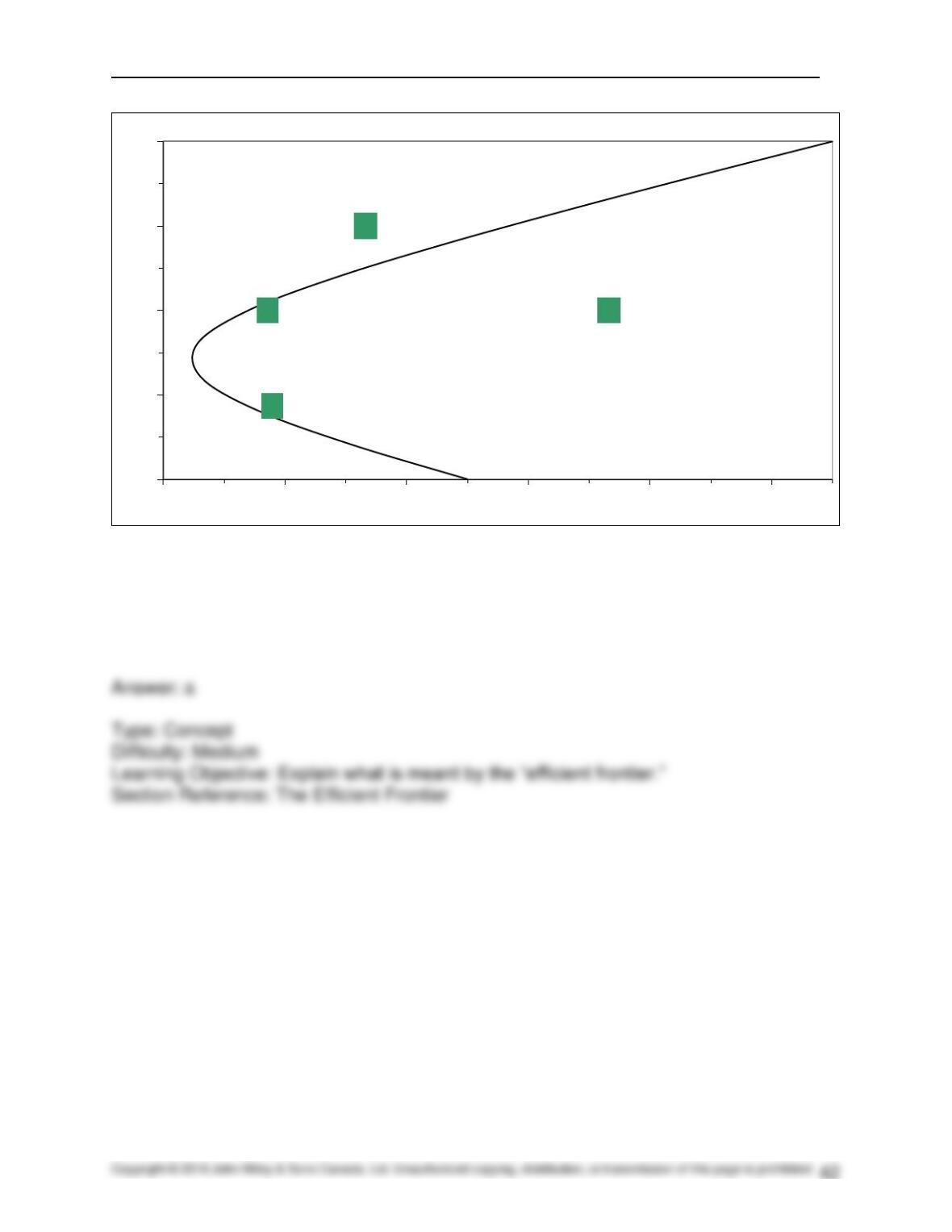
88. The standard deviation and expected returns for 4 portfolios (A, B, C, and D) are
graphed on the following efficient frontier:
2.0%
2.5%
3.0%
3.5%
4.0%
4.5%
5.0%
5.5%
6.0%
2.5% 3.5% 4.5% 5.5% 6.5% 7.5%
Expected return
Standard deviation
Risk, Return, and Portfolio Theory 8 – 42
Which of the following portfolios are attainable?
a) A and B only
b) B and D only
c) B, A, and D only
d) All are attainable
A
B
C
D
Expected return
Standard deviation
8 – 43 Test Bank for Introduction to Corporate Finance, Fourth Canadian Edition
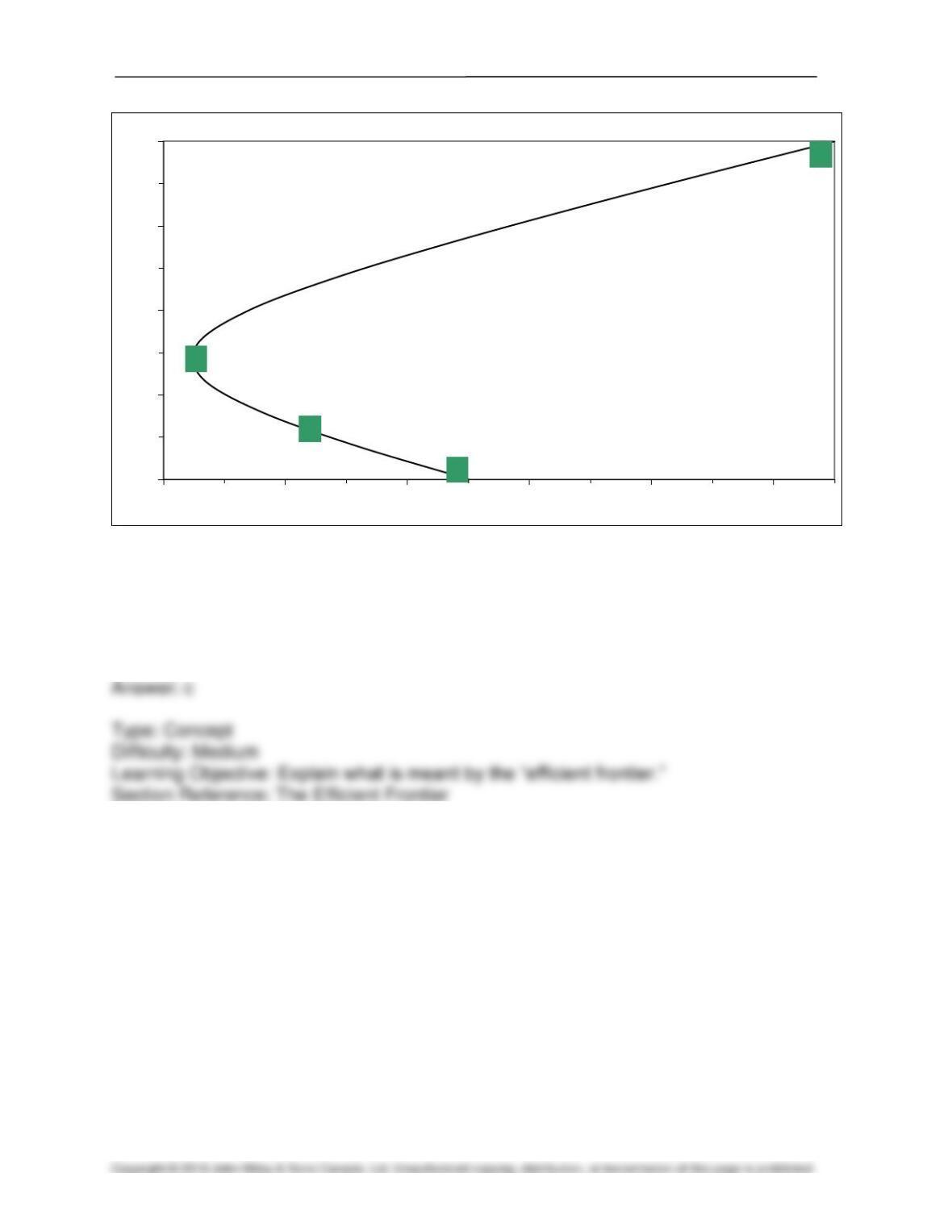
89. Which portfolio represents the minimum variance portfolio?
a) B
b) C
c) A
d) D
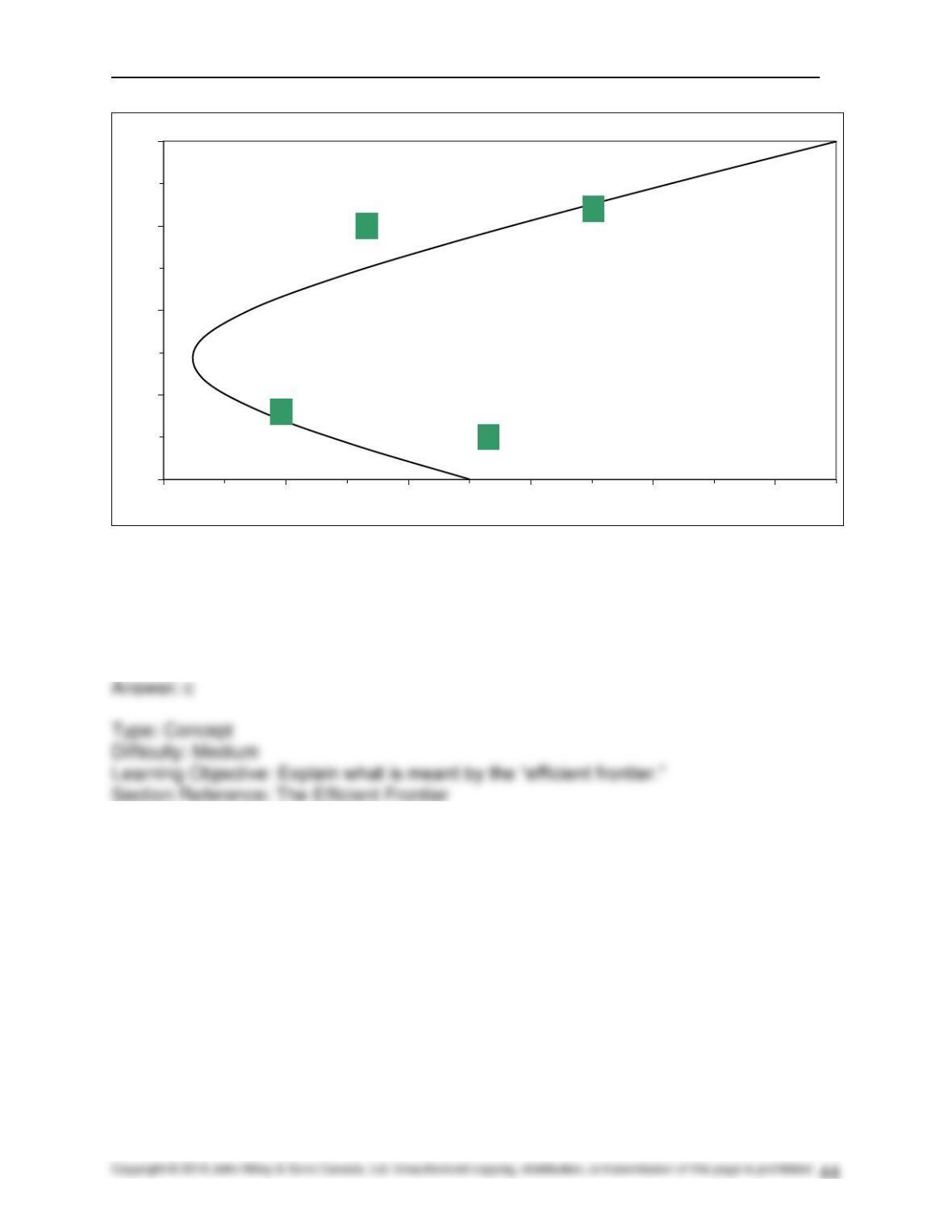
90. The standard deviation and expected returns for 4 portfolios (A, B, C, and D) are
graphed on the following efficient frontier:
A
B
C
D
Expected return
Standard deviation
Risk, Return, and Portfolio Theory 8 – 44
Which of the following portfolios are efficient?
a) A and C only
b) B and D only
c) B only
d) All are efficient
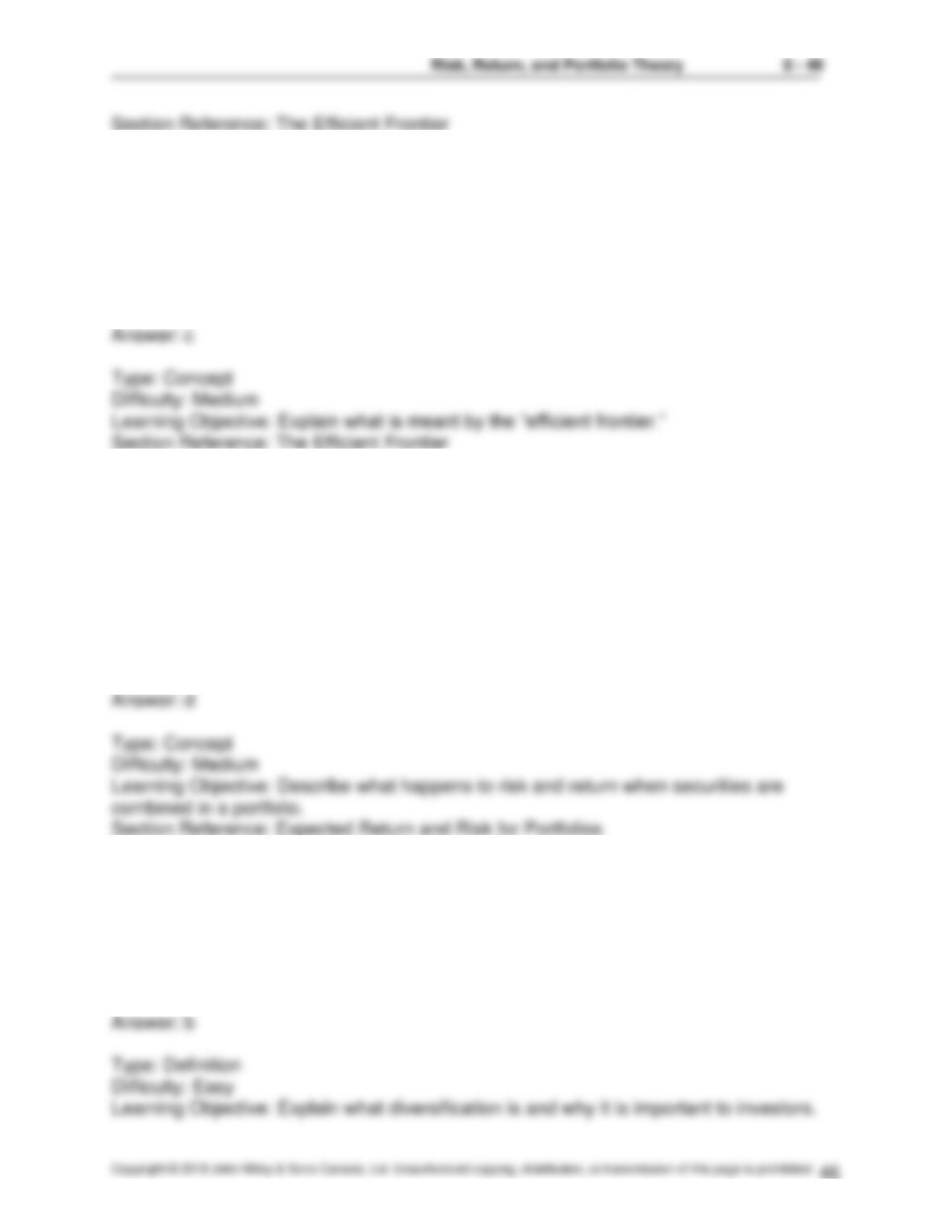
91. The standard deviation and expected returns for 4 portfolios (A, B, C, and D) are
graphed on the following efficient frontier:
A
B
C
D
Expected return
Standard deviation
8 – 45 Test Bank for Introduction to Corporate Finance, Fourth Canadian Edition
Which of the following portfolios are inefficient?
a) A and D only
b) B and C only
c) C and D only
d) All are inefficient
92. Which of the following statements is FALSE?
a) All portfolios on the efficient frontier are attainable.
b) Every portfolio below the efficient portfolio can be improved.
c) All portfolios on the efficient frontier have the same variance to return ratio.
d) The minimum variance portfolio represents the lowest level of variance that an
efficient portfolio can have.
A
B
C
D
Expected return
Standard deviation
93. Which of the following statements is FALSE?
a) The minimum variance portfolio has the lowest variance possible for an efficient
portfolio.
b) Every portfolio below the efficient portfolio has a higher risk exposure for a
correspondingly lower return than if it were within the efficient portfolio.
c) All portfolios on the efficient frontier have the same variance/return ratio.
d) All portfolios on the efficient frontier are attainable.
94. Which of the following is NOT a correct statement?
a) Of all the combinations of available securities, the minimum variance portfolio is a
portfolio that lies on the efficient frontier and has the minimum amount of portfolio risk.
b) Efficient portfolios are those portfolios that offer the highest expected return for a
given level of risk.
c) Investors prefer higher returns and lower risk, so if they are exposed to additional
risk, they expect to be compensated for that additional exposure.
d) Portfolios on the lower segment of the minimum variance frontier dominate portfolios
that lie above the minimum variance portfolio on the upper segment.
95. Non-systematic risk is also called:
a) market risk
b) unique risk
c) total risk
d) any of the above
96. If a company’s stock price decreases due to the poor sales in one of its product
lines, this is an example of:
a) systematic risk
b) total risk
c) market risk
d) non-systematic risk
97. Which of the following is TRUE?
a) Large numbers of securities are required to achieve diversification.
b) Portfolio risk can always be reduced by adding additional securities.
c) Systematic risk can never be eliminated.
d) Non-systematic risk can never be reduced.
98. Which one of the following is NOT an example of systematic risk?
a) Jump in oil prices to new highs
b) Central bank decides to increase interest rates
c) Recall of a newly released product
d) New regulations on industry subsidies
99. Amazon’s new mobile phone Fire spectacularly under-performed analyst
expectations leading to a drop in share price. This is an example of:
a) Market risk
b) Non-systematic risk
c) Standard risk
d) Systematic risk
100. Which one of the following is NOT an example of systematic risk?
a) Mercedes-Benz recalls its B-series line of automobiles due to rollover safety concerns.
b) Central bank decides to increase interest rates.
c) Rising oil prices impact a number of industries including the airline industry.
d) A newly elected government passes a new law restricting industry subsidies.
101. In a two-security portfolio, 25% is invested in Security A and the remainder in
Security B. If the portfolio standard deviation is 12%, and the individual standard
deviations for Security A and Security B are 22% and 7%, respectively, what is the
covariance of the returns on Securities A and B?
a) 0.017
b) 0.023
c) 0.0375
d) 0.0469
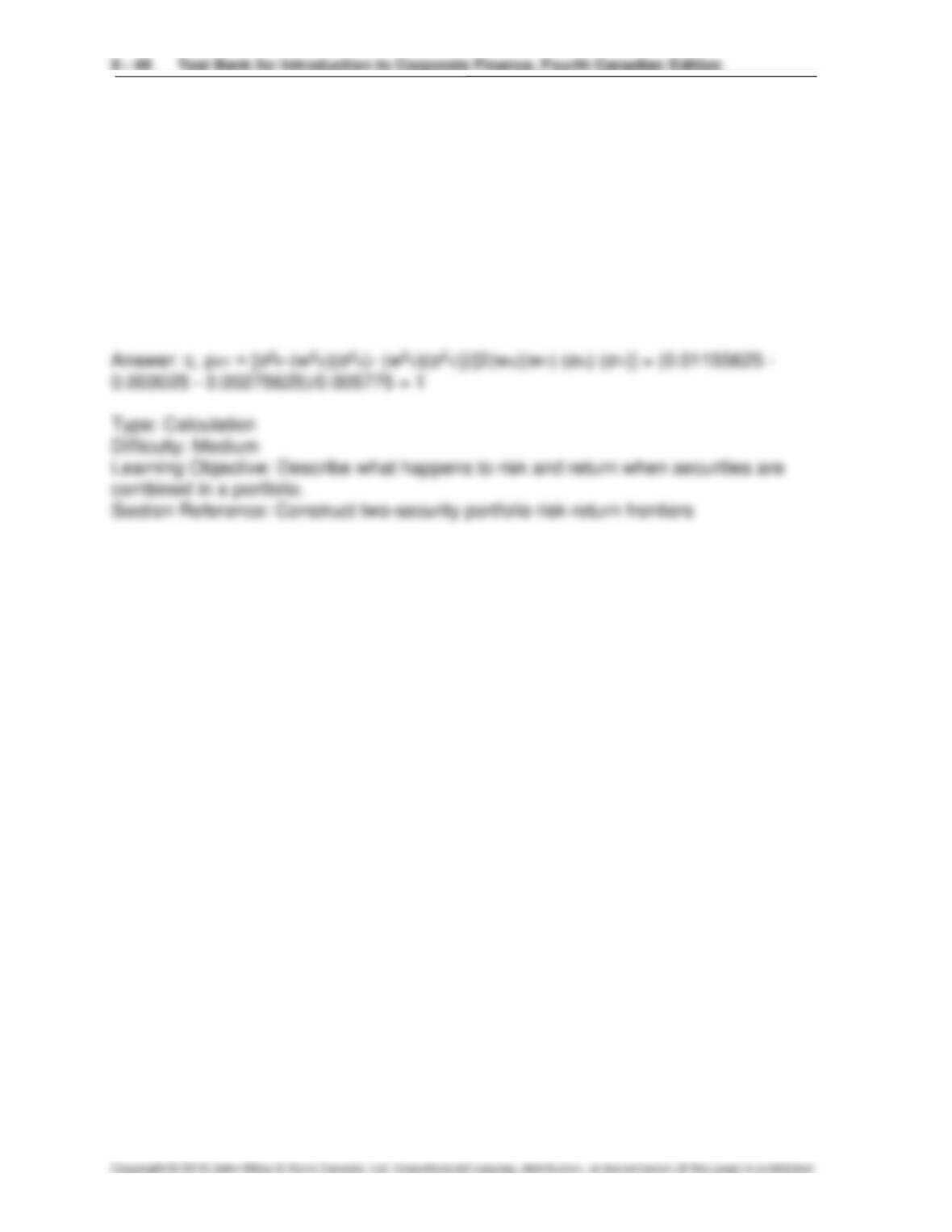
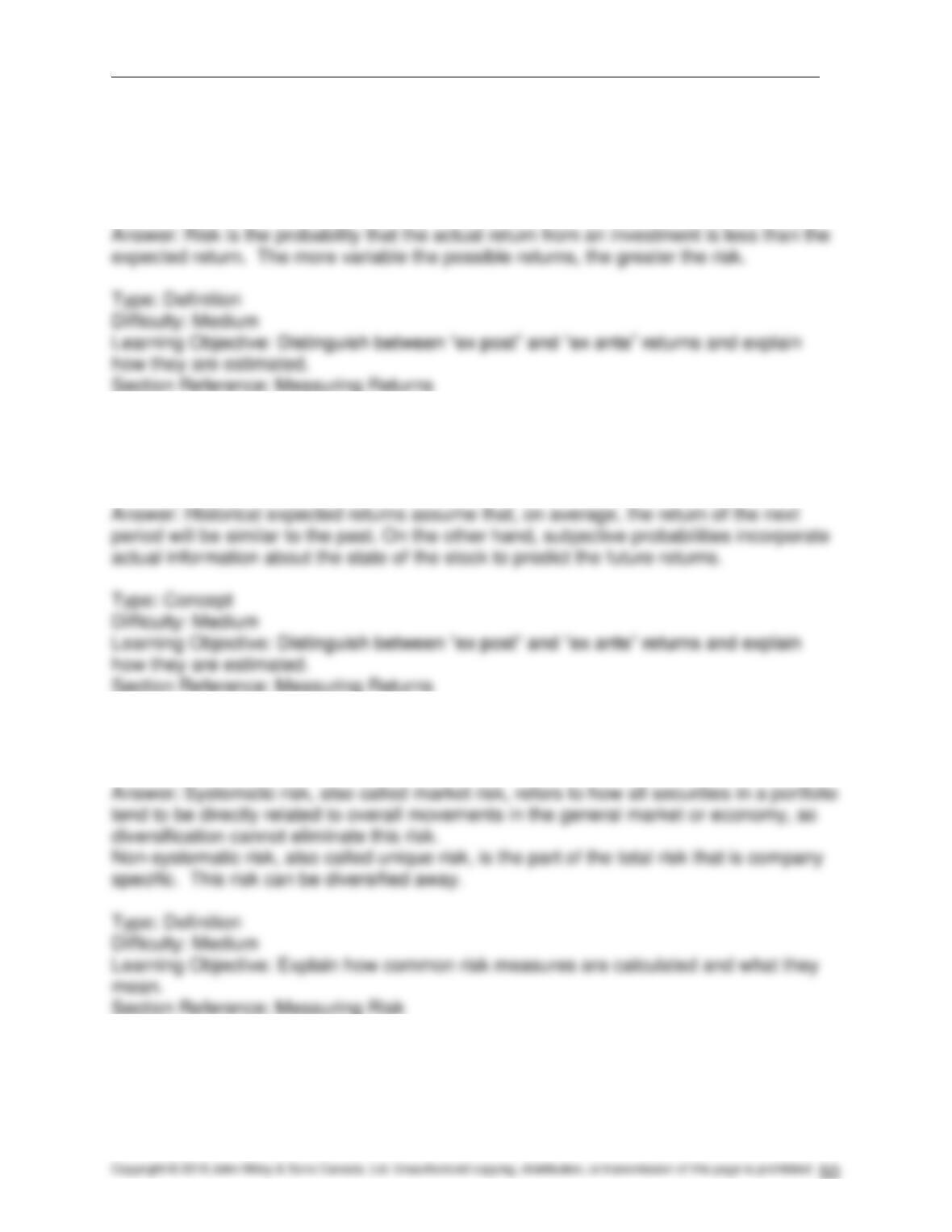
102. In a two-security portfolio 25% of your money is invested in Security X and the
remainder in Security Y. If the standard deviations of Securities X and Y are 22 % and 7
%, respectively, and the portfolio variance is 0.01155625, what is the correlation
between the two securities?
a) -0.003275
b) 0.03275
c) 1.0
d) -1.0
Risk, Return, and Portfolio Theory 8 – 50
PRACTICE PROBLEMS
103. Define the term “risk” and explain how it is related to the expected return.
104. Discuss the difference between expected returns using subjective probabilities and
expected returns based on historical values.
105. Distinguish between systematic and non-systematic risk.
106. What are the components of total return and total risk?
8 – 51 Test Bank for Introduction to Corporate Finance, Fourth Canadian Edition
107. Define and discuss expected return with regard to individual securities and a
portfolio as a whole.
108. Does diversification always reduce the overall risk?