8 – 21 Test Bank for Introduction to Corporate Finance, Fourth Canadian Edition
b) It stipulates that investors should diversify their investments so as to be unnecessarily
exposed to a single negative event.
c) It shows how to form portfolios with the highest possible expected rate of return for any
given level of risk.
d) It demonstrates that by combining securities into portfolios, we can increase risk.
47. No benefits of diversification with two stocks occur when
AB
is:
a) 0
b) 1
c) –1
d) 0.52
48. Stocks A and B have a correlation of +1. If stock A went from $10 to $12 over the
past month, what is the price of stock B, if its price one month ago was $5?
a) $5
b) $4
c) $6
d) Cannot be determined
49. Use the following two statements to answer this question:
I. The expected return on a portfolio is the equally weighted average of the expected
returns on the individual securities in the portfolio.
II. The standard deviation of a portfolio reflects the weighted impact of the individual
securities’ standard deviations and the relationship among the co-movements of the
returns on those individual securities.
a) I is incorrect, II is correct.
b) I is correct, II is incorrect.
c) I and II are incorrect.
d) I and II are correct.
50. Which of the following is a FALSE statement of the correlation coefficient?
a) It measures how security returns move in relation to one another.
b) Positive correlation coefficients imply that the returns on Security A tend to move in
the same direction as those on security B.
c) Negative correlation coefficients imply that the returns on Security A tend to move in
the opposite direction to those on security B.
d) The closer the absolute value of the correlation coefficient is to one, the weaker the
relationship between the returns on the two securities.
51. Use the following three statements to answer this question:
I. When
1
AB
=
and we know the return on Security A, we can predict the return on
Security B with certainty.
II. Generally, security returns display positive correlations with one another but they are
less than one, because all securities tend not to follow the movements of the overall
market.
III. Any value of correlation less than +1 provides a possibility of diversification.
a) I is incorrect, II is correct, III is correct.
8 – 23 Test Bank for Introduction to Corporate Finance, Fourth Canadian Edition
b) I is correct, II is incorrect, III is correct.
c) I and II are incorrect, III is incorrect.
d) I and II are correct, III is incorrect.
52. Use the following three statements to answer this question:
I. There will be benefits from diversification as long as
1
AB
+
.
II. As long as
1
AB
=−
, an equally weighted portfolio would be risk-free.
III. Diversification can never eliminate the total risk of the portfolio.
a) I is correct, II is incorrect, III is correct.
b) I is incorrect, II is correct, III is correct.
c) I and II are correct, III is incorrect.
d) I, II and II are incorrect.
53. Which of the following is NOT a correct statement?
a) Risk-averse investors like expected returns and dislike risk, and therefore require
compensation to assume additional risk.
b) Efficient portfolios are those portfolios that offer the highest expected return for a
given level of risk, or offer the lowest risk for a given expected return.
c) The minimum variance portfolio is a portfolio that lies on the efficient frontier and has
the minimum amount of portfolio risk available from any possible combination of
available securities.
d) Portfolios on the lower segment of the minimum variance frontier dominate portfolios
that lie above the minimum variance portfolio on the upper segment.
54. Which of the following is TRUE about diversification?
a) By diversifying, portfolio risk can be reduced to zero.
b) There is no benefit from diversification if the correlation coefficient is 1.
c) The variance is the weighted average of the individual securities’ variances when the
correlation is equal to -1.
d) If the covariance between two securities is negative, then the portfolio’s standard
deviation can be reduced to zero.
55. What is the expected return for a portfolio that has $800 invested in Stock A and
$1,200 invested in Stock B, if the expected returns on Stock A and Stock B are 10%
and 18%, respectively?
a) 14.00%
b) 14.80%
c) 13.20%
d) 12.60%
The information below is used to answer the next two questions:
State of the Economy Probability of Occurrence Stock A
Expected Return Stock B
Expected Return
8 – 25 Test Bank for Introduction to Corporate Finance, Fourth Canadian Edition
Expansion 20% 25% 35%
Stable 50% 15% 25%
Recession 30% –5% –15%
56. Given the following forecasts, what is the expected return for a portfolio that has
$1,500 invested in Stock A and $4,500 invested in Stock B?
a) 12.0%
b) 12.5%
c) 14.0%
d) 14.2%
57. Calculate the correlation between the two stocks.
a) -0.99
b) 0
c) 0.99
d) -1.00
58. Suppose you own 100 shares of CyberChase Corporation and 200 shares of
NetSurfer Corporation. At the time of purchase, the stocks of CyberChase and
NetSurfer were trading at $25 and $15 per share, respectively. What is the expected
Risk, Return, and Portfolio Theory 8 – 26
value of the portfolio if CyberChase has an expected return of 8 percent and NetSurfer
has an expected return of 13 percent?
a) $6,065
b) $6,090
c) $7,095
d) $7,270
59. What is the expected return for a portfolio that has $1,000 invested in Stock X,
$1,500 invested in Stock Y, and $2,500 invested in Stock Z, if the expected returns on
Stock X, Stock Y, and Stock Z are 10%, 12%, and 15%, respectively?
a) 11.90%
b) 12.00%
c) 12.50%
d) 13.10%
60. A portfolio consists of two securities: Nervy and Goofy. The expected return of
Nervy is 12 percent with a standard deviation of 15 percent. The expected return of
Goofy is 9 percent with a standard deviation of 10 percent. What is the portfolio
standard deviation if 35 percent of the portfolio is in Nervy and the two securities have a
correlation of 0.6?
a) 9.02%
b) 10.52%
c) 11.75%
d) 12.18%
8 – 27 Test Bank for Introduction to Corporate Finance, Fourth Canadian Edition
61. You are contemplating investing in two stocks ABC and XYZ that have an expected
return of 12 percent and 9 percent, respectively. If your target expected return is 10
percent, what would be the weight in ABC?
a) 50%
b) 33%
c) 67%
d) 100%
Use the following information to answer the next four questions:
State of the Economy Probability of Occurrence Stock X
Expected Return Stock Y
Expected Return Stock Z
Expected Return
Recession 35% 25% –10% 15%
Average 45% 14% 8% 25%
Boom 20% 4% 14% –10%
62. Given the following forecasts, what is the expected return for a portfolio that has
$2,200 invested in Stock X, $3,600 in Stock Y, and $4,200 invested in Stock Z?
a) 10.62%
b) 14.82%
c) 30.50%
d) 33.25%
63. What is the correlation between stocks X and Y?
a) 0.26
b) -0.96
c) 0.96
d) 0.51
64. What is the correlation between stocks X and Z?
a) 0.96
b) 0.51
c) -0.26
d) 0.26
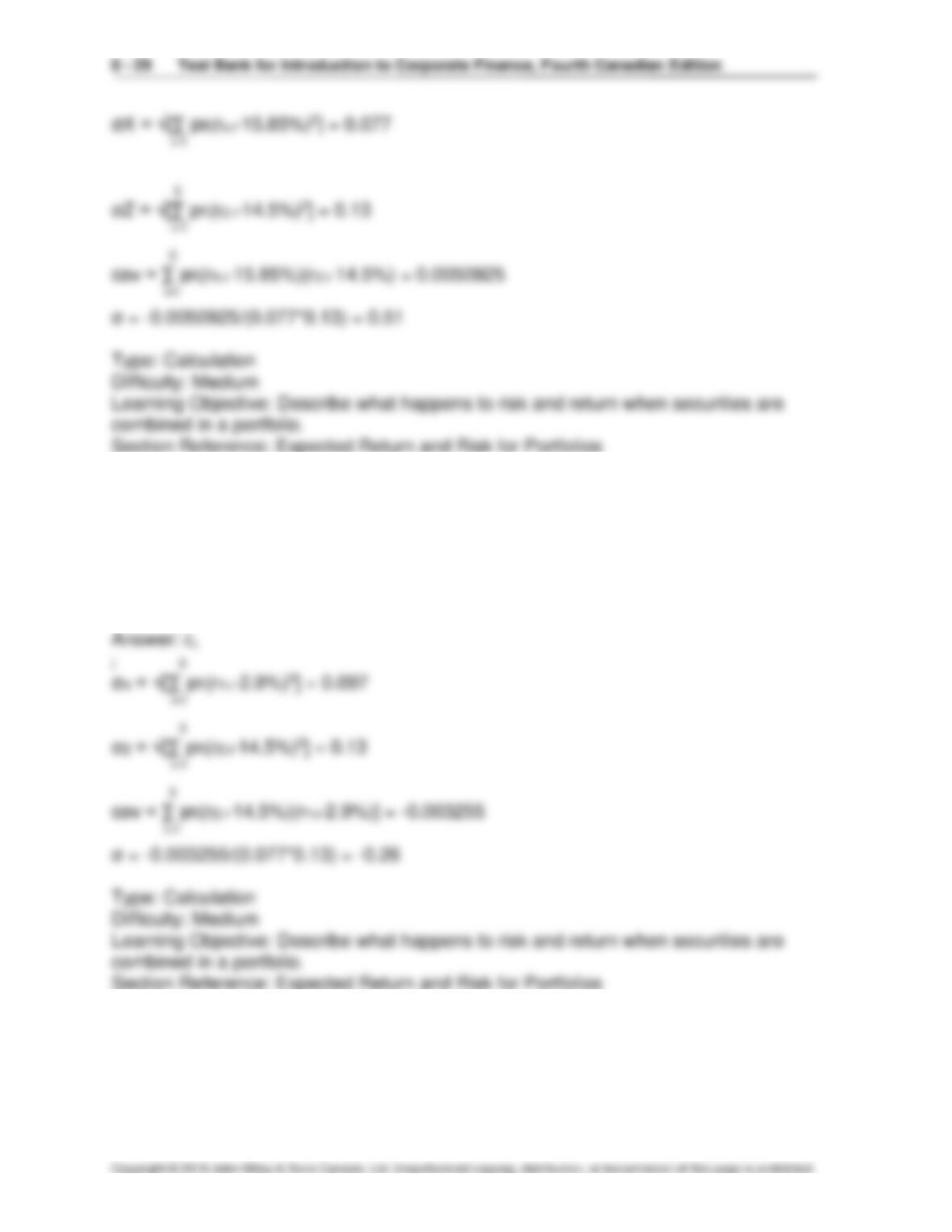
65. What is the correlation between stocks Y and Z?
a) 0.96
b) 0.51
c) -0.26
d) 0.26
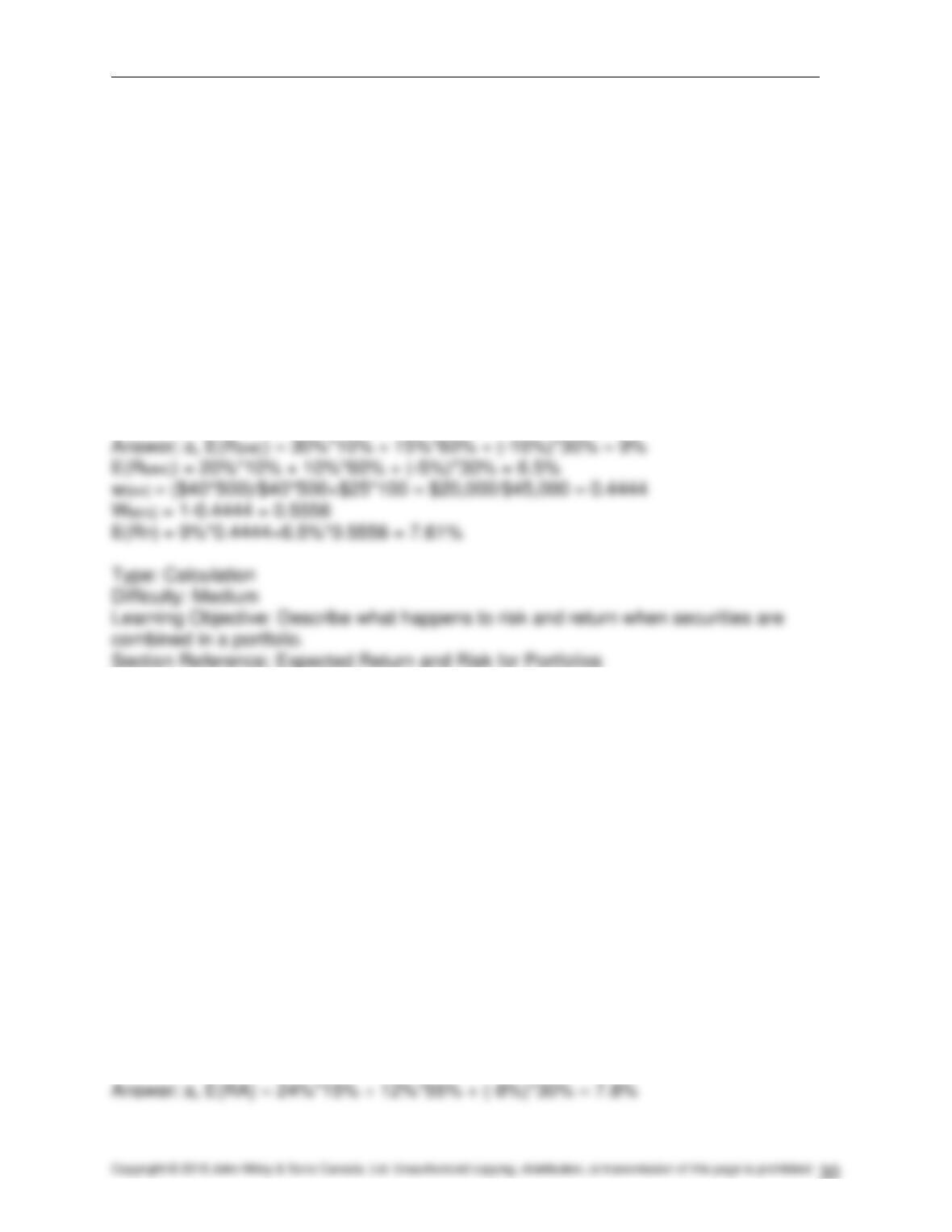
66. Suppose you own a portfolio that has 500 shares of SHC Company and 1,000
shares of MHC Company. The stock prices of SHC and MHC at the time of purchase
Risk, Return, and Portfolio Theory 8 – 30
were $40 and $25 per share, respectively. Given the following forecasts, what is the
expected return for the portfolio?
State of the Economy Probability of Occurrence SHC
Expected Return MHC
Expected Return
Boom 10% 30% 20%
Average 60% 15% 10%
Recession 30% –10% –5%
a) 7.61%
b) 7.89%
c) 11.94%
d) 12.56%
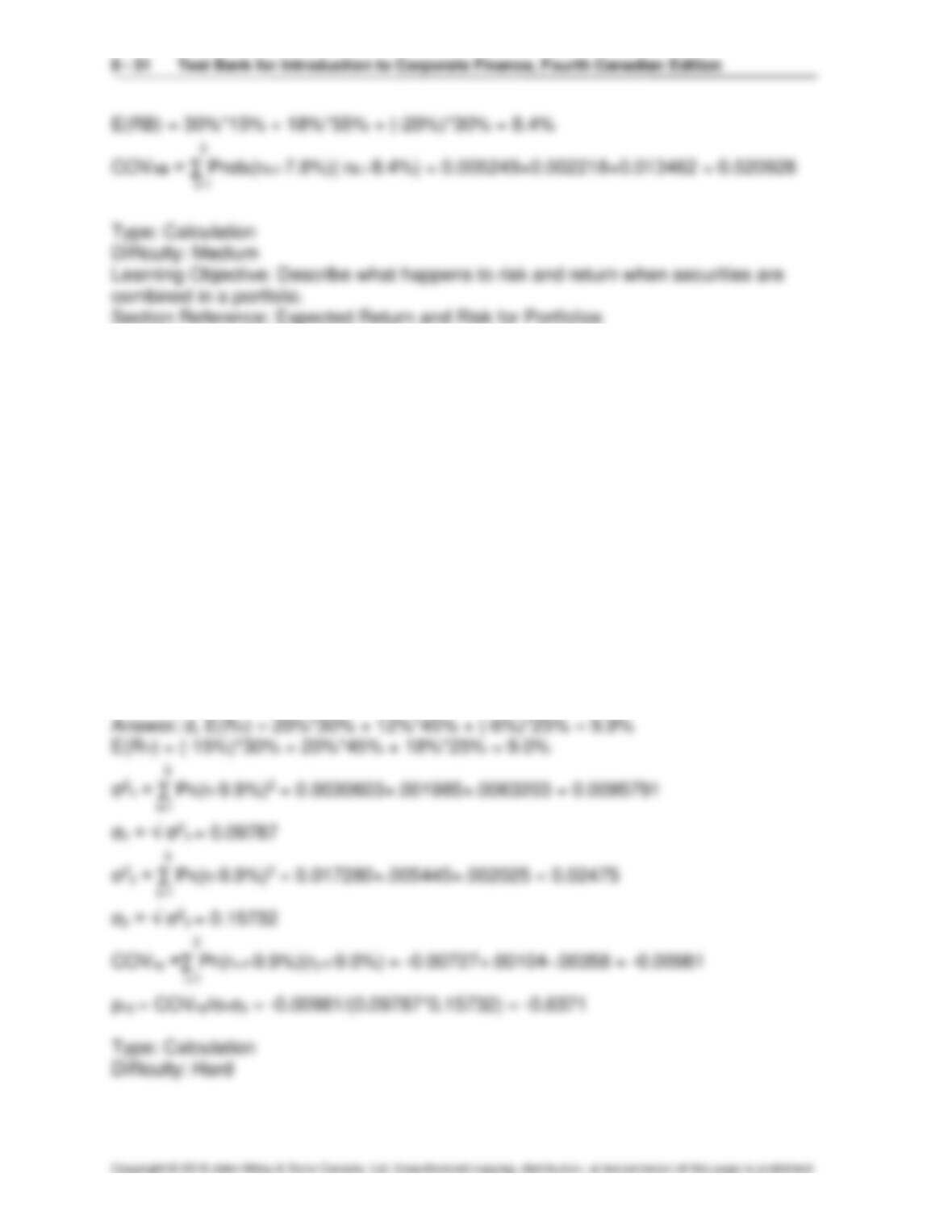
67. Given the following forecasts, what is the covariance of the returns on securities A
and B?
State of the
Economy Probability of
Occurrence Stock A
Expected Return Stock B
Expected Return
Boom 15% 24% 30%
Normal 55% 12% 18%
Recession 30% –8% –20%
a) 0.0209
b) 0.1447
c) 0.2348
d) 0.9871
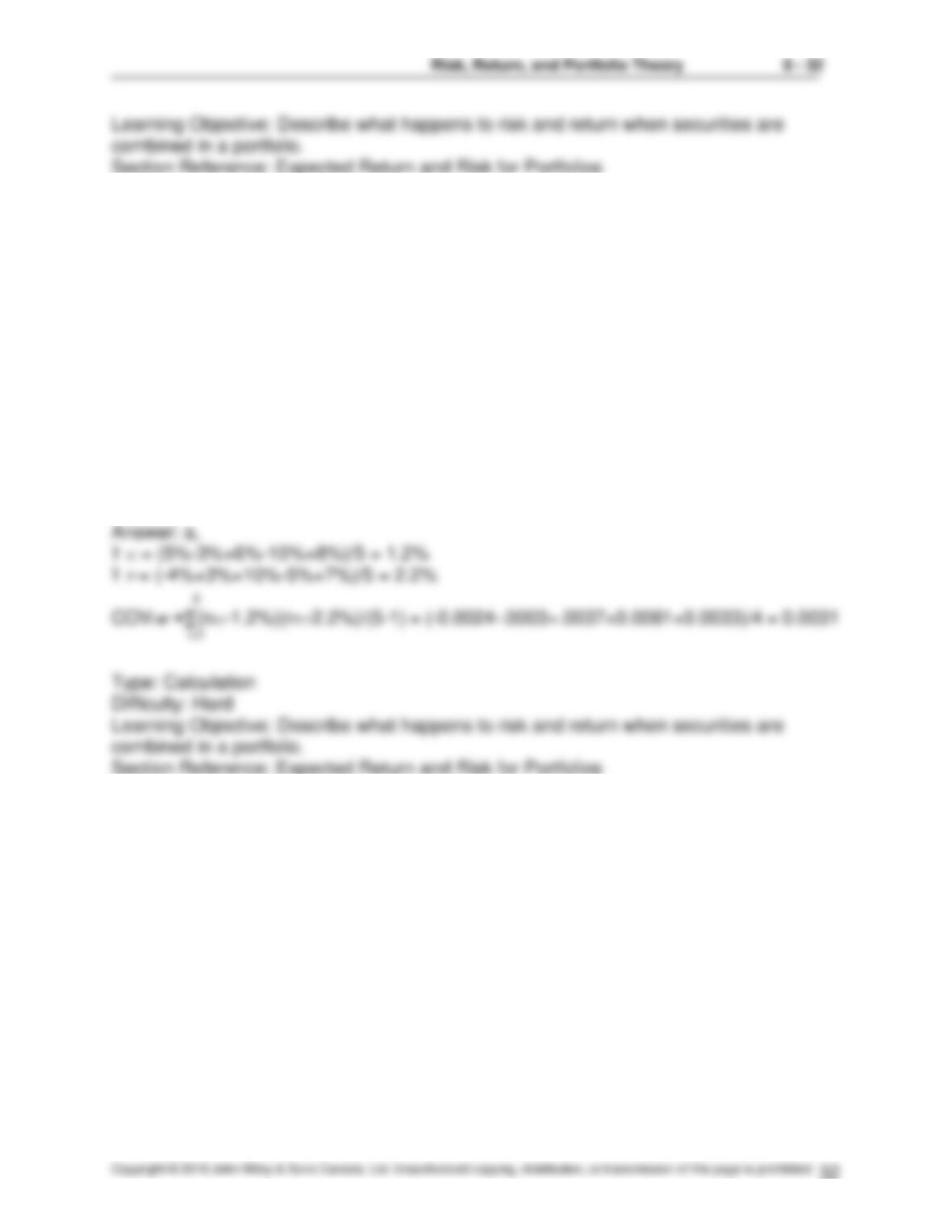
68. Given the following forecasts, what is the correlation between securities X and Y?
State of the
Economy Probability of
Occurrence Stock X
Expected Return Stock Y
Expected Return
Boom 30% 20% –15%
Normal 45% 12% 20%
Bust 25% –6% 18%
a) –0.0098
b) 0.0098
c) -41.38
d) –0.6371
69. What is the covariance of the daily returns on Hocus and Pocus?
Return of Hocus Return of Pocus
Monday 5% –4%
Tuesday –3% 3%
Wednesday 6% 10%
Thursday –10% –5%
Friday 8% 7%
a) 0.0031
b) 0.0235
c) 0.0368
d) 0.0449
70. You have observed the following quarterly returns for companies Humpty and
Dumpty:
Humpty Dumpty
1st Quarter 15% –6%
2nd Quarter –3% 8%
3rd Quarter –8% 10%
4th Quarter 11% 4%
What is the correlation between the returns on the two companies?
a) –0.007
b) –0.333
c) –0.667
8 – 33 Test Bank for Introduction to Corporate Finance, Fourth Canadian Edition
d) –0.894
71. The expected returns for Hickory Inc. and Dickory Inc. are 8 percent and 13 percent,
respectively. The standard deviation is 12 percent for Hickory and 18 percent for
Dickory. What is the portfolio standard deviation if 40 percent of the portfolio is in
Hickory and there is no relationship between the returns on the two securities?
a) 0.7108%
b) 1.3968%
c) 8.4309%
d) 11.8186%
72. The expected returns for ABC Company and XYZ Company are 12 percent and 9
percent, respectively. The standard deviation is 20 percent for ABC and 15 percent for
XYZ. What is the portfolio standard deviation if one-third of the portfolio is in ABC and
the two securities have perfect positive correlation?
Risk, Return, and Portfolio Theory 8 – 34
a) 16.67%
b) 10.00%
c) 2.78%
d) 1.00%
73. The expected returns for Bumpy Inc. and Bouncy Inc. are 20 percent and 8 percent,
respectively. The standard deviation is 35 percent for Bumpy and 16 percent for
Bouncy. What is the portfolio standard deviation if 45 percent of the portfolio is in
Bumpy and the two securities have perfect negative correlation?
a) 4.60%
b) 6.95%
c) 0.21%
d) 0.48%
74. Suppose you plan to create a portfolio with two securities: Rolie and Polie. Rolie
has an expected return of 6 percent with a standard deviation of 5 percent. Polie has
an expected return of 18 percent with a standard deviation of 15 percent. The
correlation between the returns of these two securities is perfectly negative. What
percentage of your investment should be in Polie to make the portfolio risk free? What
would be the expected return on the portfolio?
a) Portfolio weight in Polie = 25%; expected return on the portfolio = 9.00%
b) Portfolio weight in Polie = 40%; expected return on the portfolio = 10.80%
c) Portfolio weight in Polie = 60%; expected return on the portfolio = 13.20%
d) Portfolio weight in Polie = 75%; expected return on the portfolio = 15.00%
75. Suppose you own a two-security portfolio. You have 25 percent of your funds
invested in Security A and the balance of your funds invested in Security B. Security A
has a standard deviation of 8 percent and Security B has a standard deviation of 12
percent. What is the covariance of the returns on Securities A and B if the portfolio
standard deviation is 10 percent?
a) 0.0040
b) 0.0093
c) 0.0147
d) 0.0258
76. Suppose you own a two-security portfolio. You have 35 percent of your money
invested in Security X and the remainder in Security Y. The standard deviations of
Securities X and Y are 10 percent and 15 percent, respectively. What is the correlation
between the two securities if the portfolio variance is 0.013225?
a) 0.0055
b) 0.0137
c) 0.3654
d) 0.9148
77. The expected return on Alpha Inc. is 8 percent and the expected return on Beta Inc.
is 24 percent. What is the trade-off between investing in Alpha and Beta if the portfolio
weight in Alpha is increased by 1%?
a) –0.08%
b) –0.16%
c) –0.24%
d) –0.32%
78. Indiana Jones intends to form a portfolio with two securities: Virtual and Real.
Virtual has an expected return of 25 percent with a standard deviation of 5 percent.
Real has an expected return of 12 percent with a standard deviation of 16 percent. The
correlation between the two securities is 0.2. What is the portfolio standard deviation if
the portfolio has an expected return of 20 percent?
a) 0.55%
b) 1.08%
c) 7.41%
d) 10.40%
79. Cinderella plans to form a portfolio with two securities: Jaq and Gus. The
correlation between the two securities is –1. Given the following forecasts, what are the
weights in Jaq and Gus that will set the standard deviation of the portfolio equal to zero?
State of the
Economy Probability of
8 – 37 Test Bank for Introduction to Corporate Finance, Fourth Canadian Edition
Occurrence Jaq
Expected Return Gus
Expected Return
High Growth 15% 25% –10%
Moderate Growth 30% 13% 8%
Recession 55% –5% 12%
a) Portfolio weights in Jaq and Gus are 74.37% and 25.63%, respectively
b) Portfolio weights in Jaq and Gus are 25.63% and 74.37%, respectively
c) Portfolio weights in Jaq and Gus are 60.51% and 39.49%, respectively
d) Portfolio weights in Jaq and Gus are 39.49% and 60.51% respectively
80. Suppose you observed the following data on two securities: Mars and Venus:
Mars Venus
Expected Return 6% 20%
Standard Deviation 8% 35%
You short sold 200 shares of Mars at $20 per share and purchased 400 shares of
Venus at $25 per share to increase the possible return on the portfolio. The correlation
between the securities is 0.30. What is the standard deviation of the portfolio?
a) 7.06%
b) 26.56%
c) 32.45%
d) 56.96%
Risk, Return, and Portfolio Theory 8 – 38
81. A portfolio consists of three securities: Treachery (T), Sleazy (S), and Felony (F).
The expected returns for Treachery, Sleazy, and Felony are 10 percent, 8 percent, and
16 percent, respectively. The standard deviation is 15 percent for Treachery, 20
percent for Sleazy, and 25 percent for Felony. The covariance of the returns on the
three securities is: COVTS = 0.0144, COVTF = 0.0084, and COVSF = 0.03. What is the
portfolio standard deviation if 20 percent of the portfolio is in Treachery and 35 percent
is in Sleazy?
a) 17.73%
b) 13.91%
c) 3.14%
d) 1.93%
82. Suppose you plan to create a portfolio with three securities: Dizzy (D), Lazy (L), and
Crazy (C). The expected returns for Dizzy, Lazy and Crazy are 6 percent, 8 percent,
and 10 percent, respectively. The standard deviation is 9 percent for Dizzy, 15 percent
for Lazy, and 12 percent for Crazy. The correlation coefficients among the returns for
the three securities are: CORRDL= 0.6, CORRDC = -0.3, and CORRLC = 0.4. What is
the portfolio standard deviation if 30 percent of the portfolio is in Dizzy and 40 percent is
in Lazy?
a) 0.34%
b) 0.87%
c) 5.82%
8 – 39 Test Bank for Introduction to Corporate Finance, Fourth Canadian Edition
d) 9.33%
83. Your portfolio that has $500 invested in Stock A and $1,500 invested in Stock B. If
the expected returns on Stock A and Stock B are 7% and 23%, respectively, what is the
portfolio return?
a) 19.00%
b) 17.80%
c) 16.10%
d) 12.00%
84. A portfolio is composed of 100 shares (priced at $22/share) of Mensa Corporation
and 200 shares of Einstein Corporation (priced at $15/share). What is the expected
value of the portfolio if Mensa has an expected return of 14 percent and Einstein has an
expected return of 8 percent?
a) $5,530
b) $5,748
c) $5,796
d) $6,272
85. The efficient frontier is constructed by:
a) Maximizing expected portfolio return while holding portfolio variance constant.
b) Minimizing portfolio variance while holding expected portfolio return constant.
c) Either A or B
d) None of the above will generate an efficient frontier.
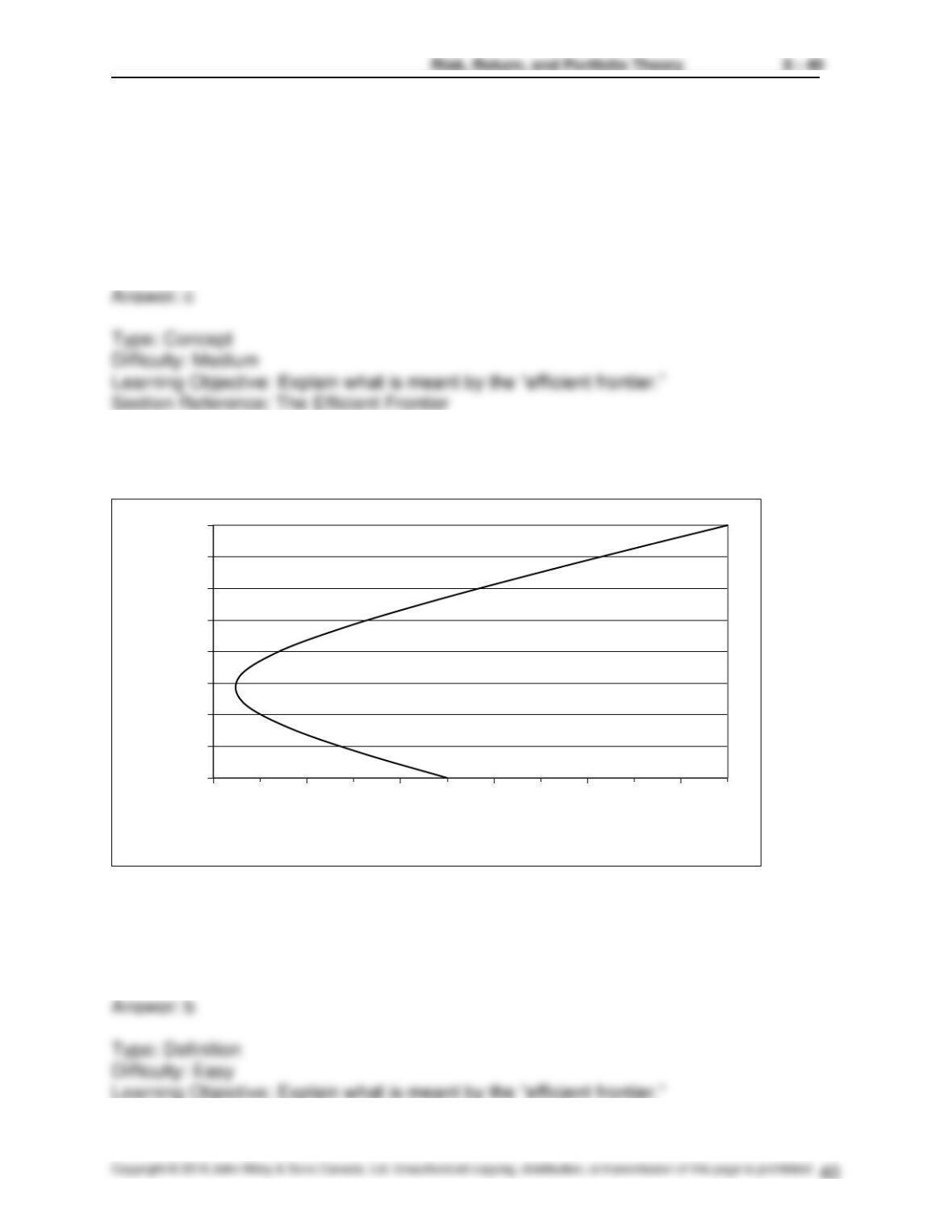
86. For the following efficient frontier, the standard deviation of the minimum variance
portfolio is:
a) <2.5%
b) Between 2.5% and 3.5%
c) Between 3.5% and 4.5%
d) 5.0%
2.0%
2.5%
3.0%
3.5%
4.0%
4.5%
5.0%
5.5%
6.0%
2.5% 3.5% 4.5% 5.5% 6.5% 7.5%
Expected return
Standard deviation